Newsletter
Want to keep up to date with all our latest news and information?


ResidentialBusiness
Administrators
-
Joined
-
Last visited
Everything posted by ResidentialBusiness
-
Operations will continue while application for holding company of former FTSE 100 group proceedsView the full article
-
In 1995, the kids’ brand Hanna Andersson debuted matching family pajamas, kick-starting a trend. Three decades later, it’s become a tradition in many families to buy PJs emblazoned with reindeer or Christmas trees or menorahs to wear during the holidays. But if you’re concerned that seasonally specific sleepwear may not be so eco-friendly—after all, how much use will your toddler get from those Santa Claus jammies?—Hanna Andersson has a suggestion for you: Why not buy them secondhand? In 2023, Hanna Andersson launched Hanna-Me-Downs, a website for customers to buy and sell pre-owned products. If you scroll through the site, you’ll find thousands of gently used Hanna Andersson pajamas for the whole family, along with dresses, T-shirts, and trousers from previous seasons. Since the platform debuted, Hanna Andersson has become the top resold children’s brand in the U.S., selling more than 160,000 garments to 25,000 customers. And interest in Hanna-Me-Downs is only growing, with site visits increasing by 30% this year. Aimée Lapic, who became the brand’s CEO in 2022, helped launch Hanna-Me-Downs and believes it has been one reason behind the brand’s growth in recent years. (Since Hanna Andersson is a private company owned by the private equity firm L Catterton, it does not share its revenue, but says it has experienced double-digit growth since 2019, and even higher levels of profitability.) Other factors include its decision, in 2020, to shutter all 65 of its brick-and-mortar stores to become a purely digital direct-to-consumer retailer, and its launch, in 2023, of a rewards program that now has more than a million members. While it might seem counterintuitive for a resale site to accelerate Hanna Andersson’s growth—since it might cannibalize the brand’s sale of new clothing—Lapic says the opposite is true. While the platform itself does not generate a profit, she believes it has brought new customers to the brand, also reinforcing the message that its products are made to last. “Circularity benefits us from a business perspective,” Lapic says. “It’s a real solid proof point that we sell high-quality, durable clothing.” Shopping for Kids in the Era of Fast Fashion Many parents find it hard to shop sustainably for their kids. Children grow out of their clothes quickly and ruin outfits with stains and tears. In the era of fast fashion, budget retailers like Carter’s and Target market children’s clothes that are so inexpensive, parents don’t mind if they only last a few weeks or months before throwing them out. So it might not seem worth it to spend more on durable clothes that are more expensive. Four more than 40 years—as fast fashion has taken off—Hanna Andersson has tried to make the case that it is worth spending more on high-quality kids’ clothes. Its dresses start at $50, and T-shirts start at $30. Carter’s sells those products for as low as $15 and $5, respectively. This focus on quality goes all the way back to the brand’s origins. Hanna Andersson was founded by Gun Denhart, a Swede who had settled in Portland, Oregon. She wanted to create clothing that would allow kids to play in the rainy, muddy conditions that were common in the Pacific Northwest. Today, the company continues to focus on quality, thanks to rigorous durability standards. In testing, each garment is washed between 60 and 100 times to ensure the fabric won’t wear out or fade. Over the years, the company has introduced new eco-friendly fabrics such as certified organic cotton, Oeko-Tex fabrics that are certified to be free from harmful chemicals; and its newest material, HannaSoft, which is made of bamboo. In each case, it puts the new materials through durability tests. Hanna Andersson has attracted a wide range of customers, Lapic says. Some are well-heeled parents who shop from other high-end children’s brands, like Petit Bateau or Janie and Jack. But others are middle-class families. “Not all of our customers are wealthy,” she says. “Some just buy fewer clothes than they would otherwise, and others buy secondhand.” For years, consumers have been shopping for used Hanna Andersson clothes on other brands’ secondhand sites. Lapic says that it made sense for the company to create its own platform so it could engage directly with these fans of the brand. “Our clothes were very popular on ThredUp and Poshmark,” Lapic says. “We thought we had an opportunity to keep these buyers and sellers within the Hanna Andersson ecosystem.” Resale as a Growth Engine Lapic says that the brand tries to give Hanna-Me-Downs customers good value for their old clothes. When they send in a used product, they can get 70% of the resale value in cash. If they choose to get store credit at the main Hanna Andersson website, they can get 100% of the resale value. Lapic says that 80% of sellers choose the store credit option. And the brand has found that when these customers use their credit to shop from the Hanna Andersson site, they spend two and a half times the amount on the gift card. Besides engaging people who are already big fans of the brand, Lapic says that it has also tapped into an entirely new customer base that has never shopped with Hanna Andersson before. This group is drawn to Hanna-Me-Downs’ lower prices, and 50% will return to the site to stock their kids’ closets with pre-owned Hanna Andersson clothes. “They end up buying from us multiple times,” she says. Ultimately, Lapic says that Hanna-Me-Downs illustrates that promoting sustainable behavior doesn’t have to come at the cost of profitability. The resale site keeps clothes circulating in the economy for longer, and reinforces the message that it is better to buy fewer, better-quality items. “We are excited about how this platform benefits our customers, the planet, and future generations,” Lapic says. View the full article

-
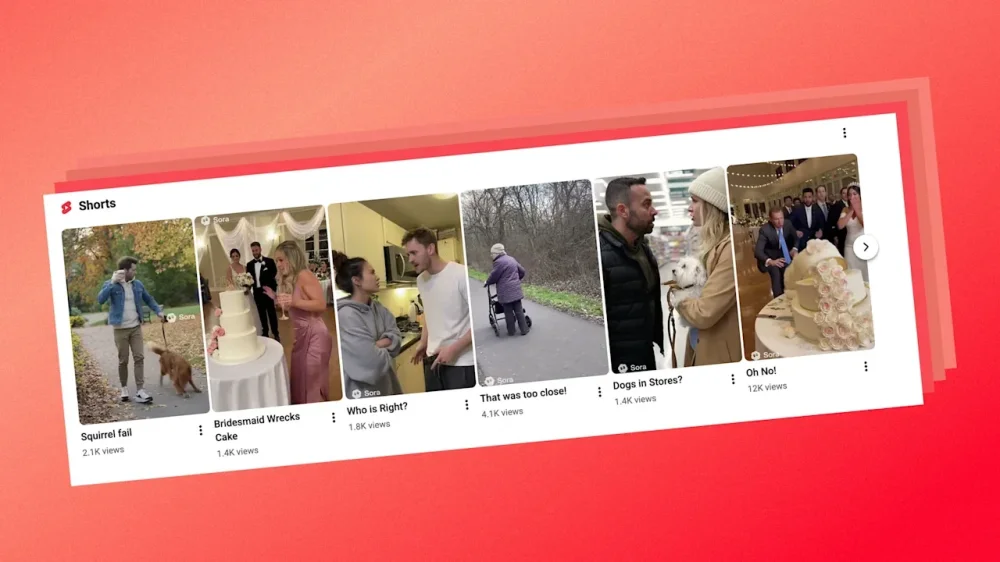
The kinds of videos that do well on YouTube Shorts are depressingly predictable: cute cats, heated arguments, crazy stunts, and plenty of good old-fashioned shots of people suffering low-key injuries. The issue is that the real world produces only so many epic fails. And of the small number that do happen, even fewer are caught on video. Think of all the airplane passenger arguments and dropped wedding cakes that have gone untaped and unposted! Enter Sora. OpenAI’s new video generator is hyperrealistic, and was clearly trained on billions of hours of short-form, vertical video. That makes it incredibly good at generating the kinds of short, grabby videos that pull in our attention and manipulate our emotions. How do I know? I used Sora to create an entirely fake YouTube channel, populated with AI-generated versions of the kinds of videos I see on YouTube Shorts and TikTok all the time. It took me about 30 minutes to build and it cost nothing. In less than a week, I have 21,400 views and counting. Let’s dig in. Slop by the bucketful Getting access to OpenAI’s Sora social network is hard. The platform launched as an invite-only app, and despite this hurdle quickly ballooned to more than 5 million active users. It’s growing even faster than ChatGPT. Once you’re into Sora, though, using Sora 2 (the actual video generation model behind it) is extremely easy. You just type in the concept for a video, and Sora 2 writes the script, generates about 11 seconds of very realistic vertical video, and even adds synchronized audio. The app struggles with beautiful, cinematic footage. In my early testing, Google’s rival Veo 3.1—which the tech behemoth launched to compete with Sora 2—is much better at that. But where Sora 2 succeeds is in generating emotionally charged, short-form vertical videos. The model was likely built to drive the Sora social video network, and it shows. I decided to test the appeal of Sora 2’s videos by moving them over to a traditional short-form video platform so they could compete in the real world against actual grabby, vertical clips. To that end, I opened up Sora 2 and started typing in ideas for emotionally heated videos at random. I quickly found that Sora 2 can work with either very detailed or very vague ideas. For one video, I used ChatGPT to write a detailed script for a complex scenario: a woman making a phone call in order to reconnect with her estranged mother. Sora 2’s video nailed the task. From the subtle jump cuts to the swelling music (again, entirely AI-generated), it’s 11 seconds of surprisingly powerful micro-cinema. For other videos, I went much simpler, letting Sora 2 run with my basic prompt. The text “two roommates have an argument, cellphone video” yielded this: Entering “A man mistakenly knocks over a giant, beautiful wedding cake and people are shocked, realistic cellphone video” produced this gem, which is my favorite Sora video so far: In total, I created eight videos. Each one took about 60 seconds to generate. Using Sora 2 within the Sora app is currently free. Basically, the system generates AI slop by the bucketful. Your job is simply to give the model direction and scoop up its output. Cat fail arbitrage You can post your AI slop directly to Sora itself. But I wasn’t content to stop there. Instead, I wanted to see how these videos would do in the real world. So I went over to YouTube and started uploading them to the platform’s YouTube Shorts section—basically YouTube’s clone of TikTok. Rather than starting a channel entirely from scratch, I used a neglected one where I had previously posted videos of my dog, Lance. It had no traffic to speak of, and only a handful of videos, mostly uploaded to share with friends and family members. The channel felt like an ideal blank slate; it wasn’t entirely new—I was worried that YouTube might flag and delete a fully new channel that started posting AI content right out of the gate—but hadn’t been developed at all. I could thus test what would happen if an existing YouTuber suddenly started posting nothing but Sora’s delightful slop. I uploaded each of my new videos. Crucially, I didn’t want to deceive anyone, so I left Sora’s prominent watermarks in place. I also fully disclosed that the videos are AI generated, using YouTube’s Altered Content flag. It doesn’t seem to have mattered. As I write this about a week later, my videos have already received 21,400 views. Poor little Lance’s best video had gotten only 2,600 views in the three years since I posted it. My top video from Sora—the one of the wedding cake falling—is at 12,000 views and counting. Containment is impossible AI-generated videos wouldn’t be so much of a threat to the traditional social media landscape if they stayed put. You could go to Sora for AI-generated fails, and TikTok or YouTube Shorts for the authentic ones. My experiment proves that this containment is unrealistic. It’s shockingly easy to move videos from Sora to other vertical video platforms. And despite disclosures and watermarks, users seem to engage with the AI videos just as much as they would with real ones. Sora the social network is also a pared-down experience when it comes to running the Sora 2 model. In its new API, OpenAI provides developers with direct access to Sora 2, including customizable video lengths and aspect ratios. Videos generated through the API cost $0.10 per second. They have no distinguishable watermarks. It took me only about 20 minutes to code up an integration in Python, and I was creating fully automated AI slop for about $1 per video, at scale. All that’s to say: YouTube, TikTok, and Instagram are about to be inundated with an unstoppable deluge of this stuff. YouTube tacitly admitted that when it introduced its Altered Content flag over a year ago. At the time, AI video was so janky and unusable that YouTubers were confused as to why anyone would need to disclose AI content’s origins. Now we know. For consumers, the message is clear. From here on out, trust nothing that you see on vertical video apps. That amazing bottle flip or delightfully juicy neighbor fight clip may well have emerged not from real life, but from the endless slop bucket of Sora 2. View the full article
-
Below, co-authors Barry Schwartz and Richard Schuldenfrei share five key insights from their new book, Choose Wisely: Rationality, Ethics, and the Art of Decision-Making. Barry spent 45 years teaching psychology at Swarthmore College. Now he holds a visiting position at the Haas School of Business, University of California, Berkeley. Richard held a similarly long tenure at Swarthmore College, 42 years, as a philosophy professor. What’s the big idea? There is no such thing as a calculator for life’s decisions. Try as we might to quantify, count, and calculate in search of the “right” choice, that is simply not how wise decision-making happens. Qualitative judgment and consideration of preferences and values are required when identifying the best option before us. Listen to the audio version of this Book Bite—read by Barry—below, or in the Next Big Idea App. 1. Sorting through the possibilities Imagine waking up on a beautiful Saturday morning and asking yourself, What should I do today? You consider the possibilities: get some exercise, go for a hike, go to a lovely park with a serious book under your arm, catch up on work, veg out, and watch sports on television. Or maybe, instead of thinking about what you might do, think about what we might do. What social activities might you engage in? Get in touch with friends, visit your mother at the assisted living facility, or help your adult daughter pack for her apartment move. Lots of possibilities. Is there a right way to think through your options for the day? Is there a right way to choose which of these things to do? 2. Rational choice theory In economics, according to rational choice theory, there is a rational way to make decisions, which requires thinking about two things: How valuable are the options you’re deciding between? How likely is it that the option you pick will be as good as you expect? We live in an uncertain world, and so you assess the value and probability of your options, then multiply them. What you get is expected utility. The rational choice should be the option that provides the greatest amount of expected utility. This framework analogizes the decisions we make in life to the decisions you might make in a gambling casino. What’s the best strategy in a blackjack hand? What are the odds and payoffs at the roulette table? In situations like this, it only matters how much you could possibly win and how likely you are to win. Rational choice theory suggests that we should think about most of our decisions in these terms. In figuring out how good it will be if I choose this option, and how likely it is to be that good, you must quantify the relevant information. Create a spreadsheet of all the factors that might matter in making a choice. List how good a particular option is with respect to all these factors, and enter a value for both how good it is and how probable it is. Fill out the spreadsheet with all the options, push a button that does the math, and you’ve made a rational decision. “This framework analogizes the decisions we make in life to the decisions you might make in a gambling casino.” Rational decisions are quantitative. You need to attach quantities and magnitudes to both the value of the options and the likelihood that you will achieve that value. Rational choice theory has nothing to tell us about what your preferences among options should be, what your values should be, or what set of options you should consider. In this economic framework, you have whatever values you have, your options are whatever options the world presents, you create the spreadsheet, do the math, and pick the best option. That’s the model of rational decision making. 3. Framing the options Do we behave as rational decision makers? Definitely not. About 50 years ago, psychologists Daniel Kahneman and Amos Tversky started studying how people make decisions. They did some beautiful and extremely important research, but unfortunately, Tversky died prematurely. Kahneman survived to win the Nobel Prize in Economics and published a book called Thinking Fast and Slow, which has been on the bestseller lists for almost 10 years. His work helped create the field of behavioral economics. Behavioral economics research has illustrated the ways in which people fail to meet the standards of rational choice theory. People are bad at thinking about probability. People are heavily influenced by the way in which options are framed. People divide their decisions into different accounts and often don’t aggregate the potential consequences of those decisions into one big account. People are highly influenced by anchors. A $500 suit seems inexpensive on a rack full of $1000 suits but seems quite expensive on a rack of $200 suits. These aspects of decision-making get us to more or less the right place, but they can also lead us seriously astray. The way Kahneman came to regard human decision making is that there are two processes happening: Conscious process: Thinking through the pluses and minuses of various options when asking yourself what choice to make. This is effortful, slow, and demanding. Automatic process: This system delivers answers to you even before you frame the question. It is fast, efficient, and operating whether you want it to or not. These two systems interact, and sometimes the automatic system leads the more deliberate, rational system astray. Even if we end up making rational decisions, it’s not through the processes that rational choice theory tells us we should follow. 4. Not everything can—or should—be calculated Rational choice theory is a terrible model of what it means to be a rational decision maker. Are most of our decisions really like casino gambles? Can everything that matters in a decision be quantified? What’s good about doing strenuous exercise on a hike? And what’s good about helping your daughter pack? What is the common scale of value? “Can everything that matters in a decision be quantified?” If you’re choosing a job, you might be interested in knowing the salary, benefits, who your colleagues will be, whether the work will be interesting, the location, opportunities for advancement, and other relevant details. It’s preposterous to attach numbers to all those factors and then use those numbers in a spreadsheet to figure out which job is best for you. Similarly, if you’re deciding where to go to college, you might be interested in quantifiable things like graduation rate and average salary after graduation, but what about the qualitative features of the education, social life, food, and housing? Can these things be arrayed on a spreadsheet using a common scale for assigning value? When you follow rational choice theory, instead of thinking about decisions, you count. Calculation substitutes judgment. In some areas of life, that could be a good thing, but in many others, shutting down your ability to subjectively reflect will lead to worse, impoverished, pinched decisions. 5. A rational decision requires rational judgment Rational choice theory is dangerous as a normative standard. It narrows our thinking by encouraging us to invent quantifications of things that can’t be quantified. During the Vietnam War, the U.S. government was facing pushback from citizens and wondering how to generate popular support for the war. It was concluded that if the public saw that the U.S. was winning, then more people would favor involvement. But it was a guerrilla war, so can someone know who’s winning? It was decided to use body counts and casualties as an indicator. If the enemy had higher numbers of wounded or dead than our side, then we must be winning. This affected our fighting strategy. Instead of seeking strategic advantages, we made decisions designed to maximize casualties because it meant we could tell folks back home that the U.S. was winning the war. As a result, we didn’t win the war, and thousands of people died needlessly. “Rational deciding requires rational judgment and not just counting.” You can see the danger of rational choice theory decisions, like where to go to college, too. People are heavily influenced by the ratings of U.S. News & World Report, so universities have learned how to game those ratings by making themselves look good with respect to the dimensions that U.S. News cares about. Does that make them better institutions? Maybe sometimes, but mostly it does not. Rational choice theory forces us to focus on things that can be easily compared and quantified while leaving out the rest. Rational deciding requires rational judgment and not just counting. We don’t want our ability to think and judge rationally to atrophy because we think that the rational approach to decisions is essentially mechanical and algorithmic. Enjoy our full library of Book Bites—read by the authors!—in the Next Big Idea App. This article originally appeared in Next Big Idea Club magazine and is reprinted with permission. View the full article

-
Over the last five years, artificial intelligence has shifted from a fringe interest to one of the most important drivers of global economic growth. So important has the technology become that the United Nations Security Council held its first open debate on artificial intelligence last month. While little of substance was achieved, a General Assembly resolution authorizing the creation of an independent scientific panel on AI may have a more enduring impact. One of the core questions this panel will seek to answer is how AI can support sustainable economic development without entrenching inequality. The potential dangers here have deep historical parallels. AI runs on compute, cloud capacity, and data—resources that are concentrated in the hands of countries in the Global North. Africa, for example, hosts less than 1% of global data center capacity, leaving the continent reliant on expensive infrastructure abroad. Even an IT powerhouse like India hosts just 3% of global capacity, despite being home to nearly 20% of the world’s population. Meanwhile, workers across the Global South are earning as little as $2 an hour creating, cleaning, and labeling data for use in Western models. A new digital colonialism? To some, this looks like a digital version of the kind of resource extraction associated with the age of empires: labor and data flow inexorably north, where they create economic value, but little of this value finds its way back into the pockets of developing nations. The reality is that these patterns are driven by market forces rather than imperial ideology, but the historical echoes are troubling nonetheless. Whatever the motivations, we know that this kind of concentration of power can do long-term economic and social damage. In some cases, the results are felt only in the underserved countries. AI systems trained to deliver healthcare to Western patients, for instance, can be dangerously inaccurate when working with other populations, limiting the transferability of the advances made in the West. Similarly, researchers at Columbia University have found that Large Language Models are less able to understand and represent the societal values of countries that have limited digital resources available in local languages. These limitations are just the tip of the iceberg. AI is not just a productivity tool—it’s a force multiplier for innovation. It will shape how we farm, teach, heal, and govern in the future. If the Global South remains a passive consumer of imported AI systems, it risks losing not just economic opportunity but digital sovereignty. The Industrial Revolution brought extraordinary wealth to Europe and North America while locking much of the world into dependency for generations. AI could repeat that cycle—more rapidly and at an even greater scale. Why this should worry every global business The irony is that this approach hurts everyone, including the companies driving it. In terms of population, India has overtaken China while Nigeria and other African nations are enjoying booming birthrates. These countries represent tomorrow’s largest markets. Yet multinationals that treat them as data factories without trying to situate that data in its local context will find that they don’t understand the customers they will desperately need tomorrow. A model that misunderstands how most of the world thinks about family, risk, or trust is a model doomed to fail. We have already seen how this trend can play out. The mobile money transfer company M-Pesa revolutionized banking in Kenya while Western banks were still trying to penetrate the market with credit cards. Today, Indian companies are developing chatbots that can speak to the hundreds of millions who communicate daily in so-called “low resource languages.” Unless multinationals begin to think intentionally about how they can serve these underserved populations, they will find themselves looking in from the outside once these markets mature. The path forward Avoiding the dangers of “algorithmic colonialism” and earning a position in emerging markets for AI products and services requires deliberate action from governments, businesses, and global institutions. Data centers, power supply, and research capacity should be financed like roads and ports, with blended capital from development banks and sovereign funds. Without local compute capacity, nations will inevitably remain digital renters, not owners. Governments should also establish data trusts to negotiate how their citizens’ information trains global models, including setting benefit-sharing and transparency requirements. AI annotation work should pay living wages with proper labor protections. And critically, we need investment in open-source models, multilingual datasets, and local developers, so solutions are built with communities, not just for them. Some companies are already changing course. They are investing in local infrastructure, creating genuine partnerships, and recognizing that sustainable profits come from creating value with communities, not extracting it from them. They understand that today’s data creators and workers will be tomorrow’s consumers, and, potentially, tomorrow’s innovators as well, if they are given the chance. AI has the potential to be a great global equalizer—or it could become the most powerful driver of inequality in human history. We have seen what happens when transformative technology is hoarded: inequality deepens, resentment grows, and instability follows. If we want to write a different story—one in which the Global North and South cocreate the future and share the benefits of artificial intelligence—we must act now, before the gap becomes unbridgeable. 4 things leaders can do today to start bridging the AI divide 1. Audit your AI’s geographic blind spots today. Map where your training data comes from and which populations it represents. If more than 80% comes from Western sources, you run the risk of not being able to represent or communicate effectively with consumers from much of the world. Work to diversify your data if that is feasible, or develop localized AI systems that are trained or tuned with local data. 2. Create transparent data-sharing agreements. Develop a framework for using local data to train your models, including benefit-sharing provisions and audit rights for local data providers. Companies that move first will become preferred partners when governments start to mandate these arrangements. 3. Pay fair wages for AI work—and let your target markets know you are putting your money where your mouth is. Commit to paying local sustainable living wages plus a mark-up for data annotation and AI training work. Make this commitment public. You will attract better talent, improve the quality of your data, and build brand equity in emerging markets. 4. Launch an open-source initiative in at least one emerging market. Pick a specific challenge in a growth market—healthcare in Nigeria, agriculture in India, education in Indonesia—and commit to building an open-source solution with local developers. The relationships and market intelligence you gain will be worth more than any proprietary advantage you might give up. View the full article

-
In 2025, Amazon, Dell, Apple, Google, IBM, Meta, Salesforce, and dozens more have doubled down on demands for employees to return to the office (RTO) at least three days a week, if not all five. And they’re getting exactly what they want. Now, when I say “exactly what they want,” you might be expecting me to paint a picture of workers happily returning to their daily commutes, overcrowded highways, cavernous or claustrophobic offices, constant interruptions, and extra expenses, and all of it resulting in massive productivity gains. That’s not happening, the productivity-gains part. And the longer we play this out, the sillier the performances of “productivity theater” have become. The truth is, the science on productivity is still out. So you have to go with your gut. Or your experience. And what 30 years of gut and experience tells me is that the real question isn’t whether people are more productive at home—it’s whether companies can afford to lose their best talent over this. Right now, tech workers are desperate. Companies know it. That’s why Amazon can demand five days in the office and get compliance instead of resignations. But the labor market isn’t static; it never was. In fact, it tends to whipsaw back and forth every few years. Remember 2022? Companies were begging people to take jobs. Signing bonuses, remote work, unlimited PTO—whatever it took. Candidates were ghosting interviews. That shoe was totally on the other foot, and it was a Doc Marten. But if we look at history, even recent history, a lot of companies that are mandating RTO now are writing the future resignation letters for their best employees, to be delivered the nanosecond the tech job market stops being the worst in history. Let me tell you how common sense foreshadows a reckoning for RTO. How did we get here? I don’t want to defend remote work. I really don’t. But I’m a huge fan of common sense. It’s a little ironic that remote work accelerated with another mandate—that we all stay home for most of 2020 and a lot of 2021. I, for one, still can’t believe that happened. But it’s what happened next that mattered. As the pandemic restrictions lifted almost universally by 2022, the natural calls by employers for their employees to return to the office were met with an unexpected backlash. “No, thanks. We’re more productive, our work-life balance is much better, we feel better, and anyway you said we could do this.” That backlash peaked in 2024, when a bunch of Dell employees, shockingly, chose to take the hit to their company future rather than come back to the office. “That’s fine. We’d rather do a better job in a more comfortable environment. By the way, we’ve moved to New Zealand.” Yeah, it got silly. And corporate tech did not take that silliness lying down. Employees needed to return to the office because . . . well, because it’s always been that way. Does it matter that in a post-pandemic internet business world, that physical proximity no longer matters? That doesn’t matter. As employers started stamping their feet over the mandates, I started talking about common sense. For one, the long-term hits these companies were taking to their talent candidate pool, their employee morale, and their productivity when measured from the employees’ perspective, were costs that were going to far outweigh their sunk real estate costs in the short term. But then corporate tech got smart. Sort of. Employers started making the misguided assumption that the employees who were most dead set against returning to the office were the ones that the company could live without. RTO became a natural, if completely illogical, weeding-out mechanism. And that kinda worked. But kinda didn’t. Sure, the troublemakers all found the door and gave the finger on the way out, but the go-along-to-get-along crowd stopped performing and got performative, and the rest of the tech workforce got ready to revolt. Then the employers got bailed out by the worst tech labor market in history. When there are more job seekers than jobs, tech companies can mandate a company loyalty sing-along every morning, and the entire workforce will start warming up their vocal cords. What’s next for the labor market and RTO? Well, what does common sense tell us? Productivity is in the eye of the beholder. In any position where creativity, innovation, or even decision-making matters, I’d argue that there is no stable metric for productivity that goes beyond correlation to causation where employee performance is concerned. So you have to go with simple, common-sense concepts. Evolution doesn’t come with introductory pamphlets. There is no title card for the next phase of the future of work. It just happens, and you evolve or die. And if we couldn’t connect the dots that the internet had made physical proximity irrelevant in every case where it wasn’t mandatory (i.e., surgery, construction, airline pilot), the pandemic lockdowns ironically hammered that point home. As an evolutionary concept, the productivity argument no longer even matters. It’s the same productivity argument that was being made when we were deciding whether everyone still had to wear suits and skirts to work. But if that kind of common sense doesn’t sway the naysayers, I can make the argument even common-sensier. Yo. 2022. The job market was supposed to have recovered by now. It hasn’t, and that has emboldened a lot of employers to lean into their leverage with their supply of scarce and valuable jobs. But the market will recover. When it does, the first questions that are going to need to be answered are: “Why am I on a Zoom with the person down the hall?” “Why can we only hire within a two-hour commute of some of the most expensive real estate in the country?” “Why am I wearing this three-piece suit with matching fedora and a pocket watch? I’m a database administrator.” Because when an employee has leverage, questions like that no longer make any sense. And the very same companies demanding RTO now will likely be forced to offer remote work again to compete for scarce, valuable talent. They’ll be right back where they started, while their talent heads to those smart companies that see remote work as an evolutionary concept, and are creating solutions that accommodate both remote and in-office employees. If you are also a fan of common sense, please join my email list and I’ll shoot you a quick heads-up when I spout something close to it. —Joe Procopio This article originally appeared on Fast Company‘s sister publication, Inc. Inc. is the voice of the American entrepreneur. We inspire, inform, and document the most fascinating people in business: the risk-takers, the innovators, and the ultra-driven go-getters that represent the most dynamic force in the American economy. View the full article

-
Resolution Foundation calls on Rachel Reeves to level up treatment of freelancers and employees in Budget View the full article
-
Greens-Labour and Christian Democrats vow to form coalition without Geert Wilders’ party after elections on WednesdayView the full article
-
Move allows employees to use bank’s large language model to generate reviews from their own promptsView the full article
-
Much of their time is spent appeasing and aligning competing forcesView the full article
-
Keir Starmer’s government should seize the chance to make radical reformsView the full article
-
The President’s ‘favourite field marshal’ is confidently wooing global powers, but Asim Munir faces far tougher challenges closer to home View the full article
-
Most of us don’t need convincing that time tracking can be useful. The real challenge is knowing how to use it to its full potential. For many teams, time tracking software is used reactively, giving a record of what happened that day. It logs tasks, tags projects, and generates reports after the fact. You The post How to use time tracking software to fuel team momentum: A practical playbook appeared first on RescueTime Blog. View the full article
-
It’s the digital equivalent of a clogged drain. You boot up your computer, click the Google Chrome icon, and… wait. You wait to type a search term. You wait for the page to load. You wait while your once-speedy gateway to the internet chugs along like a steam engine trying to keep up with a bullet train. The problem: Chrome is a beast – a powerful, functional beast, but a beast nonetheless. Over time, it gets bloated, weighed down by all the digital detritus we pile onto it. But don’t despair. You don’t need a new computer, you just need a digital declutter. Here’s how we’re going to put some pep back in your browser’s step. Note that though feature names and their locations may differ slightly, most or all of these fixes work for Chromium-based browsers as well, such as Microsoft Edge. Disable (or remove) unused extensions This is almost always the main culprit. You installed an extension that seemed like a good idea a year ago—a coupon clipper, a niche productivity tool, a way to add a trail of sparkles to your cursor—and now it’s silently sucking down your RAM like quicksand. Every single extension needs a little slice of your computer’s brain to run, and they add up fast. To access your extensions, do the following: Click the three-dot menu in the top-right corner. Go to More Tools > Extensions. Look at the list. Be brutal. If you don’t use it at least once a week, toggle it off or, better yet, click Remove. You’ll be surprised how many extensions you forgot you even had. Put dormant tabs to sleep You have 37 tabs open right now. One is a work document, one is a recipe you’ll never try, one is a YouTube video you paused three days ago, and three are different iterations of fantasy football research. Every single one of those tabs is demanding resources, even the ones you haven’t looked at in days. Google knows we have this problem, which is why it created the Memory Saver feature. It essentially puts inactive tabs to sleep, freeing up system memory for the tabs you’re actually using. Here’s how: Click the three-dot menu and go to Settings. Click Performance in the left sidebar. Make sure Memory Saver is toggled on. You can also designate certain sites to always stay active (like a live chat or your email), so the important stuff stays awake, and the less important stuff gets a well-deserved nap. Clear cache and cookies This is the classic, “have you tried turning it off and on again?” of browser optimization. Your cache stores parts of websites (images, code, etc.) so they load faster the next time. Your cookies store user data. Over time, these piles of tiny files get huge, slow down your browser’s ability to find what it needs, and generally get in the way. Here’s how to clear them. Use the keyboard shortcut: Ctrl + Shift + Del (Windows/ChromeOS) or Command + Shift + Del (Mac). Set the Time range to All time. Make sure Cached images and files is checked. Cookies and other site data is optional: clearing it logs you out of everything, which is annoying, but can help. Click Clear data. It’s a quick blast that clears out the deep recesses of your browser. Do this once a month, and you’ll notice a difference. Check for updates Sometimes, the answer isn’t some clever hack or esoteric setting—it’s just making sure you have the newest version. Google is constantly tweaking Chrome to make it run faster and consume less power. If you haven’t closed your browser in a week, you’re probably running on old software. Here’s how to check for updates: Click the three-dot menu. Go to Help > About Google Chrome. Chrome will instantly check for and apply any updates. You might be prompted to relaunch. Even if you’re not asked to relaunch, do it anyway. A clean relaunch can solve a world of problems. View the full article
-
Surge in equities comes ahead of President Donald The President’s visit to TokyoView the full article
-
Free-market president wins big endorsement for reforms after weeks of financial market turmoil View the full article
-
Agreement comes as insurer seeks to ward off competition in lucrative transfer market for pension risk View the full article
-
Leadership failures at UK government department criticised by cross-party Commons committee View the full article
-
Rachel Reeves’ Riyadh trip comes as she seeks to persuade fiscal watchdog to factor such deals into Budget forecasts View the full article
-
Sarah Pochin’s comments on race in advertising elicit concerted response by politicians in effort to dent populist party’s appealView the full article
-
America’s 40th and 47th presidents both employed protectionist measures but in vastly different waysView the full article
-
High-level talks yield progress ahead of summit between The President and XiView the full article
-
Deal would be biggest acquisition under chief executive Vas NarasimhanView the full article
-
As the landscape of business technology evolves, the alliance between Salesforce and Amazon Web Services (AWS) is set to redefine the way small businesses harness artificial intelligence. Salesforce recently announced significant advancements in AI tools through their partnership with AWS, highlighting the rapid adoption of AI agents as essential systems in workplaces. For small businesses, these developments promise not just improved efficiency but also a transformative effect on customer interactions. Salesforce’s Agentic Enterprise Index revealed that in the first half of 2025, the deployment of AI agents jumped an astonishing 119%. Businesses are seeing a 65% month-over-month increase in employee interaction with these AI agents, with conversations becoming 35% longer. These statistics underscore a critical shift: AI is no longer a futuristic concept but an integral component of daily business operations. Ruba Borno, Vice President of Global Specialists and Partners at AWS, emphasized the collaborative mission of the two giants: “The cloud transformed how enterprises operate, and now agentic AI is driving the next evolution.” This statement reflects a commitment to making advanced AI accessible & secure for small businesses, particularly through tools like Amazon Connect and AWS Clean Rooms. Integrating advanced AI solutions within small business operations can yield significant benefits. For example, CRM integration allows companies to tap into their data efficiently. Salesforce’s Data 360 feature, which offers Zero Copy functionality, lets businesses access data stored in systems like Amazon Redshift without the redundancy of duplication. This means instant data access leads to quicker decision-making, ultimately enhancing customer interactions. A practical application of this can be seen in 1-800Accountant, which uses the Data 360 framework for real-time data access. Their AI agents autonomously resolve 70% of routine tax inquiries, allowing their human staff to focus on more complex issues. Ryan Teeples, CTO of 1-800Accountant, stated, “Zero Copy is a significant value driver. We don’t have to replicate every piece of data, which is crucial with hundreds of millions of transactions.” This efficiency directly translates to improved customer satisfaction and optimized resource allocation. Salesforce has also rolled out Data 360 Clean Rooms, which provide a secure environment for collaborative analysis of data without exposing sensitive information. This feature can significantly benefit small businesses by enabling them to work with partners and glean insights while adhering to strict data privacy regulations. For instance, Expedia Group utilizes these clean rooms to empower advertisers to measure their return on ad spend accurately, enhancing the overall effectiveness of marketing campaigns. Nevertheless, there are challenges that small business owners should consider. Implementing AI tools requires a clear understanding of the technology, as well as a commitment to ongoing training and adaptation. There may be apprehensions about data governance, particularly when leveraging cloud technologies. Ensuring that deployment is secure and compliant is vital for maintaining customer trust. Additionally, businesses may struggle with the initial costs of transitioning to these advanced systems. However, with Salesforce’s presence in the AWS Marketplace, procurement processes are streamlined, offering consolidated billing and simplified purchasing avenues. This can make the adoption of these technologies less daunting for small enterprises, allowing them to focus on leveraging AI rather than getting bogged down in procurement complexities. One notable achievement of the Salesforce and AWS collaboration is the ability for small businesses to create customized AI agents capable of many tasks, from appointment scheduling to customer service management. Toyota Motor North America exemplifies this by automating workflows and enhancing their customer service with agent-powered solutions that ensure secure interactions and effective resolutions. As the partnership continues to unfold, small businesses can expect new innovations to simplify their integration of AI. Pasquale DeMaio, VP of Amazon Connect at AWS, stated, “Customers expect their contact center to be open, intelligent, and easy to deploy.” The growing ease of accessing powerful AI capabilities signals that small businesses can no longer afford to ignore the potential of agentic enterprises. The future of work is rapidly approaching, and small businesses that harness these advancements stand to gain a significant competitive edge. With AI as an ally, organizations can unlock new methods of engagement, improve efficiency, and ultimately enhance the customer experience. For more detailed insights on the evolving landscape of AI and its implications for small businesses, you can read the original press release from Salesforce here. Image via Envanto This article, "Salesforce Reports 119% Surge in AI Agent Adoption, Transforming Workplaces" was first published on Small Business Trends View the full article
-
As the landscape of business technology evolves, the alliance between Salesforce and Amazon Web Services (AWS) is set to redefine the way small businesses harness artificial intelligence. Salesforce recently announced significant advancements in AI tools through their partnership with AWS, highlighting the rapid adoption of AI agents as essential systems in workplaces. For small businesses, these developments promise not just improved efficiency but also a transformative effect on customer interactions. Salesforce’s Agentic Enterprise Index revealed that in the first half of 2025, the deployment of AI agents jumped an astonishing 119%. Businesses are seeing a 65% month-over-month increase in employee interaction with these AI agents, with conversations becoming 35% longer. These statistics underscore a critical shift: AI is no longer a futuristic concept but an integral component of daily business operations. Ruba Borno, Vice President of Global Specialists and Partners at AWS, emphasized the collaborative mission of the two giants: “The cloud transformed how enterprises operate, and now agentic AI is driving the next evolution.” This statement reflects a commitment to making advanced AI accessible & secure for small businesses, particularly through tools like Amazon Connect and AWS Clean Rooms. Integrating advanced AI solutions within small business operations can yield significant benefits. For example, CRM integration allows companies to tap into their data efficiently. Salesforce’s Data 360 feature, which offers Zero Copy functionality, lets businesses access data stored in systems like Amazon Redshift without the redundancy of duplication. This means instant data access leads to quicker decision-making, ultimately enhancing customer interactions. A practical application of this can be seen in 1-800Accountant, which uses the Data 360 framework for real-time data access. Their AI agents autonomously resolve 70% of routine tax inquiries, allowing their human staff to focus on more complex issues. Ryan Teeples, CTO of 1-800Accountant, stated, “Zero Copy is a significant value driver. We don’t have to replicate every piece of data, which is crucial with hundreds of millions of transactions.” This efficiency directly translates to improved customer satisfaction and optimized resource allocation. Salesforce has also rolled out Data 360 Clean Rooms, which provide a secure environment for collaborative analysis of data without exposing sensitive information. This feature can significantly benefit small businesses by enabling them to work with partners and glean insights while adhering to strict data privacy regulations. For instance, Expedia Group utilizes these clean rooms to empower advertisers to measure their return on ad spend accurately, enhancing the overall effectiveness of marketing campaigns. Nevertheless, there are challenges that small business owners should consider. Implementing AI tools requires a clear understanding of the technology, as well as a commitment to ongoing training and adaptation. There may be apprehensions about data governance, particularly when leveraging cloud technologies. Ensuring that deployment is secure and compliant is vital for maintaining customer trust. Additionally, businesses may struggle with the initial costs of transitioning to these advanced systems. However, with Salesforce’s presence in the AWS Marketplace, procurement processes are streamlined, offering consolidated billing and simplified purchasing avenues. This can make the adoption of these technologies less daunting for small enterprises, allowing them to focus on leveraging AI rather than getting bogged down in procurement complexities. One notable achievement of the Salesforce and AWS collaboration is the ability for small businesses to create customized AI agents capable of many tasks, from appointment scheduling to customer service management. Toyota Motor North America exemplifies this by automating workflows and enhancing their customer service with agent-powered solutions that ensure secure interactions and effective resolutions. As the partnership continues to unfold, small businesses can expect new innovations to simplify their integration of AI. Pasquale DeMaio, VP of Amazon Connect at AWS, stated, “Customers expect their contact center to be open, intelligent, and easy to deploy.” The growing ease of accessing powerful AI capabilities signals that small businesses can no longer afford to ignore the potential of agentic enterprises. The future of work is rapidly approaching, and small businesses that harness these advancements stand to gain a significant competitive edge. With AI as an ally, organizations can unlock new methods of engagement, improve efficiency, and ultimately enhance the customer experience. For more detailed insights on the evolving landscape of AI and its implications for small businesses, you can read the original press release from Salesforce here. Image via Envanto This article, "Salesforce Reports 119% Surge in AI Agent Adoption, Transforming Workplaces" was first published on Small Business Trends View the full article