Newsletter
Want to keep up to date with all our latest news and information?


ResidentialBusiness
Administrators
-
Joined
-
Last visited
Everything posted by ResidentialBusiness
-
Nations must work out how to contend with The President’s America and ChinaView the full article
-
The new Adobe Premiere Mobile is now available for free in the Apple Store. It promises “pro-level” video editing for YouTube and TikTok pros—or anyone who needs cutting multiple tracks of video at 4K resolution together with motion graphics, subtitles generation, overlay captions, AI-generated stickers, and a never-ending list of technical features. That’s cool, but Adobe really had me on board when it showed off its AI sound generator, which can interpret your vocals to generate actual effects. Like you hum, “pa-pa! pa-pa! Paaaaa-para-pa-PA!” in your iPhone’s microphone, ask Premier to turn it into a fanfare, and it will remake your voice into a full orchestral 20th-Century-Foxy intro. It’s a fun feature that will save people countless hours going through never-ending lists of sound effects and music clips for their video edits. But please disregard my childhood Freddie Mercury dreams for a minute. The new Premiere looks like an excellent upgrade to Adobe Premiere Rush, the company’s previous free mobile video app. Rush looked bad and behaved even worse. Its interface was too hard and imprecise for my fat fingers to navigate on a tiny screen, and its feature set was lacking at best. Users often complained about the app simply not working. Adobe promises that this will not happen with the new Premiere Mobile, which is supposed to handle 4K HDR video with ease on any modern iPhone thanks to its new native iOS architecture. “Premiere Mobile is built from the ground up to take advantage of the core technology the iPhone offers”, says Mike Folgner, director of product management, digital video and audio at Adobe. “Creators want frame-by-frame precision, responsive and fast performance, and the ability to work across multiple tracks with full creative control. We saw how excited creators were about infinite layers in Photoshop mobile, and we knew we needed to bring that same freedom to Premiere mobile where we’re offering creators unlimited tracks.” Its unlimited multitrack timeline actually works like the desktop version, the company claims, editing with frame-accurate precision. “We know that more and more content is being created entirely on mobile, from quick, short-form clips to more advanced edits,” Folgner tells me. “It’s important to us that we meet creators where they are and empower all creators to tell their stories. “With Premiere Mobile, our goal is to provide the precision and control needed for complex edits, while keeping the experience intuitive for those just getting started.” A new look Aesthetically, the new app’s interface seems to have taken a page from the successful Photoshop Mobile, with new, bolder control handles and style. Indeed, as Folgner points out, they have applied the same design principles and language to the new app. “We’re making significant strides so that if a user is familiar with a toolset or interaction in one app, they can easily recognize and understand it in another,” he says. It seems that Adobe has finally figured out that a tiny phone display requires an entirely different interface. The larger controls and AI-aided features—from the way clips get cut and snap to each other to its one-click background removal feature—will help with that. At least one beta tester is happy with the UX redesign. YouTuber and designer Mai Pham believes “it is just truly built differently.” When I asked her how, she say it’s built for mobile workflows, and that it is a “game changer.” For Pham, “the large timeline view really makes it feel powerful, but still intuitive on a phone. It’s not just a desktop tool squeezed into mobile, it’s designed differently, and I can’t wait to see how it grows and evolves.” Folgner says Adobe has worked with hundreds of creators throughout several stages of the process to shape the new app with their feedback. He claims that beta testers are excited about “how more efficient, unconstrained, and fluid” the new app is. Music to my lips The Generative Sound Effects tool is what stole my attention, however. It’s a good example of how AI can actually help the creative process. Premiere Mobile doesn’t make you search in a database to slap a stock audio clip onto your timeline: it creates perfectly timed sound elements based on text prompts and voice input. You describe the sound you want, hum the timing, and the AI builds custom audio that matches exactly what you want. This matters because most creators spend ridiculous amounts of time hunting through stock audio libraries or recording their own Foley effects. Now they can conjure soundscapes with their mouths. The app also includes a speech enhancing feature, another must-have AI feature when it works. In theory, it transforms amateur audio recordings from your phone’s mic into crystal-clear voiceovers by removing echo and background noises. AI galore Adobe is leaning hard on AI for many other functions. The new app includes a way to generate animated captions following different styles, with automatic subtitle generation, motion effects, and cinematic transitions all powered by AI. It also has automated color grading tools to unify your clips’ looks or change the mood of your video. These are handled with a single finger in what Adobe calls tap-to-adjust functionality. Adobe also claims that its Firefly-based tools will let users generate “commercially safe” stickers, turn images to video clips directly within the mobile interface, and expand the background of a video clip. Finally, one-tap exports automatically resize videos for every major social platform including TikTok, YouTube Shorts, or Instagram, keeping the main action in frame again using AI. This intelligent export system, Adobe claims, creates platform-optimized versions with proper aspect ratios and compression settings. Adobe Premiere Mobile is available now for—”paPA-paPAAAAAA!”—free. View the full article

-
We may earn a commission from links on this page. Deal pricing and availability subject to change after time of publication. Did you know you can customize Google to filter out garbage? Take these steps for better search results, including adding Lifehacker as a preferred source for tech news. Battery-powered cameras are convenient until you realize how often they need recharging. That’s where the Ring Spotlight Cam Pro Solar Bundle, now $199.98 on Amazon (down from $289.98), makes sense. The included solar panel keeps the battery topped up, even through stretches of cloudy weather, so you don’t have to climb up a ladder every few weeks. At this price—the lowest it’s ever been, according to price trackers—you’re getting both the camera and the panel in one box, which covers power, monitoring, and lighting in a single package. Ring Spotlight Cam Pro, Solar | 3D Motion Detection, Two-Way Talk with Audio+, and Dual-Band Wifi (2022 release) - Black $199.98 at Amazon $229.99 Save $30.01 Get Deal Get Deal $199.98 at Amazon $229.99 Save $30.01 The camera itself is one of Ring’s more advanced models. It records sharp HDR video at 2K resolution with a wide field of view and offers color night vision when the spotlights kick on. Reviewers note the footage looks crisp, and two-way audio is clear enough for conversations. Ring also adds extras like 3D motion detection and Bird’s Eye View, which maps out the path of movement on your property. Combined with instant alerts, you can see not just that someone approached your yard but exactly where they walked. Bright built-in spotlights act as a deterrent and make night recordings more useful than standard infrared-only clips. The system integrates easily with Alexa and has a long list of IFTTT automations for third-party gear, but it doesn’t support Google Assistant or Apple HomeKit. That said, there are caveats worth considering. Out of the box, you get live view and motion alerts, but most of the smarter features require a Ring Home subscription. The Basic Plan, at $4.99 per month, unlocks video history, person detection, and the ability to share or download clips. Without it, you’ll lose stored footage once the included 30-day free trial ends. The solar panel also isn’t the most subtle piece of hardware, so it may stand out if mounted in front of your house. And while setup is straightforward through the Ring app, the bundle’s price is still higher than many competing solar cameras. That said, if you want to minimize battery charging and prefer a system that’s easy to install and manage, this deal brings a premium package to its lowest cost yet. Our Best Editor-Vetted Tech Deals Right Now Apple AirPods Pro 2 Noise Cancelling Wireless Earbuds — $199.00 (List Price $249.00) Samsung Galaxy S25 Edge 256GB Unlocked AI Phone (Titanium JetBlack) — $819.99 (List Price $1,099.99) Apple iPad 11" 128GB A16 WiFi Tablet (Blue, 2025) — $319.00 (List Price $349.00) Blink Mini 2 1080p Indoor Security Camera (2-Pack, White) — $34.99 (List Price $69.99) Ring Battery Doorbell Plus — $79.99 (List Price $149.99) Blink Video Doorbell Wireless (Newest Model) + Sync Module Core — $34.99 (List Price $69.99) Ring Indoor Cam (2nd Gen, 2-pack, White) — $49.98 (List Price $79.99) Amazon Fire TV Stick 4K (2nd Gen, 2023) — $24.99 (List Price $49.99) Shark AV2501S AI Ultra Robot Vacuum with HEPA Self-Empty Base — $229.99 (List Price $549.99) Amazon Fire HD 10 (2023) — $69.99 (List Price $139.99) Deals are selected by our commerce team View the full article
-
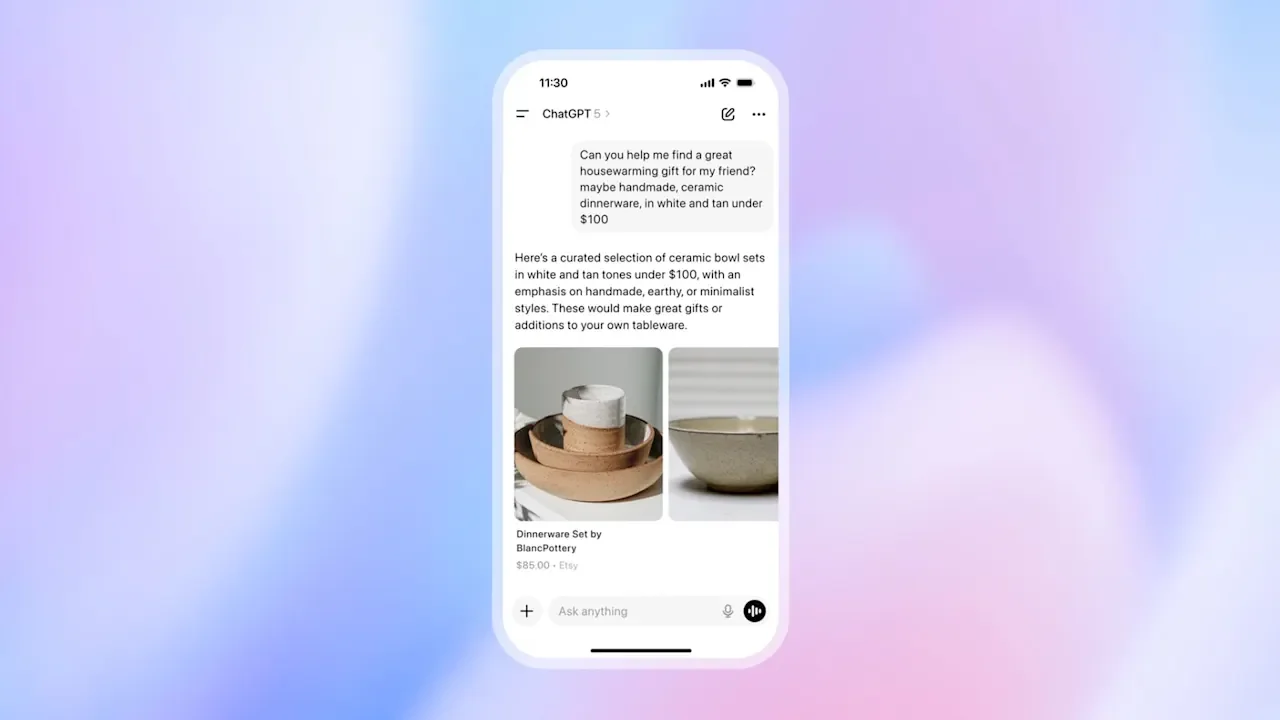
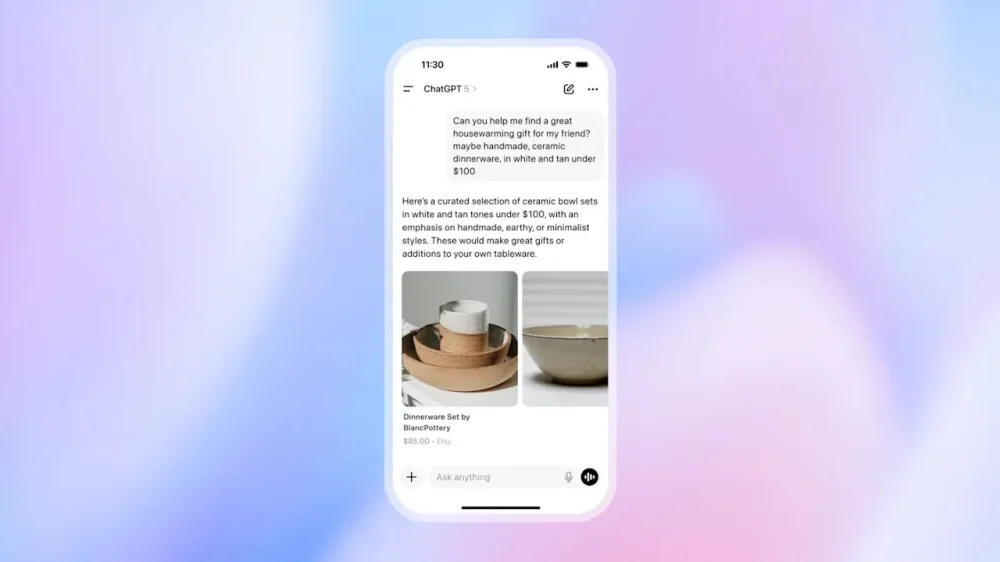
OpenAI just released Instant Checkout for ChatGPT—a new feature that lets users directly make purchases within the ChatGPT interface. ChatGPT can now spend your money for you. It’s a huge deal—both for users, brands, and the future of agentic AI. Here’s why. Stickers at the ready Consumers are already enthusiastically turning to chatbots like ChatGPT to research products before deciding what to buy. As TechCrunch shared earlier this year, referrals from chatbots to top merchant websites are up almost 400% year over year. I personally used ChatGPT to research an $800+ laptop purchase this summer. Before, users could do their research in ChatGPT, but they needed to go directly to a merchant’s website to actually check out. Instant checkout seeks to close that loop by allowing you to buy products within ChatGPT’s interface—sometimes with as little as a single click. I tested out the new system within hours of its launch. OpenAI initially rolled out Instant Checkout with a single merchant partner: Etsy. (Shopify retailers will apparently follow soon.) To see how it works, I fired up my ChatGPT interface and asked the bot to find me a Bichon Frise sticker on Etsy (Bichons are the best kind of dog—and the kind I happen to have). After about 30 seconds of research, ChatGPT presented me with three different Bichon Frise sticker options. Helpfully, it suggested which sticker would be best for a water bottle, the back of my laptop, and other use cases. Before, I would’ve had to go to Etsy’s website to actually buy my sticker. Now, though, when I clicked on the one I liked best, a prominent “Buy” button appeared. Clicking it brought up a standard set of payment options—Google Pay, Link payments, and the like. Selecting an existing credit card from my Google Pay account, I confirmed my address and pressed “Buy.” ChatGPT popped up a message saying it was communicating with Etsy. Seconds later, I got a purchase confirmation in my ChatGPT window. I had spent $4.81, and my Bichon Frise sticker was on the way! Why it matters Yes, the ability to purchase bespoke vinyl stickers using the world’s most powerful AI is neat. But in the bigger scheme of things, why does Instant Checkout matter? Firstly, instant checkout is significant because it’s not intended to be a one-off tool. Along with its launch, OpenAI rolled out a new open source protocol—termed the Agentic Commerce Protocol (ACP)—that the company says will allow for direct communications between merchants and providers of chatbots like ChatGPT. By implementing ACP, merchants can make it easy for chatbot users to purchase things directly from them. The fact that OpenAI rolled out a fully formed protocol along with its new feature suggests they’re trying to build an ecosystem for chatbot shopping, not simply rake in a bit more revenue during the upcoming Black Friday season. The company clearly hopes that other chatbot builders will adopt its protocol, creating an ecosystem that will bring in a wide range of merchants. The release notes for Instant Checkout say that any merchant using the Stripe platform can enable the new protocol in a few clicks. Many retailers are doubtless scrambling to have their tech teams do that straight away. If OpenAI succeeds with this ambition, they’ll put their tool in a place to compete with the Amazons and Walmarts of the world—not just Google and other search engines. If chatbot shopping really takes off, it could become a whole new sales channel for merchants. The fact that it supports small merchants and allows purchases in a single click—without an external merchant account—could help to dramatically level the playing field for merchants and creators who struggle to compete with Amazon and other giants. The new protocol is also significant because it gives a clear “why” to the emerging discipline of Generative Engine Optimization (GEO). As I’ve shared previously, brands are scrambling to get their products mentioned and recommended within chatbots. Before, though, many brands wondered if doing the work of GEO was really worth it. Referrals from AI bots are increasing rapidly, but they’re still tiny. Why invest money and resources in getting your brand into chatbots now? Why not wait and see what the future brings? With Instant Checkout, chatbots are now not just a research tool, but an actual source of revenue and sales. It’s also far easier with a protocol like ACP to attribute purchases directly back to a chat. That will make brands far more willing to throw money at generative engine optimization in an effort to get not only mentions, but actual sales from the bots. I already predicted a generative engine optimization craze before Instant Checkout rolled out—the new feature only deepens the appeal of GEO. Useful agents? Finally, instant checkout represents the newest direction for the concept of AI agents—which has seen feverish excitement in Silicon Valley, but not much application in the real world. It’s cool to watch a computer research your flight to Atlanta or plan out a lunch for you. But most people probably won’t actually use AI to do those things. If an AI can actually close the loop and directly make purchases on your behalf, though, that might make AI agents worth using. Imagine asking ChatGPT to plan your kid’s firetruck themed birthday party (the kind of thing many parents, myself included, already do). If the system just gave you some ideas for cake toppers and placemats, that would be neat, but of limited value. If it could list all of the items you needed to make an awesome party, get your permission to buy them from 10 different merchants at once, and then have them all sent to your door with a single click, that would be a much more useful tool. People already use OpenAI’s Deep Research—one of the only successful applications of agentic AI technology—to explore new topics or summarize news. With Instant Checkout OpenAI may have created another agentic AI tool that normal people will actually use. OpenAI has already proven itself adept at spending gobs of money from venture capital backers and partners like Microsoft. With Instant Checkout, it’s ready to start spending yours, too. View the full article
-
Wholesale Produce Supply, a food supplier based in Minneapolis, has recalled more than two dozen varieties of its fresh cut and processed cantaloupe products due to a risk of contamination with Listeria monocytogenes, the Food and Drug Administration (FDA) has announced. According to a notice posted by the FDA on Monday, September 29, no illnesses have been reported to date, but Listeria has the potential to cause serious infections. Here’s what to know: Which products are affected by the recall? Wholesale Produce Supply fresh cut cantaloupe was sold to distributors in Nebraska, North Dakota, and Wisconsin, who may have distributed the product to other states. The impacted products were sold under two brands: Harvest Cuts and Fresh and Finest. They were distributed to “traditional grocery locations.” The recall notice does not name specific retailers. Fast Company reached out to Wholesale Produce Supply for additional details and will update this story if we hear back. Affected products were packed in traditional plastic clamshell containers. Some packages included only cantaloupe, while others featured cantaloupe mixed with other fresh-cut fruits. The potential Listeria contamination was discovered during routine testing performed by the company, according to the FDA. Wholesale Produce Supply has suspended production and distribution of the affected lot and is investigating the cause of the problem. The company has recalled the following retail products. You can find the full product descriptions, UPC codes, and lot numbers on the FDA website. Cantaloupe and Honeydew (12-ounce) Cantaloupe Chunks (8-ounce) Cantaloupe Chunks (16-ounce) Cantaloupe Chunks (6-ounce) Cantaloupe Chunks “F&F” (12-ounce) Cantaloupe Chunks (5-pound) Cantaloupe Spears (16-ounce) Fruit Medley (8-ounce) Fruit Medley “F&F” (12-ounce) Fruit Mix (16-ounce) Fruit Mix (6-ounce) Fruit Mix CHWG (MCT) (5-pound) Fruit Salad (16-ounce) Fruit Salad (6-ounce) Fruit Tray CHPG w/ Dip “HC” RND (2-pound) Fruit Tray w/ Strawberries “HC” (2-pound) Fruit Tray w/ Watermelons “HC” (2.5-pound) Fruit Tray w/ Watermelons “HC” (2.5-pound) Luau Blend Fruit Mix “F&F” (10-ounce) Melon Mix (16-ounce) Melon Mix (6-ounce) Melon Mix Bowl (48-ounce) Melon Mix Bowl & Grapes (48-ounce) Melon Mix CHW (MCT) (5-pound) Melon Mix Spears (16-ounce) Consumers should not eat the recalled product Customers who have purchased affected Harvest Cuts or Fresh and Finest products should not consume them. Rather, return the product to the place of purchase for a full refund. If you have any questions, contact Wholesale Produce Supply by calling (612) 378-2025. Some people are more at risk of Listeria infection Consuming foods contaminated with Listeria can lead to infection, which can be potentially serious and even fatal. According to the Mayo Clinic, healthy people rarely become very ill from Listeria infection. However, pregnant women, adults 65 and older, and people with weakened immune systems are more at risk for infection. As reported by the Centers for Disease Control and Prevention (CDC), Listeria infection is “the third leading cause of death from food borne illness in the United States.” View the full article

-
Former police minister Nkosinathi Emmanuel Mthethwa had been named in corruption allegations this monthView the full article
-
Visa has officially launched its new Visa Commercial Solutions (VCS) Hub, aiming to revolutionize commercial payments for small businesses and fintechs alike. By integrating advanced technologies, including generative AI, Visa is transforming a traditionally complex landscape into a more accessible and streamlined system. This development holds significant implications for small business owners who are continually looking for ways to enhance their operations and improve cash flow management. The VCS Hub promises to dramatically simplify financial management for businesses by providing a unified platform that addresses various payment needs. This shift is particularly beneficial for small enterprises that may lack extensive financial resources or the infrastructure to handle complicated payment processes. The platform offers an end-to-end solution for payables, allowing businesses to manage invoice and supplier payments efficiently. It supports flexible, ad-hoc payments, granting organizations the agility necessary to respond swiftly to evolving business scenarios. “Visa is not just modernizing commercial payments; we’re reinventing them,” stated Gloria Colgan, SVP and Global Head of Product for Visa Commercial Solutions. With the VCS Hub, companies can leverage GenAI-driven workflows to automate accounts payable, which not only optimizes cash flow but also diminishes manual bottlenecks. This level of automation can free up valuable time and resources for small business owners, allowing them to focus more on growth and less on tedious financial management. Key enhancements of the VCS Hub include: AI-Powered Payables: Generative AI algorithms will drive automated workflows that anticipate business needs, helping to streamline financial operations. Embedded Payments: The platform allows for seamless integration into existing business applications like accounting and ERP systems. This feature simplifies the management of payments by embedding payment functionalities right within the tools small businesses already use. Reporting and Insights: Advanced analytics will enable users to access actionable insights and predict market trends. This data-driven approach empowers small business owners to make informed decisions in real time. Personalized Experiences: The platform can tailor user experiences through AI-generated recommendations, alerts, and next steps that aim to enhance growth and operational efficiency. The VCS Hub is not just a technological upgrade; it is a strategic move to democratize access to competitive payment technologies for smaller players, often sidelined in the digital transition. With the capability to centralize fragmented systems into a single ecosystem, small businesses can enjoy a more integrated payment experience that traditionally only larger corporations had. However, as with any new technology, challenges may arise. Some small business owners might need to invest time in training and adapting existing processes to leverage the full capabilities of the VCS Hub. Initial unfamiliarity with AI-driven platforms could lead to a learning curve that requires patience and resource allocation. Moreover, while Visa’s open APIs enhance integration, small businesses might find themselves relying heavily on third-party vendors for technical support and updates. Businesses will need to evaluate their current IT capabilities against the new system’s requirements to ensure a smooth transition. Visa is currently accepting consultations from new issuers and fintechs to explore how the VCS Hub can transform their business operations. For small business owners looking to innovate and streamline their payment processes, this could be an opportune moment to engage with Visa representatives to discover the potential benefits tailored to their specific needs. As commercial payments continue to evolve, the VCS Hub by Visa represents a pivotal step toward a more intelligent and efficient financial ecosystem for small businesses. By embracing this new technology, small businesses can better position themselves to thrive in a competitive landscape. For more details, you can view the original press release from Visa here. Image via Visa This article, "Visa Launches AI-Driven VCS Hub, Transforming Commercial Payments Today" was first published on Small Business Trends View the full article
-
Visa has officially launched its new Visa Commercial Solutions (VCS) Hub, aiming to revolutionize commercial payments for small businesses and fintechs alike. By integrating advanced technologies, including generative AI, Visa is transforming a traditionally complex landscape into a more accessible and streamlined system. This development holds significant implications for small business owners who are continually looking for ways to enhance their operations and improve cash flow management. The VCS Hub promises to dramatically simplify financial management for businesses by providing a unified platform that addresses various payment needs. This shift is particularly beneficial for small enterprises that may lack extensive financial resources or the infrastructure to handle complicated payment processes. The platform offers an end-to-end solution for payables, allowing businesses to manage invoice and supplier payments efficiently. It supports flexible, ad-hoc payments, granting organizations the agility necessary to respond swiftly to evolving business scenarios. “Visa is not just modernizing commercial payments; we’re reinventing them,” stated Gloria Colgan, SVP and Global Head of Product for Visa Commercial Solutions. With the VCS Hub, companies can leverage GenAI-driven workflows to automate accounts payable, which not only optimizes cash flow but also diminishes manual bottlenecks. This level of automation can free up valuable time and resources for small business owners, allowing them to focus more on growth and less on tedious financial management. Key enhancements of the VCS Hub include: AI-Powered Payables: Generative AI algorithms will drive automated workflows that anticipate business needs, helping to streamline financial operations. Embedded Payments: The platform allows for seamless integration into existing business applications like accounting and ERP systems. This feature simplifies the management of payments by embedding payment functionalities right within the tools small businesses already use. Reporting and Insights: Advanced analytics will enable users to access actionable insights and predict market trends. This data-driven approach empowers small business owners to make informed decisions in real time. Personalized Experiences: The platform can tailor user experiences through AI-generated recommendations, alerts, and next steps that aim to enhance growth and operational efficiency. The VCS Hub is not just a technological upgrade; it is a strategic move to democratize access to competitive payment technologies for smaller players, often sidelined in the digital transition. With the capability to centralize fragmented systems into a single ecosystem, small businesses can enjoy a more integrated payment experience that traditionally only larger corporations had. However, as with any new technology, challenges may arise. Some small business owners might need to invest time in training and adapting existing processes to leverage the full capabilities of the VCS Hub. Initial unfamiliarity with AI-driven platforms could lead to a learning curve that requires patience and resource allocation. Moreover, while Visa’s open APIs enhance integration, small businesses might find themselves relying heavily on third-party vendors for technical support and updates. Businesses will need to evaluate their current IT capabilities against the new system’s requirements to ensure a smooth transition. Visa is currently accepting consultations from new issuers and fintechs to explore how the VCS Hub can transform their business operations. For small business owners looking to innovate and streamline their payment processes, this could be an opportune moment to engage with Visa representatives to discover the potential benefits tailored to their specific needs. As commercial payments continue to evolve, the VCS Hub by Visa represents a pivotal step toward a more intelligent and efficient financial ecosystem for small businesses. By embracing this new technology, small businesses can better position themselves to thrive in a competitive landscape. For more details, you can view the original press release from Visa here. Image via Visa This article, "Visa Launches AI-Driven VCS Hub, Transforming Commercial Payments Today" was first published on Small Business Trends View the full article
-
Charlie Javice, the founder of a startup company that promised to revolutionize the way college students apply for financial aid, was sentenced Monday to more than seven years in prison for cheating JPMorgan Chase out of $175 million by greatly exaggerating how many students it served. Javice, 33, was convicted in March of duping the banking giant when it bought her company, called Frank, in the summer of 2021. She made false records that made it seem like Frank had over 4 million customers when it had fewer than 300,000. Addressing the court before she was sentenced, Javice, who was in her mid-20s when she founded the company, said she was “haunted that my failure has transformed something meaningful into something infamous.” Sometimes speaking through tears, she said she “made a choice that I will spend my entire life regretting.” Judge Alvin K. Hellerstein largely dismissed arguments by Javice’s lawyer, Ronald Sullivan, that he should be lenient because the negotiations that led to Frank’s sale pitted “a 28-year-old versus 300 investment bankers from the largest bank in the world.” Still, the judge criticized the bank, saying “they have a lot to blame themselves” after failing to do adequate due diligence. He quickly added, though, that he was “punishing her conduct and not JPMorgan’s stupidity.” Javice was among a number of young tech executives who vaulted to fame with supposedly disruptive or transformative companies, only to see them collapse amid questions about whether they had engaged in puffery and fraud while dealing with investors. Her prosecution drew comparisons to the case against Elizabeth Holmes, the founder of a blood testing company, Theranos, that collapsed amid fraud allegations. Javice, who lives in Florida, has been free on $2 million bail since her 2023 arrest. The judge said she could remain free while she appeals the verdict. She was convicted of conspiracy, bank fraud and wire fraud charges. Her lawyers had argued that JPMorgan went after Javice because it had buyer’s remorse. A graduate of the University of Pennsylvania’s Wharton School of Business, Javice founded Frank to launch software that promised to simplify the arduous process of filling out the Free Application for Federal Student Aid, a complex government form used by students to apply for aid for college or graduate school. Frank’s backers included venture capitalist Michael Eisenberg. The company said its offering, akin to online tax preparation software, could help students maximize financial aid while making the application process less painful. The company promoted itself as a way for financially needy students to obtain more aid faster, in return for a few hundred dollars in fees. Javice appeared regularly on cable news programs to boost Frank’s profile, once appearing on Forbes’ “30 Under 30” list before JPMorgan bought the startup in 2021. Sullivan told Hellerstein that his client was very different from Holmes because what she created actually worked, unlike Holmes, “who did not have a real company” and whose product “in fact endangered patients.” Sullivan said the bank rushed its negotiations because it feared another bank would acquire Frank first. A prosecutor, Micah Fergenson, though, said JPMorgan “didn’t get a functioning business” in exchange for its investment. “They acquired a crime scene.” Fergenson said Javice was driven by greed when she saw that she could pocket $29 million from the sale of her company. “Ms. Javice had it dangling in front of her and she lied to get it,” he said. And in seeking a long prison sentence for Javice, prosecutors cited a 2022 text she had sent to a colleague in which she called it “ridiculous” that Holmes got over 11 years in prison in the Theranos case. Prosecutors added that the message was “desperately needed” because of “an alarming trend of founders and executives of small startup companies engaging in fraud, including making misrepresentations about their companies’ core products or services, in order to make their companies attractive targets for investors and/or buyers.” —Larry Neumeister, Associated Press View the full article

-
We may earn a commission from links on this page. Did you know you can customize Google to filter out garbage? Take these steps for better search results, including adding Lifehacker as a preferred source for tech news. One method for faster, more interesting study sessions is popular in elementary schools, which is why you may not have heard of it, though it’s applicable to all ages: the KWL chart. The chart is easy enough for a fourth-grader to construct, but helps make even graduate-level study sessions more fruitful by making them more engaging and easy to follow along with. All you need is a notebook and a pen on hand the next time you're reading, watching, or listening to new material. (For $10, you can even get a notebook full of pre-made KWL charts so you don't have to do the work of drawing them yourself.) What is a KWL chart?KWL stands for Know, Want to Know, and Learn. Its use is popular among teachers of younger kids, but it’s recommended by universities, too. KWL charts are part of the constructivist teaching method, which is based on the constructivist theory, or belief that people learn more when they’re actively engaged in the meaningful process of constructing knowledge rather than just passively receiving information. Put more simply, constructivists believe that you learn more when you interact with your material as opposed to just reading or hearing it. A smattering of research in the wide world of academia has also suggested that KWL charts are more effective for reading comprehension than conventional, passive techniques. To better understand constructivist learning, think of all the other kinds of activities you did in elementary school. Activities like building a model volcano or playing Jeopardy! with big cards taped to the whiteboard are constructivist. You probably even remember some of the content you learned during those games or activities, even though they were years ago and you struggle to remember more boring passages you read just last week. There's a reason for that: Being engaged with a concept truly does make a difference. How to use a KWL chartKWL is similar to the SQ3R method in that you’ll be using a pencil and paper to take notes as you study. On your paper, make three columns and title them Know, Want to Know, and Learn. (If you get one of those KWL notebooks I mentioned, this is already done for you.) With or without the pre-made notebook, try to do this by hand, not digitally, as handwriting is better for retention. While it's easier to do this in a word processing doc and you might even think you should, so you don't run out of room for all your ideas, the limited space offered by physical paper is a good thing: Also like the SQ3R method, you want to do this on small chunks of material, like a chapter or brief section of text, instead of focusing on too big of an area. In the event you've already scaled-down your focus to just one chapter or section but you still think you'll have too much content for three columns on one page, you can opt for three pages, each labeled with one of the KWL pillars, but that should be the maximum space allowance you give yourself. KnowBefore starting to read a given chapter or section (or watch part of a recorded lecture, listen to an assigned podcast, etc.), write everything you already know—or think you know—about it in the Know column. Think of this a little like blurting, a learning technique that calls on you to write or say everything you know about a topic before checking it against your notes to see what you missed. In this case, you may not have pre-existing notes to reference, but it will still get you in the zone, at least in terms of using active recall to pull anything you might be familiar with out of the recesses of your memory. Want to knowNext, move over to your Want to Know section and write down what you’d like to learn or get from the material. If you don’t know much about the topic, it’s fine to write that you want to know what it even is or jot down broad questions, but for an easier way to set specific goals, look at things like chapter subheadings, summaries, or tables within your materials, and base your questions off of those. For instance, if your chapter includes a graph showing that a certain disease is more prevalent in a specific country, one of your want-to-know questions can be why that is. This is a chance to get creative. Ask unorthodox questions. Take some time to sit and think over what you could endeavor to find out beyond What is this chapter about? The more curious you allow yourself to be, the more you'll engage with the content. LearnFinally, consume the content, whatever it is. As you go through the material, pay close attention for anything that could help you answer the questions you wrote in your want-to-know section. Take notes elsewhere on the page if necessary, because when you’re done, you’ll reflect on what you learned, review the materials and your notes, and mark it down in the Learn column. You can write what you learned overall, but be sure that this column also includes the answers to the questions you posed in the second step. Finishing up with KWLAfter all three columns are filled out, you're not quite done. I recommend revising your notes, especially if the chart got messy. Use blurting to see how much of the material stuck with you, then check your blurting against the chart and the source material. Alternately, try a different technique to further entrench the content in your brain. Use your want-to-know questions to create a flashcard deck, for instance, and then follow the Leitner method of flashcard review. Try using the Feynman method by explaining the chapter content to a friend, a relative, or even an AI bot, which can help you break down complicated concepts into smaller bites. Try this for a variety of uses, even your personal recreational reading. KWL works well for not only the reading comprehension it was designed to enhance, but also taking notes during a lecture, participating in a classroom activity, going to a workshop, or even just watching a documentary. The whole purpose is to keep you focused and curious while you consume information, so you stay engaged as you try to find answers to the original questions you laid out. View the full article
-
We may earn a commission from links on this page. I'm a shut-in, which makes me the perfect candidate for a smart security system. I want to know exactly what's going on outside at all times of day, even while I'm still tucked tightly in bed. You don't have to be a serial introvert to benefit from a few cameras and connected devices in your home. If you're frequently away, you may also want to keep a record of packages and people who have passed through while you're out. Smart security systems are not just about catching a neighborhood cat in the act. They help keep a watchful eye when you can't, and they can be automated to trigger other devices as needed—such as a motion sensor turning on a smart light and recording a video clip, or a door opening to trigger a deafening alarm. The good news is that smart security systems are fully customizable to meet your specific needs. Some brands offer third-party monitoring as an added security measure, providing extra assistance when you're away from home. Setting up a smart security system is just as straightforward as setting up a smart home. You'll want to choose your smart security ecosystem first, then decide if you want something that's highly expandable later on. You can also keep it simple with a video doorbell that syncs with a smart display inside the home, especially if you're renting and don't have many customization options. Here's how to get started. Choosing a method of smart security Smart security systems range from the expansive to the simplistic, just like the smart home does. You choose the ecosystem you want to live in and then build from there. But before you can select that, you need a device to function as the entry point. It could be a security camera, a video doorbell, or a smart lock. The idea is that whatever you use to enter your home is the first line of defense. Everything after that is an add-on. Most people start with a security camera, with the most popular option being the video doorbell. The video doorbell offers it all: a window to the world, a clear indication that there's an eye on the outside, and the ability to deliver instant notifications for sound and movement at your door. It also serves as a button that people can press to let you know they've arrived. Installation can vary from easily mountable to more involved, depending on whether you integrate an existing doorbell chime. (I've personally eschewed this way because the chime on my old house is broken and I have no intention of ever addressing it.) As long as you have smart displays or speakers inside the home, or a smartphone with connected accessories that blare notifications, you don't need to connect it to a chime. Not all smart locks take over the door! This August smart lock works over existing door hardware so you don't have to swap out the deadbolt. Credit: Florence Ion/Lifehacker Smart locks are another way to start a smart security system, though they are pricier and a bit more complicated to install, since there's no one-size-fits-all turn-key solution for every front door. The installation process will vary depending on the type of door you have and whether you can easily swap out the lock. If you're a renter or love your door, there are "retrofit" smart locks from brands like August that allow you to keep the original keys and hardware intact. Smart locks offer access logs that track who has entered and exited the home. Some also provide tamper alerts, conditional access codes, and lockouts for repeated incorrect access codes. And with most other smart locks, you won't have to manage physical keys. There are smart security systems that extend beyond cameras and door locks to include a base station with a siren, a centralized control panel, and motion and door/window sensors. This is the route to take if you need something particularly sophisticated, especially if you want home monitoring included in the package. It requires more setup beforehand, but you can effectively string together a security system without hiring a professional to do it. The security system can also integrate with an existing smart home. If you have smart bulbs, for instance, you can set them up to turn on when a sensor detects movement. The major players in smart securitySmart security can be more overwhelming to start with than a smart home, due to the breadth of options available. But the only wrong route to take is the one that complicates the eventual goal of having a connected home you can monitor remotely. Let's start with the most straightforward entry points through the typical smart home tech players, where you might have already established yourself. Google's smart security ecosystem, Nest, includes security cameras and smart locks. It offers the benefit of professional monitoring through ADT, and you can integrate third-party cameras and sensors from brands like TP-Link's Kasa or Tapo accessories. However, brands outside of Nest may not be manageable through the Google Home app, meaning you won't have access to video clips or previews from the main app feed (though you can still ask Google to stream them to a smart display). For diehard iPhone users, there's Apple's ecosystem of HomeKit-compatible smart security hardware, including devices that have been vetted and approved by the company. You can choose cameras from Eufy, Logitech, Eve, and Aqara, all of which support Apple's HomeKit Secure Video (HKSV) for encrypted video storage in iCloud. Professional monitoring is typically offered through a handful of third-party solutions that are HomeKit-compatible, such as ADT, Vivint, or Ring. Amazon also has its own lineup of offerings, which I like to call "platform agnostic," as they are designed to work on either Android- or iPhone-compatible smart homes. Amazon's Alexa ecosystem comprises smart speakers and smart displays that deeply integrate with Ring and Blink's various security cameras, as well as other compatible devices. Ring and Blink are established flagship brands in the Alexa ecosystem, and they work best if you stick to one or the other, with Blink being the "affordable" brand and Ring having more premium options. If you're particularly set on going with a brand that has its original bearings in home security, ADT can help you get set up with Google's hardware and other compatible bits. Vivint also offers professional installation, along with options for building out the smart home beyond cameras and motion sensors. This route can be particularly pricey, since you're paying a third-party to handle the installation for you, as well as a monthly or annual subscription price. A more affordable route to take, and one that most people will likely find themselves drawn to, is the do-it-yourself approach with contract-free professional monitoring, allowing you to pay only for what you need, when you need it. Companies like SimpliSafe and Abode make it super easy to concoct your own network of smart security devices that work in tandem with one another. SimpliSafe offers month-to-month monitoring, while Abode offers on-demand, temporary professional monitoring by the day or week. SimpliSafe and Abode feature base stations, which are smart home hubs equipped with all the requisite connectivity hardware for automating devices, including cameras and motion sensors, as well as providing battery and cellular backup, and a loud alarm that blares in the event of an intruder or other emergency. This route can be cheaper, although it may also cost more if you want something particularly expansive. If you build your own smart security system, you can choose to mix and match as you please. With the advent of Matter, the unifying connection protocol, it has become easier to link ecosystems. However, Matter does not yet fully support the ideal streaming bandwidth required for security cameras and video doorbells, so you won't be able to trigger automations based on that criterion. The do-it-yourself route is attainable for anyone who doesn't mind a weekend of customizing and adjusting a new system. But if you have security cameras in your setup, I recommend sticking with the camera brand as the main "anchor" of the security system and building around that. If you have a Ring video doorbell, for instance, consider adding Abode or SimpliSafe as an option for third-party motion sensors and similar devices, especially if you're not using the Ring base station. It is easier to manage if you stick with the full Ring security system, as you'll only have to interface with one main app to check in on the home. But the option is there to mix in another provider. Picking the right smart security system Some security cameras are so easy to install they magnetize to a metal rack. Credit: Florence Ion/Lifehacker The best way to determine which system suits your specific needs is to consider the situation. If you're already a tech enthusiast, consider one of the DIY routes and integrate a system like Abode with one of the three main digital assistants—Google, Apple, or Alexa—as your main controller. This offers the most combination of mixing and matching brands, plus the added benefit of on-demand professional monitoring as needed. If you're a renter, consider the less permanent option. SimpliSafe and Ring's ecosystems were built around this flexibility, as it's each brand's bread and butter. They include everything you need right out of the box, like a base station that connects to a variety of renter-friendly accessories, stick-and-peel motion sensors, and rental-friendly camera mounting. Ring lets you pay for professional monitoring on a month-to-month basis, although it's not required to use the hardware, whereas SimpliSafe accommodates self-monitored systems. Amazon's Blink is also a viable option to consider for temporary or non-DIY living situations, especially if you prefer notifications via a smart display or speakers. For first-time home owners, consider a hybrid approach that works right out of the box, but also allows you to add to it later. Google's Nest products work particularly well in a household that's all-in, from Nest security cameras to the Nest Thermostat, which also serves as a motion sensor in the connected home. If you want to add professional monitoring at a later time, you can integrate a SimpliSafe or Abode system into an existing setup without disrupting what you've put together, or have ADT take over on a month-to-month basis. If you don't have the patience for this kind of smart home maintenance, or you'd rather opt for a professional monitoring company to handle it all, there is no shame in choosing ADT or Vivint. It will cost you more, but both companies have had ample time to establish secure device partnerships. You can get the whole kit and kaboodle through either brand, from motion sensors to security cameras. This is also the route to take if protecting your property while you're not there is key. Companies like ADT boast a massive network of monitoring centers across the continental U.S., and again, you don't have to handle everything yourself. A smart home with sirensIt can be overwhelming to start your journey into smart security. But once you set it up, you won't be able to live without the constant reminders that everything is in perfect order in your house. Indeed, I use the cameras to check in with my home and make sure it's still standing there. Sometimes that peace of mind is all it takes to allow yourself hard-earned time off. Regardless of which route you choose for your smart home, don't feel like you have to jump in all at once. I started my smart home security system with a doorbell camera and a connected thermostat. They weren't even from the same ecosystem—the doorbell camera was Ring, and Nest handled the thermostat—but I learned how to use mobile apps to develop routines around each of them. Now I live with mostly Google's Nest cameras, which take on the bulk of the surveillance work. I've incorporated a few budget-friendly brands, such as TP-Link's Kasa, around the house for a little added extra help when I need it, and a smart lock that can be remotely managed to let me know when I've left the front door unlocked. View the full article
-
We may earn a commission from links on this page. While tech companies might increasingly seem to think I want media created by AI for no specific purpose other than to fill time, all I really need is tech that automates the tedious parts of entertainment. Collecting and organizing the movies I actually want to watch, streaming music throughout the house, or creating the ambiance I need to immerse myself in a show. For actually useful home entertainment tech, here's where smart home gear can be helpful for watching TV and movies, listening to music, or playing games. Whatever your media of choice, the time you spend watching shows, listening to music, or playing games is a deeply human affair. And that means not every piece of tech that tries to automate your habits is necessarily going to be an improvement. Here, I'm less interested in how to shovel as many YouTube videos into your queue as possible, and more in how you can use tech to find and manage the media you want in the way you want it. With that in mind, here are some of the smart home gadgets that I've found genuinely useful for my home entertainment needs. Streaming boxes and sticks Amazon Fire TV Stick 4K AI-Powered Streaming Stick $24.99 at Amazon $49.99 Save $25.00 Learn More Learn More $24.99 at Amazon $49.99 Save $25.00 At this point, it's hard to find a television that doesn't have some kind of smart system on it, eager to serve up apps for your favorite streaming services. However, some of these platforms are more helpful than others. Even if your TV already has its own operating system, you can get a streaming stick or standalone box with a better platform. Google TV: This one is a personal favorite of mine. The Google TV Streamer box adds a Google-powered interface that can search for shows and movies across all of your streaming services. You can even add items to your watch list from search results on your phone, which is easily one of the most convenient ways to keep up with that show your friend told you about that you can't remember the name of. Now, just tap to add it to your watch list and it will show up on your TV at home. Roku: If you're looking for something more platform-agnostic, Roku's streaming sticks and boxes offer the widest suite of streaming services in one box. Since it's not owned by any company that also offers a video streaming platform (like, say, Amazon) you can find almost every streaming service. It lacks some of the more comprehensive search options you'll find on Google TV, but Roku more than makes up for that with its excellent physical remotes and a range of devices at every price point. Apple TV/Amazon Fire TV: Both Amazon and Apple offer their own streaming boxes that perform reasonably well, but they share a common downside: They both tend to overly privilege their own content stores. If you're heavily invested in either the Apple or Amazon ecosystem, then these might be the best options for you to buy, rent, and discover movies and shows. However, if you're a little more platform-agnostic, the other two options on this list might be a better fit. On a tangential note, one last excellent tool for organizing your watchlists is Letterboxd. This app isn't a streaming service or platform, but it's one of the best ways to discover new shows, rate and review the ones you've seen, and connect with people who share your tastes. Build ambience with smart lightsFor a while, I thought the idea of putting lights behind my TV—much less syncing those lights to what's on my screen—seemed like a needless extra. After trying it out, though, it's a game-changer. Ambient lighting behind your TV can reduce eye strain, particularly when you're watching in a dark room, making it extra immersive. In recent years, it's gotten easier than ever to sync colorful backlighting to echo the edges of what appears on your screen. It's great when watching movies, and even better when playing games, where your eyes are constantly trying to refocus as you move through virtual game worlds. Here are a couple of the most accessible systems for setting up lighting like this: Philips Hue Sync: The Philips Hue system has a feature called Hue Sync that lets you connect your smart lights to what's on your screen. The app can pair with Windows/Mac computers, some models of LG or Samsung TV, or you can use the separate Hue Play box to connect any HDMI source to your lights. Govee: If you want to save a bit of cash, Govee has a more accessible light syncing system. It offers similar features to the Hue Play Box for $260, including the sync box as well as a light strip. Even if you don't want to go to the extra effort (and expense) to sync your lighting to your display, any ambient lighting can make your viewing experience a bit better. You can even use smart home automations to automatically turn on your ambient lighting when you turn off the overhead living room lights. Upgrade your music with smart assistant-powered speakers Sonos Era 300 - Black - Wireless, Alexa Enabled Smart Speaker with Dolby Atmos (Pack of 2) $898.00 at Amazon $958.00 Save $60.00 Learn More Learn More $898.00 at Amazon $958.00 Save $60.00 For everyday use, smart speakers are fine. They can recite recipes, set timers, or play podcasts and you probably won't notice the difference much. But for listening to music, it can help to have something a bit higher quality in your home. One of my favorites is the Sonos Era 300. This speaker can field wireless streaming from a wide variety of music apps, including Spotify, Apple Music, and Amazon, or you can pair your phone via Bluetooth. It also has a 3.5mm line-in for your more analog music devices. In the past I've also used similar products from Bose, and it's worth exploring your needs when picking an audio system. Sonos in particular is known for its robust system for enabling multi-room audio. If you want to set up speakers in your living room, kitchen, office, or bedrooms, and easily play music across all of them, or move music from one room to another, Sonos is a great choice. Bose speakers offer some similar features, though its multi-room capabilities aren't quite as strong as Sonos. However, Bose soundbars are great at creating room-filling audio, particularly for movies and shows. If you're more interested in television, and only need to use your speakers solely for listening to music occasionally, the Bose ecosystem might be your better option. Bring your record collection into the 21st centuryThe phrase "smart record player" might make analog purists wince, but hear me out. The Victrola Onyx is one of my favorite smart home devices, specifically because it threads the needle of bringing old-school analog collections into the modern smart home environment. This model uses a typical RCA output, so if you have an existing analog speaker system, you can connect to it and get that full warm, crunchy audio quality you're used to from your existing record collection. However, it's also equipped with Sonos streaming, so you can keep listening to your albums in another room. It gives you the option of streaming your audio, without forcing you to lose the tactile quality of vinyl. View the full article
-
Shares of Spotify Technology SA were put on the spot this morning as the Swedish audio-streaming company announced that CEO Daniel Ek will be transitioning out of the role at the end of the year. He will be replaced by two new co-CEOs: Gustav Söderström, Spotify’s current co-president and chief product and technology officer, and Alex Norström, co-president and chief business officer. Ek will remain with the company and oversee its long-term strategy and capital allocation, and provide guidance in his new role as chairman of the board. Kicking and streaming Investors may take some time to absorb the news. Spotify stock, listed in the U.S. and trading on the New York Stock Exchange, was down nearly 4% as of 8:30 a.m. during premarket trading. However, shares are up almost 6% over the past month and a whopping 60% year-to-date as Spotify has reported consistent user growth and its first full profitable year in 2024. “I always believed that Spotify could play an important role in revolutionizing listening around the world, and with more than 700 million users, we’ve truly charted a new course bringing creativity to every corner of the globe,” Ek said in a company statement. The CEO also announced his departure on Instagram. The 42-year-old Ek cofounded Spotify in 2008 and has been with the company ever since, seeing it grow from a small Swedish startup to become the top music streaming platform in the world, with almost 700 million users worldwide along with 276 million subscribers in 180 markets. More recently, the company has leaned into the burgeoning audiobook segment, rolled out new features like “Mix” mode, and more. ‘Can’t wait to get started’ With a lot of momentum, Spotify’s new CEOs said in a joint statement that they’re confident they’ll take the company forward. “We’ve worked together a very long time and have seen Spotify through many different chapters,” Söderström and Norström said. “Nearly three years ago, when we stepped into our role as co-Presidents, we charged our teams with relentlessly focusing on building the best and most valuable experience available anywhere and that ambition hasn’t changed.” View the full article

-
Customs authorities examine use of advance trading hardwareView the full article
-
We may earn a commission from links on this page. In Lifehacker’s series, “A Guide to Automating Your Entire Home,” we’re highlighting all the ways you can power your home with autonomous technology, room by room. Whether you want to build a smart security system, turn a “dumb” device smart, or simply control your lights from your phone, this guide will help walk you through it. If you're starting out with smart home tech, you may feel overwhelmed by all the devices and protocols available to automate every part of your routine. But you don't need to invest a lot of time and money up front to replace all of your electronics. Instead, consider adding wifi-enabled smart plugs around the house to turn your "dumb" devices smart. Smart plugs, which are available from well-known brands like Wyze, TP-Link, Amazon, and GE as well as many others, transform your regular outlets into smart alternatives that can be turned on and off remotely, set on schedules, and even controlled with voice commands. All you have to do is plug them in and connect them to an app, and your lights, small appliances, and other electronics become smart. GE Cync Smart Indoor Plug, Bluetooth and Wi-Fi Enabled, Works with Alexa & Google Home, Smart Outlet $16.00 at Amazon /images/amazon-prime.svg $25.99 Save $9.99 Learn More Learn More $16.00 at Amazon /images/amazon-prime.svg $25.99 Save $9.99 Some of the best smart plugs have useful features like timers, sunrise and sunset scheduling, energy monitoring, and away modes as well as compatibility with smart home platforms from Google, Amazon, and Apple. Automate your daily routines With smart plugs, you can put your morning routine on autoplay by setting various devices to activate at specified times. For example, schedule your bedroom lights to switch on to wake you up and have your coffee maker begin brewing simultaneously (don't forget to set it up the night before). You could even use a smart plug in your bathroom to heat up your hair tools before you need to use them. You can set up routines for each individual plug, or you could link them with a voice assistant—using an Alexa-enabled device, for example—to start the whole routine with a single command. The same concept could apply at bedtime, in reverse: Use smart plugs like sleep timers for your lights and your streaming devices or even for preheating an electric blanket or turning on a space heater in your bedroom. Control indoor and outdoor lightsSmart plugs can be used to automate your lights even if you don't have smart bulbs. You could set the lamps in your living room to turn off around bedtime and on in the morning—then off again when you leave for work and back on when you return. Or connect your outdoor string lights to a weather-resistant smart plug with a routine to automatically turn on in the evening around sunset and off after an hour or two. Smart plugs are also great for scheduling and automating Christmas lights and indoor grow lights. Aanything you want a timer for, you can do with a smart plug. Using IFTTT capabilities—or as part of a larger smart home ecosystem if you have one—you could link smart plugs with motion sensors to have lights turn on for a set period of time when motion is detected. This could be useful at night in kitchens or common areas after the lights have been turned off as well as in garages and basements. Outdoor lights could be set to activate when a security camera picks up activity. Other uses of IFTTT include having a fan or heater turn on or off when your thermostat hits a specific temperature. With smart plugs, there's no need to flip switches or unplug from outlets, making light control much more convenient. As an added bonus, you can save energy (and reduce your power bill) by tweaking routines so lights aren't on when they don't need to be. Because smart plugs can be automated and controlled remotely, you can also use them for security when you're away: Set your lights to turn off and on at specified times so it looks like you're home. Command your home appliancesIf you have devices you want to manage power to, whether you're away from home or simply across the house, connect them to smart plugs—for example, you can put a water kettle or bottle warmer on a schedule, or at least hometurn them on remotely when you need them. Or set up timers for decorative elements like water fountains, aquarium lights, air fresheners, wax melts, and more. Smart plugs are also useful for ensuring electronics are turned off, like the aforementioned hair tools and space heaters. If you can't remember whether you flipped the switch before you left home, check the power consumption of the smart plugs they're attached to and disable them if needed. If you run your washer or dryer through a smart plug, you can get alerts to your phone when they finish their cycles. Access hard-to-reach outletsWith a smart plug, you can control devices connected to outlets in hard-to-reach places—such as high on a wall or behind heavy furniture or in a far corner of your garage—without needing to climb on a ladder or move things out of the way. Plugging the device in initially is the hard part, but after that, you can simply toggle the power on and off via the app or voice command or set up an automation. This can also be useful for controlling electronics in areas you don't walk through often, such as water pumps and dehumidifiers in basements and fans in attics and garages. Monitor energy usageSmart plugs provide useful data about the energy draw of various appliances and electronics. When a device is plugged in, you can see its real-time energy usage as well as historical data. Use this to reduce standby or "vampire" power, manage battery strain, and identify inefficient, energy-hungry electronics so you can make more informed (and cost-conscious) decisions about your devices. View the full article
-
A memo sent to 175,000 employees gives them 60 days to complete the training. View the full article

-
Shares of Beyond Meat slumped to a record low on Monday after the maker of plant-based meat launched an exchange offer for convertible bonds to cut more than $800 million in debt. The stock was last down 32.1% at $1.93, after falling as low as $1.23. The company last month posted a revenue drop and a wider-than-expected loss, citing weak U.S. consumer demand. It said it was still facing “an elevated level of uncertainty” and will not provide any full-year estimates. Consumer spending has been affected by economic uncertainty and consumer tastes have been shifting in the plant-based meat market. The company will exchange its $1.15 billion 0% convertible notes due 2027, with up to $202.5 million of new convertible payment-in-kind 7% notes due 2030, along with 326 million shares of its common stock, according to a filing on Monday. Payment-in-kind means Beyond Meat will be able to pay interest with additional debt instead of cash, with the payment-in-kind notes paying interest at a 9.50% annual rate. The exchange offer is meant to sharply reduce leverage and extend maturity to support Beyond Meat’s long-term vision of being a global plant protein company, President and CEO Ethan Brown said in a statement on Monday. The filing showed about 47% of holders of the 2027 notes have already agreed to the exchange offer, while other creditors have until October 28 to accept the offer. Following Beyond Meat’s results, TD Cowen analysts said in an August note that the management and board have recognized the “existential threat facing the business and are taking steps to preserve cash and stabilize sales.” However, they recommended selling the stock, noting that the company’s fragile financial situation and weak demand for meat alternatives create too much risk. Of the nine analysts who cover Beyond Meat, three have a “hold” rating on the stock and six have a “sell” or “strong sell” rating, according to LSEG. Beyond Meat’s stock is down about 50% for the year to date. Additional reporting by Lance Tupper —Caroline Valetkevitch, Reuters View the full article

-
Figures from Bank for International Settlements show rapid growth of currency tradingView the full article
-
We may earn a commission from links on this page. In Lifehacker’s series, “A Guide to Automating Your Entire Home,” we’re highlighting all the ways you can power your home with autonomous technology, room by room. Whether you want to build a smart security system, turn a “dumb” device smart, or simply control your lights from your phone, this guide will help walk you through it. Temperature is crucial to your comfort at home, and smart tech can help you find that perfect balance—starting with smart thermostats, but extending to other devices and apps to help through the summer and winter months. Not only does a smart tech overhaul like this mean more precise temperature control, it also helps cut down on energy bills, because you're only heating and cooling when you need to. These systems can be operated remotely via apps, set to work on a schedule, and can sometimes even automatically adapt to the local weather conditions. Smart thermostatsA smart thermostat is a good starting point for most people. They're simple to set up in most cases, replacing the thermostat on your wall and connecting to the same internal wiring: Google, for example, has a complete guide to installing a Nest thermostat. Once you've disconnected the power, it's typically a 20- to 30-minute job, although on older properties some more work and extra connections might be required. You can then control the temperature in your home through the physical smart thermostat itself, and through the companion app on your phone. Many smart devices will hook up to a smart home platform (or two) as well, which gives you extras like voice control (through an AI assistant such as Alexa), and tighter integration with everything else in your smart home. If you already have a home full of devices that work with Apple Home, Samsung SmartThings, or Google Home, then it makes sense to buy a smart thermostat to match. It means you'll have more options for controlling your gadgets (through an Apple TV 4K box, for example, if you're deep in the Apple ecosystem). Once you've mastered the basics, you can move on to more advanced features. Smart thermostat features can vary depending on the model and manufacturer, but most offer a broadly similar set of functions: The ability to set up heating and cooling routines to work on a schedule, remote access when you're away from home, and smart adjustments based on weather, time, or sensor readings from around your home. You could, for example, have the smart thermostat automatically adjust to your current location (reported by your phone), so putting your HVAC system into a power-saving mode when you're out at the office, then starting to heat up rooms again when you're on the way back. Or maybe you can have the temperature automatically adjusted while you sleep, maintaining a consistent coolness based on sensor readings overnight. As well as the Google Nest Thermostat mentioned above, you've also got devices like the Ecobee Smart Thermostat Premium. Its capabilities include being able to adjust temperature in relation to humidity—via the bundled smart sensor—and timing its heating and cooling for periods when electricity is going to cost the least amount, as much as possible. Ecobee Smart Thermostat Premium $219.99 at Amazon $259.99 Save $40.00 Learn More Learn More $219.99 at Amazon $259.99 Save $40.00 The Honeywell T5 Smart Thermostat is one of the most customizable devices of its type around, which extends to the information shown on its clear touchscreen panel, and you can schedule heating and cooling timings for up to a week in advance. The accompanying Resideo app means easy access to all the controls from a phone or tablet. Smart thermostat accessoriesSmart vents give you a little bit more control over how and when specific rooms are heated and cooled, whether this control is automated or handled manually. A Flair Smart Vent, for example, can be operated through a dedicated app or through a wider smart home system. Then you've got smart ceiling fans—rather than having you switch these fans on or off manually, you can set them to operate on a schedule, or have them enabled or disabled depending on the temperature. They start up when needed, and you might not have to lift a finger. With ceiling fans and some other devices (such as smart lights), you can opt to make the connected switch smart rather than the device itself. So, invest in a Lutron Caseta Smart Switch, and you can control a connected ceiling fan from your phone or tablet, or through the Amazon Alexa app and devices. It can be automated based on timings, temperature, and your location, like the other smart devices in your home. Air purity is something else that you might consider looking at, with devices like the Levoit Air Purifier available. It's another device that plugs into the Alexa ecosystem, enabling control via apps and smart speakers, and it can scrub dust and pollen from the air across an area of up to 1,073 square feet. Levoit Air Purifier $182.99 at Amazon $219.99 Save $37.00 Learn More Learn More $182.99 at Amazon $219.99 Save $37.00 There are also spot heating and cooling fans that work separately to a smart thermostat, giving you on-demand temperature control across a smaller space—you can move these from room to room as needed, and they often come with support for app control and at least some level of integration with your other smart home devices. Another example here is the Dyson Purifier Hot+Cool HP1, which throws in air purification features as well. While the cooling isn't active (it's just blowing air around), the heating is, and it can come in useful all the year round—and again, it can be operated via an app in addition to a physical remote control and the buttons on the device itself. One final option: Smart blinds. These are handy to have at night, but they also help you manage the temperatures in specific rooms. If there's a room that's a real sun trap, you can set a smart blind to block out the sunshine during the hottest part of the day, so it's relatively cool whenever you decide to go into it. Something like the Zstarr Motorized Smart Blind works well here. Via the remote control, you can set up timings for raising and lowering the blinds, and it can be plugged into Amazon Alexa and Google Home smart ecosystems as well if you need it to work with your other smart devices. There are plenty of ways to approach this, and you can add devices as you need once you've got the essentials in place. Eventually, it's possible to get the temperature of every room carefully calibrated using the right gadgets and apps—with the devices all working on a schedule of your choosing, and in combination with each other. View the full article
-
Smart home devices can streamline a lot of your day-to-day tasks: With an internet connection and some simple automations, you may never have to carry house keys, turn off the lights, or touch your thermostat. But all of this convenience comes at a potential cost, as smart tech is vulnerable to attack by cyber actors, leaving your personal data and your privacy at risk. Here's what you need to know to secure your smart home. Is your smart home secure? The short answer: not by default. Smart homes have vulnerabilities at multiple levels, from the devices themselves to your home network to the physical endpoints, like your phone, that have access to and control over your Internet of Things (IoT). To start, IoT devices may have weak built-in security protocols or lack clear instructions to help users lock them down from factory settings, leaving them open to hackers, who have to exert very little effort to access your data or spy on you. Wifi routers and smart home devices often have default credentials that are publicly available and therefore easy to get past—and data show that the vast majority of users have never changed their router admin password or adjusted any factory settings. If your home network isn't secure, nothing connected to it can be considered secure either. Smart devices can also be integrated into botnets, allowing threat actors to conduct malicious activity like account takeovers and malware distribution using your home network. A recent instance of this was a campaign known as BADBOX 2.0, which targeted off-brand consumer electronics manufactured in China. Bill Budington, a senior staff technologist at the Electronic Frontier Foundation (EFF), notes the digital divide may increase the risk for some consumers, who may seek out cheaper devices from low-cost manufacturers that have weaker security and far less to lose in terms of reputation if they are implicated in vulnerabilities compared to companies like Amazon. Finally, security can be compromised if your physical devices fall into the wrong hands. For example, if you control your smart home using apps on your phone, a threat actor could gain access in the event said phone is lost, stolen, or hacked. Smart homes can compromise privacyLeft unsecured, smart home devices can also put your privacy (and potentially your safety) at risk. Internet-connected cameras, from baby monitors to pet cams, are vulnerable to hacking, and threat actors can use them to surveil you and your home. This may include snooping on and tracking your movements, "shoulder surfing" to collect sensitive personal information, recording audio and video footage of your private activities, and sharing or selling live feeds on the dark web. (In a particularly alarming incident in 2018, a hacker reportedly issued verbal threats toward a four-month-old through a Nest-brand baby monitor.) Your smart tech is likely collecting a lot of information about you in the course of its normal activities—all of which could be exploited. For example, your robot vacuum creates and utilizes a map of your physical layout to know where to go, and usage patterns from various automations can be used to track your movements and confirm when you're away from home. There's also the possibility that your smart home devices are compromising your data in ways you aren't aware of and haven't actively consented to. A 2023 report from security experts—led by the nonprofit IMDEA Networks and Northeastern University—shows that IoT devices may inadvertently expose personal information that can be harvested and sold to companies involved in surveillance capitalism. Researchers found that spyware apps and advertisers abuse local network protocols to access sensitive data, making it easier to profile users. No security standards for smart homesThere isn't a single set of cybersecurity standards that smart home companies have to follow or an easy, centralized resource for users to research this information. Earlier this year—during the last few weeks of the Biden administration—the Federal Communications Commission launched the U.S. Cyber Trust Mark voluntary labeling program to incentivize device manufacturers to improve security and help consumers buy with confidence. However, the agency later launched an investigation into the program, delaying its rollout. For now, consumers are left to do their own due diligence. In 2017, the nonprofit Mozilla Foundation created a resource called *Privacy Not Included, with reviews of products measured against "minimum security standards" and breakdowns of any privacy concerns. The site doesn't appear to have been updated in the last year, but you can still find detailed information about the privacy and security history of well-known smart home manufacturers like Amazon, Google, Wyze, and Ecobee. Otherwise, Budington suggests simply searching the device you're considering (and the company that makes it) before buying to see if researchers or users have reported any concerns. How to improve smart home securitySecuring your smart home starts with securing your internet connection via your router. We've got a whole guide to protecting your home network, but at the very least, you should change any default router settings—admin usernames, passwords, and network names—to something unique and not personally identifiable and turn on encryption in your wireless security settings. Regularly check for updates, which provide patches for security flaws, and audit the devices connected to your network to identify anything suspicious and remove those you no longer use. You can add another layer of security with a guest network set up specifically for your IoT devices. That way, if your smart devices are compromised, everything connected to your primary network (such as computers and phones with access to your personal and financial accounts) will be protected. According to Budington, one way to further mitigate vulnerability is to reduce the number of devices with their own wireless connection, running them through a secure, centralized hub instead. Home Assistant is a self-hosted option that can be installed on a Raspberry Pi or a traditional PC or used with the plug-and-play Home Assistant Green. Hubitat also gives you local control over your device data and integrates with a variety of products, including those compatible with the Zigbee, Z-Wave, and Matter standards. Once your network is secure, you'll want to take similar steps with each of your IoT devices. Change default usernames and passwords to unique, secure alternatives and enable all available security features, such as two-factor authentication and encryption, in the device settings. Ensure your devices (and any apps used to control them) receive automatic firmware updates. You should also check your device's privacy settings, removing permissions that aren't essential for it to function and disabling features you won't use. For example, you could turn off location tracking on your smart thermostat and disable voice control for devices other than your voice assistant. Finally, while we've focused mostly on digital threats, your smart home isn't immune to physical compromise. Be aware of ways your devices can be accessed, such as those installed on the exterior of your house, and ensure phones and tablets and the apps on them that control IoT devices are secured with a PIN or biometric authentication. Remember that, by nature, anything connected to the internet is at least somewhat vulnerable to attack. You'll have to consider your own risk tolerance and weigh the convenience of having a smart device against the potential for it to be compromised—and your privacy along with it. You may find that there are some things that you simply don't need to automate, and therefore you can stick with the "dumb" alternative. View the full article
-
Cleaning is one of those necessary chores that most of us don't have much enthusiasm for. It's often demanding and tedious work, and while you're taking care of it, you do so with the knowledge that you're going to have to do it all again next week. There's some good news, though, for the cleaning-averse: Modern day tech can handle a lot of these jobs on your behalf, as smart cleaning gadgets continue to get better and better. In recent years, they've become more reliable and more effective, and you've got a host of different models to choose from. This introduction to smart cleaning technology will bring you up to date on the products that are available, and what they can do for you. Yes, you can have a home that's neater and cleaner—with just a few button presses. The pros and cons of cleaning techThe big positive from investing in smart cleaning gadgets is, of course, that you won't have to do these jobs yourself, so the hours you save can be put towards doing something you actually enjoy. These gadgets don't get tired, sick, or irritable, and will work at any time of the day or night—though you don't necessarily want a robot vacuum humming away at 4 a.m.. In many cases they can be operated remotely and work autonomously, so they can be taking care of the chores while you're out at work or on vacation. You can get smart devices to wash your windows for you. Credit: Ecovacs You are going to have to make an initial investment in the technology, and, for some devices, a rather sizable one. The argument can be made that hiring someone to do your cleaning is a better option than getting robots to do it: They might do a more thorough job, depending on the person and the gadget you're comparing them to, and you can give them more specific instructions. However, getting cleaners in does involve giving someone else access to your home, and finding a mutually convenient time. It will also be an ongoing expense. There are a few more cons to consider. One is that a certain amount of tidying up and preparation work is often required before the robots can take over. You may have to pick up toys and clothes, for example, so the robot vacuum can vacuum. By the time you've done that, you might think it makes more sense to just do the whole job yourself. Many smart devices can be controlled via an app. Credit: iRobot What's more, these gadgets require a certain level of maintenance: Depending on the device, you need to empty them out, supply them with power, water, and cleaning products, and perhaps even clean parts of them yourself. Like any piece of hardware, they will experience wear and tear, and will eventually need to be replaced. There's one other consideration to think about, which is that manual cleaning is a great way to exercise. Studies have shown that domestic duties can give you enough of a workout to extend your lifespan and improve a host of different health markers, so you might want to use some of the time that these gadgets are saving you to head out for a run or for a session at the gym. The best smart cleaning gadgets you can buyIf you've decided that you want to transform your home into one that cleans itself, you can automate a number of different processes using a number of different devices. There's plenty of choice out there, so the usual rules apply: Take your time to research the various options and the features they're offering versus their price, and find as many reviews as you can from people who've used them. Robot vacuums and mopsThis is the obvious place to start, as these are the gadgets that usually come to mind when you think of smart cleaning tech. You can find single-purpose devices that only vacuum or only mop, or devices that combine both functions. While early models had their issues with reliability and cleaning power, the robot vacuums you can buy today are generally more impressive in terms of how clean they can get your carpets and floors. You'll find features like LiDAR and camera-powered mapping and obstacle avoidance, self-emptying capabilities, and auto-adjustments depending on what surface is being cleaned. Often, everything these machines do can be organized through a companion app, so you can set the cleaners to work on a specific schedule, as well as set zones or rooms that are off limits. We're even starting to see robot vacuums that can climb up the stairs, so they really can get your whole house vacuumed and mopped without an assist. The Roborock Saros 10R comes with its own docking station. Credit: Roborock These cleaners can be a significant investment. The Samsung Jet Bot+ costs $600 and brings with it automatic emptying, LiDAR-based navigation around your rooms, smart suction adjustments, and an advanced 5-layer HEPA filtration system for trapping dust. If you've got more to spend, the Roborock Saros 10R can be yours for $1,600, and offers top-tier suction, obstacle avoidance, corner and edge cleaning, and automatic emptying via the supplied dock. Smart window washersYou can also put robots to work on your windows—although there are fewer models to choose from. Using suction to work their way across windows, cleaning and drying as they go, leaving you with window panes free of dust and grime. Again, these tools can be managed via an app, though a bit more manual setup is required to get them in position to start cleaning. The Ecovacs Winbot series includes some of the best window cleaning options on the market at the moment. The Ecovacs Winbot W2 Pro Omni costs $450, and can work while plugged in or via its built-in battery. It has a triple-nozzle system is combined with a cleaning cloth for effective performance as it methodically travels across windows of almost any size or type. The LG WM6700HBA comes with AI settings. Credit: LG Smart washers and dryersThen there are devices that add some extra smarts to existing appliances, such as smart washers and dryers. These pieces of hardware elevate clothes cleaning with a variety of useful and intelligent tricks, including the ability to adjust cleaning and drying cycles to the type and size of load, remote control via mobile apps, and a number of self-maintaining mechanisms. A good example is the LG WM6700HBA, which will set you back $1,250. There's on-board AI assistance to work out the best cycles for the clothes you're washing, an automatic dispenser for just the right amount of detergent and fabric softener to cut down on waste, and remote operations and monitoring via the LG ThinQ app. Smart dishwashersFinally we have smart dishwashers, which use automated technology to give your crockery and cutlery a better clean than standard appliances might. The features are similar to those you'll find on smart washers and dryers: Sensing technology for understanding what's been loaded in and adjusting the cleaning accordingly, remote app control and smart home integration, and as much automated maintenance and self-cleaning as possible. Take a look at the Bosch 500 Series, which is priced at $1,250 at the time of writing. It has intelligent sensors to check cleaning progress, an AutoAir feature that automatically pops the dishwasher door open when cleaning is finished to let air circulate, and the option of operating cleaning cycles and other dishwasher features from an app on your phone. View the full article
-
When the clock strikes midnight tonight, the U.S. government could shut down. If that happens, it will be because Congressional Republicans and Democrats could not reach an agreement on a new funding bill, which is required to keep the government running. As noted by CBS News, one of the key sticking points between Democrats and Republicans involves healthcare provisions in the proposed bill. Democrats want provisions in the bill that would help fund healthcare for millions of Americans across the country. They also want restrictions on President The President’s ability to withhold such healthcare funding. Republicans have so far refused to entertain these provisions. If a deal can’t be reached, the federal government will shut down on Wednesday, October 1. The shutdown will impact Americans in different ways, depending on their livelihoods and the services they rely on. Here’s how a government shutdown could affect three large groups of Americans, including Social Security recipients, travelers, and federal workers. What if I’m a Social Security recipient? The good news is that if you currently receive Social Security payments, the government shutdown will not stop those payments from being sent to you, reports CBS News. This is no doubt a relief for the 74 million Americans who get Social Security checks every month. The reason Social Security checks will continue to come is that Social Security spending is mandatory and therefore does not need to be renewed on a yearly basis. However, some administrative tasks of the Social Security Administration (SSA) could be impacted due to federal workers being furloughed during the shutdown. This could include “benefit verifications, earnings record corrections and updates, overpayments processing, and replacing Medicare cards,” Max Richtman, CEO of the National Committee to Preserve Social Security & Medicare, told CBS News. Will a government shutdown delay my flight? If the government does shut down, not all federal employees who work in travel-related positions will be furloughed. This is because some of these workers are considered “essential,” so federal law says they must continue working—albeit without pay in many cases. Essential federal workers include those who work for the Transportation Security Administration (TSA) and Customs and Border Protection (CPB). It also includes those who work for the Federal Aviation Administration (FAA), including air traffic controllers, as noted by USA Today. However, while these workers will continue to perform their roles, it’s possible that if the shutdown continues for a long time, some of them could attempt to strike over a lack of pay. If a strike occurs, it could cause delays at airports. And then there are the “non-essential” federal employees who work in travel-related positions, such as those in the National Park Service. Many of these workers will be furloughed, which could lead to the closure of national parks or their understaffing. How will a government shutdown affect federal workers? Without a doubt, the most immediate impact of a federal shutdown will be felt by Americans who work for the federal government. If a shutdown occurs, most federal employees who are considered “non-essential” workers will be furloughed. During the time they are off work, they will not be paid, which could have devastating financial consequences for them and their families. A law passed in 2019 states that federal workers who are furloughed during a shutdown have a right to back pay once funding is restored, but that law does nothing to help those workers while the shutdown is in place. What’s more, things could be worse for federal workers this time around when compared to previous government shutdowns. That’s because the The President administration has stated that if the government is shut down, federal agencies should prepare to permanently lay off federal workers whose jobs don’t align with President The President’s priorities, CNN reports. If the The President administration goes through with those plans, it could mean that when some federal workers leave their jobs on Wednesday, if there is a shutdown, they may never return to those roles again. Will a federal government shutdown happen? Congress has less than 24 hours to avert a federal government shutdown. And as of the time of this writing, there are no signs that the Republicans and Democrats are close to an agreement to pass the funding needed to avert a shutdown. If the government shuts down, it will not be unprecedented. As CBS News notes, government shutdowns have occurred 14 times since 1980. The most recent shutdown was in The President’s first term in 2018-2019, when the federal government shut down for 34 days—the longest shutdown on record. Whether the average American who isn’t a federal worker feels the immediate impact of any shutdown depends on their situation, but most should experience a limited impact if the shutdown doesn’t last long. As noted above, this is because Social Security checks will continue to arrive, planes will remain in the air, and mail will continue to be delivered (since the United States Postal Service is a self-funded institution). To see how a shutdown may affect other aspects of life, it’s worth checking out the various 2025 Federal Government Shutdown FAQs that are being posted by some members of Congress on their websites. View the full article

-
We may earn a commission from links on this page. In Lifehacker’s series, “A Guide to Automating Your Entire Home,” we’re highlighting all the ways you can power your home with autonomous technology, room by room. Whether you want to build a smart security system, turn a “dumb” device smart, or simply control your lights from your phone, this guide will help walk you through it. We might not live in a future where your home can cook your meals, do your dishes, and walk your pets—yet. But there's one area where the smart home of the future became a normal reality while we were barely paying attention: your lights. I've been using smart lights for the better part of a decade and I can't go back to typical lights. There are several brands of smart lights from companies like Philips, GE, Wyze, and more that can turn any lamp or light fixture into smart home-controlled lighting. You can use your phone, smart speakers like Amazon's Echo line, or Google's Nest speakers. The best smart light brands right now WiZ Connected Smart Light Bulbs $31.13 at Amazon Learn More Learn More $31.13 at Amazon Several major brands manufacture smart lights and, while it is technically possible to mix and match bulbs from different companies, it's easier if you stick to one ecosystem. With that in mind, here are a few of the most established companies and the benefits of each: The reigning champion: Philips Hue. These are the lights I personally use. Philips Hue is the most established competitor, with a massive array of bulbs, light strips, lamps and other lighting gear. Its software suite is also one of the most developed, with robust automation tools and colorful scene libraries. Historically, it's also been the most expensive system, but the company recently announced a line of cheaper bulbs. An inexpensive entry point: Wiz. If you don't want to spend $50 per light bulb in your home—and who can blame you?—Wiz is an affordable alternative to Hue. The company offers full-color bulbs that start as low as around $12 per bulb, in a variety of form factors. For stylistic flair: LIFX. Similar to Philips Hue, LIFX is a bit more expensive, but the company offers a wide variety of unique, stylish lights, like colorful tube bulbs, or flexible LED strips. For customizable lighting arrays: Nanoleaf. While Nanoleaf technically makes its own series of typical smart light bulbs, the company is best known for its modular lighting kits. These kits come in shapes like hexagons, lines, blocks, and more. Each piece can be individually controlled, and you can combine them to make your own designs for wall lighting. They're not subtle, but they're fun as heck. These are just a few of the many companies out there producing smart lights. While a few like Philips Hue require dedicated hubs to make their lights work, most companies are now focused on making standalone bulbs that can connect directly to wifi. The growing Matter standard is also (slowly) making it easier to integrate lights from multiple companies. While you'll still likely need to refer to a company's own app or hub to make some changes, Matter-compatible smart lights can usually replace the need to look for "Works With Google Home" or similar labels for your specific setup. What you need to set up smart lightsIn most cases, the only thing you'll technically need to set up smart lights is the lights themselves. Most smart light manufacturers at least make bulbs compatible with A19 sockets (the kind in most of your lighting fixtures and lamps), and ecosystems like Wiz, LIFX, and GE's Cync don't require a dedicated hub. Philips Hue, notably, does. And if you're getting into Hue now, you're probably best off getting the Hue Bridge Pro, which supports syncing lights to your media, using your bulbs as motion sensors, and more new features. While that's technically all you need to set up smart lights, there are a few things you can get to make even better use of your new system: A smart speaker. I cannot emphasize enough how great it feels to turn your bedroom lights off while tucked snugly under the covers. Voice-controlled speakers like Google Nest and Amazon Echo devices are excellent for this. A smart display. The one downside to smart lights is that you can't use switches on the walls the same way anymore (more on that later). But a smart display can be a huge improvement. Google Nest Hubs or Amazon Echo Show devices can put an array of controls for your smart lights in a prominent place so anyone in your home can not only turn lights on and off with a tap, but change lighting levels or color scenes. Some smartphone widgets. While all of the above are convenient, more often than not, you'll probably have your phone on you. Some smart light manufacturers build robust widgets for iPhone and Android devices, so you can tap a button on your home screen to turn your lights on and off. It's worth checking to see which features a company supports before committing to an ecosystem. The last things you'll need to set up your smart lights are time and patience. While the process has gotten a lot simpler than it was even a few years ago, you might need to spend a bit of time fiddling with room names, syncing services, and testing out a few commands. Fortunately, you usually only need to do this once. I've even moved to a new home and kept my old setup largely intact. What you can do with smart lights"Okay, sure, smart lights are getting cheaper, but are they really worth the extra money over simple bulbs and a wall switch that's worked for decades?" I hear you cry. And I'm here to tell you, absolutely, yes. I've used a lot of new tech over the years that's fun at first, but annoying once the novelty wears off. But smart lights are one of the few areas where I never want to go back. Here are a few of the ways I make use of smart lights on a regular basis: Change lights with the sun. During the day, the bright, cool light coming in from your windows has a different quality than the warm, dimmer lights you're used to from lamps. With smart lights, you can set your bulbs to automatically adjust based on a set schedule (or your local sunrise/sunset) to ease the lighting conditions in your home. Set the mood for date night... Sometimes, all it takes to turn a regular Tuesday night into a romantic evening is a simple shift in mood lighting. I have a few scenes in my Philips Hue app saved for when I want to create some nice ambiance for my partner when we're having a chill evening in. …or for self-care. Similar to the above, one of my favorite Hue scenes is an animation that mimics the flickering of candlelight. Set the lights in your bathroom to this scene, draw a warm bath, toss in a bath bomb, and have the most relaxing night in. Simulate activity while you're away. One of the best ways to make a local burglar think twice about trying to enter your home is to convince them someone is there. With lighting schedules, you can set your home to turn lights on and off even while you're away. Turn lights on automatically for you. Ever trip over things in the dark while you're bringing in groceries? No more. Most smart light ecosystems allow you to automatically turn on certain lights when you enter a geofenced area (like your home). Alternatively, some suites like Philips Hue have motion-sensing features so you can turn lights on when you enter a room, without relying on tools like GPS. With automation services like IFTTT, you can even set up more complex controls—e.g., flashing lights when your doorbell rings, or blinking a light in your office when you get an email from your boss. Smart light switches make it all even easier LIFX Smart Switch, 2 Button in-Wall Wi-Fi Smart Touch Switch (White) $23.90 at Amazon $49.99 Save $26.09 Learn More Learn More $23.90 at Amazon $49.99 Save $26.09 When I first set up smart lights in my home, my loved ones were mostly on board, but there was one point of contention: the light switch. People are still generally used to flipping switches when they enter a room. With smart lights, they generally need to stay on all the time, and you even need to retrain your muscle memory a bit to not forget and accidentally turn them off manually. There are two main ways to fix this in the smart home world, and which one you need can depend on how much effort you want to put in (and, frankly, whether you rent or own your home): In-wall smart light switches. Some smart light switches, like this one from LIFX can be installed directly in place of your existing light switches. This one lets you turn a light on or off from the wall switch, without cutting off the ability to turn it back on from a voice command or smart phone app. Since it also replaces the old switch, there's less need to adjust your muscle memory. Remote control switches. If you don't want to (or can't) replace your in-wall light switches, companies like Philips Hue offer a handy alternative in the form of remote switches. These provide buttons you can use to turn on/off or dim lights from a battery-powered remote. This model in particular comes with a plate you can stick on your wall next to your regular switch, while the remote is removable so you can take it with you around the room. It uses sticky pads and magnets for mounting, so you can safely put it up in an apartment and take it with you when you move. Strictly speaking, smart light switches are optional. That's part of the appeal of smart lights, after all. But if you live in a home with multiple people, and if you have guests over who might not have access to your lighting controls, a physical switch can be a handy addition. View the full article
-
Corporate finance is undergoing a transformative shift, particularly for small to mid-sized businesses. Recent findings from Visa’s third annual Growth Corporates Working Capital Index indicate that working capital is now a pivotal growth engine rather than merely a buffer against risks. This evolution offers a wealth of opportunities for small business owners, allowing them to leverage new tools and strategies for better liquidity management. Visa’s Index, which surveyed over 1,400 CFOs and Treasurers across 10 industries and 23 countries, highlights two distinct profiles of finance leaders emerging in this landscape: the Strategic Planner and the Adaptable Accelerator. Both types are utilizing technology and financial tools to navigate challenges and seize opportunities. The Strategic Planner adopts a long-term view, not just safeguarding capital but actively utilizing it for growth and supplier relationship building. On the other hand, the Adaptable Accelerator is focused on immediate needs, quickly deploying working capital solutions to manage volatility or to seize unforeseen growth opportunities. Notably, usage of corporate cards for these purposes has tripled globally, signaling a shift toward agility in finance. Lauren Hewings, Visa’s Head of Working Capital Solutioning, stated, “Our 2025-2026 Index underscores that working capital management is no longer defensive. Finance leaders are unlocking an average of $19 million in savings while accelerating supplier payments and transforming receivables.” This statistic can be game-changing for small business owners who often feel the pinch of cash flow constraints. Efficient cash management significantly impacts small businesses, and the Index reveals promising strategies. By leveraging AI and digital tools, CFOs and Treasurers have reported as much as $19 million in savings through better management of liquidity. In fact, over half of Growth Corporates have begun using AI for enhanced forecasting and workflow automation. This approach has led to an impressive increase in cash flow visibility and a marked decrease in financial uncertainty. Small businesses are particularly well-positioned to derive benefits from this trend. The ability to pay suppliers faster, negotiate better terms, and utilize AI-driven insights could mean the difference between thriving and just surviving in a competitive market. Visa’s research shows that 53% of finance leaders use corporate and virtual cards to enhance cash flow. This trend underscores a noteworthy pivot: more businesses are recognizing corporate cards not just as transactional tools but as strategic instruments for financial growth. However, as with any emerging strategy, there are challenges. Visa’s Index notes a significant increase in loan rejection rates, now sitting at 27% globally, complicating financing options for many businesses. Small business owners may find themselves frustrated by traditional banks, which often lag in providing digital-first tailored offerings. The shift in financial needs means that a re-evaluation of partnerships with financial service providers may be necessary to align with immediate business goals. The Index also highlighted that small and mid-sized companies are increasingly demanding simplified digital solutions and on-demand financing that aligns with real-time cash flow. For business owners, this means seeking out partners that can offer flexibility and match the pace of today’s fast-evolving marketplace. The advantages of pivoting strategies in working capital management are clear. Finance leaders embracing these shifts are outperforming their peers, demonstrating enhanced efficiency and innovation. With veteran CFOs twice as likely to leverage corporate cards strategically, it becomes apparent that experience in finance significantly influences organizational outcomes. In this new era of financial management, small business owners can potentially enhance liquidity while maximizing their growth capabilities by rethinking their approach to working capital. Embracing technology and understanding the profiles of effective financial leaders can help smaller firms navigate a complex financial landscape, ultimately fostering resilience and driving growth. To explore the full report and benchmark your operations, visit Visa’s dedicated site: Visa Working Capital Index. The findings not only provide insights into managing liquidity but also offer a roadmap for small businesses aiming to thrive in today’s volatile economic climate. Image via Envato This article, "CFOs Shift Focus: Working Capital Transforms into Growth Engine" was first published on Small Business Trends View the full article
-
Corporate finance is undergoing a transformative shift, particularly for small to mid-sized businesses. Recent findings from Visa’s third annual Growth Corporates Working Capital Index indicate that working capital is now a pivotal growth engine rather than merely a buffer against risks. This evolution offers a wealth of opportunities for small business owners, allowing them to leverage new tools and strategies for better liquidity management. Visa’s Index, which surveyed over 1,400 CFOs and Treasurers across 10 industries and 23 countries, highlights two distinct profiles of finance leaders emerging in this landscape: the Strategic Planner and the Adaptable Accelerator. Both types are utilizing technology and financial tools to navigate challenges and seize opportunities. The Strategic Planner adopts a long-term view, not just safeguarding capital but actively utilizing it for growth and supplier relationship building. On the other hand, the Adaptable Accelerator is focused on immediate needs, quickly deploying working capital solutions to manage volatility or to seize unforeseen growth opportunities. Notably, usage of corporate cards for these purposes has tripled globally, signaling a shift toward agility in finance. Lauren Hewings, Visa’s Head of Working Capital Solutioning, stated, “Our 2025-2026 Index underscores that working capital management is no longer defensive. Finance leaders are unlocking an average of $19 million in savings while accelerating supplier payments and transforming receivables.” This statistic can be game-changing for small business owners who often feel the pinch of cash flow constraints. Efficient cash management significantly impacts small businesses, and the Index reveals promising strategies. By leveraging AI and digital tools, CFOs and Treasurers have reported as much as $19 million in savings through better management of liquidity. In fact, over half of Growth Corporates have begun using AI for enhanced forecasting and workflow automation. This approach has led to an impressive increase in cash flow visibility and a marked decrease in financial uncertainty. Small businesses are particularly well-positioned to derive benefits from this trend. The ability to pay suppliers faster, negotiate better terms, and utilize AI-driven insights could mean the difference between thriving and just surviving in a competitive market. Visa’s research shows that 53% of finance leaders use corporate and virtual cards to enhance cash flow. This trend underscores a noteworthy pivot: more businesses are recognizing corporate cards not just as transactional tools but as strategic instruments for financial growth. However, as with any emerging strategy, there are challenges. Visa’s Index notes a significant increase in loan rejection rates, now sitting at 27% globally, complicating financing options for many businesses. Small business owners may find themselves frustrated by traditional banks, which often lag in providing digital-first tailored offerings. The shift in financial needs means that a re-evaluation of partnerships with financial service providers may be necessary to align with immediate business goals. The Index also highlighted that small and mid-sized companies are increasingly demanding simplified digital solutions and on-demand financing that aligns with real-time cash flow. For business owners, this means seeking out partners that can offer flexibility and match the pace of today’s fast-evolving marketplace. The advantages of pivoting strategies in working capital management are clear. Finance leaders embracing these shifts are outperforming their peers, demonstrating enhanced efficiency and innovation. With veteran CFOs twice as likely to leverage corporate cards strategically, it becomes apparent that experience in finance significantly influences organizational outcomes. In this new era of financial management, small business owners can potentially enhance liquidity while maximizing their growth capabilities by rethinking their approach to working capital. Embracing technology and understanding the profiles of effective financial leaders can help smaller firms navigate a complex financial landscape, ultimately fostering resilience and driving growth. To explore the full report and benchmark your operations, visit Visa’s dedicated site: Visa Working Capital Index. The findings not only provide insights into managing liquidity but also offer a roadmap for small businesses aiming to thrive in today’s volatile economic climate. Image via Envato This article, "CFOs Shift Focus: Working Capital Transforms into Growth Engine" was first published on Small Business Trends View the full article