All Activity
- Past hour
-
We may earn a commission from links on this page. Deal pricing and availability subject to change after time of publication. Anker’s Nebula P1i Portable Projector is down to $295 on Amazon from its usual $369, and according to price trackers, that’s the lowest it has gone so far. That makes it one of the more affordable ways to get a full HD projector with built-in streaming. The P1i is designed around convenience—it runs Google TV out of the box, so you can jump straight into apps like Netflix without plugging in a streaming stick. Setup is also simple: Anker’s Smart Instant Setup handles autofocus, keystone correction, and screen alignment, so you can place it down and get a usable image in seconds. Anker Nebula P1i Portable projector with wifi and Bluetooth $295.00 at Amazon $369.00 Save $74.00 Get Deal Get Deal $295.00 at Amazon $369.00 Save $74.00 At just under five pounds, it's also easy to move, although that light build comes with a small downside. If the projector gets nudged, the image can shift, which means you may need to readjust it. Using a tripod helps, especially if you’re setting it up outdoors or want something more stable at home. In terms of connections, it keeps things simple with one HDMI port, a USB-A slot, and a headphone jack. You can hook up a console or streaming device if you want, but the built-in interface already covers most use cases. The Nebula P1i can accept a 4K signal but scales it down to 1080p, which is fine for movies and casual viewing. While the image looks good in the center with colors that come across as fairly natural, the edges soften a bit if you’re projecting at an angle. Brightness is another constraint, so it performs best at night or in a dark room—daytime viewing with ambient light washes out a lot of detail. Also, while its fold-out speakers are loud enough for a small gathering and make voices easy to follow, they lack depth, so movies do not feel as full as they should. You can pair Bluetooth speakers for better audio, but that adds to both cost and setup. There’s also no built-in battery, so it always needs to stay plugged in, which takes away some of the flexibility you might expect from a portable projector. Our Best Editor-Vetted Tech Deals Right Now Apple AirPods Pro 3 Noise Cancelling Heart Rate Wireless Earbuds — $199.99 (List Price $249.00) Apple iPad 11" 128GB A16 WiFi Tablet (Blue, 2025) — $299.00 (List Price $349.00) Apple Watch Series 11 (GPS, 42mm, S/M Black Sport Band) — $299.00 (List Price $399.00) Fire TV Stick 4K Plus Streaming Player With Remote (2025 Model) — $29.99 (List Price $49.99) Amazon Fire TV Soundbar — $99.99 (List Price $119.99) Blink Video Doorbell Wireless (Newest Model) + Sync Module Core — $35.99 (List Price $69.99) Ring Indoor Cam (2nd Gen, 2-pack, White) — $59.98 (List Price $79.99) Deals are selected by our commerce team View the full article
-
One of the biggest challenges in AI search is that visibility is being shaped by systems you can’t directly observe. Nothing like Google Search Console exists for ChatGPT, Claude, or Perplexity. No reporting layer showing what’s crawled, how often, or whether your content is considered at all. Yet these systems are actively crawling the web, building datasets, powering retrieval, and generating answers that shape discovery — often without sending traffic back to the source. This creates a gap. In traditional SEO, performance and behavior are connected. You can see impressions, clicks, indexing, and some level of crawl data. In AI search, that feedback loop doesn’t exist. Log files are the closest thing to that missing layer. They don’t summarize or interpret activity. They record it — every request, every URL, every crawler. For AI systems, that raw data is often the only way to understand how your site is actually being accessed. Some visibility is emerging — just not from AI platforms That lack of visibility hasn’t gone entirely unaddressed. Bing is one of the first platforms to introduce this natively. Through Bing Webmaster Tools, Copilot-related insights are beginning to show how AI-driven systems interact with websites. It’s still early, but it’s a meaningful shift — and the first real example of an AI system exposing even part of its behavior to site owners. Beyond that, a new category of tools is emerging. Platforms like Scrunch, Profound, and others focus on AI visibility, tracking how content appears in AI-generated responses and how different agents interact with a site. In some cases, they connect directly to sources like Cloudflare or other traffic layers, making it easier to monitor crawler activity without manually exporting and analyzing raw logs. That visibility is useful, especially as AI systems evolve quickly. But it isn’t complete. Most of these tools operate within a defined window. Some only surface a limited timeframe of agent activity, making them effective for near-term monitoring, but less useful for understanding longer-term patterns or changes in crawl behavior. AI crawler activity isn’t consistent. Unlike Googlebot, which crawls continuously, many AI agents appear sporadically or in bursts. Without historical data, it’s difficult to determine whether a change in activity is meaningful or normal variation. Log files solve for that. They provide a complete, unfiltered record of crawler behavior — every request, every URL, every user agent. With continuous retention, they enable analysis of patterns over time and revisiting data when something changes. Dig deeper: Log file analysis for SEO: Find crawl issues & fix them fast Your customers search everywhere. Make sure your brand shows up. The SEO toolkit you know, plus the AI visibility data you need. Start Free Trial Get started with Not all AI crawlers behave the same way In log files, everything appears as a user agent string. On the surface, it’s easy to treat them the same, but they represent different systems with different objectives. That distinction matters, because it directly affects how they access and interact with your site. AI-related crawlers generally fall into two groups: training and retrieval. Training crawlers Training crawlers, such as GPTBot, ClaudeBot, CCBot, and Google-Extended, collect content for large-scale datasets and model development. Their activity isn’t tied to real-time queries, and they don’t behave like traditional search crawlers. You’ll typically see them less frequently, and when they do appear, their crawl patterns are broader and less targeted. Because of that, their presence – or absence – carries a different implication. If these crawlers don’t appear in your logs at all, it’s not just a crawl issue. It raises the question of whether your content is included in the datasets that influence how AI systems understand topics over time. At the same time, it’s important to consider how much data you’re analyzing. Training crawlers don’t operate on a continuous crawl cycle like Googlebot. Their activity is often sporadic, which means a short log window (a few hours, or even a single day) can be misleading. You may not see them simply because they haven’t crawled within that timeframe. That’s why analyzing log data over a longer period matters. It helps distinguish between true absence and normal variation in how these systems crawl. Retrieval and answer crawlers Retrieval crawlers operate differently. Agents like ChatGPT-User and PerplexityBot are more closely tied to live, or near-real-time, responses. Their activity tends to be event-driven and more targeted, often limited to a small number of URLs. That makes their behavior less predictable and easier to misinterpret. You won’t see the same volume or consistency you would from Googlebot, but patterns still matter. If these crawlers never reach deeper content, or consistently stop at top-level pages, it can indicate limitations in how your site is discovered or accessed. Traditional crawlers still matter, but they’re no longer the full picture Googlebot and Bingbot still provide the baseline. Their crawl behavior is consistent and typically gives a reliable view of how well your site can be discovered and indexed. The difference is that AI crawlers don’t always follow the same paths. It’s common to see strong, deep crawl coverage from Googlebot alongside much lighter, or more shallow, interaction from AI systems. That gap doesn’t show up in Search Console, but becomes clear in log files. What AI crawler behavior actually tells you Once you isolate AI crawlers in your log files, the goal isn’t just to confirm they exist. It’s to understand how they interact with your site – and what that behavior implies about visibility. AI systems crawl the web to train models, build retrieval indexes, and support generative answers. But unlike Googlebot, there’s very little direct visibility into how that activity plays out. Log files make that behavior observable. There are a few key patterns to focus on. Discovery: Are you being accessed at all? Start by checking whether AI crawlers appear in your logs. In many cases, they don’t — or appear far less frequently than traditional search crawlers. That doesn’t always indicate a technical issue, but highlights how differently these systems discover and access content. If AI crawlers are completely absent, they may be blocked in robots.txt, rate-limited at the server or CDN level, or simply not discovering your site. Presence alone is a signal. Absence is one too. Crawl depth: How far into your site do they go? When AI crawlers do appear, the next question is how far they get. It’s common to see them limited to top-level pages – the homepage, primary navigation, and a small number of high-level URLs. Deeper content, including long-tail pages, or location-specific content, is often untouched. If crawlers aren’t reaching those sections, they’re not seeing the full structure of your site. That limits how much context they can build and reduces the likelihood that deeper content is surfaced in AI-generated responses. Crawl paths: How AI systems actually see your site When AI crawlers access a site, they don’t build a comprehensive map the way traditional search engines do. Their behavior is more selective and influenced by what’s immediately accessible, which means your site structure plays a larger role in what they reach. In log files, this appears as concentrated activity around a small set of URLs. Requests are typically clustered around the homepage, primary navigation, and pages that are directly linked, or easy to discover. As you move deeper into the site, crawl activity often drops off, sometimes sharply, even when those pages are important from a business, or SEO, perspective. The practical implication: pages buried behind JavaScript-heavy navigation, or weak internal linking, are significantly less likely to be accessed. As a result, the version of your site AI systems interact with is often incomplete. Entire sections can be effectively invisible because they sit outside the paths these crawlers can follow. This is where log file analysis becomes particularly useful, because it exposes the difference between what exists and what’s actually accessed. Crawl friction: Where access breaks down Log files also surface where crawlers encounter issues. This includes: 403 responses (blocked requests). 429 responses (rate limiting). Redirects and redirect chains. Unexpected status codes. For AI crawlers, these issues can have an outsized impact. Their activity is already limited, and failed requests reduce the likelihood they continue deeper into the site. Cross-system comparison: How does this differ from Googlebot? Comparing AI crawler behavior to Googlebot provides useful context. Googlebot typically shows consistent, deep crawl coverage across a site. AI crawlers often behave differently – appearing less frequently, accessing fewer pages, and stopping at shallower levels. That difference highlights where your site is accessible for traditional search, but not necessarily for AI-driven systems. As those systems become more influential in discovery, crawl accessibility becomes a multi-system concern – not just a Google one. Get the newsletter search marketers rely on. See terms. How to analyze AI crawler behavior with log files You don’t need a complex setup to start getting value from log files. Most hosting platforms retain access logs by default, even if only for a short window. You’ll find that retention varies across hosting providers, but it’s often limited to anywhere from a few hours to a few days. Kinsta, for example, typically retains logs for a short rolling window, which is enough to get started but not for long-term analysis. Start with the logs you already have The first step is simply to export access logs from your hosting environment. Even a small dataset can surface useful patterns, particularly when you’re looking for presence, crawl paths, and obvious gaps. At this stage, you’re not trying to build a complete picture over time. You’re looking for directional insight into how different crawlers are interacting with your site right now. Use a log analysis tool to make the data usable Raw log files are difficult to work with directly, especially at scale. Tools like Screaming Frog Log File Analyzer make it possible to process that data quickly. Logs can be uploaded in their raw format and broken down by user agent, URL, and response code, allowing you to move from raw requests to structured analysis without additional preprocessing. This is where the data becomes usable. Segment by crawler type Once the logs are loaded, segmentation becomes the priority. Start by isolating user agents so you can compare AI crawlers, Googlebot, and Bingbot. This is critical, because behavior varies significantly across systems. Without segmentation, everything blends together. With it, patterns start to emerge. To filter your views by bot, select your bot at the top right of the Log File Analyser. This will update all subsequent analysis to the bot you’ve selected. You can begin to see: Whether AI crawlers appear at all. How their activity compares to traditional search. Whether their behavior aligns or diverges. Analyze crawl behavior against your site structure From there, shift from presence to behavior. Look at which URLs are being accessed, how frequently they appear, and how that maps to your site structure. This is where the earlier analysis becomes practical. You’re not just asking what was crawled. You’re asking: Are crawlers reaching deeper content? Which sections of the site are being skipped entirely? Does this align with how your site is structured and linked? This is where crawl paths, accessibility, and prioritization start to surface as real, observable patterns. Use response codes to identify friction Filtering by response code adds another layer of insight. This helps surface where crawlers are encountering issues, including: Blocked requests. Rate limiting. Redirect chains. Unexpected responses. For AI crawlers, these issues can have a greater impact. Their activity is already limited, so failed requests reduce the likelihood that they continue further into the site. Cross-reference crawlable vs. crawled One of the most valuable steps is comparing what can be crawled with what is actually being crawled. Running a standard crawl alongside your log analysis allows you to identify this gap directly. Pages that are accessible in theory, but never appear in logs, represent missed opportunities for discovery. Understand what your logs don’t show As you work through log data, it’s also important to understand its limitations. Server-level logs only capture requests that reach your origin. In environments that include a CDN, or security layer like Cloudflare, some requests may be filtered before they ever reach the site. That means certain crawler activity, particularly blocked, or rate-limited, requests, won’t appear in your logs at all. This becomes relevant when interpreting absence. If specific AI crawlers don’t appear in your data, it doesn’t always mean they aren’t attempting to access the site. In some cases, they may be getting filtered upstream. How to scale: Continuous log retention Log file analysis breaks down quickly if you’re only looking at short timeframes. A few hours of data, or even a single day, can show you what happened. It can also make it look like nothing is happening at all. With AI crawlers, that distinction matters. Their activity isn’t continuous. Training crawlers may appear intermittently, and retrieval agents are often tied to specific events or queries. A short log window can easily lead you to the wrong conclusion. A crawler that doesn’t appear in your data may still be active. It just hasn’t shown up within that window. This is where retention changes the analysis. Once you’re working with a longer dataset, you’ll see how often it appears, where it shows up, and whether that behavior is consistent over time. What looked like absence starts to resolve into patterns. Moving beyond your hosting limits At that point, the limitation isn’t analysis. It’s access to data over time. Most hosting environments aren’t designed for long-term log retention. Even when logs are available, they’re typically tied to a short rolling window. That makes it difficult to revisit behavior, compare time periods, or understand how crawler activity evolves. To get beyond that, you need to store logs outside of your hosting environment. Log storage options include: Amazon S3 is one of the most common approaches. It provides flexible, low-cost storage that allows you to retain logs continuously and query them when needed. If the goal is to build a historical view of crawler behavior, it’s a practical and widely supported option. Cloudflare R2 serves a similar purpose and can be a better fit for sites already using Cloudflare. It keeps storage within the same ecosystem and simplifies how log data is handled, particularly when edge-level logging is part of the setup. The specific platform matters less than the shift itself. You’re moving from whatever your host happened to keep to a dataset you control. Bridging the gap with automation Not every setup supports continuous streaming, and most teams aren’t going to build that infrastructure upfront. If your retention window is limited, automation becomes the practical way to extend it. Instead of manually downloading logs, you can schedule the process. Many hosting providers expose logs over SFTP, which makes it possible to pull them at regular intervals before they expire. A scheduled SFTP job – whether built in a workflow tool like n8n, or scripted – is enough to turn a short retention window into something you can actually analyze over time. That’s often the difference between one-off analysis and something repeatable. See the complete picture of your search visibility. Track, optimize, and win in Google and AI search from one platform. Start Free Trial Get started with Getting closer to a complete view As your dataset grows, so does the need to understand its boundaries. Log files show you what reached your site. They don’t always show you what tried to. In environments that include a CDN, or security layer, some requests may be filtered before they reach your origin. That becomes more noticeable over time, particularly when certain crawlers appear less frequently than expected. At that point, edge-level logging becomes a useful addition. It provides visibility into requests that are blocked or filtered upstream and helps explain gaps in origin-level data. It’s not required to get value from log analysis, but it becomes relevant once you’re trying to build a more complete picture of crawler behavior across systems. Log files show you what reached your site. They don’t show everything, but they’re the only place this interaction becomes visible at all. You’re not optimizing for one crawler anymore. And the teams that start measuring this now won’t be guessing later. View the full article
-
Defence secretary’s comments come as US also widens scope of blockade of Iranian shippingView the full article
-
Pledge by Scotland’s main pro-independence party could provoke constitutional row with WestminsterView the full article
- Today
-
Websites aren’t built for AI agents, and that’s a problem. Slobodan Manic explains what needs to change. The post Machine-First Architecture: AI Agents Are Here And Your Website Isn’t Ready, Says NoHacks Podcast Host appeared first on Search Engine Journal. View the full article
-
IAB's annual report shows search ad growth fell while social media and digital video posted stronger year-over-year gains. The post Search Ad Growth Slows As Social & Video Gain Faster appeared first on Search Engine Journal. View the full article
-
We may earn a commission from links on this page. Deal pricing and availability subject to change after time of publication. The Levoit LV-H133 air purifier has dropped to $76.99 on Woot, down from its original $249.99 and still significantly lower than the $199.99 it’s currently going for on Amazon. According to price trackers, this marks the lowest price it has reached so far. This deal is set to run for two days or until stock runs out, whichever comes first, with free shipping for Prime members and a $6 fee for everyone else. Levoit LV-H133 Air Purifier 3-stage HEPA filtration for spaces up to 1,150 square feet $76.99 at Woot $249.99 Save $173.00 Get Deal Get Deal $76.99 at Woot $249.99 Save $173.00 The LV-H133 is built to handle spaces up to about 1,150 square feet, which covers a typical bedroom, living room, or even a studio apartment. The cylindrical design pulls air in through perforations around the base, runs it through its internal system, and pushes it out through a wide radial vent at the top. Setup is simple and takes a couple of minutes, with no complicated assembly beyond removing packaging from the filter and locking the shell back in place. After that, maintenance mostly means wiping down the vents and replacing filters every six to eight months, with a built-in indicator to remind you. In day-to-day use, the purifier leans on a three-stage filtration system. The pre-filter catches larger debris like dust and lint, the HEPA filter targets particles as small as 0.3 microns, and the carbon layer helps reduce odors from cooking, smoke, or pets. There are a few modes to choose from, including an auto setting that adjusts fan speed based on sensor readings in real time, along with low, medium, and high speeds. On its lowest setting, it runs at about 25 dB, and on high, it reaches around 52 dB, so it is fine for overnight use, but you will hear it working when pushed. The controls are on top, with clear buttons for speed, timer, and display. The main tradeoff is the lack of wifi or app control, which newer models offerte. Still, at this price, the appeal is simple: solid coverage and proven filtration without paying for smart features you may not need. Our Best Editor-Vetted Tech Deals Right Now Apple AirPods Pro 3 Noise Cancelling Heart Rate Wireless Earbuds — $199.99 (List Price $249.00) Apple iPad 11" 128GB A16 WiFi Tablet (Blue, 2025) — $299.00 (List Price $349.00) Apple Watch Series 11 (GPS, 42mm, S/M Black Sport Band) — $299.00 (List Price $399.00) Fire TV Stick 4K Plus Streaming Player With Remote (2025 Model) — $29.99 (List Price $49.99) Amazon Fire TV Soundbar — $99.99 (List Price $119.99) Blink Video Doorbell Wireless (Newest Model) + Sync Module Core — $35.99 (List Price $69.99) Ring Indoor Cam (2nd Gen, 2-pack, White) — $59.98 (List Price $79.99) Deals are selected by our commerce team View the full article
-
The role of auto-generated creative continues to evolve as advertisers weigh efficiency and scale against control and compliance. The post Should You Use Auto-Generated Creative? – Ask A PPC appeared first on Search Engine Journal. View the full article
-
In 1988, a London pre-teen with a penchant for programming and gaming wrote a version of the classic board game Othello—also known as Reversi—for his Amiga 500 home computer. Teaching a piece of software to play the game was an ambitious coding project for someone so young. And with that, Demis Hassabis notched his first achievement in the field of artificial intelligence. The Othello-playing app “beat my kid brother, who was only five at the time,” Hassabis remembers. “It was an ‘a-ha’ moment for me, because I just thought, ‘Wow, it’s incredible that you can make a program that’s inanimate and it can go off and do something on your behalf.'” That proved to be a fateful epiphany. More than two decades later, it led to him cofounding DeepMind, the AI startup that did much to push the technology forward, both before and after its acquisition by Google in 2014. In 2023, Google merged DeepMind with Google Brain, its other highly productive AI arm, and named Hassabis as CEO of the combined operation, Google DeepMind. The AI model he oversees, Gemini, is now at the heart of Google products used by billions of people. Long before the fruits of DeepMind’s work were everywhere, the company was a research lab whose early focus was on training algorithms to play games. That didn’t just connect them back to Hassabis’s childhood Othello app. From the very dawn of AI, researchers have used gaming as a canvas for discovery. For example, back in 2019, I wrote about a 1960 TV special that documented IBM’s checkers-playing computer. Games are so powerful as a research tool because they’re “a microcosm of something important in real life,” explains Hassabis. “And we get to practice it many times in an environment that’s serious, but not serious, in a sense.” Last month marked the tenth anniversary of the capstone to that quest—a history-making moment not just for DeepMind, but the entire AI field. The 2,500-year-old Chinese board game Go had been considered, in Hassabis’s words, “the Mount Everest of game AI”—so deep and mystical in its mechanics that for years, computers struggled to play it even poorly, let alone well. But from March 9-15 2016, in a match held in Seoul, DeepMind’s AlphaGo software beat Lee Sedol, Go’s world champion, four games to one. Demis Hassabis The victory reverberated far beyond the crowd of obsessives who had wondered if it was even possible. “Maybe, looking back on it now, it was the beginning of what we would consider the modern AI era,” says Hassabis. It was certainly tangible proof that the tech could amaze even the people responsible for its breakthroughs. It was soon joined by other signs, such as Google Brain’s June 2017 research paper on “transformers”—the fundamental ingredient that would give us generative AI. AlphaGo also marked a transition for DeepMind. Once its AI had beaten Go, gaming was short on obvious Mount Everests to conquer, and more consequential challenges beckoned. In 2018, DeepMind unveiled the first version of AlphaFold, its algorithm for predicting protein structures. That breakthrough’s transformative implications in areas such as drug discovery and materials research inspired the creation of Isomorphic Labs, a new startup within Google’s parent company Alphabet, and led to Hassabis and DeepMind distinguished scientist John Jumper sharing the 2024 Nobel Prize in Chemistry. Today, Google DeepMind’s website reflects its wide-ranging research efforts, from predicting weather to error-correcting quantum computers to understanding how dolphins communicate. But Hassabis doesn’t talk about games like they’re a musty part of his past. Indeed, he’s as engaged and proud talking about the long road that led to AlphaGo’s big win as when discussing Google DeepMind’s current activities. Gaming just happened to be the first type of artificial intelligence that captured his imagination. What he learned along the way remains as relevant as ever. “It was obvious to me from 16, 17 years old that AI was what I was going to do with my career,” he says. “And, if it could work, the biggest thing of all time.” From chess to Pong to Go By the time Hassabis tackled Othello on his Amiga, he was already an old hand at board-game wizardry. At four, he took up chess. At eight, he’d earned enough playing it competitively to buy his first computer. At 13, he became the world’s second-highest rated player under the age of 14, after the legendary Judit Polgár. Demis Hassabis Hassabis credits his time as a chess prodigy with sharpening his skills at problem-solving, visualization, and thinking clearly under pressure; it doesn’t seem a stretch to guess that it might have been a boon to his self-confidence as well. “There aren’t many things children can do where they can compete against adults at the highest level when they’re five or six years old,” he says. (He recommends chess as part of school curriculums and still plays it online in the middle of the night as “a gym for the mind.”) Still a wunderkind at age 17, Hassabis won an internship at computer game studio Bullfrog after entering a competition in a magazine for Amiga users. Before long, he’d co-created Theme Park, an amusement-park simulator that sold tens of millions of copies. Theme Park didn’t just let players choose rides. They also set prices, hired staff, operated concessions, sold stock, and otherwise optimized the business to thrive. Unlike a board game or most computer games, it offered entirely open-ended play, powered by an algorithm rather than a fixed set of rules. As Hassabis saw his creation behave in ways he hadn’t explicitly programmed into it, his mind reeled. “The key thing was that every time someone played the game, they had a unique experience, because the AI would react to how they were playing it,” he recalls. “We got letters from kids. They sent screenshots of these amazing end states they got their theme parks into. And we had no idea you could even do that, even though we’d made the game.” Theme Park Sixteen years elapsed between Theme Park‘s release and DeepMind’s inception. During them, Hassabis earned a BA in computer science and a PhD in cognitive neuroscience, with more time in the game business sandwiched in between. When he and his friends Shane Legg and Mustafa Suleyman decided to start an AI company together, it was with the aspiration—even loftier in 2010 than now—of developing algorithms that could at least match human cognitive ability at typical tasks. (Legg called that artificial general intelligence, or AGI, a term the entire field embraced.) But the cofounders began with a vastly more manageable project: training AI to excel at early Atari home video games such as Pong, Breakout, and Space Invaders. Not that it was a sure thing at the time. “We might have been 20 years too early,” says Hassabis. “Nobody knew. And so we had to try it.” The fact that the video games in question were ultra-minimalist 1970s relics didn’t result in immediate gratification. “It took months to win a single point at Pong, the simplest Atari game,” Hassabis remembers. Eventually, though, “We won the game 21-nil,” he says. “And then we could play all Atari games after another year or so.” The technique DeepMind used to trounce Pong—deep reinforcement learning—had broad applicability in AI beyond gaming. Heartened by its progress, the company turned its attention to Go. Though leaping directly from some of the world’s most basic games to one of unrivaled complexity might sound jarring, it may have been inexorable. Teaching AI to play Go at the highest possible level had been an irresistibly audacious goal for computer scientists since the 1970s. It had also been on Hassabis’s own mind for 20 years, even though he was only an amateur at the game himself. As a Cambridge undergrad, he’d discussed AI and Go with a classmate, David Silver. In 2008, a program Silver had co-created, MoGo, became the first software to beat a professional Go player, albeit while competing with the advantage of a handicap. Hassabis was reunited with his old friend when Silver joined DeepMind, where he worked on the Atari project and went on to lead AlphaGo’s development. Decades of thought had also gone into chess-playing AI before IBM’s Deep Blue beat reigning world champion Garry Kasparov in 1997. But compared to Go, chess looked like Candyland. “In Go, there are 10 to the power 170 possible board positions—far more than there are atoms in the universe,” says Hassabis. That ruled out brute-force approaches such as programming the AI to handle every theoretical combination of pieces, as IBM had done for Deep Blue. DeepMind ended up training a deep neural network with reinforcement learning to only explore meaningful moves for any given layout of pieces on the Go board. Hassabis compares the approach to infusing the algorithm with human intuition. Except AlphaGo was capable of taking more data into consideration than even the most gifted and disciplined human player, providing it with the opportunity to make decisions that felt not just intuitive, but magical. That point was proven early in game two of AlphaGo’s match with Sedol, in a way that left jaws agape when it happened and still resonates today. For the game’s 37th move—forever after known as “Move 37″—the AI chose a play so unexpected that eyewitnesses wondered if Aja Huang, the DeepMind scientist responsible for moving AlphaGo’s pieces on the board, had made it in error. “Lee Sedol chose that moment to go and have a smoke on the balcony,” recounts Hassabis. “He comes back in, and he sees Move 37. You see his facial expression change, and he’s sort of amazed by it. And bemused, perhaps.” Everyone involved knew that no human Go master would have made Move 37. But it wasn’t clear until much later in the game if it had been remarkably smart or remarkably dumb. Eventually, however, it turned out to be essential to beating Sedol—”almost as if AlphaGo put the piece there for 100 moves later,” says Hassabis. “Not only was it unusual, it was the pivotal move to win the game. That’s what makes it one of the greatest Go moves of all time.” Maybe you’d need to be a serious Go aficionado—which I’m not—to truly appreciate what made Move 37 special. But it’s easy to get swept up in its drama when watching AlphaGo, the 2017 documentary about the match. It continues to be fodder for courses, presentations, blog posts, and podcasts, making it a strong candidate for the most-analyzed single decision made by AI to date. Of course, if Move 37 was merely a startling bit of board-game play, it wouldn’t be so endlessly compelling. By making it, AlphaGo showed how AI is capable of not just simulating human thought, but going beyond it. Achieving that higher state of reasoning was why DeepMind took on Go in the first place. Subsequent research efforts such as AlphaFold have aimed to catalyze a similar effect. “The real world’s a lot harder than a game,” says Hassabis, but “You need that element of finding a new insight or new structure in the data. That’s what you’re looking for in science.” He adds that Move 37-like thinking is also apparent in current Google products such as the Deep Think version of Gemini, which is tuned for applications in science, math, and engineering. At its best, human game play—be it on a computer, a board, or an athletic field—is always an act of creativity. Hassabis doesn’t hesitate to call Move 37 creative. But mind-blowing though it was, he doesn’t consider it equal to human creativity at its most inspired. “It’s not true out-of-the-box creativity,” he stresses. “Because that would be something like [telling] the AI system, ‘Come up with an elegant game that only takes a few hours to play. It takes five minutes to learn the rules, but several lifetimes to master. And it’s esoterically beautiful as well.'” In other words, he says, AI must do more than conjure up additional moments like Move 37 to prove its creative bona fides: “It needs to invent a game as deep and as beautiful as Go—and obviously, with today’s systems, we’re nowhere near that.” That gives AI researchers at Google DeepMind and elsewhere another gaming Everest to scale—and we humans comforting evidence that we remain unbeatable, for now, on at least one meaningful front. View the full article

-
Paid search success used to be driven by optimizations. You adjusted bids, restructured campaigns, refined match types, and added negatives. Performance moved accordingly. That’s still how many accounts are managed. When I audit them, they often look “well optimized”: active management, no glaring structural deficiencies, and targets that match achieved ROAS. On paper, everything checks out. But performance is quietly stuck. Google Ads no longer responds to isolated optimizations. It builds on what you’ve been rewarding. So when I hear, “That didn’t work,” it usually means the change didn’t override months of prior signals. What most advertisers still call optimization is actually training. They’re teaching the system the wrong lessons. Why isolated optimizations don’t move the needle anymore Today’s Google Ads environment is dominated by Smart Bidding, Performance Max, broad match expansion/AI Max, and modeled conversions. These systems don’t reset when you make a change. They learn cumulatively. If you raise a ROAS target this week, that action doesn’t override six months of reinforced signals. If you launch a new campaign but shut it down after 10 days, the system doesn’t “forget” that volatility was punished. If brand revenue consistently carries the account, Google learns that safe, predictable demand is the highest priority. The platform continuously optimizes toward the behaviors that survive, get funded, hit targets, and avoid being paused. When accounts plateau despite strong management, it’s rarely because bids are wrong. It’s because the system has been trained to avoid uncertainty, but uncertainty is where growth lives. Your customers search everywhere. Make sure your brand shows up. The SEO toolkit you know, plus the AI visibility data you need. Start Free Trial Get started with What training looks like in a Google Ads account On the back end, Google Ads is constantly answering one question: What does success look like here? It infers the answer from: Which conversions you include. How you value them. Which campaigns are protected during volatility. How quickly you react to performance swings. Over time, those signals shape the system’s behavior: Which queries it expands into. Which audiences it prioritizes. How aggressively it competes in auctions. Whether it explores new demand or recycles existing buyers. Training is about the direction you reinforce over months. If repeat customers hit your ROAS target easily and prospecting campaigns fluctuate, which one do you think the system will prioritize over time? Here’s a pattern I’ve seen more than once. Month 1: Non-brand drives 52% of revenue. Month 6: Non-brand drives 36%. ROAS improves, and everyone’s happy. Except new customer growth flattens. The system has simply learned that predictable revenue is more important than incremental revenue. That’s training. How you might be training Google Ads wrong These mistakes are subtle and are often framed as good management. That’s what makes them dangerous. Mistake 1: Training on the easiest revenue Branded search converts well, returning customers convert well, and promo periods convert very well — so we lean in. We scale budgets behind what works and protect it. Over time, Google learns that predictable revenue is the safest path to success. Here’s a simplified example (replace with real data if available): MonthBranded cost %Account ROAS133%$5.44235%$5.03340%$6.10438%$6.69542%$7.06646%$7.39 ROAS improved during this period, but incremental demand declined due to the account’s conservative training. This is one of the most common ceilings we see. Mistake 2: Punishing volatility This one hits close to home for most teams. Short-term inefficiency is part of prospecting, but most advertisers respond to it immediately: Tightening ROAS targets after one soft week. Pulling budget during learning phases. Pausing campaigns that explore new or expanded audiences. From a human perspective, this feels responsible, but from a training perspective, it sends a clear message: exploration (uncertainty) is unacceptable. The system adapts by prioritizing stability over expansion. It narrows the query mix. It leans harder into repeat purchasers. It becomes increasingly efficient, and increasingly stagnant. If everything in your account feels equally clean, you’re probably recycling demand. Even if ROAS fluctuates, a prospecting or awareness campaign can still drive meaningful new customer lift if given time to mature, as in the example below: The difference between plateaued accounts and growing accounts is rarely skill. It’s tolerance for controlled volatility. Mistake 3: Pretending all purchases are equal In most DTC setups, every purchase is treated equally, but a first-time, full-price buyer, a repeat customer, and a promo-driven order aren’t equal signals. When every purchase sends the same signal, Google will favor the one that’s easiest to reproduce. That’s usually repeat behavior. Then we wonder why new customer acquisition gets harder. For the client above, the implementation of lapsed customer targeting and valuation led to a 53% YoY increase in orders vs. a 12% YoY increase the three months prior. Get the newsletter search marketers rely on. See terms. What intentional training actually looks like This is where many teams get uncomfortable, because it requires letting go of short-term ROAS obsession in favor of aligning Google Ads with the actual business model. If a client’s business depends on new customer growth, but you’re optimizing purely to blended ROAS, you’ve misaligned the system from the start. If mis-training is cumulative, so is intentional training. Here’s what that looks like in practice: Maintain efficiency lanes Efficiency lanes exist to protect baseline revenue. They’re tightly managed. They often include brand campaigns and high-intent non-brand terms with predictable performance. These campaigns can carry stricter ROAS or CPA targets. They stabilize cash flow. They help CEOs sleep at night. They are not your growth engine. Build growth lanes Growth lanes are structured differently. They often include broader match types, category expansion, new audience layering, or creative angles that introduce new use cases. They have looser yet realistic targets. If your efficiency campaigns run at a 500% ROAS target, your growth campaigns might operate at 350%, with the explicit understanding that they exist to expand demand and acquire new customers. Here’s the key: you don’t tighten the growth lane every time it fluctuates. You let it learn. In one DTC account, separating these lanes and holding growth campaigns to a slightly lower ROAS threshold led to a 43% lift in YoY new customers in Q4, while blended ROAS actually improved 10%. You can see the spend and order relationship below, where an increased investment in new drove measurable change, and the reduction on returning customers didn’t harm the bottom line. This controlled asymmetry is how you scale smarter. Change signals slowly If you adjust ROAS targets every two weeks, you’re resetting the system constantly. Targets shouldn’t be adjusted weekly in response to noise. Campaigns shouldn’t pause during early learning unless structurally broken. Creative testing should be protected long enough to produce a clear signal. Give it time and let data compound. In one account, simply holding ROAS targets steady for 60 days — instead of tightening them after minor dips — resulted in broader query expansion and improved non-brand impression share without increasing spend. The performance didn’t spike overnight. It grew gradually — that’s training working. See the complete picture of your search visibility. Track, optimize, and win in Google and AI search from one platform. Start Free Trial Get started with What it means to manage a trained system If any of the mistakes feel familiar, ask yourself: Do we tighten targets faster than we loosen them? Has our revenue mix shifted toward brand and repeat customers over time? Do we pause exploratory campaigns within the first 2–3 weeks? Have our core conversion definitions changed multiple times in the last 60 days? Is query expansion flat despite budget headroom? If the answer is often “yes,” the system isn’t failing you. It’s doing exactly what you trained it to do. That’s the shift. Paid search used to be about making better decisions than the auction in real time. Now it’s about designing the environment the auction learns from. That’s a different job. Automation doesn’t reward who moves fastest. It reflects what you’ve been teaching it. Once you see the account as something you’re training, the question changes. It’s no longer “Why isn’t this working?” It’s “What have we been rewarding?” View the full article
-
Google Ads has rolled out a new update to the channel performance report on the insights report that shows spend over time per channel. This shows you more clarity over your spending and if there are spikes or other reasons for those changes.View the full article
-
Wikipedia says famed SEO news journalist is "non-notable" as the industry rages in response on platform known for reliable information, X, formerly known as Twitter. View the full article
-
Missiles and drones killed and injured residents in Kyiv, Odesa, Dnipro and ZaporizhzhiaView the full article
-
Google has made a number of updates to its Merchant Center product data specifications. Some changes went into effect on April 14, 2026 and others happen June 30, 2026 and January 31...View the full article
-
John Ormerod accused of making money transfers after being designated for arranging oil tanker purchases for LukoilView the full article
-
Google Ads announced that starting in September Dynamic Search Ads will automatically upgrade to AI Max. This includes automatically created assets (ACA) and campaign-level broad match setting will automatically be upgraded to AI Max.View the full article
-
Company is focusing on price cuts and more products with natural ingredientsView the full article
-
Google announced this week that Offerwall is now generally available on AdSense. Google has been expanding access to its publishers for Offerwall and now, it should be available to all.View the full article
-
Scottish and Welsh election results may reignite the debate but it is all one big pantomimeView the full article
-
To buy one of each item in President Donald The President’s company’s online storefront today would cost you nearly six figures. The good news is you’ll qualify for free shipping for an order over $125. The The President Store sells a whole skincare line plus branded golf gear, robes, blankets, glassware, and more. There’s the classic red “Make America Great Again” hats for $47, an $80 The President Home jasmine room spray and diffuser set, and The President-branded coffee pods that sell for $18 for a 12-pack. All told, there are 1,492 total items for sale at the The President Store that together cost $91,145.12, according to a new review of The President’s branded merchandising business by the watchdog group Citizens for Responsibility and Ethics in Washington, or CREW. It’s unlike anything we’ve ever seen in the presidency, and it’s a growing revenue stream for The President. “We’ve never seen any president profit off of something like the The President Store, or indeed, any of the numerous businesses that The President has continued to profit from while serving as president,” CREW communications director Meghan Faulkner tells Fast Company. She says the merch along with things like Mar-a-Lago memberships or The President’s cryptocurrency “normalizes the idea that the presidency is for sale.” “The merch store is just the most obvious physical representation of how The President has essentially put his office up for sale,” Faulkner says. CREW found that this storefront, which The President launched in 2017 during the first year of his first term, brought in about $8.8 million in 2024, the latest year of The President’s financial records, which is more than double how much it made the year before. Of the shop’s currently available products, 662 of them were launched since he took office for a final term last year. Congress could and should pass a law requiring presidents and vice presidents to divest from assets that could pose a conflict of interest within 30 days of taking office, Faulkner says, and there should be clear enforcement mechanisms to hold them accountable if they don’t divest. The The President Store isn’t the same thing as The President’s since-shuttered online campaign store where he once hawked MAGA hats to fundraise for his presidential campaigns. It’s his company’s own storefront, which isn’t beholden to the same Federal Election Commission rules, like annual limits or a prohibition against any foreign purchases. This revenue also goes straight to him rather than being split up among other groups that his joint fundraising campaign revenue was once divided between. The growth of The President’s merchandising business comes amid a broader shift in his overall merchandising strategy. Though The President continued his campaign shop for a time after taking office for a second term last year, introducing new products like a prop “Gulf of America” executive order, lately the focus has been on releasing new products on his company’s shop instead, like new “The President 250”-branded items to profit off the anniversary of the U.S. founding this year. Meanwhile the campaign’s online shop is no longer accessible from The President’s campaign website. Before entering politics, The President licensed his name to branded buildings and products like water and a board game, and his hotel and golf course business necessitated things like branded toiletries and robes that he still sells today. But it’s unusual for a U.S. president to sell branded gear in office like The President does. Jimmy Carter’s family put its peanut farm in a blind trust after he took office, and they didn’t start a peanut butter brand or sell peanut tchotchkes to supporters. And while some presidential libraries do have gift shops, those come after a president leaves office, and are nowhere near as robust as The President’s efforts. The President’s merch isn’t just lifestyle stuff, it’s explicitly political too. He sells at least 99 items that reference his presidency, including a $55 Space Force hat and a $50 “Gulf of America – Yet Another The President Development” hat. The shop also sells merch promoting an unconstitutional third term, like “Four More Years!” and “The President 2028” hats and a shirt that says “The President 2028 (Rewrite The Rules).” The President’s already rewriting the rules of how presidents profit of their office. By merchandising his presidency, he’s monetized political fandom into a personal revenue stream for himself. View the full article

-
A recently updated patent describes how an automated assistant can circle back to a user when an answer is available at a later date. The post Google’s Patent On Autonomous Search Results appeared first on Search Engine Journal. View the full article
-
In 2020, as people began to realize they would be spending significantly more time at home than they had planned in January, a lot of people splurged on a new TV. Approximately 315.6 million new sets found their way to households around the world that year, a 6% increase from the year before. Those sets still have some life in them. The average TV will run for 10 years or more without issue, but many homeowners are starting to feel like their sets are getting a bit long in the tooth. And over the next year or two, the industry could see a big rush in customers. Circana, which monitors consumer purchases, says the average TV is replaced every 6.6 years. That figure dropped to 5 years during the pandemic, reflecting the surge in buying as people stayed (and worked) from home full-time. That puts more than 20% of the sets in use globally in that upgrade zone. Manufacturers are eager for the possible sales uplift—and it could come early this year. Big sporting events tend to drive buyers to new sets. The days before the Super Bowl are filled with discounts on high-end sets and sales to fans who want to see the game as clearly as possible. This year, the 2026 World Cup is expected to be a sales driver. Labor Day also sees a surge as the NFL season nears. (Black Friday, of course, is huge as price-conscious shoppers hunt for bargains.) Price is one of the key drivers when it comes to consumer purchasing decisions on new TVs, but screen size is playing an increasing role as well. That’s proving beneficial for companies like TCL, which is the world’s second-largest TV brand by shipment volume (and one of the leaders in large screen TVs). And the company is betting people are ready to go bigger in 2026 and 2027. “Historically, [consumers have] upgraded to get a larger TV,” says Chris Hamdorf, senior vice president at TCL. “The TV they bought six years ago that they thought was a big TV isn’t a big TV anymore.” Consumers do seem to agree bigger is better. Research group Omdia predicts the ultra-large category (80 inches and above) will increase by 44% from 2025 to 2029, an increase of 9 million units in 2025 to over 13 million by 2029. “There are some growth dynamics within the TV hardware category. Larger TVs, especially those between 65 and 85 inches, have been growing in sales,” Circana wrote in its 2026 Future of TV report. “Even extra-extra-large TVs enjoyed respectable sales during the recent holiday season.” Besides the itch to get an even bigger screen on the wall, there’s a degree of FOMO among consumers when it comes to newer TVs. You can’t walk into a Costco, Sam’s Club or Best Buy without seeing the latest and the greatest sets, which generally have a better picture quality than the sets people own. Additionally, newer sets have improved integration of apps, including streaming services (meaning they can jump from Netflix to Disney+ with less lag). The rise of cloud gaming services also plays a role, as consumers can play, for example, the latest Xbox games without having to drop $500 or more on a console. The hurdle to this growth could be the same one facing many consumer electronics manufacturers today: The voracious appetite of the artificial intelligence industry. Computer memory shortages are causing a scramble in several industries, as prices escalate and availability dissipates. That, ultimately, will impact prices—and, likely, the bottom line of manufacturers. The hope within the industry is that the value proposition with advances in sets is enough to convince consumers to make the purchase “The memory costs are real and that is going to impact the industry, says Hamdorf. “The more premium the TV, the more memory they have in them. If you’re a consumer and the last time you purchased a TV was during COVID, the prices you’re paying for TVs today, even with the memory costs, and what you’re getting in that TV is going to be significantly better than five or six years ago.” That’s due to the natural price declines of components. An 85-inch set during COVID, Hamdorf says, cost about $2,000. Today, that amount will get you a 98-inch set. Many Americans, however, don’t want to spend $2,000 on a new TV. A survey by CNET found the average American wants to spend $1,177. Fortunately, that can still result in a much better set. “At the end of the day, an inexpensive TV upgrade to a larger size really provides a noticeable value impact for the average consumer,” says Paul Gagnon vice president of thought leadership at Circana. “For the price of a couple trips to the movie theater for a family of four, you can get a big screen TV with the latest streaming video apps and probably a big trade up compared to the older TV in the house.” And for those that want the biggest and best? “The good thing for the consumer is this is an incredibly competitive business,” says Hamdorf. View the full article

-
While the Chinese export surge continues unabated, import volumes have been anaemicView the full article
-
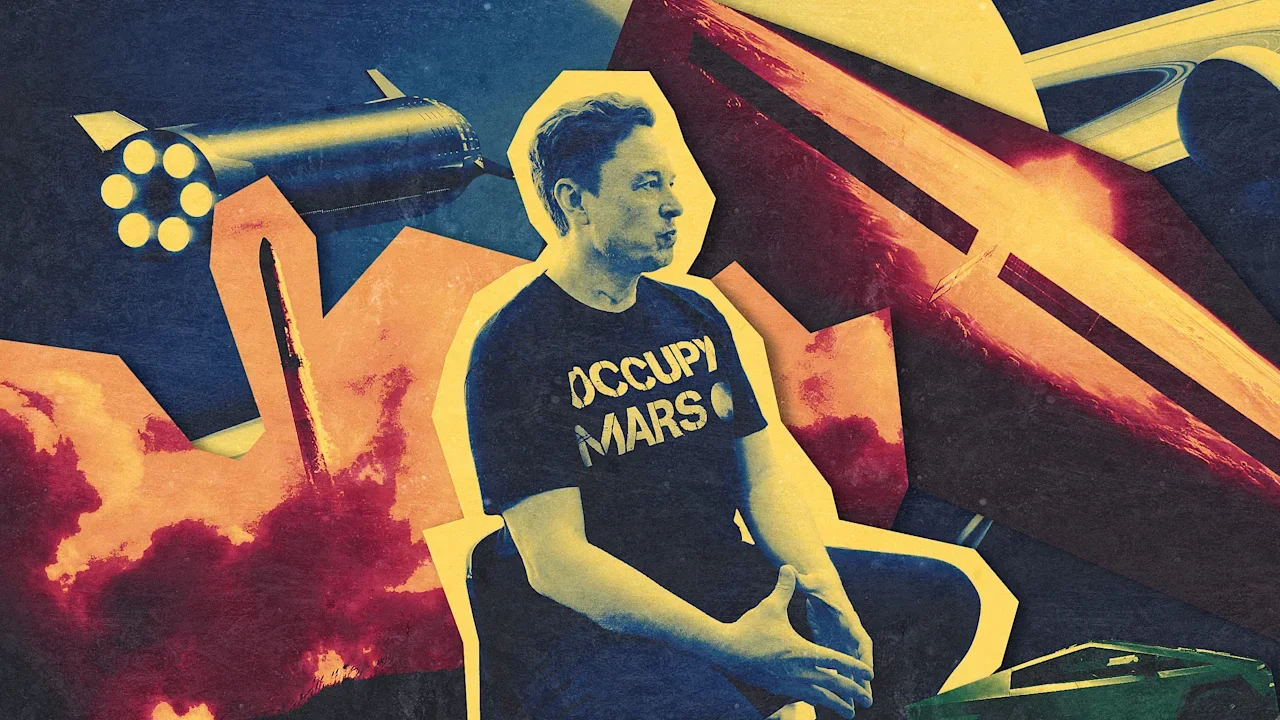
Elon Musk wants to execute the largest initial public offering in history, chasing a staggering $1.75 trillion to $2 trillion valuation for SpaceX. To justify this unprecedented price tag, he is aggressively hyping a cosmic vision: launching 1 million artificial intelligence servers into orbit to create a 100-gigawatt space data center in the next decade. He plans to one day build a factory on the moon to catapult these servers to Earth’s orbit. If that sounds like the background plot of a boring space movie, it’s because it is science fiction. The TL;DR: here is that Musk’s blueprint is fundamentally broken, according to experts in physics, aerospace engineering, and chip design. It ignores basic thermodynamics and the logistical impossibility of extraterrestrial manufacturing. Even if the talented SpaceX engineers perform multiple miracles to make their CEO’s plan work, the real timeline spans decades, not years, as Musk has proposed. This sci-fi narrative masks a vulnerable core business that, despite being the current leader by a wide margin, could lose its launch monopoly to cheaper Chinese rockets and face a fatal technological disadvantage in the upcoming space cellular war. Sound familiar? Yes, SpaceX 1.0 could quickly become Tesla 2.0. And yet Musk—who, remember, has a long history of delays in his enterprises—boldly claims that SpaceX can build the required lunar infrastructure for his million-satellite plan in less than a decade, and that his orbital AI computing idea can reach cost parity with terrestrial AI farms in just two to three years. According to the experts I’ve spoken to, this timeline is unlikely to play out. And if you’re planning to spend your money on Musk’s latest pipe dream, you should pay attention to what the experts are saying. Those pesky physics Down on Earth, when a computer processor gets hot, a fan blows ambient air across it (it can be liquid-cooled, but that radiator also needs to radiate out the heat through air). The air absorbs the thermal energy and carries it away through a fluid motion called convection. In space, it’s a different story. Space is a vacuum, so there’s no air to carry the heat away. Electronics must shed their thermal energy by glowing, radiating it away as infrared light. “Refrigeration in space is more challenging than on Earth because standard systems rely on gravity to manage liquids and gases,” Harvard astrophysicist Avi Loeb tells me in an email interview. He says that without gravity pinning it to the bottom of the server, “the oil used to lubricate traditional compressors can clog the system.” Furthermore, Loeb points out, “heat cannot rise away from components through natural convection.” Damien Dumestier is an engineer who analyzed orbital data centers for the ASCEND project, which examined the feasibility of launching orbital servers. He agrees with Loeb and adds that new technologies will need to be developed to make it happen. “In space you need to refrigerate IT hardware. The main difference is that on Earth you have the ambient air, which is roughly around 20 degrees Celsius,” Dumestier tells me in an email interview. In space you have minus 270°C temperatures, but heat must radiate out of components due to the lack of air, which is a very inefficient way to keep things cool. “You cannot use convection or airflow to collect the thermal power from the dissipative elements,” Dumestier says. “Therefore the only way to dissipate the thermal power outside of the data center is to use radiative elements.” Ryan McClelland, a research engineer at NASA Goddard Space Flight Center, puts the real issue in one clean sentence: “Cooling things in space is well understood. It is the scale required that is mind-boggling.” Indeed. It’s not that cooling things in space is impossible. It’s the scale of what Musk is proposing that makes it extremely hard. Right now, a standard modern telecom satellite generates roughly 20 kilowatts of heat, which is low enough that the flat metal body of the spacecraft itself can act as a passive radiator, or a surface that slowly bleeds heat into the cold of space. That is a solved aerospace problem. But Musk wants to build a 100-gigawatt network with 1 million satellites. Simple division dictates that each individual spacecraft must continuously process 100 kilowatts of power (100,000,000 kilowatts divided by 1,000,000 satellites). That is an entirely different thermal beast, as astrophysicist and science communicator Scott Manley points out. Manley says that at 100 kilowatts per ship, a satellite’s natural surface area is nowhere near large enough to shed the heat. SpaceX will be forced to equip each satellite with massive, fragile, deployable radiators that unfold into space. Furthermore, the heat doesn’t magically jump from the melting silicon processors to those external wings; it must be physically carried there. This requires pumping tons of pressurized cooling fluid every minute through a complex labyrinth of narrow pipes. When you multiply that zero-gravity plumbing nightmare by 1 million satellites, the sheer mechanical absurdity of Musk’s data center becomes impossible to hide. “Basically, all the energy collected (either by direct illumination and heating, or via the solar panels) must be radiated,” European Southern Observatory astronomer Olivier Hainaut says. “And yes, the radiation is not efficient, so large radiators are needed. That said, looking at the current version of their satellites, their radiators are significantly smaller than their solar panels. Still, they will be large.” Dumestier calculates that the ratio of power generation to heat dissipation is roughly 4.5 to 1. To cool 100 gigawatts of computing power, SpaceX will need an astronomically massive physical footprint of radiators. A silicon Dyson sphere Then there’s the issue of feeding those AI processors. SpaceX will use solar panels to power them, but generating the power envisioned by Musk is a mathematical nightmare. Loeb tells me that capturing 100 gigawatts of solar flux requires an effective panel area of 1.07 billion square feet. Even if you chop that massive array into a million separate satellites, each unit requires a 32.8-foot solar panel. “A linear alignment of just 10 components stretches across roughly the full height of the Artemis II Space Launch System rocket,” Loeb explains. He compares the sheer scale of this million-server constellation to a “miniature version of a Dyson sphere,” referring to the theoretical megastructure first proposed by physicist Freeman Dyson in 1960 that entirely encompasses a star to capture its power. In a 2023 paper, Loeb suggests that as stars evolve, they might break these Dyson spheres apart, turning them into “thin interstellar objects which are pushed around by radiation pressure.” You can’t just bolt a standard off-the-shelf server into this environment. A top expert in the chip industry who requested anonymity tells me that “cooling and solar energy production will require a huge footprint.” He stresses that the industry must invent entirely new hardware, noting, “We need to reimagine how chips are designed for space (heterogeneous compute, integrated Peltier coolers, integrated photonic chips) etc.” A Peltier cooler acts like a microscopic electronic refrigerator glued directly to the silicon to force heat out, while photonic chips use beams of light instead of electrical currents to transmit data, eliminating much of the heat entirely. While basic photonic integrated circuits are just now reaching commercial mass production for Earth-based data centers, fully integrating microscopic Peltier cooling directly into the silicon die remains largely confined to experimental research. Mass-manufacturing these exotic processors, let alone engineering hundreds of millions of them to survive the radioactive vacuum of space, pushes this timeline decades into the future. Hainaut speculates that SpaceX may already be working on solving the chip problem, since the rocket company and Tesla recently announced Terafab, a joint $25 billion chip factory in Texas. Nobody outside the company knows exactly what’s being built there, and this chip company may actually be for the Starlink mobile plans. But even if they manage to solve this problem and come up with amazing new hardware, the timeline alone keeps ruining the investment pitch. “I still think we can have small-scale data centers (with specific objectives) in space within 10 years for sure. . . . We cannot underestimate Musk,” the chip expert says. The key phrase here is small-scale. The Kessler lottery and lunar latency The problems with this plan don’t end with hardware. Placing a million massive structures into low Earth orbit—just 250 to 370 miles above our heads—invites a planetary disaster. Loeb warns that this density would “pose a serious risk for collisions, where the debris would catastrophically trigger a cascade chain reaction” known as the Kessler effect. Debris from crowded orbits is already wreaking havoc. In late 2025, the return of three Chinese astronauts aboard the Shenzhou-20 was delayed because orbital debris struck their spacecraft, causing cracks in a window. In a 2023 report the Federal Aviation Administration issued a stark warning that falling space debris could cause human casualties by 2035. Dumestier notes that 100 megawatts is completely unmanageable in low Earth orbit, which is why Europe’s ASCEND study proposed a far safer alternative: deploying just 1,000 satellites—each producing 1 megawatt—at a much higher altitude of 870 miles (for comparison, low Earth orbit is 250 to 260 miles)—to avoid the Kessler effect. But that comes short on the 100-gigawatt promise Musk is making by a factor of 100. Furthermore, to avoid the crushing cost of launching all this heavy hardware from Earth, Musk’s master plan is to build a factory on the moon and use an electromagnetic mass driver to hurl the servers into orbit. “Building a suitable factory on the moon will probably take many decades,” Loeb tells me. “The use of an electromagnetic catapult to launch satellites is an unproven technology. The entire project sounds more like a speculative science fantasy than a believable technological project.” Musk wants to have a lunar factory up and running in just a decade, which is a wildly ambitious timeline, but Hainaut tells me that we shouldn’t underestimate SpaceX engineers. “They are good, and they control the whole stack,” he says, reminding me of the early days of Starlink, when astronomers complained about brightness in January and SpaceX launched modified spacecraft in March. “That kind of turnaround time is completely unheard of in the space industry,” Hainaut points out. “I suspect they can (eventually) do it,” though it will be “later than they claim.” Under pressure Let’s assume that SpaceX engineers manage to pull everything off in two or three decades. Cool. There’s another big elephant in the room: money. As Dumestier points out, that’s the real problem. How can they pull it off, even with that massive valuation, soon enough to actually make money and survive? Even if SpaceX manages to magically conquer these unprecedented engineering challenges, the timeline would span decades. Musk is mainly going to use the massive influx of capital from the IPO to bankroll his decades-long science fiction dreams of lunar factories and mass drivers. But the company still needs to generate lots of money to keep going. Right now, SpaceX is running on two massive cash engines that Musk is desperately trying to leverage into his $1.75 trillion IPO: its workhorse Falcon 9 commercial rocket and Starlink’s 9 million subscribers. Without the commercial launches and continuous, dramatic Starlink growth, the card castle starts to fall apart. And it just so happens that those two SpaceX revenue engines are under heavy fire. Each Falcon 9 rocket launch prints money for the company, with a staggering operating profit margin as high as 77%. But state-backed Chinese aerospace companies are already aggressively undercutting Musk’s prices, with plans to sink them even more by building enormous factories to produce thousands of rockets. You don’t even have to wait a year or two for that. As of March 2026, a commercial firm established by the Chinese Academy of Sciences, CAS Space, successfully launched its Kinetica-2 rocket at a cost of roughly $1,970 per pound. For context, SpaceX’s most recent Falcon 9 launch prices charge customers roughly $3,100 per pound. Now, keep in mind CAS’s price tag is for a ride in an expendable rocket. They are testing reusable technology this year and, according to the company, they’re aiming to halve the cost when that happens. Domestically, the monopoly is also breaking, with rivals like Rocket Lab and Blue Origin bringing their own cheaper, reusable rockets to market to steal SpaceX’s lucrative commercial and government launch contracts. Adding to the financial pressure that may crush Musk’s plan is Starlink, which he wants to turn into a global phone provider. Currently the source of up to 80% of SpaceX’s gross revenue, the division may lose the space cellular wars to multiple competitors, like Amazon Leo, multiple constellations from Chinese companies, and a small Texas-based company called AST SpaceMobile, which is backed by telecom giants like AT&T. While SpaceX plans an environmentally reckless, brute-force constellation of 34,000 disposable Starlink V3 satellites—operating on weak, high-frequency signals that bounce off buildings and require users to buy an entirely new phone equipped with a proprietary SpaceX modem chip—AST has vastly superior technology that will allegedly allow it to cover the world with just 90 massive unfolding satellites. The latter also owns key “gold spectrum,” the low-band radio waves that penetrate walls and connect directly to the standard 5G smartphones already in consumers’ pockets. To further complicate SpaceX’s immediate future, its Starlink V3 is so heavy that the Falcon 9 cannot launch it in economically viable numbers. The entire broadband business model hinges on Starship, a super-heavy rocket that remains in the testing phase. Even Musk admitted that because the Falcon 9 lacks the volume for next-generation satellites, SpaceX faces a “genuine risk of bankruptcy” without Starship. Of course, SpaceX may be able to fend off competitors and solve all the huge engineering problems ahead. After all, SpaceX succeeded in making reusable rockets happen at the 11th hour, just when Musk thought the company was about to go under. Still, with all the external forces aligning against the company and a sci-fi plan that may require decades to come to fruition, it’s hard to imagine investors getting any significant profits for an extremely long time. The current situation feels all too familiar to me. It’s as if we’re watching SpaceX walk the exact same path as Tesla: an industry that Musk started, scaled to incredible heights, only to fall, wrecked by his own hubris and the unstoppable rise of better technology, better design, and the overpowering Chinese supply chain and manufacturing muscle. Musk’s astronomical valuation relies on investors looking at the moon, a tall tale seemingly designed to obscure his company’s breaking points right here on Earth. View the full article

-
Egyptian coder Assem Sabry has long wanted an AI model that represents his culture. The problem is he hasn’t been able to find one. “The AI industry in Egypt . . . doesn’t exist,” Sabry says. So he built his own: Horus, named after the ancient Egyptian god of the sky. Sabry says the goal was to stop “relying on other models, like the American or Chinese models,” and instead ask what a more Egyptian-focused model might look like. To make Horus work, he trained it using GPUs from Google Colab and other cloud providers, alongside open-source datasets. The model, released in early April, drew more than 800 downloads in its first week on Hugging Face. Sabry is one of a growing number of developers trying to correct a long-standing imbalance in AI. Models are fluent in English and, to a lesser extent, Chinese, but far less capable in most other languages. So-called minority languages are, in reality, spoken by the global majority. Yet thanks to the way models are trained (on massive scrapes of the web), combined with the economics of the tech industry, English remains dominant. In 2023, researcher Aliya Bhatia, alongside a colleague at the Center for Democracy & Technology, published a study arguing that nonstandard languages were “Lost in Translation” because of the smoothing effects and commercial incentives shaping Big Tech. In the rush to capitalize on AI, companies prioritized English-language support—in part due to limited training data—and did little to address the gap. For years, the economics have reinforced the problem. Training AI models is expensive, and companies have little incentive to build for smaller language groups without a clear return. That dynamic has finally begun to shift. The rise of local LLMs, along with big AI companies tightening token limits, has opened space for smaller players. “Two years ago, AI wasn’t as good as now, and the LLMs weren’t open-source,” Sabry says. “Now we can really build our AI models from scratch.” Yet obstacles remain. Bhatia notes that “some barriers still exist in terms of compute, in terms of underlying infrastructure, and in terms of funding,” which collectively “remains a huge barrier.” Still, progress is visible. What’s emerging is less a formal ecosystem than a loose, global patchwork of locally focused models: Switzerland’s Apertus, Latin America’s Latam-GPT, Nigeria’s N-ATLaS, Indonesia’s Sahabat-AI, AI Singapore’s SEA-LION, Vietnam’s GreenMind, Thailand’s OpenThaiGPT, and Europe’s Teuken 7B. Each offers an alternative to the dominant models from OpenAI, Anthropic, and Alibaba. Some efforts remain grassroots, like Sabry’s. Others have institutional backing. Apertus, for instance, is a collaboration between two Swiss universities and the Swiss National Supercomputing Center, which contributed more than 10 million GPU hours, equivalent to tens of millions of dollars in commercial compute. Most projects operate far below that scale. Still, the ability to train and deploy local models at a relatively low cost is changing the calculus. A fine-tuned version of Meta’s Llama 3.2, trained on 14,500 pairs of Indian legal-language examples, has logged just over 1,000 downloads since early April. That’s a niche audience, but a meaningful one, and one that would have been difficult to justify economically until recently. The early uptake suggests a market beyond the mainstream. It also raises a question for the largest AI companies. “What these alternatives offer is a demonstration that it’s possible to build systems that better represent global majority users and languages,” Bhatia says, “as long as major AI companies actually want to take a page out of this book and learn from them.” View the full article