All Activity
- Past hour
-
Small business owners face an ever-changing landscape, but a recent survey from the National Federation of Independent Business (NFIB) reveals a glimmer of hope as optimism rises in several key industries. According to the NFIB Research Center’s latest quarterly Small Business Economic Trends survey, optimism grew significantly across various sectors, with the overall Optimism Index landing at 99.3 in January—showing improvements in all industries except for construction. “Small business optimism rose in all reported industries except for construction,” said Holly Wade, Executive Director of NFIB’s Research Center. “While overall optimism has gone up, more owners are reporting supply chain disruptions.” Key figures from the survey reveal that 68% of small business owners now rate their business’s overall health as good or excellent—an increase of 5 points since October. Despite this upswing, a noteworthy 62% reported experiencing supply chain disruptions, which could impact their operations moving forward. Small business owners in the manufacturing sector emerged as the most optimistic, with an Optimism Index reading of 103.8—4.5 points above the overall index. This increase reflects improved expectations for real sales and inventory, suggesting a potentially lucrative avenue for small manufacturers. “The net percent of small businesses in the manufacturing industry expecting real sales to increase rose 18 points from October to a net 24%,” the report noted. For the construction sector, however, the news is mixed. The Optimism Index dipped 2.5 points to 103, largely due to shrinking hiring plans and unfilled job openings. While construction businesses still maintain optimism above historical averages, recent trends raise concerns about the industry’s labor pool. “Thirty percent of small businesses in the construction industry reported labor quality as their single most important problem,” Wade pointed out. Retailers and service providers face their own unique challenges. The retail sector remained the least optimistic of all industries, with an Optimism Index of 95.2—a figure slightly below the general small business average. Despite a notable rise in sales expectations, declines in capital expenditure plans temper overall optimism. Conversely, service industry optimism saw a surge, with the Optimism Index increasing by 3.7 points to match the overall index. “Expectations for better business conditions in the services industry rose 6 points from October to a net 24%,” reported the survey. While there are promising trends, small business owners should remain vigilant. The rise in supply chain disruptions, reported by 62% of respondents, holds particular weight. Each industry experiences this challenge differently, with 80% of wholesale businesses facing disruptions compared to just 32% in professional services. The variance highlights the need for targeted supply chain strategies tailored to specific sector needs. As businesses navigate these shifting dynamics, they may want to explore alternative suppliers, diversify their supply chains, or invest in inventory management technologies to mitigate risks. Another potential hurdle is the labor market. Construction firms reported high instances of unfilled job openings—43%, according to the survey. This statistic underscores the ongoing issue of staffing that many industries continue to encounter. Business owners may need to enhance their recruitment strategies, perhaps by offering training programs or competitive compensation packages to attract and retain the right talent. The full report detailing these findings is available via the NFIB here. As small business owners digest this data, the highlight is clear: while optimism is on the rise, navigating the challenges of supply chain disruptions and labor shortages will be key to sustaining growth and success in the upcoming quarters. Image via Google Gemini This article, "Small Business Optimism Grows Except in Construction, NFIB Survey Shows" was first published on Small Business Trends View the full article
-
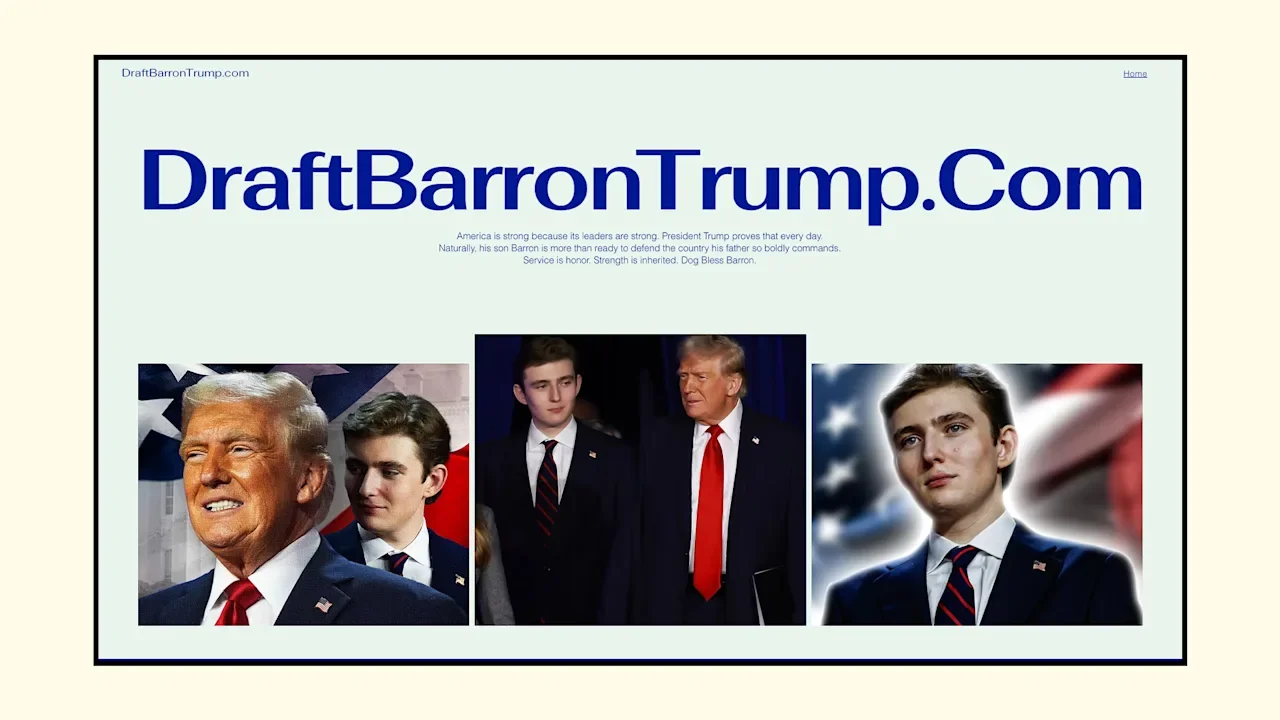
Over the weekend, a new website popped up that opens with a striking manifesto: “America is strong because its leaders are strong. President The President proves that every day. Naturally, his son Barron is more than ready to defend the country his father so boldly commands.” The site, built by a self-described “creator of anti-fascist websites,” is called DraftBarronThe President.com. It was designed by Toby Morton, a comedy writer who once worked on projects like South Park and MADtv, and has now spent the past six years building satirical websites that take aim at powerful political figures. DraftBarronThe President.com was published just hours after the U.S. and Israel launched a major attack against Iran on February 28, killing Iranian Supreme Leader Ayatollah Ali Khamenei and sparking an ongoing conflict in the Middle East. The site echoes calls online from critics of the military action for The President’s youngest son, Barron, to join the war effort as the scale of future violence remains uncertain. “When power is projected abroad, it is only right that strength exists at home,” the website reads. “If you’re looking for proven genes, inherited courage, and unquestionable resolve, look no further than the The President family. Leadership starts somewhere.” Calls for Barron The President to be drafted gain traction online Morton’s websites are often immediate reactions to current events, meaning that they tend to prioritize speed over intricate design. That appears to be the case for DraftBarronThe President.com, which was published on March 1, just a day after the U.S. and Israel attacked Iran. The site features a dual-tone blue color scheme accented by several heavily edited images of Barron and The President posed in front of the American flag—somewhat reminiscent of the White House’s recently updated website, which utilizes an extremely airbrushed Americana aesthetic. DraftBarronThe President.com also includes a brief About Us section (offset with images of the president shutting his eyes during official briefings) and a series of fake testimonials. One invented quote in this latter section, attributed to Donald The President Jr., reads, “This moment is really about Barron, okay? Always has been. He represents strength, courage, and service. I’ll be honoring that sacrifice in my own way, mainly by talking about it from a safe distance.” An Instagram post from Morton debuting the site on March 1 has already amassed nearly 50,000 likes and about 1,000 comments. Fast Company reached out to Morton for comment. On other platforms, including X and Bluesky, AI-generated images of Barron in military uniform have begun to gain traction amidst more general calls for The President to bear personal responsibility for the war in Iran. A very real anxiety among young people In the United States, the last mandated military conscription took place in 1973 at the end of the Vietnam War. Today, the military relies on an entirely volunteer corps—though all American men aged 18 to 25 are mandated to be registered with the Selective Service Administration, which keeps a list of Americans who would be called to serve if Congress instituted a draft. While experts say a modern reinstitution of the draft is unlikely, the potential for such an event has become a very real concern for many young people in recent years. Google searches for the term “military draft” spiked in late June amidst escalating tensions in the Middle East, and the query is once again trending upward in recent days. Satirical websites as a form of protest For Morton, satirical website design has become a form of digital protest, often directed at the The President administration. On Substack, he describes himself as “Founder of the First Church of Petty Digital Revenge.” Morton’s projects have included sites like MTG2026.org, a parody of a prospective campaign for former Congresswoman Majorie Taylor Greene; NancyMace26.com, a similar concept for ultra-conservative U.S. Representative Nancy Mace; and HiltonICE.com, a site chronicling Hilton Hotel’s lodging of ICE agents. Most recently, Morton acquired the domain The PresidentKennedyCenter.org after predicting that The President would add his name to the iconic arts center—a premonition that ultimately came true in December. That website is now dedicated to collecting information about The President’s relationship with convicted sex offender Jeffrey Epstein. In a January interview with The New York Times, Morton explained, “Since 2020, I’ve been grabbing domains tied to politicians and authoritarian figures and turning them into blunt, often uncomfortable reflections of what they actually represent.” He added that his sites “mirror and expose political power by using its own language against it.” View the full article

-
Anthropic has announced a new “memory” tool that allows Claude users to copy over their chats from other AI chatbots, giving those who want to switch over from ChatGPT, Gemini, and Copilot an easy way. The new memory tool is available to paid Claude subscribers only and enables them to import saved memories from rival AI chatbots, and comes as more people seem to be turning toward Claude and away from ChatGPT over growing concerns about how, and to what end, the U.S. military will use AI chatbots. (While OpenAI signed a deal with the Pentagon, Anthropic said no.) As Fast Company previously reported, despite Pentagon demands to use AI assistants for “all lawful purposes,” Anthropic pushed back, saying it did not want its technology to be used for mass surveillance and autonomous weapons. After Anthropic refused to comply, the Defense Secretary Pete Hegseth labeled it a “supply chain risk,” forcing military contractors to ditch it. On Reddit, the “Cancel ChatGPT” movement has users clapping back, posting screenshots of canceled subscriptions and deleted accounts and how to extract their data, and accusing OpenAI of having “no ethics at all”. One other poster commented, “fastest install of my life.“ How to use the Claude’s new memory tool “[You can] switch to Claude without starting over,” according to Anthropic’s website. “Bring your preferences and context from other AI providers to Claude. With one copy-paste, Claude updates its memory and picks up right where you left off.” Here’s how: First, get a subscription if you don’t already have one. Then go to the memory tool. Step 1: “Copy and paste the provided prompt into a chat with any AI provider. It’s written specifically to help you get all of your context in one chat.” (Hit “copy prompt” button.) Step 2: “Copy and paste the results into Claude’s memory settings. That’s it! Claude will update its memory and you’re good to go.” According to Anthropic, Claude will learn your preferences across conversations; keeps project context separate so nothing bleeds together; and allows users to see and edit everything it remembers. View the full article

-
A reader writes: I have a weird, complicated relationship with my boss, Amelia, who is part of the C-suite. We have very different working styles. We are both from the same Latin American country but both of us live and work in the U.S. Last week, she asked me to join a call with her and the CEO of our company in another country. The CEO suggested Friday but Amelia said she was taking that day off and suggested Monday instead. Monday was a holiday for both her and me, but she was traveling to a different country so she was going to be working anyway. When I pointed out that it was a holiday, she said, “Oh come on, it’s only 30 minutes.” This made me feel like my day off is not as valuable as her day off. But I was going to be the least senior person on the call so I figured I’d just do it. I spent the whole morning of my day off thinking about the impending call and when it finally arrived I dutifully connected, and so did the other country CEO. Amelia didn’t show. The CEO and I ended up having the meeting ourselves. Two hours later, Amelia sent me a Teams message saying, “Sorry, I was in an in-person meeting that ran long.” So here are my thoughts: – This meeting was clearly not as urgent as she made it seem. Otherwise she would’ve shown up. If it was not urgent, we could’ve had the call the next day. – I could’ve had the meeting without her in the first place and had it on Friday as the CEO suggested, without having to work on a holiday. – I know different cultures see time and especially other people’s time differently. But she and I are from the same country, so I don’t think this is cultural. Am I justified in feeling enraged? I feel frankly disrespected but I’m not sure if this is just a minor inconvenience or if I’m right to be deeply offended. And if I’m right to be deeply offended, do I say something to her and how would you word it? I need a reality check and would appreciate your opinion. I don’t know that deeply offended is warranted, but deeply irritated? Absolutely. The most generous reading of what happened is that because it was a work day for Amelia, she lost track of the fact that it wasn’t a work day for you. But that doesn’t make it okay; it’s absolutely not. In fact, it wasn’t okay for her to ask you to take the call on a holiday in the first place, unless the meeting topic was truly urgent and had to happen that day. Maybe that was the case, I don’t know, but it doesn’t sound like it since when you tried to push back, her answer was “it’s just 30 minutes” — not something else that would explain and justify the urgency like “I know it’s not ideal, but unfortunately we’ve got to finalize the proposal before it’s due to the client the next day.” Regardless, once she had asked you to set aside time on your day off, she really needed to show up for that call — or at least let you know it wasn’t happening. Not doing that was disrespectful and rude. And then it was compounded by how casual she was about it later; she should have profusely apologized and acknowledged that you were waiting for her on your day off. As for whether you should say something to her about it … I don’t know that there’s a lot of point to it, but if you want to, you could say, “What happened on Monday? I was supposed to be off but set aside time to meet when you said you needed me to.” But with the way she’s already handled it, I’m skeptical that she’ll get the message. There’s more value in thinking about what patterns you see from her generally: is she regularly disrespectful of your time? Does she not respect your off hours in other situations too? Does she assume her schedule should be your schedule, or that you should never object to giving up off time to make life more convenient for her? There are a lot of different patterns that could be in play, but identifying what they are will help you figure out what boundaries you need to set with her going forward. And in particular, if in the future she asks you to schedule work on a day you’re supposed to be off, you might make a point of already having an unmovable conflict. The post my boss asked me to join a work call on my day off … then stood me up appeared first on Ask a Manager. View the full article
-
Google is expanding its recurring billing policy to allow certified U.S. online pharmacies to promote prescription drugs with subscriptions and bundled services. What’s happening. Certified merchants can now offer: Prescription drug subscriptions — recurring billing for prescription medications. Prescription drug bundles — combining drugs with services like coaching or treatment programs, as long as the drug is the primary product. Prescription drug consultation services — recurring consults to determine prescription eligibility, either standalone or bundled with medications. Requirements for eligibility. Merchants must maintain certified status, submit subscription costs in Merchant Center using the [subscription_cost] attribute, include clear terms and transparent fees on landing pages, and comply with all existing Healthcare & Medicine and recurring billing policies. Accounts previously disapproved can request a review once requirements are met. Why we care. The update opens new revenue opportunities for online pharmacies, letting them leverage recurring models and bundled services while staying compliant with Google policies. The bottom line. Certified U.S. online pharmacies can now run recurring prescription and bundled offers, giving them more flexibility to reach patients and scale subscription-based services. Dig deeper. Recurring billing policy expansion: Prescription drugs View the full article
-
In relation to large groups, engaging team building activities can play a vital role in enhancing communication and collaboration among employees. Selecting the right activities is important, as it can cater to diverse interests and encourage teamwork. From indoor options like escape rooms to outdoor challenges such as rope courses, the possibilities are vast. Comprehending the benefits and different types of activities available is key to maximizing their impact on your team. What options might best suit your organization’s needs? Key Takeaways Choose customizable activities that accommodate diverse interests and boost communication among team members. Engage participants in smaller teams during activities to foster collaboration and deeper connections. Consider indoor options like escape rooms or group cooking classes for problem-solving and bonding experiences. Outdoor activities, such as themed scavenger hunts or field days, encourage teamwork and physical engagement. Balance in-person and virtual events to cater to varying preferences while promoting direct interaction. Benefits of Team Building Events for Large Groups Team building events for large groups offer numerous benefits that can greatly improve workplace dynamics. One significant advantage is improved communication, which can increase by up to 50%. This boost encourages better collaboration among employees. Considering that approximately 55% of workers in large companies don’t know their coworkers well, engaging in team building activities for large groups becomes fundamental. Isolation may lead to a productivity decline of up to 20%, highlighting the importance of these events for creating connections. Furthermore, participating in teamwork activities improves critical thinking and promotes bonding through collaboration, both significant for larger teams. These events also raise overall team morale, which is imperative for maintaining a positive work environment. How to Choose a Team Building Activity for Big Groups Choosing the right team building activity for large groups can be a challenging task, especially when considering the diverse needs and interests of participants. To guarantee the success of your large group events, keep the following points in mind: Encourage collaboration: Select activities that boost communication and teamwork, as they can improve interaction and morale considerably. Engage diverse interests: Opt for activities, like scavenger hunts or sports, that can be customized to various preferences and abilities, ensuring everyone feels included. Facilitate smaller teams: Choose activities that allow participants to break into smaller divisions, such as cooking classes or escape rooms, so that all members can actively engage and contribute. Indoor Activities for Large Groups When large groups gather indoors, a variety of activities can create an engaging environment that promotes collaboration and strengthens relationships among participants. Indoor activities for large groups, like escape rooms and collaborative challenges, improve problem-solving skills and communication. These activities encourage teamwork as participants solve puzzles and work toward a common goal. Engaging in activities such as the Marble Run or Tower of Strength allows groups to build structures creatively under time constraints. Group cooking classes and team beats not only promote cultural learning but additionally provide a fun, interactive space for bonding. The duration of these indoor activities can range from 30 minutes to several hours, making them adaptable to various schedules. Incorporating competitive elements can boost team morale and engagement, eventually leading to improved productivity and collaboration within the workplace. Outdoor Team Building Activities for Large Groups Outdoor team building activities for large groups offer an excellent way to cultivate camaraderie and collaboration among participants. These activities not only promote teamwork but in addition engage individuals in physical challenges and creative problem-solving. You can customize events like scavenger hunts or relay races to incorporate specific themes or company elements. Furthermore, competitive games such as paintball or capture the flag improve strategy and communication skills in a dynamic setting. Consider these engaging options for your next event: Field days or outdoor rope courses: Encourage coordination and trust among team members through shared challenges. Community service projects: Allow your group to bond during giving back, improving morale and a sense of purpose. Themed scavenger hunts: Stimulate interaction while promoting teamwork in a fun environment. These outdoor team building activities for large groups will create lasting connections and improve team dynamics effectively. In-person vs. Virtual Team Building Events How do in-person and virtual team building events compare in nurturing team cohesion? In-person events promote direct interactions, greatly reducing feelings of isolation among team members, which is a common issue in virtual settings. When you organize team building for 300 individuals, in-person activities allow for dynamic experiences that often don’t translate well to a screen. Virtual team building requires careful activity selection to maintain engagement, as remote environments can lead to disconnection. Although both formats improve communication and collaboration, in-person options often provide more hands-on experiences. Effective virtual events leverage technology for connection, but they still face unique challenges in participation. Balancing both formats is essential to cater to diverse preferences, ensuring all members feel included and valued, regardless of their work arrangement. In the end, each approach has its strengths and weaknesses, and comprehending them can help you choose the best method for your team. Summary of Best Large Group Team Building Activities Large group team building activities typically involve 50 to 500 participants, offering diverse options that improve communication, collaboration, and overall morale. Here are some of the best activities designed for large teams: Squid Game-inspired challenge: This engaging activity can accommodate over 200 participants, focusing on teamwork and problem-solving within an hour. Escape Room experience: Perfect for 50 to 100 players, this activity promotes critical thinking and social skills, lasting between 30 minutes to an hour. Group Cooking Classes: By splitting large teams into smaller groups, you encourage cultural learning and teamwork during a shared meal, with activities ranging from 1 to 2 hours. These options guarantee effective team building for 50 people, allowing everyone to participate actively as they cultivate a sense of unity and shared purpose. Frequently Asked Questions How Do I Measure the Success of Team Building Activities? To measure the success of team building activities, you should establish clear objectives beforehand. After the event, gather feedback through surveys or discussions to assess participants’ experiences. Look for changes in team dynamics, communication, and collaboration. You can as well track performance metrics, such as productivity or project completion rates, over time. What Is the Ideal Duration for Team Building Events? The ideal duration for team building events typically ranges from two to four hours. This timeframe allows participants to engage in activities without experiencing fatigue or losing focus. Shorter sessions, around one hour, can work for specific objectives, but they often limit deeper interactions. For more thorough experiences, consider half-day or full-day events, ensuring you balance activities with breaks to maintain energy and engagement throughout the event. Can Team Building Activities Be Customized for Specific Teams? Yes, you can customize team building activities for specific teams. Tailoring these activities involves considering the team’s objectives, dynamics, and challenges. You might focus on improving communication skills, nurturing collaboration, or boosting morale. By incorporating team-specific scenarios or goals, you guarantee the activities are relevant and impactful. Furthermore, gathering team input on preferences can improve engagement and effectiveness. Customization leads to a more meaningful experience, ultimately benefiting the team’s overall performance and cohesion. How Can I Ensure Participation From Remote Team Members? To guarantee participation from remote team members, utilize technology effectively. Schedule virtual meetings at convenient times, considering different time zones. Use interactive tools like polls and breakout rooms to promote engagement. Encourage open communication by setting clear expectations and inviting input. Incorporate activities that require collaboration, allowing team members to feel included. Regularly check in with remote participants to address any concerns, ensuring they feel valued and connected to the team. What Are Some Budget-Friendly Team Building Options for Large Groups? For budget-friendly team-building options, consider activities like scavenger hunts, trivia competitions, or DIY workshops. You can organize a potluck, where each member brings a dish, cultivating camaraderie without high costs. Outdoor games, such as relay races or tug-of-war, require minimal supplies and promote teamwork. Virtual icebreakers, like online quizzes or group discussions, are effective for remote settings. These options guarantee engagement as well as keeping expenses low, allowing everyone to participate meaningfully. Conclusion In summary, selecting the right team building activity for large groups can greatly improve collaboration and communication among employees. By considering various options—like indoor games, outdoor challenges, and virtual events—you can cater to diverse interests and preferences. Each activity offers unique benefits, nurturing teamwork and improving morale. In the end, investing in these experiences contributes to a cohesive work environment, empowering teams to work together more effectively in achieving organizational goals. Image via Google Gemini This article, "Engaging Team Building Activities for Large Groups" was first published on Small Business Trends View the full article
- Today
-
Below, Liz Tran shares five key insights from her new book, AQ: A New Kind of Intelligence for a World That’s Always Changing. Liz is a leadership coach to the CEOs and founders of some of the world’s fastest-growing companies. Her work has been featured by the Today Show, The New Yorker, the New York Times, Bloomberg, Fast Company, Entrepreneur, and other outlets. What’s the big idea? The most consequential divide in modern society is not economic or political. It’s psychological. The gap between people who can adapt to constant change (high Agility Quotient) and those who feel undone by it is shaping everything from workplaces to mental health. Listen to the audio version of this Book Bite—read by Liz herself—below, or in the Next Big Idea App. 1. AQ, or the Agility Quotient, is the primary intelligence needed for today’s world. One of my primary responsibilities when I worked in venture capital as an executive at a top firm was to try to understand what all the most successful founders in our portfolio had in common. I started with a personality assessment for every founder we deemed successful, and then I also had long conversations with them about their childhood influences, education, and current hobbies. At the end of a two-year research period, I discovered that all the most successful, happy, and fulfilled leaders have just one thing in common: they’re always changing. Not only are they always developing themselves, but they also have a standout capability to handle change, uncertainty, and the unknown. This is what we call the agility quotient, or AQ. And it’s not just leaders. According to the Journal of Managerial Studies, employees with high learning agility are promoted more and receive higher salary increases than their low-agility peers. A study from the University of Minnesota showed that agility is a better predictor of an employee’s potential for career advancement than IQ. It no longer matters how smart you are. In a world where stability is a myth, AQ is the primary aptitude that matters. 2. IQ is a relic of the past. Intelligence, as a concept, is only 150 years old. It emerged in the late 1800s in France, as mandatory education was adopted and the government suddenly needed a way to rank and place students efficiently in the right classrooms. The historic context that initiated this was the shift from an agrarian to an industrial society. The norm had been that you grow up and then work on your family’s farm. But suddenly, cognitive abilities became important because you might abandon that farm and go work in a factory or industry somewhere. In addition to school systems, the government and military also needed a mechanism for sorting, ranking, and placing people into the right groupings—thus the concept of IQ was born. “IQ and EQ are no longer sufficient to explain how we can thrive.” IQ reigned as the go-to primary intelligence until the 1990s, when globalization and a shift to knowledge work ushered in a new era in which teamwork, collaboration, and communication suddenly became more important. You might be working with someone in London while you are based in Tokyo, and you need to understand how to work with and communicate with them effectively and efficiently. This was the beginning of EQ, a measure of your interpersonal skills. The term was then popularized by Daniel Goleman’s 1995 book, Emotional Intelligence: Why It Can Matter More Than IQ. Over the past 35 years, school systems and corporations around the world have focused on developing EQ skills in their students and employees. In the midst of our new technology revolution, with AI changing everything we know about work, IQ and EQ are no longer sufficient to explain how we can thrive. Agility Quotient—the ability to handle change, uncertainty, and the unknown—is the intelligence most suited for the world today. 3. You can future-proof yourself. Think about the very beginning of your career, those early days when you were looking for a job and imagining what your life might become. Did you ever imagine you would end up here? I’d venture a guess that you’d likely be surprised about where you are now. That’s because change is no longer linear but exponential, which means we’ve become bad at predicting where the future is going. For instance, members of Gen Z, currently the youngest generation in the workforce, are predicted to have 18 jobs spanning six career paths in their adult lives. Compare this to Baby Boomers, who often held one job for decades and received a pension upon retirement. The same type of instability also holds true for our personal contributions. According to Harvard’s re-skilling lab, the hard-won technical skills we’ve spent our whole careers cultivating, like computer programming, accounting, and social media marketing, have a half-life of just five years. In most tech sectors, that’s more like two-and-a-half years. Without a doubt, there’s no chance we can imagine where the future is going to take us. This is why we, as ambitious professionals, must shift our focus from investing in our job titles to investing in ourselves by developing highly transferable, durable skills that will make us strong, capable generalists who can thrive in any future terrain. “Members of Gen Z are predicted to have 18 jobs spanning six career paths in their adult lives.” Durable skills are human-oriented, broad-based skills like receiving feedback, learning aptitude, self-advocacy, persuasion, and, of course, agility. While technical skills will always be important, they can and will expire faster than we believe. When we invest in ourselves and our durable skills, we become timeless, unique, and invincible. 4. Successful businesses intentionally cultivate cultures of AQ. When Satya Nadella took over as CEO of Microsoft in 2014, it was a low AQ organization. The stock price had been pretty much stagnant, and the public viewed Microsoft as a bureaucratic beast that had missed out on Big Tech trends like mobile and social networking. Nadella was inheriting a pretty tough job. There were many sweeping strategic decisions that he needed to make. What Nadella understood was that before he could make these strategic decisions, he first needed to overhaul the entire culture by teaching Microsoft how to be a high-AQ organization. He styled this initiative as a shift from a know-it-all culture (IQ-based) to a learn-it-all culture (AQ-based). Nadella got started building an entirely new culture. He and his team populated the company with stories of what a Learn-It-All mindset looked like, and then he filled the hallways with supportive visuals and put quotes on coffee mugs. The mugs became so popular that people started collecting and trading them. Finally, Nadella rallied his entire team, and they repeated this AQ-oriented philosophy over and over again until it was ingrained in every employee. Of course, Nadella did push new processes, but he knew that a high AQ, learn-everything mindset mattered most. Microsoft has been immensely successful under Nadella’s leadership. Stock price has risen 1,000 percent since he became CEO, and the company has pivoted away from Microsoft Office to invest in cloud computing and AI. These bets have paid off. At points, Microsoft has been the world’s most valuable company. Even in 2025, the company’s stock was up 23 percent and was outperforming the S&P 500. If you want your company, or even just your team, to be successful, it means recruiting for high-AQ people, training employees to raise their AQ, and building a holistic company culture that prioritizes change, agility, and comfort with ambiguity. 5. Embrace your AQ archetype. Imagine yourself in the Sonoran Desert, a harsh expanse of land that stretches from Arizona to Mexico, where the temperatures climb as high as 120 degrees. The heat and dryness are why thousands of migrants, hikers, and adventurers have died while traversing the Sonoran Desert. What would you do if you had to survive out there? My answer to that is research. I would obsessively read everything I could about the Sonoran Desert—its flora, fauna, and climate—and then I would write down every worst-case scenario that I could imagine. This is because my AQ archetype is the Novelist. Think of a novelist sitting at their desk, dreaming up a story, and then writing down the plot. “When we invest in ourselves and our durable skills, we become timeless, unique, and invincible.” That is exactly how the Novelist archetype operates. They have a vision, and then they design a step-by-step plan to get there. The downside of being a Novelist is that we are not so good at reactive change, meaning the change that we did not ask for. For instance, when a flight gets canceled or a meeting gets rescheduled, this type of commotion throws the Novelist into a frenzy. They just can’t handle the curveballs that life throws at them. The opposite of a novelist is the Firefighter. They’re the person you call in an emergency. They are excellent in chaos. They’re good at creative problem-solving in high-octane situations (hence the name Firefighter). Because they’re so good at handling anything at the last minute, they often forget to do the type of long-term strategic vision setting that the novelist excels at. Instead, the firefighter says, “Well, I’ll just wing it, so why even bother making a plan?” The third archetype is the Astronaut. This type is great at both proactive change, which the Novelist thrives on, and reactive change, which the Firefighter does so well. In fact, they’re fast at change. The downside of being an Astronaut, however, is that they’re a lot faster than the people around them, and they can become quite impatient when their colleagues, friends, or family members don’t understand. They change their minds quickly, but are not the best at explaining their decisions. If you’re an Astronaut and want to make things frictionless with those around you, take the time to slow down and explain your context. Finally, the last type is the Neurosurgeon, and this is the Astronaut’s opposite. The Neurosurgeon is slower, intentional, and not one to change their mind on a dime. In fact, it takes them quite a while to make up their mind about anything, whether it’s deciding to propose to a partner, buy a house, or even something as small as buying a new sweater. The Neurosurgeon wants to make sure that they put a high degree of research and intentionality into any decision that they make. This might mean that the Neurosurgeon seems to have lower AQ, but in truth, the neurosurgeon can be one of the most high-AQ archetypes because once they have set their mind to something, they never give up until it is accomplished. Part of thriving in this world that requires AQ is understanding your archetype and how to make the most of the hand you’ve been dealt. Enjoy our full library of Book Bites—read by the authors!—in the Next Big Idea app. This article originally appeared in Next Big Idea Club magazine and is reprinted with permission. View the full article

-
Forward March? The initial market movements on Monday seem to indicate that’s the case, at least for crypto. On Monday, the price of Bitcoin (BTC) was up more than 5%, jumping to more than $69,000 as of 12 p.m. ET from around $65,500 on Sunday afternoon. Likewise, Ethereum (ETh) was up around 6% while XRP rose about 3%. The CoinDesk 20, a crypto market index, is also up around 5%. The broad increase in crypto values was a reversal from a downslide that cryptocurrency markets had been seeing in the lead-up to the United States and Israel launching attacks on Iran on Saturday. On Saturday, after news of the attacks broke, Bitcoin values fell to near $63,000. But as of midday Monday, values were up around 9% from that Saturday low point. At the same time, the broader stock market has been flat. The S&P 500 is actually down around 1.5% over the past month. Additionally, crypto-related stocks are also up on Monday. For instance, Coinbase Global (Nasdaq: COIN) saw its shares rise around 4%, while stablecoin issuer Circle Internet Group (NYSE: CRCL) was up 13%. The latter company had already been riding a wave of stock growth that was bolstered by its better-than-expected earnings report last week. All told, Circle stock is up more than 56% over the last five days. Why is crypto surging? There may be a few factors that are fueling the early-week crypto bounce-back. For one, we may be seeing a technical rebound after the Crypto Fear and Greed Index dipped into the “extreme fear” spectrum in recent days. That could be a sign for some investors that the market is oversold, and that it may be a good time to jump back in and take advantage of relatively low asset prices. Relatedly, the crypto market has been undergoing a large-scale liquidation event, as many investors have cleared their holdings in recent weeks and months. That, in part, is why crypto values—including Bitcoin—have fallen so precipitously over the past six months. Bitcoin is down more than 37% since last October, for example. The attacks on Iran over the weekend may have shaken some investors out of torpor, serving as a signal that certain markets are ripe for reinvestment. With conflict in the Middle East risking further geopolitical destabilization, investors may looking for alternative or “safe haven” assets for their money, assuming the conflict in Iran affects equity markets. Whether or not Bitcoin qualifies as safe havens is the topic of much debate, but it’s worth noting that trajectory of traditional safe-haven assets like gold and silver are also mixed this week: gold is up, silver is down. As Bloomberg points out, crypto investors may just be dismissing what’s happening in Iran or sending a message that they don’t think it’ll have a spillover effect into the markets. For now, it’s impossible to say if today’s market movements will be a brief bump or part of a broader rebound for cryptocurrencies. View the full article

-
Google updated its Image SEO and Discover documentation to explain how schema markup and the og:image meta tag influence thumbnail selection. The post Google Clarifies How It Picks Thumbnails For Search, Discover appeared first on Search Engine Journal. View the full article
-
Google updated both its image SEO best practices and Google Discover help documents to clarify that Google uses both schema.org markup and the og:image meta tag as sources when determining image thumbnails in Google Search and Discover. Image SEO best practices. Google added a new section to the image SEO best practices help document named Specify a preferred image with metadata. In that section, Google wrote: “Google’s selection of an image preview is completely automated and takes into account a number of different sources to select which image on a given page is shown on Google (for example, a text result image or the preview image in Discover).” Here is how you influence the thumbnails Google chooses: Specify the schema.org primaryImageOfPage property with a URL or ImageObject. Or specify an image URL or ImageObject property and attach it to the main entity (using the schema.org mainEntity or mainEntityOfPage properties) Specify the og:image meta tag. Here are the overall best practices when choosing these methods: Choose an image that’s relevant and representative of the page. Avoid using a generic image (for example, your site logo) or an image with text in the schema.org markup or og:image meta tag. Avoid using an image with an extreme aspect ratio (such as images that are too narrow or overly wide). Use a high resolution, if possible. Google Discover image selection. In the Discover documentation Google added a section that reads: “Include compelling, high-quality images in your content that are relevant, especially large images that are more likely to generate visits from Discover. We recommend using images that meet the following specifications: At least 1200 px wide, High resolution (at least 300K) and 16×9 aspect ratio” “Google tries to automatically crop the image for use in Discover. If you choose to crop your images yourself, be sure your images are well-cropped and positioned for landscape usage, and avoid automatically applying an aspect ratio. For example, if you crop a vertical image into 16×9 aspect ratio, be sure the important details are included in the cropped version that you specify in the og:image meta tag).” “Enabled by the max-image-preview:large setting, or by using AMP“ “Use either schema.org markup or the og:image meta tag to specify a large image that’s relevant and representative of the web page, as this can influence which image is chosen as the thumbnail in Discover. Learn more about how to specify your preferred image. Avoid using generic images (for example, your site logo) in the schema.org markup or og:image meta tag. Avoid using images with text in the schema.org markup or og:image meta tag.” Why we care. Images can have a big impact on click-through rates from both Google Search and Google Discover. Here, Google is telling us ways we can encourage Google to select a specific image for that thumbnail. So review these help documents and see if any of this can help you with the images Google selects in Search and Discover. View the full article
-
We may earn a commission from links on this page. Deal pricing and availability subject to change after time of publication. I didn't understand the need for a power station until this past winter gave me a rude awakening. Although I ultimately didn't lose power, the prep for that what-if scenario of facing freezing temperatures without power was enough for me to decide to get one. While I went with the EcoFlow DELTA 3 Ultra Plus, I should have waited, because the more powerful EcoFlow Delta Pro 3 is $1,999 right now—a steep 46% discount from the $3,699 list price. This is its lowest price ever, according to price tracking tools. EF ECOFLOW DELTA Pro 3 Portable Power Station $1,999.00 at Amazon $3,699.00 Save $1,700.00 Get Deal Get Deal $1,999.00 at Amazon $3,699.00 Save $1,700.00 While I haven't had a chance to put the power station to the test during a full blackout, I am impressed by the functionality of the EcoFlow app. You get the ability to prioritize which devices receive power the longest, so when battery power is scarce, the essentials will keep running while the other devices shut off. How that might work in the real world: You leave your refrigerator plugged in overnight, along with your phones and a heater. You can prioritize your refrigerator so if the battery runs low during the night, it will shut off power to your phone and heater to keep you fridge running longer. You can also monitor your energy use, and the app will automatically start charging your power station if it detects a storm is coming. The power station is extremely quiet when in use. Although it's heavy, it's still easily portable with its handle and rear wheels. The unit has seven AC outlets total, including standard, RV, 240 V, and twist‑lock, four USB ports (A and C), two 12 V DC outputs, and solar charging inputs if you ever want to get extra accessories down the road. The 4096 Wh battery can keep essentials running for a while—it can power the average fridge for up to 28 hours while keeping other essentials like Wi-Fi, lights, phone charging, and AC running simultaneously. Our Best Editor-Vetted Tech Deals Right Now Apple AirPods 4 Active Noise Cancelling Wireless Earbuds — $119.00 (List Price $179.00) Samsung Galaxy S26 Ultra 6.9" 512GB Privacy Display Smartphone + $200 Gift Card — $1,299.99 (List Price $1,699.99) Samsung Galaxy Buds 4 AI Noise Cancelling Wireless Earbuds + $20 Amazon Gift Card — $179.99 (List Price $199.99) Google Pixel 10a 128GB 6.3" Unlocked Smartphone + $100 Gift Card — $499.00 (List Price $599.00) Apple iPad 11" 128GB A16 WiFi Tablet (Blue, 2025) — $329.99 (List Price $349.00) Apple Watch Series 11 [GPS 46mm] Smartwatch with Jet Black Aluminum Case with Black Sport Band - M/L. Sleep Score, Fitness Tracker, Health Monitoring, Always-On Display, Water Resistant — $329.00 (List Price $429.00) Amazon Fire TV Soundbar — $99.99 (List Price $119.99) Deals are selected by our commerce team View the full article
-
With nearly 40,000 locations in over 100 countries, tens of millions of people worldwide regularly eat McDonald’s iconic burgers. But in an Instagram post that’s blowing up the internet, company CEO Chris Kempczinski appears less-than-thrilled to be eating one himself. The video was posted to Kempczinski’s Instagram account a month ago, but found new life over the weekend on platforms like X and TikTok, with many users wondering if it’s “intentionally cringe,” saying that Kempczinski looks “uncomfortable” or commenting how he “looks like he’s gonna hurl.” “From this video, it seems likely the CEO of McDonald’s has never eaten McDonald’s before,” one user wrote. In the post, the CEO presents a new menu item: The Arch Burger, a burger with two patties, three slices of cheese, crispy onions, pickles, Big Arch sauce, and more. “This is something we have tested already in Portugal, Germany, Canada,” Kempczinski tells viewers. “I love this product. It is so good. I’m going to do a tasting right now, but I’m going to eat this for my lunch, just so you know.” “‘We’ve tested it on the Germans and the Canadians, and now we believe it may even be fit for human consumption’,” one TikTok user mocked. After the CEO introduces the burger, he comments on how big it is and wonders “how to attack it” before he takes one bite, which users have called small enough to call Kempczinski’s genuine enjoyment of the burger—which he repeatedly refers to as a “product”—into question. “Dude’s 1000% vegan,” one X reply read. “It’s giving Squidward trying a Krabby Patty for the first time,” replied another. Other users leveled more substantial business criticism. “Going direct only works when it’s authentic,” one user wrote, before listing other issues with the communication. “Really kills the mood if it feels like the CEO’s blinking in Morse code.” “Asking this guy to eat a McRib is going to be like watching an episode of Fear Factor,” wrote one X user. While the video was, of course, meant to promote the burger, it seems to have had the exact opposite effect, as the video is quickly going viral for all the wrong reasons, essentially turning it into a PR nightmare. Fast Company reached out to McDonald’s about the promotional video but did not hear back by the time of publication. Chrissy Bernal, CEO of Be a Better Brand PR, tells Fast Company that comfortability with a brand’s item is massively important. “Audiences are highly attuned to spot hints of inauthenticity,” Bernal explains. “His awkwardness equated to a lack of cohesion with the audience.” Likewise, Bernal said that social media users were spot on to call out his use of the word “product,” explaining that it felt “clinical and detached.” Bernal also says the term “clashed with the emotional equity McDonald’s has spent decades building.” Social media drama aside, the chain has been reporting solid sales, and is performing well when it comes to the fast food wars. So, regardless of the cringe video, we’re guessing many Americans will still gladly eat an Arch Burger. Plus, at the end of the day, the internet loves a dogpile, and users often look for a target to drag. And either way, any publicity is good publicity, as the saying goes. “People are talking about this video like it’s anything but positive for McDonald’s,” one X user wrote. “The CEO is piling up millions of free impressions with the new product front and center the whole time.” View the full article

-
No one wants to be in a bad movie—but imagine a movie studio casting you in new movies after you die, without your consent. That may have once seemed something out of a Black Mirror episode, but it’s becoming a real issue, and many think current legal protections don’t go nearly far enough. In 2024, the late Ian Holm appeared, in digital form, in Alien: Romulus four years after his death, a move some critics decried as “digital necromancy.” Early this year, producers partnered with a British artificial intelligence startup to re-create the voice of Alain Dorval, who spent decades dubbing Sylvester Stallone classics like Rocky and Rambo in French. The plan was scrapped after his daughter called the re-created voice, set to appear in 2025’s Armor, “unacceptable.” Of late, unconfirmed reports have surfaced of studio plans for the recently deceased Diane Keaton to be digitally resurrected for a sequel to 2005’s The Family Stone. “Her family is fuming,” said one source. As concerning as it is for the estates of deceased actors, the potential for AI resurrection and manipulation is a real concern for working actors due to the rise in contracts that include rights “in perpetuity” to an actor’s likeness. Signing your likeness away After the 2023 SAG actors’ strike, actors in the US gained some legal protections against post-death AI resurrection—in fact, it’s thought to be one of the key reasons the dispute dragged on for so long. But many countries outside the US, including the UK, do not yet have comparable legal protections via their acting guilds or image rights. Even if legal protections do exist, that doesn’t stop actors from potentially signing away the rights to their image via what’s known as an “in-perpetuity contract.” These types of contracts, if they hold up in court, can grant forever rights to exploit digital images a company has captured of an actor. Victoria Haneman, a professor at the University of Georgia School of Law, says that “in-perpetuity” contracts began appearing in big-budget Hollywood contracts en masse all the way back in 2021. But with the technology improving so rapidly, the issue of consent becomes an increasingly thorny one. She points to how rapper Kanye West is thought to have spent over $1 million in 2020 on a hologram of Robert Kardashian, the deceased father of ex-wife Kim Kardashian; by the standards of modern AI deepfakes, it looks robotic and practically amateurish. “You do not even know what you do not know with regard to how your image can be used later,” Haneman says. “A lot of actors have signed very broad contracts without really contemplating this possibility. They sign contracts with perpetuity clauses in them, not really understanding how that image can be used later.” Of course, it’s impossible to tell what dead actors might make of AI re-creations of themselves. But many living actors have had less-than-stellar experiences of seeing themselves re-created on screen. Scott Jacqmein, a Texas-based actor, was paid just $750 in 2024 for the rights to his likeness to be used in AI-generated ads on TikTok, according to a contract reviewed by Fast Company. Over the next year, Scott found his own AI likeness was being used to advertise witches for hire, as well as to promote home insurance in Spanish (he doesn’t speak Spanish). Scott, whose story was first covered by The New York Times, later found his likeness being used on YouTube to promote “male enhancement” products, a violation of the contract he signed. Scott moved into professional acting later in life after a decade-long career in nursing. He didn’t have an agent and understood little about the business of the industry. But his issue is not just that his likeness was used in ways that he would not otherwise consent to, but that AI-generated representations simply don’t do good actors justice. “Looking at the reels that TikTok did, they absolutely missed my spark, my essence, and what I have to bring to any role that is offered to me,” he says. “Even though I’m playing a raging Hulk, I’m going to bring my nuances, my personality, my traits that aren’t necessarily able to be picked up by AI and replicated by AI.” Legal patchwork Many of the issues with actors finding their AI likenesses repurposed beyond what they expected come down to the lack of what are known as “image rights”—which are different from the protections given to creators by copyright—and can differ by country or state. “In the UK, we don’t really have a concept of a right to your face,” says Lillian Edwards, a professor of technology law at Newcastle Law School. “Partly because it would have a really bad impact on freedom of expression. It might stop you taking pictures of groups of people, for example, or putting celebrities into memes.” If an independent movie director were to create an AI Sean Connery, the use of his likeness would be theoretically legally sound, as there is no postmortem image or “personality” right in the UK. Currently, though, she says most companies seek the permission of relatives because of the risk of negative publicity, at least at present. “The point is that copyright law is not designed to protect your image but the works you create,” Edwards says. “It’s meant to incentivize you to create more useful works—whereas your face is something you’re just born with.” Some countries have passed legislation to prevent AI resurrection done without permission of heirs or a will. Some US states protect image and reputation after death up to a point. Denmark passed legislation earlier this year establishing posthumous rights to one’s image, including body and face, for up to 50 years after death. Joe Ashman, a British actor who has been in Netflix series like Free Rein and The Man Who Fell to Earth, when asked about in-perpetuity contracts, thinks that when he first started out in professional acting at the age of 18, “he would have signed anything just to get a job.” Now, Joe has overwhelming confidence in his agent and management team to handle any negotiations on his behalf, but many forms of AI re-creation would make him extremely uncomfortable, including serious body modification. This means no slimming down, no adding muscle, or even changing hair color. Though he insists that any resurrection would need to be done under the right circumstances, he doesn’t deny financials would be part of his attitude on the topic—providing for your family after death isn’t a bad prospect. “I love the idea that if things did happen and somebody wants to pay a lot of money to digitally re-enhance me, I could pay for my nephews to go to college.” What can actors do now? Legal experts have differing views on mitigating potential risks this poses to actors. University of Georgia’s Haneman feels that ultimately centralized legislation or action from unions is what is needed—unestablished actors simply don’t have the power to hold their ground against powerful movie studios. The UK Artificial Intelligence Bill is a proposed piece of legislation set to pass sometime in 2026, which will write AI regulation principles into law and establish standards for AI developers and users. But at present it only focuses on the work creatives produce—not their images themselves. In particular, Haneman thinks that “in-perpetuity contracts” in their current state definitely do not address any future risks posed by AI to actors. “If I have the ability” to own an actor’s image in perpetuity, she says, “I’m going to do that.” Awareness of these issues does now seem to be slowly building within the industry, and more established actors are speaking out. Homer Simpson’s voice actor Hank Azaria recently called the idea of AI replacing him and his fellow Simpsons voice actors “just plain wrong.” Meanwhile, Samuel L. Jackson has weighed in on “in perpetuity” and “known and unknown” clauses in contracts, telling young actors to simply cross them out. (Jacqmein’s advice on signing in-perpetuity contracts is similar: “Just don’t”). The issue may be that law simply always advances slower than technology. Existing laws protecting actors and celebrities evolved over hundreds of years—not 20. The film and TV world is now truly in uncharted territory when it comes to AI resurrection, and it’s unknown if the lawmakers and industry can react quickly enough. View the full article

-
Anthropic may have lost a fan in Donald The President, but it seems to have gained plenty of new ones after refusing to make a deal with the United States government, citing ethics concerns. The AI company was embroiled in debate with the Department of Defense (DoD), which has been using Anthropic’s technology internally at various levels. After the DoD announced it would only contract with AI companies that acceded to “any lawful use” of their products, Anthropic pushed back, asking that certain safeguards remain in place to prevent its technology from being used for mass domestic surveillance and fully autonomous weapons. The DoD set a deadline of 5:01 p.m. on Friday, February 27 for Anthropic to agree to its new policy or risk being blacklisted by the government. The day before the deadline, Anthropic CEO Dario Amodei released a statement explaining the company’s position. “In a narrow set of cases, we believe AI can undermine, rather than defend, democratic values,” Amodei said. “Some uses are also simply outside the bounds of what today’s technology can safely and reliably do. […] We cannot in good conscience accede to their request.” The February 27 deadline passed without agreement, and President The President quickly ordered all government agencies to “immediately cease” using all Anthropic technology: “The Leftwing nut jobs at Anthropic have made a DISASTROUS MISTAKE trying to STRONG-ARM the Department of War, and force them to obey their Terms of Service instead of our Constitution,” he wrote in a post on Truth Social. Defense Secretary Pete Hegseth followed The President’s post with a statement on X, saying he was directing the Pentagon to designate Anthropic as “a Supply-Chain Risk to National Security,” barring any company in business with the U.S. military from any commercial activity with Anthropic. “America’s warfighters will never be held hostage by the ideological whims of Big Tech,” Hegseth added. But a bad rap from the The President administration apparently translates to popularity with the general public. The day after being blacklisted by The President, Anthropic’s app Claude jumped to No. 1 on Apple’s ranking of the top free apps in the U.S., topping both OpenAI’s ChatGPT and Google’s Gemini. On Monday, March 2, the Claude app temporarily went down, with Anthropic citing “unprecedented demand” as the cause for the crash in a statement while working to resolve the issue. Meanwhile, AI users across social media have applauded Anthropic’s decision not to bend to the government. That includes workers from Amazon, Google, and Microsoft, who co-authored a letter calling on their employers to follow Anthropic’s lead should the U.S. government offer them similar deals; and celebrities like Katy Perry, who posted a screenshot of her apparently subscribing to Claude’s annual Pro subscription with the caption, “done.” done pic.twitter.com/DkS9DmlUAR — KATY PERRY (@katyperry) February 28, 2026 Following Hegseth’s announcement that Anthropic could be designated as a supply chain risk, the company released another statement saying it was “deeply saddened by these developments.” “We believe this designation would both be legally unsound and set a dangerous precedent for any American company that negotiates with the government,” it said. “No amount of intimidation or punishment from the Department of War will change our position on mass domestic surveillance or fully autonomous weapons. We will challenge any supply chain risk designation in court.” View the full article

-
We may earn a commission from links on this page. Deal pricing and availability subject to change after time of publication. Smartphone cameras have reached a point where the weak link in most videos is no longer image quality—it’s shaky hands. The DJI Osmo Mobile 7P is built to fix that, and it’s currently down to $99 from $129.99, its lowest price so far, according to price-trackers. It’s a foldable three-axis gimbal that supports larger phones like the iPhone 16 Pro Max and Galaxy S25 Ultra without feeling strained. Once your phone is mounted and balanced, the motors keep footage level and smooth in a way that built-in stabilization still can’t fully match. DJI Osmo Mobile 7P $99.00 at Amazon $129.00 Save $30.00 Get Deal Get Deal $99.00 at Amazon $129.00 Save $30.00 Getting started does not require much setup. You unfold it, snap your phone into the clamp, and it balances itself in seconds. The controls are straightforward and placed where your fingers naturally rest. The joystick lets you nudge the frame left or right, and the record button is easy to hit without shifting your grip. A rear trigger switches between portrait and landscape instantly, so you can move from TikTok to YouTube framing without taking the phone off. There’s also a built-in extension rod for higher or wider angles, and a small tripod in the base for hands-free filming. The magnetic multifunction module is where it becomes more than just a stabilizer. It enables gesture control and subject tracking even inside third-party apps, so you are not locked into DJI’s app ecosystem. In actual use, the tracking is what changes the experience most. The gimbal locks onto your face and follows you as you move across a room, which makes solo filming feel far less awkward. You do not have to keep checking whether you are still centered in the frame; that alone can save time during retakes. It’s one reason why PCMag gave the Osmo Mobile 7P an “outstanding” rating, and Lifehacker's Associate Tech Editor Michelle Ehrhardt said it feels like having “your own dedicated camera person” once you learn the basics. Battery life will depend on how many of those features you keep running. DJI estimates up to 10 hours if you are just using the gimbal. Turn on the tracking module, and you are closer to 4.5 hours. Add the fill light, and it drops to around three. For short sessions or content captured in bursts, that is workable. For long events or full-day shoots, you may need a power bank. If you mostly film static videos at a desk, a simple tripod is probably enough. But if your content involves movement, walking shots, or filming yourself without help, the Osmo Mobile 7P can make your footage look more controlled without making your setup complicated. Our Best Editor-Vetted Tech Deals Right Now Apple AirPods 4 Active Noise Cancelling Wireless Earbuds — $119.00 (List Price $179.00) Samsung Galaxy S26 Ultra 6.9" 512GB Privacy Display Smartphone + $200 Gift Card — $1,299.99 (List Price $1,699.99) Samsung Galaxy Buds 4 AI Noise Cancelling Wireless Earbuds + $20 Amazon Gift Card — $179.99 (List Price $199.99) Google Pixel 10a 128GB 6.3" Unlocked Smartphone + $100 Gift Card — $499.00 (List Price $599.00) Apple iPad 11" 128GB A16 WiFi Tablet (Blue, 2025) — $329.99 (List Price $349.00) Apple Watch Series 11 [GPS 46mm] Smartwatch with Jet Black Aluminum Case with Black Sport Band - M/L. Sleep Score, Fitness Tracker, Health Monitoring, Always-On Display, Water Resistant — $329.00 (List Price $429.00) Amazon Fire TV Soundbar — $99.99 (List Price $119.99) Deals are selected by our commerce team View the full article
-
A reader writes: I was recently promoted to a director role, and one of my direct reports is my former boss who hired me into the company, “Tom.” Tom was a great boss in the eight years I worked for him. He’s an all-around terrific manager who coaches well, provides clear goals, gives flexibility to meet those goals, provides opportunities to learn and grow, advocates for his team, the works. After a few years working for him, a promotion opened up and Tom urged me to apply. I got it, became his peer, and built my own effective team using his style as my model. Last year, our department director positioned opened up. Tom and I both applied. I impressed our relatively new division VP, and got the job. Days after that, I found out through a colleague that Tom was very disappointed. Apparently the previous division VP had told Tom that he was a “shoo-in” for. the job when it opened. In fact, he turned down some outside opportunities that would have paid more because he was anticipating this promotion. I had no idea that this was his expectation. Tom has been nothing but professional and complimentary with me, but I’m really concerned about how I can manage him effectively. I need him to stay—he has longstanding personal relationships with all our key clients. If he left suddenly, we would be in a real bind. Our HR and division VP have also emphasized the need to keep Tom on staff due to his role as a talent spotter and his client relationships. I asked about getting him a raise and an intermediate promotion, but our corporate structure is pretty stratified and there’s nothing between his level and mine. What do you recommend to navigate the potential awkwardness of managing my former boss, as well as keeping him happy despite his disappointment in not getting this job—and his missing out on the raise that came with it? I answer this question over at Inc. today, where I’m revisiting letters that have been buried in the archives here from years ago (and sometimes updating/expanding my answers to them). You can read it here. The post I’m afraid my star employee is going to quit appeared first on Ask a Manager. View the full article
-
Most social media tools — including Buffer, historically — operate on a pretty simple model: you give us your content, we publish it, we show you some charts. If you want to improve, that's on you. Go look at the analytics. Figure out what's working. Adjust your strategy. Come back and use the tool again. The problem is the gap between the data and what you're supposed to do with it. It’s where most people get stuck. Take posting times as an example. It's one of the most common questions we hear: "When should I post?" And the honest answer has always been: "It depends. Look at your analytics. Test different times. See what works for your audience." Which is technically correct but also exhausting. Especially if you're managing multiple accounts, or you're a creator juggling social alongside everything else you do, or you're just trying to stay consistent without turning it into a part-time job. So we've been asking ourselves: why are we making people do this work? We have the data and we can see patterns in their performance. We're kicking off an effort to build a more insights-driven product—one that actively helps you make better decisions about your social media presence. And we're starting with something fundamental: when to post. Introducing Smart SchedulingWe've recently introduced an algorithm-based approach that automatically determines optimal posting times based on what we know performs well for each platform. We’re calling it Smart Scheduling. When you're setting up a posting schedule, Buffer will now suggest times based on proven patterns across each network. You can accept the recommendations and let Buffer handle the timing, or customize your schedule if you prefer specific control. If you’re new to Buffer, this removes the guesswork and gets you posting at times that are likely to work. If you already have a posting schedule running, you can update it to use recommended times with a single click. We'll show you what's changing before you confirm, and if you have posts already queued, we'll let you know they'll shift to match your new schedule. We’ve also added posting time recommendations for specific days. Let’s say you have a post that must be published on Friday, but it’s not part of your typical posting schedule, and you want it to land at the optimal time. Rather than you needing to pick a random time, we’ll recommend a best time for that day. These are small shifts in how the product works, but it reflects a bigger change in how we're thinking about Buffer's role for creators, marketers and small businesses. More to comeInstead of just being a place where you schedule posts and check stats, Buffer will actively help you get better at social media. It will surface the right insight at the right moment, as a natural part of your workflow. This is the direction we’re headed: More contextual recommendations. If your engagement is trending down on a channel, we will tell you and suggest what might help. If your best-performing content type has shifted, we will flag it before you spend another week posting the wrong thing. Metrics that are useful AND comprehensive. We're going to make key insights accessible to everyone, not just users on paid plans. And we're going to focus on the metrics that actually help you make decisions, not just the ones that look impressive in a report. Automation that makes you faster without making you generic. For people who rely on social media professionally, this means tools that handle the repetitive stuff like optimizing posting times, or identifying your best content to reshare, so you can focus on the creative and strategic work only you can do. The common thread: your social data should work for you. Not the other way around. We think there is a real opportunity to: Help you stay consistent without the cognitive overhead of constantly second-guessing your strategy.Give you the flexibility to work however you want—one account or twenty, free plan or paid—while still getting the insights you need to improveThat's the Buffer we're building toward: one that makes all your social data useful and actionable to you, so you can focus on your voice and your business. More to come! View the full article
-
PM hits back at The President comments that Britain ‘took too long’ to allow its bases to be used for Iran strikesView the full article
-
Israel spent years hacking Tehran’s traffic cameras and monitoring bodyguards ahead of the assassination of Iran’s supreme leaderView the full article
-
Mid-market businesses are set to gain a competitive edge with the recent partnership between Intuit and Anthropic. This collaboration promises to introduce tailored AI agents designed specifically for various industries, enhancing workflow efficiencies and promoting smarter decision-making. With the integration of Anthropic’s Claude Agent SDK into Intuit’s existing platform, businesses now have an unprecedented opportunity to create and customize AI agents that cater to their specific operational needs. These agents are not just basic automation tools; they are advanced systems capable of blending data from multiple sources to provide actionable insights. This means companies can now develop solutions that align with their workflows without requiring extensive technical expertise. For instance, a regional restaurant chain with multiple locations will be able to implement an AI agent that synthesizes sales data with inventory management, payroll, and other financial metrics. This integration can automatically pinpoint margin variances and identify underperforming locations, ultimately allowing the business to respond swiftly with data-driven strategies. Similarly, a construction subcontractor managing significant project volumes can deploy an AI agent that keeps everything from project timelines to customer communications in sync, helping to flag any billing gaps and ensuring compliance with relevant regulations. The implications of such features are clear: small businesses can expect to improve both their operational efficiency and their bottom line by harnessing the power of AI tailored to their unique contexts. Integrating Intuit’s financial intelligence into Anthropic’s ecosystem is another significant benefit that small businesses should consider. Users will enjoy seamless access to Intuit’s suite of financial tools—including QuickBooks for accounting, TurboTax for tax management, and Mailchimp for marketing—directly within Anthropic products like Cowork and Claude.ai. This interconnectedness will enhance user experience and negate the need for jumping between platforms. Alex Balazs, Intuit’s Chief Technology Officer, emphasized the transformative nature of the partnership: “By combining Intuit’s proprietary data and domain-specific services with AI models built to support security, accuracy, and compliance, we’re delivering something customers haven’t had before: custom AI agents that truly understand their finances, their workflows, and their industry.” However, as exciting as these developments may be, small business owners should also be mindful of potential challenges. Customizing AI agents demands not just an initial investment of time and resources but an ongoing commitment to training and adaptation as their business evolves. Additionally, with any integration of advanced technology, concerns around data privacy and compliance will remain paramount. Intuit has underscored its commitment to security and responsible governance in this arena, ensuring that customer data is handled with the utmost care. Still, businesses must stay vigilant about how their data is shared and utilized within these new systems. The rollout of these capabilities is anticipated to start in spring 2026, allowing businesses ample time to prepare. By embracing this technology, small to mid-sized enterprises stand to unlock new capabilities, streamline operations, and ultimately enhance profitability—all while navigating an increasingly digital landscape. Paul Smith, Chief Commercial Officer at Anthropic, echoed the importance of this collaboration: “The combination of Intuit’s platform with Claude will enable Intuit customers to build and use AI agents that understand their specific industry, workflows, and compliance requirements.” As small businesses look for ways to innovate and stay competitive, the partnership between Intuit and Anthropic presents a promising avenue worth exploring. With AI becoming a crucial component of business strategy, now might be the ideal time to consider how these tools could reshape your operational landscape. For more details on this partnership, visit the original press release here. Image via Google Gemini This article, "Intuit and Anthropic Launch Custom AI Agents for Mid-Market Businesses" was first published on Small Business Trends View the full article
-
Mid-market businesses are set to gain a competitive edge with the recent partnership between Intuit and Anthropic. This collaboration promises to introduce tailored AI agents designed specifically for various industries, enhancing workflow efficiencies and promoting smarter decision-making. With the integration of Anthropic’s Claude Agent SDK into Intuit’s existing platform, businesses now have an unprecedented opportunity to create and customize AI agents that cater to their specific operational needs. These agents are not just basic automation tools; they are advanced systems capable of blending data from multiple sources to provide actionable insights. This means companies can now develop solutions that align with their workflows without requiring extensive technical expertise. For instance, a regional restaurant chain with multiple locations will be able to implement an AI agent that synthesizes sales data with inventory management, payroll, and other financial metrics. This integration can automatically pinpoint margin variances and identify underperforming locations, ultimately allowing the business to respond swiftly with data-driven strategies. Similarly, a construction subcontractor managing significant project volumes can deploy an AI agent that keeps everything from project timelines to customer communications in sync, helping to flag any billing gaps and ensuring compliance with relevant regulations. The implications of such features are clear: small businesses can expect to improve both their operational efficiency and their bottom line by harnessing the power of AI tailored to their unique contexts. Integrating Intuit’s financial intelligence into Anthropic’s ecosystem is another significant benefit that small businesses should consider. Users will enjoy seamless access to Intuit’s suite of financial tools—including QuickBooks for accounting, TurboTax for tax management, and Mailchimp for marketing—directly within Anthropic products like Cowork and Claude.ai. This interconnectedness will enhance user experience and negate the need for jumping between platforms. Alex Balazs, Intuit’s Chief Technology Officer, emphasized the transformative nature of the partnership: “By combining Intuit’s proprietary data and domain-specific services with AI models built to support security, accuracy, and compliance, we’re delivering something customers haven’t had before: custom AI agents that truly understand their finances, their workflows, and their industry.” However, as exciting as these developments may be, small business owners should also be mindful of potential challenges. Customizing AI agents demands not just an initial investment of time and resources but an ongoing commitment to training and adaptation as their business evolves. Additionally, with any integration of advanced technology, concerns around data privacy and compliance will remain paramount. Intuit has underscored its commitment to security and responsible governance in this arena, ensuring that customer data is handled with the utmost care. Still, businesses must stay vigilant about how their data is shared and utilized within these new systems. The rollout of these capabilities is anticipated to start in spring 2026, allowing businesses ample time to prepare. By embracing this technology, small to mid-sized enterprises stand to unlock new capabilities, streamline operations, and ultimately enhance profitability—all while navigating an increasingly digital landscape. Paul Smith, Chief Commercial Officer at Anthropic, echoed the importance of this collaboration: “The combination of Intuit’s platform with Claude will enable Intuit customers to build and use AI agents that understand their specific industry, workflows, and compliance requirements.” As small businesses look for ways to innovate and stay competitive, the partnership between Intuit and Anthropic presents a promising avenue worth exploring. With AI becoming a crucial component of business strategy, now might be the ideal time to consider how these tools could reshape your operational landscape. For more details on this partnership, visit the original press release here. Image via Google Gemini This article, "Intuit and Anthropic Launch Custom AI Agents for Mid-Market Businesses" was first published on Small Business Trends View the full article
-
Did you know that you have free access to the Freelancers Union Legal Clinic? If this is the first you’re hearing about our Legal Clinic, we are excited to share some details with you! The clinic provides free legal support to all independent workers across the country. If you’re a freelancer, that means you. After you submit a complaint form on our website, our legal team will reach out directly to you and provide direct, specialized guidance based on your legal questions and concerns. Even if you have already sought every option for recourse without legal assistance (i.e. direct appeal to the client, demand letters, attempted mediation), the clinic can provide advice through consultation with our pro bono legal counsel, and if necessary – steps you could consider for pursuing legal action. As freelancers, we know that you value your ability to decide what work you take on and your ownership over your creative output. Working independently, you make the decisions that govern how you spend your time without the constraints of a boss. However, it can feel especially isolating when your rights are not respected. Without coworkers to commiserate with about potential legal violations, it can be difficult to know where to turn. All too often freelance labor is taken for granted and clients cut corners – jeopardizing your livelihood, your rights, and your future. Every day, freelancers with explicit agreements outlining scopes of work and payment do not receive timely payment for their work. Three-quarters of freelancers nationwide report not being paid on time. When clients delay, contest, and refuse payment for freelancers’ work it can feel overwhelming and unclear about where to turn for help. We, at the Freelancers Union, are here to tell you that you do have recourse to resolve these violations of your rights. The Freelancers Union is proud to have both sponsored the adoption of the Freelancers Isn’t Free Act for New York City in 2017, statewide across New York in 2024, and supported the growth of freelancer rights’ laws across the country. The Freelance Isn’t Free laws mandate that freelancers must be provided with a written contract, paid within 30-days unless otherwise stipulated, and will not be subject to retaliation. The laws provide double damages for freelancers who prevail on their claims in court. If you are experiencing issues including: nonpayment or delayed payment, employer misclassification, harassment, retaliation, unsafe working conditions of any kind, or other forms of abuse – please reach out to our legal clinic through our complaint form. And if you know of other freelancers facing similar issues with a specific client of yours, please share the complaint form with them so that we can speak with them too. The Freelancers Union Legal Clinic will be with you every step of the way to make sure that your voice is heard and that your rights are respected. View the full article
-
Did you know that you have free access to the Freelancers Union Legal Clinic? If this is the first you’re hearing about our Legal Clinic, we are excited to share some details with you! The clinic provides free legal support to all independent workers across the country. If you’re a freelancer, that means you. After you submit a complaint form on our website, our legal team will reach out directly to you and provide direct, specialized guidance based on your legal questions and concerns. Even if you have already sought every option for recourse without legal assistance (i.e. direct appeal to the client, demand letters, attempted mediation), the clinic can provide advice through consultation with our pro bono legal counsel, and if necessary – steps you could consider for pursuing legal action. As freelancers, we know that you value your ability to decide what work you take on and your ownership over your creative output. Working independently, you make the decisions that govern how you spend your time without the constraints of a boss. However, it can feel especially isolating when your rights are not respected. Without coworkers to commiserate with about potential legal violations, it can be difficult to know where to turn. All too often freelance labor is taken for granted and clients cut corners – jeopardizing your livelihood, your rights, and your future. Every day, freelancers with explicit agreements outlining scopes of work and payment do not receive timely payment for their work. Three-quarters of freelancers nationwide report not being paid on time. When clients delay, contest, and refuse payment for freelancers’ work it can feel overwhelming and unclear about where to turn for help. We, at the Freelancers Union, are here to tell you that you do have recourse to resolve these violations of your rights. The Freelancers Union is proud to have both sponsored the adoption of the Freelancers Isn’t Free Act for New York City in 2017, statewide across New York in 2024, and supported the growth of freelancer rights’ laws across the country. The Freelance Isn’t Free laws mandate that freelancers must be provided with a written contract, paid within 30-days unless otherwise stipulated, and will not be subject to retaliation. The laws provide double damages for freelancers who prevail on their claims in court. If you are experiencing issues including: nonpayment or delayed payment, employer misclassification, harassment, retaliation, unsafe working conditions of any kind, or other forms of abuse – please reach out to our legal clinic through our complaint form. And if you know of other freelancers facing similar issues with a specific client of yours, please share the complaint form with them so that we can speak with them too. The Freelancers Union Legal Clinic will be with you every step of the way to make sure that your voice is heard and that your rights are respected. View the full article
-
We may earn a commission from links on this page. Deal pricing and availability subject to change after time of publication. Marshall’s Monitor III ANC headphones have the kind of design that makes you want to show them off. The textured earcups and gold logo lean fully into the amp-inspired look, and at $249.99 (down from $379.99, and currently their lowest price ever, according to price trackers), they’re finally priced in a way that feels competitive. Marshall Monitor III A.N.C. Over-Ear Bluetooth Headphones $249.99 at Amazon $379.99 Save $130.00 Get Deal Get Deal $249.99 at Amazon $379.99 Save $130.00 These are over-ear Bluetooth headphones with active noise cancellation, and they’re clearly aimed at people cross-shopping Bose and Sony. The difference is that Marshall is selling a vibe along with the sound. The build feels sturdy, and small details like replaceable ear cushions and a swappable silicone headband strap suggest they’re made to last longer than most. They fold down neatly into a compact hard case (included), but they’re not water-resistant, so they’re better suited for travel and home listening than sweaty workouts. Living with them day to day is mostly smooth. The small gold joystick handles volume and track controls in a way that feels intuitive after a few minutes. There’s a separate button to toggle noise cancellation and transparency, plus a customizable shortcut button you can set up in the Marshall app. The app itself is simple, with a five-band EQ and a few presets, though it’s not especially deep if you like fine-tuning every frequency. Bluetooth 5.3 keeps connections stable, but you’re limited to AAC and SBC codecs, so there’s no hi-res audio support. You also can’t charge and listen through a traditional 3.5mm cable at the same time, since the single USB-C port handles both charging and wired playback. Battery life is where these headphones stand out. Up to 70 hours with ANC on is more than enough for long trips, and turning ANC off stretches that to an almost excessive 100 hours. As for sound, they deliver strong bass and crisp highs, with enough punch to make hip-hop and electronic tracks feel lively. Noise cancellation reduces plane engine rumble and city noise well, but it does not match leaders like Bose in blocking midrange chatter, notes this PCMag review. If top-tier ANC is your priority, Bose still has the edge. If you want bold design, long battery life, and lively sound at a significant discount, this deal makes the Monitor III ANC worth a look. Our Best Editor-Vetted Tech Deals Right Now Apple AirPods 4 Active Noise Cancelling Wireless Earbuds — $119.00 (List Price $179.00) Samsung Galaxy S26 Ultra 6.9" 512GB Privacy Display Smartphone + $200 Gift Card — $1,299.99 (List Price $1,699.99) Samsung Galaxy Buds 4 AI Noise Cancelling Wireless Earbuds + $20 Amazon Gift Card — $179.99 (List Price $199.99) Google Pixel 10a 128GB 6.3" Unlocked Smartphone + $100 Gift Card — $499.00 (List Price $599.00) Apple iPad 11" 128GB A16 WiFi Tablet (Blue, 2025) — $329.99 (List Price $349.00) Apple Watch Series 11 [GPS 46mm] Smartwatch with Jet Black Aluminum Case with Black Sport Band - M/L. Sleep Score, Fitness Tracker, Health Monitoring, Always-On Display, Water Resistant — $329.00 (List Price $429.00) Amazon Fire TV Soundbar — $99.99 (List Price $119.99) Deals are selected by our commerce team View the full article
-
While much has been discussed about what the AI takeover means for those in entry-level roles, it seems even CEOs aren’t exempt. Uber employees have created an AI version of their company’s top executive, according to the company’s CEO. “One of my team members told me that some teams have built a Dara AI, you know, so that they basically make the presentation to the Dara AI as a prep for making a presentation to me,” Dara Khosrowshahi said on a recent episode of The Diary of a CEO podcast hosted by Steven Bartlett. “You can imagine, like, you know, by the time something comes to me, there’s been a prep and a meeting of the slide deck has been beautifully honed,” he continued. “So they have Dara AI to tune their prep.” It’s unclear exactly how the AI version was trained (the engineers won’t share the code with him, Khosrowshahi said), but Uber employees have replicated Khosrowshahi’s feedback style and decision making patterns to stress-test their work before they take it to the boss. “Are you concerned that they’re going to show Dara AI to the board?” Bartlett asked on the podcast, to which both men laughed. It’s the latest high-profile case study of employees using AI in novel ways in the workplace. Some 12% of employed adults say they use AI daily in their job, according to a Gallup Workforce survey of more than 22,000 U.S. workers. A recent Deloitte report revealed that eight out of ten employees believe AI can support their professional growth through tailored learning opportunities. Here, Dara AI is a savvy response to the high-pressure environment Khosrowshahi admits he has created. “We’re going to be really demanding,” he told Bartlett about working at Uber. “If you’re not performing, we’re going to let you know—and if you don’t fix it, we’re going to push you out.” Khosrowshahi also addressed work-life balance: “Part of working hard is sending emails to the team on a Saturday and if I don’t get a response on Saturday, sending them an email on Sunday with a question mark,” said Khosrowshahi. “Don’t come here if you want to coast,” he warned. View the full article