All Activity
- Today
-
During the final weeks of his battle with ALS, the late actor Eric Dane teamed up with ElevenLabs to restore his voice with the use of artificial intelligence technology—creating an emotional moment for his family, friends, and nurses when they heard how authentic it was. “The final version of Eric’s voice sounded exactly like him,” Rebecca Gayheart Dane, his widow, said during a recent discussion at the Fast Company Grill at SXSW. “If you are familiar with him at all, you know he had a very distinct voice and he had a distinct way of telling his stories—he was witty, acerbic, he just had a lot of personality—and this voice captured that so perfectly. It sounded so real.” ElevenLabs, the New York-based AI voice technology company that made all of that possible, now has its sights set on providing one million people with free access to voice-restoration technology. But that wasn’t part of its original mission; rather, the company launched in 2022 with a voice model that turned text into audio, making it “sound human” with emotions and intonations, explained Mati Staniszewski, the company’s cofounder and CEO. “Very organically, a lot of people started reaching out to be able to use that technology when they lost their voice,” Staniszewski explained. As those stories continued to pour in, the company opened up an impact program to provide the technology for free—such that now someone can send a voice sample on a Monday and have a sample by the end of the week. ‘HOW AI CAN BE USED FOR GOOD’ ElevenLabs has now helped restore the voices of about 7,000 people worldwide, of which 11 of their stories are documented in “11 Voices,” a documentary series it premiered at SXSW in Austin, Texas. Some of those stories capture “deeply emotional” moments, which makes the company’s work very motivating, Staniszewski said. “It just reaffirms the commitment to the mission of transforming the interactions with each other with technology, through technology, around the world.” Having seen how much happiness it brought to Dane to have his voice restored before the Grey Anatomy star’s death last month, Gayheart Dane is continuing his advocacy work by supporting the “1 Million Voices” initiative—and she’s inspired by how many people this technology could help. “It’s AI being used ethically for a great reason,” she said. “A lot of people are cautious around AI, but I think this is the best example of how AI can be used for good.” View the full article

-
Nearly every major policy paper, and the wannabe thought leaders that quote them, says that university enrollment and programming skills are the winning combination for the next Industrial Revolution. My analysis of 11 million professional programmers at Gild completely disagreed. This is not the Industrial Revolution. Don’t believe me? Try this thought experiment . . . and be honest. You are the CEO of a multinational company with 100,000 employees. Rate all of their jobs on a scale from ‘lowest’ to ‘highest’ skill. Now consider a near future in which AI and automation have disrupted the bottom 80% of those jobs by skill-level. Those 80,000 jobs are not needed anymore, and those lower-skilled employees are staring at pink slips. But just as with the Industrial Revolution, automation, in this case in the form of artificial intelligence, has created an equal number of high-skilled jobs. So you have 100,000 employees and 100,000 great jobs—or maybe even more. This is wonderful! Problem solved, right? But wait, now your company needs five times as many high-skill employees. AI hasn’t created any new lower-skill jobs because if they fall below the skills threshold then those jobs are in turn automated as well. So ask yourself these questions: will many, if any, of those lower-skilled employees be qualified to fill these new top-20% roles in your company, even with reskilling? Take a step back. Today, how easy is it to recruit for and fill those top 20% positions that already exist in your company? How would that change if you have five, ten, twenty times as many “top jobs” to fill? And what if we’re not talking about the top-20% but the top-1%? Will productivity boosts from AI lift your entire labor force into these elite roles? Do you truly believe you can retrain even a minority of your workforce to fill those new jobs? I believe that we can, but it isn’t going to be through reskilling or the gig economy. It won’t be because we’ve given everyone a university degree or taught them all to program. And in order to secure a robot-proof future for our children and our economy, we must stop pretending that it will be. Lessons from history The post-World War II economic transformation in Germany is often cited as the ultimate proof of concept for large-scale reskilling. The successful transition of naval shipyard workers into the booming automotive industry is presented as a template for our own AI-driven disruptions. A closer, more critical look at this historical case study, however, reveals a far more complex and cautionary tale. The success of this grand retooling was highly conditional and exposed a deep, underlying truth about the nature of skills. The retraining programs were overwhelmingly successful for low- to medium-skilled workers whose jobs were defined by relatively routine tasks. For them, it was a lateral transfer; the repetitive work of the factory line was analogous to the repetitive work of the shipyard. They were swapping one set of well-posed problems for another. The true story lies in the program’s surprising failure. The highly-skilled workers and, most notably, the experienced managers proved profoundly resistant to retraining. This was not a failure of intelligence or work ethic; it was a failure of adaptability. These were individuals with deep expertise in the unique, project-based constraints of building massive vessels. When placed in the high-volume, process-driven world of the automobile factory, their hardwon expertise became a form of cognitive rigidity. They lacked the metalearning skills—the fluid adaptability and comfort with uncertainty—required to navigate a fundamental shift in their professional context. The very brevity of so many six-week retraining programs reveals a systemic misunderstanding of what it truly takes to build these deeper capacities. The leaders of this transformation, often the scions of the company founders, navigated the chaotic, post-war world with relative ease. They were not just trained in a specific skill; they were raised in an environment that cultivated the very adaptability and strategic thinking the displaced managers lacked, inheriting a form of human capital that prepared them for change. But this post-war boom did not create a universally creative economy. It created a robust, high-skill service economy. This professional middle class was a vital engine of prosperity, but it was distinct from the creative class. This history shows that reskilling for even sophisticated routine work does little to address the persistent, unmet demand for the truly creative talent needed to explore the unknown. A case study I saw this exact dynamic play out in a recent collaboration with a major global financial services company. They projected 200,000 layoffs over the next 10 years due to ‘technological obsolescence’ and launched a well-funded corporate initiative to ‘upskill’ their team. The program was a catastrophic failure. Within two years, nearly all of the original one thousand employees had left the company. These elite employees saw the move for what it was: a lateral transition that required an immense amount of effort just to maintain their same professional status. They called it “treading water.” The problem wasn’t a lack of skills. The problem was a fundamental lack of adaptability. “Reskilling” may be shouted self-servingly as the future of work, but it becomes evident over time that simply reskilling people into different jobs will not improve their long-term prospects because their intellectual experiences have not fundamentally changed. Reskilling, even for the most elite and credentialed workers, is a doomed strategy if their entire career has not prepared them to explore the unknown. Adaptability and other meta-learning skills are not a “soft” layer you can bolt onto an existing skill set in a six-week course. They are foundational capacities that must be cultivated over a lifetime. But won’t automation free people to be more creative and innovative? Isn’t that what happened in the Industrial Revolution? It’s always struck me that the lazy myth of the Industrial Revolution involves a bit of a bait-and-switch in which new jobs were created and society advanced, and therefore the lives of individual people must have improved at the same pace. Only . . . those weren’t the same people, and at times it took a generation or more for those improvements to take hold. Whenever I hear the AI bait-and-switch it brings to mind a cartoon from, strangely enough, the science journal Nature. Two horses are looking down from a hilltop at a Model-T driving up the road. One horse turns to another and says, “I’m not worried—the wheel, the plow—new innovation always means more jobs for horses.” Unfortunately for our four-legged protagonist, Derek Thompson noted in The Atlantic, “After tractors rolled onto American farms in the early 20th century, the population of horses and mules began to decline steeply, falling nearly 50% by the 1930s and 90% by the 1950s.” The Gilded Age analogy The Gilded Age of the late 19th century presents a stark case study in the divergent paths of human capital. The mass migration from farm to factory is often portrayed as a simple story of industrial progress, but it was, for most, a lateral transition into a more brutal form of routine labor. The exhausting, repetitive, and soul-crushing work on the factory line offered regular pay but stripped away the autonomy and seasonal variation of agricultural life, leaving workers with little time or energy for anything beyond sleep and simple diversions. While this new industrial system was insatiable in its hunger for this kind of routine labor, it also created a new landscape of ill-posed engineering and logistical problems, opening a second, very different path for a select few. The divergence between these two paths was not a matter of luck or circumstance but of endogenous motivation. The individuals who thrived and became the era’s great innovators were not made creative by their new environment; they were spontaneous creatives who brought a pre-existing, fanatical drive to their work. They were the ones already tinkering in the barn after supper, who saw a broken wagon as an opportunity, not a chore. For them, industrialization was a necessary but not sufficient condition for success; it lowered the threshold for their creativity to flourish by freeing them from the necessities of farm labor and exposing them to more complex problems. Their defining characteristic was a willingness to make immense personal sacrifices, forgoing leisure to working endless unpaid hours, not for a specific reward but because they were intrinsically compelled to solve the problem in front of them. So can we train endogenous motivation and creativity? I’ve been proud of nearly every product that my companies have released, and my work in education most of all. We published scientific papers, gave invited talks, and presented demos around the country with the belief that we would transform teaching. But every teacher that played with our tools said the same thing: “That’s cool . . . and a little terrifying. And what the hell am I supposed to do with it?” We imagined that we were handing teachers a tool to influence the life outcomes of their students. Each of these innovative products had huge potential to help and could have genuinely been a foundation for a more creative learning experience for both teachers and students. But in every case, they (and I) simply assumed that the presence of the technology would inevitably lead to better outcomes. For all its AI sophistication, cognitive analytics never made teachers or students more creative, even when they were given the freedom to explore without negative consequences. All of these technologies, including my own, were responding to the same basic impulse: because we can imagine a world in which these technologies do good, that world is inevitable. The myth of technological empowerment Sadly, it doesn’t work that way. The idea that any technology will make people more creative simply by existing is ludicrous. The vast majority of people, educators included, are heavily entrenched in a pattern of routine labor and systems that discourage creativity. Shoving technology into their hands and saying “go” will not transform work from non-creative into creative overnight. My research has found intriguing evidence that evoking and developing creativity really is possible, but experiences at Gild and across numerous EdTech projects demonstrated a brutal truth: the idea that technology will magically empower remains pure myth. Of course people can change, but that change comes from intentional effort. It is not the inevitable result of some Econ101 supply and demand curve. In 2014 at Gild, I had this amazing dataset—122 million working professionals—and my entire mission was to use the data to predict who did the highest quality work. But I’ve never had to interview for a job my whole life. What the hell did I know about what makes a great employee? So when I was hired, I figured I would do what any scientist would do in a job like this—read the existing research. In fact, I read over 100 years worth of research about what makes a great employee. I looked for more than correlations but what actually causes people to do great work. At the same time, I was also the CEO and chief scientist at Socos Learning, where we were looking at the predictors of positive long-term life outcomes in young children. It turns out, the factors we found in children’s life outcomes were nearly identical to the predictors we found in professionals who did the best work. Perhaps It is not shocking that the qualities that make for an exceptional life also make us good at our jobs. Across the Socos data on children’s long-term life outcomes and Gild’s data on 122 million working professionals, we discovered a rich set of nearly 50 factors that might collectively be described as your ability to learn how to learn. More so than all the data we cram on a resume—your skills, your name, your zip code, even your university—it is these meta-learning factors, things like emotional intelligence, social skills and creativity, that say who you are and who you can become. Most of these factors involve experiential learning: they develop slowly over time through direct experiences. I know many leaders and venture capitalists in the Tech industry tend to believe that you’ve either got it or you don’t, but research disagrees. Take resilience, defined as an individual’s likelihood of pushing through failure to achieve success. While some of resilience’s qualities are almost certainly rooted in genetic differences between individuals, it is absolutely possible to intervene and increase (or decrease!) resilience over time. But clearly a lecture on the value of resilience won’t change anyone. Instead, a resilience intervention involves direct experience with failure. And this is where our educational system and labor market get it wrong. Is it important to know when the Treaty of Westphalia was signed or to understand how AI works? Yes, but these are only the tools. We have built our entire education system and labor market not just myopically focused on these tools, but on treating humans as though they were just tools themselves. We educate little kids and employees like they are a tool belt instead of an artist. We hire people this way. This has always been the wrong thing to do. Now we live in a world where AI is a tool that can wield itself. If we continue to build people to be tools in a world where AI is the ultimate tool, we reach a dead end. Our existing institutions do not utilize the strengths of humanity. We need to rebuild education and the future of work to focus on the artist and what they do with the tools. The future of humanity is about the artists. Excerpted with permission of the publisher John Wiley & Sons, Inc., from Robot-Proof: When Machines Have All the Answers, Build Better People. Copyright © 2026 by Vivienne Ming. This book is available at all bookstores, online booksellers, and from the Wiley web site at www.wiley.com. View the full article

-
The housing market is about to step out of its prolonged slump. And, according to a new report from Realtor.com, selling conditions are about to become favorable. According to the real estate destination’s 2026 Best TIme to Sell report released today, the market is set for a major spring turn around. That’s because, in addition to warmer spring weather, mortgage rates have also been on the downslide, dropping to their lowest rate in at least three and a half years. That, coupled with the typical springtime surge, is likely to inspire more home shoppers to begin their spring time search. The best week for listing, the report says, will be the week of April 12 through the 18th. While springtime listing is usually smart, receiving an average of 16.7% more views in mid-April and selling approximately 17% faster, the report explains that this spring could be one for the books. Last year, homes that were listed during the same time spent 50 days on the market, selling 10 days faster than 2025’s average and three days faster than the 2019 (pre-pandemic) average. Listing during that window can also lead to listing prices of around 1.3% higher than the average week. According to the report, putting your house on the market in mid-April can mean listing at $5,300 more than the annual average, or $26,000 more than listing in January. Plus, home prices are more stable with roughly 18.9% fewer homes seeing price reductions. “After years of being squeezed by limited inventory and high rates, the 2026 housing market is starting to feel more approachable for those who have been sidelined,” Danielle Hale, chief economist at Realtor.com, said in a press release. “This shift doesn’t just mean more options; lower rates and tempered price growth should give buyers’ some budget breathing room. For sellers, the mid-April window represents an opportunity to enter a market that feels more within reach for buyers while benefiting from a seasonal advantage in terms of pricing and competition.” The report explains that it’s important that home-sellers aren’t late to the listing game, given that by late June, competition is especially fierce. While prices are reaching peak levels in early summer, the number of listings surges by around 38.4%, meaning your home could more easily get passed over. When you list always matters, but if you live in certain parts of the country, it’s even more important this year. “The housing market remains undersupplied, especially in the Northeast and Midwest, meaning sellers of well-priced, move-in ready homes are likely to find success,” Hannah Jones, senior economic research analyst at Realtor.com, explains in the release. “However, in the South and West where inventory is more abundant, sellers face softer conditions.” Jones adds, “In those metros, optimizing timing to this early spring window is even more critical to differentiate a property from the growing competition.” View the full article

-
Nike and U.S. Soccer just revealed the official team jerseys for the 2026 FIFA World Cup, and they’re the perfect blend of something old and something new. The U.S. men’s national team (USMNT) kits include two distinct home and away jersey designs that take visual inspiration from the American flag. The home “stripes kit” features classic rippling red and white waves; the away “stars kit” highlights subtle shining stars on a dark navy backdrop. The designs will be worn across all 27 U.S. Soccer national teams (including men’s and women’s, youth, and senior teams) in the lead-up to the 2026 World Cup, which will conclude with a final match on home soil at New York’s MetLife Stadium. Nike has served as the official apparel partner of U.S. Soccer since 1995, and the two entities signed another 10-year deal back in 2021. But this year marked a turning point in the 31-year collaboration. After athletes and fans reacted negatively to the team’s jerseys in 2022, USMNT players were much more involved in the latest design process. Their aesthetic sensibilities shine through with uniforms that balance an homage to World Cup history with a modern, undeniably cool edge. Starting from square one The design process for the 2026 team kits started all the way back in fall 2023. It was just about a year after several USMNT players held up a team photo shoot because they were so displeased with that year’s kits, which included one plain white jersey and one blue tie-dye jersey. In an interview with The Athletic this March, midfielder Tyler Adams explained that the delay stemmed from the fact that the team “didn’t feel that [the kits] represented us.” The shake-up nudged Nike and U.S. Soccer to rethink the design process from beginning to end. In past years, players’ feedback was taken into consideration, but it was typically collected through a predesign interview phase, meaning players took more of a back seat during active brainstorming and prototyping. This time around, players were consulted throughout the process, from the very earliest meetings to the final draft stage. Adams told The Athletic that by the end, he felt like the team “had more say than Nike had.” “This was the first time players got direct, in-person face time with the designers over multiple touchpoints,” says Maribeth Towers, VP of consumer products at U.S. Soccer. “This was sparked by the players expressing an interest in being able to share their input into the design of the kits early in the process. Nike and U.S. Soccer came together to bring the players along the journey to ensure the kits authentically represent the identity of the team.” One jersey for the stadium, one jersey for the club During the brainstorming phase, Towers says, players expressed a “diverse array of preferences”—with a few key notes in common. First, they wanted a jersey design that was recognizable enough to easily identify fans in the stands as a source of motivation. Second, they wanted a trendier jersey that could be worn both on and off the field (some players, according to The Athletic, specifically requested a jersey that could be worn “to the club”). To hit that first criteria, the design team took its cues from a 2012 jersey known as the “Waldo.” Multiple players cited this classic red-and-white-striped version as their favorite World Cup look of all time, and it’s long reigned as a beloved design among fans, too. The jersey stood out in the stands and on the field for its retro Americana look, but also for its striking similarity to the titular character in the book series Where’s Waldo? (hence its enduring nickname). This year’s home “stripes kit” gives the Waldo a modern facelift, adding color gradients and waves to the red lines that suggest the natural movement of the flag. “When we began our conversations with athletes regarding their preferences for representation and emotional experience, one significant insight emerged: They are highly motivated by fan engagement within the stadium,” says Yazmin Rosete, a senior designer for Nike’s global football apparel. Compared to the “stripes kit,” the away “stars kit” has a more modern, edgy look that does, indeed, seem like something an off-duty player might wear straight to the bar. It’s rendered in a dark navy blue that verges on black, with accents of reflective stars that are visible only from close range. Towers told The Athletic that initial prototypes of this piece were actually too bright, and players requested that they be toned down, resulting in a more subtle final look. In sum, she tells Fast Company, the two jerseys “complement each other because they’re so different.” They’re a clever mash-up of fan service and player swag that, hopefully, will offer something for everyone. View the full article

-
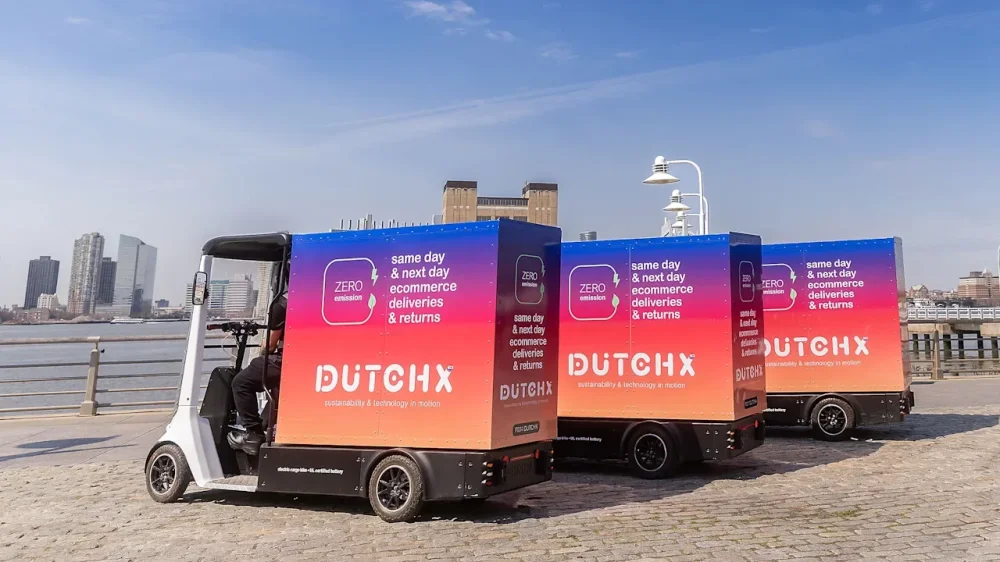
Marcus Hoed, a Dutch immigrant who founded the New York-based shipping company DutchX in 2013, was always intrigued by the possibilities of biking—specifically cargo bikes—to fill in the same-day shipping gap in urban logistics. For the last few years, the company has billed itself as a zero-emissions shipper: a fleet of electric-powered vans that traverse roadways and bridges while cargo bikes handle the last few miles of a package’s journey. But starting last December, DutchX found a way to dramatically cut delivery times. Typically, shipping from its Brooklyn Marine Terminal sorting facility to Midtown West would take about 75 minutes, after navigating over a bridge or via a tunnel under the East River. But now, using a ferry, the firm can do the same trip in a third of the time. “We don’t need to drive a van into Manhattan, we don’t need to deal with parking challenges, and we don’t need to pay the fee for congestion pricing,” he says. Instead, goods are dropped off at Pier 70 and loaded directly onto a bike that can navigate Manhattan’s busy streets. DutchX’s ongoing trial is just one facet of a plan pushed by New York City to revolutionize everyday freight transport by revisiting the potential of the city’s vast network of waterways. The Blue Highways program seeks to modernize water-based shipping across the city—including turning the Brooklyn Marine Terminal into an all-electric marine port—and divert much of the 90% of city freight traffic that moves into and through the city by truck. It’s a stark example of coming full circle. Trade in New York City once took place on bustling piers and waterfronts that have now become the home of upscale apartment buildings and urban parks. The Blue Highways initiative believes the waterfront can once again become a key part of the transit system, ideally with clean power and with many fewer cars, vans, and trucks. The trial on Pier 79 is part of a suite of investments the city is making in creating water-based transit options for freight shipping. Piers and shipping depots have been, or will be, retrofitted for more of this water-based delivery, and ideally, future stages of the program will invest in electric charging for battery-powered boats. Currently, there are some emissions savings by eliminating idling vans and grouping together shipments on boats, but the road map includes plans to add electric boats in 2027. This concept comes at a time when cities are battling rising traffic and congestion from e-commerce deliveries, and shippers and consumers seek out lower- or zero-emission options for shipping. Hoed says that his firm—which has five hubs across the city and 272 bikes—ships a lot of smaller consumer goods, such as perfumes or fashion items, but there’s also more and more interest in zero-emission deliveries from bigger companies delivering furniture and electronics. Sections of the city packed with industrial warehouse and shipping sites, such as Hunts Point in the Bronx, have cascading impacts on the city’s traffic and pollution, says Joy Gardner, executive director of the not-for-profit Empire Clean Cities. And these overloaded roadways lead to congestion and increased diesel pollution from trucks. Transitioning this traffic to other sources, especially bikes and boats, can lessen that burden. Hunts Point, for example, welcomes more than 15,000 trucks a day, and the surrounding public school students have the city’s highest asthma rate. The city has done a good job of exploring and laying out a cleaner transition for Blue Highways, such as trialing so-called renewable diesel made from recycled fats and oils that creates 50% less emissions, and eventually expanding charging infrastructure for ports and piers. A public-private partnership overseen by the New York City Economic Development Corp. and the New York City Department of Transportation, Blue Highways announced its long-term vision in October 2025 and has identified more than two dozen sites. The program will include shipping wholesale food and beverages by barge from the Hunts Point Food Distribution Center. (A few trial runs have already been staged.) “Not every delivery in the city may be able to move by water, and it’s going to take a while to figure out some of the logistics. But it is one of many tools that I think the city can utilize to decarbonize,” Gardner says. Hoed says he’s still evaluating the impact of the Blue Highways trial. He’s certain at this point that while the boat-and-bike method delivers faster times without raising the price of shipping, he’s not yet sure if it decreases cost, or if there are ways to achieve even more efficiency with additional practice. Currently, the company makes the run once a day on weekdays, departing from Brooklyn at 10:30 a.m. on a boat that can hold the equivalent of 45 vans. Hoed says he doesn’t see a world where this pilot stops, because it’s delivering results for his company. “Congestion costs companies like ours a lot. I’m not even talking about traffic. Those hours in traffic jams cost us a lot in terms of wages.” View the full article
-
The former Rocket employee said she faced pressure to resign after requesting remote-work accommodations and leaves of absence to deal with health conditions. View the full article
-
Realtors and loan officers are wary of using artificial intelligence in place of a real estate agent, after a homeowner claimed to realize meaningful savings. View the full article

-
An SEO experiment shows how easily misinformation ranks in Google Search and spreads to other sites. The post SEO Test Shows It’s Trivial To Rank Misinformation On Google appeared first on Search Engine Journal. View the full article
-
UK is too slow to boost defence spending while underfunding areas of comparative advantage View the full article
-
Nvidia has unveiled DLSS 5, a new PC gaming technology that uses AI to re-render video games in real time. It’s basically a make-it-realistic filter, affecting characters, foliage, textures, and lighting. It’s but another example of how in the age of AI, the world may never be the same. And the gaming community doesn’t quite know what to think yet. While the previous versions of DLSS simply upscaled a game’s resolution using AI, this version turns a tree that looks like a 3D model into a tree that looks like a real tree. It’s a monumental change. And a bold move. Unsurprisingly, the gaming community is fiercely divided. While some embrace the leap in visual fidelity, a loud contingent of hardcore players is furious, claiming it destroys artistic intent. The latter camp claims it turns games into AI slop, the derogatory term that everyone loves to use now, whether it’s accurate or not. It used to mean poor-quality AI-generated images or video, but that meaning has been lost, turning into the 2026 version of “It’s Photoshop!” and “It’s CGI!” whining of yesteryear. The way I see it, DLSS 5 looks fantastic most of the time. The intense backlash feels like it’s half posturing, and half psychological disconnect. Our brains are used to filling in the blanks of lower-fidelity graphics. And when faced with a highly detailed reality, we experience a jarring dissonance. It reminds me of how bad it feels to hear a beloved comic book character’s voice for the first time in an animated movie, and realize it doesn’t match the one in your head. Reality bites The two big complaints I keep hearing about DLSS are that this technology averages everyone toward one single beauty standard, and that it throws an unapproved filter over an artist’s painstaking work. On YouTube, people like Luke Stephens called the technology “AI slop garbage,” complaining that a young character in Hogwarts Legacy “can look like a 45-year-old man.” Similarly, YouTuber AngryJoeShow lamented, “They turned DLSS into a TikTok filter. This is like hiring someone to lick off the flavor of a potato chip before you eat it.” Critics have also lamented a loss of creative identity across DLSS-ified games. A user on Reddit argued that characters from totally different genres “all appear as if they belong to a single title, which feels like a blatant disregard for the original artistic vision.” And industry veteran John Linneman noted that while the environmental lighting shows great potential, “the character stuff is horrendous and should have been left out.” But to me, this comment on Reddit is the one that defines the reality of it, going back to my original thesis of the brain disconnect: “The more realistic they become, the less they feel like true games.” That’s fine. It’s a valid point. Or at least as valid as my own point of view having grown up on Atari and NES: Any game past the Game Boy Advance or the DS doesn’t feel like a true game to me. Just give me 16-bit sprites. The rest of the overproduced, stiff, motion-capture 3D-modeled stuff with infinite cutscenes you kids like is just garbage to me, not real gaming! See? That criticism doesn’t seem to make a lot of sense, either. The promise of AI-rendered gaming With apologies to critics, I simply do not see how DLSS 5 is bad. Every demo I’ve watched looks perfectly in-line with the original games, showing no fundamental style change—just vastly more detail and dramatically improved lighting. Both my gamer and non-gamer friends agree that the processed graphics look superior in most instances. To me, the true uncanny valley—that creepy feeling when a digital human looks almost real but not quite—is a product of robotic motion and stiff facial expressions in big-budget games, not the sheer fidelity of the rendering itself. Analyst Ryan Shrout rightly pointed out that “the early ‘it’s just a face filter’ isn’t the right take,” adding that the enhancements to shadows, water, and foliage are incredibly impressive. Another Redditor summarized the reality of the situation perfectly: “DLSS 5 isn’t replacing good rendering. It’s amplifying it.” It’s also crucial to remember that Nvidia is not forcing this on unsuspecting creators. As Bryan Catanzaro, VP of Applied Deep Learning Research at Nvidia, told me back in 2023, Nvidia works closely with game developers to further develop DLSS. And remember, DLSS 5 is optional. Existing games will not suddenly morph overnight without permission; the technology requires a specific, intentional patch from the studio to even function. Gamers will also be able to opt in or out. What we are witnessing right now is the loud birth of a new era. As Unreal Engine artist JSFILMZ observed, “It feels like we’re moving toward fully generated frames—not just upscaled ones.” I anticipate that more developers will focus more of their energies on getting much better motion and physics and gameplay, rather than investing insane resources on extremely detailed modeling and texturing. Down the line, I can see game developers just concentrating on the game dynamics, using 3D models to guide the AI rendering precisely, which will use other types of assets (like detailed images of the characters and the rest of the game elements) to create every game frame from scratch. So instead of panicking over a perceived loss of artistic purity, we need to recognize that our brains are simply adjusting to a digital reality that finally matches the physical one. And that we are moving into a new era, just like we went from 8- to 16- to 32-bit sprites to low-def 3D games and the current generation of PC and console gaming. The pixels are just changing again, and once the initial shock wears off, we’ll wonder how we ever played without this new tech. View the full article

-
If you’re looking to improve teamwork and creativity within your company, there are several engaging activities available nearby. From the competitive spirit of a guacamole-making contest to the adventurous thrills of zip lining, these options cater to diverse interests. You can likewise try stress-relief activities or enjoy unique experiences like indoor go-kart racing. Each option provides a memorable way to bond with colleagues. Let’s explore these opportunities in more detail. Key Takeaways Engage in a Guacamole Making Competition to foster teamwork and creativity, suitable for groups of 25 or more. Experience outdoor activities like zip lining at Geronimo Adventure Park, perfect for team bonding with groups of 6 to 40 people. Unwind at Tantrums Rage Room, where teams can relieve stress through item smashing in a fun, collaborative environment. Compete in K1 Speed Houston’s indoor go-kart racing for thrilling team-based competition designed for groups of 30 or more. Enhance communication and strategy skills with Houston Axe Throwing, offering various packages for groups of eight or more. Guac Rock: A Guacamole Making Competition If you’re looking for an engaging way to improve teamwork within your organization, consider Guac Rock, a guacamole-making competition that combines culinary creativity with collaboration. This interactive event is perfect for groups of 25 or more, making it an excellent choice for corporate retreats or offsite team-building activities in Columbus, Ohio. No master chef skills are required, so even those with basic avocado mashing abilities can participate. Team members will work together to create unique guacamole recipes, promoting communication and collaboration as they share ideas and techniques. An executive chef may assist in judging the competition, ensuring a professional touch and adding excitement to the event. Bar Fight: A Mixology Competition Following the fun and creativity of “Guac Rock,” teams can shift gears to “Bar Fight,” a mixology competition that blends trivia with drink crafting to improve teamwork and creativity. This engaging activity consists of three phases, where teams design a themed drink and presentation to impress judges. As one of the premier team building activities in Columbus, “Bar Fight” promotes collaboration in a fun pub-style atmosphere, making it ideal for team bonding. With a minimum group size of 25 participants, this competition accommodates larger teams, creating a dynamic experience that encourages interaction. Pricing varies, offering flexibility for companies looking to improve team dynamics through spirited competition. Participants won’t just develop mixology skills but will also learn to work together effectively, ensuring that everyone contributes to the final product. “Bar Fight” stands out as a unique way to combine learning, creativity, and camaraderie in the workplace. K1 Speed Houston Teambuilding Activities K1 Speed Houston offers an exciting indoor go-kart racing experience that’s perfect for team-building activities. With a team-based competition format, participants can engage in friendly rivalry during earning points based on their racing performance, which encourages collaboration and strengthens team dynamics. Located conveniently in Houston, this venue accommodates larger groups, making it an ideal choice for companies looking to improve teamwork through thrilling racing challenges. Indoor Go-Kart Racing K1 Speed Houston presents a unique opportunity for companies seeking effective team-building activities. This venue accommodates groups of 30 or more participants, allowing for an engaging experience that combines fun with valuable teamwork benefits. With high-speed electric go-karts on a professional track, you’ll enjoy a thrilling yet safe environment for friendly competition. Participants collaborate to earn points for their team, enhancing communication and cooperation among members. K1 Speed additionally tailors unique activities to suit your group’s specific needs, ensuring an unforgettable experience. Located at 14900 Northwest Fwy, Houston, TX 77040, it’s easily accessible for local businesses interested in innovative team-building options, even those planning corporate events in Columbus, Ohio. Team-Based Competition Format When participants engage in go-kart racing at K1 Speed Houston, they’re not merely racing; they’re furthermore involved in a structured team-based competition format that encourages collaboration and strategic thinking. This facility offers unique team-oriented activities, allowing larger corporate groups to compete together. With a minimum group size of 30, you can cultivate strong communication and camaraderie among team members. As your team races on the professional track in high-speed electric go-karts, they’ll work in the direction of earning points for their collective success. This competitive environment not only improves teamwork but also provides an exciting alternative to traditional team building activities Utah. Points System Collaboration Engaging in a points system collaboration during team-building activities at K1 Speed Houston can greatly improve your team’s dynamics and performance. This unique approach allows your team to earn points together as they navigate the professional track in high-speed electric go-karts. As you participate in company team building activities near me, you’ll experience an exhilarating environment that promotes friendly competition and teamwork. With groups of 30 or more, this activity becomes not just a thrilling racing experience but also an opportunity for members to strategize and improve their collaborative skills. The available group pricing options make it a cost-effective choice for companies aiming to boost teamwork through this exciting and engaging activity. Geronimo Adventure Park Team Building At Geronimo Adventure Park, you can engage in a range of outdoor activities like zip lining, axe throwing, and climbing, which are perfect for adventurous teams. With options for groups of 6 to 40 people, the park tailors experiences to meet your specific needs during nurturing teamwork and communication. A dedicated host can guide your group through these challenges, enhancing team dynamics and building trust among participants. Adventure Activities Overview Geronimo Adventure Park offers a variety of adventure activities intended to improve team dynamics through engaging outdoor experiences. You can choose from exciting options like zip lining, axe throwing, and climbing, all designed to encourage collaboration and communication among team members. The park accommodates groups of 6 to 40 people, making it suitable for small to medium-sized teams seeking unique fun group activities in Houston. A dedicated host is available to guide you through the activities, ensuring a customized experience that meets your group’s needs. Furthermore, facilitated team-building options allow your team to tackle challenges that promote trust and teamwork in a thrilling environment. Located in Spring, TX, Geronimo Adventure Park is easily accessible for companies looking to bond. Team Building Benefits Building strong teamwork is essential for any organization’s success, and participating in team-building activities at Geronimo Adventure Park can greatly improve this aspect. By engaging in activities like zip lining, axe throwing, and climbing, you’ll cultivate trust and collaboration among team members. The park tailors its team-building events in DC to meet your group’s specific needs, accommodating 6-40 participants, which is perfect for smaller teams. A dedicated host enriches the experience by guiding your team through challenges, ensuring a smooth and enjoyable event. These outdoor adventures not only break down barriers but also encourage open communication, making it easier for team members to connect on a personal level. In the end, you’ll leave the park with stronger bonds and improved teamwork. Tantrums Rage Room Tantrums Rage Room in Houston offers a distinctive team-building experience that allows participants to relieve stress through a unique activity—smashing various items in a controlled environment. This engaging venue promotes teamwork and collaboration, as participants bond over shared experiences of stress relief and fun. With each session priced at $56 per person and a minimum group size of 10, it’s perfect for corporate outings or team events. Located at 1730 Elmview Dr. A, Houston, TX 77080, Tantrums provides a safe atmosphere for teams to unwind and connect. You can customize your experience by selecting from different packages that vary in the number and type of items available for smashing, including dishes, TVs, and computers. Whether you’re organizing team building events in Orange County or seeking a unique bonding experience in Houston, the Tantrums Rage Room delivers an unforgettable opportunity for stress relief and team engagement. Houston Axe Throwing If you’re looking for an engaging way to boost team dynamics, Houston Axe Throwing provides an exciting environment where groups can participate in themed games and competitions. This venue is perfect for corporate team-building events, accommodating groups of eight or more. You can select from various packages, such as Casual, Party Pack, and Premium, which includes a dedicated expert coach for improved learning. Here’s a quick breakdown of the available packages: Package Features Ideal For Casual Basic axe throwing experience Small groups Party Pack Includes drinks and snacks Celebrations Premium Expert coaching included Professional development Axe throwing encourages communication, focus, and strategy, making it an exciting choice for team building in Columbus. Located at 1431 W 20th St Unit B, Houston, TX 77008, it’s a great spot for team bonding. Armand Bayou Nature Center Armand Bayou Nature Center serves as an ideal setting for companies seeking to improve teamwork through outdoor adventures. Located at 8500 Bay Area Blvd, Pasadena, TX 77507, it offers a variety of activities aimed at improving collaboration and communication among team members. You can engage in hiking and nature exploration as you learn about local wildlife and ecosystems, which enriches the overall experience. The center tailors its team-building activities to meet the specific needs of your group, ensuring an effective and enjoyable outing. Pricing and group sizes vary based on the selected programs, making it accessible for teams of all sizes. If you’re looking for engaging team-building activities in Salt Lake City or nearby, consider the unique opportunities at Armand Bayou Nature Center. This environment not only nurtures teamwork but also provides valuable educational experiences that your team can benefit from long after the day ends. Frequently Asked Questions What Is the Typical Duration of Team-Building Activities? The typical duration of team-building activities varies, usually lasting between two to eight hours. Shorter activities, like icebreakers or workshops, often take around two to four hours, whereas full-day events may include more extensive challenges or training sessions. Some companies may opt for multi-day retreats to encourage deeper connections. In the end, the duration depends on the objectives, the number of participants, and the specific activities planned, ensuring a balance between engagement and effectiveness. Are Activities Suitable for Remote or Hybrid Teams? Yes, many activities are suitable for remote or hybrid teams. Virtual team-building exercises can include online games, collaborative projects, or discussion forums, allowing participants to engage from different locations. These activities often use video conferencing tools to facilitate interaction. Moreover, hybrid activities can combine in-person and virtual elements, ensuring everyone feels included. How Do I Choose the Right Activity for My Team? To choose the right activity for your team, start by evaluating your team’s goals and dynamics. Consider their preferences, strengths, and weaknesses. Review whether the activity promotes collaboration, communication, or problem-solving. Think about logistics like location, budget, and time constraints. Additionally, confirm the activity accommodates all team members, including any remote participants. Finally, gather feedback post-activity to measure its effectiveness and adjust future selections based on what resonates best with your team. What Is the Ideal Group Size for These Activities? The ideal group size for team-building activities typically ranges from 6 to 20 participants. Smaller groups, like 6 to 10, encourage deeper connections and easier communication. Nevertheless, larger groups, around 15 to 20, allow for diverse interactions and a wider range of skills. Consider the activity type when choosing size; some activities require collaboration, whereas others focus on individual strengths. In the end, the right size balances engagement and participation for effective outcomes. Can We Customize Activities to Fit Our Company Culture? Yes, you can definitely personalize activities to fit your company culture. Start by evaluating your team’s values and goals, then choose activities that align with those principles. For example, if collaboration is essential, opt for group challenges that require teamwork. Moreover, you can modify existing activities by incorporating company-specific themes or objectives. This customized approach not just improves engagement but reinforces your organizational identity, nurturing a stronger team bond. Conclusion To summarize, these seven team-building activities offer diverse options for companies looking to improve collaboration and creativity among employees. From the engaging Guac Rock competition to the adventurous challenges at Geronimo Adventure Park, each activity promotes teamwork in a unique way. Whether you prefer culinary contests or outdoor adventures, these experiences can help strengthen workplace relationships as they encourage a productive environment. Consider incorporating one of these activities into your team’s schedule for effective bonding and skill development. Image via Google Gemini and ArtSmart This article, "7 Exciting Team Building Activities for Companies Near Me" was first published on Small Business Trends View the full article
-
Whether you’re a devoted college basketball junkie or you just pay attention for a few weeks each spring, you’ll get a lot more out of the Division I men’s tournament if you know the storylines behind the matchups. Here are some of the biggest narratives to follow from work, home, and wherever you watch the games. The year of the freshmen From February 2021 until the start of the 2025-26 college basketball season, there were exactly three 40-point games by freshmen. On January 24, 2026, three freshmen achieved that milestone on a single day. Two of them were playing against then-top-12-ranked teams, on the road. Kingston Flemings of Houston scored 42 points against Texas Tech, Keaton Wagler of Illinois scored 46 points against Purdue, and AJ Dybantsa of BYU scored 43 points against archrival Utah. All three players were selected as Associated Press All-Americans, and play for teams seeded No. 2, 3, and 6, respectively, in this year’s NCAA Tournament. Meanwhile, the national player of the year favorite, Cameron Boozer, is a freshman playing for Duke, the overall top-seeded team. Arkansas, which is a No. 4 seed after winning the SEC Tournament, is led by Darius Acuff Jr., a freshman point guard who averages 23 points per game. Kansas guard Darryn Peterson has been in and out of the lineup with injuries throughout the year, but has looked every bit the part of a potential superstar in the NBA, and will play for the No. 4-seeded Jayhawks in the tourney. Arizona, another No. 1 seed, starts three freshmen: Koa Peat, Brayden Burries, and Ivan Kharchenkov. Mikel Brown Jr. (Louisville), Nate Ament (Tennessee), Braylon Mullins (UConn), Killyan Toure (Iowa State), and Trey McKenney (Michigan) are all key players on teams with a chance to make a run. Even some of the mid-majors in the NCAA Tournament have star freshmen on their rosters. Santa Clara’s Allen Graves is getting NBA draft buzz. Hofstra’s Preston Edmead won CAA Tournament MVP thanks to a buzzer-beater and a heroic performance. Alex Wilkins of Furman also won his conference tournament MVP after making the All-Conference second team. This is the greatest freshman class in the history of college basketball, and these players are ready for their NCAA Tournament moment. Can Nebraska finally do it? The University of Nebraska-Lincoln has had a basketball team for 130 years. The school has been a member of a power conference for much of that time, first in the Big 12 (which was then known as the Big 8) and then in the Big Ten (confusing, but different conferences). Among the 79 teams in power conferences, Nebraska is the only one that has never won a game in the NCAA Tournament. The Cornhuskers have as good a shot as ever to wipe that dubious honor clean this year. They started the regular season with 20 consecutive wins and have already matched the program’s single-season win record of 26, entering the tournament at 26-6. Nebraska earned a No. 4 seed in the tournament and will take on the Troy University Trojans on Thursday, March 19, at 12:40 p.m. Eastern time. KenPom gives the Huskers a 92% chance of winning that game. Back-to-back back-to-backs Florida’s miraculous run to win the national championship last year included a hard-fought second-round win over UConn, the winner of the previous two national championships. The Gators are in position to have a chance to match that feat and win back-to-back national championships themselves for the second time in program history. Head coach Todd Golden’s team started the season just 5-4, but is 21-3 since then, winning the SEC regular season championship by three games. All of that earned Florida a second consecutive No. 1 seed in the NCAA Tournament and made the team a popular pick to win another title. Should Florida win the national championship, it would be the first time in the 87-year history of the tournament that a team won back-to-back championships immediately after a different team won back-to-back championships. The Gators would also join UCLA as the only two programs to win back-to-back national championships on two separate occasions. Florida won the 2006 and 2007 championships, while UCLA went back-to-back in 1964 and 1965 before winning seven in a row from 1967 to 1973. Miami has people talking Think about it: 31 wins; 0 losses. That was Miami University’s regular season. The RedHawks of Ohio became the first team to enter their conference tournament with an unblemished record since Gonzaga’s 2020-2021 season. But Gonzaga is a college basketball powerhouse. This is Miami University. Head coach Travis Steele’s team won four overtime games during the regular season, and five other games by one possession, holding on by the skin of its teeth to keep its undefeated record alive. After losing to UMass in the quarterfinals of the Mid-American Conference tournament, the RedHawks didn’t earn the automatic bid from their conference. Because they played one of the weakest schedules in the country—not for lack of trying, their at-large case was one of the most polarizing in recent memory. But the selection committee decided to put Miami in the tournament, rewarding the team for winning all of its regular-season games. Miami will take on Southern Methodist in the First Four on Wednesday, March 18, at 9:15 p.m. Eastern time in Dayton, just 32 miles from its Oxford, Ohio, campus. If the RedHawks win, they move on to play the Tennessee Volunteers in Philadelphia on Friday, March 20, at 4:25 p.m. ET. Another top-seed collision course? Last year, all four No. 1 seeds made it to the Final Four of the tournament. The top of the sport was historically good, and it remains historically good this year. On prominent analytics website KenPom.com, Duke, Michigan, and Arizona have power ratings well higher than everybody else, similar to how last year’s top four separated themselves from the pack in that metric. Most fans don’t like a tournament devoid of upsets, because the upsets are a major part of why March Madness can be so exciting. And it’s certainly true that the most compelling storylines tend to come with those Cinderella runs. Similar to last year’s tournament, this year’s may end up being light on upsets, but it’s likely to be filled with heavyweight battles between elite college basketball teams in the later rounds. Last season’s Final Four delivered two epic semifinals and a classic national championship game. This year’s action will culminate on Monday, April, 6, at 8:30 p.m. ET, in Indianapolis. View the full article

-
On a hot day, most clothing traps heat. But fabric coated with nanodiamonds—tiny diamond particles—can instead release heat, helping cut energy use for air-conditioning. The diamond nanoparticles, each less than one-thousandth of the width of a human hair, have the same carbon crystal structure as larger diamonds. But since they don’t have to be perfectly formed and can be made from carbon waste such as plastic, they are relatively inexpensive to make. The structure means that they’re especially effective at moving heat. “Because carbon has exceptional thermal properties, it can absorb energy and heat quickly, and it can dispense it quickly through that system,” says Shadi Houshyar, an engineering professor at Australia’s RMIT University, whose team developed nanodiamond-coated fabric in the university’s Centre for Materials Innovation and Future Fashion. Diamonds are already used in electronics to help keep parts like computer chips cool. The researchers realized that they could use the same idea in clothing. “We decided to add nanodiamonds to textiles,” Houshyar says. “When it’s in contact with the skin, it absorbs heat quickly from the body.” Then it releases the heat. It’s particularly helpful in areas like the torso that get hottest. “It has a high capacity, so it can pull heat from the body for many hours,” she adds. While it could be used in any type of clothing, it can also be useful in protective gear for firefighters, she says. Clothing made from the fabric can lower your body temperature by around 4 to 5 degrees Fahrenheit (2 to 3 degrees Celsius)—enough that you don’t have to crank up the AC as much to feel comfortable in extreme heat. Curtains made from nanodiamond-coated fabric can also keep homes cooler; house paint could also potentially incorporate nanodiamonds. To add the material to fabric, the scientists use a sustainable binder that Houshyar says can securely attach the nanodiamonds for at least 50 wash cycles. The team is now also developing a way to coat yarn with a layer of the material earlier in the manufacturing process. Nanodiamonds can be made from waste carbon—including plastic waste—by exposing the carbon to extreme pressure and temperature in a reactor, rearranging the atoms into a diamond structure. By tweaking the process, it’s possible to give the material other properties, including the ability to absorb or release moisture. “There’s a possibility that this could replace PFAS,” Houshyar says. Unlike PFAS (forever chemical) coatings, which are used to make rain jackets and other clothing water-repellent, the nanodiamonds are nontoxic and environmentally safe. As climate change makes extreme heat more likely, other researchers are exploring new ways to redesign clothing to keep people cool. Engineers at the University of Massachusetts Amherst recently used calcium carbonate—low-cost chalk—to coat fabric that cooled by several degrees in tests. Others are experimenting with materials like silver nanowires and zinc oxide. Now, Houshyar’s team is looking for funding to spin the research into a startup. “Companies are already interested,” she says. The project, called DiamondCool, is a finalist in H&M’s Global Change Award for 2026, a prize that backs early-stage work to make fashion more sustainable. View the full article

-
Parents make “deals” with their kids everyday. Mow the lawn and get your allowance. Finish your dinner, and you’ll get some ice cream. When Corey Scholibo was eight, his mother made him an offer: if he stopped sucking his thumb, he’d earn $20. He stopped in a week, and she made good on the promise. Now 47, Scholibo has a business designed around these childhood “deals.” In January, he launched an app-based service, Dayo Deals, that enables parents to strike bargains with their teenage children—specifically to help them reduce their screen time and social media use. Together, both parties work together to establish time limits and a monetary reward. If the teen stays within the limit, they keep the money; if not, the cash vanishes. Sure, it could be considered bribery. But Scholibo argues, quite simply: cash talks. “There’s something transactional about it, and that’s kind of the point,” he says. A screen time solution Parents and teens alike agree that the overuse of smartphones is a problem. According to Pew, half of teens between 13 and 17 spend more than four hours a day on their phone. Forty-six percent report being online “almost constantly,” with six in ten teens using social media apps like TikTok, Instagram, and Snapchat. But many are willing to ditch the screens. Nearly half of U.K. youths between 16 and 21 recently said that they support a digital curfew. Actually implementing limitations is difficult: A Pew Research study from 2024 found that four in ten teens and parents argue regularly about screen time, and while 76% of parents say managing screen time is a priority, 43% say it’s hard to do. “There’s never really been a product where people use it this much and dislike it this much,” Scholibo says of screens. “Except maybe insurance.” Scholibo, a former journalist and entrepreneur whose previous ventures include compostable tableware and a plant-based wellness line for menopause-aged women, started the app with his co-founder, Patrick Triato, when Triato grew concerned about his own kids’ screen time. Scholibo and Triato realized that America is unlikely to follow countries like Australia and Spain in banning social media use by children under 16. But the pair did notice people looking to restrict themselves, which was giving rise to a new category of products that Scholibo calls “restriction-as-a-service,” such as Bark and Brick. Scholibo describes Dayo as a “peer-to-peer payment model.” With a subscription of $9.99 a month, parents and kids set deal parameters together, then monitor progress live on a colorful dashboard that also shows monthly progress and days-in-a-row streaks. If teens keep their screen use under the allotted time, they can withdraw their reward—via Venmo or PayPal, or in gift card form from brands like Starbucks, Adidas, and Amazon. But if they go over, they watch the money travel back to their parents. “It’s like asking your kid to give you back $5 at the fair,” Scholibo says. “No one wants to do that.” The brand connection Dayo initially launched in April 2025 as a “rewards-based marketplace” for helping adults reduce their own screen time. It resembled any earned rewards program: If users stick to their self-imposed limits, they can claim discounts at close to 100 partner stores such as Yeti, North Face, Stumptown Coffee, and Portland-based Powell’s Books. That iteration of the app still exists and currently has a user base of 6,000 people; just as parents set their teens’ deals, they can set their own, with Dayo as their “sponsor.” They gradually earn discounts with partner stores; for example, they might work up to 40 “Dayo Dollars” toward a $100 Yeti cooler or Rumpl blanket. For these partner companies, it’s good PR with little risk: be involved in a mission, and simultaneously gain some new customers. Christopher Eng, founder of ergonomic furniture company Smallish, via email, calls it “a win-win. We acquire new customers at a cost similar to what we would spend on other channels, while providing the discount directly to the user.” Some brands even tie Dayo’s mission to their own. “Hammies is all about the simpler times when shorts were shorter and people got together in person to socialize,” said Grant Nestor, founder of the retro-themed apparel store. Drew Downie, co-founder of pet supply company Lay Lo, credits Dayo for encouraging “people to spend more intentional time with their dogs.” Teens can also earn these discounts, but Scholibo reports that they overwhelmingly want to cash out or get a gift card. (Dayo doesn’t have direct partnerships with these gift card partners but with Tango, a gift card aggregator.) The rewards conundrum Dayo is based on the theory of contingency management, a behavioral intervention used frequently in drug addiction therapy. It offers a tangible and immediate reward, like a voucher or cash, for a good behavior change such as abstaining from a drug. Or a screen. The notion of engaging in bribery may turn off some parents, but “one person’s bribery is another person’s positive reinforcement,” says Nicholas Kardaras, a psychologist and clinical professor at Stony Brook University who focuses on substance and behavioral addiction, and who wrote Glowkids, a 2016 book about the epidemic of screen addiction. “Money does have value, especially in our materialist culture with adolescents,” Kardaras says. “In the short term, it’ll work.” Kardaras explains that a major issue with extrinsic rewards—e.g. tangible incentives, like money—is that they tend to diminish in perceived value over time, so parents would likely have to keep upping the sum. It’s a similar idea to being in the same job year after year with the same salary; your perceived value often starts to outweigh the compensation. “I think parents need to understand it’s not the whole solution,” Kardaras says. “It’s a “starting point.” The magic number In the longer term, he says, parents would need to shift from extrinsic motivation to intrinsic—where the will to behave a certain way comes from within, fueled by a change in personal values. That might be helping kids to understand that there are more valuable things than social media likes and followers, and that excessive screen time is unhealthy. Once that happens, “social media has less of a gravitational pull.” While Scholibo respects the argument, he believes absolutely in the rewards system as a motivator. “It wasn’t like my parents sat down and tried to educate me on why I should empty the dishwasher for the good of society,” he says. He also realizes that some parents are simply strapped for cash. Dayo doesn’t have firm data yet but Scholibo has anecdotally found $100 to $200 to be “highly impactful.” To help fund the deals, Dayo is starting what it calls a “scholarship” program, initially with 15 scholarships of $50 a month for three months. Teens will apply for it, which will in turn equip Dayo with some case studies and a better understanding of the gravity of screen dependence. Eventually, Scholibo may look to recruit more brand partners to sponsor these scholarships, particularly banks, which typically want to attract young people as lifelong customers, and influential individuals. “Why couldn’t Bank of America sponsor 1,000 teens?” he says.“Why couldn’t Scott Galloway, who talks about how he wants to get young men off social media?” Galloway declined Scholibo’s initial invitation to get involved, but Scholibo has plans to reach out again. Meanwhile, Scholibo is working on growing the audience for his “reduction-as-a-service” product, defending its transactionary nature for what it is. “What I can do is get your time back,” he says, “and I can get you money for it.” View the full article

-
Google's John Mueller says why migrating a site to HTTPS may cause a site to lose all rankings. The post Google Explains Why HTTPS Migration May Negatively Impact SEO appeared first on Search Engine Journal. View the full article
-
I still remember the thrill I felt in 2013 when I got the chance to interview IBM’s Watson team. Two years earlier, it had competed on the popular game show Jeopardy! and beaten human champions Brad Rutter and Ken Jennings. After that interview, I wrote an article for Forbes arguing that Watson would inaugurate a new era of cognitive collaboration. As I look back now, more than a decade later, the article holds up remarkably well. I compared learning to collaborate with AI to pilots learning to “fly by wire,” using automated rather than manual controls. We still have pilots, of course, but they don’t actually fly planes anymore. They manage the systems that fly the planes. Today, we’re at a similar juncture. Wall Street analysts estimate that investment in AI will approach $700 billion this year. McKinsey reports that nearly 90% of businesses are using AI and, perhaps not surprisingly, a horde of newly minted AI experts are rising to meet the demand, thinking they’re on the ground floor of an opportunity. Here’s why you shouldn’t be one of them. The Hype Cycle Explained In the 1990s, Gartner analyst Jackie Fenn noticed a pattern: New technologies would emerge, get hyped up beyond any realistic expectation, go through a period of disillusionment and disappointment, and only later gain traction and become productive. Gartner dubbed this phenomenon the “Hype Cycle.” With respect to artificial intelligence, the technology trigger was probably ChatGPT’s enterprise launch in March 2023, but some might argue that the development of transformer algorithms was technically the trigger. Either way, all of a sudden, people got really excited by AI, and investment and adoption soared. Today, we are either at or near the peak of inflated expectations. Roughly $350 billion was invested in AI last year, and that’s set to double this year. At the same time, the evidence that these investments are resulting in significant productivity gains is mixed at best. A recent Duke University survey of CFOs found no impact on productivity at all. Clearly, it is possible that there are actual productivity gains that aren’t yet captured by the data (Stanford’s Erik Brynjolfsson seems to think so). Also, it is not unusual for a technology to initially have a negative effect on productivity as users move up the learning curve. So what we’re observing might just be the typical growing pains of a new technology. Still, we’re talking about nearly a trillion dollars of investment in just two years. And because the AI chips make up roughly 60% of that investment and are amortized over three years, to be financially viable, AI firms need to start producing hundreds of billions of dollars in profits fairly quickly. That seems unlikely, and we’re almost surely headed for a trough of disillusionment. The Compulsion Of Reflexivity George Soros made a fortune betting against conventional wisdom. When the British government committed to keeping the pound pegged to the German mark, he bet against it and earned a billion dollars in the process. He later pulled off similar trades against the Thai baht and the Japanese yen. Where others saw a boom, Soros saw a bust right around the corner. His secret weapon was a theory he calls reflexivity. The basic idea is that expectations don’t form in a vacuum. They are shaped, in part, by our perceptions of what other people believe. The more widely an idea is accepted, the more likely we are to accept it ourselves and that, in turn, reinforces the collective zeitgeist. If many believe that AI will create an economic boom, similar to that of electricity or the internal combustion engine, we’re more likely to believe it, too. That belief drives behavior: Investors buy stocks, companies pour money into AI, and the prediction becomes self-referential and self-reinforcing. All of this adds fuel to the fire. Nobody wants to get left out of a good thing. What’s interesting about Soros’s theory is that it doesn’t depend on the merits or demerits of the asset or idea in question. You can believe in the transformative power of AI and still recognize that many of the decisions being made are driven by reflexivity. And when reflexive bubbles unwind, it’s not just asset prices that fall. So do reputations built on temporary expertise. Chasing The Wave It’s hard not to be amazed by AI. Today, anyone on earth who owns a cheap smartphone can access technology that seemed like science fiction just a short time ago. Advocates can point to real data showing that it has had significant real-world impacts. So why not jump on the wave and enjoy the ride? Research from the St. Louis Federal Reserve Bank illustrates a key part of the problem. There is a wide disparity in the impact of AI. Some occupations, like software development, are being completely transformed by AI. Others, such as personal services, are hardly being affected at all. So perhaps it’s not surprising that people ensconced in the tech world predict that other industries will see similar productivity gains. Consider OthersideAI CEO Matt Shumer’s viral tweet about how AI has completely transformed his ability to produce code and create products. You can’t blame him for being excited—the gains are truly impressive. In a similar vein, OpenAI CEO Sam Altman claimed that similar impacts will soon be seen in other industries, such as marketing and communications: “It will mean that 95% of what marketers use agencies, strategists, and creative professionals for today will easily, nearly instantly, and at almost no cost be handled by the AI—and the AI will likely be able to test the creative against real or synthetic customer focus groups for predicting results and optimizing. Again, all free, instant, and nearly perfect. Images, videos, campaign ideas? No problem.” What sticks out to me about that quote is how little Sam Altman’s vision corresponds to the actual work that people in marketing agencies do—which is to work with clients to identify objectives and craft strategies to achieve. The production and placement of creative assets has been highly automated for quite some time. The truth is that few people write code for a living, and extrapolating gains from software development to the economy at large takes quite a leap of faith. Humanity’s superpower—the thing that has allowed us to create our own destiny—is collective action. To do that, you need humans to interact with other humans. Doubling Down On The Expertise You Already Have There’s no doubt that artificial intelligence is a transformative technology—but so were smartphones, broadband mobile internet, cloud computing, and many other things over the last 20 years. It is truly amazing to think that just 20 years ago, none of it existed and life was significantly different. Yet still, none of those things had much of an impact on productivity. The most likely scenario is that the future will look a lot like the past. Many things will be improved. Some will be transformed. But adoption will be uneven, with some organizations and industries moving quickly to put new applications into practice, while most will lag. As progress fails to meet expectations, disappointment and disillusionment will set in, and focus and budgets will shift elsewhere. If you are truly an AI expert, with the knowledge and skill to shape the technology, you can still expect to do well. There will never be a shortage of organizations that need people to help leverage technology to do important work for them. But if you are just chasing the wave, you will be tying yourself to the ebbs and flows of market sentiment. The truth is that you can’t separate a technology from the environment in which it operates. As the German philosopher Martin Heidegger argued: To build for the world, you need to understand what it means to live in it. Technology becomes powerful when people who understand solutions learn to collaborate effectively with people who understand important problems that need to be solved. So while there is clearly a need for genuine AI experts, we still need experts in every other human domain. You’re much better off betting on yourself than betting on a technology you have little or no agency over. View the full article

-
Former deputy prime minister’s intervention comes ahead of local election in MayView the full article
-
As a graduate of Harvard Law School and Harvard Business School I believed full-time roles were the only way to succeed, until an unexpected Bollywood acting opportunity opened my eyes to freelance-forward careers. Since then, I have toggled between holding full-time executive roles and fractional ones. If you’re not familiar with the phrase, you can think of fractional work as the executive version of freelancing. Fractional leaders work in a C-suite or other senior role part-time, usually for multiple companies simultaneously. Landing a fractional role I landed my first fractional General Counsel role when I attended an industry conference in the hopes of finding my next job. Instead, I met a startup founder who needed legal support but didn’t have enough work to justify hiring somebody full-time. A month later, I got my second fractional General Counsel role from a different founder in similar circumstances. Job postings for fractional work are fairly limited, owing to their custom nature and partial workload. Instead, this job type relies heavily on the “hidden job market”. To maximize your chances of getting a fractional role, seek out events that your future manager would attend. Fractional roles are often at startups and SMBs, so prioritize conferences attracting those companies’ founders, leadership, or investors. If you can’t meet your prospective clients organically, try to have a mutual friend introduce you, engage on social media, or send a thoughtful cold email directly. After securing your first fractional role, you can follow the same path to get your second, or ask your existing client for a referral. Building a book of business takes time. Depending on your circumstances, it might make sense to seek out other freelance or even full-time work while growing your fractional career. A day in the life Here’s what my day usually looks like when I’m doing fractional work. I wake up by 7 am, do yoga, then scan messages to see if any fire drills came in overnight. If not, I’ll eat breakfast and get to my desk by 9 a.m. Then I log in to each of my company accounts. Since I have a different calendar for each company, I confirm I don’t have any double-booked meetings or deadlines. I’ll then triage the requests that came in overnight, and make a master to-do list mapping out the day’s tasks for each client, as well as administrative tasks for running my own business. Inevitably, new work comes in during the day and I’ll triage that by urgency too. Some days, I’ll spend the entire day in meetings and have to catch up on deliverables at night. Other days, I’ll be heads down on documents and have an open calendar. When client work is light, I focus on my own business admin or brand building. In the evening, I usually break for family dinner or a dance class. I’ll log back on afterward if needed to finish anything due by end of day and start making the next day’s to-do list. The Biggest Upsides of Fractional Work These are the biggest benefits of fractional careers that I didn’t know before I started: 1. Financial As a fractional executive you often command a rate that is high for the number of hours worked (though often still cheaper for any company than hiring a full-time employee). As you continue to increase your rate and build a portfolio of clients, you may quickly out-earn your full-time salary while also working fewer hours. 2. Flexibility Perhaps the biggest advantage of fractional work is its flexibility. Because you negotiate with each client individually, you choose when and how you work, in addition to the actual work itself. If you love being in an office, you can probably join your client in person. If you thrive remotely, that’s often available fractionally even if it wouldn’t be possible full-time. And when the workload expands, you decide whether the extra responsibility is within the scope of your part-time role. 3. Diversification Working for multiple clients benefits your finances, skills, and brand. Financially, the loss of any one client is less catastrophic than a layoff. Educationally, diversification uplevels your skills. You can learn from each client’s business and see industry patterns from different angles. Lastly, diversification benefits your brand. With more than one client, you have multiple shots at earning a success story that can land you lucrative clients in the future. And if one company stumbles, you’re not gambling with your whole resume the way you would in a full-time job. The Hidden Risks of Fractional Work The benefits of fractional work come at a cost. Here are the biggest downsides I’ve seen: 1. Financial You have to keep selling, and income can vary substantially. There may be seasons where you don’t earn anything at all. You have to plan for your retirement and possibly set up a solo 401(k). And it’s not always possible to get equity at the companies where you work, which means you’d miss the financial upside of what you’re building. You might also miss upside if the role grows so much that the company needs someone full-time instead of fractional. 2. Health Staying healthy as a fractional worker can be tricky. Health insurance when you’re self-employed is hard to get, expensive, and does not always cover what you need. Paid time off is not guaranteed if you get sick. Deadlines and work commitments also have a way of colliding such that your busy seasons take extra finesse to negotiate. You often can’t tell one client that another is keeping you busy, and there may be no team you can delegate tasks to. 3. Community Fractional work can be lonely. The flip side of being sheltered from office politics is that you’re also insulated from team bonding. You’ll likely miss some company retreats, all-hands meetings, and parties. You might also lose the feeling of building something bigger than yourself, and the tidy sense of identity that comes with having a job title people at cocktail parties understand. How Do You Balance These Tradeoffs? Neither full-time nor fractional work alone is the promised land. Each working style brings its own set of opportunities and tradeoffs. But the thing that surprised me most was that fractional and full-time work feed off each other. As your title and responsibility in the full-time world grows, you can earn better titles and pay as a contractor. This progression helped me become a fractional executive instead of staying a project-based freelancer. The reverse was also true. More clients equals more experiences you can share in interviews to show future employers that you can solve their problems. Most of us are seeking money, enjoyable work and a sense of stability where our livelihood won’t be ripped out from under our feet. Both fractional and full-time work can accomplish these goals. But the most potent elixir to future-proof yourself? Creating a career that has both full-time and fractional elements. With this kind of dual-track career, wherever the market goes next, you can go with it. View the full article

-
Employee training is vital for both personal and organizational development. It improves skills and knowledge, boosts confidence, and promotes engagement among staff. By investing in training, companies can improve talent retention and align employees with their goals. This creates a competitive edge and reduces turnover costs. Additionally, a commitment to training nurtures innovation and adaptability. Comprehending these benefits can greatly impact your organization’s success. So, what are the specific advantages you might not be aware of? Key Takeaways Employee training boosts confidence, with 90% of learners feeling more self-assured in their roles post-training. Organizations prioritizing training are twice as likely to retain employees and reduce turnover costs significantly. Continuous learning enhances decision-making skills, with 84% of learners reporting improved abilities in this area. Training programs align with organizational goals, improving overall performance and adaptability in a changing market. A strong training culture fosters innovation, empowering employees to share new ideas and solutions effectively. Enhanced Employee Skills and Knowledge Employee training plays a crucial role in improving your skills and knowledge, as it equips you with the tools necessary to perform your job effectively. The advantages of training employees are significant; 87% of learners report acquiring skills they can immediately apply to their roles. This immediate application boosts your productivity and performance. Furthermore, the importance of employee training becomes even clearer when you realize that 91% of learners feel more competent in their field after completing their courses. By addressing skill gaps through customized training, organizations can encourage creative problem-solving, driving overall effectiveness. The benefits of employee training extend beyond individual capabilities; they create a more competent workforce ready for current and future challenges. In addition, a culture of continuous learning improves employee satisfaction, with 90% of learners feeling more self-assured at work post-training. As a result, investing in training ultimately contributes to both personal and organizational growth. Increased Employee Confidence and Engagement When employees participate in training programs, they often experience a significant boost in confidence and engagement levels. Post-training, 90% of learners report feeling more self-assured in their work, highlighting why training is essential for employees. This increased confidence translates into better decision-making, with 84% of employees feeling more capable of making business decisions after training. A continuous learning culture signals to you that your growth is valued, enhancing your motivation and engagement. Engaged employees, who feel confident as a result of training, tend to take ownership of their roles and collaborate more effectively. This leads to improved performance across the organization. When you embrace new challenges as a consequence of training, you contribute to a more dynamic and innovative workforce. Comprehending the 10 benefits of training employees, it’s clear that nurturing confidence and engagement is crucial for both individual and organizational success. Improved Talent Retention and Growth Investing in employee training not just boosts confidence and engagement but also plays a significant role in talent retention and growth. In today’s competitive job market, companies that prioritize training are twice as likely to retain their workforce. With 70% of employees willing to leave for better training opportunities, it’s clear that development is essential for retention. A lack of growth opportunities impacts 63% of workers, driving them to seek new positions. By encouraging continuous learning, you create a sense of belonging and purpose, finally lowering turnover rates. Furthermore, developing internal talent reduces recruitment costs and creates clear pathways for career advancement. Statistic Percentage Importance Organizations prioritizing retention 88% Retention is a top concern Employees considering leaving for training 70% Training opportunities matter Workers citing lack of growth as a reason 63% Growth opportunities impact turnover Alignment With Organizational Goals Aligning training initiatives with organizational goals is crucial for cultivating a cohesive and productive workforce. When training programs clearly convey your company’s values and priorities, you guarantee that employees understand the mission and align their efforts accordingly. This alignment promotes a sense of commitment to professional development, enhancing workplace satisfaction and loyalty. In a virtual work environment, strong alignment becomes even more critical, as it helps create a unified culture in spite of physical distances. Companies that effectively connect training with strategic objectives often experience notable improvements in employee performance and productivity. Furthermore, promoting a culture of learning that aligns with organizational goals equips your workforce to adapt to changing market demands. This proactive approach not only prepares employees for current challenges but also positions your organization for future success, creating an agile team ready to tackle new opportunities as they arise. Competitive Advantage in the Market When you invest in employee training, you’re not just enhancing skills; you’re positioning your organization to adapt to market trends effectively. This commitment to training boosts your agility, allowing you to respond swiftly to shifts in customer demands as you cultivate future leaders within your workforce. Adapting to Market Trends Organizations that prioritize employee training gain a significant advantage in adapting to market trends and responding to customer needs. When you invest in continuous development programs, your employees become better equipped to integrate digital solutions, ensuring your business thrives in a digital economy. Companies with effective training strategies are twice as likely to meet production goals, illustrating how training directly impacts market competitiveness. Moreover, a commitment to workforce development encourages innovation; trained employees are more likely to propose ideas and solutions that align with market demands. Enhancing Organizational Agility To stay competitive in a continuously changing market, enhancing organizational agility is vital. By investing in employee training, you equip your team to adapt swiftly to market shifts and evolving customer needs. Continuous learning allows employees to integrate digital solutions, which is significant in today’s digital economy. Companies with effective learning strategies are twice as likely to meet production goals, highlighting the connection between training and agility. Additionally, training encourages critical thinking and innovation, enabling your workforce to propose new ideas that keep the organization responsive to emerging trends. A culture of ongoing development prepares your team to tackle future challenges, reinforcing your organization’s ability to respond effectively to changing market demands and maintain a competitive edge. Cultivating Future Leaders Investing in employee training not just improves skills but also plays a crucial role in nurturing future leaders within your organization. By identifying and developing high-potential individuals, you prepare them for leadership roles, ensuring a robust talent pipeline. Organizations that prioritize leadership training often see a significant return on investment, with 84% of employees believing training should evolve with their roles, which boosts retention and engagement. Proactive initiatives promote a culture of continuous learning, empowering employees to face challenges and innovate. Companies with strong training programs are 2.5 times more likely to be viewed as innovative, positioning themselves as industry leaders. By nurturing leadership skills, you create a well-prepared workforce ready to navigate future challenges and drive business success. Higher Job Satisfaction and Morale When you invest in employee training, you’re not just enhancing skills; you’re boosting engagement and loyalty. Employees often feel a stronger commitment to their roles, knowing their growth is valued, which leads to higher job satisfaction. This culture of continuous learning can transform the workplace, nurturing a sense of ownership and greatly improving overall morale. Enhanced Employee Engagement Employee training greatly improves engagement, leading to higher job satisfaction and morale among staff. When you participate in training programs, you’re likely to see a 90% increase in self-assurance at work. This boost in confidence helps you make better business decisions, with 84% of learners reporting improved decision-making skills. Furthermore, a culture of continuous learning promotes a sense of value and appreciation, which greatly enhances your engagement. Improved job satisfaction from training initiatives likewise correlates with higher employee retention; 45% of those who leave cite a lack of learning opportunities. Organizations investing in employee development create an atmosphere where you recognize the commitment to your growth, further elevating morale and engagement within the workplace. Increased Loyalty and Commitment Training programs can greatly improve employee loyalty and commitment by making individuals feel more valued within their organizations. When employees receive training, they experience a 90% increase in self-assurance at work, which improves their job satisfaction and morale. This investment in development signals to employees that their growth matters, reducing turnover considerably—63% of employees leave because of a lack of growth opportunities. Companies that prioritize employee training are twice as likely to retain staff, nurturing a culture of engagement. As employees perceive this commitment, they tend to take ownership of their roles, leading to a more dedicated workforce. Ultimately, training not just boosts morale but also increases productivity, benefiting both employees and the organization. Reduced Turnover Costs Investing in employee training is a strategic move that can lead to significant reductions in turnover costs. When you provide learning opportunities, you address a primary reason why 45% of employees leave their jobs. This investment not merely encourages loyalty but likewise saves money in the long run. Consider the following: Replacing an employee can cost between 50% to 200% of their annual salary, making retention vital. Organizations with over 100 employees could lose between $660,000 and $2.6 million annually as a result of poor retention. Employees who receive training are 70% more likely to be satisfied with their career growth, decreasing turnover rates. A strong commitment to employee development can boost retention by up to 50%, creating a more stable workforce. Fostering Innovation and Adaptability To promote innovation and adaptability, you need to embrace change effectively. By stimulating creative problem-solving and encouraging collaborative teams through training, you can equip your employees with the skills necessary to navigate evolving challenges. This approach not just boosts engagement but additionally improves your organization’s ability to respond to market shifts and customer demands. Embrace Change Effectively Embracing change effectively is vital for organizations aiming to cultivate innovation and adaptability in today’s swiftly evolving business environment. By prioritizing employee training, you can guarantee your team is engaged and enthusiastic to learn, which drives innovative capacity. Here are key benefits of promoting this culture: Continuous learning promotes a forward-thinking mindset, empowering employees to share new ideas. Investing in training improves your ability to adapt to changing market demands and customer needs. Training equips your workforce with skills to navigate emerging technologies like big data and AI. A strong learning culture encourages agility, allowing teams to respond swiftly to market shifts and seize new opportunities. Stimulate Creative Problem-Solving Cultivating an environment that stimulates creative problem-solving is vital for organizations aiming to promote innovation and adaptability. Employee training nurtures a culture of critical thinking, enabling teams to tackle challenges with innovative solutions. When organizations prioritize continuous learning, they empower employees to propose new ideas, enhancing their capacity to adapt in changing markets. Training programs focused on problem-solving techniques encourage creative thinking, which can lead to improved efficiency and productivity. Employees equipped with up-to-date knowledge are more likely to embrace new technologies and methodologies, creating an agile workforce ready to navigate market trends. Foster Collaborative Teams When organizations invest in employee training, they lay the groundwork for nurturing collaborative teams that drive innovation and adaptability. By focusing on training, you can improve teamwork and communication, which are crucial for success. Here are some key benefits of cultivating collaborative teams through training: Reduced Information Silos: Training encourages open communication, breaking down barriers between departments. Engaged Employees: A strong learning culture motivates employees to share innovative ideas and solutions. Collective Problem-Solving: Team-oriented training helps employees understand each other’s goals, promoting cooperative problem-solving. Increased Agility: A collaborative environment allows quicker responses to market changes and customer needs, improving overall organizational adaptability. Investing in training not only boosts innovation but prepares your teams to thrive in a dynamic business environment. Strengthened Employer Branding Investing in employee training greatly improves your organization’s employer branding, showcasing a strong commitment to the development and well-being of your workforce. When you prioritize training, you reflect a dedication to nurturing talent, which attracts top candidates in a competitive job market. Organizations that focus on employee development are twice as likely to retain their staff, demonstrating how effective training cultivates loyalty and reduces turnover. A culture that values training elevates your company’s reputation, making it more appealing to potential hires. Positive employer branding, backed by solid training programs, can boost employee morale and satisfaction, contributing to a stronger overall company culture. Creation of Future Leaders Employee training serves as a crucial mechanism for identifying and nurturing high-potential individuals within an organization, preparing them for future leadership roles. By investing in training, you create a solid pipeline of capable leaders, ensuring your organization’s long-term success. Here are some key aspects of how training encourages future leaders: Mentorship Opportunities: Development programs often include mentoring, allowing employees to learn from experienced leaders. Strategic Planning Exercises: These exercises cultivate vital leadership skills, helping employees understand decision-making processes. Personal Growth Focus: Training initiatives emphasize skill development, enhancing employees’ abilities to take on greater responsibilities. Culture of Continuous Improvement: Prioritizing training encourages an environment where employees are motivated to grow, paving the way for emerging leaders. Through these approaches, your organization can effectively prepare individuals to navigate future challenges and adapt to evolving market demands. Frequently Asked Questions What Are the Benefits of Training Employees? Training employees offers several significant benefits. First, it improves job performance, helping you meet production goals more effectively. You’ll likewise notice increased employee retention, as many workers prefer companies that invest in their development. Furthermore, training nurtures a culture of continuous learning, boosting confidence in decision-making. In addition, it can reduce hiring costs by developing internal talent and cut operational costs through improved efficiency and fewer errors, ultimately leading to a more productive workforce. What Is a Key Advantage of On-The-Job Training? A key advantage of on-the-job training is that it allows you to apply new skills immediately in your work environment. This method improves your productivity, as you’re less likely to make errors when trained particularly for your role. Moreover, it can boost your job satisfaction since you feel valued in your professional growth. By nurturing a culture of continuous learning, on-the-job training encourages you to take ownership of your responsibilities, leading to increased engagement. What Is the Main Goal of Employee Training? The main goal of employee training is to improve your skills and boost productivity, ensuring you meet or exceed industry standards. It provides you with vital knowledge for career advancement as it aligns your capabilities with your organization’s objectives. By addressing skill gaps, training promotes better performance and creative problem-solving. In the end, effective training can increase your confidence and engagement, making you feel more capable in your role, which can lead to greater job satisfaction. What’s the ROI of Employee Training? The ROI of employee training can be significant. Companies that invest in training often see increased productivity and efficiency, as skilled employees complete tasks more quickly and accurately. Furthermore, organizations with effective training programs can reduce turnover rates, saving substantial costs associated with hiring and onboarding new staff. Ultimately, investing in training not just improves employee engagement but additionally drives innovation, contributing directly to achieving production goals and overall business success. Conclusion In conclusion, investing in employee training offers substantial benefits that improve skills, boost engagement, and enhance retention. By aligning training efforts with organizational goals, companies not only gain a competitive edge but additionally cultivate a culture of innovation and adaptability. Moreover, a commitment to employee development strengthens employer branding and nurtures future leadership. Ultimately, these advantages contribute to a more satisfied and productive workforce, making employee training a vital element for organizational success. Image via Google Gemini and ArtSmart This article, "10 Key Benefits of Employee Training You Should Know" was first published on Small Business Trends View the full article
-
Employee training is vital for both personal and organizational development. It improves skills and knowledge, boosts confidence, and promotes engagement among staff. By investing in training, companies can improve talent retention and align employees with their goals. This creates a competitive edge and reduces turnover costs. Additionally, a commitment to training nurtures innovation and adaptability. Comprehending these benefits can greatly impact your organization’s success. So, what are the specific advantages you might not be aware of? Key Takeaways Employee training boosts confidence, with 90% of learners feeling more self-assured in their roles post-training. Organizations prioritizing training are twice as likely to retain employees and reduce turnover costs significantly. Continuous learning enhances decision-making skills, with 84% of learners reporting improved abilities in this area. Training programs align with organizational goals, improving overall performance and adaptability in a changing market. A strong training culture fosters innovation, empowering employees to share new ideas and solutions effectively. Enhanced Employee Skills and Knowledge Employee training plays a crucial role in improving your skills and knowledge, as it equips you with the tools necessary to perform your job effectively. The advantages of training employees are significant; 87% of learners report acquiring skills they can immediately apply to their roles. This immediate application boosts your productivity and performance. Furthermore, the importance of employee training becomes even clearer when you realize that 91% of learners feel more competent in their field after completing their courses. By addressing skill gaps through customized training, organizations can encourage creative problem-solving, driving overall effectiveness. The benefits of employee training extend beyond individual capabilities; they create a more competent workforce ready for current and future challenges. In addition, a culture of continuous learning improves employee satisfaction, with 90% of learners feeling more self-assured at work post-training. As a result, investing in training ultimately contributes to both personal and organizational growth. Increased Employee Confidence and Engagement When employees participate in training programs, they often experience a significant boost in confidence and engagement levels. Post-training, 90% of learners report feeling more self-assured in their work, highlighting why training is essential for employees. This increased confidence translates into better decision-making, with 84% of employees feeling more capable of making business decisions after training. A continuous learning culture signals to you that your growth is valued, enhancing your motivation and engagement. Engaged employees, who feel confident as a result of training, tend to take ownership of their roles and collaborate more effectively. This leads to improved performance across the organization. When you embrace new challenges as a consequence of training, you contribute to a more dynamic and innovative workforce. Comprehending the 10 benefits of training employees, it’s clear that nurturing confidence and engagement is crucial for both individual and organizational success. Improved Talent Retention and Growth Investing in employee training not just boosts confidence and engagement but also plays a significant role in talent retention and growth. In today’s competitive job market, companies that prioritize training are twice as likely to retain their workforce. With 70% of employees willing to leave for better training opportunities, it’s clear that development is essential for retention. A lack of growth opportunities impacts 63% of workers, driving them to seek new positions. By encouraging continuous learning, you create a sense of belonging and purpose, finally lowering turnover rates. Furthermore, developing internal talent reduces recruitment costs and creates clear pathways for career advancement. Statistic Percentage Importance Organizations prioritizing retention 88% Retention is a top concern Employees considering leaving for training 70% Training opportunities matter Workers citing lack of growth as a reason 63% Growth opportunities impact turnover Alignment With Organizational Goals Aligning training initiatives with organizational goals is crucial for cultivating a cohesive and productive workforce. When training programs clearly convey your company’s values and priorities, you guarantee that employees understand the mission and align their efforts accordingly. This alignment promotes a sense of commitment to professional development, enhancing workplace satisfaction and loyalty. In a virtual work environment, strong alignment becomes even more critical, as it helps create a unified culture in spite of physical distances. Companies that effectively connect training with strategic objectives often experience notable improvements in employee performance and productivity. Furthermore, promoting a culture of learning that aligns with organizational goals equips your workforce to adapt to changing market demands. This proactive approach not only prepares employees for current challenges but also positions your organization for future success, creating an agile team ready to tackle new opportunities as they arise. Competitive Advantage in the Market When you invest in employee training, you’re not just enhancing skills; you’re positioning your organization to adapt to market trends effectively. This commitment to training boosts your agility, allowing you to respond swiftly to shifts in customer demands as you cultivate future leaders within your workforce. Adapting to Market Trends Organizations that prioritize employee training gain a significant advantage in adapting to market trends and responding to customer needs. When you invest in continuous development programs, your employees become better equipped to integrate digital solutions, ensuring your business thrives in a digital economy. Companies with effective training strategies are twice as likely to meet production goals, illustrating how training directly impacts market competitiveness. Moreover, a commitment to workforce development encourages innovation; trained employees are more likely to propose ideas and solutions that align with market demands. Enhancing Organizational Agility To stay competitive in a continuously changing market, enhancing organizational agility is vital. By investing in employee training, you equip your team to adapt swiftly to market shifts and evolving customer needs. Continuous learning allows employees to integrate digital solutions, which is significant in today’s digital economy. Companies with effective learning strategies are twice as likely to meet production goals, highlighting the connection between training and agility. Additionally, training encourages critical thinking and innovation, enabling your workforce to propose new ideas that keep the organization responsive to emerging trends. A culture of ongoing development prepares your team to tackle future challenges, reinforcing your organization’s ability to respond effectively to changing market demands and maintain a competitive edge. Cultivating Future Leaders Investing in employee training not just improves skills but also plays a crucial role in nurturing future leaders within your organization. By identifying and developing high-potential individuals, you prepare them for leadership roles, ensuring a robust talent pipeline. Organizations that prioritize leadership training often see a significant return on investment, with 84% of employees believing training should evolve with their roles, which boosts retention and engagement. Proactive initiatives promote a culture of continuous learning, empowering employees to face challenges and innovate. Companies with strong training programs are 2.5 times more likely to be viewed as innovative, positioning themselves as industry leaders. By nurturing leadership skills, you create a well-prepared workforce ready to navigate future challenges and drive business success. Higher Job Satisfaction and Morale When you invest in employee training, you’re not just enhancing skills; you’re boosting engagement and loyalty. Employees often feel a stronger commitment to their roles, knowing their growth is valued, which leads to higher job satisfaction. This culture of continuous learning can transform the workplace, nurturing a sense of ownership and greatly improving overall morale. Enhanced Employee Engagement Employee training greatly improves engagement, leading to higher job satisfaction and morale among staff. When you participate in training programs, you’re likely to see a 90% increase in self-assurance at work. This boost in confidence helps you make better business decisions, with 84% of learners reporting improved decision-making skills. Furthermore, a culture of continuous learning promotes a sense of value and appreciation, which greatly enhances your engagement. Improved job satisfaction from training initiatives likewise correlates with higher employee retention; 45% of those who leave cite a lack of learning opportunities. Organizations investing in employee development create an atmosphere where you recognize the commitment to your growth, further elevating morale and engagement within the workplace. Increased Loyalty and Commitment Training programs can greatly improve employee loyalty and commitment by making individuals feel more valued within their organizations. When employees receive training, they experience a 90% increase in self-assurance at work, which improves their job satisfaction and morale. This investment in development signals to employees that their growth matters, reducing turnover considerably—63% of employees leave because of a lack of growth opportunities. Companies that prioritize employee training are twice as likely to retain staff, nurturing a culture of engagement. As employees perceive this commitment, they tend to take ownership of their roles, leading to a more dedicated workforce. Ultimately, training not just boosts morale but also increases productivity, benefiting both employees and the organization. Reduced Turnover Costs Investing in employee training is a strategic move that can lead to significant reductions in turnover costs. When you provide learning opportunities, you address a primary reason why 45% of employees leave their jobs. This investment not merely encourages loyalty but likewise saves money in the long run. Consider the following: Replacing an employee can cost between 50% to 200% of their annual salary, making retention vital. Organizations with over 100 employees could lose between $660,000 and $2.6 million annually as a result of poor retention. Employees who receive training are 70% more likely to be satisfied with their career growth, decreasing turnover rates. A strong commitment to employee development can boost retention by up to 50%, creating a more stable workforce. Fostering Innovation and Adaptability To promote innovation and adaptability, you need to embrace change effectively. By stimulating creative problem-solving and encouraging collaborative teams through training, you can equip your employees with the skills necessary to navigate evolving challenges. This approach not just boosts engagement but additionally improves your organization’s ability to respond to market shifts and customer demands. Embrace Change Effectively Embracing change effectively is vital for organizations aiming to cultivate innovation and adaptability in today’s swiftly evolving business environment. By prioritizing employee training, you can guarantee your team is engaged and enthusiastic to learn, which drives innovative capacity. Here are key benefits of promoting this culture: Continuous learning promotes a forward-thinking mindset, empowering employees to share new ideas. Investing in training improves your ability to adapt to changing market demands and customer needs. Training equips your workforce with skills to navigate emerging technologies like big data and AI. A strong learning culture encourages agility, allowing teams to respond swiftly to market shifts and seize new opportunities. Stimulate Creative Problem-Solving Cultivating an environment that stimulates creative problem-solving is vital for organizations aiming to promote innovation and adaptability. Employee training nurtures a culture of critical thinking, enabling teams to tackle challenges with innovative solutions. When organizations prioritize continuous learning, they empower employees to propose new ideas, enhancing their capacity to adapt in changing markets. Training programs focused on problem-solving techniques encourage creative thinking, which can lead to improved efficiency and productivity. Employees equipped with up-to-date knowledge are more likely to embrace new technologies and methodologies, creating an agile workforce ready to navigate market trends. Foster Collaborative Teams When organizations invest in employee training, they lay the groundwork for nurturing collaborative teams that drive innovation and adaptability. By focusing on training, you can improve teamwork and communication, which are crucial for success. Here are some key benefits of cultivating collaborative teams through training: Reduced Information Silos: Training encourages open communication, breaking down barriers between departments. Engaged Employees: A strong learning culture motivates employees to share innovative ideas and solutions. Collective Problem-Solving: Team-oriented training helps employees understand each other’s goals, promoting cooperative problem-solving. Increased Agility: A collaborative environment allows quicker responses to market changes and customer needs, improving overall organizational adaptability. Investing in training not only boosts innovation but prepares your teams to thrive in a dynamic business environment. Strengthened Employer Branding Investing in employee training greatly improves your organization’s employer branding, showcasing a strong commitment to the development and well-being of your workforce. When you prioritize training, you reflect a dedication to nurturing talent, which attracts top candidates in a competitive job market. Organizations that focus on employee development are twice as likely to retain their staff, demonstrating how effective training cultivates loyalty and reduces turnover. A culture that values training elevates your company’s reputation, making it more appealing to potential hires. Positive employer branding, backed by solid training programs, can boost employee morale and satisfaction, contributing to a stronger overall company culture. Creation of Future Leaders Employee training serves as a crucial mechanism for identifying and nurturing high-potential individuals within an organization, preparing them for future leadership roles. By investing in training, you create a solid pipeline of capable leaders, ensuring your organization’s long-term success. Here are some key aspects of how training encourages future leaders: Mentorship Opportunities: Development programs often include mentoring, allowing employees to learn from experienced leaders. Strategic Planning Exercises: These exercises cultivate vital leadership skills, helping employees understand decision-making processes. Personal Growth Focus: Training initiatives emphasize skill development, enhancing employees’ abilities to take on greater responsibilities. Culture of Continuous Improvement: Prioritizing training encourages an environment where employees are motivated to grow, paving the way for emerging leaders. Through these approaches, your organization can effectively prepare individuals to navigate future challenges and adapt to evolving market demands. Frequently Asked Questions What Are the Benefits of Training Employees? Training employees offers several significant benefits. First, it improves job performance, helping you meet production goals more effectively. You’ll likewise notice increased employee retention, as many workers prefer companies that invest in their development. Furthermore, training nurtures a culture of continuous learning, boosting confidence in decision-making. In addition, it can reduce hiring costs by developing internal talent and cut operational costs through improved efficiency and fewer errors, ultimately leading to a more productive workforce. What Is a Key Advantage of On-The-Job Training? A key advantage of on-the-job training is that it allows you to apply new skills immediately in your work environment. This method improves your productivity, as you’re less likely to make errors when trained particularly for your role. Moreover, it can boost your job satisfaction since you feel valued in your professional growth. By nurturing a culture of continuous learning, on-the-job training encourages you to take ownership of your responsibilities, leading to increased engagement. What Is the Main Goal of Employee Training? The main goal of employee training is to improve your skills and boost productivity, ensuring you meet or exceed industry standards. It provides you with vital knowledge for career advancement as it aligns your capabilities with your organization’s objectives. By addressing skill gaps, training promotes better performance and creative problem-solving. In the end, effective training can increase your confidence and engagement, making you feel more capable in your role, which can lead to greater job satisfaction. What’s the ROI of Employee Training? The ROI of employee training can be significant. Companies that invest in training often see increased productivity and efficiency, as skilled employees complete tasks more quickly and accurately. Furthermore, organizations with effective training programs can reduce turnover rates, saving substantial costs associated with hiring and onboarding new staff. Ultimately, investing in training not just improves employee engagement but additionally drives innovation, contributing directly to achieving production goals and overall business success. Conclusion In conclusion, investing in employee training offers substantial benefits that improve skills, boost engagement, and enhance retention. By aligning training efforts with organizational goals, companies not only gain a competitive edge but additionally cultivate a culture of innovation and adaptability. Moreover, a commitment to employee development strengthens employer branding and nurtures future leadership. Ultimately, these advantages contribute to a more satisfied and productive workforce, making employee training a vital element for organizational success. Image via Google Gemini and ArtSmart This article, "10 Key Benefits of Employee Training You Should Know" was first published on Small Business Trends View the full article
-
Continued closure of the Strait of Hormuz threatens the movement of gas and fertilisers as well as oilView the full article
-
Analysts warn Tehran’s ability to prolong disruption to oil and gas flows ‘has a way to go’View the full article
-
Many in the country, haunted by memories of the 1980s, are convinced Israel is preparing a broad land offensiveView the full article
-
Containers are being dropped off at far-flung ports while freight rates have soaredView the full article
-
Collapsed Market Financial Solutions extended mortgages to entities tied to defendant in Michael Adams caseView the full article