All Activity
- Past hour
-
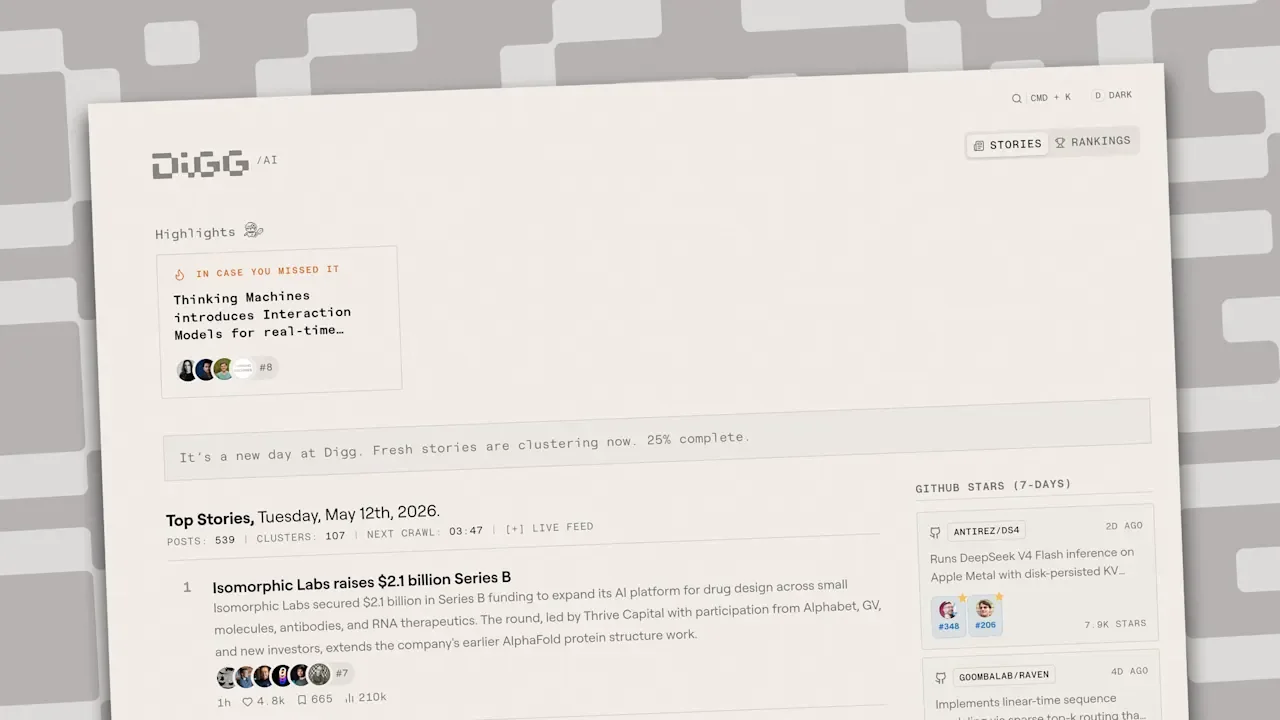
When the history of the internet is written, the story of Digg might be one of its most fascinating chapters. The site that established the template later popularized by Reddit has ebbed in and out of relevance for much of its existence. Two months ago, it shut down. Now it’s back once again, and it wants to keep users up to speed on the fast-growing world of artificial intelligence. Like an overly determined game of whack-a-mole, the Digg website is live once more, with a headline reading “Hello Again” on its home page and a new mission statement. “The bet is simple: the internet has more noise than ever, and the people who can sort signal from it have never been more valuable,” reads the note from founder Kevin Rose. “We’re starting with AI. It’s the noisiest, fastest-moving space on the internet right now. Papers, launches, threads, hot takes flying past faster than anyone can keep up with. If we can surface what actually matters here, we can do it anywhere.” Digg says it plans to monitor the 1,000 “most thoughtful voices in AI” to see what they’re paying attention to. It will then rank those stories to let users know what matters most. Among the sources the site is following are Sam Altman, Elon Musk, Andrej Karpathy, and Geoffrey Hinton. The list also includes professors, investors, researchers, and reporters focused on the AI beat. Rather than using the site’s well-known URL, though, the home page currently refers users to a secondary site: di.gg/ai. That’s only temporary, Digg says. “When things are ready, we’ll move home to digg.com,” the website reads. Also, other areas of focus beyond AI will be forthcoming, Rose said. Déjà vu If you’re viewing this latest direction for Digg with skepticism, that’s understandable. Last year, Rose and Alexis Ohanian bought Digg back with plans to revive it. Backed by True Ventures, where Rose is a partner, and Ohanian’s Seven Seven Six, the revived Digg said it would offer a more human-centered experience. That proved challenging. Justin Mezzell, who was CEO at the time but has seemingly stepped away from the company, announced in March that the relaunch, which had launched just two months earlier, had been scrapped after the site was quickly overwhelmed by bots and AI agents. Spammers, meanwhile, sought to boost their SEO rankings by exploiting Digg’s still-considerable authority with Google. “Within hours, we got a taste of what we’d only heard rumors about,” he wrote. “The internet is now populated, in meaningful part, by sophisticated AI agents and automated accounts. We knew bots were part of the landscape, but we didn’t appreciate the scale, sophistication, or speed at which they’d find us.” Digg also said it underestimated the loyalty users had built with competing sites. Luring them back after such a long absence proved difficult, especially as bots dominated the platform. The latest version of Digg makes no mention of how it plans to overcome those challenges. Something new, something old Like the original Digg, the new site eschews the bells and whistles of modern platforms in favor of a bare-bones approach. The newsfeed sits against a beige background reminiscent of a 1980s computer screen. The site offers headlines and stripped-down summaries of the news, generally just one or two sentences long, followed by what appear to be X.com profiles of the people discussing the story. The site refreshes in real time, and top stories are displayed for both the current and previous day. Rose’s goal is to return Digg to the prominence it once enjoyed. When it was founded in 2004, the repository of internet links quickly became a must-visit destination, with users upvoting and downvoting stories they liked or loathed. That formula has since become commonplace across the web. Digg grew to an estimated valuation of $160 million by 2008. A 2010 redesign was so unpopular, however, that much of its audience migrated to Reddit, which offered a similar voting system. Rose sold the company in 2012 and remained absent until he repurchased it alongside former rival Ohanian last year. View the full article

-
Amazon can deliver anything—including, increasingly, eyeballs to advertisers. And now, its upcoming slate of content, including an adaptation of the best-selling novel Fourth Wing and a list of young adult content, is sure to have advertisers excited. The e-commerce giant held its annual Upfront event at the Beacon Theater in New York City on Monday night, showcasing new TV shows, movies, sports, and podcasting content destined for its Prime Video streaming platform and podcasting platforms. While there were big names in attendance—the event included appearances by Oprah Winfrey, Chris Pratt, Arnold Schwarzenegger, and Michael B. Jordan, among others—what stole the show was the immensity of Amazon’s advertising apparatus. Alan Moss, vice president of global advertising sales at Amazon Ads, said users watched 17% more content on its streaming platforms over the past year than during the preceding year. Tanner Elton, VP of advertising sales at Amazon, noted that the company had penetrated 90% of U.S. households in one form or another, and as a result, had reams of data and customer insights to draw on for advertisers. One Amazon exec even noted that it actively “works backwards from the customer” to create content, analyzing their consumption habits, and then working to create content that’s likely to resonate. That content is in theory more likely to convert for advertisers. And in an ongoing expansion of its entertainment offerings, Amazon is continuing to up the ante on sports content, for instance, and expanding its exclusive podcast offerings, producing more TV shows and movies. Amazon said that the NFL Wild Card playoff game, streamed exclusively on Prime earlier this year, drew a record 31.6 million viewers. Not only that, but those who watched it were on average seven years younger than viewers of NFL playoff games broadcast on linear TV, and 41% more likely to engage with advertiser content in some shape or form. What new programming is coming to Prime? As for the new and upcoming content? Here’s a brief rundown of some of the projects announced at the event: The Oprah Podcast will be distributed exclusively on Wondery starting in July, and produce two new episodes per week. Duke University basketball signed an exclusive streaming deal with Prime, and next season, three high-profile games will be shown via the platform: Matchups against UConn, Michigan and Gonzaga. Amazon is leaning hard into young adult (YA) content, with new seasons or content for Off-Campus, The Summer I Turned Pretty, and others. The hit show The Terminal List, starring Chris Pratt, is getting a second season. An adaptation of the 1980s series Voltron is in the works, as is an adaptation of the video game series God of War. A new series based on Bladerunner is also in the works, called Bladerunner 2099. Oscar-winning actor Michael B. Jordan announced a trio of projects: The Greatest, a series focused on Muhammad Ali; Delphi, a series set in the Creed and Rocky universe; and an adaptation of the best-selling novel Fourth Wing, by Rebecca Yarros. View the full article

-
As a small business owner, comprehension vital accounting services can streamline your operations and improve financial performance. These services, like bookkeeping and payroll processing, help maintain accuracy in financial records and guarantee timely tax compliance. By leveraging financial statement preparation and accounts management, you can make informed decisions that promote growth. Curious about how each service can directly impact your business? Let’s explore these significant components in more detail. Key Takeaways Accurate bookkeeping ensures financial health by maintaining precise records of transactions and facilitating timely financial statements. Payroll processing guarantees correct employee compensation, compliance with regulations, and timely paycheck distribution, enhancing employee satisfaction. Tax preparation and compliance minimize liabilities by adhering to deadlines and local regulations, ensuring professional engagement for potential savings. Financial statement preparation provides insights into business profitability and cash flow, aiding decision-making and securing funding from investors or lenders. Effective accounts management, including receivables and payables, stabilizes cash flow through timely collections and strategic payment scheduling. Bookkeeping Services: The Backbone of Financial Management Bookkeeping services are vital for maintaining the financial health of small businesses. These services involve daily recording of financial transactions, including sales, payments, and receipts, providing an organized overview of your finances. Regular bookkeeping guarantees timely preparation of important financial statements, like income statements and balance sheets, which help you assess your business performance. Effective bookkeeping practices, such as bank reconciliation, identify discrepancies and unauthorized transactions, promoting accurate cash management. By utilizing professional bookkeeping services, you can reduce errors in financial reporting and tax filing, guaranteeing compliance with regulatory requirements during the process of minimizing tax liabilities. Investing in these accounting services for small businesses allows you to concentrate on core activities without the hassle of maintaining your financial records. With an organized system in place, your records will be IRS-ready year-round, providing peace of mind as you grow your accounting service small business. Payroll Processing: Ensuring Accurate Employee Compensation In the realm of payroll processing, getting employee compensation right is essential. You need to calculate wages accurately, guarantee proper tax withholding, and distribute paychecks on time. Accurate Wage Calculations Accurate wage calculations are vital for effective payroll processing, as they guarantee employees receive the correct compensation for their work hours, including any overtime and applicable deductions like taxes and benefits. Adhering to federal and state regulations is imperative, as you must comply with minimum wage laws and timely payment schedules to avoid penalties. Utilizing payroll software can simplify this process by automating tax withholdings, generating pay stubs, and ensuring compliance with changing tax laws. Conducting regular audits of payroll records helps identify discrepancies and aligns employee compensation with company policies. In the end, accurate payroll processing boosts employee satisfaction and retention and reduces the risk of costly audits and legal disputes related to wage calculations. Tax Withholding Compliance Payroll processing doesn’t stop at accurate wage calculations; it also includes the vital task of tax withholding compliance. You need to accurately calculate and withhold federal, state, and local taxes to avoid penalties. Staying updated with the latest tax rates and regulations, such as the IRS’s federal income tax withholding tables, is critical. Moreover, you must report and remit payroll taxes, including Social Security and Medicare contributions, which total 15.3% of wages, shared equally between you and your employees. Regular payroll audits help you identify discrepancies and guarantee that compensation aligns with agreed-upon wages. Timely Paycheck Distribution Ensuring timely paycheck distribution is essential for maintaining employee satisfaction and motivation, as over 50% of workers report that receiving their pay on time directly affects their overall job contentment. Payroll processing involves calculating wages, withholding taxes, and issuing paychecks in compliance with federal and state regulations to avoid penalties. Paycor minimizes financial errors, as even minor mistakes can lead to significant discrepancies in employee compensation and tax reporting. Utilizing payroll software can streamline this process, cutting administrative time by up to 40% and improving tracking of employee hours and overtime. Furthermore, regular payroll audits help maintain accuracy and compliance, identifying potential issues before they escalate, ensuring employees receive the correct compensation swiftly. Tax Preparation and Planning: Navigating Compliance and Savings In regard to tax preparation and planning, comprehending your compliance requirements is key to minimizing your tax liabilities. You’ll want to stay informed about filing deadlines and leverage tax-saving strategies that apply to your specific business situation. Tax Compliance Requirements Steering through tax compliance requirements can feel overwhelming for small business owners, especially as regulations vary considerably by state and industry. In Texas, for instance, if your annual revenue exceeds $1,230,000, you’re subject to the Texas Franchise Tax, which necessitates careful planning to avoid penalties. Furthermore, businesses face an 8.25% combined Sales and Use Tax on taxable goods and services, requiring diligent record-keeping to guarantee compliance and avoid audits. It’s also crucial to understand industry-specific taxes, like hotel occupancy tax for hospitality businesses. Engaging in regular tax planning helps minimize overall tax liability throughout the year, as strategic year-end moves and proper management of deductions can greatly affect your tax outcomes, assuring your business remains compliant and financially healthy. Tax Savings Strategies Tax savings strategies play a crucial role in helping small businesses minimize their overall tax liability and navigate the intricacies of tax preparation and planning. Here are some key strategies to reflect on: Utilize Section 179 Deduction: Deduct the full purchase price of qualifying equipment and software. Conduct Regular Financial Reviews: Make informed decisions throughout the year that positively affect tax outcomes. Understand Local Tax Regulations: Be aware of Texas Franchise Tax for businesses with revenue over $1,230,000. Engage Professional Accounting Services: Guarantee compliance with current tax laws as you identify potential savings. Filing Deadlines Awareness Awareness of filing deadlines is crucial for small businesses, as it directly impacts compliance and potential tax savings. Federal income tax returns are due by April 15, with partnerships and S corporations needing to file by March 15. If you’re self-employed or own certain corporations, keep in mind that estimated tax payments are due quarterly on April 15, June 15, September 15, and January 15 of the following year. Texas businesses with revenues over $1,230,000 should note that the Texas Franchise Tax has similar deadlines. Furthermore, Sales and Use Tax returns are due on the 20th of each month for monthly filers, whereas annual filers have a January 20 deadline. Staying organized with these dates helps avoid penalties and optimize tax savings. Financial Statement Preparation: Key Insights for Decision Making When you prepare financial statements, you’re not just creating documents; you’re developing critical tools that inform your business decisions. These statements, including balance sheets, income statements, and cash flow statements, provide a thorough overview of your financial health. Accurate financial statements are crucial for evaluating your operational performance, allowing you to track revenues and expenses effectively. Here are four key insights to reflect on: Profitability Evaluation: A well-prepared income statement helps you analyze your profitability over specific periods. Regulatory Compliance: Regularly prepared statements guarantee compliance with necessary regulations. Cash Flow Insights: Timely insights into cash flow enable effective decision-making. Funding Opportunities: Well-crafted financial statements can help secure financing from lenders and investors by demonstrating your stability and growth potential. Utilizing these statements strategically can greatly impact your business’s success. Accounts Receivable and Payable Management: Maintaining Cash Flow Financial statements provide a clear picture of your business’s financial health, but managing accounts receivable and payable is equally important for maintaining cash flow. Effective accounts receivable management guarantees you’re collecting payments on time, which can reduce your days sales outstanding (DSO) and stabilize cash flow. By implementing clear invoicing processes and follow-up reminders, you could decrease late payments by up to 30%, improving your liquidity. On the other hand, a healthy accounts payable system allows you to manage cash outflows strategically. It helps you capitalize on vendor discounts as well as avoiding late fees. Regularly reviewing accounts receivable aging reports can help you identify slow-paying customers and tackle potential collection issues proactively. Furthermore, utilizing accounting software can automate invoicing and payment tracking, streamlining these processes to save you time and reduce errors, ultimately enhancing your business’s financial management efficiency. Bank Reconciliation: Keeping Financial Records Accurate Maintaining accurate financial records is vital for any small business, and monthly bank reconciliation plays a key role in this process. By ensuring that your bank statements align with your accounting records, you can identify discrepancies such as lost checks or unauthorized transactions. Here are four key benefits of regular bank reconciliation: Detects embezzlement: Spotting unusual transactions helps protect your business from potential fraud. Minimizes bank charges: It reduces the risk of erroneous fees that could negatively impact your cash flow. Facilitates cash management: You gain a clear picture of available funds and upcoming liabilities, aiding in better financial planning. Provides peace of mind: Knowing your financial records are accurate and up to date is fundamental for tax preparation. Engaging in monthly bank reconciliation not merely improves accuracy but additionally allows for timely adjustments and informed decision-making, boosting your overall financial performance. Unlimited Consultations: Support for Your Financial Questions Having access to unlimited consultations as part of your accounting service package can greatly improve your grasp of your business’s financial setting. With these consultations, you can ask any financial questions without worrying about additional fees, allowing you to gain clarity on complex issues. This support is beneficial regardless of your accounting knowledge level, ensuring you feel comfortable discussing your concerns and inquiries. Open communication is emphasized during these consultations, helping you stay informed about your financial health and the implications of your choices. Regularly engaging with your accountant encourages proactive financial management, allowing you to address potential issues before they escalate. Frequently Asked Questions What Accounting Services Do Small Businesses Need? Small businesses typically need several key accounting services to guarantee financial health. You’ll require bookkeeping for daily transactions, accounts payable and receivable management, and payroll processing for accurate employee compensation. Financial statement preparation, including balance sheets and income statements, is vital for evaluating performance. In addition, tax preparation and planning help minimize liabilities, whereas regular bank reconciliations maintain accurate records. Finally, unlimited consultations with accounting professionals provide ongoing support for financial decision-making. What Accounting Is Needed for a Small Business? For a small business, you need thorough accounting practices to guarantee financial accuracy and compliance. Key services include bookkeeping to track daily transactions, payroll processing for employee payments, and tax preparation to meet legal obligations. Regular financial statement preparation allows you to assess profitability and performance. Furthermore, maintaining a clean general ledger minimizes errors, whereas monthly Bank of America reconciliations help detect discrepancies, guaranteeing your financial records remain accurate and up-to-date. What Is the Average Cost of a CPA for a Small Business? The average cost of a CPA for a small business varies considerably, typically ranging from $150 to $300 per hour, depending on their expertise and your location. Monthly retainers can fall between $300 to $3,000 or more, influenced by your business’s complexity. For specific tasks, like tax preparation, fees often start at around $500. Be aware of potential hidden costs for additional services, so clarify pricing structures upfront with your CPA. Which Accounting Package Is Best for a Small Business? Choosing the best accounting package for your small business depends on your specific needs. Consider the complexity of your transactions and required services, like bank reconciliation, financial statements, and consultations. Packages typically range from $300 to over $3,000 monthly. Look for providers with expertise in your industry and verify their credentials. A thorough package won’t just guarantee compliance but will additionally provide strategic guidance to help you make informed decisions for growth. Conclusion By utilizing these crucial accounting services, you can greatly improve your small business’s financial health. Accurate bookkeeping, efficient payroll processing, and thorough tax preparation not only guarantee compliance but additionally promote strategic planning. Managing accounts receivable and payable effectively helps maintain cash flow, whereas regular bank reconciliations keep your records precise. Furthermore, unlimited consultations provide ongoing support for your financial queries. Embracing these services can streamline your operations and empower you to make informed decisions for your business’s future. Image via Google Gemini and ArtSmart This article, "7 Essential Accounting Services for Small Businesses" was first published on Small Business Trends View the full article
-
In a trial featuring a clash between Elon Musk and OpenAI CEO Sam Altman, neither of the tech titans has emerged as an overly sympathetic character. But nobody has more to lose than Altman, who is expected to take the stand this week to defend himself. Already, testimony about Altman’s turbulent tenure at the ChatGPT maker has become prime fodder for internet jokes. One piece of evidence that has inspired countless memes was a text exchange between Altman and a company officer, Mira Murati, in 2023 during his short-lived ouster as CEO, when Altman asked if things were moving “directionally good or bad” and she wrote back: “Sam this is very bad.” Musk, the world’s richest man, is seeking Altman’s second ouster from the company leadership as part of a civil lawsuit accusing him of betraying their shared vision for OpenAI. Since its start as a nonprofit funded primarily by Musk, Open AI has evolved into a capitalistic venture now valued at $852 billion. Even if Musk loses, the trial has invited further scrutiny of Altman’s leadership at a pivotal time for the company and its competition with Musk’s own AI firm and another rival, Anthropic, formed by a group of seven ex-OpenAI leaders. All three firms are moving toward planned initial public offerings that are expected to be some of the largest ever. A jury that’s already heard about Altman’s character from a parade of his former allies and adversaries will ultimately decide the verdict. But the repercussions could reverberate widely. “This is not looking good for any of them and I think that that’s a little bit unfortunate for the AI industry at a time when the public perception of AI is quite negative and seems to be getting worse,” said Sarah Kreps, director of Cornell University’s Tech Policy Institute. Musk warned Altman would be one of America’s ‘most hated’ men The lawsuit accuses Altman and his top lieutenant, Greg Brockman, of double-crossing Musk by straying from the San Francisco company’s founding mission to be an altruistic steward of a revolutionary technology. The lawsuit alleges they shifted into a moneymaking mode behind his back. Shortly before the trial began, Musk abandoned a bid for damages for himself and instead is seeking an unspecified amount of money to be paid to fund the altruistic efforts of OpenAI’s charitable arm. In a text exchange with Brockman proposing a possible settlement, Musk warned that Brockman and Altman “will be the most hated men in America” as a result of the trial. While Musk, the head of SpaceX, Tesla and a slew of other companies, was well known by the San Francisco Bay Area jury pool, fewer knew who Altman was before the start of the trial, even if they were familiar with ChatGPT. As the trial has played out in a federal courtroom in Oakland, California over the last two weeks, jurors have heard from witnesses including OpenAI ex-board members Helen Toner and Tasha McCauley, who spoke about the decision to fire Altman in 2023 before they were themselves ousted from the board of directors when Altman returned to his role. In video testimony last week, Toner said a starting point for the decision to oust Altman was when OpenAI co-founder Ilya Sutskever, a respected AI scientist, reached out to confide some of his own concerns. “A phrase we used was ‘a pattern of behavior,’ so no one single cause,” Toner said. “The pattern of behavior related to his honesty and candor, his resistance of board oversight.” Sutskever was instrumental in the unsuccessful attempt to oust Altman but later said he regretted his role in the shakeup. In his own testimony Monday, Sutskever confirmed that he wrote a 2023 memo to OpenAI’s board that characterized Altman as pitting his executives against one another and exhibiting a “consistent pattern of lying” that was causing a loss of trust and productivity. Sutskever said Altman’s behavior contributed to an environment that was “not conducive” to the company’s goals, including its mission to safely build artificial general intelligence. He said he later backtracked and supported Altman’s reinstatement because he was concerned about what would happen to a company he worked hard to create and “cared very much about.” “I felt that, had I not done this, the company would have been destroyed, and I felt that this was a Hail Mary,” he testified. OpenAI begins presenting its side The trial has carried risks also for Musk, who is pursuing an initial public offering this summer for his rocket ship maker, SpaceX, which could make him the world’s first trillionaire. Among the witnesses has been Shivon Zilis, a former OpenAI board member who served as a conduit between Musk and OpenAI’s leaders and also didn’t disclose that Musk was the father of her two young twins, according to trial testimony. Not until midday Monday, on the third week of the trial, did OpenAI begin calling its own witnesses, starting with Bret Taylor, the current chair of OpenAI’s board who painted a more positive portrait of Altman’s leadership. “I think Sam has done a great job as CEO,” Taylor said. “He’s been forthright with me and the other board members.” Syracuse University professor Shubha Ghosh, an expert in business and technology law, said regardless of the outcome of the case, he has doubts about Altman staying on as CEO of OpenAI in the long run. “A lot this of might depend upon a testimony,” he said. “And I don’t know what he’s going to say or how he’s gonna say it. But even like the best case, movie theater type performance, with all the music playing and the angels descending or whatnot, I don’t see him coming off as a fairly strong leader, especially (since) this case has gone this far.” —Barbara Ortutay and Matt O’Brien, AP Technology Writers View the full article

-
As the job market shifts dramatically under the influence of artificial intelligence, small business owners may wonder how to adapt and thrive. Salesforce’s recent initiative to recruit AI-native graduates could provide a significant blueprint for success in an era defined by technological progress and evolving workforce needs. Today’s college graduates are navigating perhaps the toughest job landscape in years, with AI predicted to disrupt traditional work roles substantially. In fact, entry-level hiring has already dropped by 6%, prompting small businesses to reevaluate how they build their teams. Recognizing this shift, Salesforce is stepping up its efforts to harness emerging talent, launching a new Builder program aimed at recruiting 1,000 graduates and interns to facilitate the development of its AI platform, Agentforce. Graduates now entering the workforce are often not just consumers of AI but innovators shaping its future. “The AI-native generation entering the workforce today isn’t threatened by AI. They’re the ones building it,” said Nathalie Scardino, Chief People Officer at Salesforce. This cohort displays remarkable proficiency with AI tools—reportedly being four times more likely to engage with AI daily, which enables them to deliver results three times faster than their more traditional counterparts. Small businesses could significantly benefit from this trend by considering the following key takeaways: Adaptation to AI: The incorporation of AI-native talent can enhance operational efficiencies and improve service delivery. These individuals are versed in AI technologies and can help drive productivity in ways that older managerial staff might not. Fostering Innovation: By employing AI-native graduates, small businesses can create an environment ripe for collaboration and innovation, with new workflows designed to harness the advantages of AI capabilities. Real-World Implementation of AI: Salesforce’s Builder program encourages its participants to engage in hands-on projects in areas like engineering and product development, offering small businesses a roadmap for facilitating similar experiences. Engaging emerging talent through practical projects, such as hackathons and collaborative workspaces, can attract dynamic individuals ready to make impactful contributions. While the potential benefits are substantial, small business owners should also be aware of potential challenges. Cultural Fit: AI-native workers may come with a different working style or expectations. A clash of generational work ethics and practices could pose hurdles. Small businesses need to create inclusive environments that accommodate diverse approaches to work. Skill Adaptation: Integrating new technology and training staff may require upfront investment in time and resources. Small firms may question how to navigate these changes without compromising operations. Retention Strategies: As demand for skilled AI talent rapidly increases, retaining these workers could become challenging. Organizations should consider developing mentorship programs and career pathways to maintain morale and commitment. Salesforce isn’t just recruiting talent; it’s actively reshaping how work gets done through its Emerging Talent Playbook. This guide offers strategies for small businesses to attract and engage AI-savvy individuals. According to the playbook’s 3As framework—Attract, Assess, and Activate—companies should engage emerging talent right from their educational experiences, evaluate their adaptability to evolving AI technologies, and integrate them through structured onboarding processes. The principles laid out in the playbook aim to prepare small businesses for a future in which adaptability to AI will be crucial. “Businesses can’t afford to wait for their workforce to catch up to AI,” Scardino added, reinforcing the urgency for organizations to act now. With the correct strategies and an emphasis on integrating AI-native talent, small businesses can position themselves not just to survive in an AI-driven landscape, but to thrive. For more detailed insights from Salesforce’s initiatives and findings, visit the original post here. Image via Google Gemini This article, "Salesforce Launches Initiative to Hire 1,000 AI-Native Graduates" was first published on Small Business Trends View the full article
- Today
-
Prebiotic soda brand Poppi has come a long way since it first appeared on Shark Tank under its original name, “Mother Beverage,” in 2018. Allison Ellsworth cofounded Poppi with her husband Stephen Ellsworth—but before becoming multimillionaires, though, the Ellsworths were maxing out their credit cards to launch Poppi. “My husband told me I was absolutely crazy, but he trusted the vision,” Ellsworth said. “So we maxed out our credit cards, sold one of our cars to buy bottles [and] opened our own manufacturing facility.” The pair invested $90,000 into the business in the first year, while her husband worked various gigs to cover their mortgage. In 18 months of launching what was then “Mother Beverage,” the Ellsworths generated half a million dollars in revenue. Allison EllsworthFast Company After locking in a deal with Rohan Orza on Shark Tank, the Ellsworths rebranded “Mother Beverage” to Poppi. All the while, Ellsworth was pregnant and the couple was raising their kids, juggling school dropoff with early morning Zoom meetings. “I think it’s OK to live in chaos, and to like it,” Ellsworth told the Wall Street Journal. “A lot of people talk about work-life balance. I think if you want to be successful, you kind of have to sacrifice that.” While some see long hours and endless availability as a badge of honor, that’s not the case for all—and can come with the risk of burnout. Last year, a survey found that 85% of people said work-life balance was more important to them than pay. Still, another 2025 survey found that two-thirds (65%) believed that sacrificing work-life balance is necessary to be successful. While workers want balance, they believe that grinding is the price of success. For the Ellsworths, that risk seems to have paid off. In the years since its rebrand, Poppi’s TikTok marketing during the pandemic—combined with the drink’s vibrant packaging and flavor options—created a loyal following by billing itself as a healthier choice to other sodas. Last year, the Ellsworths became centimillionaires when they sold Poppi to PepsiCo for nearly $2 billion. After the exit, Ellsworth said she felt a sense of sadness. “People don’t talk about the post-exit blues,” she said. One year after the sale, though, Ellsworth feels content and prepared to start her next business venture with her husband. “It almost takes a year, when you get that amount of wealth, to set it up correctly,” Ellsworth said. “We didn’t know how rich we were,” Ellsworth added. “You don’t know how rich you are until you start spending money. I was like, ‘am I spending too much money on clothes? Are we spending too much money on travel?’ And my financial adviser kept saying, ‘you guys are fine.’ But it’s so hard to make that big of a jump.” Since the exit, Ellsworth told the Journal that she’s upgraded her home, bought two more for her mom and aunt, splurged on a $1 million monthlong family vacation to Europe, hired a private chef, spent $27,000 on a stylist and more. “Some might call it materialistic, but I worked really hard for those things,” Ellsworth said. The couple has also opened investment accounts with $5,000 each for their three children between the ages of 4 and 9. “They did buy Pepsi stock […] They said ‘now we can be investors in Poppi.’ It was really cute,” Ellsworth said. In the interview, Ellsworth talked WSJ reporter Gunjan Banerji through her favorite heels, from Prada to Christian Louboutin. “What’s the point of having all this money if we can’t have fun with it?” Ellsworth asked. View the full article

-
A reader writes: I work for a large company and am my manager’s (“Sharon”) only direct report. Sharon is professional and high-performing the three days a week she is in the office. However, on her work-from-home days and even on her scheduled days off, her behavior becomes deceptive, erratic, and deeply disruptive. I choose to work in the office five days a week and arrive at 7 am — an hour before the rest of the team — which has made me the “face” of the team while Sharon has become a digital ghost. Some examples of her erratic behavior: • On a remote day, Sharon claimed she couldn’t work due to a failure in our software. Since our department manages that software, I checked the logs; no such failure existed. • She once manufactured a “critical emergency” on her scheduled day off, calling me at 7:30 am claiming she couldn’t click a link because her cat was sitting on her phone, and asking me to submit a compliance report for her. Peer managers later confirmed that there was no urgency to this request, and it could have waited until the next day when she was back at work. • Despite an HR policy mandating that cameras be on during remote meetings, Sharon remains camera-off at home but camera-on in the office. • She sometimes skips our team’s mandatory morning status meetings, later calling me for “debriefs” that interrupt my own work. Minutes for these meetings are uploaded daily by a dedicated note-taker to a shared digital document accessible by our entire team, so there shouldn’t be a need for her to call me about them when she can simply check this document. Recently, this has turned into what feels like active career sabotage: • I have led a high-profile app project since long before Sharon arrived. She asked me to cancel the twice-weekly status meetings about it that I had been leading since before she arrived; these meetings were an essential tool for staying in the loop about development and testing progress, and without them I feel like I don’t have a proper grasp on progress, even as the app has grown in complexity in recent months • She frequently cancels our scheduled 1:1s, instead relying on phone calls out of nowhere on WFH days or asking me to “swing by” her desk with zero notice. I never know what she’s going to ask about, and it feels designed to keep me off-balance. • During these calls, she has explicitly told me not to take notes and to “just listen.” Note-taking is essential for my focus, but she seems determined to eliminate any audit trail of her instructions. • She is questioning my “bandwidth” to continue as project lead on the app. Yet she refuses to delegate my low-level grunt work, despite me providing full documentation for a hand-off to other team members • In the two years she has managed me, I have received the lowest performance scores of my time at this company. During a recent “swing by” session where she claimed my performance had “dropped sharply,” I offered to show her my detailed weekly task logs. She waved me off, said the data wasn’t relevant, and continued to insist I lacked bandwidth. • She recently told me that if our next release is delayed, she will have to “justify” to a high-level VP stakeholder why she gave me such a “high” score (the score was actually quite low). I have a great long-term relationship with this VP, and this felt like a direct threat to my reputation. How do I handle a manager who makes formal accusations about my performance but refuses to look at the evidence that disproves them? Also, how do I protect my reputation with the VP when my manager is actively trying to eliminate my audit trails? And finally, what do you make of her erratic behavior? I have my own thoughts and suspicions, but I would love to have your input on it in case there’s an angle I’m not considering. Yeah, something is up with Sharon, although I don’t know what it is. If she weren’t professional and high-performing on the days she’s in the office, I’d suspect this was just garden-variety incompetence and disorganization, combined with a low work ethic, and that she was trying to hide her own ineptness by painting you as the problem. But if she’s good at her job when she’s in the office, that falls apart. I do wonder if, due to whatever’s going on during her days away, she’s feeling threatened by your competence and that’s why she told you to cancel your app status meetings and is making what sound like baseless threats. But what is it that’s creating such a different Sharon when she’s not there? Is she working a second job / hiding a meth problem / possessed by a Dybbuk? I have no idea. For what it’s worth, some of this on its own wouldn’t be that big of a deal. There are plenty of managers out there who skip or cancel meetings and then want updates at inconvenient times later (and it’s not usually designed to keep you off-balance) or who stay camera-off at home. But lying about an easily checked software failure? Claiming her cat sitting on her phone was a “critical emergency” when the report she asked you to do in her place wasn’t even urgent? Forbidding you from taking notes when you talk to her? Refusing to look at actual facts (like your weekly task logs) when she criticizes your performance and your bandwidth? Something is up here. She may indeed be actively trying to sabotage you, but she also may be flailing so badly at her job that that’s just a secondary effect. Regardless, I don’t see good solutions that include you continuing to work for Sharon long-term. Do you have the ear of anyone senior who you can discreetly talk to about what’s going on — maybe that high-level VP who you mentioned you have a great relationship with? You could explain Sharon’s erratic behavior on her out-of-office days and that she’s been making unwarranted accusations about your work while refusing to look at actual data that would disprove them, and ask for their help navigating it. Or, in theory, you could ask HR for their help with that last part (responding to performance concerns when Sharon won’t look at actual data), but on something like this I’d rather loop in someone with more capital and influence than HR usually has when there are problems with a manager. The post my manager’s erratic behavior is sabotaging my work appeared first on Ask a Manager. View the full article
-
Most of the executive teams I work with have been investing in AI for a few years. The ones who are frustrated are not the skeptics. They are the believers whose programs have not connected to the P&L. They have the pilots, the internal momentum, the board slide showing everything in flight. What they do not have is a clear line between that activity and business performance, and at this point in the AI cycle, that gap is no longer acceptable. I spent several years running AI at scale inside Kroger and its data science subsidiary 84.51°, where we processed millions of predictions per second across thousands of store locations. We measured work in margin, basket size, and customer retention rather than how many models were in production, whether the pilots were impressive, or if the work moved the business. That experience shaped how I think about what AI requires from leadership, and what most leadership teams are still getting wrong. The executives I work with are not confused about whether AI matters. They are managing tighter margins, more expensive capital, and boards that want results rather than roadmaps. In my experience, closing that gap comes down to three things. 1. Value has to show up on the P&L Most companies can tell you exactly how many AI models they have running. Very few can tell you what those models are worth to the business. AI can improve both sides of the income statement through better personalization and smarter pricing that support revenue. Automation and sharper forecasting cut costs and waste, but most companies are spreading investment across too many initiatives with too little connection to enterprise value. They are generating activity without changing their economics. The question worth asking is not where the company is using AI. It is where AI is changing the unit economics of the business. Most organizations cannot answer the second one. 2. Velocity is an underrated strategic advantage Almost every large organization knows more than it can act on. Data and insight exist, but the distance between signal and response is slow. Decision cycles drag, functions operate from different assumptions, and by the time internal alignment happens, the moment has often passed. I watched this play out firsthand in financial services. A team built models to identify customers of competing firms most likely to switch in a specific line of business. The analysis was sound and the models performed. What followed was months of organizational hesitation and revisited governance questions long after the pilot had proven viable. By the time leaders made a decision, the market conditions had shifted, and they exited the business. Someone inside summed it up perfectly, “The surgery was successful, but the patient was dead.” The technology worked. The moment was gone. AI can close that gap through faster reporting, better forecasting, and earlier anomaly detection. It is not about doing things cheaper. It is about being able to move when it matters, and that is as much a leadership problem as a technology one. 3. Confidence is not a soft outcome Today, executives are managing risk in a compressed timeframe that most have never experienced. Markets shift quickly, reputational risk moves faster, and the leaders who hold up tend to be the ones with genuine visibility into what is happening and enough discipline to act decisively. AI can extend that visibility by leveraging earlier signals, better scenario modeling, and a clearer line of sight into where problems are building. It does not replace judgment. It raises the premium on judgment, because faster decisions with better information still require someone who knows what matters and is willing to act. When it works, it shows up in how the leadership runs the business and how they are perceived by boards, investors, and the teams being led. Risk does not disappear with caution. It accumulates when decisions are delayed. OWN THE AGENDA None of this happens because a company acquires the right platform or adds AI to someone’s title. It happens because the CEO owns AI as a business agenda, not a technology agenda. That means being specific about where AI changes the economics of the business, measuring outcomes rather than effort, and being willing to cut work that generates activity without generating value. That last part is harder than it sounds when there is internal momentum behind programs and people whose identities are tied to them. The companies that understand where the connection between the work and the results shows up in the numbers are setting a standard for AI use that is worth following. Todd James is the founder and CEO of Aurora Insights. View the full article

-
Outlook is among the best Gmail alternatives for most people. Microsoft's email service is free and has a bunch of features that Gmail does not. At the same time, there are some shared features you'll likely want to use if you're coming from Gmail—they're just not enabled by default. I've been using Outlook's email service for over a decade, and these are the best hacks I've discovered while sorting through my inbox. Disable image downloads to prevent email tracking by shady companiesCompanies and organizations often use pixel tracking to see if you've opened their emails. Every one of these emails includes a hidden tracking pixel, which sends read receipts to the sender when opened. Outlook's default settings protect you from the worst of it, but you should take a few additional steps to safeguard your account. Go to Outlook.com and log in to your account. Click the gear icon in the top-right corner to open settings. Now, go to Mail > Junk email. Under "Security options," select Block attachments, pictures, and links from anyone not in my Safe senders and domains list. Note that this might not be for everyone, as it requires you to manually vet people who send emails to you. From a security standpoint, however, it's your best tool against email tracking, phishing, and scam attempts. You can also go to Outlook settings > Mail > Layout, and choose Don't show sender images to add an extra layer of privacy protection. On a similar note, you can go to the Message handling tab in the same settings page, and uncheck For shopping-related messages show a sender logo and relevant links in the message header. Use "Safe senders" to stop Outlook from sending good emails to spamOutlook's "Safe senders" list lets you add people to a trusted contacts list. Emails from these people won't be sent to spam, and won't be subject to restrictions such as blocked links or attachments—perfect for anyone who uses the hack above. You can use this feature to ensure that important emails, such as account statements from your bank, or paystubs from your employer, are never sent to spam. To get started, go to Outlook settings > Mail > Junk email > Add safe sender. You can also select the Safe mailing lists tab to add mailing lists to the Safe senders list. This is great for newsletters from your favorite publications, or safety-related emails from your companies. Run an automated inbox sweep to delete emails every 24 hours Credit: Pranay Parab One of Outlook's best features is Sweep. It automatically checks your inbox for emails from certain senders, and follows your instructions to manage the clutter. For example, my bank sends me an email for every transaction on my credit card. At one point, I was looking at 150+ unread emails that I had no use for. So, I used Sweep to keep transaction emails from the past 10 days, and archive the rest. To set it up, select any email in your inbox, then choose the Home tab at the top of the page in Outlook's desktop or web apps. Select Sweep, and you'll see a pop-up asking what to do with emails from that sender. There are four options here: Move all messages from the Inbox folder Move all messages from the Inbox folder and any future messages Always keep the latest message and move the rest from the Inbox folder Always move messages older than 10 days from the Inbox folder You also have a drop-down menu to select where you want to move these messages. I usually select one of the last two options above, and move the rest of the messages to the Archive folder, or Deleted Items. I've used this feature for a couple years now, and it works flawlessly in the background. If you ever want to change or delete Sweep rules, go to Outlook settings > Mail > Sweep. Configure gestures to delete emails in one swipeOutlook's mobile apps support gestures to quickly triage emails without opening each manually. You can swipe left or right to archive, delete, or report emails. However, you can customize these gestures to suit your needs. Go to Outlook settings in the mobile apps, and navigate to Email > Swipe Options. On this page, select what happens when you swipe right or left. Some useful options include delete, archive, flag/unflag, mark read/unread, snooze, and read and archive. In Outlook's desktop and web apps, go to Outlook settings > Mail > Customize actions. This will let you configure swipe gestures (for laptops with a touchscreen), and quick actions, which are the buttons that appear on each email in your inbox. I used this to replace the Pin button with Archive as I never pin emails in my inbox. You can select a maximum of four actions for each email. Turn off Copilot AI and disable Microsoft's data collection Credit: Pranay Parab In Outlook's mobile, desktop, and web apps, go to Settings > Copilot, and disable Turn on Copilot. This will turn off almost all AI features in the apps. You should also go to Outlook settings > Mail > Smart suggestions, and turn off Show suggested replies. Microsoft also collects a bunch of data and enables AI services in your Outlook account. If you want to disable this, head to Outlook settings > Mail > Privacy and data > Privacy settings. Turn off all options on this page to disable optional diagnostic data collection, prevent Microsoft from analyzing your emails for "connected experiences," and disable online content linked to emails in your inbox. You can also select Delete history to clear your search history from Outlook. While you're at it, go to Mail > Compose and reply, and disable Microsoft Edge Autofill. With this feature enabled, Microsoft Edge will pull from your Outlook inbox to autofill information, namely flight info. This feature may be useful for those who use Edge a lot, but it's not of much use to those who don't. Try this hidden menu to bulk unsubscribe from junk mail listsWhile working on this article, I discovered Outlook's hidden bulk unsubscribe feature. This feature lists all the subscriptions in your inbox and lets you unsubscribe from all of them without opening a single email. To try it out, go to Outlook settings > Mail > Subscriptions. Click the Unsubscribe button next to any of the lists, and Outlook will handle the rest for you. Switch to Gmail's keyboard shortcuts to speed up email actionsI've never liked Outlook's keyboard shortcuts much. As an example, "Ctrl-N" opens a new email in Outlook. In Gmail, it's "C." While Ctrl-N is the more familiar shortcut, it's not as fast as using a single keystroke. The good news is you can use Gmail's keyboard shortcuts in Outlook and save a lot of time. I love this hack because most people have Gmail as their primary email account, and now you don't have to remember two sets of shortcuts for email. To set this up, go to Outlook settings > General > Accessibility > Keyboard shortcuts. Select Gmail, and you're all set. Google has all of Gmail's keyboard shortcuts listed here, if you need a refresher. Use "Quick steps" to mark emails read and archive in one click Credit: Pranay Parab I find myself marking emails read and archiving quite a bit, and I've set up a single-click workflow using Outlook's "Quick steps." You can do that too by going to Outlook settings > Mail > Quick steps. Give your Quick step a name, choose an action such as Mark as read, and click the Add another action button. You can now select Move to, followed by Archive. On the same page, you can add a keyboard shortcut for this action, and click Save. This is a basic example of what you can do with Quick steps. You can set up any multi-step workflow to suit your needs, which could include categorizing emails, turning emails into tasks, or muting an email conversation, among many others. Set up undo send to prevent accidentally sending incomplete emailsIf you're ever regretted sending an email right after hitting the Send button, you're not alone. In Gmail, the undo send feature is enabled, but that's not true for Outlook. You'll need to enable it manually from Outlook settings > Mail > Compose and reply > Undo send. Use the slider to set a timer between 0 and 30 seconds, which is how long you have to stop sending an email where you've misspelled your own name. (Been there, done that.) Configure Outlook's email filters to highlight messages sent directly to youYou can use Outlook's rules feature to filter out messages where you're marked in the cc or bcc fields of an email. This way, you can focus on emails directly addressed to you, and move the rest to a different folder. To set this up, go to Outlook settings > Mail > Rules, and select Add new rule. Give this rule a name, select I'm not on the To line as the condition. In the actions field, select Move to, and pick a folder. Select Stop processing more rules to avoid further rule conflicts, and click Save. Now, all emails where you're in cc or bcc will go to the new folder, keeping your inbox exclusive to direct messages. View the full article
-
U.K. Prime Minister Keir Starmer told members of his Cabinet on Tuesday that he has no intention of resigning as calls within his Labour Party for him to step down grew louder. Starmer is trying to shore up support within his Cabinet following a febrile few days in the wake of hefty losses for the Labour Party in local elections last week, which if repeated in a national election would see it overwhelmingly ejected from power. The meeting, which lasted about an hour, took place as around 80 Labour backbenchers, or nearly a fifth of the party’s representation in the House of Commons, said Starmer should stand down, or at least set out a timetable for his departure. Under Labour party rules, 81 lawmakers are needed to formally trigger a leadership contest. However, no one has yet announced they will stand as a candidate for the leadership, directly challenging Starmer. First resignation On Tuesday, junior minister Miatta Fahnbulleh became the first member of his government to step down, urging Starmer “to do the right thing for the country” and set a timetable for his departure. Fahnbulleh, who is considered to be on the left of the party, said she was proud of her service, but that the government hadn’t acted with the vision, pace and mandate for change it had been given by voters. “Nor have we governed as a Labour Party clear about our values and strong in our convictions,” she said. Despite winning a landslide election victory in July 2024, Labour’s popularity has sunk and Starmer is getting much of the blame. The reasons are varied, including a series of policy missteps, a perceived lack of vision, a struggling British economy and questions over his judgment — especially over his appointment of Peter Mandelson as U.K. ambassador to Washington despite the envoy’s ties to the convicted sex offender Jeffrey Epstein. Starmer defiant At the start of the Cabinet meeting on Tuesday, Starmer said he took responsibility for the losses in last week’s local elections across the U.K. but that he would fight on. Labour was squeezed from right and left, losing votes to both the anti-immigrant Reform UK and the “eco-populist” Green Party, as well as nationalist parties in Scotland and Wales. The result reflects the increasing fragmentation of U.K. politics, long dominated by Labour and the Conservatives. Starmer said that there’s a process to oust a leader and that it hadn’t been triggered. Under Labour’s rules, candidates must have the support of a fifth of the party’s House of Commons lawmakers — a number that currently stands at 81. “The country expects us to get on with governing,” Starmer said. “The past 48 hours have been destabilizing for government and that has a real economic cost for our country and for families.” That cost was evident in financial markets on Tuesday, with the interest rate charged on British government bonds up by more than those of comparable nations — that shows that investors are putting a higher price on taking on government debt. Some voices of support As Cabinet ministers left 10 Downing Street, some voiced their support for the embattled prime minister. Works and Pensions Secretary Pat McFadden said nobody publicly challenged Starmer at the meeting, while Business Secretary Peter Kyle said the prime minister was showing “really steadfast leadership.” Health Secretary Wes Streeting, long believed to be preparing for a leadership challenge against Starmer, did not comment as he left the meeting. “Wes Streeting, do you want the job, or not?” one person yelled from across the street. “Are you measuring the curtains?” He was among senior ministers who dodged a barrage of shouted questions from a gaggle of reporters outside. Though no one in his Cabinet has challenged Starmer, he will be aware that someone else within the parliamentary party could trigger the leadership process. The next U.K. national election doesn’t have to be held until 2029, but British politics allows parties to change leader midterm without the need for a general election. Starmer had hoped to regain momentum with a speech on Monday intended to kickstart his fightback, and an ambitious set of legislative plans to be set out by King Charles III at the State Opening of Parliament on Wednesday. Danica Kirka in London contributed to this report. —Brian Melley and Pan Pylas, Associated Press View the full article

-
OpenAI is making a clearer push into e-commerce advertising by letting retailers generate ads directly from their product catalogues inside ChatGPT. What’s happening. Retailers can now connect product feeds to ChatGPT, allowing the platform to automatically create ads using product names, images and attributes, instead of building campaigns manually. The ads themselves don’t change for users. They still appear beneath responses and are clearly labelled as sponsored. Why we care. Running ads at scale has been a major barrier for e-commerce brands in ChatGPT. This update removes that friction, especially for retailers with large inventories, by turning product catalogues into ready-to-run ad campaigns. Zoom in. Brands set rules for which products to include, then let the system generate ads automatically. It mirrors how shopping campaigns work on platforms like Google, where structured feeds power both organic and paid visibility. What’s new. Previously, product data could inform ChatGPT’s answers, but it couldn’t be used for advertising. Now, that same data powers both, effectively linking organic presence with paid campaigns. Between the lines. This signals a shift in how OpenAI plans to monetise shopping. Rather than taking a cut of transactions, it’s moving toward capturing ad budgets already spent on platforms like Amazon and Meta. What they’re saying. Industry analyst Debra Aho Williamson called feed-based automation “table stakes,” noting that ChatGPT’s edge lies in serving ads based on conversational intent rather than traditional signals. Ad tech partners like StackAdapt say the setup integrates easily with existing feeds, lowering adoption barriers. Context. The move follows a series of performance-focused updates, including cost-per-click bidding and new conversion tracking tools. Cost-per-action models are also reportedly in development, pointing to a deeper push into performance advertising. What to watch. Expect more retailers to test ChatGPT as a performance channel as setup becomes easier. The bigger question is whether conversational intent can drive conversions as effectively as traditional search or marketplace signals. Bottom line. OpenAI is turning product feeds into ads — making ChatGPT a more viable, scalable channel for e-commerce advertising. View the full article
-
Here is a recap of what happened in the search forums today...View the full article
-
When a website migration goes wrong, the consequences can be a devastating loss of organic traffic and revenue. But what happens when the damage isn’t immediately visible? What if Google is silently deprioritizing your content, page by page, until your traffic has evaporated? This is the case study of how a multinational media organization lost 90% of its traffic following a domain migration, and how addressing a seemingly harmless technical issue — soft 404 errors — helped unlock suppressed traffic potential across 13 country-specific domains. While this case study examines events from 2021–2023, the lessons learned remain timeless and directly applicable to any site facing indexing challenges today. The catastrophic drop In January, 2022, the Brazilian localization of a cryptocurrency news website completed a domain migration. After the transition, traffic didn’t just drop — it plummeted. Comparing December 2021 to December 2022, both sessions and pageviews had fallen approximately 90% year-over-year. According to Google Search Console data, the old domain (xx.com.br) was receiving between 15,000 to 25,000 clicks per day before migration. After migrating to the new subdomain structure (br.xx.com) in January, traffic collapsed and never recovered. It stabilized at around 2,000 to 4,000 clicks per day — a sustained loss that persisted for over a year. The migration coincided with three major Google algorithm updates in June 2021: the core update, spam update, and page experience update. While these updates caused the expected temporary volatility, the Brazilian site showed no signs of recovery. Your customers search everywhere. Make sure your brand shows up. The SEO toolkit you know, plus the AI visibility data you need. Start Free Trial Get started with The migration problem: More than just redirects Domain migrations typically show an initial traffic drop as Google recrawls and reassesses the site. That’s expected. Normally, this traffic recovers within weeks or months. In this case, there were no signs of recovery. The root cause? The old domain continued to be crawled by Google long after the migration. According to the team’s analysis, proper redirect implementation and technical migration protocols weren’t fully implemented, causing Google to split its crawl budget between two domains rather than consolidating authority on the new one. In mid-August 2022, after addressing the migration issues with the SEO and IT teams, there was a subtle uptick — a peak of 12 clicks and 37 impressions on Aug. 29, 2022. While modest, this represented the first signs of recovery and indicated that Google was beginning to properly recognize the new domain. Using Facebook Prophet forecasting on pre-migration data, the team estimated that without the migration issues, the Brazilian site would have exceeded 2 million monthly clicks by early 2022. Instead, it was generating a fraction of that traffic. Understanding the indexing bottleneck While fixing the migration was critical, it revealed a deeper problem affecting not just Brazil, but all 13 of the site’s country domains: a massive indexing backlog. Google’s page processing follows four stages: Crawl: Google discovers and reads pages. Render: The page code is rendered. Index: Pages wait in a queue to be stored in Google’s index. Rank: Pages appear in search results with rankings. The Brazilian site was taking an average of 2 minutes for Google to crawl new articles (an acceptable amount of time for a news site). However, indexing these articles was taking 24 hours. For time-sensitive cryptocurrency news, this delay was catastrophic. By the time the site’s articles were indexed, the news cycle had already moved on. The scale of the site migration problem: 513,000 crawled, but not indexed, pages In January 2023, Google Search Console revealed alarming indexing issues across all domains: Crawled – currently not indexed: 513,369 pages (Brazil alone) Soft 404: 1,193 pages and growing rapidly Alternate page with proper canonical tag: 2,532 pages Discovered – currently not indexed: 524 pages The “Crawled – currently not indexed” issue was particularly concerning. These were pages that Google had successfully crawled but chose not to index. This typically happens when Google considers a page low-quality, duplicate, or not worth the crawl budget. Upon investigation, the team discovered that converter pages (e.g., “/usd-to-thor?amount=250” or “/eur-to-signaturechain?amount=1000”) were being automatically generated at scale. These thin content pages were consuming Google’s crawl budget, causing it to deprioritize the entire domain. The soft 404 time bomb While fixing the migration and removing low-quality pages was important, the most insidious issue was the proliferation of soft 404 errors. A soft 404 occurs when a page returns a 200 (success) status code but actually contains no meaningful content — essentially a “page not found” that doesn’t properly signal its emptiness to search engines. Unlike hard 404s, which clearly communicate that the page doesn’t exist, soft 404s confuse search engines and waste crawl budgets. The data revealed this wasn’t isolated to Brazil. Soft 404 errors were growing exponentially across multiple domains: xx.com (main site): 90,400 affected pages es.xx.com (Spain): 17,700 pages kr.xx.com (Korea): 15,400 pages fr.xx.com (France): 15,100 pages de.xx.com (Germany): 8,010 pages Specifically for France, Google Search Console data showed a direct correlation: As soft 404 errors began accumulating in October 2022, total crawl requests dropped from 60,000–70,000 per day to just 20,000–30,000 per day. Google was literally giving up on crawling the site efficiently. The crawl budget crisis The concept of crawl budget is critical to understanding why soft 404s matter so much. Search engines allocate a finite amount of resources to crawl each website. If Google wastes time crawling broken, empty, or duplicate pages, it has less capacity to discover and index your valuable content. For news sites publishing dozens of articles daily, this creates a vicious cycle: New content doesn’t get indexed quickly, engagement drops, Google further reduces crawl budget, and the problem compounds. In January 2023, Google was wasting significant resources crawling pages that provided no value. This meant: Slower indexing of new, timely content. Reduced visibility in search results. Lost traffic opportunities. Degraded domain authority in Google’s eyes. The systematic fix: Addressing root causes of site migration problems Starting Jan. 31, 2023, the team implemented a comprehensive technical SEO remediation plan focused on three priorities: Urgent: Soft 404 resolution The team identified the source of soft 404 errors and implemented proper HTTP status codes. Pages that truly didn’t exist began returning proper 404 or 410 status codes. Pages with content were fixed to render properly. High priority: Crawl budget optimization Removed or noindexed automatically generated currency converter pages. Implemented stricter URL parameter handling. Used robots.txt to block low-value URL patterns. Set up proper canonicalization for variant pages. Medium priority: Core Web Vitals While user experience metrics were important, the team recognized that fixing indexing issues would have a more immediate impact than optimizing page speed. Core Web Vitals improvements were addressed, but not at the expense of resolving indexing bottlenecks. Get the newsletter search marketers rely on. See terms. The results: Dramatic recovery across all domains Weeks after implementing the fixes, the impact was measurable: Brazil (br.xx.com) Crawled – currently not indexed: Dropped from 513,000 to 220,000 pages (57% reduction). Soft 404 errors: Reduced from 1,193 to 370 pages (69% reduction). Traffic recovery: Visible upward trajectory starting early 2023. Germany (de.xx.com) Indexed pages: Increased from ~150,000 to 370,748. Total clicks: Rose from ~8,000/day average to sustained 12,000-15,000/day. Google Discover traffic share: Jumped from 42% to 58%. Poland (pl.xx.com) Indexed pages: Grew from ~100,000 to 135,556. Total clicks: Increased significantly with multiple traffic spikes above 30,000/day. Google Discover traffic share: Rose from 15% to 86%. Spain (es.xx.com) Google Discover clicks: Increased from ~450,000 to 912,721 total. Traffic distribution: Discover now represents 65% of total traffic. All domains combined By late April 2023, soft 404 errors across all domains had dropped from a peak of approximately 120,000 pages to under 20,000 — an 83% reduction. Most remarkably, the biggest traffic gains came from Google Discover — Google’s personalized content recommendation feed. As indexing health improved, Google began trusting the domains enough to recommend their content more aggressively to users. The Core Web Vitals paradox Interestingly, improvements to Core Web Vitals (page speed, interactivity, and visual stability) showed mixed results: Desktop improvements: Germany: 25.1% → 97.1% good URLs Poland: 20.5% → 68.9% good URLs Korea: 15% → 84.6% good URLs Mobile challenges: Brazil: 0% → 0% (no improvement) Argentina: 0% → 0% Thailand: 0% → 0% Korea: 93.4% → 0.5% (severe regression) Turkey: 94% → 0% (severe regression) The team’s hypothesis: Core Web Vitals performance is heavily influenced by regional factors like CDN proximity, server location, network quality, and device capabilities. Countries with poor mobile infrastructure or greater server distance showed minimal improvement despite technical optimizations. This reinforced an important lesson: Not all technical SEO issues affect all markets equally. A one-size-fits-all approach would have wasted resources by optimizing for metrics that couldn’t improve without infrastructure investment, while the real wins came from addressing indexing fundamentals. Key technical SEO lessons 1. Indexing issues The President almost everything else No amount of content quality, backlinks, or page speed optimization matters if Google isn’t indexing your pages. Before optimizing what’s visible, ensure your content is actually being indexed. 2. Soft 404s are silent killers Unlike hard 404s that immediately alert you to problems, soft 404s quietly accumulate, degrading your crawl budget until you notice traffic declining. Regular monitoring of Google Search Console‘s “Pages” report is essential. 3. Domain migrations require exhaustive validation The Brazilian site’s migration issues persisted for over a year. A proper migration protocol should include: Complete redirect mapping verification. Confirmation of old domain deindexing. Search Console property setup and validation. Multi-week monitoring of both old and new domains. Crawl rate and indexing speed tracking. 4. Crawl budget is real for high-volume sites For sites publishing 10+ articles daily across multiple domains, crawl budget optimization is not optional. Automatically generated pages, URL parameters, and infinite scroll implementations can quickly consume available crawl resources. 5. Regional differences demand regional solutions Core Web Vitals data showed that Brazil, Argentina, and Thailand couldn’t achieve the same performance as European markets. Instead of forcing uniform standards, prioritize fixes tailored to each market that can actually succeed. 6. Google Discover is increasingly critical For news and timely content publishers, Google Discover accounts for a substantial share of traffic in some markets. But Discover only promotes content from sites Google trusts — and technical issues like soft 404s directly erode that trust. Practical site migration implementation guide For teams facing similar challenges, here’s a systematic approach: Weeks 1-2: Audit and prioritize Access Google Search Console for all properties. Export “Page indexing” reports for all domains. Identify the scale of each issue category. Calculate the trend (growing, stable, or declining). Prioritize based on issue volume and growth rate. Weeks 3-4: Fix soft 404s Sample 20–30 URLs from the soft 404 report. Identify common patterns (empty pages, broken functionality, etc.). Implement proper HTTP status codes (404, 410, or fix the content). Validate fixes in Google Search Console. Monitor for reduction in affected pages. Weeks 5-8: Address crawled but not indexed Analyze URLs to identify auto-generated content. Implement robots.txt rules or noindex tags for low-value pages. Review and strengthen internal linking to important pages. Ensure proper canonicalization across variants. Request reindexing via Search Console for key pages. Weeks 9-12: Monitor and optimize Track indexing coverage weekly. Monitor crawl rate changes in Search Console. Measure organic traffic recovery. Identify remaining outlier issues. Document learnings for future migrations. Calculating the traffic loss from migration issues How significant was this suppressed traffic opportunity? According to Facebook Prophet forecasting based on pre-migration data, the Brazilian site was trending toward 20,000+ daily clicks. At the time of fix implementation in early 2023, it was receiving approximately 5,000–7,000 daily clicks. This represented roughly 6575% of potential traffic being suppressed — or conversely, the site was only achieving 25–35% of its forecasted potential. More broadly, across all 13 domains, the soft 404 and indexing issues prevented approximately 500,000 pages from being indexed. Given average click-through rates for indexed pages, this represented millions of potential monthly impressions and hundreds of thousands of potential clicks being left on the table. See the complete picture of your search visibility. Track, optimize, and win in Google and AI search from one platform. Start Free Trial Get started with Technical debt compounds The most important lesson from this case study is that technical SEO issues don’t stay static — they compound. What starts as a few hundred soft 404s becomes thousands, then tens of thousands. Google’s response isn’t immediate punishment, but gradual deprioritization. Traffic doesn’t crash overnight; it bleeds slowly. For the Brazilian site, it took over a year to recognize the full scope of the problem. During that year, competitors filled the gap, topical authority eroded, and recovery became exponentially harder. The good news? Once identified and systematically addressed, these issues are fixable. Within 12 weeks of implementing the remediation plan, every domain showed measurable improvement. Some saw traffic double or triple. Technical SEO is often seen as unglamorous maintenance work. But as this case demonstrates, it’s the foundation upon which all other optimization rests. Before worrying about AI-generated content, E-E-A-T signals, or the latest algorithm update, ensure Google can actually find, crawl, and index your content. Because the best content in the world is worthless if it’s trapped outside search engine indexes. View the full article
-
Finally, some good news. Amid widespread reports of retail closure after closure, a new report on retail market dynamics from the real estate services company JLL outlines the sectors that are leading openings so far in 2026. Restaurants and discount dollar stores lead the way, with Dollar Tree opening 400 new stores and Starbucks opening 175. The growth across these industries is promising, even as other areas are still facing closures in the first quarter of 2026. But the same thing happened last year, with early 2025 closures evening out by the end of the year. Even as store closures continue to create vacancies, other tenants are quick to move into those spaces. When stores like Party City and Bed Bath & Beyond close, their vacant spaces in valuable complexes are being taken over by grocery, fitness, and entertainment stores. National rent growth has slowed overall, but the year-over-year change rate indicates a clear regional split. Markets in Sun Belt cities like Atlanta, Phoenix, and Orlando are experiencing rent growth after years of population growth and expanding retail customer base. Minneapolis is the one exception, with the highest national rent growth percentage at 6.7%. Several coastal markets are pulling down the average, with cities like Los Angeles and San Francisco seeing rent declines. All of these shifts are slowly altering the look of shopping centers across the country. The demand for brick-and-mortar storefronts for apparel, accessories, and electronics is declining as online shopping becomes more prolific. But complexes centered around restaurants, grocery and discount stores, or fitness are staying afloat and expanding into the gaps left by closures. View the full article

-
As Amtrak continues to roll out new high-speed trains, it’s also improving on another pain point of train travel: unwieldy suitcases. A new partnership with Away is promoting a set of sleek luggage designed to tackle some of the issues of maneuvering a suitcase through the tight spaces on a moving train car. The first feature is small, but undeniably useful—a brake to stop your suitcase from rolling away when you’re standing in a train corridor before disembarking (or in similar situations, like balancing in a crowded subway car). “Luggage has a tendency to shift or roll away at the exact moment you need it to stay put,” says Hannah Clayton, vice president of design at Away. Away’s team designed a new type of wheel brake that locks both the wheels and fork of the suitcase “to eliminate the drifting and shifting that’s common with many other brake systems,” Clayton says. The switch to turn the brake on and off is also easy to reach, sitting on the top of the suitcase where the brand previously had a battery pack. “From a user experience perspective, it was important to us that the system felt intuitive and easy to access while moving through transit environments,” she says. Grabbing something from a suitcase is also less awkward in small spaces. Instead of laying the bag flat to unzip it, there’s a second way to get inside—a vertical opening on the front, so you can reach into the main compartment while the suitcase is still upright. (The collection is named Topside after this feature.) The lid has an interior laptop sleeve and other storage. The bags are as compact as possible to make it easier to roll down aisles or squeeze into luggage racks. “We focused on maximizing capacity while minimizing footprint,” says Clayton. “The design offers significantly more depth within a more compact footprint, making it easier to navigate dense urban spaces and forms of public transportation.” The suitcase has more vertical packing space because its design allows a deeper main compartment than a traditional 50/50 split case, with the top lid for easier access. Along with three sizes of bags (ranging from $375 to $475), the company also designed a separate “closet” system of inserts with hooks and compartments that can be packed vertically, then removed from the suitcase and hung up in a tight space like a sleeper car, so travelers don’t have to live out of an open suitcase. Amtrak’s push to rebrand train travel For Amtrak, a partnership with Away “just felt logical,” says Whitney Cripe, Amtrak’s senior director of brand marketing. When the partnership began, Away had already designed the collection, so the train operator didn’t have input on the features. (That may happen for future products, Cripe says.) But it recognized that the luggage was ideally suited for trains. Away’s design-conscious branding also matches Amtrak’s aspirations. “This partnership really helps us elevate perceptions around rail travel as a more premium modern experience,” Cripe says. “We’re showing up differently and giving people new reasons to talk about train travel and reconsider taking the train.” As Amtrak’s new official luggage partner, Away offered early access to Amtrak’s first-class Acela customers before the luggage launched to everyone else. It’s also offering discounts to some Amtrak customers for a limited time. For Amtrak, it’s a way to gain new—and potentially younger—customers as it tries to reposition itself. More partnerships are coming, Cripe says. Earlier this year, it also launched a limited edition “Trak Suit” designed through a collaboration with students at the New York School of Design. It remains to be seen how much the marketing efforts can convince more people to ride. In theory, trains have some advantages over flying. You don’t have to show up hours early. Train stations are often more centrally located than airports; in some cities, it’s faster to get there. You don’t have to wait in a long security line and go through screening (though as Amtrak considers letting riders put guns in on-board lockboxes, maybe the lack of screening isn’t necessarily a good thing). Once onboard, you aren’t stuck in your seat for long periods; you can walk around, and depending on the train, visit a dining car or go to a lounge car with panoramic views. The carbon footprint is lower than flying or driving, especially on Amtrak’s electric trains, with 72% less emissions than planes. Still, the fundamentals need to be in place for most people to see the train as a better option for a short trip. Despite the rollout of some new trains, Amtrak’s average equipment is still decades old, with many cars dating back to the 1980s or 1970s. The new Acela trains have had mixed reviews, with some riders complaining about uncomfortable seats or “interrogation-style” lighting at night. Though faster than other American trains, it also lags far behind high-speed rail in other countries, like China, where the high-speed rail network now covers more than 30,000 miles. The new Acela trains lack the vintage-inspired, high-tech charm of France’s newest trains. And many smaller cities still don’t have access to Amtrak service. Amtrak says that it hit a record high ridership of 34.5 million passengers last year, and record-high revenue of $3.9 billion. But with faster, more comprehensive service, it’s easy to imagine much bigger numbers. That would take investment: Amtrak’s previous CEO has said that federal funding—even the $66 billion for rail in 2021’s Infrastructure Investment and Jobs Act—is a “rounding error” compared to what would be needed to have a rail system comparable with Europe or Asia. But meanwhile, it’s possible that better luggage might be enough to convince more travelers to try the train. View the full article

-
Although posting lower volume than in the fourth quarter, all six active underwriters remained profitable, even with borrowers facing economic turbulence. View the full article
-
Core CPI came in above forecasts and Treasury yields surged, while copper's record-high prices add to inflation concerns, the head of correspondent business development at AD Mortgage writes. View the full article
-
When deciding on the best business structure, you might consider an LLC over a sole proprietorship or corporation for several compelling reasons. An LLC provides personal liability protection, keeping your assets safe from business debts. It additionally offers tax flexibility, enhancing potential financial outcomes. Plus, having an LLC can boost your credibility with clients and investors. With a more adaptable management structure and simplified tax filing, the benefits are clear. But what are the other factors to weigh in your decision? Key Takeaways LLCs provide personal liability protection, safeguarding personal assets from business debts unlike sole proprietorships. Tax flexibility in LLCs allows for multiple tax structures, enhancing tax planning strategies compared to sole proprietorships. LLCs enhance credibility with clients and investors, improving access to funding opportunities and perceived stability. LLCs offer a flexible management structure, allowing shared decision-making and adaptation as the business grows. Compliance obligations for LLCs are simpler and less burdensome than those for corporations, streamlining business operations. Personal Liability Protection When considering the structure of your business, personal liability protection is an essential factor to evaluate. An LLC provides this protection, meaning you won’t be personally liable for the business’s debts and liabilities, unlike a sole proprietorship where your personal assets are at risk. If creditors come after your business, they can pursue your home and savings as a sole proprietor. Choosing LLC over a sole proprietorship or an S Corp can considerably impact your financial security, especially for high-risk businesses. The legal separation that an LLC offers improves credibility with clients and investors, making it a more appealing option. In the end, when comparing LLC, sole proprietorship vs. S Corp, you’ll find that the personal liability protection of an LLC is a crucial advantage. Tax Flexibility Options Choosing the right business structure not just affects personal liability protection but also offers various tax flexibility options that can greatly influence your overall tax burden. An LLC can be taxed as a sole proprietorship, C corporation, or S corporation, allowing you to choose the most advantageous method for your situation. In a sole proprietorship vs LLC vs S corp comparison, LLCs enable profit-sharing among members, enhancing tax planning strategies. If you opt for S corporation status, you can pay yourself a salary and take dividends, potentially reducing self-employment taxes. Whereas both LLCs and sole proprietorships benefit from pass-through taxation, LLCs offer more options for structuring income and deductions, which can lead to better tax outcomes compared to the simplicity of a sole proprietorship. Enhanced Credibility With Clients Establishing your business as an LLC can greatly improve its credibility with clients and vendors. This formal structure signals professionalism and adherence to state regulations, enhancing trust in your operations. Clients often see LLCs as less risky since they limit personal liability exposure in case of business debts or lawsuits. By displaying your LLC status in marketing materials and contracts, you communicate a commitment to legitimacy that sole proprietorships may lack. Furthermore, the perception of stability associated with LLCs can help you forge stronger relationships with financial institutions. Overall, clients are more likely to engage with businesses that demonstrate a solid, organized structure, making the LLC formation a strategic choice for enhancing your credibility. Easier Access to Funding Securing funding becomes considerably easier when you form an LLC, as lenders typically perceive these businesses as lower-risk investments. Unlike sole proprietorships, which lack liability protection, LLCs allow you to build a separate credit history independent of your personal finances. This separation is appealing to investors, who prefer the limited liability that an LLC provides, reducing their personal risk. Furthermore, LLCs have access to diverse funding options, including venture capital and angel investors, who are drawn to structured entities. The credibility associated with an LLC improves your business’s reputation, making it simpler to establish relationships with banks and investors. Separate Legal Entity Status When you form an LLC, you create a separate legal entity that can own property, enter contracts, and incur debt independently of you. This legal distinction not just protects your personal assets from business liabilities but additionally improves your business’s credibility with clients and funding sources. Conversely, a sole proprietorship leaves your personal assets vulnerable, highlighting the significant advantages of choosing an LLC or corporation for liability protection and business reputation. Legal Distinction Explained How does the legal structure of a business impact your personal liability? When you choose an LLC, you create a separate legal entity, distinct from its owners. This means that your personal assets are typically protected from business debts and obligations. Conversely, a sole proprietorship lacks this legal distinction, exposing you to personal liability for all business debts. An LLC can enter contracts, sue, or be sued independently, boosting its credibility and making it easier to raise capital. Corporations likewise enjoy separate legal entity status but come with more regulatory requirements, such as adopting bylaws and holding shareholder meetings. Comprehending these distinctions can help you make informed decisions about your business structure and manage your personal risk effectively. Liability Protection Benefits Establishing an LLC provides significant liability protection benefits due to its status as a separate legal entity. This means your personal assets are shielded from business debts and liabilities, unlike in a sole proprietorship where you’re personally liable. Feature LLC Sole Proprietorship Legal Status Separate entity No legal separation Personal Liability Limited liability for members Full personal liability Protection from Lawsuits Yes No Asset Protection Yes No Tax Treatment Pass-through taxation Personal taxation This separation makes LLCs particularly advantageous for high-risk businesses, as it limits your exposure to creditors and legal claims, safeguarding your personal wealth. Business Credibility Enhancement An LLC’s separate legal entity status greatly improves its business credibility, making it a preferred choice for many entrepreneurs. This formal distinction bolsters trust among clients, vendors, and financial institutions, as they recognize the LLC as a legitimate entity. Unlike sole proprietorships, which operate under the owner’s name, LLCs can enter contracts and own property in their business name, further establishing professional credibility. Moreover, the structured nature of an LLC signals a commitment to legal compliance and risk management, which attracts potential investors. This improved credibility can boost branding and marketing efforts, making your business appear more legitimate to consumers. As a result, lenders often view LLCs as lower risk, facilitating easier access to credit and funding opportunities. Flexible Management Structure Though both LLCs and sole proprietorships serve as viable business structures, the flexibility offered by an LLC’s management structure stands out remarkably. An LLC can have multiple members, allowing for shared decision-making and diverse management styles, whereas a sole proprietorship limits operations to one individual. With an LLC, you can appoint managers, who may or may not be members, bringing in external expertise for better oversight. The management structure is typically detailed in an operating agreement, defining roles and responsibilities. Furthermore, LLCs can adapt their management as the business evolves, facilitating leadership changes without legal hurdles. On the other hand, a sole proprietor has no such flexibility in profit-sharing or operational governance, making LLCs a more versatile choice. Simplified Tax Filing Process Regarding tax filing, both LLCs and sole proprietorships enjoy the benefits of pass-through taxation, which means you report your business income on your personal tax return. This setup simplifies recordkeeping, as you won’t have to navigate the intricacies of corporate taxes. Although single-member LLCs use Schedule C like sole proprietors, multi-member LLCs may need additional forms, but overall, the process remains less burdensome than that of corporations. Pass-Through Taxation Benefits Pass-through taxation offers significant benefits, especially regarding simplifying the tax filing process for both LLCs and sole proprietorships. With this structure, you report your business income on your personal tax return, avoiding the double taxation common in corporations. Here are some key advantages: Single-member LLCs file taxes using Schedule C of Form 1040, just like sole proprietors. You only pay self-employment taxes on profits, currently set at 15.3% for Social Security and Medicare. LLCs can elect S-corporation status, potentially lowering self-employment taxes by allowing salary and profit distributions. The straightforward nature of pass-through taxation means less complex accounting and fewer compliance requirements compared to corporations. Choosing this structure can greatly simplify your overall tax experience. Simplified Recordkeeping Requirements Choosing a business structure like a sole proprietorship or an LLC can greatly simplify your recordkeeping requirements. Sole proprietorships have minimal obligations, allowing you to report your business income and expenses directly on your personal tax return with Schedule C. Similarly, LLCs benefit from pass-through taxation, enabling you to report profits and losses on your individual tax returns without corporate filings. Both structures allow you to deduct business expenses from gross income, making recordkeeping straightforward. Although LLCs require some compliance paperwork, like filing articles of organization, their ongoing tax reporting is typically less complex than corporations. Frequently Asked Questions Why Would Someone Choose an LLC Over a Sole Proprietorship? Choosing an LLC over a sole proprietorship gives you personal liability protection, meaning your assets are safer from business debts. An LLC additionally offers tax flexibility; you can decide how you want to be taxed. Plus, forming an LLC boosts your credibility with clients and lenders, making it easier to secure funding. Although it involves more paperwork and costs, it’s a strategic choice if you’re planning for growth or need shared management. Who Pays More Taxes, LLC or Sole Proprietor? When comparing taxes between an LLC and a sole proprietor, it often depends on your specific situation. Sole proprietors pay self-employment taxes of 15.3% on all net earnings. LLC members can opt to be taxed as an S corporation, which might lower their self-employment tax liability. Furthermore, LLCs offer more tax flexibility and might provide deductions for business expenses that sole proprietors can’t claim, potentially affecting overall tax payments. Why Would Someone Choose a Corporation as a Business Form Over a Sole Proprietorship or LLC? Choosing a corporation as your business form offers several advantages. You’ll benefit from limited liability protection, meaning your personal assets are safe from business debts. Corporations can raise capital more easily by issuing shares, which can fuel growth. They likewise continue to exist independently of ownership changes, ensuring stability. Furthermore, you might access certain tax benefits, like retaining earnings at a lower tax rate, which isn’t available with sole proprietorships or LLCs. Do You Pay Less Taxes as an S Corp or LLC? When comparing taxes for an S Corporation and an LLC, you might find both offer advantages. S Corps allow you to reduce self-employment taxes, as only salaries are taxed, whereas distributions aren’t. LLCs provide flexibility in tax classification, letting you choose how you’re taxed. Both structures enable you to deduct business expenses before reporting income. In the end, the choice hinges on your specific financial situation and business goals, so evaluate each option carefully. Conclusion To summarize, choosing an LLC over a sole proprietorship or corporation offers significant advantages that can benefit your business. With personal liability protection, tax flexibility, and improved credibility, an LLC can provide a solid foundation for growth. Furthermore, its separate legal entity status and simplified tax filing process make it an attractive option for entrepreneurs. By considering these factors, you can make an informed decision that aligns with your business goals and helps guarantee long-term success. Image via Google Gemini and ArtSmart This article, "7 Reasons to Choose LLC vs. Sole Proprietorship or Corporation" was first published on Small Business Trends View the full article
-
Enterprise content leaders are scaling AI output and struggling to do it well. The highest-maturity organizations already know why. The post Scaling AI Content Is The #1 Enterprise Priority: How Do You Scale Without Penalty? appeared first on Search Engine Journal. View the full article
-
Understanding cable tech can be hard at times—harder than it should be, really—and weighing the pros and cons of a new gadget is complicated enough without having to know the differences between HDMI 2.1 and HDMI 2.2, or the reason some USB-C ports are also Thunderbolt ports. Help is at hand, though: WhatCable does a fine job of analyzing the cables attached to your Mac—not just giving you a list of specs but also explaining what those specs mean. One way the app can be useful is in explaining why your MacBook isn't charging as quickly as it could be. This can be down to the charger and the cable you've got connected, and WhatCable will break all of this down for you without any jargon. You'll see the rate your laptop is charging at, and the reasons why. Why your cables matterTo fully explain the modern cable landscape would take an article many times the length of this one, but it is possible to get to grips with the basics relatively quickly. Every connection has three elements that you need to consider together: The port on the device you're connecting to (like a monitor or charger), the cable in between, and the port on the device you're using (like a phone or laptop). For the best results (the fastest charging or the smoothest display performance, for example), all those elements must be supporting the same standards. If they aren't, you might not get optimum results, or the setup might not work at all. Unfortunately for us as consumers, simply finding a cable that fits a port isn't enough to guarantee everything will work, or work as well as you might like. Both cables and ports come with supported standards that you need to weigh, like the various flavors of USB (we're up to USB 4.0 version 2 now, for reference). Always double-check the specs when buying a new cable. Credit: Lifehacker The most common port you'll see on laptops and phones today is USB-C, but this is only the start of the story. USB-C ports can also support Thunderbolt and DisplayPort protocols, as well as a variety of USB speeds—you need to check the device spec for details. Even similar-sized ports on the same device may be configured differently. When you've determined what the ports on your computer or phone are capable of, you need to find a cable that supports the same standard, to get the best possible results. Be careful when reviewing cable listings before buying, both in terms of specs and length—cables beyond one meter (a little over three feet) typically require extra tech to support the highest data speeds, and will therefore usually be more expensive. To add to the confusion, these standards are changing pretty regularly, with manufacturers sometimes adopting the changes promptly and sometimes waiting a while to implement them. The short version is, don't rush cable buying, or think that all cables and ports are the same. Spend a few extra minutes analyzing the relevant specs in detail, and it'll pay off. How WhatCable can help figure out your cablesYou can download WhatCable for free from its website or GitHub page, which will both direct you to a zip archive. Launch the app, and WhatCable shows up on the menu bar; click its icon to see details of connected USB cables. Via the cog icon (top right) you can have WhatCable launch with macOS, and run as a regular app rather than from the menu bar. As soon as you get connect a cable, you'll see information on the charging speed and data transfer rate (where applicable), and a breakdown of what the cable can do. If you've connected a charger, then you'll be told whether or not it's a good match for your MacBook. Look for the "charging well" message for confirmation, alongside the charging rate. If a cable isn't charging your MacBook at the maximum speed, or the MacBook is itself limiting the charging (because the battery is almost full), you'll be told about this too. WhatCable presents its data in a simple, understandable way. Credit: Lifehacker If you've hooked up a phone or another peripheral, then its identity will be reported inside WhatCable, and it's here that the data transfer speeds might be more relevant. If an external storage device has been connected, then you'll see the transfer speed it's negotiated with the Apple operating system. WhatCable also looks at the e-marker inside a cable, which is essentially its digital ID, advertising its capabilities to the computer it's plugged into. If there are discrepancies between this e-marker and commonly followed technology standards, then you'll see an orange flag. It's not necessarily saying the cable is a fake, but just alerting you to something that doesn't quite seem right. In short, any details that the cable is reporting to macOS will get shown by WhatCable, and you should see a significant difference between cheap and limited cables and the more expensive and powerful ones—which will be a reassurance if you've paid extra. View the full article
-
Twelve years ago BuzzFeed Inc reportedly valued itself at almost $1 billion, scaring off rumored interest from the Walt Disney Company. Fast-forward to this week and BuzzFeed is selling a controlling stake to Allen Family Digital for $120 million—$100 million of which isn’t due for five years. Allen Family Digital, associated with Byron Allen, will control about 52% of BuzzFeed’s outstanding shares at $3 each. BuzzFeed’s shares were up more than 101% to over $1.49 on Tuesday morning. The stock has been trading at under a dollar a share for most of this year. What the deal means for BuzzFeed As part of the deal, BuzzFeed CEO and founder Jonah Peretti will transition into a new role, president of BuzzFeed AI. Notably, BuzzFeed hasn’t exactly had success with its AI strategy, which included AI-generated quizzes and articles, as Futurism reported. Meanwhile, the title of CEO will transfer to Allen—a comedian and the CEO, founder, and chairman of Allen Media Group. “Byron’s vision, operational experience, and long-term commitment to premium content makes him exceptionally well-positioned to lead BuzzFeed and HuffPost into our next phase of growth,” Peretti said in the announcement. “To prepare for his arrival, we are planning to make significant changes, including cost reductions and setting up BuzzFeed Studios . . . and Tasty as a new independent entity,” Peretti continued. Peretti also noted how Allen’s long-running show, Comics Unleashed, is taking over Stephen Colbert’s The Late Show slot on CBS. Allen originally found success as a comedian and pays CBS for the airtime, according to the Los Angeles Times. Peretti is “highly confident that his relationships with talent will bring some incredible stars to the BuzzFeed platform.” How is BuzzFeed doing as a company? BuzzFeed has taken quite a tumble from its mid-2010s heyday when it claimed a nearly $1 billion value, according toThe New York Times. The landscape for social media, where BuzzFeed generated much of its traffic, has changed dramatically in the decade since. Platforms such as Facebook and Twitter (now X) stopped prioritizing links and instead now focus on keeping users on their own platforms. The announced sale came alongside BuzzFeed’s sluggish quarter-one earnings report. The first quarter for 2026 saw BuzzFeed earn $31.6 million in revenue—a 12.4% decline year-over-year (YOY). The company’s advertising revenue decreased 19.8% YOY, and its net loss worsened by 22% YOY, rising from $12.5 million to $15.1 million. In a post-earnings call, BuzzFeed CFO Matt Omer said the company would withhold full-year guidance for the time being due to the sale. View the full article
-
April figure marks highest level in three years as effects of conflict reverberate through US economyView the full article
-
We may earn a commission from links on this page. Deal pricing and availability subject to change after time of publication. Google’s second-generation wired Nest Doorbell is down to $97.99 on Woot, a steep drop from its usual $179.99 price. That undercuts Amazon’s current price for a new unit by more than $80, and even beats Amazon’s refurbished listing by a couple of dollars, making this its lowest price ever, according to price trackers. Woot says the deal will last for two days or until stock runs out, and Prime members get free shipping while everyone else pays an extra $6. For anyone already using Google Home devices, this is one of the more approachable smart home upgrades in this price range, because the installation process and app setup are both fairly straightforward. Google Nest doorbell (wired, 2nd gen) $97.99 at Woot $179.99 Save $82.00 Get Deal Get Deal $97.99 at Woot $179.99 Save $82.00 This model needs to connect to your existing doorbell wiring, so you can’t mount it wherever you want, like the battery-powered version—but that also means you won’t have to worry about recharging it every few months like you would with the battery-powered version. Video quality is sharp at 1280x960 with HDR, and the night vision performs better than many cheaper doorbells, which turn dark footage into a blurry mess. During the day, it captures clear detail across a porch, sidewalk, and driveway area, while nighttime footage still makes people and packages easy to identify. Audio quality is also surprisingly solid. Conversations through the two-way speaker sound clear on both ends, and background noise from traffic or wind doesn’t completely overpower voices. Google also includes some genuinely useful smart detection features without immediately forcing a subscription. The doorbell can recognize people, packages, vehicles, animals, or general motion, and the alerts are more selective than you might expect. It can usually tell the difference between someone approaching your door and someone simply walking down the sidewalk across the street. That said, the biggest downside is Google’s free cloud storage window—event recordings stay available for three hours unless you pay for a Google Home subscription, which starts at $10 per month. Also, its field of view is narrower than some competing doorbells, especially if your existing wiring places the camera too close to the wall or door frame, notes this CNET review. Our Best Editor-Vetted Tech Deals Right Now Apple AirPods Pro 3 Noise Cancelling Heart Rate Wireless Earbuds — $229.00 (List Price $249.00) Apple Watch Series 11 [GPS 46mm] Smartwatch with Jet Black Aluminum Case with Black Sport Band - M/L. Sleep Score, Fitness Tracker, Health Monitoring, Always-On Display, Water Resistant — $329.00 (List Price $429.00) Apple iPad 11" A16 128GB Wi-Fi Tablet (Silver, 2025) — $319.99 (List Price $349.00) Shark AV2501AE AI XL Hepa- Safe Self-Emptying Base Robot Vacuum — $299.99 (List Price $649.99) Dell 15 DC15250 (Intel Core i7 13th Gen, 512GB SSD, 8GB RAM, Touch Display) — $599.99 (List Price $839.99) Deals are selected by our commerce team View the full article
-
Today, Spotify is releasing some never-before-seen data to users—and it’s coming in a format that looks strikingly familiar. To celebrate its 20-year anniversary, Spotify is launching Your Party of the Year(s), an in-app experience designed to hit users with a blast of nostalgia by walking them through highlights of their own user journey with the app, including their first song ever streamed. The format is a click-through, interactive infographic, and it looks a whole lot like Spotify Wrapped. Since it debuted in 2014, Wrapped has become a core pillar of Spotify’s business. In 2025, more than 300 million users engaged with the launch, up 20% from 2024. And that’s not even counting the free promo that Spotify raked in as a result: The campaign inspired 630 million shares across social media, up 42% year-over-year. In a February earnings call, Spotify co-CEO Alex Norström revealed that day one of last year’s Wrapped marked the highest single day of premium subscriber intake in Spotify history. Today, Wrapped is such a golden goose in the marketing world that countless other companies have tried to dupe the format, with varying degrees of success (looking at you, LinkedIn). Its success comes in large part due to the anticipation that builds around the campaign, which rolls out only once a year—in December—to celebrate users’ year in music. Your Party of the Year(s) feels like the closest Spotify has ever come to a Wrapped-inspired experience outside of end-of-year—and, for Spotify’s executive team, it’s part of a delicate balance between bringing learnings from Wrapped into the rest of the year and ensuring that Wrapped remains its own distinct brand moment. What to know about Your Party of the Year(s) Last year, Wrapped 2025 embraced a retro, scrapbook-inspired aesthetic as a response to fans’ negative response to its more techy, AI-centric experience in 2024. Your Party of the Year(s) seems to be taking a similarly analog-looking approach: The whole experience is designed to look like a homemade (if very artistically crafted) birthday letter. Jeremy Wirth, Spotify’s global executive creative director, says his team took inspiration from the early days of Spotify. “A lot of us behind the campaign lived the party night subculture of the early aughts. It was important to pay homage to 2006, the year Spotify was founded, so we referenced the iconography and typography of DIY party flyers,” he says. “We then combined that handmade design language with the photography style that defined the indie sleaze era—high flash dance floor candids.” The experience opens with an animation of a wax seal—featuring the Spotify logo, of course—parting to reveal a home page with big, blocky text and a smattering of gold stars, like the kind you’d be awarded in elementary school. From there, the platform takes you on a glitzy romp down memory lane, starting with your first day on the app and moving on to a quiz about your first-ever song; your most-streamed artist of all time; and a playlist of 120 of your top-listened-to songs. Each slide is decorated with tinsel cut-outs, disco tiles, and colorful confetti. And, of course, several of the key slides are designed to be shared directly to socials. In all, Your Party of the Year(s) is clearly a lower lift than Wrapped in terms of design and scope, but it’s drawing users in by sharing personal data that the company has never revealed before. Can Your Party of the Year(s) shine without dimming Wrapped’s sparkle? Your Party of the Year(s) is guaranteed to drive new engagement, user-generated content (UGC), and subscriptions for Spotify. It might seem like a no-brainer for Spotify to start rolling out more Wrapped-style experiences like these—except, at a macro level, the brand runs the risk of diluting Wrapped’s impact by over-saturating its audience with data storytelling. According to Mark Hazan, Spotify’s SVP of marketing and partnerships, the brand doesn’t take a launch like Your Party of the Year(s) lightly. Any personalization experience at Spotify is measured against one key goalpost: It has to feel like a “genuine gift” to fans, not just a data showcase. “Our 20th anniversary felt like a once-in-a-generation occasion. The kind of milestone that genuinely warranted doing something we’d never done before outside of Wrapped,” Hazan says. “We were very deliberate in how we designed this experience so it would feel truly distinct: less about what defined a year, and more about the broader, personal story of a listener’s entire time on Spotify.” On the design side, Wirth’s team intentionally made Your Party of the Year(s) visually distinct from Wrapped, opting for several unique choices like full-bleed photography and stop-motion animation to give the experience its own look and feel. The result is more intentionally imperfect than Wrapped’s dialed-in aesthetic to lean into the nostalgia of 2006. Wirth says his team also chose to highlight only stats that would work in the context of an all-time retrospective—offering them a peek behind Spotify’s data curtain that even Wrapped has never pulled back. More broadly, Spotify has been working in recent months to incorporate more and more permanent in-app features that directly capitalize on users’ clear desire for personalization. These include AI-prompted playlists, a concept called Taste Profile that would let users control how Spotify understands their listener profile; and listening stats, which give users a bite-sized look at their week in music. The features bring learnings from Wrapped into the app without stealing the annual experience’s spotlight. “While we will always protect the magic of Wrapped, we also know that users want to learn more about their listening data—so, we’ve found fun new ways to package it up for them,” Hazan says. View the full article

-
After a rough start to the year, America’s four major publicly traded quantum computing companies are surging once again. The latest rally kicked off about a month ago, right around World Quantum Day, and since then, all four quantum computing companies—D-Wave Quantum Inc. (NYSE: QBTS), IonQ, Inc. (NYSE: IONQ), Quantum Computing Inc. (Nasdaq: QUBT), and Rigetti Computing, Inc. (Nasdaq: RGTI)—have recovered much of their 2026 losses. And today, their stocks are up even more. Here’s why. Quantum stocks are finally reversing their bad start to 2026 America’s so-called Quantum Four publicly traded companies saw an incredible year of stock gains in 2025. But in the first part of 2026, investor sentiment soured. Some of this was likely due to simple profit-taking after a stellar run and a little post-high clarity that while quantum computing may be the future of computing, that future is still years away. And of course, external factors, including geopolitical uncertainty, AI bubble fears, and generalized anxiety about the economy, also helped pull down quantum stocks (as with most other tech stocks). But in the last month, the fortunes of quantum stocks began to turn. As Fast Company previously reported, this all started around World Quantum Day in mid-April. And that April rally is now continuing into May. As of this writing, all four quantum computing companies are seeing their stock prices jump yet again in premarket trading, including: D-Wave Quantum Inc. (NYSE: QBTS): up almost 7% IonQ, Inc. (NYSE: IONQ): up 4.5% Quantum Computing Inc. (Nasdaq: QUBT): up 24% Rigetti Computing, Inc. (Nasdaq: RGTI): up 5% Keep in mind, those premarket gains are in addition to gains seen over the the previous five trading sessions. Since that time, Rigetti is up nearly 16%, Quantum Computing Inc is up over 7%, IonQ is up over 24%, and D-Wave is up nearly 15%. Why have the Quantum Four surged so much over the past week? It’s quantum earnings season The most significant reason why quantum stocks are surging recently is that we are in quantum earnings season, when all four major quantum computing companies report their latest results—and those results have been good. IonQ kicked off the quantum earnings season last week, reporting its Q1 2026 results on May 6. The company reported a staggering 755% year-over-year revenue growth. Rigetti and Quantum Computing Inc. were up next, with both companies reporting their Q1 2026 results yesterday, May 11. Rigetti reported revenue growth of 193% year over year, while Quantum Computing Inc. posted an astronomical revenue growth of over 9,300% year over year for its Q1. Finally, this morning, D-Wave reported its Q1 results. While the company’s revenue actually declined 81% year over year, it reported Q1 bookings of $33.4 million—a growth of 1,994% versus Q1 2025 bookings. “Bookings” are signed contracts for future business, and surging bookings signify that the company’s business dealings are picking up pace. A long road ahead Despite the recent stock price surge in all four quantum companies, the firms and the technology have a long road ahead before quantum computing represents as big a shift in the technology landscape as AI does today. Many experts believe that the widespread use of quantum computers will not arrive until the mid-2030s at the earliest. However, when it does, the shift in computing has the possibility to upend everything from communications to national security, and the companies operating at the center of that shift stand to gain the most. For now, before today’s premarket gains, three of the four Quantum Four had stock prices in the red year-to-date, including Rigetti (down 7.4%), Quantum Computing Inc. (down 0.78%), and D-Wave (down 8.1%). Only IonQ was positive for the year, up a respectable 26.7%. View the full article