All Activity
- Past hour
-
 The New York City-based lender, whose roots lie in taxi lending, believes an expanded home-improvement loan operation will generate mid-teen loan growth this year. View the full article
 -
Move follows similar initiatives by other Wall Street institutions but comes as concerns mount about sector’s healthView the full article
-
The increase in borrower activity came as housing starts ended 2025 on a high note, while mortgage rates were a percentage point lower year-over-year. View the full article
- Today
-
While Android has automated, built-in backups for plenty of data, including photos, apps, and settings, local files have been excluded. In order to ensure you don't lose PDFs, documents, and other files stored on your device, you have to manually upload or copy them to the cloud or another location. But that's changing, at least in part: the February Google Play Services update comes with a new feature that will copy and upload your Downloads folder to Google Drive. This is a meaningful update to Android's backup system, but it has some limitations. Here's what to know before enabling it. How Android will back up your files after the updateAs Android Authority describes, the local file backup feature applies only to items in your Downloads folder. It will not cover your device's entire internal storage. The backup will go to Google Drive as a static copy, meaning that files will not be continuously synced, and if you make changes in one location, they won't be reflected in the other. Backups will likely take place occasionally, such as when your phone is idle, charging, and connected to wifi. Android handles videos and photos similarly with backups to Google Photos. Other device data, like your call and text history and system settings, are backed up to Google Drive. How to check your Android backup settingsWhile automatic backups of local files are useful for anyone who doesn't already have a comprehensive backup plan (and if you don't, you should), they could potentially take up a significant amount of space in your Google Drive storage. If you keep lots of invoices, tickets, documents, or installers in your Downloads folder, you may want to be more selective about what you back up and where—especially if you already pay for extra Drive capacity and need it for other purposes. Thankfully, file backups are disabled by default. To turn them on, go to Settings > Google Backup and select Downloads. You can also change your backup preferences for photos and videos and "other device data" from this menu. Note that this feature is expected to be rolled out gradually and may not be available on your device immediately. View the full article
-
The impact of insurance costs, availability and related state rules also were top of mind at the Mortgage Bankers Association servicing conference. View the full article
-
In today’s digital shopping environment, utilizing online coupon codes can greatly reduce your expenses. Tools like Ibotta and Fetch allow you to earn cash back on products and gift cards, respectively. Browser extensions such as PayPal Honey and Capital One Shopping automate the search for discounts, ensuring you benefit from the best deals. The following discussion outlines seven top resources that can improve your shopping experience and maximize your savings. Explore these options to find what suits you best. Key Takeaways PayPal Honey automatically applies coupon codes at checkout, ensuring you don’t miss out on potential savings from major retailers. Capital One Shopping finds and applies discounts while providing price drop alerts, helping you secure the best deals from various retailers. RetailMeNot offers cash back on entire purchases, allowing you to save more while shopping at over 20,000 brands. Groupon provides significant discounts on local services and attractions, making it easy to find deals in your area. Flipp consolidates digital coupons and loyalty offers from multiple retailers, streamlining your shopping experience and maximizing savings. Ibotta: Best For Earning Cash Back on Individual Products Ibotta is an excellent choice for anyone looking to earn cash back on individual products, especially since it allows you to select coupons before you shop. This coupon app connects with thousands of retailers, giving you access to a wide range of products eligible for cash back. You can easily upload physical receipts or link your online retail accounts to earn rewards seamlessly. Ibotta offers flexible redemption options, allowing you to transfer cash back directly to your PayPal, or redeem it as gift cards. Furthermore, you can receive free coupons by mail, enhancing your savings even further. With high ratings of 4.8 stars in the App Store, Ibotta proves to be a reliable choice for maximizing your cash back savings. Fetch: Best for Effortlessly Earning Gift Cards With Fetch, earning points is straightforward and requires minimal effort on your part. Simply submit your shopping receipts from various RetailMeNot, and watch your rewards accumulate quickly. You can then redeem these points for gift cards from popular brands, allowing you to benefit from your everyday purchases. Earning Points Simplified Fetch stands out as a top choice for effortlessly earning gift cards through a straightforward process that requires minimal effort. With Fetch, you can easily accumulate points by submitting receipts from any grocery or retail purchases, including those made with online coupons for all detergent. Here’s how to maximize your rewards: Submit shopping receipts from various stores. Connect your email and online retail accounts like Amazon. Use the mobile app or upload physical receipts for convenience. Choose from a variety of gift cards from popular retailers. Fetch’s high rating of 4.8 stars from 6.5 million reviews showcases its reliability as a discounts store. This means you can earn points without any complicated steps, making it an ideal option for obtaining gift cards. Receipt Submission Process To start earning points with Fetch, grasping the receipt submission process is crucial. You can submit receipts effortlessly through the Fetch mobile app or your computer, making it convenient to earn points from various retailers. Simply take a picture of your grocery receipts or upload physical ones directly. By connecting your email, Amazon, and Walmart accounts, Fetch automatically tracks eligible purchases, improving your points accumulation. Furthermore, you can boost your savings by using free printable manufacturer coupons or grocery coupons, increasing your total. Keep an eye out for exclusive bonuses tied to specific brands, as these can greatly increase your point earnings. With a high rating of 4.8 stars in the App Store, Fetch is a reliable choice for maximizing rewards. Gift Card Redemption Options Earning points through receipt submissions opens the door to a variety of gift card redemption options that improve your shopping experience. With Fetch, you can effortlessly redeem points for gift cards from popular retailers, enhancing your budget. Here’s what you can expect: Gift cards from major brands like Starbucks and Amazon Easy tracking of eligible purchases by connecting your email and accounts A simple redemption process directly through the app High user satisfaction ratings, with 4.8 stars on the App Store This convenience is particularly useful when you’re engaged in laundry detergent couponing, allowing you to stack savings with Tide digital coupons. Utilizing Fetch not only maximizes your savings but also streamlines your shopping experience. PayPal Honey: Best Browser Extension for Discounts When you’re shopping online, PayPal Honey acts as your personal discount assistant by automatically searching for and applying coupon codes at checkout. It additionally keeps you informed about price drops on items you’re interested in, ensuring you never miss a deal. With features like these, Honey makes it easier for you to save money during shopping online. Automatic Coupon Search As you shop online, the PayPal Honey browser extension simplifies the coupon searching process by automatically finding and applying discount codes at checkout. This means you can save money effortlessly, whether you’re looking for Tide coupons or printable laundry detergent coupons. Honey additionally notifies you if your purchases qualify for PayPal Rewards points, adding even more value to your shopping experience. Automatically applies discount codes. Tracks price drops on desired items. Supports both desktop and mobile shopping. High user rating of 4.6 stars on Chrome Web Store. With PayPal Honey, you can easily shop discount offers without the hassle of searching for codes manually, ensuring you get the best deals available. Price Drop Alerts PayPal Honey’s browser extension not merely helps you find and apply coupon codes, but it also features a useful tool called “DropList” that tracks price drops on items you want to purchase. By setting up price drop alerts, you can stay informed when your desired products, such as Tide coupons free printable or other coupons for laundry products, drop in price. This feature guarantees you never miss a deal, allowing you to buy at the best possible price. You’ll receive notifications directly, making it easy to act quickly. Plus, with insights into price history, you can see how prices have fluctuated, helping you make informed purchase decisions. The extension is highly rated, reflecting its effectiveness in assisting you save. RetailMeNot: Best For Cash Back on Full Purchase Amounts RetailMeNot stands out as an excellent choice for online shoppers seeking to earn cash back on their full purchase amounts. With access to over 20,000 brands, you can easily maximize your savings. Here are some key benefits: Browse cash back offers via the RetailMeNot website, app, or browser extension. Earn cash back on your entire purchase, not just specific items. Stack cash back offers with promo codes and free shipping for greater savings. Transfer your cash back rewards to platforms like Venmo or PayPal, giving you flexibility. RetailMeNot has received high ratings of 4.8 stars in both the App Store and Google Play Store, highlighting its reliability and user satisfaction. It’s a practical choice for savvy shoppers looking to improve their online shopping experience. Groupon: Best For Discounts on Local Services and Attractions Groupon serves as a potent resource for those looking to save money on local services and attractions, offering discounts of up to 70%. You can easily browse deals based on your location through the Groupon website or mobile app, ensuring you find offers nearby. The platform features a wide variety of discounts, including dining, entertainment, wellness services, and outdoor activities, catering to diverse interests. Whether you’re seeking a relaxing spa day or an adventurous excursion, Groupon has options for everyone. You can purchase deals directly through the app or website, making it convenient to access and redeem offers. With high ratings of 4.8 stars in the App Store and 4.5 stars in Google Play, Groupon is recognized for its user-friendly interface and effective savings opportunities. Flipp: Best For Discounts on Local Products Flipp stands out as an excellent tool for finding discounts on local products, making it easy for you to save money during shopping. By entering your ZIP code, you can access weekly ads from nearby stores and discover great local deals. The app allows you to click on specific deals to locate products in your nearest retailers, enhancing your shopping experience. Clip digital coupons directly within the app. Add loyalty cards for streamlined savings. Access offers from multiple retailers in one place. Enjoy high ratings of 4.8 stars for user satisfaction. With Flipp, you maximize savings effortlessly, ensuring you get the best deals on local products during your enjoyment of a user-friendly interface. Capital One Shopping: Best For Amazon Shoppers If you’re an Amazon shopper looking to maximize your savings, Capital One Shopping is a valuable tool that can improve your online purchasing experience. This browser extension automatically finds and applies coupon codes during checkout, making it especially beneficial for Amazon shoppers. It works seamlessly in the background, scanning for discounts without any extra effort on your part. You’ll also receive price drop alerts and can compare prices on Amazon, ensuring you secure the best deal for your desired items. Furthermore, Capital One Shopping allows you to earn rewards points on purchases, which can be redeemed for future savings. Users highly rate this extension for its effectiveness and integration, making it a must-have for savvy online shoppers. Frequently Asked Questions What Is the Best Site for Coupon Codes? When you’re searching for the best site for coupon codes, consider RetailMeNot. It offers cash back and allows you to stack deals from over 20,000 brands. Honey is another great choice; its browser extension finds the best discounts automatically at checkout. If you shop on Amazon, Capital One Shopping provides price drop alerts and automatic coupons. For local deals, Groupon can save you up to 70% on activities and services in your area. Where Do Extreme Couponers Get the Coupons? Extreme couponers often gather coupons from multiple sources. You can find printable coupons on brand websites or digital coupons through mobile apps like Ibotta and Fetch. Furthermore, joining social media groups dedicated to couponing lets you exchange valuable tips and information. Subscribing to newspapers can provide coupon inserts, whereas store loyalty programs often offer exclusive discounts. Finally, consider using coupon clipping services to access rare or high-value coupons for an even better deal. What Is the WAYDAY20 Promo Code? The Wayfair promo code provides you with a 20% discount on qualifying purchases during Wayfair‘s Way Day sale events. You can apply this code at checkout on the Wayfair website or app. It’s important to be aware that this promo code is time-sensitive, often valid only during specific promotional periods. Make sure to check the sale dates and verify which items are eligible, as some products may be excluded from the discount. How to Find Promo Codes That Actually Work? To find promo codes that actually work, start by using browser extensions like PayPal Honey or Capital One Shopping, which automatically apply codes at checkout. Check reputable coupon websites, such as RetailMeNot and Ibotta, for verified offers. Sign up for newsletters from your favorite retailers, as they often share exclusive codes. Furthermore, follow brands on social media for limited-time promotions. Always read the fine print to guarantee the codes meet any requirements. Conclusion In summary, utilizing these seven online coupon codes can greatly improve your shopping experience. Whether you prefer cash back through Ibotta and RetailMeNot or discounts from platforms like Groupon and Flipp, there’s an option for everyone. Browser extensions such as PayPal Honey and Capital One Shopping streamline the process, ensuring you don’t miss out on savings. By incorporating these tools into your routine, you can effectively reduce your spending as you enjoy a variety of products and services. Image via Google Gemini and ArtSmart This article, "7 Best Online Coupon Codes for Major Retailers" was first published on Small Business Trends View the full article
-
At first glance, it could be the trailer for a new Hollywood blockbuster starring Brad Pitt and Tom Cruise. “This was a 2 line prompt in seedance 2,” Irish filmmaker Ruairí Robinson clarifies in a caption on X of the 15-second clip, which shows two of the industry’s biggest stars locked in a fistfight on a crumbling rooftop, complete with sweeping camera angles and crisp sound effects. This was a 2 line prompt in seedance 2. If the hollywood is cooked guys are right maybe the hollywood is cooked guys are cooked too idk. pic.twitter.com/dNTyLUIwAV — Ruairi Robinson (@RuairiRobinson) February 11, 2026 The viral AI-generated clip has garnered more than 1.8 million views since it was posted on X last week, triggering panic and backlash from Hollywood. Deadpool screenwriter Rhett Reese reposted the video with the message, “I hate to say it. It’s likely over for us.” I hate to say it. It’s likely over for us. https://t.co/248PmWnEgr — Rhett Reese (@RhettReese) February 11, 2026 Much has been made of the threat AI poses to a range of industries, including Hollywood. From screenwriters to special effects teams, the dawning realization that the latest tools can now produce highly realistic likenesses alongside high-octane production has only deepened the anxiety among already beleaguered industry insiders. Reese expanded on his stance in a follow-up X post: “My glass-half-empty view is that Hollywood is about to be revolutionized/decimated. If you truly think the Pitt v Cruise video is unimpressive slop, you’ve got nothing to worry about. But I’m shook.” The clip was created using Seedance 2.0, a new AI service from ByteDance, the Chinese company that also owns TikTok, which launched last Friday. Upon its release, X was quickly flooded with clips from others trying their hand at generating their own major motion pictures. An alternate ending to Game of Thrones went viral (it has since been taken down), as did riffs on Spider-Man, Shrek, and more. New Spiderman trailer? Nope, just another scene created seamlessly with Seedance 2.0 Incredible stuff pic.twitter.com/v5eJ4pZAo3 — 0xMarioNawfal (@RoundtableSpace) February 9, 2026 ByteDance has since promised to tighten the rules governing its new AI tool following intense backlash from Hollywood over copyright concerns. “We are taking steps to strengthen current safeguards as we work to prevent the unauthorised use of intellectual property and likeness by users,” the company told Deadline. (ByteDance did not immediately respond to Fast Company’s request for comment.) Meanwhile, the studio backlash has been swift and severe. Charles Rivkin, the chairman and chief executive of the Motion Picture Association, which represents the major U.S. studios—Netflix, Paramount Pictures, Prime Video & Amazon MGM Studios, Sony Pictures, Universal Studios, The Walt Disney Studios, and Warner Bros. Discovery—called on ByteDance to “immediately cease its infringing activity.” “By launching a service that operates without meaningful safeguards against infringement, ByteDance is disregarding well-established copyright law that protects the rights of creators and underpins millions of American jobs,” he wrote in a statement last week. The actors’ union SAG-AFTRA has also accused Seedance of “blatant infringement,” while the Human Artistry Campaign added that, “Authorities should use every legal tool at their disposal to stop this wholesale theft.” SAG-AFTRA Statement on Seedance 2.0. https://t.co/lbqj1m0AYt pic.twitter.com/Etl8bsj5tA — SAG-AFTRA (@sagaftra) February 13, 2026 Disney, which agreed in a $1 billion deal last year to bring its characters to Sora, the AI company’s short-form video platform, also sent a cease-and-desist letter to ByteDance, according to Axios. The letter accused the Chinese company of supplying Seedance with a “pirated library” of Disney’s characters. “We believe this is just the tip of the iceberg,” Disney attorney David Singer wrote, “which is shocking considering Seedance has only been available for a few days.” View the full article

-
You may be loyal to United, but the airline really wants you to show your loyalty by carrying around a United MileagePlus credit card or debit card. Chicago-based United Airlines announced a major overhaul to its frequent flyer program on Thursday, with better benefits arriving soon for its cardholders. While the airline cheerily billed the changes as giving travelers “new reasons” to have one of its credit or debit cards, the changes mean that non-cardholders will soon accrue fewer rewards than they currently do. The biggest change is that starting on April 2, United MileagePlus cardholders can earn up to four times more miles on travel booked with the airline than non-cardholders—and even if the flight wasn’t booked with that card. That provision ensures that cardholders, which United deems its “most loyal members,” still reap more rewards for travel, even if they have to book with a different credit card. As the airline lays out in detail, the changes mean that different tiers of membership status or different cardholders will accrue different rewards for travel. But other changes are also designed to benefit cardholders, including a discount of 10% or 15% on airfare and access to a benefit once reserved to the highest-status members: “Saver Award” seats for less miles in United Polaris business class. “MileagePlus is designed to reward loyalty to United, and our best customers deserve the best benefits in the industry,” Andrew Nocella, United’s chief commercial officer said in a statement. “MileagePlus members can now earn more miles faster with a United card—and every one of those miles will go further with our always-on award ticket discounts and expanded access to Saver Award fares.” ‘STRAIGHT UP INSULT’ United claims the forthcoming changes to its frequent flyer program will offer cardholders “some of the richest rewards among airline or travel credit card programs.” But United frequent flyers who don’t have a card will likely view the changes as a considerable downgrade because they’ll soon earn less on a ticket than they do today. A standard MileagePlus member without status or a credit card currently earns 5 miles per dollar on travel, which will be cut to 3 miles per dollar starting April 2. Cardholders, meanwhile, will earn 6 miles per dollar. Another significant blow to non-cardholders who don’t have elite status is that they’ll no longer earn miles by booking the airline’s basic economy fares. Not only is the scaling back of benefits frustrating to some United flyers, but also how much the airline is pushing its line of credit cards co-branded with JPMorgan Chase. Several Redditors on the r/unitedairlines subreddit lamented that the changes will hurt United frequent flyers who aren’t U.S. citizens and can’t—or don’t want to—get a credit card, with one calling it a “straight up insult.” Several people also noted that the changes seem to indicate that United cares more about its banking relationship with Chase than flying, with one person saying the airline has “essentially” become a subsidiary of the bank. Finally, one Redditor who said they’ve achieved both “gold” and “platinum” status levels with the airline purely based on “butt-in-seat miles” and flights, declared: “There goes the last of my United loyalty.” CHANGES TO AIRLINE PROGRAMS The travel reward space has become big business in recent years, as credit card companies and airlines individually and collectively try to up the ante to lure customers. But these companies must balance the perks they offer in pursuit of the biggest spenders versus those they dole out to the hoi polloi. Since airlines started teaming up with banks to offer co-branded credit cards, they’ve reserved their best rewards for cardholders. United’s latest move goes beyond the changes that other airlines have made to their frequent flyer programs in recent months—and could test the limits on loyalty. United follows competitors Delta Air Lines and American Airlines in stripping the reward benefits for basic economy travel, after those airlines announced the same change in December. Delta also announced increased rewards for people who have one of its credit cards that are co-branded with American Express. Last year, United raised the spending requirements to achieve its premier frequent flyer status. The latest changes to the MileagePlus program have been in the works for about 18 months and are in response to a changing landscape for travel credit cards, as Nocella told CNBC. The company didn’t immediately respond to an interview request from Fast Company. “In the credit card space in general, a lot’s changed over the last five to 10 years in terms of the number of travel credit cards that are out there,” Nocella said. “What I’m thinking about as we make these changes for United is to make sure that if you hold the credit card, you put it top of wallet, and then if you don’t hold the credit card, there’s a reason to get the credit card that seems incredibly compelling if you’d like to fly United Airlines and if you’d like to have that … trip to Tahiti or to Rome or wherever we may be able to take you.” WILL TRAVELERS BE ONBOARD FOR CHANGES? The rewards space has been a bonanza for savvy customers in recent decades, but those freebies come with more and more strings attached. While many companies have opted for the subscription model, leading to subscription fatigue, United may find that there’s some pushback in so aggressively tying its sense of loyalty to what credit cards flyers carry in their wallets It’s also happening at a time when Americans are increasingly stretched thin financially. Americans had $1.28 trillion outstanding in credit card balances in the fourth quarter, up 5.5% from the same period in 2024, according to figures from the Federal Reserve Bank of New York. Meanwhile, 29% of Americans have more credit card debt than emergency savings and less than half (47%) of Americans have sufficient liquidity to cover a $1,000 emergency expense, according to an annual survey conducted by Bankrate. And the changes to the MileagePlus Program weren’t embraced by investors in the stock market. As of late Thursday, United shares fell nearly 6%. View the full article

-
West Virginia’s attorney general filed a lawsuit against Apple on Thursday accusing the iPhone maker of knowingly allowing its software to be used for storing and sharing child sexual abuse material. John B. McCuskey, a Republican, accused Apple of protecting the privacy of sexual predators who use iOS, which can sync images to remote cloud servers through iCloud. McCuskey called the company’s decisions “absolutely inexcusable” and accused Apple of running afoul of West Virginia state law. “Since Apple has so far refused to police themselves and do the morally right thing, I am filing this lawsuit to demand Apple follow the law, report these images, and stop re-victimizing children by allowing these images to be stored and shared,” McCuskey said. The West Virginia attorney general said the state would seek “statutory and punitive damages,” changes to Apple’s child abuse imagery detection practices and other remedies to make the company’s product designs “safer going forward.” In the new lawsuit, the state cites a handful of known complaints about Apple’s mostly hands-off approach to its image hosting service. The biggest concern: Apple finds far fewer instances of online child exploitation than its peer companies do because it isn’t looking for them. In a statement provided to Fast Company, Apple pointed out an iOS feature that “automatically intervenes” when nudity is detected on a child’s device. “All of our industry-leading parental controls and features… are designed with the safety, security, and privacy of our users at their core,” an Apple spokesperson said. Apple walks the privacy tightrope The West Virginia lawsuit isn’t the first of its kind that Apple has faced in recent years, though it is the first coming from a state. In late 2024, a group thousands of sexual abuse survivors sued the company for more than $1 billion in damages after Apple walked away from a plan to more thoroughly scan the images it hosts for sexual abuse material. In the case, the plaintiffs’ legal team cited 80 instances in which law enforcement discovered child sexual abuse imagery on iCloud and other Apple products. Most tech companies rely on a tool developed by Microsoft more than a decade ago to automatically scan images they host and cross-reference those images against digital signatures in a database of known child abuse imagery. That tool, known as PhotoDNA, flags those images and acts as the first step in a reporting chain that leads to law enforcement. In the U.S., internet platforms are required by law to report any instances of suspected child sexual abuse material (CSAM) to the National Center for Missing & Exploited Children, the organization that spearheads child abuse prevention online in the country. NCMEC collects tips from online platforms through a centralized CSAM reporting system known as the CyberTipline and forwards those concerns, many collected via PhotoDNA, to relevant authorities. In 2023, NCMEC received only 267 reports of suspected CSAM from Apple. During the same time frame, the organization received 1.47 million reports from Google, 58,957 reports from Imgur and 11.4 million reports from Meta-owned Instagram. Apple appears to know the extent of the problem. “We are the greatest platform for distributing child porn,” Apple executive Eric Friedman said in an infamous 2020 text message that surfaced in discovery during the lengthy court battle between Apple and Fortnite maker Epic Games. Friedman made the statement in a conversation weighing whether the company’s policies are weighted too heavily toward user privacy rather than safety. Apple is known for robust privacy practices that make its products famously safe from potential hackers. Over the years, those same encryption systems have frustrated law enforcement agencies like the FBI who have sought data locked away on iPhones in the course of their investigations. “At Apple, protecting the safety and privacy of our users, especially children, is central to what we do,” an Apple spokesperson said. “We are innovating every day to combat ever-evolving threats and maintain the safest, most trusted platform for kids.” View the full article

-
We may earn a commission from links on this page. Deal pricing and availability subject to change after time of publication. When shopping for OLED TVs, brightness is a crucial factor, because it helps overcome ambient lighting and delivers better-looking HDR content. Samsung’s brightest OLED TV thus far, released in 2025, is the S95F, praised for its picture quality and surprisingly impressive sound. Right now, a 65-inch refurbished Samsung 65-Inch S95F OLED TV is just $1,899, which is over $1,000 off its list price. Refurbished Samsung 65-Inch S95F OLED TV $1,899.00 at Amazon $2,997.99 Save $1,098.99 Get Deal Get Deal $1,899.00 at Amazon $2,997.99 Save $1,098.99 This TV's deep blacks, dramatic contrast, and “very bright OLED panel”, as PCMag describes it, are the standout features on this large-screen 4K TV. Beyond improved brightness that maxes out at a striking 2,386 nits, it also features fantastic color performance and a powerful, advanced 4.2.2-channel speaker system that reduces the need for an external speaker or soundbar. The TV has a nearly bezel-less design and a One Connect box to minimize cable clutter. The S95F also has some of the best anti-glare tech, which is rare for an OLED. While the LG G5 is technically brighter, its anti-glare system doesn’t perform as well. The S95F’s matte anti-reflection coating drastically reduces glare and is designed specifically to perform well in bright rooms, which is a major perk if the room your TV is in gets a lot of daylight. It supports HDR10 and HDR10+ content at 120Hz, with up to 165Hz variable refresh rate and AMD FreeSync Premium Pro. Like other Samsung TVs, this one doesn’t support Dolby Vision. The TV is covered by Woot’s 90-day limited warranty, and ships free for Amazon Prime users (otherwise, shipping is $6). Since it’s refurbished, it may have minimal signs of wear, but that won’t affect performance. View the full article
-
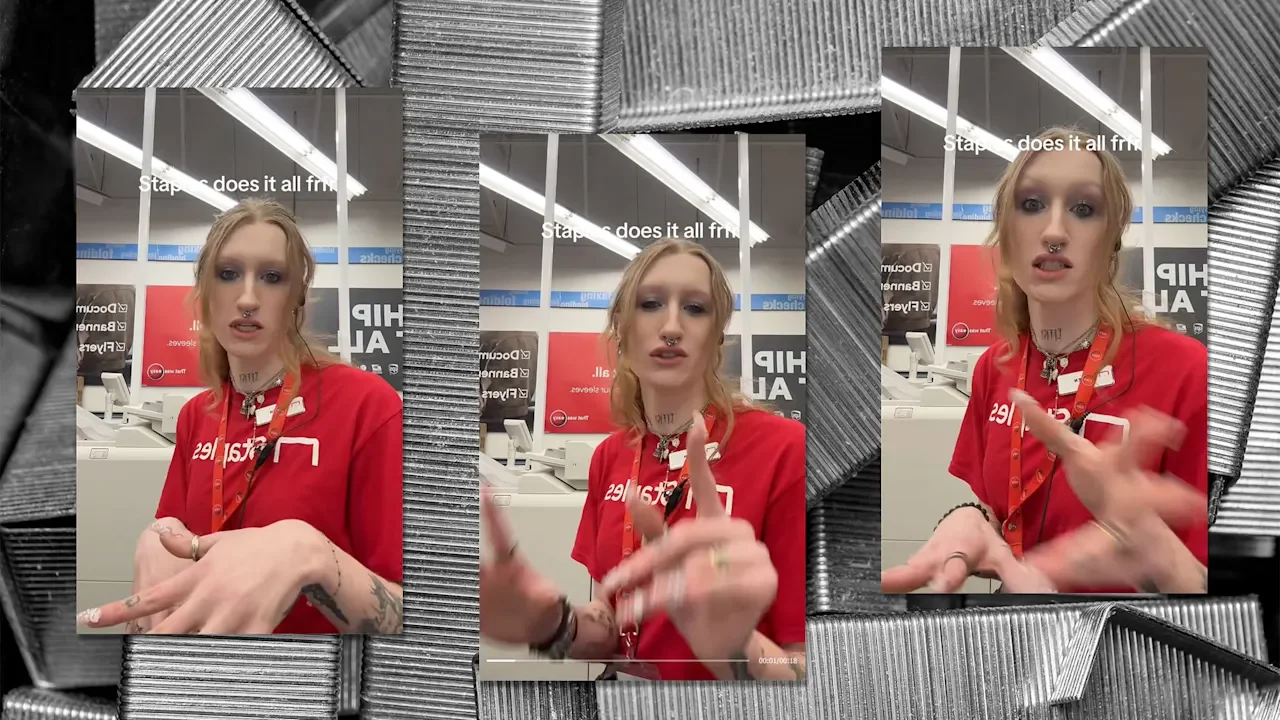
By now, the so-called “Staples Baddie” may have crossed your feed with her tutorials and informational videos exploring her workplace. TikTok creator @blivxx, known online as Oblivion, started getting attention in January for highlighting niche services and products offered at Staples. It’s a distinctly Gen Z approach to social media. Videos from Staples Baddie (whose real name is Kaeden) feature ASMR, heavy slang, and an authenticity that has viewers—and brands—hooked. Comments on Kaeden’s videos range from tame (“Staples better give you your flowers asap” on a January 21 post about business cards) to unhinged (“Staples did my BBL” on a February 6 video about the one-stop shop). Each video is flooded with users sharing that they went to Staples after seeing Staples Baddie’s (unofficial) promo. The influx comes as much-needed relief for the office supplies provider. Staples has been open about its financial struggles in today’s increasingly online shopping-driven economy. What’s most effective about this kind of influencer marketing is that, well, it isn’t really marketing. Staples Baddie isn’t a paid micro-celebrity; she’s paid, but it’s her wage for working at the store. The creator’s videos are often filmed on the clock, with her sporting the Staples-branded red shirt, lanyard, and name tag. Still, she’s found a way to be authentic about what she’s promoting, something that paid collabs with influencers often miss the mark on. She’s self-aware, too: In a January 30 video, Kaeden dryly argues that she deserves commission because “[she’s] like the Paris Hilton of Staples.” And Staples seems to agree. “We’re incredibly proud of our associate, Kaeden, and the passion she brings to her work,” Staples Chief Marketing Officer Bob Sherwin said in an email to Fast Company. “It’s been exciting to see the positive response and enthusiasm she’s sparked.” As for what’s next, the plan is simple for now. Kaeden will continue to film her content as Staples Baddie, with the support of Staples, which is mutually beneficial for everyone involved. “We’ve connected with her to share our appreciation, and we are exploring opportunities to collaborate and continue supporting her creativity and engagement with the community,” Sherwin said in an email. It all makes sense: When an opportunity arises like this one, for a content collaboration with an influencer who actually has a real connection to the brand, well, companies might be wise to support their local baddie. View the full article

-
IDEAS shared have the power to expand perspectives, change thinking, and move lives. Here are two ideas for the curious mind to engage with: I. Nicole Vignola on self-talk: “If you tell yourself you’re having a bad day, your brain will find ways to reinforce that belief, and you’ll go about the rest of your day finding ways to prove that this day is bad. And so it is with negative self-beliefs. When you believe that you are not worthy, or not confident, or you have a negative belief about yourself, your body language follows that belief. Moreover, the brain perceives your behaviour as normal and stops paying conscious attention to it, and before you know it, you’ve snowballed to further reinforce this belief with everything you do.” Source: Rewire: Break the Cycle, Alter Your Thoughts and Create Lasting Change II. Leslie John on the power of opening up: “Something sensitive, we are not necessarily entering a zero-sum transaction. We are creating a possibility for mutual trust, better relationships, connection, growth, even safety. Ironically, what seems like a loss of control is often what unlocks the very things we want most. This is the mistake economists (and, frankly, a lot of us) often make: treating information as a commodity to be protected or extracted. Disclosure is an investment—it’s risk in the service of trust.” Source: Revealing: The Underrated Power of Oversharing * * * Look for these ideas every Thursday on the Leading Blog. Find more ideas on the LeadingThoughts index. * * * Follow us on Instagram and X for additional leadership and personal development ideas. View the full article
-
Food retailers blame supply constraints on withdrawal from commitment to source slower-growing breedsView the full article
-
Picture a jazz quartet mid-performance. The bassist anchors the rhythm with meticulous precision—years of practice evident in every note. The saxophonist, meanwhile, closes her eyes and ventures into uncharted melodic territory, responding to something she heard in the drummer’s improvised fill three bars ago. What you’re witnessing isn’t chaos, nor is it rigid execution. It’s something far more valuable: the dynamic interplay between discipline and imagination that produces work no one has ever heard before. This is exactly the capability that distinguishes organizations that merely survive disruption from those that shape it. In an era defined by the rapid-fire shifts of the Fourth Industrial Revolution and the ubiquity of AI, many organizations find themselves chasing the “prize” of innovation without understanding the engine that drives it: creativity. Too often, leaders mistake innovation for a purely technical or systemic process, forgetting that it is actually a human competency rooted in a dynamic tension between two seemingly opposite forces. This is where the WonderRigor method becomes a vital strategic tool for the modern professional. What is WonderRigor? WonderRigor is the ability to toggle between wonder and rigor to solve problems and deliver novel value. Rather than treating these concepts as opposites—the dreamer versus the doer—the method recognizes them as a “chaordic” system: a blend of chaos and order that mirrors how creativity actually works in the real world. Wonder is our capacity to exercise awe, to pause, and to ask audacious “blue-sky” questions like “What if?” It requires what the Italians call il dolce far niente—the sweetness of doing nothing—to allow assumptions to suspend and ideas to marinate. Wonder is the CEO who, instead of immediately optimizing the quarterly report, asks her team: “What problem would our customers pay us to solve that we haven’t even imagined yet?” Rigor is our capacity for discipline, deep skill, and time on task for mastery. It’s the backstage machinations—the hard, sweaty work that anchors the wonder and ensures a project actually reaches completion. Rigor is the product designer who spends six months testing prototypes, the financial analyst who builds seventeen iterations of a model before presenting to the board, the writer who revises the same paragraph until it finally sings. Here’s the insight that changes everything: rigor cannot be sustained without wonder, and wonder is often found in the midst of rigor. The designer who tests those seventeen prototypes isn’t just grinding—she’s paying close enough attention to notice the unexpected behavior in prototype twelve that sparks a breakthrough. The analyst who rebuilds his model is cultivating the pattern recognition that allows him to see opportunity where others see noise. By intentionally toggling between these two states, individuals and teams can increase their Creativity Quotient (CQ) and navigate the complex, “wicked” problems that lack linear solutions—which is to say, nearly every problem worth solving today. The Four Situational Modalities: Which problem-solving “persona” does this moment require? Theory is useful, but leaders need tools. The WonderRigor method provides four situational modalities—or “personas”—that help teams determine how to approach a specific challenge. These are not fixed traits or personality types. They’re lenses to try on depending on the needs of the moment, the way you might switch between different pairs of glasses depending on whether you’re reading a contract or scanning a horizon. 1. Specialize: when precision is the priority The Specialize modality is high on rigor, lower on wonder. You choose it when the situation demands deep expertise, proven methods, and meticulous attention to detail. When to use it: You’re a surgical team performing a complex procedure. You’re an accounting firm closing the books on a major audit. You’re a manufacturing team where a 0.01% defect rate has real consequences. In these contexts, creativity lives in the micro-refinements, the accumulated wisdom of repetitive practice, the ability to execute flawlessly under pressure. The risk: Specialization becomes dangerous when it’s the only mode you inhabit. The specialist who never lifts her head develops blind spots. She may be so focused on optimizing existing processes that she misses the industry shift that makes those processes obsolete. In practice: A global logistics company had spent years perfecting their warehouse operations. Their specialists could move products with stunning efficiency—and they were completely blindsided when a competitor introduced drone delivery. They had specialized themselves into strategic irrelevance. The solution wasn’t to abandon specialization, but to create deliberate moments where specialists stepped out of their expertise to explore adjacent possibilities. 2. Hack: when speed The Presidents perfection The Hack modality prioritizes expediency over polish. You’re working with what you have, moving fast, and tolerating imperfection in service of momentum. When to use it: Your startup needs a minimum viable product by next week. Your team faces an unexpected crisis that requires immediate workarounds. The market window is closing and “good enough” today beats “perfect” in six months. The risk: Hack mode can become an addiction. Teams that never leave it accumulate technical debt, cut corners that eventually collapse, and mistake activity for achievement. The quick fix becomes the permanent solution, which becomes the source of next year’s crisis. In practice: During the early pandemic, restaurants had 48 hours to pivot to takeout-only models. This was hack mode at its best: owners repurposing parking lots, creating menu items that traveled well, cobbling together delivery partnerships. The restaurants that thrived, however, were those who eventually transitioned out of hack mode—who took what they learned during the scramble and systematized it through specialization, or reimagined it entirely through invention. 3. Provoke: when you need to blow up the status quo The Provoke modality sits high on wonder, lower on rigor. It’s characterized by audacious, imaginative thinking that shakes others out of their assumptions. When to use it: The team is stuck in groupthink. Everyone is optimizing a business model that may not deserve to exist. The organization has been asking the same questions for so long that no one notices they’re the wrong questions. The risk: Without rigor to ground it, provocation becomes “loosey-goosey”—exciting conversations that never translate into action. The perpetual provocateur can damage their credibility if they’re seen as someone who loves to challenge but never builds. In practice: When streaming was still a radical concept, the provocateurs inside Netflix asked: “What if we put ourselves out of business before someone else does?” That question—which seemed absurd to a company making billions from DVD rentals—created the space for transformation. But the provocation only mattered because Netflix also had the rigor to execute on what the question revealed. 4. Invent: the synthesis that creates new markets The Invent modality is where wonder and rigor achieve balance. It’s the space of the true thought leader, the market creator, the person who shapes categories rather than competing within them. When to use it: You’re not solving an existing problem—you’re defining a new one. You’re creating a product that customers don’t yet know they need. You’re building something that will make your current offerings obsolete. The requirement: Invention demands that you’ve spent equal time “in the trenches” working out kinks and “in the clouds” dreaming audaciously. You cannot skip directly to this modality. The inventor has done the reps; she has the intuition that only comes from deep practice combined with broad curiosity. In practice: When Apple introduced the iPhone, they weren’t improving existing phones—they were inventing a new category. But that invention was only possible because Apple had spent years both specializing (obsessive attention to industrial design, user interface) and provoking (asking what a “computer in your pocket” really meant). The iPhone felt “right” because it balanced high expertise with sharp intuition—the hallmark of the Invent modality. Putting it together: the art of situational toggle The power of WonderRigor lies not in finding the “right” modality and staying there, but in developing the situational awareness to know which lens the current moment requires—and the agility to shift when circumstances change. Consider a product development team working on a major launch. In the early ideation phase, they might operate primarily in Provoke mode: challenging assumptions, asking heretical questions, exploring possibilities that seem impractical. As concepts solidify, they shift toward Hack mode: quickly prototyping, testing rough versions, building momentum through iteration. As the launch approaches, Specialize mode takes over: refining details, ensuring quality, executing with precision. And throughout the process, the best teams maintain awareness of when they might be ready for an Invention—a leap that transcends iteration. The trap that most organizations fall into is getting stuck. They specialize forever, never questioning their approach until disruption forces them to. They hack indefinitely, accumulating shortcuts that eventually collapse. They provoke without building, mistaking critique for contribution. Or they attempt invention without earning it—trying to leapfrog into thought leadership without the rigor foundation that makes real invention possible. Think like a jazz musician Return to that jazz quartet. What makes their performance compelling isn’t just the technical skill (though they have it) or the bold improvisation (though they do that too). It’s the toggling—the bassist who knows when to lock into a steady groove and when to take a melodic risk, the saxophonist who has practiced scales for thousands of hours precisely so she can forget them in the moment of creation. This is what WonderRigor offers the modern professional: not a rigid framework, but a practiced flexibility. The ability to move between discipline and imagination, between execution and exploration, between the known and the possible. In a business landscape where yesterday’s expertise can become tomorrow’s liability, this capacity to toggle isn’t a nice-to-have—it’s the fundamental skill that separates those who shape the future from those who merely react to it. The next time you face a complex challenge, don’t ask “What’s the solution?” First ask: “Which modality does this moment require?” Then be prepared to shift as the music changes. View the full article

-
The lawsuit accuses Veterans United of deceptively suggesting it's part of the Department of Veterans Affairs and steering clients to more costly loans. View the full article
-
We may earn a commission from links on this page. Just about everyone has a microwave. You might not know its wattage, vintage, or what in the heck half the buttons actually do, but you know that if you pop something in there and cook it for a while, you get hot food back for your trouble. Some intrepid souls actually learn how to use a microwave properly, expertly timing out defrostings, reheatings, and popcorn by the bucket. They really are incredibly useful and powerful appliances. As amazing as your microwave is, it could be better—it just needs a little help. If you really want to get the most out of your appliance, you’ll need to pick up a few microwave gadgets that will expand its capabilities and take out some of the guesswork. This plate stacker can double your microwave's cooking capacityFirst and foremost, we all know one of the main frustrations with microwaves: You can typically only cook/heat one dish at a time. If you’re warming up some leftovers for yourself and a partner, someone’s plate is going to sit on the counter for a bit, cooling off, while the second one cooks. And if you’re trying to actually cook an entire meal with your microwave, you’re going to have a heck of a time serving everything up at a consistent temperature. Unless you invest in a microwave-safe plate stacker. It’s a simple idea that instantly makes your microwave more useful, because you can now cook or heat up several things at once. These microwave-safe egg cookers make perfectly poached, scrambled, or boiled eggsCan you cook eggs in the microwave without a cool gadget? Sure—as long as you’re not terribly picky about how your eggs turn out. If you’d prefer to enjoy eating the eggs you cook in there, you should pick up an egg boiler to make hard- or soft-boiled eggs, and an egg cooker that can poach or scramble an egg perfectly (it can also make adorable mini-omelets). These little tools ensure your eggs come out fluffy and delicious instead of rubbery and weird-looking. Use the microwave to make melty, crispy sandwichesEntire restaurant chains have been built on our collective love of toasted sandwiches, but they’re impossible to make in a microwave ... unless you have one of these sandwich maker gadgets. With one, you can make grilled cheese sandwiches, panini, or even quesadillas to your heart’s content without firing up your burner. This gadget helps microwave bacon come out crispyYou can cook anything in a microwave, as long as your working definition of “cooked” is just “hot.” As anyone who’s ever tried in desperation to cook bacon in their microwave knows, what you get is a soggy mass of bacon-esque stuff. Unless you have this microwaveable bacon grill, which makes it possible to cook up crispy bacon without dealing with a greasy pan that spits pain at you, or the lengthy cleanup it requires. A microwave rice cooker can make fluffy, delicious rice in a jiffyA rice cooker is a terrific appliance if you make a lot of rice, but sometimes you don’t have room for one more countertop or stovetop appliance, and not everyone makes rice often enough to need one. This cheap microwave rice cooker makes it dead simple to cook a batch of rice in your microwave in a little over 10 minutes, and the rice comes out fluffy, slightly sticky, and delicious. Use this device to make al dente pasta in the microwaveCooking dry pasta isn’t exactly rocket science. Even if you don’t bother reading directions or don’t really care about al dente pasta, it’s just a matter of boiling water, dumping in pasta, and cooking until it’s soft and edible. But if you need to cut some corners and skip the time it takes to boil water, you can cook pasta to a very acceptable level of al dente-ness in the microwave with the Fasta Pasta Microwave Cooker. It’s only usable with dry pasta—fresh pasta will still have to be boiled, sorry—but it ensures perfect pasta every time in just a few minutes, without any boiling necessary. It even has pre-measured cutouts in the lid so you can easily portion out your meals. This device can help you microwave a cake in five minutesIt happens: You’re craving cake, and you have no cake. You have all the ingredients for cake, but you lack the most important thing: The will to pull it all together, fire up the oven, and wait. Enter the Rapid Cake Maker. Put your mix, eggs, and other ingredients into the appropriate (and pre-measured) container, combine in the pan and mix, then microwave for 5-6 minutes. That’s right, that’s all that stands between you and a warm, moist cake. We are truly living in the future. Try a microwave steamer for easy vegetable prepSteaming is a nice method to cook fresh-tasting vegetables and fish. Steaming on a stovetop can produce a fair amount of dirty dishes, though—or maybe you're just low on stovetop space. Steaming in your microwave using one of these, on the other hand, is a fast and easy alternative. Add water to the bottom, adjust the vents, cover, and in a few minutes your food is cooked perfectly. It can be used with fresh or frozen veggies or anything else you would normally steam cook. View the full article
-
In December 2025, Andrea Lucas, the chair of the U.S. Equal Employment Opportunity Commission, invited white men to file more sex- and race-based discrimination complaints against their employers. “Are you a white male who has experienced discrimination at work based on your race or sex? You may have a claim to recover money under federal civil rights laws. Contact the @USEEOC as soon as possible,” she wrote in a post on X. In February 2026, the EEOC began to investigate Nike on what the agency said was suspicion of discrimination against white workers. Both initiatives followed the EEOC’s March 2025 characterization of diversity, equity, and inclusion efforts, or DEI, as potentially discriminatory against white men. The EEOC characterization falls within the The President administration’s larger pattern of calling DEI “illegal discrimination.” At the Center for Employment Equity at the University of Massachusetts, we have done extensive research on who files discrimination charges with the EEOC. Given the EEOC’s December 2025 solicitation for white men to file discrimination complaints, we revisited our prior research to see what is known about discrimination against white people and, in particular, what is known about white and white male discrimination charges registered with the EEOC. As part of our research, the EEOC gave us access to discrimination charges submitted to the agency and state Fair Employment Practices Agencies from 2012 to 2016. By law, all U.S. employment discrimination claims must be submitted to the EEOC, or state agencies with equivalent roles, prior to any legal actions. While the EEOC has a history of sharing its data with researchers stretching back to the 1970s, the EEOC stopped sharing current and historical data with researchers in 2016. As a result, we do not have any data on discrimination complaints after 2016. Judging by the EEOC’s yearly reports, the basic patterns have not changed much in the interim. White men already file complaints When we looked at all sex- and race-based discrimination charges received by the EEOC, unsurprisingly we found that men are much less likely than women to file sex-based discrimination charges. But white men do file about 10% of sex discrimination complaints. While Black, Hispanic, and Asian male employees are more likely to file racial discrimination complaints, white men file about 9% of such complaints. In the same study, when we compared legal charges filed with the EEOC to national survey data, we found that percentages submitting a legal complaint to the EEOC roughly correspond to the percentages of survey-reported experiences of discrimination at work. Together, these two findings suggest that white people generally, and white men in particular, were already filing employment discrimination charges. Second, we did a deeper dive on sexual harassment charges. We found that while white men were 46% of the labor force, they filed 11% of sexual harassment charges and 11% of all other charges, most commonly tied to disability and age. The general pattern is that, while white men already file discrimination charges, they are less likely to experience employment discrimination than other groups. The risk of filing complaints Charges filed with the EEOC can result in two types of benefits to the charging party: monetary settlements and mandated changes in workplace practices. White men who filed sexual harassment charges received some benefit 21% of the time—lower than white women, at 29%. That’s also lower than Black women, at 23%, and higher than Black men, at 19%. The EEOC already receives discrimination charges from white men and, at least for sexual harassment, treats them similarly to other groups. Most people who submit a discrimination charge do so to improve their employment experience and those of their co-workers. But submitting these claims to the EEOC or a state Fair Employment Practices Agency is a high-risk, low-reward act. We found that, at least for sexual harassment, employers responded to white men’s complaints in much the same way as to other groups. White men who filed sexual harassment discrimination charges lost their job 68% of the time and experienced employer retaliation at about the same rate. Retaliation can include firing but also other forms of harassment at work, such as abusive supervision and close monitoring by human resource departments. We found this pattern of employer retaliation and worker firings for all demographic groups that file any type of discrimination complaint. White men who file discrimination charges receive the same harsh treatment from their employers as any other group. Urging more white men to submit discrimination complaints based on the perceived unfairness of DEI practices, as the EEOC has done, is likely to lead to job loss and retaliation from employers. What will happen? It’s possible that EEOC chair Lucas’ call for more discrimination charges from white men will increase the number of filings. This is exactly what happened after 2012 when the EEOC ruled that the 1964 Civil Rights Act’s prohibition of sex discrimination also protected LGBTQ workers from sexual-orientation and gender-identity discrimination. More concerning is the EEOC defining employer efforts to prevent discrimination and create inclusive workplaces as discrimination against white men. In the end, all workers want to be treated fairly and with respect. Employer efforts to create such workplaces should be supported. It would be a better use of EEOC resources to support companies’ efforts to create such workplaces. Donald T. Tomaskovic-Devey is a professor of sociology and director of the Center for Employment Equity at UMass Amherst. Steven Boutcher is an associate professor of social science research at UMass Amherst. This article is republished from The Conversation under a Creative Commons license. Read the original article. View the full article

-
Pressure builds quickly on a live construction site. Weather shifts, trades overlap and instructions change without much notice. A well-kept site diary keeps daily events from slipping through the cracks and protects your position when questions arise later. If you’re running UK projects, this guide shows how to keep one properly. What Is a Site Diary In Construction? A site diary in construction is a formal daily record maintained on a building project to document site activities, labour levels, plant usage, weather conditions, deliveries, instructions and notable events. It provides a chronological account of what occurred on site each day and serves as an official project record. Site diaries are essential on any construction project, but they can’t match the real-time visibility provided by modern construction project management software like ProjectManager. ProjectManager is an award-winning construction project management software designed to build detailed construction programmes, allocate labour and plant, monitor progress, control costs and compare planned vs actual performance through live dashboards and reports to identify delays, variations and cost overruns before they impact the project. Get started for free today. /wp-content/uploads/2024/04/Light-mode-portfolio-dashboard-CTA-1600x851.pngLearn more What Is the Purpose of a Site Diary? At its core, a site diary exists to capture what actually happened on site each day, not what was planned to happen. It supports day-to-day monitoring of progress, resources, site conditions and instructions so project teams can track performance against programme. Beyond routine oversight, it also plays a critical role when accountability becomes important. Delay claims: When progress slips, entries detailing weather, late information or restricted access help demonstrate the true cause of delay. Adjudication or dispute resolution: A consistent daily record can support your position if disagreements escalate under JCT or NEC contracts. Variations and change instructions: Notes confirming verbal directions or revised works provide evidence if valuation is later challenged. Health and safety investigations: Records of site conditions, inductions and incidents can clarify what controls were in place at the time. Resource and productivity analysis: Labour and plant entries allow managers to review output levels and identify underperformance. Who Makes and Maintains the Construction Site Diary? On most UK construction projects, responsibility for maintaining the site diary sits with the site manager or site agent. That individual is accountable for ensuring daily entries are completed accurately, signed off where required and stored properly. Even if others contribute information, the duty to keep the record consistent and defensible ultimately rests with them. Although one person holds accountability, a site diary is never produced in isolation. Accurate entries depend on coordinated input from supervisors, engineers, subcontractors and commercial staff throughout the project lifecycle. Site Manager or Site Agent: Oversees the entire recording process, verifies daily information, confirms instructions received and ensures entries reflect actual site conditions. Section Engineer or Project Engineer: Provides technical details on completed works, inspections, testing results and any deviations from drawings or specifications. General Foreman or Works Supervisor: Supplies daily labour numbers, plant allocation, productivity notes and reports on site access or sequencing issues. Health and Safety Manager or Advisor: Contributes information on inductions, toolbox talks, incidents, near misses and any temporary control measures implemented. Quantity Surveyor or Commercial Manager: Uses diary entries to cross-check variations, delays, compensation events and resource levels against contractual entitlements. /wp-content/uploads/2026/02/Construction-Site-Diary-Template-for-Excel.png Get your free Construction Site Diary Template Use this free Construction Site Diary Template for Excel to manage your projects better. Download Excel File What Should Be Included In a Site Diary? To keep the record useful and defensible, each entry must capture consistent core information. Let’s break down the main components that should appear in a properly maintained UK construction site diary. Project Administrative Details Every entry should clearly reference the basic administrative details that anchor the record to a specific project and date. Including identifiers such as contract particulars, site location and daily conditions ensures entries cannot later be disputed or confused with another scheme. Key elements for this section: Project name Site address Contract number Client / Employer Principal Contractor Date Weather conditions (AM/PM, temperature, rainfall, wind) Working hours Labour on Site Labour on site refers to all operatives physically present and carrying out work during the day, including direct staff, subcontractors and agency workers. Recording these figures matters because manpower levels directly affect productivity, programme performance and entitlement to extensions of time if resources are restricted. Key elements for this section: Number of operatives on site Breakdown by trade (e.g. groundworkers, bricklayers, electricians) Subcontractors present Agency labour Any labour shortages or absenteeism Plant & Equipment Plant and equipment covers all mechanical assets and temporary machinery used to execute the works, from excavators and cranes to smaller powered access units. Documenting plant presence, deliveries and downtime is essential because availability, breakdowns or removals can directly impact output and support delay or disruption assessments. Key elements for this section: Plant on site (telehandler, excavator, crane, MEWP, etc.) Deliveries or removals of plant Breakdowns or downtime /wp-content/uploads/2026/01/2026_construction_ebook_banner-ad.jpg Work Activities Carried Out Daily descriptions of work activities create a clear picture of actual progress on site, not just what the programme suggests. Recording what was built, where it was built and how much was achieved helps track performance. Just as importantly, it provides factual backing when assessing delay events, disruption claims or valuation disagreements later. Key elements for this section: Specific tasks completed Location of works Quantities achieved where relevant Work started / work completed Material Deliveries Materials arriving on site directly influence sequencing, productivity and quality control. Logging deliveries, timings and condition on arrival allows managers to track supply chain reliability. When materials are late, short or rejected, those records can support extension of time claims, loss and expense submissions or commercial discussions with suppliers. /wp-content/uploads/2026/01/Material-list-template-600x154.pngFree material list template for Excel Key elements for this section: Materials delivered Delivery times Any rejected materials Short deliveries or damaged goods Instructions and Communications Instructions and communications include any formal or informal directions, clarifications or exchanges that influence how the works proceed, whether issued by the architect, engineer, employer or site team. These entries should capture written instructions, confirmed verbal directions and responses to technical queries to ensure the project record reflects what was actually authorised. Documenting these exchanges protects the contractor if scope changes, delays or cost implications are later disputed. Clear diary notes can demonstrate when instructions were received and how they affected progress or resources. Key elements for this section: Architect’s Instructions (AI) Engineer’s Instructions Site instructions Verbal instructions (noted carefully) RFIs raised or responses received Delays & Disruption Delays and disruption refer to events that prevent planned activities from proceeding as programmed or reduce productivity on site. These can stem from design information, access constraints, weather, resource limitations or unforeseen conditions, and must be clearly described with timing and impact noted to create an accurate daily record. Capturing these issues in the site diary strengthens entitlement to extensions of time or loss and expense claims. Clear daily evidence helps demonstrate cause and effect when programme impacts are later assessed. Key elements for this section: Late drawings Access issues Adverse weather Labour shortages Variations affecting progress Utility clashes Health & Safety Construction sites carry constant risk, and the diary should reflect how those risks were managed each day. Recording safety briefings, incidents and compliance checks demonstrates that controls were actively implemented. If an accident investigation or regulatory review occurs, detailed daily notes can evidence due diligence and responsible site supervision. Toolbox talks held Accidents or near misses HSE visits Method statement compliance issues Permit-to-work activity Inspections & Tests Inspections and tests cover all quality assurance checks carried out to confirm the works comply with drawings, specifications and contractual requirements. These include planned verification activities under inspection and test plans, statutory inspections and internal quality reviews that confirm workmanship standards. Noting these activities in the site diary helps demonstrate compliance, supports payment applications and provides evidence if workmanship is later questioned or defects are alleged. ITP inspections Concrete pours & cube tests Building Control inspections Clerk of Works visits Snagging observations Visitors Movement in and out of the site should never go unrecorded. Logging visitors creates a traceable account of who attended, when they were present and why. That detail can clarify instructions issued during walkthroughs, confirm inspections took place and demonstrate controlled access if security, safety or liability questions arise later. Client visits Consultant attendance Building Control Utility companies Third parties Variations Change rarely arrives neatly packaged, which is why variations must be documented as they arise. Recording instructed changes, emerging compensation events under NEC contracts and ongoing discussions protects commercial positions. Noting the potential impact on time and sequencing also ensures programme consequences are tracked from the outset rather than reconstructed later. Variations instructed Potential compensation events (under NEC) Change discussions Impact on programme General Observations Not every issue fits neatly into a predefined category, yet those small daily details often become important. General observations capture site conditions, access constraints, neighbour complaints, workforce tensions or security incidents that influence how work proceeds. Including them provides broader context and prevents gaps in the overall project narrative. Site Diary Template Track daily site activity with this free construction site diary template for Excel. Record labour, plant, weather, instructions, delays, deliveries and inspections to maintain accurate contemporaneous records and support contract administration. /wp-content/uploads/2026/02/Construction-Site-Diary-Template-for-Excel-600x324.png Site Diary Example Imagine a general contractor delivering a new 85,000 square foot corporate headquarters in Canary Wharf, London. The scheme involves a reinforced concrete frame, curtain wall façade and CAT A office fit-out across eight storeys. Below is a single site diary entry for one working day. For simplicity, some components of a site diary have been omitted. Project Administrative Details Item Details Project Name Thames View Corporate Headquarters Site Address 15 Marsh Wall, Canary Wharf, London E14 Contract Form JCT Design & Build 2016 Client Rivergate Holdings Ltd Principal Contractor London Build Contractors Ltd Date 18 February 2026 Weather AM: Light rain, 4°C | PM: Overcast, 6°C, moderate wind Working Hours 08:00 – 17:00 Labour on Site Trade / Category Number on Site Notes Groundworkers 8 Basement drainage installation Steel Fixers 6 Level 3 slab reinforcement Electricians 5 Containment works Level 2 Drylining Subcontractor 10 Partition framing Level 1 Agency Labour 3 General site duties Plant & Equipment Plant Status Notes Tower Crane Operational Used for steel and formwork lifting Telehandler Operational Material distribution on ground level MEWP Operational Façade bracket installation Excavator (8T) Down 2 hrs Hydraulic hose replaced at 11:30 Work Activities Carried Out Activity Location Progress / Quantity Concrete pour (Level 3 slab) Level 3 120m³ completed Partition framing Level 1 65 linear metres installed Cable tray installation Level 2 40% of east wing completed Deliveries and Materials Material Delivery Time Status Ready-mix concrete 09:15 Accepted Reinforcement steel 07:50 Short delivery (2 bundles missing) Plasterboard pallets 13:40 1 pallet damaged, rejected Instructions & Communications Reference Description Action Taken AI-014 Revised ceiling detail Level 2 Forwarded to drylining subcontractor RFI-032 Response Clarification on drainage invert levels Groundworks adjusted layout Verbal Instruction Client requested additional data cabling Recorded pending formal confirmation Delays & Disruption Issue Time Impact Notes Morning rainfall 1 hour lost Delayed external façade works Short rebar delivery 2 hours Pour sequence adjusted Utility clash discovered Under review Survey requested Visitors Visitor Organisation Purpose Client Representative Rivergate Holdings Ltd Monthly progress walkthrough Building Control Officer London Borough Authority Inspection of Level 3 slab Structural Engineer Design Consultants LLP Review reinforcement prior to pour Free Construction Project Management Templates We’ve created dozens of free construction project management templates for Excel, Word and Google Sheets. Here are some that are ideal for UK construction projects. Gantt Chart Template Plan and programme construction works with this Gantt chart template for Excel. Sequence activities, assign durations, track progress and identify critical tasks to maintain control over timelines and site performance. Snagging List Template Use this snagging list template to record defects, incomplete works and quality issues before practical completion. Track locations, responsible trades and rectification status to ensure a smooth handover process. Method Statement Template Document safe systems of work with this method statement template for construction projects. Outline task sequences, resources and control measures to ensure compliance with health and safety requirements on site. ProjectManager Is Ideal for Tracking Construction Site Progress ProjectManager includes Gantt charts, workload charts, timesheets and real-time dashboards and reports, making it ideal for building and managing construction programmes, coordinating trades on site, monitoring labour and plant utilisation, tracking site costs and sharing photos and documents from inspections. Watch the video below to learn more! Related Construction Project Management Content Our content library features over 100 construction blogs, templates, ebooks and other types of content to help construction project managers better understand the many moving parts that must be managed to deliver successful construction projects. Here are some of them. How to Make a Construction Phase Plan (Templates Included) Program of Works in Construction: A Quick Guide Tendering Process in Construction: A Quick Guide Top 10 Tender Documents In Construction Construction Cost Planning: How to Make a Cost Plan Cost Value Reconciliation: How to Make a CVR Report ProjectManager is online project management software with the tools you need for construction project management. Our features make planning, monitoring and reporting on your project more efficient and effective. Being online means our software is accessible everywhere and at any time. Plus, the data you get is more accurate because it’s updated immediately. Try ProjectManager for free with this 30-day trial offer. The post How to Maintain a Construction Site Diary (Example & Template Included) appeared first on ProjectManager. View the full article
-
OpenAI is serving ads inside ChatGPT, and new findings suggest the experience looks quite different from what the company originally envisioned. What’s happening. Research from AI ad intelligence firm Adthena has identified the first confirmed ads appearing on ChatGPT for signed-in desktop users in the U.S. The big surprise. Early speculation suggested ads would only surface after extended back-and-forth conversations. That’s not what’s happening. When a user asked “What’s the best way to book a weekend away?”, sponsored placements appeared immediately — on the very first response. What they look like. The ads feature a prominent brand favicon and a clear “Sponsored” label, a design that differs slightly from the concepts OpenAI had previously shared publicly. Why we care. ChatGPT is one of the most visited sites on the internet. Ads appearing in its responses marks a significant moment for the future of AI monetization — and a potential shift in how brands reach consumers at the point of inquiry. Between the lines. The immediacy of the ad trigger suggests OpenAI is treating single, high-intent prompts — not just sustained conversations — as viable ad inventory. That’s a meaningful strategic signal for advertisers evaluating where to place budget. The bottom line. ChatGPT’s ad era has quietly begun. For marketers, the question is no longer if they need an AI search strategy — it’s whether they’re already late. First spotted. CMO of Adthna, Ashley Fletcher shared his team spotting the ads on LinkedIn. View the full article
-
Google launched an AI Professional Certificate with seven self-paced modules and three months of AI Pro access. Eligible U.S. small businesses can enroll free. The post Google Offers AI Certificate Free For Eligible U.S. Small Businesses appeared first on Search Engine Journal. View the full article
-
An effective online reputation strategy is vital for any brand aiming to thrive in today’s digital environment. It involves actively monitoring your online presence, engaging with customers, and addressing feedback swiftly. You must as well focus on building positive content whilst implementing SEO practices to improve visibility. Moreover, having a crisis management plan is critical to respond to potential threats. Comprehending these components can greatly influence how your brand is perceived; nonetheless, there’s much more to explore. Key Takeaways Consistently monitor your online presence using tools like Google Alerts and social media listening platforms to stay informed about brand sentiment. Engage proactively with customers by responding to feedback promptly, as consumers expect replies within seven days. Develop a crisis management plan that includes predefined communication protocols and roles to address potential reputational threats effectively. Create and share high-quality content that highlights customer success stories and aligns with brand values to build credibility and trust. Implement SEO best practices to enhance brand visibility and push down negative information in search results, improving overall online reputation. Understanding Online Reputation Management In today’s digital environment, Online Reputation Management (ORM) plays a crucial role in shaping how your brand is perceived. To effectively manage your online reputation, start with key online reputation management tips, such as regularly monitoring mentions of your business through tools like Google Alerts. This proactive approach helps you identify potential issues early. Reputation management best practices likewise emphasize the importance of engaging with customer feedback; remember, over half of consumers expect a response within seven days of leaving a review. To further improve online reputation, focus on content creation that highlights customer success stories and aligns with your brand values, enhancing both trust and search engine visibility. Essential Elements of an Effective ORM Strategy Building on the foundation of comprehension online reputation management, you’ll want to focus on the key components that make up an effective ORM strategy. First, consistent monitoring of your online presence is critical; use tools like Google Alerts and social media listening platforms to identify potential issues early. Proactive reputation building is another fundamental element of an effective ORM strategy, as engaging positively with customers and sharing valuable content improves brand perception. Furthermore, having a crisis management plan is necessary to mitigate damage during adverse situations. Implementing SEO best practices boosts brand visibility, allowing you to push down negative information by creating positive content. Finally, addressing customer complaints swiftly is fundamental; since 53.3% of customers expect responses within seven days, timely engagement demonstrates your commitment to customer satisfaction. Together, these online reputation management best practices form a thorough reputation management strategy that can safeguard your brand’s image. Monitoring Your Online Presence Effective monitoring of your online presence is critical for safeguarding your brand’s reputation, as it allows you to identify and address potential issues before they escalate. An effective online reputation management strategy includes setting up Google Alerts for your brand name and relevant keywords. This way, you’ll stay informed about new mentions and conversations about your business online. Engaging in social listening on platforms like Facebook and Twitter is another fundamental aspect of business reputation monitoring; it enables you to respond to customer complaints and feedback swiftly, demonstrating your commitment to customer satisfaction. Regularly checking review sites like Yelp and TripAdvisor is likewise imperative for managing customer sentiment. Ignoring negative feedback can lead to long-term damage, so addressing concerns quickly shows you value customer input and care about their experience. Implement these reputation management tips to effectively monitor your online presence and protect your brand. Proactive Reputation Building To build a strong online reputation, you need to focus on proactive strategies that engage your audience and create positive content. By consistently monitoring your online presence and responding quickly to criticism, you can maintain a favorable image. Furthermore, sharing valuable content that reflects your brand values not just attracts attention but likewise helps mitigate any negative feedback. Monitoring Online Presence Monitoring your online presence is crucial for proactively managing your brand’s reputation, especially in today’s digital environment. By consistently tracking your online activity, you can identify potential reputation issues early, allowing for swift intervention. Utilizing online reputation management techniques like Google Alerts helps you monitor brand mentions across various platforms, ensuring you address negative feedback without delay. Engaging in social listening on social media allows you to connect with customers directly, addressing complaints efficiently. Regularly analyzing reviews on sites like Yelp and TripAdvisor offers valuable insights into customer sentiment and areas for improvement. By engaging with both positive and negative feedback, you demonstrate a commitment to customer satisfaction, which highlights the significance of online reputation management in building a strong brand. Engaging Content Creation Creating engaging content is essential for proactively building your brand’s reputation online, as it not only boosts visibility but also nurtures trust among consumers. According to studies, 70% of consumers prefer learning about a company through articles rather than ads. Incorporating customer success stories and testimonials can improve credibility, with 79% of consumers trusting online reviews like personal recommendations. Regularly publishing high-quality blog posts or videos can elevate your SEO rankings, pushing down negative results. Utilizing storytelling techniques evokes emotional responses, as 92% of consumers favor brands that share stories. This engaging content creation drives social media sharing, amplifying positive brand perception. For a thorough approach, refer to an online reputation management guide to learn effective reputation management techniques. Responding to Criticism Though it might be tempting to ignore criticism, addressing customer complaints swiftly is vital for maintaining your brand’s reputation. Engaging with criticism within 24-48 hours can prevent negative reviews from escalating, as 53.3% of customers expect timely responses. By acknowledging issues and apologizing when necessary, you demonstrate a commitment to customer satisfaction, which can help rebuild trust. Utilizing social listening tools for real-time monitoring allows you to respond effectively to negative sentiments before they amplify. Highlighting public resolutions of past issues showcases your responsiveness and dedication, turning challenges into positive narratives. Furthermore, training employees to handle criticism constructively improves your online reputation management activities, leading to a better reputation overall. Crisis Management and Reputation Repair When a crisis hits, having proactive communication strategies and swift response protocols in place is essential for your brand’s reputation. You’ll need to acknowledge mistakes quickly and adapt your communication based on online sentiment to effectively manage the situation. After addressing the crisis, focus on reputation recovery techniques, such as sharing positive stories and customer testimonials, to rebuild trust with your audience. Proactive Communication Strategies Proactive communication strategies are vital for effective crisis management and reputation repair, as they allow brands to address potential issues before they escalate. By monitoring online mentions and sentiment, you can identify concerns early, which is fundamental in online reputation management marketing. Establishing a clear communication protocol and defining team roles helps guarantee a coordinated response during crises. When negative feedback arises, a timely, empathetic response can mitigate damage, as 53.3% of customers expect a reply within seven days. Acknowledging mistakes and offering solutions not only aids in reputation management in digital marketing but additionally helps rebuild trust. Consistent engagement on social media nurtures a sense of community, encouraging positive interactions and enhancing brand advocacy. Rapid Response Protocols To effectively manage crises and repair your brand’s reputation, an established rapid response protocol is essential. This protocol should include a predefined communication plan outlining roles, responsibilities, and approved messaging to guarantee a cohesive response during a crisis. Timely responses are critical, as 53.3% of customers expect businesses to address negative feedback within seven days to minimize reputational damage. Utilizing sentiment analysis tools can help you identify the tone and urgency of online conversations, allowing for prioritized and customized responses. In addition, establishing a crisis management team trained to handle public relations challenges greatly reduces the impact of negative incidents. Regularly updating and practicing your crisis management plan guarantees your team’s readiness, minimizing risks during a brand reputation crisis. Reputation Recovery Techniques Effective reputation recovery techniques are crucial for any brand facing a crisis, as they provide a roadmap for restoring trust and credibility. A well-defined crisis management plan should outline potential threats and include pre-approved communication protocols, ensuring a quick response. Addressing negative publicity swiftly can mitigate damage; a sincere apology and transparent communication can help restore customer loyalty. Engaging personally with affected customers shows commitment to their satisfaction and can turn negative experiences into opportunities. Utilize social listening tools to monitor public sentiment in real-time, adjusting your strategies as needed. After the crisis, implement reputation repair techniques such as sharing positive customer stories and testimonials, which can overshadow negative perceptions and rebuild brand credibility. For effective strategies, refer to online reputation guides and reputation management examples. The Role of SEO in Online Reputation Management Even though many business owners may overlook the importance of search engine optimization (SEO) in shaping their online reputation, it plays a crucial role in how potential customers perceive a brand. By focusing on online reputation SEO, you can improve brand visibility in search results, making it easier for customers to discover positive content about your business. Utilizing reputation management keywords and optimizing your online profiles allows you to push down negative search results, enhancing your overall image. To effectively advance online reputation management, regularly produce high-quality content, such as blogs and articles. This not merely boosts your search ranking but also builds trust and credibility with both search engines and consumers. Social Media Marketing and ORM Social media marketing plays a significant role in online reputation management (ORM) by allowing brands to interact directly with their customers and shape public perception. Here are some online reputation tips to improve your company online reputation: Engage Regularly: Respond to both positive and negative comments to show you care about customer feedback. Monitor Channels: Keep an eye on your social media platforms to address issues swiftly, preventing potential PR crises. Share Valuable Content: Post informative and engaging content to build trust and encourage customer loyalty. Collaborate with Influencers: Partner with influencers who align with your values to tap into their established credibility and audience. Frequently Asked Questions What Is an Online Reputation Management Strategy? An online reputation management (ORM) strategy involves monitoring your brand’s online presence and actively managing customer feedback. You should set up tools like Google Alerts to track mentions and sentiments. Encouraging satisfied customers to leave positive reviews can greatly impact potential buyers’ decisions. Responding quickly to reviews—both positive and negative—demonstrates your commitment to customer satisfaction. Incorporating SEO practices guarantees that favorable content ranks higher, pushing down any negative information associated with your brand. How to Increase Online Reputation? To increase your online reputation, start by monitoring mentions and reviews consistently. Use tools like Google Alerts to catch feedback early. Quickly respond to reviews, especially negative ones, within 24-48 hours. Encourage satisfied customers to leave positive reviews, as these can boost your credibility. Create high-quality content that highlights positive experiences and engage actively on social media, thanking customers for their support and addressing concerns professionally. Consistency in these actions builds a stronger reputation. What Is an Example of Online Reputation? An example of online reputation can be seen in how Chipotle handled its E. coli crisis. When faced with a major health concern, you saw the company quickly close affected stores, provide free meals, and issue public apologies. This proactive approach helped restore customer trust and maintain their brand image. Which of the Following Is Used to Improve Online Reputation? To improve your online reputation, you can implement several strategies. Start by using monitoring tools like Google Alerts to track brand mentions. Actively respond to customer reviews within 24-48 hours, showing you value feedback. Create high-quality, SEO-optimized content that highlights positive customer experiences. Encourage satisfied customers to leave reviews, as many consumers rely on them before purchasing. Finally, develop a crisis management plan to address any negative publicity swiftly, ensuring trust remains intact. Conclusion An effective online reputation strategy is essential for maintaining your brand’s integrity and visibility. By actively monitoring your online presence, engaging with customers, and implementing SEO best practices, you can build trust and push down negative content. Having a crisis management plan in place allows for swift responses to potential threats, ensuring your brand remains resilient. In the end, a proactive approach to online reputation management will safeguard your brand’s image and cultivate lasting relationships with your audience. Image via Google Gemini This article, "What Is an Effective Online Reputation Strategy?" was first published on Small Business Trends View the full article
-
An effective online reputation strategy is vital for any brand aiming to thrive in today’s digital environment. It involves actively monitoring your online presence, engaging with customers, and addressing feedback swiftly. You must as well focus on building positive content whilst implementing SEO practices to improve visibility. Moreover, having a crisis management plan is critical to respond to potential threats. Comprehending these components can greatly influence how your brand is perceived; nonetheless, there’s much more to explore. Key Takeaways Consistently monitor your online presence using tools like Google Alerts and social media listening platforms to stay informed about brand sentiment. Engage proactively with customers by responding to feedback promptly, as consumers expect replies within seven days. Develop a crisis management plan that includes predefined communication protocols and roles to address potential reputational threats effectively. Create and share high-quality content that highlights customer success stories and aligns with brand values to build credibility and trust. Implement SEO best practices to enhance brand visibility and push down negative information in search results, improving overall online reputation. Understanding Online Reputation Management In today’s digital environment, Online Reputation Management (ORM) plays a crucial role in shaping how your brand is perceived. To effectively manage your online reputation, start with key online reputation management tips, such as regularly monitoring mentions of your business through tools like Google Alerts. This proactive approach helps you identify potential issues early. Reputation management best practices likewise emphasize the importance of engaging with customer feedback; remember, over half of consumers expect a response within seven days of leaving a review. To further improve online reputation, focus on content creation that highlights customer success stories and aligns with your brand values, enhancing both trust and search engine visibility. Essential Elements of an Effective ORM Strategy Building on the foundation of comprehension online reputation management, you’ll want to focus on the key components that make up an effective ORM strategy. First, consistent monitoring of your online presence is critical; use tools like Google Alerts and social media listening platforms to identify potential issues early. Proactive reputation building is another fundamental element of an effective ORM strategy, as engaging positively with customers and sharing valuable content improves brand perception. Furthermore, having a crisis management plan is necessary to mitigate damage during adverse situations. Implementing SEO best practices boosts brand visibility, allowing you to push down negative information by creating positive content. Finally, addressing customer complaints swiftly is fundamental; since 53.3% of customers expect responses within seven days, timely engagement demonstrates your commitment to customer satisfaction. Together, these online reputation management best practices form a thorough reputation management strategy that can safeguard your brand’s image. Monitoring Your Online Presence Effective monitoring of your online presence is critical for safeguarding your brand’s reputation, as it allows you to identify and address potential issues before they escalate. An effective online reputation management strategy includes setting up Google Alerts for your brand name and relevant keywords. This way, you’ll stay informed about new mentions and conversations about your business online. Engaging in social listening on platforms like Facebook and Twitter is another fundamental aspect of business reputation monitoring; it enables you to respond to customer complaints and feedback swiftly, demonstrating your commitment to customer satisfaction. Regularly checking review sites like Yelp and TripAdvisor is likewise imperative for managing customer sentiment. Ignoring negative feedback can lead to long-term damage, so addressing concerns quickly shows you value customer input and care about their experience. Implement these reputation management tips to effectively monitor your online presence and protect your brand. Proactive Reputation Building To build a strong online reputation, you need to focus on proactive strategies that engage your audience and create positive content. By consistently monitoring your online presence and responding quickly to criticism, you can maintain a favorable image. Furthermore, sharing valuable content that reflects your brand values not just attracts attention but likewise helps mitigate any negative feedback. Monitoring Online Presence Monitoring your online presence is crucial for proactively managing your brand’s reputation, especially in today’s digital environment. By consistently tracking your online activity, you can identify potential reputation issues early, allowing for swift intervention. Utilizing online reputation management techniques like Google Alerts helps you monitor brand mentions across various platforms, ensuring you address negative feedback without delay. Engaging in social listening on social media allows you to connect with customers directly, addressing complaints efficiently. Regularly analyzing reviews on sites like Yelp and TripAdvisor offers valuable insights into customer sentiment and areas for improvement. By engaging with both positive and negative feedback, you demonstrate a commitment to customer satisfaction, which highlights the significance of online reputation management in building a strong brand. Engaging Content Creation Creating engaging content is essential for proactively building your brand’s reputation online, as it not only boosts visibility but also nurtures trust among consumers. According to studies, 70% of consumers prefer learning about a company through articles rather than ads. Incorporating customer success stories and testimonials can improve credibility, with 79% of consumers trusting online reviews like personal recommendations. Regularly publishing high-quality blog posts or videos can elevate your SEO rankings, pushing down negative results. Utilizing storytelling techniques evokes emotional responses, as 92% of consumers favor brands that share stories. This engaging content creation drives social media sharing, amplifying positive brand perception. For a thorough approach, refer to an online reputation management guide to learn effective reputation management techniques. Responding to Criticism Though it might be tempting to ignore criticism, addressing customer complaints swiftly is vital for maintaining your brand’s reputation. Engaging with criticism within 24-48 hours can prevent negative reviews from escalating, as 53.3% of customers expect timely responses. By acknowledging issues and apologizing when necessary, you demonstrate a commitment to customer satisfaction, which can help rebuild trust. Utilizing social listening tools for real-time monitoring allows you to respond effectively to negative sentiments before they amplify. Highlighting public resolutions of past issues showcases your responsiveness and dedication, turning challenges into positive narratives. Furthermore, training employees to handle criticism constructively improves your online reputation management activities, leading to a better reputation overall. Crisis Management and Reputation Repair When a crisis hits, having proactive communication strategies and swift response protocols in place is essential for your brand’s reputation. You’ll need to acknowledge mistakes quickly and adapt your communication based on online sentiment to effectively manage the situation. After addressing the crisis, focus on reputation recovery techniques, such as sharing positive stories and customer testimonials, to rebuild trust with your audience. Proactive Communication Strategies Proactive communication strategies are vital for effective crisis management and reputation repair, as they allow brands to address potential issues before they escalate. By monitoring online mentions and sentiment, you can identify concerns early, which is fundamental in online reputation management marketing. Establishing a clear communication protocol and defining team roles helps guarantee a coordinated response during crises. When negative feedback arises, a timely, empathetic response can mitigate damage, as 53.3% of customers expect a reply within seven days. Acknowledging mistakes and offering solutions not only aids in reputation management in digital marketing but additionally helps rebuild trust. Consistent engagement on social media nurtures a sense of community, encouraging positive interactions and enhancing brand advocacy. Rapid Response Protocols To effectively manage crises and repair your brand’s reputation, an established rapid response protocol is essential. This protocol should include a predefined communication plan outlining roles, responsibilities, and approved messaging to guarantee a cohesive response during a crisis. Timely responses are critical, as 53.3% of customers expect businesses to address negative feedback within seven days to minimize reputational damage. Utilizing sentiment analysis tools can help you identify the tone and urgency of online conversations, allowing for prioritized and customized responses. In addition, establishing a crisis management team trained to handle public relations challenges greatly reduces the impact of negative incidents. Regularly updating and practicing your crisis management plan guarantees your team’s readiness, minimizing risks during a brand reputation crisis. Reputation Recovery Techniques Effective reputation recovery techniques are crucial for any brand facing a crisis, as they provide a roadmap for restoring trust and credibility. A well-defined crisis management plan should outline potential threats and include pre-approved communication protocols, ensuring a quick response. Addressing negative publicity swiftly can mitigate damage; a sincere apology and transparent communication can help restore customer loyalty. Engaging personally with affected customers shows commitment to their satisfaction and can turn negative experiences into opportunities. Utilize social listening tools to monitor public sentiment in real-time, adjusting your strategies as needed. After the crisis, implement reputation repair techniques such as sharing positive customer stories and testimonials, which can overshadow negative perceptions and rebuild brand credibility. For effective strategies, refer to online reputation guides and reputation management examples. The Role of SEO in Online Reputation Management Even though many business owners may overlook the importance of search engine optimization (SEO) in shaping their online reputation, it plays a crucial role in how potential customers perceive a brand. By focusing on online reputation SEO, you can improve brand visibility in search results, making it easier for customers to discover positive content about your business. Utilizing reputation management keywords and optimizing your online profiles allows you to push down negative search results, enhancing your overall image. To effectively advance online reputation management, regularly produce high-quality content, such as blogs and articles. This not merely boosts your search ranking but also builds trust and credibility with both search engines and consumers. Social Media Marketing and ORM Social media marketing plays a significant role in online reputation management (ORM) by allowing brands to interact directly with their customers and shape public perception. Here are some online reputation tips to improve your company online reputation: Engage Regularly: Respond to both positive and negative comments to show you care about customer feedback. Monitor Channels: Keep an eye on your social media platforms to address issues swiftly, preventing potential PR crises. Share Valuable Content: Post informative and engaging content to build trust and encourage customer loyalty. Collaborate with Influencers: Partner with influencers who align with your values to tap into their established credibility and audience. Frequently Asked Questions What Is an Online Reputation Management Strategy? An online reputation management (ORM) strategy involves monitoring your brand’s online presence and actively managing customer feedback. You should set up tools like Google Alerts to track mentions and sentiments. Encouraging satisfied customers to leave positive reviews can greatly impact potential buyers’ decisions. Responding quickly to reviews—both positive and negative—demonstrates your commitment to customer satisfaction. Incorporating SEO practices guarantees that favorable content ranks higher, pushing down any negative information associated with your brand. How to Increase Online Reputation? To increase your online reputation, start by monitoring mentions and reviews consistently. Use tools like Google Alerts to catch feedback early. Quickly respond to reviews, especially negative ones, within 24-48 hours. Encourage satisfied customers to leave positive reviews, as these can boost your credibility. Create high-quality content that highlights positive experiences and engage actively on social media, thanking customers for their support and addressing concerns professionally. Consistency in these actions builds a stronger reputation. What Is an Example of Online Reputation? An example of online reputation can be seen in how Chipotle handled its E. coli crisis. When faced with a major health concern, you saw the company quickly close affected stores, provide free meals, and issue public apologies. This proactive approach helped restore customer trust and maintain their brand image. Which of the Following Is Used to Improve Online Reputation? To improve your online reputation, you can implement several strategies. Start by using monitoring tools like Google Alerts to track brand mentions. Actively respond to customer reviews within 24-48 hours, showing you value feedback. Create high-quality, SEO-optimized content that highlights positive customer experiences. Encourage satisfied customers to leave reviews, as many consumers rely on them before purchasing. Finally, develop a crisis management plan to address any negative publicity swiftly, ensuring trust remains intact. Conclusion An effective online reputation strategy is essential for maintaining your brand’s integrity and visibility. By actively monitoring your online presence, engaging with customers, and implementing SEO best practices, you can build trust and push down negative content. Having a crisis management plan in place allows for swift responses to potential threats, ensuring your brand remains resilient. In the end, a proactive approach to online reputation management will safeguard your brand’s image and cultivate lasting relationships with your audience. Image via Google Gemini This article, "What Is an Effective Online Reputation Strategy?" was first published on Small Business Trends View the full article
-
The word “toning” is something of a joke in many fitness circles, because it’s a word that’s thrown around when people mean other things. Sometimes it’s a code word for being thin, as when somebody may promise you that a workout will tone your muscles rather than making you bulky. Other times it’s a moneymaking gambit, as when somebody says you can do their toning exercises at home rather than buying weights or a gym membership instead. To the extent that the word means anything, we talked about this a bit when we discussed the fear of getting bulky. Being “toned” usually means having some muscle definition while still being able to see your body as feminine or thin. "Toned" isn't anything in human biology—it's a word we use when walking a tightrope of ways we hope to be perceived. What happens when you exercise a muscle?When you ask your muscles to do something, they get better at doing it. While entire dissertations have been written about exactly what happens inside your muscle cells when you exercise, the ways we change our muscles when we lift weights mostly fall into two categories: You get better at using that muscle (neuromuscular adaptations) The muscle gets bigger (hypertrophy) Of those two things, only the second one (the muscle getting bigger) has a visual impact. Both of them affect how strong you are, or to put it another way, what you can do with that muscle. Getting stronger and getting bigger happen together: You can try to favor one over the other, but training for strength will get you bigger muscles as a side effect, and training for bigger muscles is pretty much impossible without also getting stronger. Now, the human body is complex, so of course there aren’t only two things that happen. But those are the main ones. Other things that happen, if less noticeably: Your muscles get better at contracting repeatedly (muscular endurance) You burn calories during the workout These features aren’t exclusive to strength training. You burn calories and build endurance with cardio, too, such as running. These last two items do not have a visible effect on your body. You can’t tell how good somebody’s endurance is by looking at them. Burning calories can theoretically result in fat loss, or even muscle loss, but that also depends on how many calories you eat. Exercise, by itself, does not necessarily change the amount of fat on your body. So how do I get that “toned” look?When we look at the visible changes we can make to our bodies through exercise, there are really only two things we can control: We can make specific muscles bigger with resistance training (such as lifting weights) We can eat fewer calories than we burn, while also resistance training to preserve muscle; this causes us to lose fat all over our bodies. Note that you can target which muscles you want to get bigger, but there’s no way to lose fat on a specific body part. Fat distribution isn’t really under our control, which is why you can’t exercise your way to a flat tummy, or slim your thighs, or anything like that. You can work your muscles to make them bigger, and eat in a calorie deficit to make your whole body smaller, and see what happens. To address a few other things that get discussed alongside toning: You can’t build “long, lean muscles” specifically. Lean just means without fat, so if you want to look lean, you’re looking at fat loss. And the length of a muscle isn’t something you can control: It’s attached to your bones. How would it get longer? Sometimes people mean that they want their muscles not to look rounded or not to have a peak in their bicep, but that’s not really under our control either. The shape of your muscle comes down to things like its attachment points and the length of your tendons versus the contractile portion of the muscles. Those are just things you’re born with, and training can't really change them. What does a “toning” workout do?Based on what we know so far, you’d expect that if you want muscle definition while looking slimmer, you’d need to lift weights and pay attention to your diet. (You would also be smart to do some cardio, which is good for your health and won’t kill your gains). So then what’s with all these “toning” workouts? Isn’t there a “toning” rep range? Don’t you need smaller weights for “toning” than for getting jacked? What gives? Well, I hate to break it to you, but that’s all bullshit people say to sell stuff. Here’s the truth about rep ranges: Anything up to about 15 reps will do a pretty good job of growing your muscles and making you stronger. Anything up to about 30 reps can still grow your muscles if you take the lift to failure (that is, by rep 30 your muscles are burning and you literally can’t do another rep). Beyond that—or if you’re doing a high rep set but you put the dumbbells down before you hit failure—you’re not doing much to increase the size or strength of your muscles. You’re still working on endurance, but endurance isn’t going to do much to change how your body looks. What about the size of your weights? Well, to hit those appropriate rep ranges, you need to lift weights that are “heavy” for you. Maybe you’re new to this and five pounds is a really challenging bicep curl. Perfect! That’s your “heavy,” for now. As you get stronger, you’ll need heavier weights. (Keep in mind, though: different exercises use different muscle groups. Somebody who uses a five-pound weight for curls is going to need a heavier weight for goblet squats.) If your muscle-building exercises don’t involve weights, the same principles still apply. If it’s hard for you to do 10 air squats, then air squats are helping you to build muscle in your legs and butt. But if you can do 50, you’ll need to either add some weight or find a different no-equipment exercise that is appropriately challenging. “Toning” workouts to avoidIf you’re determined to get “toned,” the muscular training you need to do is no different than what a person would do to get jacked. The difference is that getting jacked involves a lot of food (that muscle has to come from somewhere) and a lot of time. Even if you spend all your time in the gym, you won’t come out looking like the Hulk at the end of the year. That’s bad news for people who want to look like the Hulk, and good news for people who don’t. So you need to do normal-ass strength training. With that in mind, let’s look at a couple of workouts that get marketed as being for “toning”: HIIT workouts: True HIIT workouts improve your aerobic capacity (making you a faster runner, for example) but they don’t have any special advantage in calorie burning or muscle building. A lot of popular ones aren’t even real HIIT, they’re just circuit training. Circuit training: Doing a series of different exercises with little to no rest, and then repeating that series, is called circuit training. It’s a mix of strength training and cardio, which makes it a good choice if you don’t have time to do two separate workouts. Crossfit WODs (workout of the day) fall into this category, too. You’ll probably get better results if you separate the strength and cardio components, but if you enjoy circuit training, it’ll do the job. High-rep exercises without weights or with light weights: A lot of booty band and ankle weight workouts fall into this category. If they feel hard enough to count as strength training, great! But most are not, especially once you’re not a beginner anymore. At that point, they’re just training endurance without actually building muscle. If you like them, or if endurance is important to you, enjoy. But they’re not going to “tone” you at all. View the full article
-
Reddit is piloting a new AI-powered shopping experience that transforms its famously trusted community recommendations into shoppable product carousels — a move that could reshape how the platform monetizes its search traffic. What’s happening. A small group of U.S.-based users are seeing interactive product carousels appear in search results when their queries signal purchase intent — think “best noise-canceling headphones” or “top budget laptops.” The carousels sit at the bottom of search results and include pricing, images and direct retailer links. Products are surfaced from items actually mentioned in Reddit posts and comments — not just ad inventory. For consumer electronics queries, Reddit is also pulling from select Dynamic Product Ads (DPA) partner catalogs. How it works. The AI identifies purchase-intent queries, scans relevant Reddit conversations for product mentions, and assembles them into structured, shoppable cards. Users can tap a card to get more details and link out to retailers. Why we care. Reddit’s shopping carousels give advertisers a rare opportunity to reach consumers at peak purchase intent — at the exact moment they’re seeking peer validation for a buying decision. Unlike traditional display ads, products surfaced here benefit from the implicit trust of Reddit’s community context, making them feel less like ads and more like recommendations. For brands already running Dynamic Product Ads on Reddit, this is a direct pipeline from community buzz to conversion. Between the lines. Reddit is doing something its competitors haven’t quite cracked — using organic, peer-driven content as the foundation of a commerce experience rather than pure ad targeting. That’s a meaningful distinction. Consumers increasingly distrust sponsored recommendations, and Reddit’s entire value proposition is built on authentic community voice. Formalizing that into a shopping layer could give it a credibility edge over traditional retail media networks. The big picture. Retail media is a fast-growing business, and platforms with high-intent audiences are racing to claim their share. Reddit’s search traffic has grown significantly since its Google search partnership, making this a natural next frontier. The bottom line. Reddit is experimenting with turning intent-driven search into commerce, aiming to make it easier for users to move from recommendation to transaction — without leaving the community context that drives trust. Dig deeper. In Case You Saw It: We are Testing a New Shopping Product Experience in Search View the full article
-
US president says billions of dollars pledged to ‘most prestigious’ bodyView the full article