All Activity
- Past hour
-
A comparison of 5 AI search engines show they cite different sources but converge on citing brands, a key to SEO for AI search. The post Comparison Of AI Citation Patterns Offers Strategic SEO Insights appeared first on Search Engine Journal. View the full article
- Today
-
Brand visibility is your share of presence across search, AI answers, and community platforms. Here‘s how to measure it and grow it in the AI search era. View the full article
-
Brian Hale, CEO of Mortgage Advisory Partners, warns of overcapacity, rising rates and AI-driven disruption forcing consolidation across the lending industry. View the full article
-
Check out the next set of names in the 28th edition of National Mortgage News' Top Producers survey, including on how they approach purchase business. View the full article
-
State mortgage regulators are increasingly treating supervision as enforcement, imposing large fines even when companies fix issues quickly, writes the head of public policy at NewRez. View the full article
-
The Miami Grand Prix, hosted at the Hard Rock Stadium’s 3.3-mile Miami International Autodrome, will look and feel different this year. In its fifth year, the race will spotlight the city with new experiences, activations like the MSC Yacht Club, and new sight lines for spectators. While relatively new to Formula 1’s 24 Grand Prix race season, the Miami GP’s agreement to serve as a host city until 2041 is an indicator that F1 is focused on investing in the U.S. market. It’s a big departure from F1’s history. “ We used to turn up in the U.S., race, and [then] expect everyone in the U.S. to continue to stay in love with us, engage with us, and that was probably arrogant,” says Liam Parker, chief communications and corporate relations officer at Formula 1. But in 2017, that changed when Liberty Media Corp. acquired F1, recognizing the “enormous opportunity to grow the sport.” F1, currently valued at roughly $3.6 billion, doubled down on the U.S. as a strategic market with its first modern U.S. race, Austin’s Circuit of the Americas. To deepen its U.S. presence, F1 wished for an international, cultural destination. “It was the second race to join us from the U.S. It was a big test case,” Parker says. “If Miami hadn’t gone well, people might have started to say ‘Can F1 really make a success of the U.S.’?” As the U.S. circuit’s first race, Miami GP is designed to set the tone for the rest of the calendar and plays a key role in growing F1 commercially stateside. Designing the Miami Grand Prix Parker recognizes that F1 is not competing with legacy sports like the NFL, NBA, and MLB, but rather with entertainment and people’s attention. For that reason, F1’s recipe for relevancy in the U.S. market has to go beyond the race. Parker says it centers on “people’s mindsets, news feeds, and their lifestyle.” The first Miami GP prioritized a high-quality race, garnering nearly 243,000 spectators and 2.6 million television viewers. That race faced a number of challenges, including extreme heat on the track and in the paddock, which were later resolved. Since then, attendance has grown to around 275,000 people. F1 Miami Grand Prix President Katharina Nowak and her team saw an opportunity to boost the race’s profile by turning the event into a full-on Miami experience. This year, the Miami GP team is embracing the city’s allure, focusing on three core elements: its inaugural fan fest, a man-made marina activation, and its race campus modeled after specific Miami neighborhoods. “We’re starting to think about how we turn the Miami Grand Prix into more than just a three-day weekend and starting to think about this as a full week,” Nowak says, noting that the target audience includes more than purist motorsports fans. The race’s first, free official citywide fan fest seeks to attract newer, casual fans with a “FOMO experience” steeped in entertainment programming, music, brand activations, and food and beverage offerings. Katharina Nowak “We want to make that the first touchpoint,” Nowak says. “If you’re not familiar with Formula 1 [or] don’t really know what it’s about, we give you that first opportunity. There’s no barrier to entry here.” Hosted at what Nowak refers to as one of the most iconic destinations in the world—Miami Beach—the fan fest will also serve as a communal viewing experience for the race, offering an access point for those who can’t make it to the track to view the race live. Beyond fan fest, the team announced a significant hospitality activation in partnership with MSC Cruises. Leaning into Miami as a top destination for cruises and its affinity for premium experiences, they developed the MSC Yacht Club, a five-level, 32,000-square-foot, 264-foot-long temporary structure, inspired by the French Riviera. The “super yacht,” which Miami GP describes as “the most unique hospitality offering,” offers guests a new premium dining and viewing experience of the 57-lap race featuring 19 turns. “Given our layout and where we are in terms of geography, we have a very flat track,” Nowak explains. “Being able to provide our fans with an experience where suddenly they get to see more than just one turn or going into a turn . . . that’s an experience we haven’t been able to offer in the past.” Previously, the marina offered ticketed yacht experiences. Now the Miami GP has opened the experience for general admission, maximizing fans’ access to the track’s turns six through eight. In addition to the Key Biscayne-inspired marina, the team remodeled the rest of the campus after six distinct Miami neighborhoods: Little Havana, Coconut Grove, Miami Gardens, Brickell, Wynwood, and Miami Beach. Each zone will feature its associated neighborhood’s local culture through live music, family-owned restaurants, and art. “We’re super excited to really dive into how every fan is going to experience these zones,” Nowak says. “The West Campus, for example, will be influenced by Little Havana. We are bringing Ball and Chain, which is an iconic live music venue most known for their pineapple-shaped stage, so we’re going to bring that to the West Campus this year for live music and entertainment.” Wynwood’s local restaurants will be featured at the event’s East Campus, along with art murals, installations, and the Art of Hip Hop Museum. A brand moment As F1 grows in the U.S., so do opportunities for global brands, like Lego, Apple, and Disney, looking for authentic ways to activate fans. During last year’s race, the Lego Group created an immersive experience for families that included 10 drivable Lego cars. “We’ve seen how brands and teams and the F1 industry have used Miami and this race as kind of [a] launch platform for their big moments,” Nowak says. “The Lego parade is a good example of that.” The Miami GP aims to attract brands via a “melting pot” fan base. “We’ve got more kids following us, more younger people, more women, more people of diverse backgrounds,” Parker says. “I think the U.S. strategy and the U.S. growth has been a key part in helping us unlock some of those big partnerships.” Lewis Hamilton According to a 2025 F1 and Motorsports Network fan survey, 41% of fans who haven’t attended an F1 fan experience plan to do so in the future. F1 believes it is barely scratching the surface of what’s possible in the U.S.; it will continue to take notes from Miami GP and other stateside circuits. “ The U.S has been one of those markets where it’s taught us what we can do elsewhere,” Parker says. “Miami [is] raising the bar. Austin [is] raising the bar [and] now Vegas. We’ve used that to say to people around the world and other races, how can you raise those bars?” View the full article

-
Almost everyone’s power bills are going up, but if your home still relies on old-school electric resistance heat or a conventional electric water heater, you’re likely feeling it even more. A new report breaks down how much you could save by switching to a heat pump instead. A single-family home could save an average of $1,530 a year, or $23,000 over the lifetime of a heat pump, according to an analysis from the energy-focused nonprofit RMI. If every potential house across the U.S. made the switch, customers would collectively save more than $20 billion annually, and avoid around 38 million metric tons of CO2 emissions. (Because of modeling challenges, the analysis doesn’t include apartment buildings, so the total number would be even bigger.) A mass shift from old electric heat to heat pumps would also help significantly ease strain on the electric grid. Electric resistance heaters work “essentially just like a giant toaster,” says Ryan Shea, a manager on the carbon-free buildings team at RMI. They’re a highly inefficient way to heat a house or apartment, yet they remain common, used in roughly 25 million American homes. Even more households, about 57 million, rely on the same technology for water heating. Heat pumps, which work by moving heat, are around three times more efficient. They can both heat and cool; new heat pumps are also around 20% more efficient than older air conditioners. The nonprofit’s Green Upgrade Calculator helps estimate how much you could potentially save at a specific address. The biggest savings, unsurprisingly, are in colder climates with particularly high electric bills, such as parts of the Northeast, where the payback period can be just a few years. But the switch can pay off anywhere electric resistance heat is still in use. In Texas, where the older technology remains especially common, homeowners could collectively save nearly $2 billion a year on energy bills if everyone upgraded. In a place like Texas, a mass transition would make a major difference for the grid. “Given the substantial increase in efficiency of the units, they can result in lower peak demand, and when done at scale, address some of the peak demand concerns that are really cropping up,” says Shea. It’s possible to reduce peak winter demand in Texas by 7.5 gigawatts, or the equivalent of 25 gas-fired power plants. By eliminating that extra power use, the grid can be more reliable—helping avoid situations like Winter Storm Uri, where 4.5 million Texans lost power—and can potentially delay building some new infrastructure, helping keep overall power costs lower. The analysis focuses on electric resistance heat, but if you use another type of heating system or water heater, the calculator can estimate your potential savings there, too. Fuel oil and propane are also expensive options, while gas can sometimes be cheaper, though prices remain volatile. In many states, utilities and local governments also offer generous incentives to help homeowners switch away from fossil fuels. Policy can also help nudge more people to switch from older electric heat. Building codes can help make heat pumps the default choice for new construction, for example, or encourage consumers to choose a heat pump when their central air conditioner fails and needs to be replaced. Some utilities offer incentives that make the switch especially simple. Ameren Missouri’s “pay as you save” program covers the upfront cost of new equipment. Customers repay that over time, but their monthly costs are still lower than they were before. Startups in the space also continue to innovate to reduce cost. Jetson, one company, has optimized installation costs, cutting the cost in some cases from $30,000 to $15,000. (With incentives in certain locations, that could drop as low as $5,000.) In California, where costs are particularly high, a former Apple engineer launched a startup called Merino Energy with an alternative to mini-split heat pumps that also significantly reduces cost. In Europe, Aira sells subscriptions to its heat pumps with monthly costs that are as much as 40% less than customers paid on energy bills before. View the full article

-
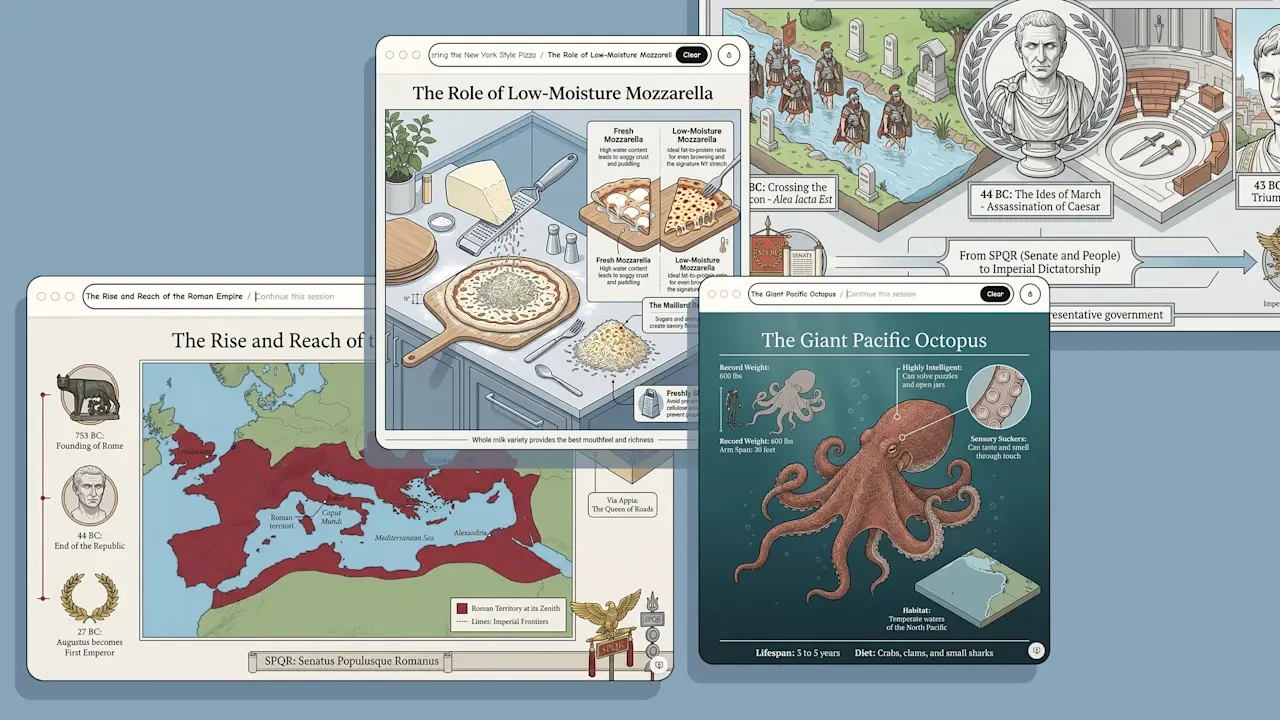
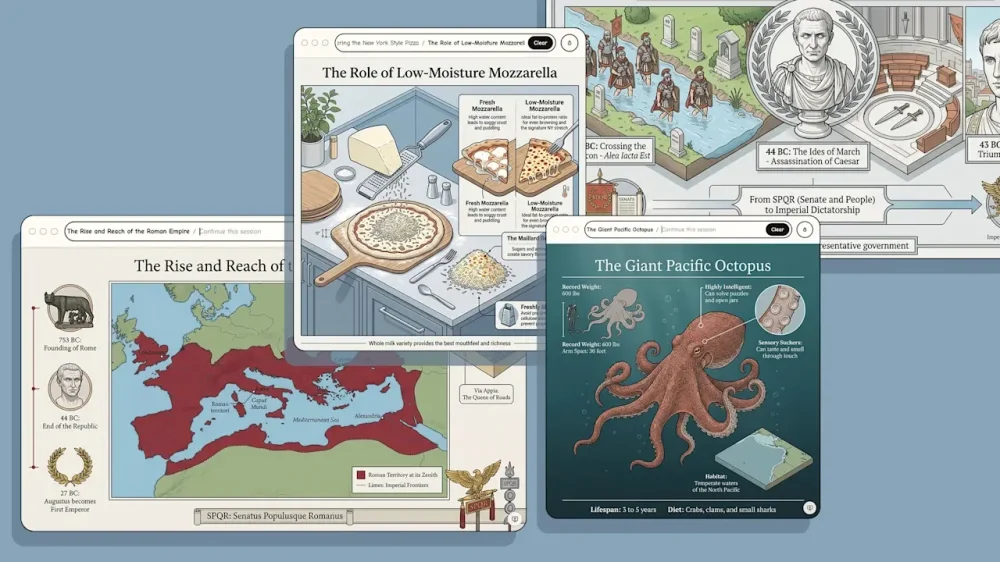
Flipbook feels less like just another AI product launch and more like a small revolt against the dead, rectangular boredom of the prototypical prompt-based AI interface. The project describes itself as an infinite visual browser generated on demand, in real time, where every page is an image and every click opens a deeper visual exploration of whatever caught your eye. Rather than writing a prompt and receiving a torrent of text, with Flipbook you get information from a large language model turned into a beautifully illustrated “book” page that you can click on to drill deeper into a topic. And oh boy, it feels fantastic to me. The idea is both fresh and familiar, and it makes me want to trash Gemini forever and make my entire web experience exactly like this. (Note: video has been edited to omit loading times) What does Flipbook do? What makes it exciting is not just the technology, but the interface philosophy behind it. Instead of forcing people to translate curiosity into a litany of text prompts, Flipbook lets them type into a browser-like search bar and then watch as that information appears as a beautiful illustration. Whether you’re interested in learning about the Roman Empire or the romantic jewel of Parque del Retiro, in Madrid, you’ll get a depiction of the basics of that subject. (Warning: Because Flipbook is now a prototype in a small server, it is slow and doesn’t quite render responses in real time as intended). Once the basic subject has been displayed, you can click anywhere on the page and Flipbook will dive deeper, opening a new page of the “book” with dynamically generated illustrations and text. Flipbook treats knowledge less like a database to be queried and more like a landscape to be explored. As the creators—Zain Shah, Eddie Jiao, and Drew Carr—brilliantly put it, the current paradigm of chat boxes and rigid layouts being sold as the future “felt like sipping an ocean of wisdom through a tiny straw.” It feels like the closest thing you will get to an LLM becoming a tactile, analog experience this side of printing an actual illustrated book in real time. It’s HyperCard colliding with AI Flipbook immediately evokes Bill Atkinson’s HyperCard, the legendary 1987 Apple software that packed information into stacks of graphically linked visual cards. This precursor to the World Wide Web let people move through ideas by clicking on drawn buttons and regions of a bitmap screen. In HyperCard, you could draw a house, define the front door as a clickable zone, and link it to another card showing the living room. It was a masterpiece of interactive design, but it required a human to meticulously draw and link every single card. Flipbook is the HyperCard dream fully realized by AI, capturing the same sensation of moving through knowledge spatially rather than linearly. When you click on a visual element—say, the engine of a car or a specific mountain in a landscape—there is no pre-authored card waiting for you. The system analyzes the exact region you clicked, infers what you’re curious about, and hallucinates the next detailed card into existence in real time. It looks like the kind of beautifully illustrated stack HyperCard might have become if it had survived long enough to collide with generative AI. The real break with the web is even stranger than that comparison suggests. By Flipbook’s own description, what you see contains no HTML at all, no conventional interface elements, and no text overlays. Even the text is rendered as pixels by the image model itself—just like HyperCard. That means your computer isn’t downloading code and assembling a layout the way browsers have done for decades. Instead, the AI physically paints the page—text, buttons, and graphics—as a single cohesive image streamed directly to your screen. And if you click on the “animate” button in the lower-right corner, the drawing actually comes alive, moving dynamically as you zoom, with objects in motion or people populating landscapes. Again, don’t expect this to work perfectly. In my experience, the animate button failed to connect, presumably because of the demand and the lack of server power. Shah was refreshingly blunt about the prototype’s underlying reality, calling it a “house of cards of APIs and open models tied together with duct tape.” But the experimental live video stream mode feels brilliant when it works. According to Flipbook, the feature animates each image and creates seamless transitions between states, turning a slideshow into a continuous morphing journey. For that, the authors claim that its video component uses an LTX-based generation system alongside the image generation stack. That matters because it hints at a future in which Flipbook may be animated all the time—not with static illustrated pages but fluid visual environments, which feels positively Harry Potter-esque. The hallucinations Of course, the magic comes with caveats. As its team describes it, the information in Flipbook comes from a combination of an “agentic web search” and the model’s own world knowledge. It basically seeks out information on the internet, looking into reliable sources, and puts things together. But like with any other LLM, inaccuracies can still happen in both the text and the drawing. I saw this myself when drilling through Madrid’s Parque del Retiro, which showed an illustration that vaguely reminds you of the original but it’s clearly wrong. Or when I clicked to know more about the statue of the Fallen Angel—said to be the only statue in the world dedicated to Satan, built at 666 meters above sea level—it showed something that didn’t look anything like the Fallen Angel until I clicked on the statue and Flipbook opened a detailed page with pretty drawings of the real thing. The authors claim, however, that you should expect the same level of accuracy of any other LLM. And as Shah points out, these underlying models will become more accurate, and the system will eventually support robust UIs and let you take real actions, like researching and booking a trip entirely inside the generated canvas. Still, what matters here is not whether Flipbook is complete today. What matters is that it points to an AI future that is finally about experience instead of output, interface instead of an irritating chatbot. It feels a lot more human to enjoy the visual understanding instead of endless text generation. If the past three years of AI have been about asking machines to talk, Flipbook suggests the next phase may be about teaching them how to show things and to educate. This spatial approach to data is why Flipbook may be the most compelling educational use of AI I’ve seen so far. Most chatbots are good at answering questions, but poor at building intuition. Flipbook seems designed for exactly that missing layer: not just telling you what something is, but showing you its context, its relationships, and the next question you didn’t know to ask. View the full article
-
Build a content marketing funnel that attracts, nurtures, and converts. Compare models, get templates, track ROI. View the full article
-
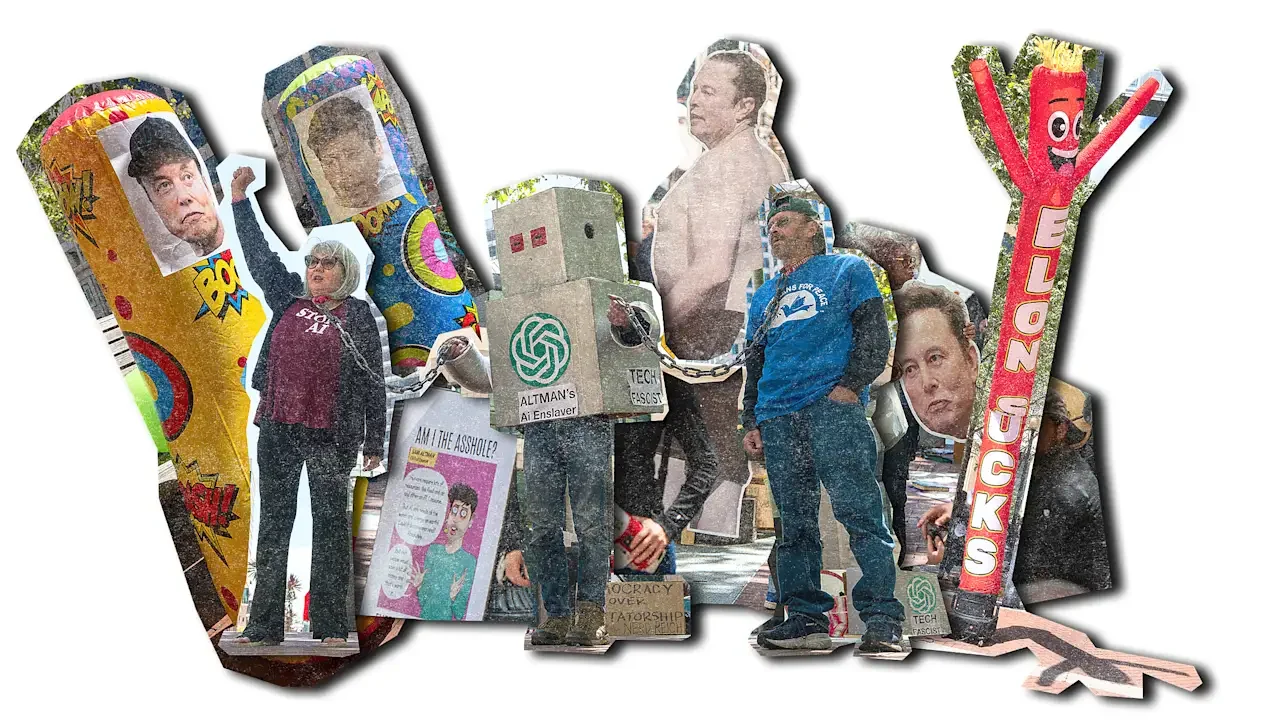
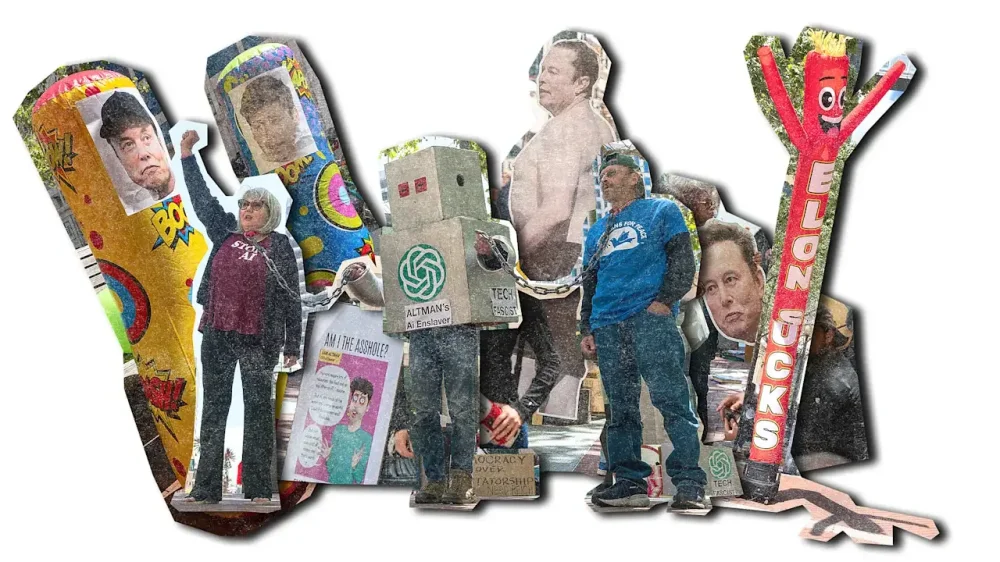
On April 27, jury selection began at the Oakland, California, federal courthouse for a high-stakes legal showdown between tech CEOs Elon Musk and Sam Altman. Outside the building, a giant cardboard cutout of Musk (dripping wet in a pair of swim shorts) stared down onlookers, while someone in a robot costume led two protestors around in chains. These visual spectacles are part of a larger protest that’s emerging around the trial—which began with opening arguments on April 28—and the two widely disliked tech bros at its center. The trial stems from a lawsuit, filed by Musk in 2024, which argues that ChatGPT-maker Open AI and its CEO, Altman, abandoned the company’s original mission to develop artificial intelligence for the benefit of humanity and not for profit. Musk provided key funding for OpenAI when it was founded back in 2015, before ultimately falling out with Altman over his vision for the company and founding a competitor, xAI, in 2023. Essentially, the trial amounts to two of the world’s richest and most powerful men duking it out over what the future of AI should look like and airing their personal dirty laundry in the process. In response, on-the-ground protestors at the courthouse are using creative works of art to convey one central message: “Everyone sucks here.” “Whoever wins, we lose” The most prominent group organizing outside the Musk v. Altman trial is Tesla Takedown, an action coalition that led nationwide protests against Tesla dealerships in 2025. In a post to the site Action Network, the group announced a gathering on April 27 that it called “Musk vs Altman: Whoever Wins, We Lose.” “Elon Musk is losing the AI arms race as xAI flails and stumbles,” the post reads. “If he wins this case, he severely damages the leader and gives himself a chance to catch up.” Meanwhile, it continues, Altman is “helping The President build killer robots and mass surveillance” and bringing the U.S. closer to a “technofascist” state. “If there’s one thing that’s clear, it’s that EVERYONE SUCKS HERE. And that’s what we’re making our theme!” The post concludes with a call for protestors to show up at the courthouse with signs and art related to that theme—and attendees did not disappoint. Monday’s protest art bore a striking resemblance to protests in Portland, Oregon, against U.S. Immigration and Customs Enforcement in late 2025, which used weaponized ridiculousness—like animal costumes, memes, and silly songs—to punch up at the The President administration. Likewise, protestors outside the Oakland courthouse now are using humor to drum up attention and get their point across. Inflatables, robots, and swimsuit shots On Monday, at least four inflatables mocking Musk appeared amid the crowd. A bright red tube man, in the classic style you might see outside a car wash, waved its arms at passersby while emblazoned with the all-caps declaration “ELON SUCKS.” Someone customized a pair of inflatable punching bags with printouts of Musk and Altman’s faces, encouraging people to take a shot. Another tube man was made specifically in Musk’s image. It parodied a moment in January 2025 when, at an inauguration rally for President The President, Musk appeared to perform a Nazi salute. Videos of this inflatable show its arm repeatedly flinging out to the side at a 45-degree angle before returning to its chest. this is wild — rat king 🐀 👑 (@mikeisaac.bsky.social) 2026-04-27T19:35:19.393Z Some protestors outside the trial embraced a kind of performance art to make a statement. One video taken at the scene shows an individual dressed in a retro sci-fi robot costume, complete with red eyes and a boxy head, wearing the title “Altman’s AI enslaver” below an image of OpenAI’s logo. The robot holds chains linked to the necks of two other protestors. Other people on the scene opted for more typical modes of visual protest: There were plenty of signs featuring mottoes like “Sam Altman, stop lying,” and “Quit ChatGPT,” as well as the aforementioned life-size cutout of Musk in a swimsuit. One of the most quietly striking works of art to emerge was a poster featuring Musk’s face superimposed onto a writhing, multi-limbed creature looming over a mother bottle-feeding her baby. Above this image, the caption reads, “The Creep State is watching!” The poster is the work of the Creep State, an organization that started as a Reddit page dedicated to discussing what it calls “tech broligarchy” that has since morphed into an action group creating art to protest figures including Musk, Jeff Bezos, Peter Thiel, Bill Gates, Marc Andreessen, and others. The group’s work uses 1984-esque visuals and messaging, inspired by B-horror and comic books, to cultivate a sense of dread around America’s most controversial figures in tech. In a statement to Fast Company, a spokesperson from the Creep State explained, “Guerrilla art has been part of movements against tyranny and fascism for generations. This time around, the boot of tyranny is being built by people who want to replace all human creativity, thought, and agency with slop generated by machines. We wanted to anchor our small piece of this movement in human-generated art that sparks the imagination and encourages people to connect in a different way.” Through all of these works, protestors are striking a balance between poking fun at the inherent silliness of the feud at its core while simultaneously drawing viewers’ attention to the very real power that both men wield over the average American. View the full article
-
Filing your taxes early can be a smart move, but you need to follow specific rules to do it right. First, gather all required documents, like W-2s and 1099s, by January 31. The IRS usually starts accepting returns in late January, giving you the chance to file before the April 15 deadline. Nonetheless, ensuring accuracy is essential to avoid delays or errors. Want to know more about the key benefits and tips for a smooth process? Key Takeaways The IRS typically begins accepting tax returns in late January, allowing early filing before the April 15 deadline. Collect all necessary documents, such as W-2s and Social Security numbers, by January 31 to prepare for early filing. E-filing is recommended for quicker processing and refunds, often received within 21 days with direct deposit. Extensions can be requested for filing but do not extend payment deadlines; taxes owed must still be paid by April 15. Filing early helps protect against identity theft by limiting the time criminals have to file under your name. Understanding Early Tax Filing Comprehending early tax filing is essential for anyone looking to streamline their tax season. You can file taxes early, typically between early January and late March, well before the April 15 deadline. The IRS usually starts accepting returns in late January, so it’s important to gather your required documents—like W-2s, 1099s, and last year’s tax returns—by January 31. Filing early not just helps you avoid the stress of last-minute submissions but can furthermore lead to an instant tax refund. E-filed returns often see refunds processed within 21 days when you opt for direct deposit. Moreover, early filing greatly reduces the risk of identity theft, as it limits the time for criminals to file fraudulent returns using your Social Security number. You’ll likewise have ample time to correct any errors or add deductions, making the entire process smoother and more efficient. Key Benefits of Filing Early Filing your taxes early offers several key benefits that can make the process smoother and more efficient. By submitting your return ahead of time, you can enjoy advantages that not only save you time but additionally provide peace of mind. Faster Refunds: Many taxpayers receive their refunds within 21 days of e-filing with direct deposit, helping you access your money sooner. Identity Theft Protection: Early filing secures your Social Security number and reduces the chance of fraudsters submitting fake returns in your name. Thorough Preparation: Completing your tax return early gives you extra time to gather documents and correct any errors, ensuring everything’s accurate before the April 15 deadline. Important Dates for Tax Filing Taxpayers should be aware of several important dates regarding filing their taxes. The IRS typically starts accepting tax returns in late January; for the 2025 tax returns, this process will begin in late January 2026. It’s important to highlight that the federal income tax filing deadline is April 15. Although you can request extensions for filing, keep in mind that these extensions don’t apply to payment. You can start organizing your tax documents as early as January to prepare for filing, ensuring that all your income and deductions are accounted for. Early filing opportunities exist from early January until late March, allowing you to submit your returns well before the April deadline. With millions of individual tax returns expected by April 15, preparing early helps you avoid the last-minute rush. Keeping these dates in mind can simplify your tax filing experience considerably. Necessary Documents for Early Filing With the tax season approaching, having the right documents ready is fundamental for early filing. To guarantee a smooth process, gather the necessary paperwork ahead of time. Here’s a list of critical documents you’ll need: Government-issued photo ID: An unexpired ID, like a driver’s license, helps verify your identity. Social Security card or number: This is crucial for accurately reporting your income and claiming tax benefits. Income documents: Collect W-2s, 1099s, and unemployment benefit statements to report your earnings correctly. If you’re self-employed, don’t forget to include Form 1099-K for any electronic payments received. Tips for a Smooth Early Filing Process To guarantee a smooth early filing process, it’s essential to stay organized and proactive. Start by categorizing your tax documents into groups, such as income items and deductions. This organization helps streamline your filing and avoids last-minute confusion. Make certain to gather all necessary documentation, including W-2s, 1099s, and last year’s tax returns, by January 31st. Consider e-filing your tax return for quicker processing; this method often allows for direct deposit of refunds, which can mean receiving your money within 21 days. Review any life changes, like marriage or job changes, that might impact your tax status. Early filing lets you identify and correct mistakes or missing documents before the April 15th deadline, which reduces stress and helps you avoid penalties. Frequently Asked Questions What Happens if I File My Taxes Early? When you file your taxes early, you typically receive your refund faster, often within 21 days if you choose electronic filing with direct deposit. Early filing likewise reduces the risk of identity theft, as it secures your Social Security number with the IRS. Furthermore, it gives you more time to gather necessary documents and correct errors, minimizing mistakes. If you owe taxes, you gain extra time to prepare your payment before the April 15 deadline. What Is the Earliest the IRS Will Accept Tax Returns? The IRS typically accepts tax returns starting in late January each year. For 2025 returns, this will likely begin in late January 2026. You can prepare your return beforehand, but the IRS won’t process it until the official date. It’s essential to check the IRS website for the exact start date, as it can change annually. Make sure you have all necessary documents, like W-2s and 1099s, ready by January 31 for smooth filing. What Is the Earliest I Can Do a Tax Return? You can typically start filing your tax return in late January of the following year. For the 2025 tax year, that means you can file as early as late January 2026. To do this effectively, make sure you’ve gathered all necessary documents, like W-2s and 1099s, by January 31. Filing early can speed up processing times and refunds, as well as reducing the chance of identity theft by securing your information with the IRS. Do You Get a Bigger Tax Refund if You File Early? Filing your taxes early doesn’t guarantee a bigger refund. Your refund amount depends on your income, deductions, and credits, which remain unchanged regardless of when you file. Nevertheless, submitting your return early can help you receive your refund faster, typically within 21 days if filed electronically. Furthermore, early filing allows you to secure your personal information with the IRS, reducing the risk of identity theft and potential delays in processing your refund. Conclusion In conclusion, filing your taxes early can bring several advantages, including faster refunds and reduced stress as the deadline approaches. To guarantee a successful early filing, gather all necessary documents by January 31 and double-check your information for accuracy. Remember, the IRS typically starts accepting returns in late January, so you can submit yours quickly. Although extensions are an option, be mindful that they don’t extend payment deadlines. Stay organized and informed to navigate the process smoothly. Image via Google Gemini and ArtSmart This article, "What Are the Rules for You to File Taxes Early?" was first published on Small Business Trends View the full article
-
Blog SEO isn‘t just about Google anymore. 11 tips to rank and get cited by ChatGPT, Perplexity, and other AI tools. View the full article
-
It’s interesting to think about what the world looked like for America’s Founding Fathers. 1776 wasn’t just a revolutionary year for giving birth to America; it also kicked off the first Industrial Revolution with James Watt’s invention of the steam engine, and modern capitalism with Adam Smith’s publishing of The Wealth of Nations. Many of the debates we have today about economics, industry, and politics would have been nonsensical in 1775. For people living at the time, feudalism, mercantilism, and the divine right of kings seemed the natural way of the world. They never experienced anything else. But after 1776, everything would change. We appear to be going through a similar transition today. The neoliberal order is under siege, while technologies like artificial intelligence, quantum computing, and synthetic biology are creating completely new paradigms. Much like the founders 250 years ago, the hardest part isn’t inventing the future, but letting go of the past. History shows that struggle is unavoidable. What Euclid’s Geometry Never Got Straight The basic geometry we learn in grade school, also known as Euclidean geometry, is rooted in axioms drawn from everyday experience, such as the principle that two parallel lines never intersect. For thousands of years, mathematicians built proofs based on those axioms to create new knowledge, such as how to calculate the height of an object. Without these insights, our ability to shape the physical world would be negligible. But what if one of those foundational assumptions was wrong? What if space itself could be curved, so that lines that appear parallel might eventually intersect? In the 19th century, some of the world’s most celebrated mathematicians, like Gauss, Lobachevsky, Bolyai, and Riemann, started asking those questions and came up with entirely new geometries based on non-Euclidean spaces. At the time, these were seen as purely theoretical and of no use in daily life. The universe, as we experience it, doesn’t curve in any appreciable way, which is why police ask us to walk a straight line if they think we’ve been drinking. So despite the prestige of those proposing it, the idea of non-Euclidean geometry was widely dismissed, often ridiculed, and largely ignored. But when Albert Einstein started to think about how gravity functioned, he began to suspect that the universe did, in fact, curve over large distances. To make his theory of general relativity work, he had to discard the old Euclidean thinking and embrace new mathematical concepts. Without those critical tools, he would have been hopelessly stuck. Yet today we make use of non-Euclidean spaces every day, because our GPS systems need to work across distances large enough that the curvature of space becomes a practical matter. They use Einstein’s equations to correct for that difference. So every time you use GPS to drive somewhere, when you get to where you’re going, you effectively prove the theory! How a 25-Year-Old Austrian Revealed The Flaw in Aristotle’s Logic In terms of longevity and impact, only Aristotle’s logic rivals Euclid’s geometry. At the core of Aristotle’s system is the syllogism: an argument built from propositions consisting of a subject and a predicate. If the propositions in the syllogism are true, then the argument has to be true. For more than 2,000 years, this idea—that correct reasoning guarantees truth—served as a foundational principle of Western thought. Yet, much like with geometry, cracks eventually began to appear. At first, logicians noticed minor flaws that had to do with Russell’s paradox, which arose with sets that are members of themselves. A simpler form, known as the barber paradox, states that the barber shaves every man in town who doesn’t shave themselves (then who shaves the barber?). At first, these seemed like strange anomalies, minor exceptions to rules that could easily be explained away. Still, the more scholars tried to close the gaps, the more problems appeared, leading to a foundational crisis. It would be resolved when a young logician named Kurt Gödel published his theorems showing that the dream of a perfectly complete logical system was fatally flawed. In a strange twist, another young mathematician, Alan Turing, built on Gödel’s work to create an imaginary machine that would make digital computers possible. In other words, in order for Silicon Valley engineers to code to create computable worlds online, they need to use machines built on the premise that perfectly logical systems are inherently unworkable. Today, computers have become such an integral part of everyday life, it’s hard to remember a time when they didn’t exist, and we have the limits of logic to thank for it. Hippocrates’ Other Idea, And Why It Had To Go Before the germ theory of disease took hold in medicine, the miasma theory (the notion that bad air caused disease) was predominant. Again, from a practical perspective, this made perfect sense. Harmful pathogens tend to thrive in environments with decaying organic matter that gives off bad smells. So, avoiding those areas would promote better health. Once again, this basic paradigm would begin to break down with a series of incidents. First, a young doctor named Ignaz Semmelweis showed that doctors could prevent infections by washing their hands, which suggested that something besides air carried disease. Later, John Snow was able to trace the source of a cholera epidemic to a single water pump. Perhaps not surprisingly, these were initially explained away. Semmelweis failed to present his data convincingly and was less than an effective advocate for his work. John Snow’s work was statistical, based on correlation rather than causality. A prominent statistician, William Farr, offered alternative explanations that preserved the prevailing view. Still, as doubts grew, more scientists looked for answers. The work of Robert Koch, Joseph Lister, and Louis Pasteur led to the germ theory. Later, Alexander Fleming, Howard Florey and Ernst Chain would pioneer the development of antibiotics in the 1940s. That would open the floodgates, and money poured into research, creating modern medicine. Today, we have gone far beyond the germ theory of disease, and even laypeople understand the concept of pathogens, such as bacteria and viruses. Life expectancy has nearly doubled since the time of Semmelweis. Building A New Path Forward In November 1989, two watershed events changed the course of world history. The fall of the Berlin Wall would end the Cold War and open up markets across the world. That very same month, Tim Berners-Lee would create the World Wide Web and usher in a new technological era of networked computing. It seemed, as Francis Fukuyama famously wrote, like the end of history. The conflict between communism and capitalism appeared to be over. Just one model remained. But, as Fukuyama also noted—and as I saw firsthand living in Moscow—the human urge to assert identity remained. We weren’t witnessing an end, but the beginning of a major realignment, in which the neoliberal order, globalism, the Washington Consensus, and digital technology would reign. But almost from the beginning, there were deep misgivings. Many developing countries, pressured by the International Monetary Fund and the World Bank to adopt policies that would never have been accepted in wealthier nations, chafed. And even in advanced economies, many felt left behind as globalization and offshoring hollowed out their economic lives. Today, “new right” intellectuals like Patrick Deneen have argued that liberalism has undermined foundational aspects of society, such as family, religion, and community. Others, like Curtis Yarvin, argue that democracy itself is inefficient, and what we need are tech-style CEO-like sovereigns. Meanwhile, Ezra Klein and Derek Thompson have called for an abundance agenda that focuses more on building what we need than preventing what we don’t want. We are now, much like America’s Founding Fathers, tasked with finding a way forward when the path is frustratingly unclear. Like generations that came before us, we will need to struggle with new paradigms made possible by advances in technologies. Yet, also like our forebears, our biggest challenge is not a lack of possibilities, but a lack of consensus. We tend to replace questions about what kind of future we want with questions about technology. But as Martin Heidegger explained long ago, we can’t build for the world until we know how we want to live in it. View the full article

-
Common SEO mistakes include duplicate content, slow pages, and more. Learn how to fix each one. View the full article
-
Promoting the wrong person is expensive and happens all too frequently. Anywhere from 30% to 50% of executive hires fail within the first year and a half. Workhuman, an employee management platform, has created a new AI tool, Future Leaders, to help improve promotion decisions. The tool, which the company announced on Tuesday, can “pinpoint high-potential employees likely to become senior leaders three to five years before promotion.” CEO Eric Mosley told a crowd at Workhuman’s annual conference in Orlando, Florida, about Future Leaders, saying the company tested it by setting its data to the year 2020, “when we were all watching Tiger King.” The tool was able to predict promotions with around 80% accuracy. He says Future Leaders is able to reverse engineer why people get promotions. For example, when asked why one person was promoted to VP, it gave a detailed explanation, pointing out that the responsibilities the person had been given meant that they were extremely valued and trusted. The AI called this “strategic trust,” Mosley explained. He said this made him realize that strategic trust was “a key indicator that somebody in the future will be promoted.” Since Future Leaders is trained on a large dataset of leaders, it can distill the patterns that make great leaders, and thus find and recommend employees who match this pattern. Mosley pointed out that the tool can be used to ensure companies don’t miss talented employees who deserve a promotion. Several companies have already been implementing AI to help with promotions. According to a 2025 Resume Builder survey, 77% of managers already use AI to assist with deciding on promotions. Tools like Future Leaders go a step further by letting managers “peek” into the future. However, even with 80% accuracy, making the final call on who gets promoted may still come down to something that no AI tool can define. As Mosley pointed out, it’s still important to use human judgment, and at the end of the day, an AI is only as effective as the human who prompts it. View the full article

-
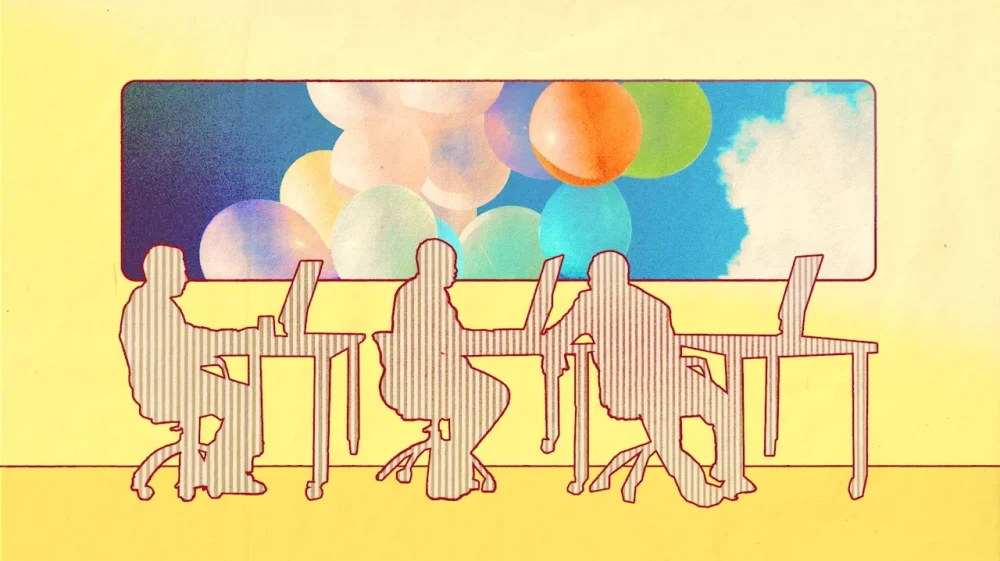
For most of human history, the idea that work should be “fun” would have seemed, at best, absurd and, at worst, offensive. Consider a Roman galley slave chained to an oar, or a medieval serf bound to land and lord, or a 19th-century textile mill worker inhaling lint in a windowless factory. Even professions we now romanticize—such as blacksmiths, sailors, or early physicians—involved long hours, high risk, and minimal autonomy. Work was, in essence, a necessary burden: dangerous, monotonous, and rarely chosen. The notion that it should also be somewhat enjoyable would have seemed like asking for dessert during a famine. Against that backdrop, the past century, and especially the past two decades, represent a remarkable deviation. Work, at least for a segment of the global workforce, has been reimagined not merely as tolerable but as potentially fulfilling, even pleasurable. Offices began to resemble adult playgrounds. Silicon Valley firms led the charge, offering sushi chefs, kombucha on tap, nap pods, on-site gyms, and curated social events. The rise (and at times weaponization) of “culture” as a corporate asset reframed employment as an experience, not just a transaction. Parallel to this, the expansion of employee wellness programs, flexible schedules, and remote or hybrid work blurred the boundary between professional and personal life. Work itself also underwent a subtle rebranding. Careers were no longer simply jobs; they became vehicles for identity, purpose, and self-expression. Employees were encouraged to “bring their whole selves to work” in order to seek meaning in what they did, and to expect that their employer would facilitate personal growth. Organizations, in turn, increasingly borrowed from the logic of consumer markets: Employees became internal customers and were offered access to coaching, leadership talks, curated learning journeys, and even quasi-membership communities. There was also, for a time, a distinctly performative ethos: the rise of the “work hard, play hard” culture. Popularized in the late 20th century and institutionalized in consulting firms, investment banks, and later tech companies, it promised intensity offset by indulgence. Long hours would be compensated with team off-sites, lavish parties, and a sense of camaraderie forged under pressure. In theory, it was a bargain. In practice, it often became asymmetrical. The “play” proved episodic, the “work” permanent. As technology dissolved temporal boundaries, the bargain eroded further. Today, for many, the culture has quietly mutated into something less balanced: work hard, then remain on call. This trajectory would have puzzled John Maynard Keynes, who famously predicted in his 1930 essay “Economic Possibilities for our Grandchildren” that technological progress would reduce the workweek to roughly 15 hours by the turn of the millennium. He was not entirely wrong about productivity gains. What he underestimated was our capacity to convert efficiency into higher expectations rather than greater leisure. Instead of working less, we have chosen—or been nudged—to work differently, and often more. An unsentimental reality Yet, as with most utopian projects, the fine print matters. Beneath the surface of kombucha taps and mindfulness sessions lies a less sentimental reality. Many of these initiatives were not purely altruistic but instrumental. Making work more enjoyable can also make workers more productive, more loyal and, crucially, more available. If your office has everything you need, why leave? If your job is your identity, why switch off? The risk is not merely longer hours but a deeper form of entanglement: the emergence of what one might call the spiritual workaholic, someone who does not feel coerced but nonetheless cannot disengage. At the same time, the standardization of performance has intensified. Metrics, dashboards, and analytics increasingly govern how work is evaluated. Even ostensibly creative roles are decomposed into measurable outputs. Technology has amplified this trend. The smartphone (and for those of you old enough, remember the Blackberry?) ensured that work followed us home. Artificial intelligence now ensures that it follows us into our thinking. Tasks that once required judgment are increasingly automated or augmented, often reducing the scope for discretion and experimentation. The result is a paradox. Work has never looked more enjoyable on the surface, yet many report feeling less engaged, less creative, and more replaceable. Research on job polarization and automation suggests that as routine cognitive tasks are digitized, human labor becomes either highly specialized or increasingly commoditized. Generative AI accelerates this dynamic by making knowledge more accessible but also more interchangeable. When everyone can produce competent output, the marginal value of individual contribution declines. Measurable benefits In such an environment, “fun” risks becoming another managed variable, something to be optimized rather than experienced. Worse, it may be crowded out entirely. Efficiency, after all, is not particularly playful. The trade-off between efficiency and humanism becomes acute. As organizations pursue ever greater productivity, they may inadvertently strip work of the very qualities that made it engaging: autonomy, mastery, and social connection. This matters because, contrary to the historical norm, fun at work is not merely a luxury. A substantial body of research suggests it has measurable benefits. First, meta-analytic evidence shows that positive affect is associated with higher job performance, particularly in roles requiring creativity and problem-solving. Second, studies on engagement consistently find that employees who experience enjoyment and interest in their work are more productive and less likely to leave. Third, research on psychological safety, led by Harvard Business School professor Amy Edmondson, indicates that environments where people feel comfortable and relaxed foster learning and innovation. Fourth, meta-analyses on intrinsic motivation, such as those by psychologists Edward Deci and Richard Ryan, show that enjoyment derived from the task itself predicts persistence and performance better than external rewards. However, the desire for fun is not universal. Cultural norms shape how appropriate it is to display enjoyment at work. In some contexts, visible seriousness signals professionalism; in others, it signals rigidity. Individual differences matter as well. Personality traits such as extraversion and openness are associated with a greater desire for stimulation and novelty, whereas conscientious individuals may derive satisfaction from structure and achievement rather than amusement. Self-assessment A useful way to think about this is not whether work should be fun, but how much fun one needs from work. Consider a simple self-assessment: 1. Do you feel energized by social interaction and novelty, or drained by it? 2. Do you seek meaning primarily through your career, or outside it? 3. How important is it that your work reflects your identity? 4. Would you prefer a stable, predictable role that enables leisure elsewhere, or a dynamic, immersive role that blurs boundaries? 5. Do you equate enjoyment with immediate pleasure, or with long-term growth and mastery? Those who score high on the need for alignment between personal identity and professional role are more likely to seek fun, or at least intrinsic satisfaction, in their work. Others may prefer to treat work instrumentally, as a means to fund a fulfilling life elsewhere. Neither approach is inherently superior, but confusion between them can be costly. What to do What, then, is to be done? Here, insights from author Dorie Clark’s work on long-term career strategy are instructive. One option is job crafting: deliberately reshaping aspects of your current role to increase autonomy, variety, and meaning. This might involve seeking projects that align with your interests, renegotiating responsibilities, or building relationships that make work more engaging. Research suggests that even small changes can significantly enhance satisfaction and performance. Another option is strategic career design. Rather than chasing immediate enjoyment, Clark advocates for a longer-term perspective: investing in skills, relationships, and reputation that create future optionality. Ironically, this may involve periods of less enjoyable work in the short term, in service of greater autonomy later. The key is intentionality. Fun, in this view, is not something one stumbles upon, but something one engineers over time. It is also worth noting that even in environments that are not obviously “fun,” people can often create pockets of enjoyment. Much of this comes down to colleagues. A strong team can transform even routine work into something tolerable, occasionally even enjoyable. Shared humor, mutual support, and informal camaraderie often matter more than formal culture initiatives. In that sense, fun at work is not always designed from the top down; it is frequently improvised from the bottom up. For those considering a more radical shift, the question is not simply “What would be fun?” but “What kind of problems do I want to spend my time solving?” Sustainable enjoyment tends to arise not from perpetual entertainment, but from meaningful challenge. As decades of research on flow have shown, people are happiest when they are stretched but not overwhelmed, engaged but not bored. The AI factor Has artificial intelligence killed fun at work? Not quite. But it has changed the conditions under which fun can emerge. By automating routine tasks, it has the potential to free humans for more creative and social activities. Yet, if deployed primarily for efficiency, it may instead compress work into narrower, more standardized forms, leaving less room for play. The future of fun at work, then, is unlikely to be determined by technology alone. It will depend on choices by organizations about how to design roles, and by individuals about how to engage with them. The historical arc suggests progress: from drudgery to dignity, from survival to, occasionally, satisfaction. Whether it extends to genuine enjoyment remains an open question. Let us not forget that work may still always be, well, work, as in something we do to get paid, if we are lucky enough. Unrealistic expectations about how much fun one ought to have at work may be the worst enemy of all, and a reliable source of disappointment. As The Shining reminds us, “All work and no play …” is not just a warning about monotony, but about imbalance. So, perhaps the real problem is not that work isn’t fun enough, but that we have forgotten to seek, protect, and value the many other sources of fun that life so generously offers beyond it? View the full article
-
Discover the criteria behind AI answers. Learn how to optimize your content for visibility in AI-driven environments. The post Why Your Content Isn’t Being Cited in AI Answers (And How to Fix It) [Webinar] appeared first on Search Engine Journal. View the full article
-
Bank slashes expectations for UK growth but keeps guidance steadyView the full article
-
French oil major manages to increase production outside Gulf, offsetting shutdowns caused by the conflictView the full article
-
You know the scenario: It’s nighttime. You’re cozy under the bed covers, drifting off to sleep. Then, your eyes fly open. Wow, that was a big credit card bill this month. It’s time to make a budget. Your boss made that weird comment yesterday. Are you on thin ice at work? Forget work—are we on the brink of a world war? And what the heck is going on with that weird mole? Before you know it, the worries are flooding your brain. You’re wracked with anxiety—and sleep isn’t coming any time soon. “I think we’ve all had that experience where we seem to spiral at night and, in the morning—in the light of day—whatever you were stressing about the night before sometimes seems almost ridiculous,” says neuropsychologist Sanam Hafeez. And that’s a problem. Lack of sleep seriously affects our ability to function, says licensed clinical psychologist and Brown University assistant professor Kristen Stone, who specializes in behavioral sleep medicine. Without enough sleep, we may experience reduced ability to pay attention, delayed reaction times, and lack of impulse control. And “enough” sleep isn’t just stitching together interrupted sleep. “If you get eight hours of very fragmented sleep, you’re not significantly better off than someone who gets four hours of consolidated sleep,” she says. Monsters in the Dark There are a few reasons why anxiety spikes in the middle of the night. First, there are fewer distractions. During the day, we can turn our thoughts to work, socializing, hobbies, and completing tasks. But brains are efficient workers—and when all those demands are fulfilled or put aside for the day, they go to work on the matters that remain. “When you think about it, it is quite adaptive for the brain to pull up the stressor once the competing material has gone away,” Stone says. Plus, we’re tired, Hafeez adds, and that fatigue may make us less able to hold off worries. At night, Hafeez says that lately she has been worrying about the locks on the doors of her house. “It’s happened several times, and I almost become paranoid,” she adds. Logically, she knows the locks are secure, but the worries are persistent. Then, there’s the snowball effect: Stone says that if you tell yourself not to think about something, you’re likely to think about it more, Stone says. Hafeez says there’s also a biological component to our night fears—that’s when we’re more attuned to danger. “That’s when the wolves and all the predators come out,” she says. We may be more likely to think, “Oh, if I fall asleep, something terrible is going to happen,” she adds. So, the amygdala, which is responsible for this restriction, your fear center, is more active, she says. Researchers like the authors of the “Mind After Midnight” paper find that our minds are more prone to negative, emotional, and less rational thoughts at night. The paper pointed to increases in behaviors ranging from violence and suicidal thinking to alcohol consumption and overeating at night. If you find your sleep interrupted by worries—or even that awkward thing you said at a family gathering last year—experts have some tips to help you get back to sleep. Process your stress Sometimes, climbing into bed is the first quiet time of the day, which may leave you vulnerable to worry-driven sleep interruptions, says sleep expert Nancy H. Rothstein, known as The Sleep Ambassador. Rothstein, who began studying sleep to find solutions for a snoring spouse, has developed a virtual sleep improvement program and consults about optimizing sleep. “When you lie down, what are you carrying into bed with you?” she asks. Before you settle in for sleep, use mindfulness or other techniques that can be effective in processing stressful thoughts and worries: Meditation, exercise, journaling, deep breathing, or other tactics can help you “transition to sleep in peace,” she says. Find gentle distractions When worries emerge at night, you may need to call on your prefrontal cortex—the part of the brain that engages in critical thinking and emotional regulation—to help control your thoughts. Remind yourself that you’re likely tired and that fatigue or nighttime negativity bias are likely making the situation look worse than it is. Hafeez suggests looking for gentle distractions, like naming objects in the room, or thinking about a positive event that happened recently. Find your ideal sleep conditions Your sleep environment matters, too. While some people need silence to sleep, others prefer some noise in the background, like ocean waves or falling rain. From temperature to noise, Hafeez suggests experimenting with the environment that works best for you. Write it out If the worries linger or other thoughts intrude, write them down. Hafeez admits to using her phone to make notes about tasks that need to be done. But if you’re concerned about blue light’s effects on sleep (which are debated)—or getting drawn into doomscrolling—you might keep a notebook and pen next to your bed. Sometimes, just writing out what’s on your mind can help you let it go. Accept that some worry is normal Stone points to evidence that a scheduled worry time during the day, sometimes called “worry postponement,” can decrease daytime worry, but the evidence that it will help you sleep better is thin. The bigger issue is worrying about worrying, she says, which will steal sleep. “There have been good effects shown for mindfulness-based interventions for helping folks improve their relationship with their thoughts: learning to notice thoughts without struggling with them, which decreases overall stress and generally fosters better sleep,” she says. Establish regular sleep times Stone also says that sleep timing matters because of our circadian rhythms. When we keep different sleep schedules on different days, we essentially “jet lag ourselves,” she says. “Trying to get more sleep by sleeping in or napping throws off these other important aspects of healthy sleep.” If sleep interruption is a chronic issue, discuss the issue with a mental health professional or your doctor to help determine if there may be underlying physical or mental health issues that need to be addressed. Sometimes, medical intervention can help keep the worries away, too. View the full article

-
Market volatility from Middle East war propels strong activity at Swiss bankView the full article
-
For decades, the American Dream was rooted in opportunity at home. Today, a growing number of workers are redefining that dream and increasingly, it doesn’t include staying in the United States. A mix of economic pressure, shifting expectations, and global opportunity is pushing employees to consider life and work abroad in ways that would have been unthinkable just a few years ago. New research from Preply’s Language and Global Career Mobility Report underscores just how widespread this shift has become. Preply, a foreign language learning platform, surveyed over 1,800 adults in the U.S., U.K. and Canada who had studied a language or were interested in learning one. More than 80% of workers in the U.S. say they are more likely to consider relocating abroad than they were two years ago, with cost of living (56%) and quality of life (55%) cited as the top reasons. This isn’t just curiosity; it’s a reflection of mounting dissatisfaction with economic conditions at home and a growing belief that better opportunities may exist elsewhere. That dissatisfaction is grounded in real economic strain. The Federal Reserve expects unemployment to hold around 4.4% amid slowing labor force growth, with job creation nearing zero—signaling a cooling job market that may limit upward mobility. At the same time, rising costs are eroding financial stability. Americans expect to delay retirement by four years as the cost-of-living climbs, while millions are struggling to cover basic expenses. More than 82 million Americans are cutting back on essentials like food and utilities just to afford healthcare. These pressures are changing how workers think about their future. It’s no longer just about finding a better job; it’s about finding a better life. And for many, that means looking beyond U.S. borders. The share of Americans considering a move abroad has grown significantly, with younger generations leading the charge. What was once a niche decision is becoming mainstream, fueled by remote work and global job access. The appeal is straightforward: lower costs, stronger social safety nets, and a higher perceived quality of life. From Europe to Latin America to Southeast Asia, countries are actively attracting American talent with favorable visa policies and incentives. At the same time, professionals are realizing that their skills and increasingly their jobs are portable. The Preply research also shows that workers are actively preparing to leave. Language learning is no longer just a personal goal; it’s becoming a career strategy. Ninety-two percent of respondents say knowing the local language is critical to succeeding abroad, and 93% would take advantage of language training if their employer offered it. Employees aren’t just thinking about relocation, they’re building the skills to make it happen. This shift should serve as a wake-up call for employers. Talent retention is no longer just about competing with other companies; it’s about competing with other countries. Why Traditional Retention Strategies Are Falling Short For years, companies have relied on compensation, benefits, and career advancement opportunities to retain employees. While those factors still matter, they are no longer enough in a world where workers can compare not just jobs, but entire lifestyles. When employees feel financially strained despite stable employment, higher salaries alone may not solve the problem. If the cost of living continues to rise faster than wages, workers will naturally look for alternatives, including relocating to places where their income goes further. At the same time, the definition of career success is evolving. Employees are placing greater emphasis on flexibility, well-being, and personal fulfillment. Remote work has made global mobility more feasible, and workers are no longer asking, “Where can I get the best job?” They’re asking, “Where can I build the best life?” This creates a new kind of retention challenge. Even highly engaged employees may be tempted to leave; not because they are dissatisfied with their employer, but because they believe they can achieve a better quality of life elsewhere. What Employers Can Do to Compete—and Win To address this shift, organizations need to rethink retention. The solution isn’t to prevent employees from considering global opportunities, it’s to integrate those opportunities into the employee experience. First, companies should embrace global career pathways. Instead of losing talent to international moves, organizations can offer internal mobility options that allow employees to work abroad while staying with the company. This retains top performers while strengthening global collaboration. Second, investing in language learning and cross-cultural skills is becoming a strategic advantage. The Preply data shows overwhelming demand for these benefits. Language skills don’t just enable relocation, they enhance communication, leadership, and adaptability. Providing access to language training signals that a company is invested in long-term growth. Third, employers need to rethink compensation in the context of geography. This requires a more holistic approach to financial well-being. Offering location flexibility or cost-of-living adjustments can help bridge the gap between expectations and reality. Fourth, organizations should double down on flexibility. Remote and hybrid work models have expanded what’s possible, but leading companies are going further, enabling employees to work from different countries and design arrangements that align with their personal goals. Finally, companies must recognize that retention is increasingly about experience, not just pay. Employees who feel supported in their growth and aligned with their organization’s mission are less likely to look elsewhere, even when global opportunities are available. The Future of Retention Is Borderless The rise of global career mobility represents a fundamental shift. Workers are no longer bound by geography, and organizations can no longer assume that talent will stay put. For employers, this moment presents both a challenge and an opportunity. Those who cling to traditional models risk losing talent to a growing wave of global mobility. But those who adapt, by embracing flexibility, investing in skills, and rethinking careers, can turn this trend into a competitive advantage. The question is no longer whether employees will consider leaving. Many already are. The real question is whether companies can give them a reason to stay. View the full article

-
In January 2025, Fortune Brands Innovations announced it was moving its company’s portfolio from individual offices across the country to one central headquarters outside Chicago, which meant hundreds of employees would need to relocate, or else lose their jobs. The move would take place in a phased approach beginning at the end of the summer, then-CEO Nicholas Fink told employees. Unsurprisingly, the news sent a jolt through the company, which owns several home and security brands including Moen and Master Lock, employees told Fast Company. On LinkedIn, a steady stream of goodbye posts from employees who refused the move emerged over the next several months. That summer, the company said that while most employees chose not to relocate, it exceeded industry benchmarks for the number of people who said “yes” to the move, though it declined to provide specific figures. Then, in February 2026, in the midst of that multi-phase relocation, Fink quit. Constellation Brands, the maker of Corona beer, announced that Fink had accepted a position as its next president and CEO. On the same day, Fortune Brands announced that Amit Banati, a veteran consumer goods executive and existing board member, would replace Fink. But that succession never happened. According to The Wall Street Journal, activist investor Ed Garden built a stake in Fortune Brands, having criticized Fink as “lacking leadership and industry experience” and arguing that the company risked making the same mistake with Banati. Banati never took the job and stepped down from the board—though he still walked away with an $18.4 million payout, Fortune reported. In March, the company announced it had launched a new CEO search and had appointed David Barry, a Fortune Brands exec who’d been with the company for over a decade, as interim CEO, effective immediately. In the past five years, under Fink’s leadership, the company saw slowing sales growth and declining profit margins as housing demand cooled, while competitors such as Masco, known for Delta faucets, held up better. Though Fortune Brands says Fink’s departure was not related to company performance nor the relocation, some employees saw his exit as tantamount to leaving a sinking ship: a ship that he sank. From the start, the relocation was unpopular, employees said. “Most people were stressed out,” a Master Lock employee who asked to remain anonymous told Fast Company. “Employee morale did go down. We started to lose people. There was a lot of anxiety, because by then it was clear that the tariffs were negatively impacting the economy. There was a lot of fear.” In his interview with Fast Company last May, Fink acknowledged the magnitude of asking people to uproot their lives and families to move to another state. “It’s a big change for a lot of people,” he said at the time. “There are people who are committed to their communities and their families and aren’t interested in a move. …And then there are people who are very excited to be a part of this.” The company hired more than 400 new employees at its Deerfield, Illinois, campus, but the departures still left a hole. “You could feel the vacuum, the gut of culture, that was there and now is missing,” Michael, a former engineer for the company who asked to be identified only by his first name, told Fast Company. When senior employees with “deep, tribal knowledge” left, he said it caused great concern. There was a feeling of, “Welp, who knows how long that server is going to work?” Another employee who worked in IT for Fortune Brands and also asked for anonymity noted that many of the employees who left had been at their brand for decades. “They took this massive network of very unique and talented and intelligent individuals, and then said, ‘Just because your location is this, you no longer serve our purpose,” she told Fast Company. As another employee put it on LinkedIn, the company “seemed to think two weeks would be enough time for 20-30-year employees to do the knowledge transfer. It’s sad.” The rollout of the relocation was turbulent, employees complained. The IT worker, who was given an exit date after telling the company she wouldn’t relocate, said her end date was unexpectedly moved earlier, giving her shorter notice than the company had promised. The company flip-flopped on other decisions, too: After originally saying it planned to close the Moen headquarters in North Olmsted, Ohio, the company later decided to maintain some operation there, cleveland.com reported. In a statement sent to Fast Company, Fortune Brands addressed some of the relocation issues: “As the process unfolded, we adjusted and adapted, including pushing back some end dates due to knowledge gaps we uncovered along the way, or accelerating some end dates because we were able to hire faster than expected,” the statement said, in part. “All individuals who experienced an end date change received several weeks of advanced notice as well as their full, robust separation benefits.” The instability at the top also didn’t sit well with some employees in the wake of the restructuring. “If you’re going to move for a company, you want to think that the company has a really solid future and a solid plan, and this doesn’t quite send that message,” the Master Lock employee said. The IT employee took aim at Fink, specifically, and said his exit showed “cowardice.” “From a leadership perspective, I think you should stick around and own what the results are,” she said. Fast Company reached out to Fink via Constellation Brands and did not hear back. Fortune Brands maintains the new headquarters was the right decision. “We are already seeing the benefits of this move take shape—from access to Chicago’s broad and deep talent pool, to stronger cross-functional collaboration and cultural cohesion,” the company said in a statement, in part. “We are excited about the momentum ahead and confident in where we are headed.” View the full article

-
It’s five answers to five questions. Here we go… 1. My boss told me my dresses need to be longer My line manager told me yesterday that there had been “comments made” about how short / inappropriate my dresses are in the office, as a member of the team who is front-facing for clients. I was asked to not wear these outfits in the office any longer. These comments have utterly humiliated me, and I spent about an hour crying on my way home. I have always dressed fairly modestly at work and am deeply uncomfortable with my body being perceived as being “on display.” My dresses are long-sleeved, with skirts that stop just above my knee. They are conventional office wear. I prefer dresses and skirts over trousers, as the medications I take have made my stomach quite bloated, and I find tight waistbands uncomfortable. But I was told they need to be longer as I’m greeting clients (as my work wear was just above the knee already, my presumption is that longer means to the knee or below). It’s a very male heavy office, so what other women wear is split between trousers and skirts that are above the knee or to the knee. My line manager was wearing an above-the-knee dress the day after telling me my outfits were too short. After looking at my work wardrobe, I estimate I’m going to have to get replace nearly 80% to get to these new standards — of dresses and skirts to the knee or lower — while also managing the other restrictions that are placed on women’s wear at our office. For instance, I’m not allowed to wear a sleeveless blouse because our male directors decided they are not professional for women. This is while the men in our office can meet with clients in hoodies or polo shirts. I simply don’t understand why my clothing is an issue 16 months into working here.Am I being unreasonable or is this unfair? Is this something I should speak to my union about? Yes, you should absolutely speak to your union. Something here doesn’t make sense — skirts and dresses to just above the knee aren’t unprofessional or inappropriate work wear, and that goes triple in an office where a bunch of other people are wearing them, including the manager who told you that you couldn’t. “You’re client-facing” doesn’t make sense as an explanation. Is there anything else that could explain why you’re getting this feedback and others aren’t? Sometimes this happens when you’re the only one in your office with a particular body shape (which doesn’t make it okay), and I wonder if that’s in play here. Ideally you’d go back to your manager and ask for clarification — including explicitly asking if she is telling you that your skirts must be below the knee, and pointing out that all your skirts are currently the same length as the ones you see other women in your office wearing. But since you have a union, pull them in for advice too. 2. CEO sends a delusional AI-generated image of himself with every email As a mere part-time staffer, I am certain there is nothing I can do about this issue, but perhaps you have some ideas. The CEO has begun to attach an AI-generated image of himself to every email he sends out. The images are universally more handsome than the real thing. No more receding hairline, or stomach fat. Plenty of bicep muscles. Not a wrinkle in sight. This is cringe behaviour, and staff mock him for it behind his back. While I am not personally invested in helping him save face, I do want to stop being forced to look at these unprofessional, inaccurate portraits. Especially since the workplace is a public library, where one would hope to avoid misinformation. No, this is amazing and you must not try to stop it! And that’s fortunate, because there’s almost certainly nothing you can do about it anyway. If you were, say, a senior communications staffer or his right-hand person or otherwise a trusted confidant, you could attempt to diplomatically address it, but assuming you are none of those things and therefore have no real standing or obligation to take this on, the only correct response is to sit back and bask in the utter absurdity of it. Is it a problem for his credibility? Yes! Is it your problem? No. You can just enjoy the spectacle. 3. I wish my board would just fire me already I am the chief executive of a small nonprofit and I report to a board, and I have been on a performance improvement plan (PIP) for the past four months. The PIP is full of things that are untrue and half true, along with some things that could legitimately be improved. The PIP was my first notice of any of those gripes that the board (or rather, a few members of the executive committee) had about me, my work, and, more pointedly, my personality. The first PIP was supposed to be 60 days. They had no objective success measure in it and missed over half the weekly check-ins we had scheduled. They are having a lawyer handle everything for them, so I didn’t receive a determination about the PIP until a couple weeks ago when they gave me another PIP with a 60-day extension. This document, even more than the first one, has things in it explaining where I am failing to meet expectations that I was unaware of and were not part of the job previously. At this point, it is clear that at least two of the board members just don’t like me and want to fire me, which is completely within their power to do. I have sincerely done what I can to meet their expectations, but I can’t and won’t change my personality or pretend to be someone I am not. And this job has turned into something different than what I was hired for. I have been looking for a new job since the process started, but it is not easy at this level and I can’t afford to be without an income or I would have quit already. How do I have the conversation with them expressing my desire to leave along with my need to be eligible for unemployment benefits? Frame it this way: “It’s clear to me that you’re unhappy with my work and I want to be realistic about my chances for success here and not drag out the process, so I’d like to propose a managed separation with a transition that will be as smooth as possible for both of us. I’d ask that you not contest my unemployment benefits since it sounds like I was likely to be let go at the end of this process anyway, but beyond that I’m flexible about what this could look like in terms of timing and messaging.” They are likely to hear this with relief. You might also consider whether you have an argument to request severance, if they’re now defining success in the role differently than what you were brought on to do. 4. Requiring 15+ hours of outside reading per week I am curious to your take on a job listing I recently came across. There is an indie bookshop in my city that is looking for booksellers — basically part-time retail work, $12/hour starting wage, nothing atypical for the area. Amongst the qualifications and job duties listed, alongside needing 3+ years experience as a bookseller and “associates or better” degree, I noticed something that seemed super wild. “Booksellers are required to spend an additional 15+ hours a week reading recent releases and bestsellers to stay up to date on merchandise and better assist customers.” (I am assuming the 15+ hours of reading homework is unpaid, but I could be wrong; this is a very hipster bookshop that I like to visit now and then but would never work at personally, so I haven’t inquired further or anything.) Is this as bonkers as it sounds to me? Or does this sound more like “continuing education” and is pretty reasonable to expect? As a general rule, if outside reading is required for non-exempt employees, they need to be paid for that time. There are exceptions for things like continuing education required to maintain a license, but booksellers aren’t licensed. They’d be better off saying that they’re looking for employees who already maintain a deep knowledge of recent releases and bestsellers and who will maintain that knowledge going forward — and then screening for dedicated readers of recent releases (which is different from just being a voracious reader in general) in their interview process — instead of presenting it like a job duty with a specific number of hours attached. 5. I was fired from my last job, then didn’t work for several years — how do I explain it in interviews? I was fired from my job several years ago. Due to a combination of burnout and undiagnosed depression, I effectively went AWOL and didn’t do anything about anything until it was too late, and I’m trying to re-enter the job market now. I have a resume gap of several years, my previous job loss was entirely my fault, and it’s been a very long time since I had to do any kind of job searching. How do I write a resume to cover this particular ground? And, in the event of an interview, any advice on how to answer the inevitable question of what I was doing while unemployed? (The honest answer is nothing, while trying to claw my way out of a mental health hole.”) You don’t address it on a resume at all; that’s the place to highlight your work history and accomplishments. In an interview, the language you want is: “I’ve been dealing with a health issue that is now resolved and I’m excited to return to work.” You don’t need to say more than that; they’re not supposed to ask for details, and it explains why you left the last job as well as what you’ve been doing since then. The post boss told me my dresses need to be longer, I wish my job would just fire me already, and more appeared first on Ask a Manager. View the full article
-
Founder of Citadel says some investors may not have realised they cannot quickly withdraw all their money from fundsView the full article