All Activity
- Past hour
-
Across 90 prompts we tested in ChatGPT, commercial prompts triggered web searches 78.3% of the time. Informational prompts did so just 3.1%. That gap changes what you should write if you want to appear in a ChatGPT answer. ChatGPT doesn’t pull every response from the same place. Some answers come from training data; others use live web search — a behavior called query fan-out. The model expands your prompt into multiple background searches, then retrieves and synthesizes across those subtopics. If your page isn’t on those branches, it won’t be pulled in. So the question is no longer just how to rank. It’s which pages open the fan-out door in the first place. In our sample, informational pages didn’t. Read on to discover where the system went instead. We tested 90 prompts across three industries: beauty, legaltech/regtech, and IT. We analyzed prompt intent, downstream query expansion, and the intent those expansions reflected. Here’s the breakdown and the core finding: most queries aligned with commercial intent, not purely informational prompts. Why this question matters now and how query fan-outs come into play Query fan-outs change the content game because the system isn’t limited to the literal prompt. It expands the request into multiple background searches, then retrieves and synthesizes across those subtopics. Fan-outs trigger parallel web searches tied to the initial prompt, creating opportunities for retrieval, mention, and link citation. Multi-query expansion is a core design pattern in modern generative search systems. Google describes AI Mode this way: it breaks a question into subtopics, searches them in parallel across multiple sources, then combines the results into a single response. That raises a strategic SEO question: should you invest more in top-of-funnel educational content, or in lower-funnel comparison, shortlist, and recommendation content? This experiment framed that problem. The objective was to test, across selected industries, where fan-out appears by intent category: informational, commercial, transactional, or branded. The initial hypothesis was direct: informational prompts wouldn’t trigger fan-out, while commercial prompts would, and those fan-outs would stay at the same funnel level or move lower. We found that ChatGPT-generated fan-outs are overwhelmingly associated with commercial intent. Disclaimer: This experiment measures observed prompt expansion behavior in ChatGPT. Google AI Mode is cited only as context to show multi-query expansion as a broader pattern in generative search, not as proof of ChatGPT’s internal architecture. The setup: what we tested The core sample includes 90 numbered prompts, heavily weighted toward informational intent. Prompt intentPromptsShare of samplePrompts with fan-outFan-out rateInformational6572.2%23.1%Commercial2325.6%1878.3%Branded11.1%00.0%Transactional11.1%00.0% The sample skews heavily toward informational prompts, with some commercial ones and minimal branded and transactional queries. We structured the experiment around the sectors in the brief: beauty/personal care, legaltech/regtech, and IT/tech. The result: commercial prompts triggered almost everything The main finding is clear. Out of 90 prompts, 20 triggered fan-out. Of those, 18 were commercial and 2 informational. Informational prompts made up about 10% of fan-out triggers (2 of 20). When they did trigger expansion, they were rewritten into more evaluative, solution-seeking subqueries. In other words, 90% of fan-out-triggering prompts in the core sample came from commercial intent. The contrast is stronger than the raw totals suggest. Commercial prompts triggered fan-out 78.3% of the time; informational prompts did so just 3.1%. This supports the working hypothesis: in this sample, fan-out was overwhelmingly a commercial phenomenon. Those 20 prompts produced 42 fan-out queries — an average of 2.1 per triggered prompt. Of those 42 fan-out queries: 39 were commercial. 2 were branded. 1 was informational. Even when a prompt triggered expansion, the system usually shifted toward comparison, product evaluation, feature filtering, shortlist creation, or brand-specific exploration — not broad educational discovery. Methodology: how we performed the analysis The experiment used 90 prompts across three industries, mostly informational, with a smaller set of commercial prompts and minimal branded and transactional queries. In the analysis, we have: Selected a representative battery of prompts. Identified the fan-outs. Classified each fan-out by intent. Observed distribution by prompt metadata. The analysis then followed three steps: Each prompt was classified according to prompt-intent labels. We counted the prompts triggering fan-out (at least one). We inspected the observed expansion queries and their assigned fan-out intent labels. That produced two distinct but complementary views: A prompt-level view, asking whether a given prompt triggered fan-out at all. A fan-out-query view, asking what kind of intent the downstream expansion actually took. That distinction matters: the first shows which prompts open the fan-out path, while the second shows where the system goes once it opens. Interpreting the results: fan-out tends to move down-funnel The cleanest interpretation is that, in this sample, fan-outs behave less like open-ended topic expansion and more like assisted decision support. Commercial prompts almost always opened the door. Once they did, fan-outs usually stayed commercial. The system expanded into comparisons, feature-based filtering, product lists, pricing-adjacent queries, and brand-specific evaluations. A few examples make that concrete. “Suggest the best accounting software for small business and explain why” expanded into a commercial comparison query around features. “What are the top AI document management systems for lawyers?” expanded into multiple product-oriented legaltech queries. “What are the best products for skin care?” expanded into a shortlist-style query around product categories and reviews. The two informational exceptions are even more revealing than the rule. “I need an open-source document management system. What can you suggest?” was labeled informational at prompt level, but the resulting fan-out moved into solution recommendation. “AI tools for legal research and document automation” also moved into a clearly commercial/evaluative downstream query. So, even when the prompt starts broad, fan-out often translates that breadth into a lower-funnel retrieval path. What this means for content strategy The takeaway isn’t to stop writing informational content. It’s this: informational content alone is unlikely to align consistently with fan-out expansion, at least in this dataset. If your goal is visibility in AI answers tied to product selection, vendor discovery, or option narrowing, you need stronger coverage of pages and passages that match those downstream commercial branches. That may include: best-of and shortlist pages comparison pages “which tool should I choose” pages feature-led category explainers alternatives pages evaluation FAQs recommendation-oriented paragraphs embedded inside broader educational pages In practical terms, your content model shouldn’t be just ToFU or BoFU, but ToFU with commercial bridges. A broad article can still help, but it should include passages the system can easily reformulate into decision-support subqueries. A purely educational piece that explains a category without naming products, tradeoffs, features, use cases, pricing logic, or selection criteria is much less likely to align with the fan-out paths seen here. Put simply: Don’t just answer the obvious question — anticipate the next evaluative step the system is likely to generate in the background. Limitations This result is directional, not universal. 90 prompts reveal a pattern, but not a stable law of AI retrieval behavior. The prompt mix is uneven. Informational prompts dominate the sample, while branded and transactional prompts are barely represented. That means those findings aren’t proof of absence. The dataset spans industries but isn’t normalized by brand, wording style, or use case. Some sectors may be easier to express in product-discovery language. This is an observational analysis of recorded fan-outs, not a controlled platform-level test. It shows what happened in this prompt set, not how ChatGPT always behaves. Google’s description of fan-out provides context, but this isn’t a Google AI Mode test. It’s a ChatGPT-focused prompt and fan-out dataset. The takeaway is strategic, not architectural. What to test next The next version of this experiment should isolate the question more aggressively and expand the dataset. A follow-up should map triggered fan-outs back to specific content formats. The goal isn’t just to confirm that commercial intent wins. It’s to identify which page templates and passage structures best cover the fan-out branches AI systems prefer. View the full article
-
I keep hearing people say AI understands their brand. It doesn’t. Let’s get that out of the way first. What it does is pattern-match at scale. It compresses your positioning, product, proof, and tone into a bundle of signals it can retrieve and remix at speed. Those patterns come from two places: Training: What the model absorbed historically. Retrieval: What it can fetch at answer time from the live web and other sources. So “AI SEO” isn’t a new channel. It’s a new representation problem: which version of your brand gets encoded, retrieved, and repeated. Most brands are already in the game. They’re just not playing with purpose. The internet is no longer a library Classic SEO was a library problem. You publish a URL. Google indexed it. A human searched and found it. AI search is a conversation that stretches out the demand curve. Head terms still drive the majority of visibility, but, ever so slowly, more volume is moving into context-heavy prompts. “With these constraints” “Like this competitor but cheaper” “Which tool fits a team like mine with these requirements?” “Given what you know about me, recommend…” Your job is to be the most relevant match inside a model’s memory and retrieval pipeline. Not by being ranked. But by being represented. AI doesn’t run on opinions. It runs on associations. From keywords to entities to embeddings Classic SEO competed for keywords. Then it shifted to entities. AI systems go one layer deeper. They turn entities into vectors. Your brand becomes a coordinate in dimensional space. Close to some concepts. Distant from others. Pulled by whatever your content and mentions repeatedly associate you to. If your brand is consistently associated with “enterprise analytics”, “real-time dashboards” and “data governance”, your vector lives near those clusters. If your messaging sprawls into adjacent territory because someone got bored of writing about the same things, the vector spreads. Precision drops. The model still has a position for you. It’s just fuzzier, less confident, and easier to swap for a competitor with cleaner signals. Three layers of AI brand visibility Before you “fix AI SEO,” identify which layer your brand is failing on. The same tactics don’t work everywhere. Training layer Your historical footprint. Press, blogs, documentation, reviews, every old thread on a forum you forgot existed. You can’t fully control it. But you can reduce fragmentation by finding and editing all possible past mentions (social profiles, directory listings, wikis, etc) to create a consistent identity across the internet. Understand the training layer by asking an AI chatbot to describe your brand with web search turned off. Retrieval layer Your live surface area. Indexed pages, product feeds, APIs. This is where traditional technical SEO of crawling, indexing and rendering matter most. It defines what the AI system can access for citations. Understand the retrieval layer by running branded intent and market category intents prompts daily using a LLM tracker and reviewing which sources are consistently cited. Generation layer That is the output seen in AI Overviews, AI Mode, ChatGPT or whatever your brand gets reassembled in front of an actual customer. Your brand will be written into the answer only if it’s a must. So ask yourself, what unique, quotable, additive content forces the LLM to mention you? Understand the generation layer by using the same LLM tracker data, but reviewing brand mentions within responses and their semantic associations. Four mechanics that decide what AI says Think of these as the forces quietly shaping your representation across the layers. 1. Consolidation (identity resolution) AI systems merge different references to the same brand if it’s obvious they belong together. Most brands don’t have one clear identity. They often have: A brand name (spaced or cased inconsistently). A legal name. A domain name. An abbreviation. A legacy name. Humans merge that automatically. Models don’t. They consolidate by pattern, not intent. Every inconsistent self-reference is a vote for fragmentation. Allow your brand to be written five different ways and split your visibility signals five times. 2. Co-occurrence (association formation) Models learn what appears together: Brand + category Brand + use case Brand + audience Brand + competitor Repeat the right pairings, and the association strengthens. Be inconsistent, and it weakens. It’s genuinely that simple. 3. Attribution (who says it, where) Models track who is being described, by whom, in what context. Your own site is one layer. Third-party mentions are another. High-trust sources carry more weight. Not because of “authority” in the classic SEO sense, but because they appear frequently inside reliable contexts in the training data and retrieval corpora. Similar outcome. Different mechanisms. 4. Retrieval weighting (what gets used in AI answers) When generating answers, AI systems decide which information to use. That decision depends on clarity, relevance, uniqueness, and ease of extraction. If key facts are buried in narrative copy, implied through metaphor, scattered across sections, the model will simply pull from somewhere else. On the other hand, if you repeat them, structure them, and make them explicit, you are more likely to be chosen by the model. You’re not writing poetry, you’re building a graph In your content, on-page and off-page, make the core entities unmissable. Your brand. Your products. Your categories. Your audience. Your differentiators. Craft a clear, consistent, canonical positioning that the machine can’t misread by creating a canonical brand bio: [Brand] is a [market category] for [audience] who need [use case], differentiated by [proof]. Then, honestly ask yourself if your answer could also describe your competition. Or better, ask AI that question. If the answer is yes, rewrite it’s unmistakably you. Then roll out that positioning everywhere. On-page with “retrieval-ready” chunks, in structured data, in “sameAs” references, industry publications, partner sites, user reviews, community discussions, social posts. Repeat key associations deliberately across pages until it feels excessive. Reduce unnecessary variation in terminology. Then the associations strengthen. Are reinforced. Compound. Beware brand drift, where inconsistencies allow misrepresentations, and a lack of information allows hallucination to creep in. Police all the edges. Consolidate or kill the pages that introduce conflicting descriptions of your brand. This is not about gaming AI. It is about reducing entropy. If that sounds boring, good. The brands that win the AI era are not going to win it with cleverness. They are going to win it with discipline. Because if answers are inconsistent across sources, your brand won’t be cleanly encoded. And the version of you that AI systems are quietly passing along to customers won’t be the one you intended. First 5 steps to AI brand visibility Write your canonical brand bio: Lock-in spacing, casing, abbreviation rules for the brand name, and clear positioning. Implement graph-based schema: Define relationships between your brand (consolidated by sameAs) and other key entities. Make proof easy to quote: Ensure awards, benchmarks, customer numbers, policies, all notable brand information is explicit and extractable. Fix historical identity fragmentation: Clean up past mentions and enforce canonical positioning everywhere possible. Repeat key associations with intention: Brand + category, use case, audience, vs competitor. Not only on your own site, but also build coverage on high-trust third parties. It’s not about you If AI systems can’t confidently represent your brand, they will default to a safer option. Usually, it’s a competitor with cleaner signals. Not because that competitor is “better”. Because that competitor is easier for the machine to use. AI doesn’t need to understand your brand perfectly. It needs to approximate it well enough to recommend you. Your job is to control that approximation through consistency, structure, and distribution. Not by publishing more. By making your brand impossible to misunderstand. View the full article
-
Google expands AI Max to Shopping and Travel campaigns. Learn what’s changing, how it works, and what advertisers should prepare for ahead of broader rollout. The post Google Launches AI Max For Shopping and Travel Campaigns appeared first on Search Engine Journal. View the full article
- Today
-
We may earn a commission from links on this page. Deal pricing and availability subject to change after time of publication. A whole-home wifi setup usually becomes a priority when your current router starts dropping signal in the rooms you actually use. That's where the Netgear Orbi Wi-Fi 6 System AX6000 (RBK852) makes a case for itself, especially at its current price of $199.99, down from $490 at Woot. This deal is available for two days or until it sells out, and shipping is free for Prime members, while non-members will need to pay a $6 fee. That said, Woot only ships within the contiguous U.S.—orders to Alaska, Hawaii, APO addresses, and P.O. boxes are not supported. Netgear Orbi Wi-Fi 6 System AX6000 (RBK852) A tri-band Wi-Fi system for up to 5,000 sq. ft. $199.99 at Woot $490.00 Save $290.01 Get Deal Get Deal $199.99 at Woot $490.00 Save $290.01 This is a two-piece mesh system, made up of a main router and a satellite, designed to spread a stable connection across larger homes. Netgear says it can cover up to 5,000 square feet (and supports up to 100 devices), and in practice, that translates to fewer dead zones in back bedrooms, upper floors, or balconies. The system uses Wi-Fi 6, which is designed to handle more devices at once, so in a home where multiple people are streaming shows, taking video calls, or gaming at the same time, it tends to hold up better without slowing everything down. Each unit is fairly large at about 10 inches tall, but that size allows room for multiple antennas and a processor that keeps traffic moving smoothly. There is also a dedicated backhaul channel between the two units, so they can communicate with each other without interfering with your everyday usage, which helps maintain stable speeds across the house. If you still rely on wired connections for a work setup or a gaming console, both units include four Ethernet ports, along with a faster multi-gig internet port on the main router. Setup and management happen through the companion app, and it is straightforward enough if you follow the prompts, notes this PCMag review. All that said, there is no built-in parental control suite, no device-level prioritization, and no USB port for sharing storage or printers. And while Netgear offers its Armor security tools, it’s only available as a 30-day trial before it becomes a paid add-on. At its original price, that felt limiting, but at $199.99, it is easier to justify if your priority is strong, consistent wifi across a large space. Our Best Editor-Vetted Tech Deals Right Now Apple AirPods 4 Active Noise Cancelling Wireless Earbuds — $148.99 (List Price $179.00) Apple Watch Series 11 [GPS 46mm] Smartwatch with Jet Black Aluminum Case with Black Sport Band - M/L. Sleep Score, Fitness Tracker, Health Monitoring, Always-On Display, Water Resistant — $329.00 (List Price $429.00) Fitbit Versa 4 Fitness Smartwatch (Black) — $149.95 (List Price $199.95) Apple iPad 11" A16 128GB Wi-Fi Tablet (Silver, 2025) — $299.99 (List Price $349.00) Anker Nano 45W 10,000mAh Compact Power Bank With Retractable Cable — $49.99 (List Price $59.99) Deals are selected by our commerce team View the full article
-
Google is doubling down on AI-driven ads just as search behavior shifts toward conversational queries, giving advertisers more automation while trying to preserve control. What’s new. AI Max expands beyond Search: Now rolling out to Shopping campaigns and travel-specific formats, broadening reach across more advertiser types. AI Brief (powered by Gemini): A new interface that lets advertisers steer AI using natural language inputs. Text disclaimers + URL automation: Compliance-friendly updates to pair with automated landing page selection. Why we care. Google is making AI Max a core layer across Search, Shopping and Travel, meaning automation will increasingly determine how ads are matched to user intent. This update expands reach into more conversational, high-intent queries that traditional keyword strategies miss, helping brands capture demand earlier in the journey. At the same time, tools like AI Brief and new compliance features give advertisers more control over messaging and targeting, reducing the risk of fully automated campaigns feeling like a “black box.” Shopping gets smarter. For retailers, AI Max for Shopping uses Merchant Center data to generate more adaptive ads that can respond to long-tail and exploratory queries, helping brands appear earlier in the discovery phase rather than only at the point of purchase. The rollout is positioned as a simple upgrade for existing Shopping campaigns, suggesting Google wants rapid adoption. Travel gets consolidated. Travel advertisers get a consolidation play. Search Campaigns for Travel bring previously fragmented formats into a single interface with unified reporting and integrated AI Max capabilities. The move reduces operational complexity while reinforcing Google’s push toward centralized, AI-driven campaign management. More control with AI Brief. The most notable addition is AI Brief, which attempts to solve a long-standing advertiser concern: lack of compliance control in automated systems. Advertisers can define messaging rules, specify which queries to prioritize or avoid, and shape how different audiences are addressed. The system then generates previews, allowing feedback before campaigns go live. Automation meets compliance. Google is refining how traffic is directed to websites. Final URL expansion uses AI to select the most relevant landing page for each query, and the new text disclaimer feature ensures required legal messaging remains intact even when automation is active. This signals a push to make AI usable in more regulated industries without sacrificing compliance. The bottom line. AI Max is evolving from a Search add-on into a foundational layer across Google Ads, combining automation, cross-format reach and advertiser input to adapt to a more AI-driven, conversational search landscape. View the full article
-
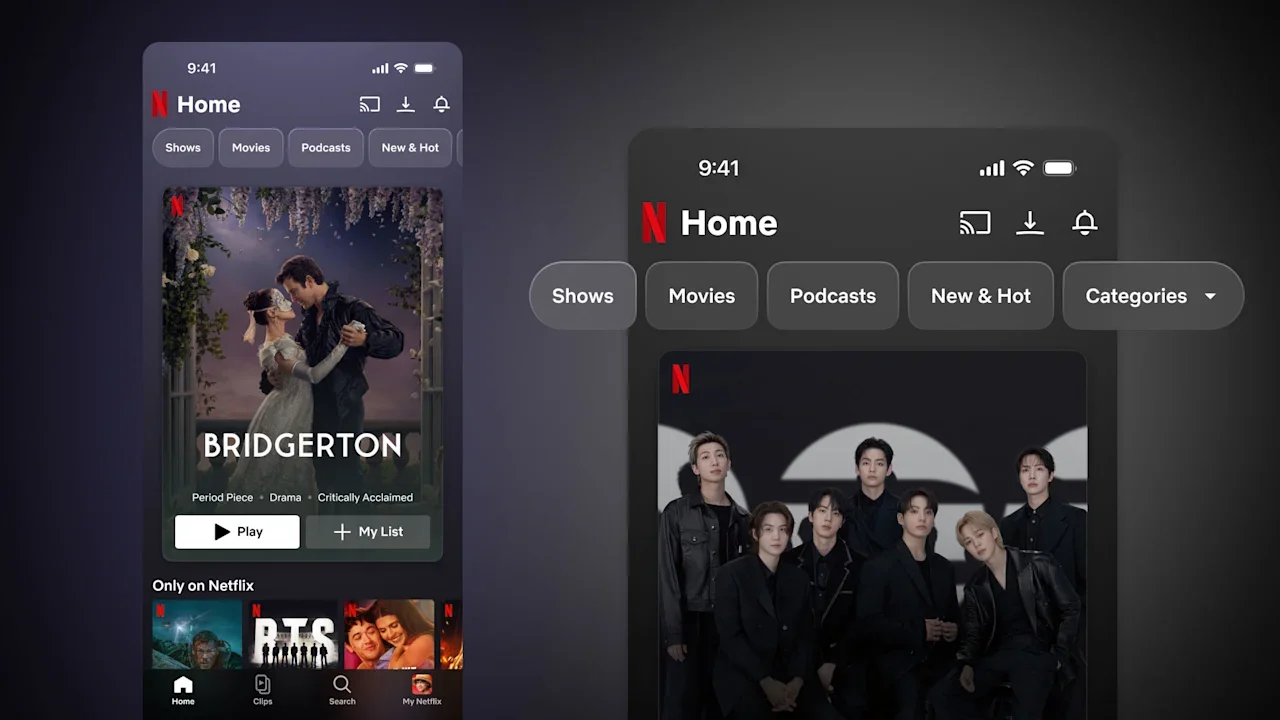
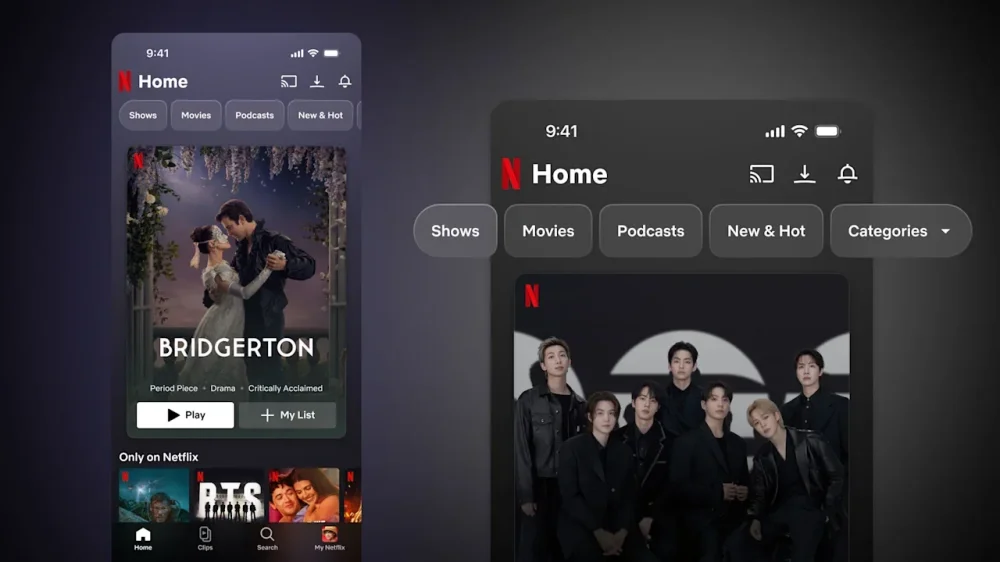
The next time you open Netflix’s app, it may look a lot more like YouTube, Instagram, or TikTok. That’s no accident: On April 29, the streaming service begins rolling out its biggest mobile redesign in years, with a major focus on vertical video. Netflix is launching the new mobile UI in the U.S., U.K., Canada, and a handful of other countries now, with plans to expand globally in the coming months. Once the app updates, subscribers will gain access to a new “Clips” tab featuring trailers, highlights, and behind-the-scenes footage from Netflix shows, movies, and podcasts, all optimized for quick, on-the-go viewing. Clips appear in an endless scroll feed, much like the experience on popular social apps. The redesign is a clear acknowledgment that the way people consume video, both on phones and TVs, is shifting. Netflix is also facing a growing field of competitors vying for viewers’ time, including YouTube, which now accounts for nearly 13% of all TV viewing time. Netflix’s answer is to bring the fight directly to YouTube’s and Instagram’s home turf: mobile phones. With vertical videos, Netflix puts podcasts front and center Media companies have long struggled to adapt to the rise of mobile-native video platforms like Instagram, TikTok, and YouTube. Case in point: Jeffrey Katzenberg’s Quibi raised $1.75 billion to create a Netflix for short-form vertical video, only to shut down six months post-launch after failing to attract viewers. Netflix aims to avoid those mistakes, and it’s not treating vertical video as an end in itself. While Quibi attempted to pioneer entirely new formats, and apps like Instagram are built to keep users scrolling indefinitely, Netflix’s Clips feed is focused on content discovery. Users can find a clip from a show they may enjoy, add it to their watch list, or rotate their phone and begin watching immediately. At its core, Netflix remains focused on long-form storytelling, which has not always translated easily to smaller screens. “Professional TV and film historically makes up a pretty small percentage of mobile viewing,” Netflix co-CEO Ted Sarandos acknowledged during a recent earnings call. That reality helps explain why Netflix has embraced one of YouTube’s most successful categories: podcasts. In recent months, Netflix has partnered with companies like Spotify, Barstool Sports, and iHeartMedia to expand its podcast offerings, adding video episodes of The Breakfast Club, The Bill Simmons Show, and the like. Highlights from popular podcasts feature prominently in Clips feeds for interested users. Netflix plans to personalize the feeds based on a subscriber’s viewing history and their Clips browsing behavior. In the coming months, the company plans to add the ability to browse Clips by categories, and, for instance, scroll through an endless feed of swoon-worthy romance moments. The new app makes room for further expansions Podcasts are just one of the ways Netflix has been expanding beyond movies and TV shows. Over the past few years, the streaming service has also embraced live programming and sports as avenues to keep its subscribers hooked. Last year, Netflix relaunched its TV experience to better incorporate this content. Today’s mobile app relaunch is supposed to solve the same problem for small screens, according to Netflix co-CEO Greg Peters. “[It] will better serve the expansion of our business over the decade to come,” Peters told investors earlier this year. Part of that is a new top-row navigation that specifically highlights podcasts and other new content categories while also leaving room for further personalization and changes in the future. “Just like our TV UI, it then becomes a starting point,” Peters said. “It becomes a platform for us to continue to iterate, test, evolve, and improve our offering.” In other words: No matter what TikTok, Instagram, and YouTube cook up next, Netflix wants to be ready for it. View the full article
-
Jerome Powell said Wednesday he plans to remain on the board of the Federal Reserve after his term as chair ends next month “for a period of time, to be determined,” saying the “unprecedented” legal attacks by the The President administration have put the independence of the nation’s central bank at risk. “I worry these attacks are battering this institution and putting at risk the things that really matter to the public,” Powell said in remarks at a press conference after the Fed announced its decision to keep its benchmark interest rate unchanged. Powell’s decision to stay — the first time a Fed chair will remain on the board as a governor since 1948 — denies President Donald The President a chance to fill a seat on the central bank’s seven-member governing board with his own appointee. The Senate Banking Committee earlier approved Powell’s successor as chair, The President appointee Kevin Warsh, on a party-line vote. Powell will continue as a Fed governor, possibly until January 2028. Warsh, if confirmed, will take a seat currently held by Stephen Miran, a previous The President appointee, whose term ended in January. Powell’s move could make it a bit harder for Warsh to engineer the rate cuts that The President has demanded, and Warsh advocated for last year, economists say. “It probably means it will take Warsh a little bit longer to build the consensus he is trying to build,” said David Seif, chief economist for developed markets at Nomura, an investment bank. U.S. Attorney for the District of Columbia Jeanine Pirro said on X Friday that her office was ending its probe into the Fed’s extensive building renovations because the Fed’s inspector general would scrutinize them instead. But she added that her office could reopen the investigation if “the facts warrant doing so.” And Pirro had said previously that she would appeal a court ruling that threw out subpoenas her office had issued. Powell said Wednesday he had been assured by the Justice Department that the appeal wouldn’t result in a reopening of the probe unless a separate investigation by the Fed’s inspector general finds evidence of criminal activity. Apparently, that didn’t bring Powell the closure he felt is needed. “I’m waiting for the investigation to be well and truly over with finality and transparency,” he said. “I’m waiting for that and I will leave when I think it appropriate to do so.” The Fed Wednesday left its benchmark interest rate unchanged for the third straight meeting but signaled it could still cut rates in the coming months, moves that attracted the most dissents since October 1992. Three officials dissented in favor of removing the reference to a future cut, while a fourth, Miran, dissented in favor of an immediate rate cut. The dissents underscore the level of division on the Fed’s 12-member rate-setting committee ahead of the end of Powell’s term as chair on May 15. “Developments in the Middle East are contributing to a high level of uncertainty about the economic outlook,” the Fed said in a statement after its two-day meeting. “Inflation is elevated, in part reflecting the recent increase in global energy prices.” The President responded to Powell’s decision late Wednesday on his social media website: “Jerome ‘Too Late’ Powell wants to stay at the Fed because he can’t get a job anywhere else — Nobody wants him,” The President posted, using his nickname for the Fed chair. Warsh has promised “regime change” at the central bank and may make sweeping changes to its economic models, communications strategies, and balance sheet. He has argued in favor of rate cuts, as The President has demanded, but he will likely find it harder to implement them with inflation topping 3%, above the Fed’s target of 2%. When asked if he believed Warsh would stand up to political pressure from The President, Powell answered, “He testified very strongly at his hearing, and I take him at his word.” The three officials who dissented against hinting that the Fed may reduce borrowing costs were Beth Hammack, president of the Federal Reserve Bank of Cleveland; Neel Kashkari, president of the Minneapolis Fed; and Lorie Logan, president of the Dallas Fed. The regional Fed bank presidents have historically been more likely to dissent, while the Washington-based governors more often support the chair. The dissents could renew tension between the The President administration and the bank presidents, who White House officials have previously criticized. Beth Ann Bovino, chief economist at US Bank, said the dissents demonstrated that Fed policymakers are “very independent” and will likely be on hold for months longer. She has forecast a rate cut in December but now isn’t sure. Wall Street investors on average don’t expect a reduction until well into next year, according to futures pricing. Powell’s decision to stay on could worsen tensions with the The President administration and would create what some analysts refer to as a “two Popes” scenario, with a chair and former chair both on the Fed’s board. In that case, divisions among policymakers could increase, if some decided to follow Powell’s lead rather than Warsh’s. Powell dismissed the notion that his staying on could cause dissension, saying, “My intention is not to interfere,” later adding that, “I’m not looking to be a high profile dissident or anything like that.” Still, Powell said he remained concerned about the Fed’s independence from the White House, which he said is essential to its ability to set rates to benefit the public, rather than in response to political pressure. When the Fed raises or cuts its short-term rate, over time it affects the cost of mortgages, auto loans, and business borrowing. Fed independence remains “at risk,” he said. “We’re having to resort to the courts to enforce our … ability to make monetary policy without political considerations. We’ve had to do that and we’ve been successful so far, but that’s not over, none of that has concluded yet.” The unusual situation comes while the economic picture remains unusually murky, putting the Fed in a difficult spot. Inflation has jumped to 3.3%, a two-year high, as the war has sharply raised gas prices. That makes it harder for the central bank to reduce rates. The Fed typically leaves rates unchanged, or even raises them, if inflation is worsening. At the same time, hiring has ground almost to a halt, leaving those without jobs frustrated by the difficulty of finding new ones. Typically, the Fed cuts rates when the job market is weak, to spur more spending and job gains. But layoffs also remain low, as employers appear to be following a ” low-hire, low-fire ” strategy. Many Fed officials have suggested that as long as the unemployment rate is low, the central bank doesn’t need to cut rates to spur more spending and hiring. Unemployment declined to 4.3% in March, from 4.4%. AP Writer Alex Veiga contributed to this report. —Christopher Rugaber, AP Economics Writer View the full article

-
Microsoft says Bing reached 1B monthly active users, as search ad revenue grew 12% and Edge gained share for the 20th straight quarter. The post Microsoft Says Bing Reached 1B Monthly Active Users appeared first on Search Engine Journal. View the full article
-
Policymakers warn risks to economy from energy shock driven by Middle East conflict have ‘intensified’View the full article
-
Yesterday, two of the biggest tech giants in the AI boom reported their latest earnings. Google parent company Alphabet Inc. (Nasdaq: GOOG) and Facebook owner Meta Platforms, Inc. (Nasdaq: META) posted Q1 2026 results with some striking similarities, including a surge in capital expenditures (capex) and strong revenue growth. But this morning, Meta’s stock is plunging, while Google’s is jumping. Here’s why. Google’s Q1 results give investors confidence in its AI strategy The way investors are reacting so differently to the two AI giants’ earnings results this morning makes the quarterly reports feel like A Tale of Two Cities, sorry, Tech Giants. For Google, it seems like the best of times, and for Meta, not so much. Yesterday, Google reported that for its most recent quarter, it achieved $109.9 billion in revenue, an increase of 22% and a record for the company. On top of that, the company reported an earnings per share (EPS) of $5.11, an increase of 82%. Google’s Search revenue also climbed 19%. This is particularly notable because many industry watchers have long debated whether the rise of chatbots will eat into the business models of traditional search engines. But that doesn’t seem to be happening—at least not for Google. And part of that may be down to Google surfacing AI search summaries at the top of its search results, which may be helping to maintain user engagement. Either way, AI is without a doubt why investors are rewarding Google’s stock price so much today. The main driver behind Google’s surging record revenue haul was the company’s cloud business. The Google Cloud division brought in $20 billion in revenue alone for the quarter, representing a staggering 63% increase. The Google Cloud Platform (GCP) primarily serves large enterprise customers by providing cloud compute infrastructure for artificial intelligence. Moreover, Alphabet said that its Google Cloud revenue was only constrained because GCP was constrained by compute capabilities (ie: it needs to keep building out more data centers to meet demand). The company says it currently has a Google Cloud backlog of over $460 billion in business. To better capture this AI-driven business in the future, Alphabet announced it would increase its full-year capital expenditure range. As noted by CNBC, Alphabet now expects its 2026 capex to increase from between $175 billion to $185 billion to a range of $180 billion to $190 billion. Yet despite adding to its already massive capital expenditure, the company’s stock price is still jumping this morning, currently up around 8% in premarket trading. But why? The answer is simple: Google may be spending a ton of money on building out its AI infrastructure, but the company’s current quarterly results show investors that the search giant is already benefiting massively from its AI expenditures. Meta, on the other hand… Investors are leery of Meta’s AI spend There’s no denying that Meta reported some very solid figures in its Q1 2026 earnings. Total revenue was $56.3 billion, a massive 33% increase from the same quarter a year earlier. The company also reported earnings per share (EPS) of $10.44, significantly higher than the $6.79 that LSEG analysts had expected, CNBC noted. Of course, that EPS was helped by $8 billion in tax breaks from the The President administration, so its actual EPS without those breaks would have been less, at around $7.31. Still, that’s higher than analysts had hoped. And, like Google, Meta also reported that it would increase its capital expenditure for fiscal 2026 in order to better build out its AI infrastructure (primarily through the development of more data centers). Meta said its capex for the year will now be between $125 billion and $145 billion, up from a range of $115 billion to $135 billion. Yet despite the surging revenue and a lower planned capex than Google, Meta’s stock is falling this morning, currently down around 9% in premarket trading. But why? The biggest factor here seems to be that, as they have shown with Google, investors don’t seem to mind hundreds of billions in AI capex spend—as long as they can start seeing some positive results from it. While the bulk of Alphabet’s surging revenue came from its AI-focused cloud division, which shows the company is benefiting from its AI data center spending, the primary driver of Meta’s Q1 revenue increase was its legacy ad business. To be sure, that increased ad revenue is nothing to sneeze at—more money is more money. But investors may feel that Meta’s expensive AI buildout has yet to begin paying off in any meaningful way. That may be all the more disappointing to investors when you consider that Meta has been doing everything it can to shift its resources to AI—and not just by building out data centers. The company has recently instituted thousands of layoffs to reduce its labor costs and increase spending in other areas, such as AI. At the same time, Meta has also made headlines over the past year for spending massively on hiring individual AI talent. Sam Altman, who leads Meta competitor OpenAI, has alleged that Meta was offering bonuses of up to $100 million to poach individual AI experts. Those headlines have not helped calm investor worries that Meta is shoveling money into an AI buildout, yet so far, it has little bottom-line benefit to show for it. There is one clear winner between META and GOOG stock in 2026 Given that Alphabet appears to be showing more tangible financial benefits from its AI spend, it’s little wonder that investors are cheering the former’s stock this morning, while punishing the latter’s. As of this writing in premarket trading, GOOG shares are currently up nearly 8% to around $375 per share. META shares, on the other hand, are currently down by around 9% to $607.50 per share. Google’s share price surge this morning puts the company firmly in the green for the year, while Meta’s drop solidifies its plunge into the red. Even before today’s stock price change, GOOG shares were up more than 10% year to date, as of yesterday’s close. Meta’s shares, by contrast, were up only 1.3% in the same timeframe. Before today’s stock price fall, over the past 12 months, Meta’s shares had risen by over 20%. Still, that was significantly behind Alphabet’s stock price rise of more than 114% during the same period. During the same timeframe, the tech-heavy Nasdaq has increased nearly 40%. View the full article
-
Can AI Mode ads drive conversions or just awareness? Learn how to evaluate performance, set realistic expectations, and measure incremental growth. The post Can AI Mode Ads Actually Drive Conversions, Or Is It Just Awareness? – Ask A PPC appeared first on Search Engine Journal. View the full article
-
We may earn a commission from links on this page. Deal pricing and availability subject to change after time of publication. Wireless charging is convenient, but it often comes with a tradeoff—phones tend to heat up, especially when you push higher charging speeds, and over time, that heat can wear down battery health. Anker Prime 3-in-1 MagSafe Charger tries to solve that problem, and it’s currently down to $149.99 (originally $229.99), just a few cents above its lowest recorded price, according to price trackers. This setup is clearly built for Apple users, with dedicated spots for an iPhone, Apple Watch, and AirPods. Anker Prime MagSafe Charger 3-in-1 Qi2 25W certified wireless charging station $149.99 at Amazon $229.99 Save $80.00 Get Deal Get Deal $149.99 at Amazon $229.99 Save $80.00 Its main pad supports 25W Qi2 wireless charging, which is about as fast as cable-free charging gets right now, and it’s paired with a built-in thermoelectric cooling system and fan to keep temperatures under control, as noted in this ZDNET review. That cooling system actively pulls heat away from your phone while it charges, so you can charge while streaming or scrolling without the phone getting uncomfortably warm. There are three charging modes you can choose from—Boost Mode is for quick top-ups when you’re heading out, Ice Mode keeps things cooler during heavier use, and Sleep Mode slows everything down and turns off the fan for overnight charging. You can switch between these on the unit’s small on-board touchscreen or through Anker’s app, which also lets you schedule charging behavior and tweak the display. The rest of the setup is solid as well, with the Apple Watch and AirPods pads charging at the standard 5W. You also get a 65W wall adapter and a five-foot USB-C cable in the box. Build quality feels premium, with metal accents and a clean finish that won’t look out of place on a desk, and the unit itself is heavy at about 1.4 pounds, so it stays stable even with larger phones attached. The pad also tilts up to 80 degrees, so it doubles as a stand for watching videos or taking calls. Our Best Editor-Vetted Tech Deals Right Now Apple AirPods 4 Active Noise Cancelling Wireless Earbuds — $148.99 (List Price $179.00) Apple Watch Series 11 [GPS 46mm] Smartwatch with Jet Black Aluminum Case with Black Sport Band - M/L. Sleep Score, Fitness Tracker, Health Monitoring, Always-On Display, Water Resistant — $329.00 (List Price $429.00) Fitbit Versa 4 Fitness Smartwatch (Black) — $149.95 (List Price $199.95) Apple iPad 11" A16 128GB Wi-Fi Tablet (Silver, 2025) — $299.99 (List Price $349.00) Anker Nano 45W 10,000mAh Compact Power Bank With Retractable Cable — $49.99 (List Price $59.99) Deals are selected by our commerce team View the full article
-
AI may not see your brand the way you think it does, according to Scott Stouffer, co-founder and CTO at Market Brew. Brands still publish content, optimize pages, build authority, and follow SEO best practices. But that may not be enough anymore. Search has moved away from a simple battle over keywords, links, and page-level signals. It’s now shaped by meaning, intent, embeddings, and retrieval, Stouffer said during his SEO Week presentation. In legacy SEO, a page could rank lower and still exist in the search results. In AI-driven systems, the first question isn’t whether you rank. It’s whether you’re ever retrieved. “If you’re not retrieved, you do not exist to AI,” Stouffer said. Your brand already exists inside AI systems as a mathematical object. You may call yourself one thing. Your homepage may say another. Your brand guidelines may promise a clear position. But AI systems build their own view of your brand from the content you have published. That computed version of your brand may be different from the one you intended to build. Retrieval now matters before ranking AI visibility begins before ranking, Stouffer said. In traditional SEO, marketers focus on positions — first, third, or tenth. But AI systems apply a filter earlier. Before anything is ranked, the system determines which content is eligible for consideration. That is retrieval. When a user asks a question, the system pulls a limited set of passages or chunks that best match the query. Those passages define the answer space. If your content isn’t included, you get no impressions, no clicks, and no visibility at all, Stouffer said. The real shift is moving from exclusion to inclusion. “You don’t lose. You just never entered the game,” Stouffer said. AI does not see pages the way SEOs do AI systems don’t treat a webpage as one clean unit, Stouffer said. They don’t evaluate pages as whole objects or prioritize layout, structure, or formatting. Content is broken apart. A page becomes chunks: passages, sections, and individual ideas. Each chunk is evaluated independently. A paragraph deep in a guide can compete on its own. A single sentence can be selected if it aligns closely with the query. This shifts competition from page versus page to passage versus passage. Most of a page may never be considered. Only the most aligned chunks are evaluated. Meaning becomes math Each chunk is converted into a vector, Stouffer explained. This vector represents meaning as a position in a high-dimensional space. It captures context and intent rather than exact wording. Two pieces of content can use different words but sit close together if they express the same idea. Others can share keywords, but sit far apart if they represent different meanings. “It’s comparing meaning, not wording, measuring distance, not keyword overlap,” Stouffer said. Relevance is determined by proximity. The closer a chunk is to a query in this space, the more likely it is to be retrieved. Your content forms clusters As chunks are mapped into this space, they group together. Content with similar meaning forms clusters, even across different pages. These clusters reflect how AI systems understand topics. This understanding comes from how content naturally groups by meaning, not by site structure or labels, Stouffer said. If content is consistent, clusters become dense and clear. If content is scattered, clusters become fragmented. What matters is not what a brand intends to say, but what its content actually communicates. The centroid is your brand to AI Within these clusters, there is a center point — the centroid, Stouffer said. The centroid represents the average position of all related content. It reflects the site’s core meaning. Every page and paragraph influences that position. Consistent content creates a clear, stable centroid. Inconsistent content dilutes it. That centroid is how AI understands your brand. Not your homepage. Not your messaging. Not your brand guidelines. Your centroid is the combined signal of everything you have published, Stouffer said. “Your centroid doesn’t care about intent. It reflects the math of everything you’ve ever published,” Stouffer said. Alignment beats isolated optimization This changes how content should be evaluated. The key question isn’t whether a page is optimized in isolation. It’s whether it aligns with the rest of the site. Each page either strengthens the centroid or pulls it in a different direction. “Optimization without alignment creates drift, and drift is what breaks consistency,” Stouffer said. As drift increases, the site becomes harder for AI systems to interpret and retrieve. “You don’t write pages, you project meaning,” Stouffer said. Retrieval starts with proximity When a query is entered, the system converts it into a vector, Stouffer said. It then searches for the closest matches in meaning space. This includes both individual chunks and the centroids that represent broader content clusters. If your content is close enough, it enters the candidate set. If it is too far away, it is excluded. Only after this stage do traditional ranking signals apply. Content quality, links, and structure matter — but only if the content is first retrieved. If not, those signals are never evaluated, he said. Most brands look too similar to AI Many brands follow similar strategies, use the same sources, and produce similar content. As a result, their centroids converge in the same region, Stouffer said. He described this as cluster collision. When multiple brands occupy the same space, AI systems don’t select all of them. They choose a few and ignore the rest. “They’re not failing best practices. They’re colliding with everyone else using them,” Stouffer said. Distinct meaning is the new advantage Producing more content or improving existing content isn’t enough. If content remains similar in meaning, it remains in the same space. “You need a distinct centroid,” Stouffer said. A clear, separate position in meaning space reduces competition and increases the likelihood of retrieval. SEO becomes a control loop This is not a one-time adjustment. Every piece of content shifts the centroid. That requires an ongoing process of measurement and adjustment, Stouffer said. Teams need to monitor alignment continuously and correct drift as it occurs. Over time, this creates a more stable system where new content reinforces the existing structure. The visibility problem is really an observability problem Most teams can’t see how their content exists in this system. They can’t see clusters, centroids, or distances — or why content is excluded. So they rely on trial and error, Stouffer said. They publish, optimize, and wait for results. When nothing changes, they try something else. Without visibility into the system, they react to outcomes rather than understanding causes. Is AI seeing the brand you think you’ve built? Your brand already exists as a mathematical object inside AI systems, Stouffer said. You do not get to choose that. You only choose whether to measure and control it or let it drift. AI does not see your brand the way you describe it. It sees the aggregate meaning of your content. “If you control your centroid, you control your visibility,” Stouffer said. View the full article
-
Plenty of brands use AI to talk to consumers. In other words, they’re tapping AI to generate customer service responses, automate interactions, and speed up outreach. But what they’re not doing is investing in the listening side of AI or leveraging into its vast capabilities here—i.e., using AI to better understand customer friction, synthesize feedback, spot patterns, or act on what people are saying. And to me, this is a major miss. Whenever leadership looks out onto their world below—rather than from within the trenches—gaps can emerge. And while leaders routinely make business decisions with the aid of spreadsheets, dashboards, and second-hand summaries, you can’t market via Excel spreadsheets alone. Data matters. Efficiency matters, too. But if leadership loses touch with the people behind the numbers, even the smartest systems can reinforce the wrong assumptions and decisions. When budgets tighten, the first victims are UX research and service design: the very capabilities that help brands understand human behavior, precisely when that understanding becomes most critical. Modern management styles highlight this disconnect. Ask a CEO for a pie chart of how they spend their workday, and you’ll see vast portions dedicated to investors, internal meetings, strategy reviews, and dashboards. But how much goes to listening to customers, frontline employees, or service teams? That’s where AI use has a real opportunity. Not just as an outreach tool, but as a listening engine. A BETTER USE FOR AI: LISTENING AT SCALE AI has resurfaced a decades-old challenge: businesses forget that communication is a two-way street, and they blast marketing collateral without giving recipients the space to react. We saw it in the mobile marketing boom of the 2000s, when brands mistook access for permission, flooded people with messages, and even faced FTC settlements. AI now risks repeating that mistake at far greater speed and scale. More content does not mean better communication, especially if no one is stopping to listen. According to research, less than a third (32%) of Americans trust AI, while just over half of consumers (53%) actively dislike or hate its use in service interactions. That should be a warning to any company rushing to automate its outward voice. Customers don’t want to feel trapped in a loop of synthetic responses. They want to feel understood. Rather than using AI solely for outreach, the tech is most valuable when it digests and acts on what it hears. It can revolutionize how organizations absorb customer and employee signals at scale. Recently, new Walmart CEO John Furner sent a companywide memo asking staff to share “one thing that slows you down or makes it harder to do your job.” The retailer is the largest private employer in the U.S. and analyzing 1.6 million responses would take it into the next CEO’s tenure. But using AI to examine them and recommend actionable improvements? Now that’s a different story. Listening is not a new leadership principle, but it’s a newly urgent one. In one banking organization we worked with, senior leaders were expected to spend hours each month listening to customer service calls. That kind of discipline matters. It keeps decision-makers close to the frustrations, questions, and emotions that define the customer experience. AI can make that process more efficient, but it shouldn’t replace the human habit of paying attention. LISTEN FIRST, THEN SPEAK The future of leadership is hybrid. Inside knowledge matters, but outside perspective does too. Strong organizations avoid siloed thinking by combining what they know internally with fresh eyes from outside the system. The same is true of customer understanding. Leaders should know their brand, yes, but more importantly, they should understand their core customer base deeply and directly. Ideally, they stay close enough to that audience that they recognize when something feels off before the dashboard tells them. Brand leaders can continue to automate pillars of their communications strategies. But if AI only makes your organization faster at talking, you’re missing the point—and making the same mistakes as mobile marketers 20 years ago. A company can look operationally sound while growing culturally disconnected. It can become consistently good, but not truly great. The companies that win will be the ones that use AI to build better feedback loops with customers and employees, synthesize what they hear at scale, and act on it quickly. And they’ll use the technology to stay closer to the humans who drive the business. The real question for leaders is: are you using AI to create more distance, or less? Justin Tobin is the founder and CEO of Gather. View the full article

-
Monetary Policy Committee says borrowing costs may need to rise if energy shock continues to hit global economyView the full article
-
Measurement noise from AI tracking tools is making it harder for brands to separate real visibility from artificial signals. The post Your AI Visibility Tracker Is Quietly Breaking Your Analytics And Your Strategy appeared first on Search Engine Journal. View the full article
-
Learning about exercise can be overwhelming. One YouTube channel tells you what to do, and you think, OK, I’ve got that. Then you see an Instagram post that tells you something else entirely. Stop by the gym and ask a trainer, and they’ll let you know that both of your sources are overthinking it and instead you should do things their way. Why is it all so complicated? I have some thoughts on that, and some tips for navigating the confusion. One of the biggest reasons is that there are many good answers for each of your fitness questions. So you don’t have to find the one true correct answer before doing your workout, any more than you’d need to identify the unquestionably best restaurant in town before going out to eat. Let’s dig in to some of the types of confusion that you’re probably running across, and what to do about each. Not every piece of fitness advice is for youFirst I’d like to address the biggest reason we see conflicting advice in any subject: Different experts are talking to different audiences. You, the reader or viewer, are not in all of those audiences at once. For example, if you search for “how to squat,” you’ll find a variety of answers to the question. One expert might have advice for bodybuilders to build as much leg muscle as possible. Another might be telling powerlifters how to get strong and move the most weight in competition. Yet another might be introducing beginners to the idea of doing an air squat for the first time. It makes sense that they would all say different things, right? How to navigate this: Decide on a type of advice to follow. If you want to learn the basics of powerlifting, for example, there are books and videos and real life human coaches who will teach it to you. And if you’re a beginner, don’t seek out advice for advanced lifters; it may not be helpful to you yet. If you can’t decide what direction you’re going, it’s fine to check out different sources and compare. But don’t expect them to all agree with each other. The algorithm rewards pointless debatesThe basics of training are pretty simple, even if it may not seem that way when you’re a beginner. You get better at running by putting in time on your feet, and not trying to turn every training run into a race. (See our beginners’ guide here.) You get stronger by lifting heavier weights over time, although that doesn’t have to mean lifting more every single week—best to follow a program that guides you through a sensible path for progress. And if you’re brand new to everything, all you really need is to build a routine and not give up; literally all of the details can wait. But we like to learn more, and if we’re confused or anxious, we often think the cure is more information. So we visit YouTube (or the information firehose of our choice) and see what it has to say. But here is where the algorithm stands in our way: YouTubers don’t have much of a career if they just put out a few videos with basic information and then sit back and relax. So we get in-depth debates on things like: Which running shoe might be marginally better than another? Should you do your morning workout before or after breakfast? Should you do dumbbell lateral raises with your hands in a neutral position or with your pinkies pointing slightly upward? (You might think I’m joking with that last one, but for a brief viral moment it was a hugely controversial subject.) Creators also get more engagement if they react to other creators, cultivate rivalries, say that everyone else has it wrong, debate creators with the opposing viewpoint, etc. The algorithm rewards confusion, because it makes people watch more videos. In reality, the direction of your pinkies on lateral raises is going to make, at most, 0.0000001% of the difference in how your shoulders look a year from now. Even if you could get a solid answer on which way is best, it wouldn’t actually matter. How to navigate this: One day I was typing the word “optimal,” and my phone auto-corrected it to “optional.” That’s a life lesson right there. Optimal is optional. If you’re doing things basically good enough, optimizing the details is going to make very, very little difference. When you are an Olympic athlete and tiny differences in your performance could make or break your chances for a gold medal, you can revisit these questions. For now, just remember that there are many paths toward fitness, and you can take whichever you find simplest or most enjoyable. Most fitness advice is meant to nudge youLet’s step out of the social media algorithm for a moment, and talk about the very reasonable things you might hear from a trainer. As a trainer is trying to guide your movement, they’ll give you cues. These are not meant to be objective descriptions of exactly what happens in a lift, but rather nudges in a particular direction. For example, if your heels pull off the ground as you are squatting, you might be told to “drive through the heels.” This can lead to confusion if you hear another trainer say to “keep even pressure on all parts of your foot.” That would be a better cue for somebody who is tipping back onto their heels, but it could work for the person who is getting up on their toes as well. The truth is that both trainers are trying to do the same thing: keep you from rocking too far forward or backward. Since cues are nudges, they can't really be right or wrong; they can just be helpful or unhelpful. The cue that works for someone else may not be the right cue for you. How to navigate this: Ask for clarification if you’re getting the advice in person. If not, try both of the conflicting cues, and see if one of them helps you to feel stronger or do the movement better. You may also want to read our explanations of the cues that tend to confuse people most. View the full article
-
For more than two decades (nearly as long as I’ve been in SEO), backlinks have been core to SEO. Google’s PageRank changed search by using backlinks as a proxy for trust. A link wasn’t just a pathway; it was a vote. The more votes you had and the more authoritative the voters were, the higher you ranked. But as Google and AI systems matured, entity-based understanding emerged. AI models became better at understanding content, context, and credibility without always needing a hyperlink as a crutch. Today, visibility isn’t driven solely by links. It’s strengthened by the broader signals your brand has earned: how often it’s mentioned, cited, and trusted across authoritative sources. Search engines and AI platforms now prioritize these signals. AI’s role in reducing reliance on links alone Modern AI systems can evaluate trust and expertise in ways that were impossible a decade ago. AI has changed how authority, trust, and expertise are measured. It can now assess authority through signals once approximated mainly by backlinks. AI can: Identify entities and map their relationships across the web. Interpret sentiment and contextual relevance. Detect manufactured link patterns with near-perfect accuracy. Understand brand prominence without a single hyperlink. Evaluate reputation signals from reviews, mentions, and citations. Cross-reference information across multimodal sources. A brand mention in a reputable publication—even without a link—reinforces entity authority. Consistent expert citations validate expertise. These signals can’t be faked. The result is a new era where links still matter, but they’re no longer the only star. Authority is now a network of signals. The rise of entity‑first SEO As Google relies less on raw link signals, something else has increased: entities — the people, brands, organizations, and concepts behind the content. Google increasingly showcases brands based on who they are and how they’re discussed across the web, alongside their backlink profile. At its core, entity-first SEO means Google and LLMs are mapping relationships: identifying brands, understanding what they’re known for, and evaluating how they’re referenced in trusted sources. For example, an outdoor gear company with a modest backlink profile began appearing in AI Overviews for “best hiking backpacks” after repeated mentions in Reddit threads, YouTube reviews, and a few expert roundups. Only some mentions included links, but the brand appeared consistently in trusted, topic-relevant conversations. Google interpreted those unlinked mentions as proof of real-world relevance. If your brand consistently appears in a positive light in topic-related conversations, AI sees that as proof you’re relevant and trusted. The brands that win now have the strongest entity presence. PR‑style links + editorial = off-page powerhouse PR-style links and editorial coverage are earned mentions in reputable publications — the kind that signal real-world authority, not algorithmic manipulation. Why editorially earned links outperform volume-based link building Old-school, volume-based link building is less effective as AI improves at detecting manufactured patterns. But high-quality, relevance-driven link building—especially when paired with PR signals—is more valuable than ever. Editorial PR links from journalists, analysts, and industry voices who choose to reference a brand because it’s newsworthy or authoritative reflect genuine credibility. They’re the digital equivalent of a trusted expert saying, “This brand matters.” Authority-Based Link BuildingVolume-Based Link BuildingStrong editorial contextThin or generic contentHigh topical relevanceLimited relevanceNatural language anchorsOver‑optimized anchorsTrusted authors and publicationsSites with weak editorial oversightClear entity associationsObvious link‑selling footprints AI doesn’t just look at the presence of a link; it evaluates the context around it. Models are trained to reward authenticity. Search aims to reward the most authoritative entities. Creating multi‑signal authority The real power comes from a combination of signals. As search has evolved, quality has become more powerful than quantity. Now AI is driving another shift. You can grow traditional, relevance-focused links alongside new brand signals. A single earned placement done well can generate: Brand mentions that reinforce entity recognition. Citations that validate expertise. Positive sentiment that strengthens trust. Topical associations that build relevance. Valuable hyperlinks for foundational growth. Entity reinforcement across the Knowledge Graph. Secondary coverage as other sites pick up the story. This is multi-signal authority — holistic credibility that AI systems are designed to reward. It tells Google and LLMs: you’re known, trusted, and relevant. You need to be part of the conversation. As powerful as PR signals are, they’re only one part of a larger authority ecosystem. AI evaluates brands through a multi-signal trust profile that determines visibility. Breaking down the new authority stack Authority is now defined by the breadth and consistency of signals that validate who your brand is across the web. It’s evaluated as humans do: reputation, recognition, expertise, and prominence. Authority is no longer a single metric tied to links. It’s a network of signals, including: Brand strength: Rising branded search volume, navigational queries, and direct traffic patterns that signal real-world recognition. Entity validation: Consistent NAP details, schema markup, and unified profiles help confirm your brand and connect references back to the same entity. Topical authority: Depth of content, subject-matter experts, and external collaboration to show your brand is genuinely knowledgeable about the topics you discuss. Reputation signals: Reviews, citations, third-party mentions, and sentiment patterns that reflect trustworthiness. PR signals: News coverage, interviews, podcast appearances, and industry mentions that reinforce your brand’s relevance. Together, these signals create a holistic authority profile that AI can interpret. The brands that win have the strongest multi-signal authority footprint. Brand strength is the silent factor Brand strength quietly outweighs other signals. The data shows it: brands in the top 25% for web mentions average 169 AI Overview citations, while the next quartile averages just 14. That’s not a small gap. This aligns with AAhrefs’ analysis of ~75,000 brands. The strongest correlations with appearing in AI Overviews were branded web mentions, branded anchors, and branded search volume—all signals of real-world brand presence. Consider two competing fitness apps. One has thousands of backlinks from generic listicles. The other is frequently mentioned in Reddit threads, YouTube reviews, and TikTok “day in the life” videos. The second app appears consistently in AI Overviews because AI sees it as part of the real-world fitness conversation, not just the link graph. The brands dominating AI Overviews have the strongest brand presence, supported by consistent links, mentions, citations, and contextual relevance. Predictions for 2027 and beyond By 2027, link building will undergo radical change. The shift from a numbers game to a confidence game will become the norm, and Share of Authority or Voice will be the new metric. Here are my top three predictions for what’s next. Prediction 1: Visibility will be measured by a “Share of Model” metric. AI rewards signal density, not link density. Link building will expand to include “seeding” information in AI training hubs. Instead of mass outreach to low-tier blogs, strategies will target user-preferred sources like Reddit, LinkedIn, Substack, and GitHub, which LLMs use for high-quality, human-led data. Brands that appear most often in training data, trusted sources, and high-authority conversations will earn visibility. This is the next step in a world where signals determine authority. Traditional MetricPredicted MetricWhy the ChangeBacklink CountEntity Citation FrequencyAI values brand mentions as much as linksDomain Authority (DA)Source Reliability ScoreFocus on the trustworthiness of the sourceAnchor TextSemantic ContextAI reads the intent around the link, not just the textPageRankShare of Model (SoM)Success is being the AI’s preferred answer Prediction 2: Brands will act as primary newsrooms as proprietary data generates the strongest authority signals. As AI systems rely more on multi-signal authority, proprietary data becomes one of the most powerful assets a brand can produce. Data isn’t just content — it’s a signal engine. It naturally earns the signals AI trusts most: PR coverage. Citations. Mentions. Social discussion. Co‑occurrence with authoritative entities. Long‑tail references in future content. Traditional link building still provides foundational authority, but data-driven assets are the accelerant. They create high-trust, high-context signals that AI models weigh heavily. On a platform where visibility depends on how often your brand appears in authoritative contexts, proprietary data is the most scalable way to increase your Share of Authority. Prediction 3: Unlinked brand mentions will become one of the most valuable authority signals Traditional contextual links will continue to build the foundation. But beyond that, search engines will track every time your brand appears alongside specific topics. Links will need “semantic context.” Every mention of your brand in news, podcasts, reviews, forums, social posts, and roundups becomes a signal that strengthens your entity. AI isn’t replacing link building — it’s expanding it The future of off-page SEO isn’t a battle between traditional link building and AI-driven signals. It’s the realization that links were always just one signal. Now search engines can understand dozens more. Traditional link building still matters. It provides the foundational authority, crawl paths, and topical relevance every site needs. AI has widened the field. It can read context, interpret sentiment, understand entities, and evaluate brand presence. These signals don’t replace links — they amplify them. Links built the foundation. Signals build the skyscraper. View the full article
-
Microsoft Advertising has added conversion and spend metrics to the PMax Website Publisher URL report. So if you check out the report, you will see a bunch more insight and data into the performance of those ads.View the full article
-
Growth in headline figure obscures worse than expected $700mn increase in fee-paying assets View the full article
-
Google may be testing showing more links and citations within the AI Mode results. Google has done this with AI Overviews a year or so ago and now may be testing it with AI Mode results.View the full article
-
Higher utilization and aggregate excess payments point to pressure, according to TransUnion. Debt-to-income averages remain below traditional mortgage caps. View the full article
-
Have you ever wondered what the “S” in S Corporation really stands for? It actually represents “Subchapter,” referencing Subchapter S of the Internal Revenue Code. This designation allows corporations to pass through income, losses, and other tax attributes directly to shareholders, helping them avoid double taxation. Nevertheless, not every business can qualify for this status. To understand the specific criteria and implications, let’s explore what it takes to become an S Corporation. Key Takeaways The “S” in S Corp stands for “Subchapter,” referencing Subchapter S of the Internal Revenue Code. S Corporations allow income and losses to pass through to shareholders, avoiding double taxation. Eligibility requires a maximum of 100 shareholders who must be U.S. citizens or residents. Only one class of stock is permitted in S Corporations, ensuring equal rights among shareholders. To elect S Corporation status, all shareholders must file IRS Form 2553 with their signatures. Understanding the Meaning of “S” in S Corp The “S” in S Corporation signifies “Subchapter,” which is derived from Subchapter S of the Internal Revenue Code. Comprehending what does S Corporation stand for is essential for small business owners considering this structure. An S Corporation definition describes it as a special type of corporation that allows income, losses, deductions, and credits to pass through directly to shareholders. This setup avoids double taxation at the corporate level, making it financially advantageous. To qualify as an S Corporation, a business must meet certain eligibility criteria, such as having no more than 100 shareholders and being a domestic corporation. The election for S Corporation status is made by filing IRS Form 2553, which requires signatures from all shareholders. Fundamentally, the “S” in S Corp stands for a unique tax treatment that combines the benefits of a corporation and a partnership, making it an attractive option for many small businesses. Overview of S Corporations When considering business structures, S Corporations offer a unique blend of benefits that can appeal to small business owners. Defined under Subchapter S of the Internal Revenue Code, these entities allow income, losses, deductions, and credits to pass through to shareholders, thereby avoiding double taxation. To qualify as an S Corporation, a business must adhere to specific criteria, including having no more than 100 shareholders, all of whom must be U.S. citizens or residents. Here’s a quick comparison of S Corporations and C Corporations: Feature S Corporation Taxation Pass-through taxation Shareholder Limits Maximum of 100 shareholders Stock Classes Only one class of stock Eligible Shareholders Must be U.S. citizens/residents Forming Process File Form 2553 for election If you’re considering how to change LLC to S Corp, remember to follow the IRS guidelines. Advantages and Disadvantages of S Corporations Comprehending the advantages and disadvantages of S Corporations can help you make informed decisions about your business structure. One key advantage is pass-through taxation, which allows corporate income and losses to be reported on your personal tax return, avoiding double taxation. You’ll also benefit from lower self-employment taxes, as only wages are subject to these taxes, whereas distributions are not. Nevertheless, S Corporations face stricter IRS regulations, including the necessity to pay shareholder-employees a “reasonable salary,” which may lead to increased scrutiny. Furthermore, the limit of 100 shareholders, all of whom must be U.S. citizens or residents, can hinder growth potential compared to C Corporations. Although S Corporations provide limited liability protection, compliance requirements, including annual reporting and specific eligibility rules, can impose extra costs and administrative burdens. Balancing these factors is vital for your business’s success. Eligibility Requirements for S Corporations To qualify as an S Corporation, your business must meet several specific eligibility requirements set by the IRS. First, your entity must be a domestic corporation and can’t have more than 100 shareholders. All shareholders need to be individuals, certain trusts, or estates; partnerships, corporations, and non-resident aliens can’t hold shares. Moreover, an S Corporation is limited to one class of stock, meaning all shares must have the same rights regarding distribution and liquidation. Furthermore, all shareholders must be U.S. citizens or residents, excluding nonresident aliens from ownership. To elect S corporation status, you’ll need the unanimous consent of all shareholders, which involves signing Form 2553. This form must then be submitted to the IRS to finalize your election. Meeting these requirements is essential for your business to maintain its S Corporation status and enjoy the associated benefits. Tax Implications of S Corporations Comprehending the tax implications of S Corporations is crucial for any business owner considering this structure. S Corporations avoid double taxation, passing income and losses directly to shareholders. You’ll report these on your personal tax returns using Schedule K-1. Annually, S Corporations must file IRS Form 1120-S by March 15, detailing their financials. Here’s a quick overview of key tax aspects: Aspect Description Impact on Shareholders Double Taxation Avoided; income taxed at personal level Lower overall tax burden IRS Form Required Form 1120-S must be filed annually Compliance with IRS regulations Schedule K-1 Reports individual share of income/losses Required for personal tax returns Health Insurance Premiums Over 2% shareholders must report premiums on W-2 Affects taxable wages Deductions and Credits Passed through to shareholders Directly impacts personal tax liability Understanding these implications can help you make informed decisions about your business structure. Frequently Asked Questions Why Is It Called an S Corp? It’s called an S Corp as it refers to a specific tax designation under the Internal Revenue Code. This structure allows small businesses to benefit from pass-through taxation, meaning corporate income isn’t taxed at the corporate level. Instead, it’s reported on shareholders’ personal tax returns. Established in 1958, the SBA designation helps small businesses avoid double taxation as they meet certain criteria, such as having no more than 100 shareholders and a single class of stock. What Does the S in C Corp Stand For? The “C” in C Corporation doesn’t stand for anything specific; it simply distinguishes this type of corporation from others, like S Corporations. C Corporations are taxed separately from their owners under the Internal Revenue Code, which can lead to double taxation on profits. This structure allows for unlimited shareholders and various classes of stock, making it suitable for larger businesses. Incorporating as a C Corp requires following specific legal and regulatory procedures. Is an S Corp Better Than an LLC? Whether an S Corp is better than an LLC depends on your specific needs. S Corps have stricter shareholder limits and require U.S. citizenship, whereas LLCs allow for more members and include nonresident aliens. Taxation differs too; S Corps pass income to shareholders, while LLCs can choose their tax classification. Furthermore, S Corps must adhere to more compliance regulations. Evaluate your ownership structure, tax flexibility, and operational requirements to determine which option suits you best. Which Is Better, S or C Corporation? When deciding between an S corporation and a C corporation, consider your business size and goals. S corps offer tax advantages by allowing income to pass through to shareholders, avoiding double taxation, but limit shareholder numbers and types. C corps, on the other hand, can attract more investors and issue multiple stock classes, making them suitable for larger businesses seeking growth. Your choice should align with your funding needs and operational structure. Conclusion In conclusion, the “S” in S Corporation stands for “Subchapter,” reflecting its designation under the Internal Revenue Code. This structure allows for pass-through taxation, offering significant advantages like avoiding double taxation. Nevertheless, S Corporations must meet specific eligibility criteria and adhere to regulations to maintain their status. Comprehending these key aspects can help you determine if this business structure aligns with your financial goals and operational needs, making it a viable option for many entrepreneurs. Image via Google Gemini This article, "What Does the “S” Stand For in S Corp?" was first published on Small Business Trends View the full article
-
Have you ever wondered what the “S” in S Corporation really stands for? It actually represents “Subchapter,” referencing Subchapter S of the Internal Revenue Code. This designation allows corporations to pass through income, losses, and other tax attributes directly to shareholders, helping them avoid double taxation. Nevertheless, not every business can qualify for this status. To understand the specific criteria and implications, let’s explore what it takes to become an S Corporation. Key Takeaways The “S” in S Corp stands for “Subchapter,” referencing Subchapter S of the Internal Revenue Code. S Corporations allow income and losses to pass through to shareholders, avoiding double taxation. Eligibility requires a maximum of 100 shareholders who must be U.S. citizens or residents. Only one class of stock is permitted in S Corporations, ensuring equal rights among shareholders. To elect S Corporation status, all shareholders must file IRS Form 2553 with their signatures. Understanding the Meaning of “S” in S Corp The “S” in S Corporation signifies “Subchapter,” which is derived from Subchapter S of the Internal Revenue Code. Comprehending what does S Corporation stand for is essential for small business owners considering this structure. An S Corporation definition describes it as a special type of corporation that allows income, losses, deductions, and credits to pass through directly to shareholders. This setup avoids double taxation at the corporate level, making it financially advantageous. To qualify as an S Corporation, a business must meet certain eligibility criteria, such as having no more than 100 shareholders and being a domestic corporation. The election for S Corporation status is made by filing IRS Form 2553, which requires signatures from all shareholders. Fundamentally, the “S” in S Corp stands for a unique tax treatment that combines the benefits of a corporation and a partnership, making it an attractive option for many small businesses. Overview of S Corporations When considering business structures, S Corporations offer a unique blend of benefits that can appeal to small business owners. Defined under Subchapter S of the Internal Revenue Code, these entities allow income, losses, deductions, and credits to pass through to shareholders, thereby avoiding double taxation. To qualify as an S Corporation, a business must adhere to specific criteria, including having no more than 100 shareholders, all of whom must be U.S. citizens or residents. Here’s a quick comparison of S Corporations and C Corporations: Feature S Corporation Taxation Pass-through taxation Shareholder Limits Maximum of 100 shareholders Stock Classes Only one class of stock Eligible Shareholders Must be U.S. citizens/residents Forming Process File Form 2553 for election If you’re considering how to change LLC to S Corp, remember to follow the IRS guidelines. Advantages and Disadvantages of S Corporations Comprehending the advantages and disadvantages of S Corporations can help you make informed decisions about your business structure. One key advantage is pass-through taxation, which allows corporate income and losses to be reported on your personal tax return, avoiding double taxation. You’ll also benefit from lower self-employment taxes, as only wages are subject to these taxes, whereas distributions are not. Nevertheless, S Corporations face stricter IRS regulations, including the necessity to pay shareholder-employees a “reasonable salary,” which may lead to increased scrutiny. Furthermore, the limit of 100 shareholders, all of whom must be U.S. citizens or residents, can hinder growth potential compared to C Corporations. Although S Corporations provide limited liability protection, compliance requirements, including annual reporting and specific eligibility rules, can impose extra costs and administrative burdens. Balancing these factors is vital for your business’s success. Eligibility Requirements for S Corporations To qualify as an S Corporation, your business must meet several specific eligibility requirements set by the IRS. First, your entity must be a domestic corporation and can’t have more than 100 shareholders. All shareholders need to be individuals, certain trusts, or estates; partnerships, corporations, and non-resident aliens can’t hold shares. Moreover, an S Corporation is limited to one class of stock, meaning all shares must have the same rights regarding distribution and liquidation. Furthermore, all shareholders must be U.S. citizens or residents, excluding nonresident aliens from ownership. To elect S corporation status, you’ll need the unanimous consent of all shareholders, which involves signing Form 2553. This form must then be submitted to the IRS to finalize your election. Meeting these requirements is essential for your business to maintain its S Corporation status and enjoy the associated benefits. Tax Implications of S Corporations Comprehending the tax implications of S Corporations is crucial for any business owner considering this structure. S Corporations avoid double taxation, passing income and losses directly to shareholders. You’ll report these on your personal tax returns using Schedule K-1. Annually, S Corporations must file IRS Form 1120-S by March 15, detailing their financials. Here’s a quick overview of key tax aspects: Aspect Description Impact on Shareholders Double Taxation Avoided; income taxed at personal level Lower overall tax burden IRS Form Required Form 1120-S must be filed annually Compliance with IRS regulations Schedule K-1 Reports individual share of income/losses Required for personal tax returns Health Insurance Premiums Over 2% shareholders must report premiums on W-2 Affects taxable wages Deductions and Credits Passed through to shareholders Directly impacts personal tax liability Understanding these implications can help you make informed decisions about your business structure. Frequently Asked Questions Why Is It Called an S Corp? It’s called an S Corp as it refers to a specific tax designation under the Internal Revenue Code. This structure allows small businesses to benefit from pass-through taxation, meaning corporate income isn’t taxed at the corporate level. Instead, it’s reported on shareholders’ personal tax returns. Established in 1958, the SBA designation helps small businesses avoid double taxation as they meet certain criteria, such as having no more than 100 shareholders and a single class of stock. What Does the S in C Corp Stand For? The “C” in C Corporation doesn’t stand for anything specific; it simply distinguishes this type of corporation from others, like S Corporations. C Corporations are taxed separately from their owners under the Internal Revenue Code, which can lead to double taxation on profits. This structure allows for unlimited shareholders and various classes of stock, making it suitable for larger businesses. Incorporating as a C Corp requires following specific legal and regulatory procedures. Is an S Corp Better Than an LLC? Whether an S Corp is better than an LLC depends on your specific needs. S Corps have stricter shareholder limits and require U.S. citizenship, whereas LLCs allow for more members and include nonresident aliens. Taxation differs too; S Corps pass income to shareholders, while LLCs can choose their tax classification. Furthermore, S Corps must adhere to more compliance regulations. Evaluate your ownership structure, tax flexibility, and operational requirements to determine which option suits you best. Which Is Better, S or C Corporation? When deciding between an S corporation and a C corporation, consider your business size and goals. S corps offer tax advantages by allowing income to pass through to shareholders, avoiding double taxation, but limit shareholder numbers and types. C corps, on the other hand, can attract more investors and issue multiple stock classes, making them suitable for larger businesses seeking growth. Your choice should align with your funding needs and operational structure. Conclusion In conclusion, the “S” in S Corporation stands for “Subchapter,” reflecting its designation under the Internal Revenue Code. This structure allows for pass-through taxation, offering significant advantages like avoiding double taxation. Nevertheless, S Corporations must meet specific eligibility criteria and adhere to regulations to maintain their status. Comprehending these key aspects can help you determine if this business structure aligns with your financial goals and operational needs, making it a viable option for many entrepreneurs. Image via Google Gemini This article, "What Does the “S” Stand For in S Corp?" was first published on Small Business Trends View the full article
-
Google Ads is testing more transparency around its partner network, letting some advertisers select if they want to run their ads on the search partner network and/or Google Display Network. It is labeled Partners in Alfa. View the full article