ResidentialBusiness
Administrators
-
Joined
-
Last visited
Everything posted by ResidentialBusiness
-
 It used to be that artificial intelligence would leave behind helpful clues that an image it produced was not, in fact, real. Previous generations of the technology might give a person an extra finger or even an additional limb. Teeth could look odd and out of place, and skin could render overly blushed, like something out of Pixar. Multiple dimensions could befuddle our models, which struggled to represent the physical world in a sensical way: Ask for an image of salmon swimming in a river, and AI might show you a medium-rare salmon steak floating along a rapturous current. Sure, we were in the uncanny valley. But at least we knew we were there. That’s no longer the case. While there are still some analog ways to detect that the content we see was created with the help of AI, the implicit visual tip-offs are, increasingly, disappearing. The limited release of Sora 2, OpenAI’s latest video-generation model, has only hastened this development, experts at multiple AI detection companies tell Fast Company—meaning we may soon come to be entirely dependent on digital and other technical tools to wade through AI slop. That has ramifications not only for everyday internet users but also for any institution with an interest in protecting its likeness or identity from theft and misappropriation. “Even [for] analysts like me who saw the evolution of this industry, it’s really hard, especially on images,” Francesco Cavalli, cofounder of one of those firms, Sensity AI, tells Fast Company. “The shapes, the colors, and the humans are perfect. So without the help of a tool now, it’s almost impossible for the average internet user to understand whether an image or a video or a piece of audio is AI-generated or not.” Visual clues are fading The good news is that at least for now there are still some telltale visual signs that content was generated via artificial intelligence. Researchers are also hunting for more. While extra fingers appear less common, AI image generation models can still struggle to produce sensible text, explains Sofia Rubinson, a senior editor at Reality Check, a publication run by the information reliability company NewsGuard. Remember that surveillance video of bunnies jumping on a trampoline that turned out to be AI-produced? You might just have to consider whether rabbits actually do that, Rubinson says. “We really want to encourage people to think a little bit more critically about what they’re seeing online as these visuals are going away,” she adds. Rubinson says it’s possible to search for whether a portion of a video has been blurred out, which might suggest that a Sora 2 watermark used to be there. We can also check who shared it. Toggling to an account’s page sometimes reveals a trove of similar videos—an almost-certain giveaway that you’re being served AI slop. On the flip side, usernames won’t necessarily help us discern who really produced content: As Fast Company previously reported, it’s somewhat easy, though not always possible, to grab a Sora 2 username associated with a famous person, despite OpenAI’s rules on using other peoples’ likenesses. Ultimately, we may need to become fluent in a model’s individual style and tendencies, argues Siwei Lyu, a professor at the State University of New York at Buffalo who studies deepfakes. For instance, Sora 2-generated speech can appear a little too fast. (Some have dubbed this an “AI accent.”) Still, Lyu warns that these indications “are subtle and can often be missed when viewing casually.” And the technology will improve, which means it’s unlikely such hints will be around forever. Indeed, researchers say the visible residue that AI was involved in creating a piece of content already seems to be fading. “The tips that we used to give in terms of visual inconsistencies are disappearing, model after model,” says Emmanuelle Saliba, a former journalist who now leads investigations at GetReal Labs, a cybersecurity firm working on detecting and studying AI-generated and manipulated content. While incoherent physical movement used to indicate AI’s use in the creation of an image, Sora 2 has improved significantly on mimicking the real world, she says. At Reality Defender, also a deepfake detection firm, every one of the company’s researchers—half of whom have doctorates—have now been fooled by content produced by newer generations of AI. “Since the launch of Sora, every single one of them has mislabeled a deepfake as real or vice versa,” Ben Colman, cofounder and CEO of Reality Defender, tells Fast Company. “If people who’ve been working on this for 5 to 25 years cannot differentiate real from fake, how can average users or those using manual detection?” Labels won’t save us, either. While companies have touted watermarking as a way to identify AI-generated content, simple workarounds appear to foil these tools. For instance, videos from OpenAI’s Sora come with a visual watermark—but online tools can remove them. OpenAI, like other companies, has committed to the C2PA standard created by the Coalition for Content Provenance and Authenticity. That specification is supposed to encode the provenance, or source, of a piece of content into its metadata. Yet the watermark can be removed by screenshotting an image created by OpenAI technology. Even dragging and dropping that image, in some cases, can remove the watermark, Fast Company’s tests with the tool show. OpenAI concedes this flaw, but a spokesperson said they weren’t able to reproduce the drag-and-drop issue. When Fast Company posed questions about this vulnerability to Adobe, which operates the C2PA verification tool, the company said the issue was on OpenAI’s end. Updating methodologies Of course, the companies Fast Company spoke to are interested in selling various products designed to save us from the deepfake deluge. Some envision that AI content detection might go the way of virus scanning and become integrated into myriad online and workplace tools. Others suggest that their platforms will be necessary because the rise of tools like Sora 2 will make video call-based verification obsolete. Some executives believe their products will play a role in protecting brands from embarrassing AI-generated content. In response to the release of the Sora app, a few of these firms do say they’re seeing growing interest. Still, like humans, even these companies need to update their methodologies when new models are released. “Even if the human cannot spot anything from the tech point of view, there’s always something to investigate,” Sensity’s Cavalli says. This often requires a mixed-methods approach, one that takes into account a range of factors, including studying a file’s metadata and discrepancies in background noise. Sensity’s detection models are also retrained and refined when new models come online, Cavalli adds. But even this isn’t always perfect. Lyu from SUNY Buffalo says that while the detection systems his team has developed still work on videos produced with Sora 2, they have lower accuracy compared to their performance on generative AI models. And that’s after some fine-tuning. Hany Farid, a UC Berkeley professor who cofounded Reality Defender and serves as its chief science officer, says the company’s forensic and data techniques have seen “better” but “not perfect” generalization in the latest models. In the case of Sora 2, some of the company’s video techniques have remained effective, “while others have required fine-tuning,” he says, adding that the audio detection models still work robustly. That’s a change from earlier eras of generative AI, when forensic techniques had to be continuously updated to apply to the latest models. “For our digital-forensic techniques, this required understanding specific artifacts introduced by the AI models and then building techniques to detect these artifacts. For our more data-based techniques, this required generating content from the latest model and retraining our models.” Whether these deepfake detection methods will continue to hold up is unclear. In the meantime, it seems that we’re increasingly heading toward a world flooded by AI but still building its seawalls. View the full article
-
Meta is working to make its apps better for boomers. This week the company announced new UX features designed to deter scammers and make Meta’s apps safer for older adults. Scammers today use all kinds of tricks to part people from their money, like soliciting personal information under the guise of fake government benefits, brazenly pretending to be customer service support, and chatting up unwitting people in the comments section of a real business’s social media page to lure them to another page. New features for older users Meta says its new in-app warnings are meant to combat that type of behavior, and will be triggered by suspicious activity. On the chat app WhatsApp, users who attempt to share their screen with an unknown contact during a video call will get a warning that says “Only share your screen with people you trust.” The pop-up notes that sharing your screen lets those you share it with “see anything you display on your screen, including sensitive details like your banking info.” On Messenger, Meta says it’s testing more advanced scam detection in chats. The company says that when scam detection is enabled, suspicious chats will trigger a warning that prompts users to request an AI review, which will explain why the message was flagged, plus provide tips for staying safe online. The feature can be toggled off or on by going to privacy and safety settings and tapping scam detection. An example AI review Meta shared of a flagged suspicious message notes “common scam signs” such as job offers promising fast cash or the ability to work from home for a job that can’t be done remotely. The AI review goes on to suggest the recipient of the message ignore job offers that seem too good to be true and never agree to send gift cards, a wire transfer, or other forms of payment to a stranger. That includes strangers who are famous. Scamming is on the rise Scammers have faked the likenesses of public figures such as Taylor Swift to make it appear as if the pop star is promoting a cookware set giveaway, and actors like Helen Mirren and Jamie Lee Curtis have in recent months warned fans about scammers using their likeness on Instagram. Meta, which was hit this month with a class-action lawsuit that alleges it profits off of impersonation scam ads, announced it’s investing in cracking down on celebrity scams in the EU, U.K., and South Korea by using facial ID technology and AI. Online scams are a real problem for Meta and other companies. Meta says since the start of year, it’s disrupted nearly 8 million Facebook and Instagram accounts associated with criminal scam centers, and these and other scams have proven costly for victims. According to the FBI’s Internet Crime Report, in 2024 people ages 60 and older lost a total of $4.8 billion to fraud—more than any other group. That’s up from more than $3 billion in 2023. Best practice for designing digital products for an aging population often calls for features like bigger fonts and intuitive design, but it also means making it safe from scammers and fraudsters who target older individuals. As Meta attempts to shore up online safety for young people by launching teen accounts with heightened parental controls, it’s clear the company also has work to do for its users at the other end of the age spectrum. View the full article

-
Those AI tools are being trained on our trade secrets. We’ll lose all of our customers if they find out our teams use AI. Our employees will no longer be able to think critically because of the brain rot caused by overreliance on AI. These are not irrational fears. As AI continues to dominate the headlines, questions about data privacy and security, intellectual property, and work quality are legitimate and important. So, what do we do now? The temptation to just say “No” is strong. It feels straightforward and safe. However, this “safe” route is actually the riskiest of all. An outright ban on AI is a losing strategy that creates more problems than it solves. It fosters secrecy, increases security risks, and puts you at a massive competitive disadvantage. I’m the founder of two tech agencies and a big proponent of AI. As a business, we also deal with customer data, often from industries like government, healthcare, and education. However, I believe there’s a much better way to address the threats posed by AI. In this article, I’ll share the dangers of flat-out AI bans and what companies can do instead. Curiosity crisis You can ban tools, but you can’t ban curiosity, especially among developers and product managers who are paid to be innovative. They’re not living in a vacuum. They’ve heard they can do this and that in a fraction of the time, and they simply want to try it out. Additionally, employees may feel that not using AI daily puts them at a disadvantage compared to their peers working at other companies where AI is allowed. When you forbid the use of AI tools, you don’t stop it. Multiple studies confirm that you simply drive it underground. A Cisco survey revealed that 60% of respondents (including security and privacy professionals from various countries) entered information about company internal processes into genAI tools; 46% entered employee names or information, and 31% entered customer names or information. This creates “Shadow IT”—the unsanctioned use of technology within an organization. In recent years, a new term has also emerged: Bring Your Own AI, or BYOI. Another study by Anagram paints even a more shocking picture: 58% of the surveyed employees across the U.S. admit to pasting sensitive data into large language models. Moreover, 40% were willing to knowingly violate company policy to complete a task faster. I guess the forbidden fruit is indeed the sweetest. As a consequence, you have zero visibility. You don’t know what tools are being used, what data is being input, or what risks are being taken. The irony is real: the problem you wanted to control is now completely out of your control. Security paradox The primary reason for a ban is to protect sensitive data. However, the ban makes a leak more likely, not less. Employees may create personal accounts and use free or cheaper plans, which often default to using your data for model training. They lack robust security features, audit logs, and data processing agreements (DPAs). On the contrary, enterprise plans, such as ChatGPT Business or Enterprise, often come with assurances that your data will not be used for training purposes. They may offer SSO, data encryption, access controls, and administrative oversight. Your sensitive data, which you feared would be leaked through an official channel, gets leaked through dozens of untraceable personal accounts. You could have secured it with an enterprise plan, but instead, you pushed it into the wild. Driving in the slow lane While you’re debating, your competitors are executing. With only 19% of C-level executives reporting a more than 5% increase in revenue attributed to AI, it may be too early to talk about the ROI. Also, the reason for a relatively small ROI may not be in the AI itself, but in the way we use it. More and more businesses are now considering applying AI to central business operations rather than peripheral processes. AI use cases in a business setting are manifold. I know firsthand that the productivity gains from AI are not marginal. At Redwerk, we do not shy away from AI-assisted development, and we’re teaching our clients how they can set up such workflows. We don’t view AI as a threat stealing developers’ lunch; we view it as a tool, allowing us to do more in-depth work faster. One practical use case for developers is generating boilerplate code or documenting APIs in seconds, rather than hours. With AI, our product managers can analyze user feedback at scale, brainstorm feature ideas, and conduct market research far more quickly. At QAwerk, we use a range of AI testing tools to generate test cases, identify obscure edge cases, and even perform initial security vulnerability scans. AI is here to stay It’s not a fad, and it’s not going anywhere. More and more apps are developing AI features, keeping pace with the competition. AI will continue changing the anatomy of work. Workplace productivity tools like Slack, Zoom, and Asana (which are all now enhanced with AI) have become ingrained in the daily operations of tech-forward businesses. Major cloud and database providers are now offering agentic AI for enterprises. Investors are pouring billions into OpenAI, despite the company operating at a loss, because they recognize that AI is the future. All these facts clearly signal one thing: AI is here to stay. How to adopt AI responsibly Throughout my entrepreneurial journey, I’ve quickly learned that being proactive is a more effective strategy than being reactive. And that pertains to everything, including AI. When questions like “Are you using AI?” are asked to support employees rather than reprimand them, you’re on the right track. You don’t need to overcomplicate things; just start. Step 1: Guide, don’t forbid Create a simple Acceptable Use Policy (AUP) with dos and don’ts. Please, no 40-page PDFs no one has ever touched (besides the person creating it). Clearly define what is and is not acceptable. For example, AI tools are approved for brainstorming, learning, and working with nonsensitive code. Do not input any client data, PII, or company IP into public AI models. Step 2: Equip your team Invest in a secure, enterprise-level AI tool. The cost is minimal compared to the productivity gains and the risk of unmanaged use. Before you do that, survey the team for their preferences. They probably have a ton of prompts that maybe work better in Gemini rather than Claude or ChatGPT, or vice versa. You need to gather all major use cases and conduct research on the tool that can address them best. This provides your team with a secure, approved sandbox to work in. Step 3: Educate and empower Did you know that millennials are even bigger advocates for AI than Gen Zers? 62% of millennials self-reported high expertise with AI. In many organizations, millennials occupy managerial positions, and they can become true champions of change. So, their enthusiasm should be nurtured rather than stifled. Run workshops. Share best practices for prompt engineering. Create a dedicated Slack/Teams channel for people to share cool use cases and discoveries. Turn it into a positive, collaborative exploration. Step 4: Listen and iterate Don’t let the policy be a stone tablet. Let your team explore, get their feedback, and then formulate more detailed policies grounded in their practical, real-world experience. You’ll learn what actually works and where the real risks lie. Final thoughts Things are moving extremely fast in the AI space. So fast, it’s challenging to keep up even without any bans. If you can’t avoid the inevitable, embrace it. Yes, data privacy and security are no joke, but banning AI is not how you ensure its integrity. Let your team experiment and innovate within the guardrails you both find reasonable and agree on. Allow industry-compliant tools, provide training, and use them to your advantage. View the full article

-
What if the women leaders who were long overlooked are the ones we can’t afford to ignore today. The proverbial career ladder has long been the dominant metaphor for success. For many, it works: a clear, linear climb, one predictable rung at a time. For others, it doesn’t, because the ladder was never built to hold the weight of multiple roles and ambitions. Women, in particular, have mastered a multi-hyphenate model of leadership out of necessity: mother and manager, founder and caregiver, mentor and innovator. What looked “nonlinear” was simply a different kind of training ground, one that creates resilience, adaptability, and perspective. Today’s multi-hyphenates are entrepreneurs-executives-authors, CEOs-board members-storytellers, and founders-volunteers-mentors. They’ve pivoted across industries, re-entered the workforce after pauses, and taken lateral moves to gain new skills or flexibility. Those shifts and gaps aren’t liabilities, they’re evidence of courage, perspective, and the kind of agility various lived experiences produce. Lattice, not ladder Instead of advancing only upward, these women have built careers in multiple directions. A “lattice” (or jungle gym) career is about growing wider, deeper, and smarter, not just higher. For generations, women’s professional ambition has been constrained and conditional: don’t pause, don’t deviate, don’t improvise. Today, women are rejecting those outdated rules and designing careers on their own terms. A multi-hyphenate career isn’t about abandoning ambition, it’s about redefining it. Success is measured not just by titles or tenure, but by influence, impact, and the ability to bring others along. In fact, when women come together, through mentorship, collaboration, and shared experience, they create a multiplier effect that accelerates learning, leadership, and impact across organizations. That’s not to say the traditional ladder is irrelevant. For many leaders, it remains a powerful and valid route to the top. It just can’t be the only one. What the modern workplace needs Even in corporate roles, this era of constant disruption is testing every leader’s ability to make high-stakes decisions and rally teams through uncertainty and upheaval. Employee expectations are shifting: new generations demand empathy, flexibility, and cultural fluency. These are existential challenges that require resilience and the ability to hold multiple perspectives at once. In that context, the women leaders who have crossed sectors, scaled startups, and taken a career pause are uniquely positioned for what the modern workplace needs right now. No matter where they sit, multi-hyphenates carry the very skills once dismissed as “soft” but now recognized as indispensable: empathy, emotional intelligence, adaptability, and the ability to build trust across divides. Innovation thrives at intersections, and these women leaders know how to bridge industries, cultures, and generations. Good for the bottom line The business case is undeniable. Companies with women executives outperform competitors by 30% and women founders deliver higher ROI when funded. From our vantage points—one leading chief, the world’s largest network for women executives—and one who is CEO and cofounder of a leading AI driven, and the fastest-growing executive search firm in the U.S.—we both hear directly from thousands of women navigating this reality. Together, they represent not just a large share of today’s workforce, but the very talent pipeline companies will depend on for the C-suite of tomorrow. The pattern is unmistakable: nonlinear careers are producing leaders uniquely equipped for today’s complexity. Yet, too many companies still cling to neatly sequenced résumés over pivots, pauses, or plurality. And they overlook a critical truth that leadership today is rarely developed in isolation. Women, in particular, are adept at building support networks that foster growth and create opportunities for many in their orbit. This collective strength can amplify influence far beyond what one individual could achieve alone. After all, leadership is a team sport. Systemic change Unlocking this potential requires change across the system. Boards should prize crisis navigation and cross-functionality. Recruiters must weigh adaptability and emotional intelligence alongside tenure. HR leaders should create returnships and project-based roles. And women themselves must stop apologizing for nonlinear journeys and claim their value. We’re not looking to replace the corporate ladder. For some, it still works, and that’s fine. But clinging to it as the only credible path is a mistake. Nonlinear, multi-hyphenate careers—once dismissed as messy, flawed, or unfocused—are proving to be a highly effective model for leadership. Women have been beta-testing this blueprint for decades. It works. And it’s time for companies to embrace it. View the full article

-
Wealth managers are keen to promote semi-liquid funds to a new group of clientsView the full article
-
“Welcome to the future!” David Arena, head of global corporate real estate for JPMorganChase, is standing on a sweeping staircase in a soaring travertine-clad lobby addressing a crowd. He’s there to welcome visitors to the ribbon cutting of 270 Park Ave., the banking behemoth’s new global headquarters in Manhattan. Behind him, an American flag hitched to a fluted bronze mast flies vigorously (it’s propelled by an artificial breeze that required a remarkable amount of fine-tuning). Standing next to him are the people who helped design and build the $3 billion, 2.5 million-square-foot supertall: JPMC CEO Jamie Dimon, British architect Norman Foster, developer Rob Speyer, New York Governor Kathy Hochul, and New Age author Deepak Chopra. For the leaders at JPMC, 270 Park is a big bet on the idea that working from an office is a competitive advantage in a business landscape that is rapidly changing. New technology, a shifting regulatory landscape, and geopolitical change are all coming to bear on the future of the financial services industry. A world-class office building, they believe, will provide an anchor in a tumultuous moment, and for many years to come. Ask the team behind 270 Park and they’ll tell you that the new HQ is meant to be a joyful, productive space. The goal is to make workers healthier in mind, body, and spirit—and therefore equipped to do their best work efficiently and effectively. “It’s a vessel where abundance flows naturally,” Chopra proclaimed when he took the podium after Arena. The office of the future, built for today JPMC began plotting its headquarters seven years ago. While it remained steadfast in its vision for the future of the office, the nature of work has transformed substantially since then. The pandemic forced many people into remote work due to health and safety concerns, and once the Slack and Zoom growing pains subsided, many folks realized that they actually had better work-life balance, saved money on commuting, and just generally felt happier and healthier while working from home—all while still getting the job done. For many, the drawbacks of remote work, like less access to equipment and feeling disconnected from company culture and team members, could be solved with a hybrid arrangement. Of the people who are able to perform their duties remotely, 52% prefer hybrid work, according to a recent Gallup poll, with just 26% preferring exclusively remote work and 22% desiring fully on-site work. These shifts provoke a question many office workers ask: If an office isn’t technically required in order to do the job, then what is the office for? As with all headquarters, particularly on Park Avenue, the city’s glass-and-steel canyon of corporate skyscrapers, they are symbols. JPMC’s new building is a symbol not only of corporate ambition but also civic aspiration. Occupying a full city block, 270 Park Ave. is the first major office building to be constructed since the COVID-19 pandemic. It’s the centerpiece of a JPMC microdistrict Dimon has assembled in the heart of Midtown Manhattan. Symbolically, and practically, it depicts a vision for the future of the financial sector in New York—one that is as brawny and commanding as Foster + Partners’ formidable skyscraper, which is held aloft by a massive bronze-clad base whose columns taper into six fan-shaped forms. According to a report in The New Yorker, the base alone required more steel to build than the 52-story building that was on the site before, the elegantly proportioned and assuringly reposed Union Carbide tower by SOM architect Natalie de Blois. Arena described the building as “a beacon of American strength.” An office “you’ll never want to leave” Dimon has been one of the most vocal supporters of returning to the office five days a week. His employees, however, have not always agreed. They have signed petitions asking for more flexibility, and unionization efforts are underway in response to the policy. But pushback doesn’t seem to be making a difference. According to a recording obtained by Reuters of a JPMC town hall in Columbus, Ohio, Dimon responded to an employee asking about the petition: “Don’t give me the sh*t that ‘work from home Friday’ works.” Later he told CNBC that employees “should respect that the company is going to decide what’s good for the clients, the company, etc., not an individual. . . . And so they can get a job—and I’m not being mean—they can get a job elsewhere.” At the press conference, Hochul praised Dimon for sticking with his commitment to build 270 Park during the pandemic, at a time when doom-forecasting pundits spelled crisis for Manhattan’s future amid a sluggish return to office and the ripple effects from less foot traffic in business districts. “He said come back to the office, I’ll give you a place you’ll never want to leave!” she crowed. I wondered if she may have been alluding to the business and its relationship to the city. Her official statement said the building “reaffirms New York as the world’s financial capital.” Over the past few years, the financial sector, which is responsible for a quarter of the city’s economy, has been shifting investment from New York and California to Sunbelt states. JPMC now employs more people in Texas than New York. Still, the bank has emphasized its commitment to New York. “The opening of our new global headquarters is not only a significant investment in New York, but also a testament to our commitment to our clients and employees worldwide,” Dimon’s statement about the opening reads. “We are strengthening our ability to serve our clients and communities—locally and globally—for generations to come.” There’s ample symbolism of this sentiment in the architecture. In his remarks, Foster described how the building is anchored into the bedrock below and that its form—which in the skyline resembles either a slender tower or an elongated, bulky ziggurat depending on your vantage point—is derived from the urban fabric and zoning code. “I’ve always admired the grid, and it is inseparable from the grid,” Foster remarked. “There’s no computer wizardry. It is four square and rooted in tradition.” In fact, 270 Park Ave. is the first project to result from the East Midtown Rezoning, a Bloomberg-era idea finalized in 2017 to attract and maintain business in the area. It also created a funding mechanism to improve the neighborhood’s public realm and mandated indoor or outdoor public space for new development. At the new headquarters, this element takes the form of a leafy public plaza on Madison Avenue furnished with concrete benches, movable jet-black Bertoia chairs and Saarinen tables, and an installation by Maya Lin composed of tessellated slate-gray stone that apparently references Central Park schist. Along Park Avenue, there are long cascading steps into the building that give the illusion of a plaza but nudge passersby to keep it moving; the steps are far too shallow to sit on, unlike at the Seagram Building a couple of blocks north. Arena described 270 Park’s open space and public art as “our gift to the city,” as though it were benevolence and not part of the deal NYC struck with JPMC to allow the company to build to an astounding 1,388 feet. Taller than the Empire State and Chrysler buildings, and with a scintillating LED light installation by the artist Leo Villareal at its crown, 270 Park is certainly making the presence of those gifts known. The quantified workplace This idealistic vision of both JPMC and Midtown—the hive of abundance within the prosperous city—hinges on a critical element: people. The building is a recruitment and retention tool that plays into the elements that have been scientifically proven to increase quality of experience, like ample natural light and clean air, as well as amenities designed to bring individual fulfillment to employees. To that end the interiors are designed to promote social, functional, and restorative activities among all teams that will use the building, which will encompass 10,000 employees. “Really you’re solving for people,” Stefanie Shunk, a design director at Gensler, told me after the ribbon cutting. The firm was responsible for 1.7 million square feet of workspace spread across 30 floors of 270 Park Ave., which includes conference floors, amenity spaces, health and wellness floors, and executive suites; the firm SOM designed the building’s eight trading floors. “We’re all high-performing individuals now,” Shunk continues. “And with an Oura ring, or different devices, we’re measuring ourselves as well. So what does that mean? Mindsets have shifted to how we think about what optimizes our day.” Shunk and her team conceived of the work floors from a perspective of “experience density” so that employees would never feel like they’re in a vast expanse or too far from amenities. The elevators on each work floor open to a double-height communal space, which resembles a café. Lactation and well-being rooms (including prayer rooms with foot baths) are located off the communal spaces. Providing sensory variety—from a dead-silent recharge room to an energetic shared space and everything between—also guided the strategy. The workspaces are flexible, built with the assumption that the business and its teams will change. They’re constructed on raised floors, arranged on a modular grid, and the walls are demountable. “We wanted this space to live over time,” Shunk says. “It wasn’t about a 10- or 20-year lease; this is a 100-year-plus building.” While the workstations are all open, Gensler devised seating arrangements and interior details that help each individual feel like they have more personal space. Along the windows, designers dispensed with private offices so that more daylight can permeate the space. Instead, they clustered workstations in groups of two and four, reducing the number of middle seats as much as they could. “People like to feel like they’re in their own space,” Shunk says. “We just didn’t want to see a run of 8, 10, 12 desks.” For people with workstations near high-traffic areas, custom glass partitions are installed so their backs are protected. The primary detail that changed due to the pandemic was the addition of video chat rooms designed for one to two people; before, the smallest conference rooms were huddle spaces intended for four to five people. Gensler designed the video chat rooms to include virtual desktops to ease moving from their workstation to the room, and tables that are contoured to give each person in a meeting a more equitable experience on-screen. Part of the value of more of these rooms is to protect the acoustical environment in the open areas. The reality of work today is that even if you are in the office, you’re likely working with someone who is not there and so video calls are now routine. “What really changed from the pandemic is we care so much more about the individual and designing to the outer edges of what people need,” Shunk says. “It used to be ‘Design for the 80%,’ and now it’s ‘Let’s solve for the majority.’” A one-stop-shop for everyone Foster describes the building as “a city within a city” where presumably every activity someone might need to do throughout the day can happen within 270 Park’s walls. One space that JPMC is particularly proud of is “The Exchange,” a three-story community hub Foster + Partners designed. It includes an expansive space for parties and corporate gatherings, plus a Danny Meyer-curated food hall with 19 restaurants and cafés (one is in an Airstream and another is in what looks like a classic green NYC newsstand). Foster + Partners designed a lavish client center at the very top of the building, with 360-degree views of the city. As I watched the video fly-through of the building’s interior that played during the ribbon-cutting ceremony, I was wowed by the wealth of spaces and the lengths the real estate team took to make the office come off as hospitable. I would very much like to work from a plant-filled office, with daylight and views of the metropolis. (Although I could do without the mandatory biometric scanning employees will need to do to enter the building; instead of badges, JPMC will use their palm or fingerprint.) The concentration of amenities and activities within the building reminded me of another architect who frequently spoke of his developments as a city within a city: John Portman, who constructed epically scaled hotels in beleaguered downtowns to spark economic development. But Midtown Manhattan now is not Atlanta in 1985. This August, pedestrian activity in the city topped pre-pandemic levels. One of the great pleasures of being in New York City is experiencing everything it offers in its entirety, not merely a microcosm designed in its image to keep people in a single location. According to Chopra, achieving an abundance mindset involves reframing your thoughts to focus on everything you currently have instead of obsessing over what you lack. In the case of JPMC, that’s likely the freedom to work remotely. Employees are steadily moving into 270 Park, with full occupancy expected by the end of the year. As they adjust to their new office, they will determine whether perks like imported taps that pour a perfect pint of Guiness, an app that enables them to order lunch to their desks, a signature scent piped into the air, and lighting that adjusts with circadian rhythms are the acts of corporate generosity or hallmarks of a gilded cage. View the full article

-
Tech giant faces penalty of up to 6% of global annual revenueView the full article
-
Stocks rally more than 4% as investors hope ruling will ease political tension in countryView the full article
-
NASA just handed Elon Musk a very public reality check—and virtually threw its own moon plans into the trashcan, although the U.S. space agency won’t be admitting that. SpaceX isn’t necessarily the shoo-in to land the first Americans on the moon since the Apollo 17 mission 52 years ago. Instead, NASA is opening the contract to other companies, like Jeff Bezos’s Blue Origin and Lockheed Martin. While this doesn’t mean that SpaceX won’t get it, it’s the agency’s way of slamming SpaceX for its delays and lack of focus on the lunar program. Reopening the marquee Artemis crewed landing contract to competition is an admission that the Starship won’t be ready on time. America’s return to the lunar surface needs a plan B. It’s a big shift that weakens SpaceX’s grip, yes, but also rattles Artemis, and—crucially—tilts the new space race toward China. “I’m in the process of opening that contract up,” NASA’s acting chief Sean Duffy said on Fox & Friends, pointing squarely to Starship’s mounting schedule slips. He added that he expects “companies like Blue Origin” and possibly others to bid, putting Jeff Bezos’s Blue Moon lander back in contention two years before the alleged scheduled landing date. NASA also told SpaceX and Blue Origin to deliver accelerated landing plans by October 29, and it will solicit proposals from the wider industry to “increase the cadence” of moon missions, a NASA spokesperson said. Blue Origin is widely expected to compete; Lockheed Martin has already convened an industry team to respond. As expected, Musk is enraged. He didn’t need to convene anything to respond on X: “The person responsible for America’s space program can’t have a 2 digit IQ,” he said in response to Duffy. Delays everywhere To recap: The Artemis program is a multi-contractor, multibillion-dollar campaign to restore a sustained U.S. presence on the moon. Artemis III is the mission that, if it doesn’t get cancelled, will put American boots back on the surface of the moon. It is a critical step for America to remain ahead of the new space race with China, which aims to colonize the solar system in this century. Whoever gets to the moon first and establishes the first base in its south pole—where water is abundant for life and, more importantly, the cooking of new rocket fuel to launch ships to Mars and beyond—will have the advantage for the next few decades. Artemis III was planned for 2027 with SpaceX’s Starship as the human landing system (HLS). This is how it works: Boeing’s Space Launch System (SLS) rocket launches four astronauts in Lockheed Martin’s Orion to lunar orbit; SpaceX’s Starship HLS then docks with Orion and ferries astronauts from lunar orbit to the surface and back. That last piece—the lunar Starship—is the fulcrum. NASA’s own advisers now say that the 2027 date could slip years due to SpaceX’s competing priorities. The agency has grown uneasy with SpaceX’s lack of progress on lunar-lander-specific milestones. Internally and publicly, Musk insists the company is “moving like lightning compared to the rest of the space industry.” But lightning alone doesn’t meet Artemis’s deadlines. Of course, nobody else in the program, including Boeing’s SLS and Lockheed Martin’s Orion, is meeting the deadlines either, but let’s discuss that later. SpaceX’s broader Starship campaign—rapid, test‑to‑failure flights to mature a super heavy‑lift system—matters for Starlink and Mars. The lunar variant is a tougher ask. As NASA program veterans point out, the HLS Starship needs to be markedly different from the prototypes flying today, then cleared for astronaut operations—a stretch for any organization on tight timelines. Meanwhile, the White House wants the moon landing done before January 2029, adding political pressure to an already complex schedule. Artemis II—the 10‑day crewed loop around the moon that sets up Artemis III—remains “on track” for April and could even get moved to February, NASA officials have said. Duffy seems to imply that Artemis III’s landing hinges on HLS being ready, but blaming Musk alone ignores the larger truth: The program is struggling on multiple fronts. The SLS core rocket is expendable and costs more than $4 billion per launch—an eye‑watering figure that undermines long‑term cadence like he says NASA needs. Lockheed Martin’s Orion capsule suffered significant heat shield erosion on Artemis I’s reentry. Not even the lunar suits are ready. NASA’s Inspector General reports tally roughly $4.3 billion in SLS overages and about three years of delays. And the program’s architecture—many contractors, many interfaces, shifting priorities—is a recipe for disaster. Even former NASA administrator Mike Griffin called the Artemis program “excessively complex” with an “unrealistic” price tag. Advantage China While the U.S. wrangles contracts, hardware, and schedules, Beijing is seemingly executing to plan. China has already completed a full landing-and-ascent test of its crewed lunar lander, Lanyue (“embrace the moon”), a vehicle that is closer to Apollo’s lunar module than NASA’s own program. Like Apollo’s lunar module, Lanyue’s has two sections. One has the main engine to land on the moon. The other has the habitacle, with a propulsion system to take off from the moon once the mission is done. It is designed to carry two Chinese astronauts between lunar orbit and the surface, supporting life support, power, and data for the surface stay. The Long March 10 heavy‑lift rocket—the equivalent to NASA’s Saturn V or its SLS—is advancing according to officials, who insist that the “overall development of crewed lunar missions is progressing smoothly.” China’s target is to put astronauts on the moon before 2030, which is actually earlier than its original projections. The CNSA—Chinese National Space Administration—is going further and faster than NASA’s plans at this point. One shocking example: It has already deployed multiple satellites in lunar orbit to support its manned missions and its future base in the moon’s South Pole, which Beijing says will be operating in 2035. By 2050, the South China Morning Post reports, the CNSA expects to have bases in the South Pole, the lunar equator, and the far side of the moon. And that’s worrying for the United States and its flagging space supremacy. This isn’t flag‑planting theater like in the 1960s. The South Pole’s permanently shadowed craters harbor large deposits of water ice. Ice means drinkable water, breathable oxygen, and rocket propellant—everything you need for permanent basing and a new space economy that will make trillions of dollars. The first nation to stand up reliable access to polar ice writes the rules of that economy. Any country that wants to establish mining and manufacturing on the moon or in asteroids on Earth’s orbit, will need a strategic permanent base on our satellite. From there, you could theoretically take over the entire solar system with an ease that you would not have from Earth. This is because launching a spacecraft from the moon takes a lot fewer resources than launching from our planet, where you have to counter 10 times the gravity force. It’s a race the U.S. can’t afford to lose and yet, each Artemis delay shifts the space race eastward. While NASA’s decision to open the Artemis III landing contract is a necessary one, it is also an admission that the current plan won’t land on schedule. In fact, Duffy himself said that it won’t fly until 2028, which NASA confirmed. You can say that a 2028 launch still gives the U.S. two years before China’s mission but, since Artemis’s history can be measured in schedule setbacks, at this point it’s very hard to believe that the calendar-wreaking havoc is over. We are going to need a series of miracles for that to work out and we just can’t rush astronaut safety. But the biggest problem for NASA is that, today, China is marching on with a centralized, fully state-backed, long-term program to put boots on the moon before the end of the decade, like Apollo. While NASA’s decision was a necessary one, if the U.S. wants to lead in the moon‑to‑Mars-and-beyond era, it must lock an operational lander as soon as possible, fix existing and future hardware issues in record time, and increase mission cadence. Right now—not some time later in the decade. Otherwise, the first footprints of this century’s lunar age will belong to Beijing. View the full article

-
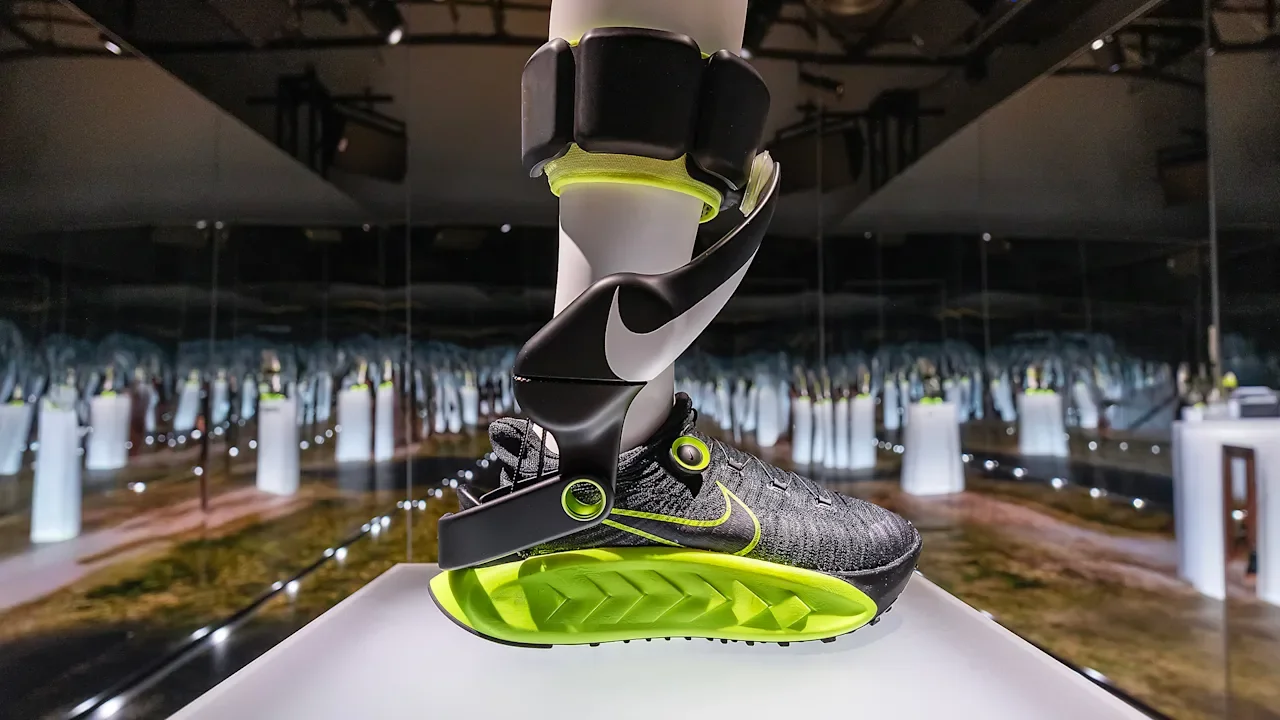
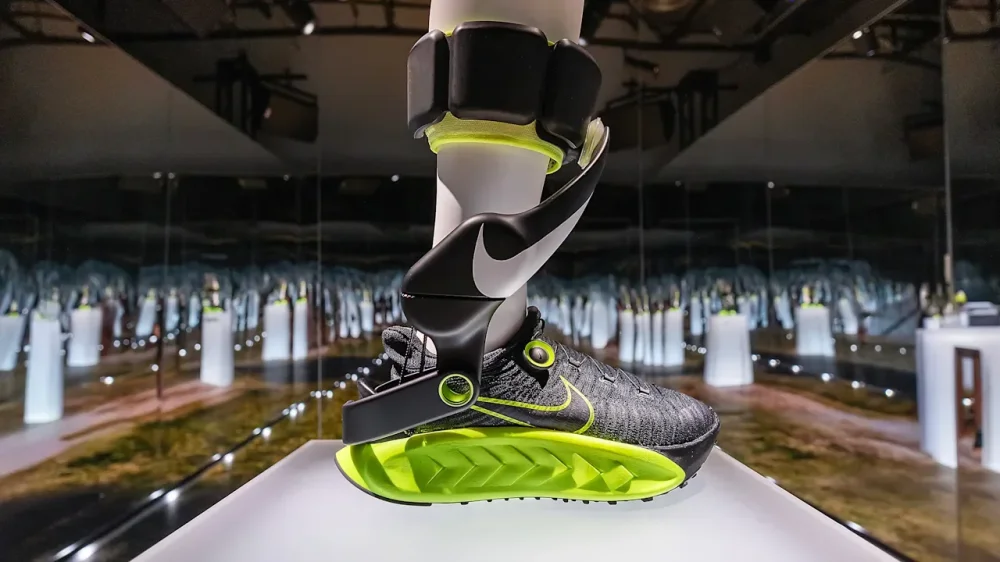
I slip on a pair of Nike running shoes. I clip a chunk of metal to the heel, which wraps around my lower leg like a shin guard. The battery goes on last, hugging it all like a high ankle bracelet. In all of 30 seconds, I’ve turned my legs into robots. I’m wearing Nike’s new exoskeleton footwear, dubbed Project Amplify. My legs feel heavier for sure. But with each step, there’s a little kick in my heel. Like a cherry bomb exploding underfoot. And when it launches next year under a new name for an undisclosed price, Project Amplify will power runs up to 10 kilometers long on a single charge, increasing your energy output by 15% to 20% along the way. “Think of it as an ebike for your feet,” says Michael Donaghu, a VP at Nike who leads the Project Amplify team. The long road toward amplification Exoskeletons offer the possibility to completely reimagine human movement, so it might not be surprising to learn that Nike has been pursuing the possibilities of exoskeletons for 14 years. As Donaghu explains, he began at Nike decades ago working for the cofounder mad scientist running coach Bill Bowerman himself, who had a penchant for saying that an ounce on your foot was worth a pound on your back. As such, much of Nike innovation is about subtraction—eliminating weight to ensure the product doesn’t get in the way of your body. Nike’s marathon-busting Vaporfly shoes offered some rebuttal to this idea, as Nike studied the possibilities of energy return, developing carbon plates and foams that could give back an extra 4% of your stride. “What if, instead of playing subtraction, we could give you more?” Donaghu muses. And exoskeleton research was right along these lines, albeit taken to the extreme. The problem a decade ago, however, was that the components needed for robotic assistance never quite added up. “The technology was too heavy, or not powerful enough,” Donaghu says. “The theory just didn’t play out in practice.” Rather than dissuading Nike, Donaghu says it kept the company focused on the longer game—and every once in a while, a new PhD would walk through the doors and reignite interest in the idea, just to keep the coals burning. “I think you can have a lot of shared intuition as a group of designers and researchers, and sometimes technology just isn’t ready to do it, or you’re not smart enough to figure it out,” he says. By 2021, the team opted to try again in earnest, dedicating full-time researchers to the project longer term. Quite a few developments helped. Algorithms, sensors, and microprocessors had all matured. But most of all, Donaghu credits the drone industry, fueled by a new wave of lightweight, high-RPM motors, with providing one of the most fundamental components of Project Amplify. “That mass adoption made smaller, more energy-dense motors of the size that you would want to put on a body,” he says. Designing the first consumer-friendly exoskeleton The design of Project Amplify is inspired by the human body. Developed in partnership with Dephy, it’s essentially a robotic version of your Achilles tendon—the connection between your calf muscles and heel that powers running and jumping. As you walk, onboard sensors track your gait and attempt to power your step at just the right moment. Donaghu likens the challenge to pushing someone on a swing. Too early, it feels weird. Too late, and it’s pointless. The task requires accuracy in the milliseconds, while accommodating for the fact that everyone’s gait is a little different. Nike hasn’t mastered this work yet. As I take my first jog in Project Amplify, I find myself fighting the machine. I don’t feel puppeted, as I have with larger exoskeletons in the past, but I don’t feel like a super version of myself, either. Instead, there’s a bit too much pressure on my shin, and my heel slips slightly out of the shoe. Allow me to admit, it’s a bit infantilizing to find yourself struggling to run at Nike HQ, and I’m admittedly despondent when another tester trying Amplify for the first time flies by me effortlessly. Tweaking the level of support and response time (simple buttons and sliders in an app) does help. And while I’m still a bit awkward, and the footwear never feels weightless, they also got my ass up a 500-foot training hill, leaving me reasonably but not devastatingly winded. For me, an elite running shoe feels like I’m running on flubber, and an e-bike can straight-up feel like driving a motorcycle. I wanted one sensation or the other in a way that wasn’t quite there yet in Project Amplify. But taking it off? A dream! All you do is pull a tab on the heel, and the robot unlatches. I’m reminded of the handful of people necessary for me to don an exoskeleton pant made with Arc’teryx. Meanwhile, Nike really has developed something that I believe most people could slip on with relative ease. Polishing Amplify for launch Despite the fact that hundreds of people have taken more than 2.4 million steps with Project Amplify, Donaghu knows the product isn’t fully cooked yet, and he’s even a bit self-conscious as the team shares a platform they’ve yet to perfect with journalists such as myself. “Could we already be in the market right now? Yeah, we actually are getting really good functional testing results and feedback from most people. It just doesn’t meet the threshold of, like, is it swoosh-worthy yet?” he says. “I just think we have a responsibility to make sure that this thing ends up being really aspirational. Like, it really disappears visually. Functionally, it’s just something that’s there helping you. And if we can’t get to that threshold, then for some of us, it’s not going to be good enough.” For now, Nike reaching that threshold means continuing to tweak the algorithms so that people like me don’t face a learning curve when using the product. He also suggests that the team still “has levers to pull” to lighten the technology while increasing its power output. And, of course, it has to look fire on your foot. To this aim, the design team has developed a mockup of Project Amplify that’s more svelt, graceful, and all-around Nike-vibing than the chunkier prototypes they’ve built thus far. Now it’s just up to the poor engineering team to bring that vision to life. As for where Project Amplify fits in the market, it’s too much power for competitive sport, but perfect for recreation. Longer term, Nike’s own CEO isn’t making any bold predictions about revenue potential or market size, but the writing is on the wall that the age of exoskeletons is coming. That’s especially for those aging with lower mobility—these technologies will revolutionize quality of life. “There are so many ways that it doesn’t fit perfectly into our business model. It’s a bigger swing,” says Donaghu, who a few beats later admits that it feels wonderful to be making such a swing, to launch a product on the true edge of the company’s capabilities. “That’s Nike at its best, when we’re just being a little more bold to say we’re responsible for trying to change this industry and just help people move by and large. What are all the things that we’re not releasing that would do that?” View the full article
-
Bethenny Frankel is a marketing maven. She’s best known for starring in the Real Housewives of New York City, and for launching the Skinnygirl lifestyle brand, starting with the now-famous “skinny girl” margarita. She then found a partner to help her manufacture the cocktail, which launched in 2009. In 2011, Frankel sold Skinnygirl for an estimated $100 million, but kept the rights to use the name. Since then, she’s launched Skinnygirl salad dressing, shapewear, and popcorn, among other items. Frankel has 4 million-plus followers on Instagram and 3.3 million on TikTok, where she sounds off on everything from coffee to handbags. Frankel is also the queen of affiliate and brand deals—netting $7 million in 2024, a figure she’s on track to exceed this year. In May, she launched The List, where fans can shop her closet as well as her “obsessions,” which range from furniture to makeup. She’s also an investor in Cumulus Coffee, ShopMy, and several other companies. Frankel sat down with Fast Company to talk about her career pivots—and what it means to be a marketer in today’s social-media-driven business world. She points out that consumers respond to authenticity and personal branding more than ever before, but also discusses the danger of blowback from putting your brand—and yourself—out there. Let’s start at the beginning. You’ve said going on Real Housewives was purely a business decision. Can you tell us about that? Well, I turned it down for a month saying I wanted to be a natural food chef. But I realized it’s not that easy to get on TV. And if this fails, no one will know about it. And if it succeeds, then it’s a great platform. I definitely did not think it was going to be a cultural phenomenon. How did you think about riding that zeitgeist? My instincts were just right there always. I think I’m a born marketer. When I was a little kid I used to want to be a copywriter, and came up with slogans and names for people’s businesses and stores. I just have always been a person that leads with marketing first. I had an agent who also represented the Kardashians, and they followed suit with monetizing the Kardashians after what I did with Housewives and the Skinnygirl margarita, which no one had ever done before. No one had monetized reality TV. Now the audience is turned off by that. Everybody’s followed in my footsteps, and everything is a photo shoot and a book cover and a launch party and a fashion line that may or may not really exist. Versus on Housewives, it was me being flawed and using that platform to go through the struggles and possibilities of building a business, whether or not it would look negative or positive to the audience. It was just a true experience that I was going through. What marketing advice do you have based on that experience? The actual lesson was that people weren’t buying the product that I was selling. They were buying the authenticity of me. They believed that I was being truthful about all areas of my life, so then they believed in what I was doing. And I think that’s where everybody’s lost their way, because everybody’s just trying to sell something to make a quick buck in the short term, but the audience is extremely savvy. While you may make money on a brand deal right now, in the long run they probably won’t trust you if you’re not telling the truth. And that’s what’s key in social media, which is the new television. How do you draw boundaries between your personal life and your professional life? Attention is the new oil. I’m so grateful and so fortunate and so humbled by the fact that I have the attention of the people. There’s a handful of people in the world right now who have the attention of the people, because even in the last year, I’ve watched it change. Everyone’s desperate because there are more people in the store. So how do you get people to come up to your counter? It is very manic and it probably really affects people’s mental health. So how do I deal with that? I don’t have to do any of this. And I think that’s what really separates me from the influencers and the content creator landscape. I wasn’t broke when I accidentally started doing this stuff and it was doing well. I was just sort of lonely. I was emotionally broke, I was sort of bored, with low-grade depression. I was at home screwing around. I found a real home in this medium. You mentioned authenticity is your superpower for engaging with people. What happens when there’s backlash because you’re putting your authentic self out there? It’s such a trap because they want me to comment, because I opine. I never rate higher than when I’m commenting. But then if you comment, people always want to know what you’re thinking. Everyone was mad at me because I wasn’t posting about Charlie Kirk. I had never heard of Charlie Kirk in my entire life, until the mob was mad at me for not posting thoughts and prayers. A couple of hours later, I said to everyone, “Sit the fuck down. I’d like to get educated. Sorry if you think I’m dumb, I can’t know what I don’t know.” The thing is I don’t get to have the fluffy buffer of just doing a TikTok dance and people wanting that. People want my opinion. I am in the impact zone often, but that’s okay. How do you deal with being in the impact zone? You go through the storm; you deal with it, and then it passes. You don’t apologize if you’re not sorry, and you don’t beg. You decide what you truly think is the right thing to do. And you do that. I’ve advised so many celebrities who have called me literally when they hit rough waters. I’m like, this is what you do. They’re like, “I don’t know how you do this.” Tell us about the pivot to investing. I mean, it’s been gradual. It’s been an evolution. The company Cameo reached out and wanted me to be on the app doing those messages for people. And I said, “Well, I’d have to own a piece of it.” I kept pushing and pushing and pushing. And then I was able to invest series A and Series B and make a good amount of money off of that investment, to say the least. And then the Bay Football Club, which is a women’s soccer team, reached out, and I thought that was interesting. So I invested in that. And then later Sheryl Sandberg came in and she invested, and so that investment is also up . . . all completely based on interest. But I have a team now. I have a COO who will go look at deals and bring some new ones. What makes you want to invest in a company? If I haven’t heard about it before and it solves problems. And then if I or my partner finds out if the actual business is good. One time on Shark Tank, I told Mark Cuban I loved his company. I love his product. He said, “Well, great, you could buy the product. You don’t have to invest in the company.” Just because I love it doesn’t mean it’s a good space or business. I have people now who help me determine that. What comes next? I’m really working on this dating concept that is a social experiment. It’s a passion project that is working. There are very strict rules and guidelines to it, and people are devouring it and clamoring to get in. People in the much larger community have said on the record that they think that matchmakers are actually criminals. And many people are very disenchanted with the apps. I think the apps serve a purpose. I’m not anti-app, but I’m anti-matchmaker, after what I’ve learned. They prey on the weakness of the heart. They just take a lot of your money and it’s never refundable. Sounds interesting. How do you figure out what’s next? I am a big planner in my life—What are we doing, where are we going? But I often change and rarely stick to the plan. Still, I like to have the framework. I often change travel and booking plans. It’s very challenging for people to keep up with. But I’m like that with business too. There’s not a big grand plan—I change what I’m doing based on how I feel in the moment. And you know, [go] where the fish are. You’re kind of in a boat, you’re prepared, and you’re an organized person. I see fish, I can catch them, and I know how to catch them. And if there are too many fish to catch, then I’ll get a bigger boat. This conversation has been condensed and lightly edited for clarity. View the full article

-
Halloween is a fun, scary time for children and adults alike—but why does the holiday seem to start so much earlier every year? Decades ago, when I was young, Halloween was a much smaller affair, and people didn’t start preparing until mid-October. Today, in my neighborhood near where I grew up in Massachusetts, Halloween decorations start appearing in the middle of summer. What’s changed isn’t just when we celebrate but how: Halloween has evolved from a simple folk tradition to a massive commercial event. As a business school professor who has studied the economics of holidays for years, I’m astounded by how the business of Halloween has grown. And understanding why it’s such big business may help explain why it’s creeping earlier and earlier. The business of Halloween Halloween’s roots lie in a Celtic holiday honoring the dead, later adapted by the Catholic Church as a time to remember saints. Today it’s largely a secular celebration – one that gives people from all backgrounds a chance to dress up, engage in fantasy, and safely confront their fears. That broad appeal has fueled explosive growth. The National Retail Federation has surveyed Americans about their Halloween plans each September since 2005. Back then, slightly more than half of Americans said they planned to celebrate. In 2025, nearly three-quarters said they would—a huge jump in 20 years. And people are planning to shell out more money than ever. Total spending on Halloween is expected to reach a record US$13 billion this year, according to the federation—an almost fourfold increase over the past two decades. Adjusting for inflation and population growth, I found that the average American will spend an expected $38 on Halloween this year—up from just $18 per person back in 2005. That’s a lot of candy corn. Candy imports show a similar trend. September has long been the key month for the candy trade, with imports about one-fifth higher than during the rest of the year. Back in September 2005, the U.S. imported about $250 million of the sweet stuff. In September 2024, that figure had tripled to about $750 million. This is part of a larger trend of Halloween becoming a lot more professionalized. For example, when I was a kid, it wasn’t unusual for households to pass out brownies, candied apples, and other homemade treats to trick-or-treaters. But because of safety concerns and food allergies, for decades, Americans have been warned to stick to mass-produced, individually wrapped candies. The same shift has happened with costumes. Years ago, many people made their own; today, store-bought costumes dominate—even for pets. Why Halloween keeps creeping earlier While there’s no definitive research establishing why Halloween seems to start earlier each year, the increase in spending is one major driver. Halloween items are seasonal, which means no one wants to buy giant plastic skeletons on Nov. 1. As total spending grows, retailers order more inventory, and the cost of storing ever-larger amounts of unsold items until the next year becomes a bigger consideration. Once a season’s commercial footprint becomes large enough, retailers begin ordering and displaying merchandise long before it’s actually needed. For example, winter coats start appearing in stores in early fall and are typically gone when the snow starts falling. It’s the same with Halloween: Retailers put out merchandise early to ensure they’re not stuck with unsold goods once the season is over. They also often price strategically – charging full price when items first hit the shelves, appealing to eager early shoppers, and then marking down prices closer to the holiday. This clears shelves and warehouses, making room for the next upcoming shopping season. Over the past two decades, Halloween has become an ever-bigger commercial holiday. The growth in people enjoying the holiday and the increase in spending has resulted in Halloween becoming one giant treat for businesses. The big trick for retailers is preventing this holiday from starting before the Fourth of July. Jay L. Zagorsky is an associate professor at the Questrom School of Business at Boston University. This article is republished from The Conversation under a Creative Commons license. Read the original article. View the full article

-
When Ben Stiller goes out to dinner, he drinks between one and three Shirley Temples. But a fully-grown adult ordering a classic child’s beverage can elicit funny looks. So, to help cut the stigma, and the sugar, the actor, director, and producer launched his own soda company last month—called Stiller’s Soda—with a grown-up version of a Shirley Temple as one of its three flavors. He simply wanted a version “that he could feel good about drinking himself,” says Stiller’s Soda cofounder Alexander Doman, a serial food and beverage entrepreneur. Stiller’s isn’t the only soda company suddenly flirting with the Shirley Temple. In the past year, soda powerhouses and drink disruptors from 7UP and Gatorade to Spindrift and Bloom Pop have debuted Shirley Temple products. Even frozen yogurt chain 16 Handles got into the game. The fizzy drink, ordered previously mostly at bars, has been a staple of American childhoods since the 1930s, when Shirley Temple herself was a young star on the big screen. Legend has it that the concoction—grenadine, lemon-lime soda, and a maraschino cherry—was created by West Hollywood bartenders so that Temple could enjoy a drink with her costars. Everyone has their own Shirley Temple memory. Barb Stuckey, chief new product strategy officer at Mattson, a major food and drink developer for retailers and restaurants, remembers family outings to the Flower Drum Chinese restaurant in Baltimore in the ‘80s, ordering chop suey with a Shirley Temple. It made her feel like a grown-up. “She’s having a glass of wine, he’s having a beer, and he’s having this thing with a straw with a little umbrella,” she says. “I want to be part of this, whatever it is.” That feeling has been passed down through generations, though few are still alive who recall the drink’s namesake. “I can’t imagine that more than 5 to 10% of Gen Zs have any clue who Shirley Temple was,” Stuckey says. “She was maybe the youngest-ever child star on the silver screen. She’s now become a maraschino cherry, pretty much.” All the more eye-opening is that Gen Z is enamored with the drink. This could be due to the generation’s love of nostalgia, its lower alcohol use, and the mocktail’s effervescence on social media. These factors have combined to raise the drink’s profile among young people and made it something you don’t have to graduate out of—leading companies to go all in on stirring up their own batches. “Arc of a new trend” Mary Haderlein, the head of Mattson’s Chicago office, tracks the modern Shirley Temple revival back to around 2021 when, homebound during the pandemic, people were shaking their own cocktails. The Shirley Temple—and the Dirty Shirley, made with vodka—was easy and unpretentious, offering the comfort of nostalgia during a scary time. “All of these childhood favorites became these master brands ,” she says, as processed favorites like Oreos and Cinnamon Toast Crunch surged in sales. Young people had the time to post their colorful creations on TikTok. At the same time, restaurants and bars were facing shutdowns and supply shortages, and Shirleys only required basic pantry ingredients. “They didn’t have to rely on an import that got caught up in the Suez Canal,” Haderlein says. When people returned to the in-real-life socializing they’d craved, the Dirty Shirley stayed popular; it was hailed as the drink of summer 2022 by The New York Times. Its profile has continued to grow. Earlier this year, The Times profiled Leo Kelly, an 11-year-old known as the Shirley Temple King, who since 2019 has rated the drink at different restaurants on Instagram, docking points for slip-ups like too few cherries. One review, of a Shirley Temple at Evermore Resort, in Orlando—which had five cherries and a score of 9.6/10—received 335,000 likes last year. Casey Ferrell, senior VP of consulting at marketing data firm Kantar, who focuses on how different generations embrace culture, says that even the youngest influencers can push trends into the public consciousness. (In the most embarrassing of snubs, Kelly declined my interview request.) In the typical “arc of a new trend,” Haderlein says, something will become popular at independent restaurants, then move to chain eateries, and eventually become ready-to-drink products on grocery store shelves. Wholesome ‘newstalgia’ 7UP was the first major beverage brand to offer the Shirley Temple via retail, in October of 2024. Katie Webb, VP of innovation and transformation at its parent company, Keurig Dr Pepper, says that 7UP naturally had “equity” in the drink, given that a lemon/lime soda is the very base of the beverage. (Note: the Shirley Temple King prefers his with ginger ale.) It was a limited run, for the holidays, and will return this year to capitalize on a season when multiple generations gather, toast, and embrace old traditions. “Gen Z are receptive to stuff that we think is nostalgic but that they never actually experienced,” says Kantar’s Ferrell says. Gen Z may use the word “wholesome” in this context. It’s a word they use a lot. Webb likes the term “newstalgia” to describe Gen Z’s unique spin on the past. And as with everything Gen Z related, visuals are key. Today’s teen and 20-somethings are drawn to food and drinks with features that stand out on TikTok or Instagram, such as bright colors, textures, foams, and fizzes. To a degree, photogenic is more important than flavorful, and Shirley Temple plays right into that: it swirls, it bubbles, and it pops on the ‘gram. They also like their beverages on the rocks. Cold drinks represented 75% of Starbucks’ U.S. sales in Q3 of 2024. “If you walk into a Starbucks, I dare you to find a single Gen Z that is drinking a hot beverage,” Stuckey says. 16 Handles knows. The frozen yogurt chain took this trend even further with its Shirley Temple cherry lime sorbet, launched as a limited run this past August. Will a Shirley Temple without sugar still taste as sweet? The downside of the traditional Shirley Temple is that it’s not exactly good for you. A typical serving could have between 30 and 60 grams of sugar, and up to 300 calories. Even Temple herself had issues with it, telling NPR in 1986 that she hated the “saccharine sweet, icky drink.” “Holy cow, they have tons of sugar,” says Amy Steel Vanden-Eykel, chief growth officer at Spindrift, who was incentivized to create an alternative. In February, Spindrift launched its own version, with no added sugar or sweeteners. It’s made with real fruit, essentially just a higher ratio of juice to carbonated water than its seltzers. (Shirley Temple is one of five flavors in its new soda line, which includes other throwbacks like Strawberry Shortcake and Orange Cream Float.) Spindrift’s tart iteration doesn’t taste all that much like a Shirley Temple to me. But the good-for-you modification is probably a smart move, given that one in three consumers say reducing non-healthy ingredients like high sugar in beverages is important, according to Mattson’s data. Other brands have dialed back the sugar, too. 7UP released a zero-sugar version as part of its rollout last year. Bloom Pop, also owned by Keurig Dr Pepper, released a prebiotic Shirley Temple in July that’s low sugar and low calorie. In September, so did Slice, which PepsiCo relaunched this year as a gut-health drink brand after sunsetting it in the early 2000s. The drink is also benefitting from the fact that Gen Z is famously not consuming as much alcohol as previous generations—about 20% less, consistent data shows. (It’s one of a handful of perceived “risky behaviors” they’re engaging in less, Ferrell says, along with driving and sex. In a chaotic-feeling world, they’re careful about “how much [risk] they’re willing to tolerate in their lives,” he says.) But they still want fun drinks, and “wholesome” sodas become favorites for the “sobercurious” to bring to the party, without the stigma such adult mocktails may have had in the past. 44 bottles Keurig Dr Pepper’s data shows that 72% of Gen Z try a new drink monthly, versus 44% of all Americans. This is great news for new flavor debuts, but worrisome news for the folks trying to build them into sustainable businesses. For 7UP, keeping the Shirley Temple flavor as a limited run makes sense. Brands used to be the “arbiters of culture,” Ferrell says. Today, that power has tipped to the consumer. “Companies now need to be reactive to whatever’s hot on TikTok.” When they pounce fast, it pays off. 7UP’s Webb, who says that the company is constantly monitoring social media to track “what kind of concoctions consumers might be making with our products,” notes that 67% of its Shirley Temple trialists were new to the brand. Gatorade is also staying flexible. In June, the brand presented WNBA player Paige Bueckers with a special-edition flavor of her favorite drink, the Shirley Temple. The video of the presentation became the brand’s most commented-on piece of social content ever, says chief brand officer Anuj Bhasin. (The company then sent 44 bottles to Bueckers fans who commented on the Instagram post, the number being a nod to the points Bueckers scored when setting a rookie record.) With only 44 bottles, the release could be considered a “brand activation,” a limited run of a product based on a disruptive cultural moment, with a campaign around it. “We are absolutely seeking to do more of these things,” Gatorade’s Bhasin says, adding that the company will rarely commit to making a new flavor like Shirley Temple permanent. The next new thing Although Gatorade maintains multiyear road maps, it also now keeps resources in reserve for forming a “quick-strike team” to execute last-minute campaigns based on fads and quick shifts in the zeitgeist. It now has a special development facility at its Valhalla, New York, R&D site to enable faster market turnaround; products produced at this site are not even meant for retail sale. The good news for big beverage companies is that ginning up a new flavor like a Shirley Temple is relatively simple. They’re sourcing straightforward syrups from longtime suppliers, not mapping out new supply chains. “This is not rocket science—it’s lemon, lime, and cherry,” Stuckey says. When it comes to Shirley Temple, “it just feels like this is built for mass consumption.” (Stiller’s cofounder Doman insists that its Shirley Temple soda had nothing to do with trends. He insists it was driven merely by Stiller’s own tastebuds, which signed off on every iteration until it was finished.) But soon enough there will be a new thing, as there always is. “These same brands are going to have to tap into something else after this winds its way through everybody’s system,” Ferrell says. What’s next? Mattson’s Haderlein is seeing a rise in bitter spritzes. Her colleague Stuckey isn’t betting against matcha. Yet because of its history, the Shirley Temple also has staying power. “It does have a genuine cultural underpinning to it,” Haderlein says, predicting that it will likely endure, at least “peripherally,” as a part of childhoods across the country, no matter what generation. How wholesome. View the full article

-
As Portland, Oregon, residents protest President Donald The President’s immigration policy outside an ICE facility, they’re also using a less expected tactic: the city’s zoning code. Portland’s Immigration and Customs Enforcement facility sits in a remodeled bank in the city’s South Waterfront neighborhood, not far from apartment buildings, restaurants and—until it recently moved because of worries about ICE—a local school. (As demonstrations increased, law enforcement used chemicals and munitions that ended up on the school’s playground.) When the federal government first wanted to lease the building in 2011, it had to get land-use approval as required by the city’s zoning laws. Portland put strict conditions in place in the approval process: Detainees couldn’t be held for more than 12 hours or overnight. Activists have said for years that ICE is violating those conditions and that the city should reconsider its land-use approval. In 2018, when protestors gathered at the same site to rally against the first The President administration for separating thousands of immigrant children from their parents, activists argued that the violations should be cause to close the facility. At the time, “elected officials were saying it wasn’t possible,” says Holly Brown, one activist. But when The President took office again earlier this year, protestors restarted their efforts to get the building shut down. This year, the city acted. “It took a lot of community pressure,” Brown says. “We’ve been doing a lot of protests at City Hall. We’ve shut down city meetings and refused to let them conduct their meetings until they deal with this. We also had someone file an official complaint with the city.” In July, the city’s permitting bureau launched an investigation, using data from the Deportation Data Project, a nonprofit that uses Freedom of Information Act requests to get detailed records from the government at detention facilities across the country. The data showed that the ICE facility had violated the city’s rules 25 times over a 10-month period, according to the city. In September, the permitting bureau issued a land-use violation to Stuart Lindquist, the property owner who rents the space to ICE for $2.4 million a year. Lindquist has challenged the city’s action, asking for a formal administrative review in which a facilitator will determine whether the city correctly applied its land-use codes. He isn’t exactly sympathetic to protestors: He reportedly hit one protestor with his Mercedes in 2018 and told a reporter that he wanted to fight activists. “I’d be glad to take them on one at a time. Bring ’em on,” Lindquist told the Willamette Week newspaper in 2018. Neither ICE nor Lindquist responded to a request to comment for this article. If the city shows that ICE is still violating the original agreement, Lindquist could face fines. But the city’s process has also kicked off another possibility: Sixty days after it issued the notice—in mid-November—it has the option to reconsider the land-use approval completely. “The city could have a hearing on whether or not it still fits the original use that it was intended for,” Brown says. “In this case, I would say it does not.” A city spokesperson told Fast Company that if Portland does reconsider the terms of the land-use approval, that wouldn’t necessarily mean revoking the approval; it might mean renegotiating the terms. Still, activists are pursuing the hope that this unlikely path could help shut the facility down. It’s something that wouldn’t work everywhere, since many ICE facilities are in federal government buildings or rented from private prison companies in areas with fewer zoning restrictions. Portland also had unusually specific conditions in its agreement. But it’s one example of a creative way to take on a government agency that has few restraints. “This is definitely an example of the city and people who live in the city using the levers of power we have available to clamp down on ICE,” Brown says. Even if other cities don’t use this particular approach, they can look for other ways to act. “Every city can and should be looking at whatever creative opportunities exist within their own laws to prevent collaboration with the The President administration,” says Matthew Lopas, director of state advocacy and technical assistance at the nonprofit National Immigration Law Center. “The The President administration has shown so much disregard for the independence and the safety of cities that it should be a priority of every city to protect their own community by refusing to collaborate to the fullest extent possible with this administration and their efforts to terrorize immigrants and entire communities,” Lopas adds. Some cities have refused to let ICE use local prison space for detention sites, for example. When ICE has a contract in place, some states have chosen not to renew it. As ICE continues to ramp up arrests and detentions—with a tripling of its budget for enforcement and another $45 billion for new detention facilities—it will continue to look for new space to operate, and some other states and cities may be able to turn to zoning laws to make it harder to build. Activists in Portland are also trying to garner more protections for residents, including asking the city to ban face masks on ICE agents and adopt new policies to help limit where ICE can go. As in other cities, ICE arrests have surged in Portland this year. (One arrest this summer involved a father dropping off his child at a preschool; the man, who is married to an American citizen and was in the process of getting a green card, reportedly had no criminal history.) Focusing on ICE’s land-use violation “is a first step,” Brown says. “It’s a learning period for us in what we can do. We’re definitely going to keep moving forward and find other ways we can get the city to put pressure on ICE to back down.” View the full article

-
As Nvidia’s value has soared—becoming the first public company to hit $4 trillion in market capitalization earlier this year—it’s been pouring money into AI startups. Its venture arm, NVentures, is also backing less expected bets. The latest: Redwood Materials, the EV battery recycling company, which just raised $350 million in a new funding round. Redwood launched in 2017 with the aim to build a U.S. supply chain for critical metals by pulling materials like cobalt and lithium from used EV batteries. But the company spun up another major business this year—using secondhand EV batteries as a low-cost form of energy storage at data centers. “I think people misname them as a recycling company,” says Joe Fath, a partner at Eclipse, which led Redwood’s new Series E round. “Recycling is really just the wedge.” The company is a recycling giant, and currently processes around 90% of the lithium-ion batteries that are recycled in North America. But their energy storage business is equally important, and can help solve one of the biggest challenges for the AI industry right now: how to source the energy that data centers need. “Power generation, storage, and cost to drive those GPUs is increasingly becoming a bottleneck,” says Patrick Moorhead, CEO and chief analyst at Moor Insights & Strategy. For a company like Nvidia, which makes the energy-intensive hardware used in data centers, helping scale up energy storage for its customers helps its own business continue to quickly expand. (Nvidia declined to comment, saying that it doesn’t discuss its investments.) In some cases, data centers can use batteries to help them go completely off the grid, as in a solar-and-battery-powered project that Redwood built with Crusoe this year. Some customers also plan to use the company’s batteries to store energy produced with natural gas. Redwood makes both the battery hardware and the software and electronics to run the system. “Speed to energy is paramount,” says Redwood Materials CEO JB Straubel. “By using storage—and in particular a very modular, flexible approach like we’re doing—people are able to bypass some of the very long interconnection queues to get electricity sourced directly from the traditional grid.” In other cases, the batteries can connect to the grid and pull electricity from it when it’s cheapest. They also provide resilience if the grid goes down. The approach also saves money. “Cost is probably the leading advantage, because we’re refurbishing and using assets that were previously deployed in a different application. For the most part, we’re able to dramatically reduce our deployment costs,” Straubel says. Nvidia has also invested in other energy companies, including participating in a $863 million funding round for Commonwealth Fusion Systems, a startup that aims to put fusion power on the grid by the 2030s. But Redwood’s technology is ready for use now. “Redwood is a leader in this market, and Nvidia is planting a flag in the sand on this key market,” says Dan Ives, global head of tech research at Wedbush Securities. “Nvidia is focused on building a vertical ecosystem, and Redwood investment is a perfect fit.” View the full article

-
In the Marshall Islands, where the land averages only 7 feet (2 meters) above sea level, people are acutely aware of climate change. Their ancestors have lived on this string of Pacific islands for thousands of years. But as sea level rises, storms more easily flood communities and farmland with saltwater. Warming ocean water has triggered mass coral-bleaching events, harming habitats that are important for both tourism and fish that the islands’ economy relies on. If the world fails to rein in the greenhouse gas emissions driving climate change, studies suggest low-lying islands like these could be uninhabitable within decades. Marshall Islands President Hilda Heine talks about climate risks to her homeland while in New York for the United Nations General Assembly in September 2025. Climate change isn’t just a problem for islands. Countries worldwide are experiencing intensifying storms, dangerous heat waves, and rising seas as global temperatures rise. Yet, after 30 years of international climate talks, 10 years of a global treaty promising to keep temperatures in check, and trillions of dollars in damage, the world is still not on track to stop rising global temperatures. Greenhouse gas emissions were at record highs in 2024, and it was Earth’s hottest year on record. I study the dynamics of global environmental politics, including the United Nations climate negotiations. And my lab and I have been tracking countries’ latest climate pledges—known as nationally determined contributions, or NDCs—to see which countries have stepped up their efforts, which have slid back, and who has ideas that can deliver a safer world for everyone. While the The President administration has been pressuring countries to back away from their climate commitments—and succeeded in delaying an International Maritime Organization vote on a global plan to tax greenhouse gas emissions from shipping after threatening other countries with sanctions, visa restrictions, and port fees if they supported it—many countries are still pressing ahead. The President agitates, but many countries are steadfast U.S. President Donald The President, whose administration came into office vowing to eliminate climate regulations and boost the fossil fuel industry, derided concerns about climate change in his Sept. 23, 2025, speech to the U.N. General Assembly. He called climate change the “greatest con job ever perpetuated” and ridiculed green energy and climate science. The President’s language no longer surprises world leaders, though. More than 100 other countries announced new climate commitments during a high-level summit a few days later. China, currently the world’s largest greenhouse gas emitter, was lauded for hitting its green energy targets five years early. Its rapid expansion of low-cost renewable energy and electric vehicle manufacturing has reduced pollution in Chinese cities while also boosting its economy and expanding the government’s influence around the world. Chinese President Xi Jinping announced the country’s first absolute emissions reduction goal at the summit, committing to cut its net greenhouse gas emissions by 7% to 10% from peak levels by 2035. China also committed to nearly triple its solar and wind power capacity and expand reforestation efforts. While advocates and other governments had hoped for a stronger announcement from China, the new goals mark an important shift from the country’s earlier carbon intensity targets, which aimed to decrease the amount of greenhouse gas emissions per unit of economic output but still allowed emissions to grow over time. International Energy AgencyDatawrapper The European Union has yet to submit its new commitments, but the group of 27 European countries delivered a letter of intent, saying it would commit to a 66% to 72% collective decrease in net greenhouse gas emissions by 2035 compared with 1990 levels. Europe has seen a swift rise in renewable energy, up sharply since Russia’s invasion of Ukraine put the continent’s natural gas supplies in jeopardy. The EU has also made waves by extending its carbon pricing rules beyond its borders. The EU’s Carbon Border Adjustment Mechanism, scheduled to begin in January 2026, will be the first system to charge for the climate impact of imported goods coming into Europe from countries that don’t have carbon prices similar to the EU’s. The measure, meant to even the playing field for EU industries, sets a global precedent for linking carbon emissions to trade. However, the EU’s climate plans are also facing some headwinds. Its parliament is moving toward softening new corporate sustainability requirements after pressure from companies. And it may face calls from some member countries to delay a new carbon market meant to cut emissions from road transportation and buildings, Politico reported. The EU has pledged to mobilize up to 300 billion Euros (about US$350 billion) to support the global clean energy transition in developing countries. The United Kingdom, Japan, and Australia submitted their most ambitious targets to date. All three put them on track to reach net-zero emissions by 2050, meaning any greenhouse gases they emit will be offset by projects that avoid carbon emissions or remove carbon from the atmosphere. In Australia, Queensland’s recent announcement that it would extend existing coal power plant use to the 2030s and 2040s may slow national progress. But Queensland also supports scaling up renewable energy and is still aiming for net-zero emissions by 2050. Norway committed to reduce its greenhouse gas emissions by at least 70% by 2035 compared with 1990 levels, which would align with the Paris Agreement goal to keep global emissions below 1.5 degrees Celsius (2.7 degrees Fahrenheit). However, it plans to remain a major oil and gas exporter. Notably, many developing countries also stepped up their commitments. Brazil pledged a net emissions reduction of 59% to 67% by 2035 and is maintaining its 2050 net-zero target. The government also drew criticism for approving plans for oil exploration near the mouth of the Amazon River. Free riding and taking cover behind the US However, while some new climate commitments signal important momentum in the fight against climate change, the tug-of-war between global ambition to slow climate change and strategic self-interests was palpable at the New York summit. The responses to The President’s remarks revealed both veiled critiques and deceleration of climate action by some governments. China criticized backsliding by some countries, without naming names. Brazil used the summit to call out countries that were late in submitting their updated climate commitments. Only about a third had submitted their updated pledges at that point. While it is difficult to parse out individual country motivations—economic stress, wars, and political influence can all play a role—many scholars worry that U.S. backsliding will lead other countries to reduce their climate commitments, and some recent pledges appear to back this up. Many petroleum-producing countries missed the U.N. pledge deadline. Qatar, which recently gifted the U.S. a jet plane for The President’s use and has an economy largely bolstered by the oil and gas industry, has not updated its pledge since 2021. The six-member Gulf Cooperation Council’s average emissions reduction target is even lower than Qatar’s, at around 21.6% by 2030. Similarly, Argentina, among the world’s top holders of shale oil and gas reserves, has not released its updated commitments. Progress on its previous commitment has been undermined by political shifts since President Javier Milei’s election in 2023. Milei initially vowed to abandon the 2030 agenda entirely and withdraw from the Paris Agreement, though his administration later backtracked. His dismissal of climate change as a “socialist lie” has aligned Argentina closely with The President, culminating in a recently planned US$20 billion aid package from the U.S. to Argentina and raising questions about whether Argentina’s climate stance reflects genuine policy or geopolitical strategy. Also noticeably absent are commitments from India, Mexico, South Africa, and Saudi Arabia. Angola weakened its climate pledge, citing a lack of international funding. A new way to make climate commitments? While many countries are promising progress to reduce greenhouse gas emissions, the commitments formally submitted as of Oct. 20 were still far below the level needed to keep global temperatures from rising by 2 C (3.6 F), let alone 1.5 C. CC BY 4.0 To help boost national efforts and accountability, Brazil has proposed a new approach it calls a globally determined contribution. Unlike the 1997 Kyoto Protocol framework, which set fixed, country-specific emission reduction targets based on historical baselines, or the 2015 Paris Agreement’s pledge-as-you-can system, it would establish global targets aligned with the Paris Agreement’s temperature goals. So, a globally determined contribution might state, for example, that the world will triple its renewable energy production and reverse deforestation by 2030. A target like that gives countries a clearer path of action. The new format would also allow city and state actions to be counted separately, increasing incentives for them to act. As the host of the COP30 climate talks Nov. 10-21, 2025, Brazil is uniquely positioned to champion this concept. In the absence of U.S. leadership, the proposal could offer a rare opportunity for countries to collectively strengthen commitments and reshape treaty language in a way never seen before—leaving open the possibility for progress. Wila Mannella, a research assistant and graduate student in environmental studies at USC, contributed to this article. Shannon Gibson is a professor of environmental studies, political science, and international relations at the USC Dornsife College of Letters, Arts and Sciences. This article is republished from The Conversation under a Creative Commons license. Read the original article. View the full article

-
Result shows how Reform’s polarising nature may also be its weakness View the full article
-
Today many people wish to break away from their corporate jobs and become entrepreneurs. And apparently they find satisfaction in doing so, because 96% of people who are self-employed have no desire to go back to a “regular job.” View the full article

-
You promised yourself this was the year you’d finally launch–and sustain–some sort of side project, be it picking up a few freelance clients, launching a blog, podcast, or YouTube channel, or setting up an e-commerce shop. One day in the hopefully not-too-distant future, your side hustle might even grow into a full-time business. View the full article
-
Raising your prices takes courage, but it’s often the only way to grow revenue when you’re a freelancer, solopreneur, or running a small service business. But it’s possible to do it without losing your clients–here’s exactly how. View the full article

-
You may not realize you’re still clinging to the corporate world’s measures of success, but they can undermine your solo efforts. View the full article

-
Leadership is not a title or a job description. It is the daily practice of turning authority into trust and presence into influence, according to renowned psychologist, University of Exeter Professor and former NBA player John Amaechi, OBE. Amaechi argues that leadership lives in ordinary moments: how you listen, the precision of your words, and the discipline of reflection. “Being a great leader is not magic,” Amaechi explains to me, “but rather the consistent choice to act with clarity and intention that helps others feel enabled, not stifled.” Too often, people think of leadership as something to perform when the spotlight is on them. Amaechi says, “In reality, the leaders who endure are those who embody their practice in every interaction. They understand that credibility is not claimed but conferred by others who watch, listen and feel the texture of their leadership every day.” In his new book, It’s Not Magic: The Ordinary Skills of Exceptional Leaders, Amaechi outlines the following five practices to make leadership tangible and consistent. Refine your observation practice Each observation is a chance to deepen your understanding, not to catch others out. “Leaders who take observation seriously learn to notice patterns that others miss, from the subtle signals of disengagement to the small acts of initiative that deserve recognition,” says Amaechi. This practice requires discipline: to watch without rushing to judgment, to gather data rather than pounce on mistakes, and to cultivate patience until the fuller picture becomes clear. Observation done well creates the foundation for trust and insight. Normalize, affirm, and reframe with precision Confidence grows strongest where people feel seen clearly and encouraged thoughtfully. “It is easy to offer vague praise, but genuine affirmation demands precision,” Amaechi explains. “Leaders who normalize challenges and setbacks remind people they are not alone in facing difficulties.” Those who affirm effort and skill help individuals recognize their own capability. Reframing, when done carefully, shifts perspective from limitation to possibility without sugar-coating reality. Together, these practices build confidence that is both resilient and realistic. Sharpen language to sharpen thinking Sharper language builds sharper self-awareness and better decisions. Amaechi shared that leaders who are careless with language often leave confusion and unintended consequences in their wake. He said that precision in words is not pedantry but a discipline that shapes thought. Clear language, he told me, clarifies intent, defines boundaries, and sharpens focus. It reduces the margin for misinterpretation and models intellectual rigor. In teams, this practice can elevate debate, reduce wasted effort, and make strategy actionable rather than aspirational. One action he recommended: Replace vague verbs with clear commitments and define success before you speak. Model reflection openly Leaders who model reflection permit others to think more deeply, not just perform better. Reflection is often treated as a private act, done in isolation. Yet when leaders show how they revisit their decisions, acknowledge their blind spots, and adjust their approach, they legitimize learning as a shared practice. This openness dismantles the myth that leaders must be infallible, shared Amaechi. It signals that growth is valued more than perfection and that courage lies not in pretending to know everything, but in being willing to rethink. Here’s an action to try this week: Share one decision you would make differently and why. Manage your physical presence Physical presence speaks loudly. Use it to invite growth, not inhibit it. From posture to tone of voice, from where you sit in a meeting to how you enter a room, your physicality shapes the atmosphere others inhabit. A leader’s presence can constrict dialogue if it conveys impatience, intimidation or distraction, shared Amaechi. Equally, it can create space for others to step forward when it conveys openness, attentiveness, and calm. Presence is not performance but alignment: What you project outwardly should be consistent with the respect and curiosity you hold inwardly. Action: Adopt a default stance with an open posture, slower tempo, and eyes on the speaker. As Amaechi says in It’s Not Magic, leadership is revealed in what people see you do, not what you say you value. For deeper tools and team diagnostics, It’s Not Magic expands each practice and shows how to implement them at scale. —Marcel Shwantes This article originally appeared on Fast Company’s sister publication, Inc. Inc. is the voice of the American entrepreneur. We inspire, inform, and document the most fascinating people in business: the risk-takers, the innovators, and the ultra-driven go-getters that represent the most dynamic force in the American economy. View the full article

-
On episode 329 of PPC Live The Podcast I speak to Jack Hepp, founder of industrious Marketing LLC, discussing the fallout and what it took to bring him back to feet after he got fired from his first PPC job. The big f-up: fired from his first agency job Jack’s defining career moment came just a year and a half into his first agency role. Despite being eager to learn, he was still new to digital marketing when a major mistake occurred. “We dramatically underspent a client’s ad budget for the month — by almost 50%,” Jack recalls. That underspend had serious consequences. The client relied heavily on Google Ads for online sales, and the missed spend translated directly into lost revenue. As the main point of contact, the blame fell on Jack. “I was fired,” he says plainly. “It was my first job ever, and it crushed me.” Communication breakdown: the real mistake Looking back, Jack believes the root issue wasn’t just the budget underspend — it was poor communication. “There were other agencies, account reps, and multiple layers of management involved,” he explains. “But I didn’t communicate clearly enough. I was afraid to admit that something was going wrong.” That fear of being honest about mistakes is common in early careers. I note, “If people hear that one mistake could get them fired, they’ll stop taking risks. That’s not how innovation happens.” Jack now emphasizes transparency as a key professional value: “If I had communicated better, maybe things would’ve played out differently.” The role of leadership and training As the conversation unfolds, it becomes clear that Jack’s situation reflected deeper organizational issues. He received no formal training before being handed digital responsibilities. “It was very much like, ‘You’re young, you know how the internet works,’” Jack laughs. “But I didn’t know what I didn’t know.” He and I agree that poor management and lack of mentorship can lead to preventable failures. “That agency set you up to fail,” I remark. “Good leadership means helping juniors understand what to do — and why.” Rising again: the power of networks After being let go, Jack initially swore off marketing altogether. “I thought I was done. I even started applying for jobs in banking,” he says. But three months later, his professional network changed everything. A local agency called him out of the blue — thanks to someone who had vouched for him. “They told the agency, ‘You need to talk to Jack. He’s great — don’t judge him by that one mistake.’” That opportunity reignited his marketing career, proving the power of community connections. “Your network can be your safety net,” I said. “Join Slack groups, PPC chats, LinkedIn communities. Those relationships can literally save your career.” Lessons learned: transparency and ownership Since that early setback, Jack has gone on to manage countless campaigns and clients. And yes — he’s made other mistakes, including the classic daily budget typo (“$1,000 instead of $100”). But this time, he handled it differently: “I went straight to my manager and owned it. We told the client, fixed the pacing, and moved on. Being transparent builds trust.” Jack’s biggest takeaway? “Communicate openly, even when it’s uncomfortable. People are usually understanding if you’re honest and proactive about fixing the issue.” On AI and the future of PPC In the latter part of the discussion, Jack and I explore how AI is changing the paid search landscape — and why experience still matters. Jack cautions against over-reliance on automation: “AI makes it easier to manage accounts, but harder to manage them well. You still need human judgment.” He’s noticed a worrying trend where brands “take the human out” of campaign management, trusting AI to do everything. “That’s when you start seeing nonsense ad copy or mismatched targeting,” he warns. I add, “AI should be a tool, not a crutch. You still need people who understand the fundamentals of marketing — audience, message, and intent.” Advice for managers and new marketers For managers training juniors in the AI era, Jack offers simple guidance: “Even if AI can automate tasks, make sure your team understands why those tasks matter. Teach the reasoning, not just the process.” This builds critical thinking — the kind that prevents mistakes before they happen. Final thoughts: The PPC Sequel If Jack’s PPC career were a movie, what would it be called? “The PPC Sequel: I thought it was over, but I came back for part two.” It’s the perfect metaphor for his journey — from fired beginner to respected thought leader. I closes the conversation with a reminder: “No matter how low things seem, things can always turn around.” View the full article
-
Boost to economy comes ahead of expected tough Budget next monthView the full article
-
UK bank returned to full private ownership in MayView the full article