All Activity
- Past hour
-
 A retail channel veteran, Promisco has spoken frequently about the potential of AI to bring efficiency and lower costs in the loan origination process. View the full article
-
If someone asked you, “What is project management?”, would you find it easy to answer? Of course, it’s about managing projects but what exactly does that entail? Project management is so multi-faceted that it’s not easy to explain in just a few words. Even project managers at the start of their careers tend to realize very quickly that there’s more to the role than meets the eye. In this post, we’ll share a clear definition of project management, explore the project management process, and provide actionable tips for successfully managing projects. What is a project? Think of a project as a unit of measurement for a specific amount of work. A project has an objective, a beginning, and an end. It groups a number of tasks that need to be accomplished for that project to be completed. In other words, a project is like a folder on a computer. That folder holds files called “plan,” “budget”, “deliverables,” “tasks,” and “deadlines.” These elements all contribute to your project, helping direct your team’s work towards a defined objective. Here’s what each element contributes to the overall project: Plan: Do you know where you’re going? It’s one thing to say “we want to redesign the website,” it’s another to actually do it. With a plan in place, you can make the best use of the resources available to you. Budget: How big is the pile of resources you can burn for this project? The first resource is money, of course, and knowing how much you have available before the project begins can inform your plan. Can you afford to hire an agency? How many developers can you use on this project? Deliverables: A deliverable is the actual thing — physical or digital — that is the outcome of your project. Maybe it’s a piece of software, an eBook, or a new policy. A project will often have multiple deliverables, each a small piece of the desired project outcome. Tasks: A task is a unit of work that can be assigned to a collaborator. The amount of work that can go into a task varies, with some tasks taking weeks to complete, while others might just take a few minutes. The best tasks have a due date and a clear objective. Deadlines: When will your project be completed? Better yet, what are some milestones you can hit along the way? The best projects don’t usually meander along until they reach 100% completion. Usually, project managers will set deadlines for each step of a project. What is project management? If you’ve ever helped organize a group project in school, or even planned a vacation, you’ve taken on some degree of project management. In the context of a business, however, project management can be defined as “the application of processes, expertise, and tools in order to meet project goals and requirements within a specific timeframe.” A project, in this context, is an endeavour carried out with the goal of achieving specified objectives. Building a new website is a project, for example, as is writing a how-to guide or designing a logo. Project management, however, is nothing without the work of dedicated project managers (PMs). The numerous roles of a PM can include: Ensuring projects are completed within a set timeline Acting as a liaison between clients and internal teams Setting and managing expectations Planning and defining project scope Creating and implementing processes Resource management Analyzing risk and roadblocks Monitoring project status Reporting and leading project retrospectives While every department requires some form of project management — or the support of a Project Management Office — many companies still fail to fully understand the value of project managers. What are the benefits of project management? Boosted efficiency: Project managers use industry-proven methodologies to plan, execute, and monitor tasks and projects to ensure they’re on-track. When project roadblocks occur, project managers are skilled in resolving disputes and finding solutions to ensure projects meet their deadlines. Higher accountability: A well-managed project will have a clearly-defined scope of work and clearly-defined roles. Not only does this make responsibilities more clear to all stakeholders, but the ongoing monitoring of the project manager ensures that everyone is held accountable for the delivery of their tasks. Cutting costs: Experienced PMs recognize when projects are at risk of scope creep and can nip it in the bud. Project management will also save you money by reducing wasted time and effort and identifying opportunities for increased efficiency. What are some common challenges in project management? Stakeholder alignment: A stakeholder is anyone who has a stake in a project. Often, leaders of teams or departments involved in that project, each stakeholder typically has their own perspective on how a project should be completed, meaning project managers have to balance different priorities. Scope creep: A project’s scope defines the tasks that need to be done for that project to be completed and the tasks that don’t need to be completed. Scope creep defines the way that list of tasks tends to grow beyond a project’s original expectations, and project managers often find themselves managing this scope over time. Dependencies: A dependency is a relationship in which the status of one task is directly tied to the status of another. The exact nature of this relationship can vary, like task A needing to be completed before work on task B can start, or work on task B only starting when work starts on Task A. Managing these dependencies can be challenging, especially without dedicated project management apps. What is a project management process? While all projects are unique, there’s an overarching set of processes that remains consistent. When you begin with a solid and proven framework, like the one below, you increase the likelihood of a successful project. Initiation (research and discovery) Before a project begins, it’s important to conduct research in order to determine whether to proceed. This stage of the process can include market research, competitive analyses, brainstorming and/or focus groups, and other forms of user research. It’s within this stage that the project goals and objectives are determined, as well as what will be required to achieve said goals. Planning Once the project scope and objectives are determined, planning can get underway. This is where you’ll figure out what exactly needs to be done, and how that’s going to happen. With proper planning, you’re able to manage your team’s time, the project cost, risk, as well as budget and timeline. The planning phase is where you’ll list the schedule of all tasks, the work breakdown structure, resource planning, a communications strategy if needed, and anything else required to help prepare for the project to actually begin. Once you’ve identified the actual work needing to be done, created a detailed schedule, and built an appropriate budget, you’re ready to move on to the execution phase. Execution This is where the project is put into motion — and where most of the project manager’s time is spent. In the execution (or implementation) phase, team members carry out their roles within the project. The project manager is there to provide guidance, check-in, and respond to requests. Monitoring and adjustment Once a project is underway, the project manager also needs to ensure everything is on track. They do this through constant monitoring. When an issue or roadblock is identified, they facilitate adjustments as needed. This phase of the project often includes a testing period. The results of these tests either guide further changes or confirm that a project is ready for launch. Completion The final stage of the project management process is its completion. Here, the project manager makes sure that the stakeholder or client has all the project deliverables, any relevant project documentation, and the closure of the project is communicated. Once the client or stakeholder is satisfied with the project deliverables, you can start planning your project retrospective to identify lessons learned — and to celebrate successes. How to improve the way you manage projects Now that you understand what’s involved in project management, it’s time to hone your skills. Here are some tips to help you achieve success as a project manager: Get to know the lingo When starting out as a project manager, it can often feel like everyone around you is speaking a different language. Become familiar with project management terminology and definitions before you start to ensure you’re not missing crucial information when the time comes. One of the best ways to learn these terms is to continuously expose yourself to them — project management books are a great way to do this. Improve communication Arguably the most important skill for any project manager to have, you want to make sure your approach to communication is clear and efficient. As we explained in a recent blog post, “According to the Project Management Institute’s Guide to the Project Management Body of Knowledge, about 75-90 percent of a project manager’s time at work is spent communicating.” Begin by establishing a structured communications framework (so everyone understands expectations and process), practice mindful listening (both to words and body language or actions), and… Use the right tools The right tools can make all the difference when it comes to effective project management. From creating projects and tasks to analyzing data and reports, there are countless tools available to make your job help you better manage projects. You’ll often need to integrate them, too. If you’re looking to elevate your experience and streamline your tools, Unito’s workflow management platform can help. Unito helps with team coordination and project management so you can break down project silos, automatically keep projects up to date, effortlessly share updates with key stakeholders, and manage clients — all from your tool of choice. Manage risks properly Every project will have some degree of risk. Your goal should be to manage potential risks before issues ever arise. Dedicate time (before the project begins) to think about any outside forces that could impact timelines, the quality of work, or your team members. For example, if you know a certain stakeholder is a very thorough editor, ensure you’re leaving an adequate amount of time to address their revisions. Avoid scope creep Scope creep happens when major changes are requested during a project that increase the amount of work required. As you plan a project, ensure you and your stakeholders are perfectly aligned on the overall scope. Collaborate on a change process in case anything absolutely needs to be changed during the course of the project. You should get buy-in for that process from both the stakeholders and your team before the project kicks off. Accept feedback Feedback is an invaluable resource for any project manager, but especially for those just starting out. The best way to learn and grow is by actually doing the work, gaining experience, and receiving constructive feedback. This feedback can help you make better decisions in future projects, so it’s always a good idea to encourage those working with you to provide feedback both as you undertake a project, and at its completion. Ask your team and stakeholders: What could I have done better? What’s one thing you appreciated about my approach/work? What was the biggest roadblock during the project? Is there anything I could have done to fix this? What was the biggest success of the project? These are all great starting points. They invite larger conversations or act as the foundation of a good retrospective. The 3 best project management methodologies A project management methodology eliminates many of the assumptions that come with managing projects, aligning everyone on how work will get done. Here are some of the most popular methodologies for managing projects. Waterfall methodology The waterfall methodology is a linear project management methodology that clearly maps out dependencies between deliverables on a timeline. This methodology essentially turns every project into an assembly line, with each deliverable being done in sequence. Because it’s such a simple methodology, it’s easy to adapt to any kind of project. Agile methodology Agile project management breaks even the most complex work down into short sprints, each between one and four weeks. Project managers load each sprint with deliverables, usually prioritizing them according to a roadmap. After every sprint, the team reviews its progress, adjusts its approach as needed, and plans the next sprint. Kanban methodology Think of a Kanban board like a whiteboard covered in Post-It notes, with each note representing an individual task or deliverable. The notes are arranged in columns, with each column representing the steps that need to happen before a task is done. As teams work on a task, it moves from column to column, giving project managers visibility on everything that’s being worked on. Why project managers use dedicated tools Project management apps systematize and standardize everything project managers need to run better projects. Without these platforms, tasks tend to fall through the cracks, teams double up on work, and stakeholders struggle to get meaningful updates. Here are a few examples of popular project management tools. Trello Trello is one of the most popular project management platforms on the market because it’s so simple to use. It’s the best introduction to the Kanban methodology for teams that run simple projects. It’s more limited than other platforms, but anyone can learn to use it relatively quickly. Use Trello if: You run simple projects. You want to use the Kanban methodology over others. You want a tool with a robust free plan. Look elsewhere for: Complex projects. Project methodologies other than Kanban. Advanced reporting. Asana Asana is a popular project management platform that supports everything from the Kanban methodology to Waterfall and Lean project management. For many teams, Asana is a natural upgrade from simpler project management tools. Use Asana if: You run everything from simple to complex projects. You need the flexibility of using many project management methodologies. You want deep reporting capabilities. Look elsewhere for: Projects that need more technical features. Teams that have rigid templating requirements for tasks and projects. First-time project managers. Jira Jira is the go-to project management tool for software teams, developers, and engineers. One of the most advanced tools of its kind on the market, Jira is built specifically with these teams in mind, giving them access to features that streamline technical work. Use Jira if: You’re building software or doing similar technical work. You need rigid templates for issues and tickets. You need the technical features that make Jira the go-to tool for software teams. Look elsewhere for: First-time project managers. Projects for non-technical teams. Simple projects. ClickUp ClickUp isn’t just a project management tool; it’s an all-in-one app for project managers and their teams. It has a built-in chat app, built-in document management, built-in AI, and a ton of other features. If you want to go beyond project management and replace multiple apps in one fell swoop, ClickUp is a solid choice. Use ClickUp if: You’re ready to invest in a tool that can cover multiple functions. Your teams can handle a steeper learning curve. You want a tool that’ll add more features more quickly than other platforms. Look elsewhere for: A tool with more advanced, dedicated project management features. A more technical tool for software development teams. A tool with a shorter learning curve. Wrike Wrike is a leading project management tool built with enterprise teams in mind. Its massive catalog of software integrations, built-in databasing, and advanced reporting tools make it a suitable hub for even the most complex projects. Use Wrike if: You want a project management tool with more depth. You need more advanced reporting features. You need industry-leading integrations. Look elsewhere for: A simple project management tool for first-timers. A tool with a shorter learning curve. A tool specifically built for software developers and other technical teams. The importance of reporting in project management Reporting is an essential part of project management. A project manager is the go-to person for everything from status updates to communicating requirements between teams. While project managers could technically communicate all of this in meetings, the right report allows them to do so in more depth without getting everyone in the same room. Most project management tools have some level of built-in reporting, allowing PMs to share basic status updates and the like. The more reports your tool supports, the easier it is to share updates without relying on additional tools or spreadsheets. Not sure what to look for? Here are some of the most common reports project managers need to produce. Budget report: Project managers build these reports to track expenses and profitability as a project goes on. That way, they give stakeholders a clear picture of how resources are being used and where additional investments might be needed. Project status report: This report gives stakeholders a quick overview of where a project’s at, including updates on key deliverables and potential roadblocks. Project health report: A project health report answers one question: “is this project still on track?” It often breaks down different elements of a project’s health, like blocked tasks and scope creep. Team availability report: With this report, project managers communicate workload across the team involved in a project. This can be used to give team leads and managers a view on how busy their reports really are, re-allocating work as needed. Risk report: This report lists the risks that can negatively impact a project and usually presents a few solutions. Essential skills for project managers In many lean organizations and small teams, project management duties are shared between people who aren’t necessarily dedicated project managers. Because project management skills are useful in other roles, anyone can build them up. Essential skills for project managers include: Leadership: Project managers need to lead the teams working on their projects, often without any formal authority. That requires the ability to support teams as they work and identify ways to motivate them. Communication: Project managers are communicators above all. They’re responsible for reporting on the progress of a project to stakeholders, clearing up misunderstandings between teams, and keeping everyone on the same page. Emotional intelligence: This skill allows project managers to understand and act on the emotions of both themselves and the teams they work with. That allows them to stay calm under pressure, negotiate disagreements, and keep meetings efficient. Critical thinking: Project managers often need to find creative solutions to problems, manage stakeholder expectations, and keep an eye on the big picture. Critical thinking is essential for doing that. Time management: Project managers don’t just need to manage their own time. They’re also responsible for managing time throughout their project. Retrospection: After a project concludes, project managers usually look back to review what went well and what didn’t, so they can improve their approach on future projects. What the experts say about project management If you need legal advice, you go to a lawyer. That’s why we asked six project managers some of the most common questions about project management. In the Project Manager Interview series, we dive into essential project management skills, common responsibilities, and more: Common project manager responsibilities: Whether you’re officially a project manager or not, you might find yourself managing essential projects for your organization. According to Elizabeth Harrin, a project manager with over 20 years of experience who writes at RebelsGuidetoPM.com, project managers do a little bit of everything: “Good project managers unblock tricky situations for their teams, smooth over the office politics, and give people the tools and environment they need to do their best work.” Project management certification: Unlike lawyers, project managers don’t explicitly need a license, but it can certainly help help, according to Alexander Nowak, a marketing and business strategy consultant with five years of project management experience: “One of the biggest benefits is in the job search phase; it gets you through filters but also conveys to employers, during the interview phase, your skillset and lets them ‘take for granted’ your capabilities here. If you’re seeking strict PMing jobs, I’d argue it’s a must.” Project management skills: The best project managers are generalists, but they sill need key soft skills. For Cornelius Fichtner, president of OSP International, and host of The Project Management Podcast, people skills are essential: “The only project where you don’t have a conflict is when you are just one person. Your ability to get [a team] all together and pull in the same direction, I think that is the number one essential skill that you need as a project manager.” How to get a job: The path to the role of project manager isn’t predetermined, and each PM lands their first job differently. Laurent DuBerger, an agile coach at Element AI and former project manager at GSoft, started in the field under a different role: “I was offered the opportunity to have the Scrum Master role when a position opened at a previous company I worked for (an internal move). I then did that for 4 years. The real position was in reality more one of Agile Project Manager.” Project management software: There’s always a right tool for the job, but in project management there are dozens of possible choices. Martin Thienpont, project manager at Valtech, says: “We like to use Jira and Confluence for our web development jobs and documentation needs. We even started implementing them for campaign projects.” Project management is one of the most critical components of any business. From the numerous roles of a project manager, to the many phases of the project management process, it’s clear why successful project managers are irreplaceable. How do project managers save time? They use integrations to make sure important data can flow across tools. Here's why FAQ: Project management What is project management? Project management is a discipline that involves running projects as efficiently as possible. Project managers ensure everyone’s expectations of a specific project align, tasks are completed on time, and blockers are removed quickly. What are the five stages of project management? The five stages of project management are: Initiation Planning Execution Monitoring and adjustment Completion What does a project manager do? Project managers are the go-to person for everything involving the project they’re responsible for. They answer questions from stakeholders, help project members collaborate more efficiently, and keep an eye on what’s happening throughout a project’s lifetime. What skills does a project manager need? Essential project management skills include: Leadership Communication Emotional intelligence Critical thinking Time management Retrospection Do project managers need certification? Project managers don’t necessarily need any specific certifications to start managing projects, and many organizations entrust project management tasks to team members who aren’t professional project managers. That said, project managers can get a certification from the Project Management Institute and similar organizations. View the full article
- Today
-
Loyalty management software is an influential tool that helps businesses create and maintain effective loyalty programs. By integrating features such as points-based rewards and tiered systems, it allows you to track customer behavior and preferences. This enables you to tailor promotions and incentives that can convert occasional buyers into repeat customers. Comprehending how this software functions and its specific benefits can considerably impact your business’s success in nurturing customer loyalty and increasing profits. Key Takeaways Loyalty management software helps businesses create and manage programs that improve customer retention and engagement. It integrates with CRM systems to provide valuable insights into customer behavior and preferences. The software supports various reward types, enabling personalized experiences that boost customer spending. Advanced tracking and analytics measure program performance and inform real-time adjustments for better results. Implementing loyalty programs can significantly increase repeat purchases and customer lifetime value, driving higher profits. Understanding Loyalty Management Software Grasping loyalty management software is essential for businesses aiming to improve customer retention and engagement. This software acts as a robust marketing tool, enabling you to create, manage, and analyze loyalty programs customized to your customers’ needs. With loyalty program management software, you can support various program types, such as points-based, tiered, and referral programs. Integration with CRM systems allows you to gain valuable insights into customer behavior, informing targeted marketing campaigns. The software likewise tracks customer activity and provides detailed reporting through intuitive dashboards. By automating processes, you’ll save time and reduce operational costs, eventually driving increased customer spending and enhancing overall profitability. Comprehending these aspects can help you leverage loyalty management software effectively. Key Features of Loyalty Management Software When businesses utilize loyalty management software, they gain access to a variety of key features intended to improve customer engagement and retention. These features include: Feature Description CRM Integration Stores data for incentive programs, enhancing customer insights. Omnichannel Distribution Offers seamless shopping experiences across mobile, web, and social media. Flexible Rewards Catalog Supports multiple reward types, such as points and discounts, customized to customer interests. Advanced tracking and analytics allow you to monitor performance metrics, automate program management, and improve outcomes. Customizable reward systems let you design targeted offers based on customer feedback, nurturing loyalty and encouraging repeat purchases. These features work together to create a thorough approach to managing customer loyalty effectively. Benefits of Implementing a Loyalty Program Implementing a loyalty program can greatly improve your business by boosting repeat purchases, strengthening brand loyalty, and driving revenue growth. By encouraging customers to return with rewards and exclusive deals, you can transform one-time buyers into loyal patrons. As a result, you not just enhance customer retention but additionally create a more stable revenue stream for your business. Boosts Repeat Purchases Loyalty programs play a crucial role in boosting repeat purchases by creating incentives that encourage customers to return. By implementing these programs, you can greatly improve your revenue. Here’s how they can benefit your business: Loyalty programs can lead to a 67% increase in repeat customer spending compared to new customers. Customers are five times more likely to return if they’re enrolled in a loyalty program. Tiered rewards, like those in Nordstrom‘s The Nordy Club, motivate higher spending during promotional events. Programs can increase average order value (AOV) by up to 25% through reward redemptions. Frequent purchase incentives, similar to McDonald’s McCafé Rewards, can drive customers back for more. These strategies can help solidify your customer base and boost overall profitability. Enhances Brand Loyalty A well-structured loyalty program can greatly boost brand loyalty, leading to long-term customer relationships that benefit your business. By implementing such a program, you can increase customer retention rates by up to 5%, which could potentially elevate profits by 25% to 95% because of repeat business. Notably, 75% of customers are willing to switch brands for better loyalty programs, demonstrating that effective initiatives can greatly improve loyalty. Customers enrolled in these programs typically spend 67% more than new customers, underscoring the financial advantages of nurturing brand loyalty. Furthermore, programs like Starbucks Rewards show how loyalty initiatives can transform one-time buyers into repeat customers, eventually reducing churn rates and encouraging sustained engagement with your brand. Increases Revenue Growth When businesses incorporate a loyalty program, they often see a significant boost in revenue growth. The impact of these programs can be profound, leading to increased customer spending and better financial performance. Here are some key benefits you might notice: A 67% increase in spending from repeat customers compared to new ones Revenue growth 2.5 times faster for businesses with loyalty programs Loyal customers being five times cheaper to retain than to acquire An increase in average order value (AOV) by up to 25% when rewards are redeemed Reduced churn rates, stabilizing revenue streams by turning one-time buyers into repeat customers Enhancing Customer Relationships Through Personalization Personalized experiences greatly improve customer relationships, as they allow businesses to connect with their audience on a deeper level. Loyalty management software enables you to gather and analyze customer data, customizing rewards and experiences to individual preferences. This approach not only improves engagement but additionally boosts satisfaction. Benefit Impact Customized Rewards Increased customer spending Customized Marketing Higher retention and loyalty rates Data-Driven Insights Real-time adjustments to offers Importance of Customer Retention Customer retention plays a pivotal role in the long-term success of any business. By focusing on retaining existing customers, you can reap significant benefits, such as: It’s five times cheaper to retain a customer than to acquire a new one. Loyal customers tend to spend 67% more over time, boosting your revenue. A mere 5% increase in retention can lead to profit increases between 25% and 95%. Positive word-of-mouth from satisfied customers reduces churn rates and costs. Effective loyalty programs, like Starbucks Rewards, can transform one-time buyers into repeat customers. Measuring the Success of Your Loyalty Program To measure the success of your loyalty program, you need to focus on key performance indicators, or KPIs, that truly reflect customer behavior, like repeat purchase rates and customer lifetime value. By analyzing these metrics with the right data analysis techniques, you can identify what’s working and what needs improvement. This approach not only helps you track progress but likewise informs your strategy for enhancing customer engagement and driving revenue growth. Key Performance Indicators Measuring the success of your loyalty program relies heavily on key performance indicators (KPIs) that provide valuable insights into customer behavior and program effectiveness. To evaluate your program effectively, consider tracking these crucial KPIs: Repeat Purchase Rates: Indicates how often customers return for more purchases post-enrollment. Customer Lifetime Value (CLV): Measures total revenue generated by a customer throughout their relationship with your business. Average Order Value (AOV): Reflects spending per transaction, which loyalty programs often increase through rewards. Engagement Rates: Includes participation in loyalty activities and redemption of rewards, showcasing customer interest. Retention Rates: Tracks the percentage of active customers over time, highlighting the program’s effectiveness in promoting loyalty. Data Analysis Techniques Analyzing data within loyalty management software plays a pivotal role in comprehending the effectiveness of your loyalty program. By tracking key performance indicators (KPIs), like customer retention rates, you can see that improving retention by just 5% can boost profits by 25% to 95%. Furthermore, grasping purchasing behaviors through data analysis helps highlight that repeat customers spend 67% more than new ones. Segmenting customer data allows you to create targeted campaigns, enhancing engagement and effectiveness. With effective analytics, you can identify strengths and weaknesses in your initiatives, enabling continuous improvement. Utilizing predictive analytics also helps you pinpoint members at risk of disengagement, allowing for timely interventions that can greatly lower churn rates, which cost less than acquiring new customers. Integrating Loyalty Management With CRM Systems Integrating loyalty management software with CRM systems greatly improves a business’s ability to understand and engage with its customers. This integration allows you to consolidate customer data, enhancing insights into behavior and preferences. Here are some key benefits: Seamless tracking of customer interactions across all touchpoints Personalized communication that boosts engagement Automated monitoring of customer value at the point of sale Effective segmentation of customers for customized loyalty rewards Increased customer lifetime value (CLV) through personalized experiences Omnichannel Experience for Customers With loyalty management software, you can create a seamless omnichannel experience that integrates your customer interactions across mobile apps, websites, and social media platforms. This multi-platform approach not only preserves a consistent brand image but additionally allows you to leverage customer data to develop personalized engagement strategies. Seamless Multi-Platform Integration To create a seamless omnichannel experience for your customers, loyalty management software plays a crucial role by integrating with various platforms such as mobile apps, websites, and social media. This integration allows customers to engage with loyalty programs effortlessly, regardless of where they are. Consistent experiences across multiple touchpoints improve customer satisfaction. 66% of shoppers prefer earning and using rewards on any platform. Real-time tracking of interactions helps you understand customer preferences. Improved communication nurtures deeper customer relationships. Accessible rewards across platforms drive higher conversion rates. Personalized Engagement Strategies How can businesses effectively engage customers across multiple channels? By leveraging loyalty management software, you can create personalized engagement strategies that improve customer interactions. This software integrates customer data, providing insights into behaviors and preferences, which allows you to tailor messaging and promotions for each individual. For instance, if a customer frequently shops online, you can send them exclusive online discounts. An omnichannel approach guarantees that customers can earn and redeem rewards seamlessly, whether they’re shopping in-store, online, or via mobile apps. Studies show that 66% of shoppers are influenced by rewards across channels. Implementing these personalized strategies can lead to a 25% increase in annual spending, as customers feel valued and recognized for their loyalty. Customization and Flexibility in Reward Systems Customization and flexibility in reward systems are essential components of effective loyalty management software, allowing businesses to create programs that truly reflect their customers’ preferences. By personalizing reward offerings, you improve engagement and satisfaction. Here are some key features to take into account: Points systems that reward customers for every purchase Gamification elements, like challenges and leaderboards, to boost interaction Discounts customized to customer spending habits Exclusive deals for loyal customers based on their preferences Real-time adjustments to rewards based on customer feedback These dynamic features enable you to respond swiftly to changing customer needs and market trends. A well-personalized reward system can even lead to a 67% increase in spending from repeat customers, highlighting the financial benefits of customized loyalty programs. Future Trends in Loyalty Management Software As businesses continue to adapt their loyalty programs to meet customer expectations, future trends in loyalty management software are emerging that focus on improved personalization and integration. The integration of AI and machine learning will improve customer experiences by analyzing behavioral data to tailor rewards. In addition, 73% of customers now expect seamless omnichannel loyalty programs, pushing brands to adopt more integrated solutions. Gamification elements, such as badges and engagement points, are set to boost interaction, with 71% of consumers more likely to engage with Gamification, offering these features. Moreover, as eco-conscious consumers rise, 62% are willing to adjust purchasing habits for sustainability, prompting brands to incorporate green initiatives. Improved analytics will also provide deeper insights, helping improve retention strategies. Frequently Asked Questions What Is Loyalty Management Software? Loyalty management software is a tool that helps you design and oversee customer loyalty programs. It tracks customer interactions and behaviors, enabling you to tailor rewards and promotions based on insights. This software integrates seamlessly with CRM and marketing platforms, allowing for personalized engagement across channels. By automating tasks within loyalty programs, you save time and resources, as you optimize customer segmentation and improve the effectiveness of your marketing campaigns. What Are the Benefits of Loyalty Programs for Businesses? Loyalty programs offer significant benefits for your business. They can improve customer retention, as retaining customers is often cheaper than acquiring new ones. This leads to higher customer lifetime value, with loyal customers spending considerably more over time. By implementing a well-structured loyalty program, you can experience faster revenue growth and gain valuable insights into customer preferences. This data allows you to tailor marketing strategies, enhancing customer satisfaction and maintaining a competitive edge. What Is Brand Loyalty and How Can It Help a Business? Brand loyalty is when consumers consistently prefer one brand over others, which can greatly boost your business. Loyal customers tend to spend more—up to 67% more—compared to new ones. By nurturing loyalty, you can enjoy a stable revenue stream and reduce customer acquisition costs through positive word-of-mouth referrals. Furthermore, even a small increase in customer retention can lead to profits rising by 25% to 95%, making brand loyalty essential for long-term success. What Are Three Benefits of Loyalty? Loyalty offers several key benefits for your business. First, it improves customer retention, making it cheaper to keep existing customers than to acquire new ones. Second, loyal customers typically spend more over time, boosting your revenue considerably. Third, loyalty programs can transform customers into brand advocates, encouraging them to refer others. Conclusion Incorporating loyalty management software into your business strategy can greatly improve customer retention and engagement. By leveraging features like customizable rewards and integration with CRM systems, you can create targeted programs that meet the specific needs of your customers. These tools not merely help in transforming occasional buyers into repeat customers but additionally provide valuable insights for future marketing efforts. As consumer preferences evolve, investing in this technology will keep your business competitive and responsive to market trends. Image via Google Gemini This article, "What Is Loyalty Management Software and How Can It Benefit Your Business?" was first published on Small Business Trends View the full article
-
A malicious ad-blocking extension on Chrome and Edge is using the ClickFix attack to infect devices with a remote access payload capable of spying on and taking over a system. NexShield pitched itself as a privacy-focused ad blocker from the developer of well-established and highly trusted uBlock Origin. However, as security firm Huntress found, the extension initiates a variation of the ClickFix attack that has been dubbed "CrashFix"—a reference to the browser crash that precedes the fake security warning and malicious command prompt. How NexShield's 'CrashFix' attacks your deviceAs BleepingComputer describes, the NexShield extension creates a denial-of-service (DoS) loop that exhausts your device's memory, ultimately freezing Chrome or Edge and causing it to crash. When the browser restarts, the extension displays a pop-up with a "Run Scan" button to identify "potential security threats that may compromise your browsing data," leading users to believe that the crash resulted from a security issue. If you follow through, you'll see another fake window with instructions for executing commands in the Windows command prompt. This is the ClickFix attack: a form of social engineering that relies on fake error messages, CAPTCHAs, and command prompts to trick users into deploying malware onto their own devices. In this case, the extension copies a command to the clipboard, and if users enter the keystrokes in the fake pop-up, downloads and executes a malicious script. After a 60-minute delay to avoid detection, NexShield delivers the payload that can run commands, fingerprint systems, and elevate privileges. Note that as of this writing, NexShield has been removed from the Chrome Web Store. How to protect your system from malwareIf you've installed NexShield, you should uninstall it and perform a full system cleanup to clear its payloads from your device. (We've got step-by-step guides to removing malware from your Mac and your PC.) As general protection against similar attacks, only install browser extensions from trusted sources. This isn't a guarantee that you'll never encounter a malicious add-on in the Chrome Web Store or in other browsers, as hackers occasionally manage to sneak through the approval process and even get their extensions labeled as trusted or verified. Some extensions are only later injected with malicious code, essentially "waking up" their ability to attack. Before installing a new extension, carefully check the creation date, reviews and ratings, and even the name, as malicious add-ons will often impersonate trusted ones (or, as in the case of NexShield, piggyback on legitimate brands like uBlock Origin). Watch for suspicious permissions—if the extension requests access to data or actions that seem excessive or are unrelated to its core function, it might be malware. Finally, never run codes or commands on your machine copied from websites or communication that you don't understand, and always verify instructions with an independent, trusted source. For this specific campaign, Huntress has other indicators of compromise you can look for on your system. View the full article
-
Close your eyes and picture the word “Valentino.” Chances are, you’re seeing a very specific shade of red. This visual imprint is part of the creative legacy left behind by the Italian fashion designer Valentino Garavani, who died at home on January 19 at the age of 93. Throughout his career, Garavani became synonymous with red—so much so that a myth that his signature brand color, Valentino Rosso, was once patented with universal color matching company Pantone has become part of fashion canon. While other designers, like Jason Wu, Richard Nicoll, and Kate Spade have indeed made custom brand colors with Pantone, the company says Garavani never turned Valentino Red into an official Pantone hue. Pantone swatch or no, though, one thing is certain: Valentino mastered the art of the brand color. Garavani founded his eponymous fashion house, Maison Valentino, in 1960, alongside his business partner Giancarlo Giammetti. From that year to his retirement in 2008, Garavani wowed the fashion world with his romantic silhouettes and sharp tailoring, designing iconic looks for stars including Princess Diana, Sophia Loren, Audrey Hepburn, Grace Kelly, and Jackie Onassis (who famously wore Valentino on her second wedding day in 1968). Amidst a career packed full of visionary moments, perhaps Garavani’s most enduring impact on fashion design will be his approach to color. From the earliest days of his career, Garavani established his own signature shade of red—a move that many modern brands make official through collaborations with Pantone. For an haute couture fashion house, it was an ahead-of-its time branding approach that made the Valentino name unforgettable. Red all the way down Garavani’s love affair with red began even before he founded Maison Valentino. He debuted his first red dress, called “Fiesta,” in 1959, featuring an orange-leaning red tulle with a skirt full of rosettes. In the 2022 book Valentino Rosso, Garavani wrote of the color, “I think a woman dressed in red is always wonderful,” adding, “she is the perfect image of a heroine.” From 1959 onward, he would include at least one red dress in every one of his collections. In 1985, Giammetti explained this pattern to Vogue: “Valentino has superstitions that became status symbols. He did red once, and now you have red in every collection. Most of our statements came to be because we are romantic; we don’t like to throw away things we like or that bring good luck.” Natalia VodianovaValentinoNatalie ImbrugliaEva Herzigova Despite the ubiquity of Valentino Rosso, the shade isn’t actually an official Pantone color. According to Laurie Pressman, vice president of the Pantone Color Institute, the company has no record of creating a custom Valentino red—though, she adds, the color mix he used was reportedly a combination of 100% magenta, 100% yellow, and 10% black. After Garavani’s retirement, Valentino did get its own Pantone color in 2022 under then-creative director Pierpaolo Piccioli, who used a custom pink to establish his imprint on the brand. An emperor of fashion, and master of brand color In many ways, Garavani’s obsession with his signature color presaged the modern era of luxury branding. Over the course of the past two decades or so, brands including Bottega Veneta, Tiffany & Co., and Hermès have made their own keystone colors (green, blue, and orange, respectively) more prominent in their branding. In an interview with The Wall Street Journal in 2022, Pressman explained that newer companies are leveraging color to stand out in a crowded digital market. Rather than waiting to develop a signature brand color over time, they’re looking to establish one as soon they come to market: “Now what took years doesn’t [anymore], because we’re seeing it on a phone every day,” she told the publication. Garavani instinctively understood the power of color to send a message, long before it was a necessity for digital communication—and his lucky hue became his brand’s biggest asset. “It has such vitality and allure that I don’t just like seeing it on clothes, but on houses, in flowers, on objects, in details,” he wrote in Valentino Rosso. “It is my good-luck charm.” “That red is a bewitching color, standing for life, blood and death, passion, love, and an absolute remedy for sadness and gloom,” Pressman says. Valentino did not respond to a request for comment. View the full article

-
The recruitment process in Human Resource Management is a vital step for any organization aiming to find the right talent. It starts with identifying job requirements and includes attracting candidates, interviewing, and selecting them. Utilizing technology like Applicant Tracking Systems can streamline these steps, but fairness and diversity should remain a priority. Comprehending this structured approach is fundamental, as it lays the groundwork for effective hiring and eventually contributes to an organization’s success. What are the key components that make this process effective? Key Takeaways The recruitment process involves identifying job requirements, attracting candidates, interviewing, selecting, hiring, and onboarding new employees. It is essential for organizational success, directly influencing talent attraction and retention. Developing a hiring strategy includes job analysis, clear descriptions, and aligning efforts with organizational goals. Structured interviews and assessment tests are used to objectively evaluate candidates’ skills and cultural fit. Effective onboarding programs are crucial for integrating new hires into the company culture and enhancing retention. Overview of the Recruitment Process When organizations need to fill a position, the recruitment process serves as a structured approach to identify and secure the right talent. The recruitment process in human resource management includes several key steps: systematically identifying job requirements, attracting candidates, interviewing, selecting, hiring, and onboarding. Utilizing technologies like Applicant Tracking Systems (ATS) and video interviewing tools can improve the efficiency of this process. Effective HR management recruitment and selection should incorporate diverse channels to reach a wider pool of candidates and emphasize creating a positive experience for applicants. Best practices likewise involve conducting structured interviews to guarantee consistency and fairness. Regularly evaluating recruitment metrics, such as yield ratios, allows organizations to assess the effectiveness of their strategies, leading to informed decisions in future hiring. Importance of Recruitment in HRM The importance of recruitment in human resource management can’t be overstated, as it plays a vital role in determining an organization’s success. Effective recruitment steps in human resource management directly influence your ability to attract and retain high-quality talent, which is critical for achieving strategic goals. A well-structured recruitment process improves employee satisfaction and reduces turnover rates, boosting overall productivity and cost-efficiency. Furthermore, solid human resource management recruitment practices help build a strong employer brand, increasing interest from top talent and creating a competitive edge in the job market. Compliance with legal standards and organizational policies is also guaranteed through a robust recruitment process, minimizing potential biases and legal issues. Finally, by continuously evaluating and refining your recruitment strategies, you can adapt to changing labor market conditions and candidate expectations, assuring ongoing effectiveness in talent acquisition and long-term organizational success. Developing a Hiring Strategy Developing a hiring strategy is crucial for aligning your recruitment efforts with the overarching goals of your organization. Start by identifying your organizational goals and staffing needs, which will guide your recruitment plan. Conduct a thorough job analysis to create clear job descriptions, outlining necessary skills, qualifications, and company culture that attract suitable candidates. Next, specify your recruitment methods, timelines, and channels for sourcing candidates. Balance internal and external recruitment approaches based on the specific roles you need to fill and current market conditions. Utilizing analytics software can help streamline your strategy by tracking application metrics and evaluating recruitment effectiveness, allowing you to pinpoint areas for improvement. Finally, continuously assess your hiring strategy by analyzing yield ratios and gathering candidate feedback. This ongoing refinement process improves your recruitment efforts, ensuring you attract the best talent for your organization and achieve your business objectives effectively. Internal vs. External Recruitment When you consider recruitment options, internal recruitment can notably reduce onboarding time and costs by promoting or transferring existing employees who already comprehend the company culture. Conversely, external recruitment opens up access to a wider talent pool, bringing in fresh ideas and specialized skills that may not exist within the organization. Both approaches have their own advantages, and grasping these can help you create a more effective hiring strategy. Advantages of Internal Recruitment Internal recruitment presents several advantages that can greatly benefit organizations looking to optimize their hiring processes. First, it typically leads to reduced onboarding time and costs since current employees already understand the company culture and processes. Promoting from within can boost employee morale and motivation, as it shows that the organization values its existing talent. In addition, internal recruitment often saves money on advertising and recruitment agency fees, making it a more cost-effective strategy. Employees promoted this way usually have a better grasp of the company’s goals and values, leading to improved alignment and productivity. Moreover, organizations that prioritize internal recruitment encourage a culture of loyalty and retention, offering clear pathways for career advancement within the company. Benefits of External Recruitment Though internal recruitment offers numerous advantages, external recruitment provides unique benefits that can greatly improve an organization’s talent acquisition strategy. By tapping into a broader talent pool, you can access diverse perspectives and skills that mightn’t exist within your current workforce. This approach infuses fresh ideas and innovation, enhancing overall business performance and competitiveness. External hires often bring varied experiences from different industries, which can improve problem-solving and adaptability to changing market conditions. Moreover, external recruitment helps mitigate internal biases, promoting a more equitable hiring process. With diverse candidates, you’re also likely to achieve a better cultural fit, contributing to a dynamic workplace culture that reflects a wide range of viewpoints, in the end benefiting the organization as a whole. Crafting Clear Job Descriptions Crafting clear job descriptions is essential for effective recruitment in any organization. You’ll want to outline specific duties, required skills, and qualifications that align with your company’s needs and culture. A well-defined job description should include the job title, department, reporting structure, and a summary of key responsibilities, providing potential applicants with a thorough overview. Including both required and preferred qualifications helps set appropriate expectations and encourages a wider pool of applicants. Using consistent language and formatting guarantees clarity, reducing misunderstandings during the recruitment process. Moreover, regularly updating job descriptions to reflect changing responsibilities and organizational goals is critical for maintaining relevance and attracting the right talent. This practice not merely helps you find suitable candidates but also improves your organization’s appeal, guaranteeing a better fit for both the role and your company culture. Selecting Recruitment Channels Once you’ve crafted clear job descriptions, the next step is selecting the right recruitment channels. Identifying effective platforms is essential for reaching potential candidates. You should consider a mix of internal and external channels customized to the specific role and industry. Utilizing diverse channels can greatly improve your candidate pool. Job portals cater to active job seekers. Social media platforms like LinkedIn engage passive candidates. Employee referrals streamline onboarding and improve culture fit. Collecting and Reviewing Applications Collecting and reviewing applications is a crucial phase in the recruitment process, as it sets the stage for identifying the most suitable candidates for your organization. You’ll want to gather applications through various channels like job portals, company websites, and social media platforms, reaching a diverse candidate pool. Once you receive applications, it’s important to organize and track them efficiently, often using Applicant Tracking Systems (ATS) to simplify the process. During the review, you’ll screen resumes and cover letters to assess qualifications and experiences, confirming they align with the job description. Shortlisting candidates involves evaluating applications based on pre-defined criteria to maintain fairness and avoid biases. Furthermore, effective communication with applicants during this stage is critical to improve their experience, providing timely updates about their application status. This thorough approach helps confirm you select the best candidates for the next steps in the recruitment process. The Interview Process As you shift into the interview process, comprehending its various formats is essential for effectively evaluating candidates’ qualifications and cultural fit. The interview typically includes structured interviews, behavioral interviews, and panel interviews, each serving a specific purpose. To improve your interview strategy, consider these key points: Structured Interviews: Use consistent questions for all candidates to minimize bias and boost reliability. Multiple Rounds: Conduct several interview stages to progressively narrow down the applicant pool based on targeted criteria. Preparation: Review candidates’ resumes and develop job-aligned questions to guarantee relevance and depth. It’s likewise important to provide timely feedback to candidates after interviews. This practice not merely maintains a positive candidate experience but additionally reinforces your organization’s employer brand. Candidate Selection Criteria When selecting candidates, you’ll want to assess their skills and qualifications carefully, including education and relevant experience. Evaluating cultural fit is equally important, as it helps guarantee that new hires align with your organization’s values and work environment. Finally, reviewing past performance can provide insights into a candidate’s potential success in the role, making it easier to identify the best fit for your team. Skills and Qualifications Assessment The skills and qualifications assessment is a critical component of the candidate selection process, guaranteeing that applicants meet the specific demands of the job. This assessment evaluates candidates against specific criteria, such as: Educational background Work experience Relevant technical skills Structured interviews and assessment tests are commonly used methods to objectively measure candidates’ skills, helping to reduce bias. Organizations often employ behavioral and situational interview questions, allowing you to see how candidates apply their skills in real-world situations. Furthermore, using standardized evaluation forms during interviews maintains consistency and fairness when comparing qualifications. Continuously refining selection criteria based on past hiring outcomes guarantees improved recruitment effectiveness and alignment with your company’s goals. Cultural Fit Evaluation Cultural fit evaluation plays an essential role in the recruitment process, as it helps determine how well a candidate aligns with your organization’s values, mission, and work environment. By using behavioral interview questions, you can ask candidates to share past experiences that highlight their core values and decision-making. This approach is effective, as candidates who resonate with your culture are more likely to stay engaged and committed, potentially reducing turnover rates by up to 50%. Scenario-based assessments can further reveal a candidate’s cultural fit, simulating real workplace situations for assessment. Moreover, incorporating peer interviews allows current employees to provide insights on how well candidates might integrate into the team, ensuring a cohesive workplace culture. Experience and Performance Review Experience and performance review are pivotal in selecting the right candidates for your organization, as they provide insight into how well individuals have performed in previous roles. By evaluating past job responsibilities and achievements, you guarantee alignment with your requirements and goals. Consider these key aspects: Use structured metrics like the STAR method to assess contributions and impact. Recognize that candidates with relevant industry experience are 40% more likely to meet performance expectations. Don’t overlook soft skills like teamwork and communication, as they account for up to 85% of workplace success. Utilizing multiple sources of performance data, including peer reviews and quantitative results, helps you gain an all-encompassing view of a candidate’s capabilities and minimizes biases in your selection process. Onboarding New Employees Onboarding new employees plays an essential role in helping them adjust to their roles and the organization as a whole. This process integrates new hires into the company culture and job responsibilities within their first few weeks. Effective onboarding programs can increase employee retention rates by up to 25% and boost productivity by 54% during the initial months. Typically, onboarding includes orientation sessions, training programs, and introductions to team members, along with providing necessary tools and resources. A well-structured onboarding plan can lead to a remarkable 70% increase in employee engagement, nurturing a sense of belonging and motivation. Furthermore, continuous feedback during this phase addresses any concerns new employees may have, ensuring their successful integration and overall satisfaction with the organization. Challenges in the Recruitment Process Steering the recruitment process comes with its own set of challenges that you need to address effectively. Attracting top talent in a competitive market can stretch your resources, whereas managing recruitment costs requires careful balancing to avoid overspending. Furthermore, addressing biases in your hiring practices is essential for cultivating a diverse workforce and ensuring fair assessments of candidates. Attracting Top Talent Attracting top talent has become a notable challenge for many organizations today, especially as competitive market conditions intensify. With nearly 69% of employers struggling to find qualified candidates, it’s essential to improve recruitment strategies. Companies that prioritize strong employer branding are 3.5 times more likely to draw high-quality applicants. Additionally, utilizing social media and employee referrals can enhance candidate quality considerably. Here are some key strategies: Invest in employer branding to boost your appeal. Use social media and referrals to tap into a wider talent pool. Implement structured interviews to minimize bias and select the best candidates based on merit. Managing Recruitment Costs Managing recruitment costs is vital for organizations that need to balance quality hires with budget limitations, especially as HR teams face increasing pressure to optimize spending. Recruitment processes often take about 40 days to finalize contracts, and extended timelines can hinder productivity and ramp up costs because of unfilled roles. Various recruitment channels, such as advertising and recruitment firms, can also incur significant expenses, making careful budgeting imperative. High turnover rates further complicate matters, as the costs of hiring and onboarding accumulate, impacting financial health. Addressing Biases Effectively Though biases in the recruitment process can unintentionally skew candidate evaluations, implementing effective strategies can greatly improve fairness and inclusivity in hiring. To address these challenges, consider the following approaches: Structured Interviews: Standardizing questions and criteria helps guarantee all candidates are evaluated fairly, minimizing subjective judgments. Blind Recruitment: Removing names and other identifying details from resumes can reduce unconscious bias during initial screenings. Regular Training: Providing training for hiring managers on recognizing and combating biases improves decision-making and promotes equity in the recruitment process. Additionally, continuously evaluating recruitment metrics, such as yield ratios, can help identify and address potential biases in sourcing and selection methods. This allows your organization to refine processes for better outcomes. Best Practices for Effective Recruitment Effective recruitment is essential for building a strong workforce, and implementing best practices can greatly improve your hiring process. Start by utilizing diverse recruitment channels like social media, job portals, and employee referrals; this broadens your candidate pool and attracts top talent. Establishing a strong employer brand boosts your organization’s reputation, making it more appealing to high-quality candidates. Conduct structured interviews to reduce bias and guarantee fair comparisons among candidates, leading to better hiring decisions. Furthermore, focus on creating a positive candidate experience throughout the recruitment process; this can improve engagement and increase acceptance rates for job offers. Finally, regularly evaluate and refine your recruitment strategies based on metrics such as yield ratios. This practice helps identify areas for improvement and elevates the overall effectiveness of your recruitment process, making sure you find the right talent for your organization. Frequently Asked Questions What Is the Recruitment Process in Human Resources Management? The recruitment process in human resources management involves several key steps. First, you identify staffing needs based on organizational goals. Next, you attract candidates through various channels, like social media and job portals. After that, you conduct interviews and select the best-fit candidates. Once chosen, you hire and onboard them effectively. Throughout, it’s crucial to evaluate recruitment metrics, ensuring compliance with legal standards and nurturing a positive experience for candidates. What Are the 7 Steps of the Recruitment Process? The recruitment process involves seven key steps. First, you identify a hiring need by collaborating with department managers. Next, you create a detailed job description outlining duties and required skills. Then, you plan your recruitment strategy and source candidates through various channels. After that, you screen applicants and shortlist the most suitable ones. You conduct interviews, and finally, you finalize the hiring process by extending job offers and preparing for onboarding the new hire. What Are the 5 Steps of the Recruitment Process? The recruitment process consists of five crucial steps. First, you identify the hiring need by evaluating gaps in your team. Next, you create a detailed job description outlining required skills and responsibilities. Then, you source candidates through various channels, such as job boards or social media. After that, you screen applicants to shortlist the best fits. Finally, you conduct interviews to evaluate their qualifications and guarantee they align with your organization’s goals. What Are the 5 C’s of Recruitment? The 5 C’s of recruitment are vital for effective hiring. First, competence checks if candidates have the necessary skills for the job. Next, culture assesses their fit within your organization’s values. Commitment measures their dedication to the role and company, which influences retention. Communication is critical for ensuring clear interactions between you and the candidates. Finally, cost evaluates the financial implications of hiring, ensuring the process remains sustainable for your organization. Conclusion In conclusion, the recruitment process in HRM is crucial for securing top talent and involves multiple steps like defining job requirements, attracting candidates, and selecting the right fit. By developing a clear hiring strategy and utilizing both internal and external recruitment methods, organizations can improve their chances of finding qualified candidates. Furthermore, focusing on clear job descriptions and effective onboarding can streamline the process. Addressing common challenges and following best practices guarantees a fair and efficient recruitment experience. Image via Google Gemini This article, "What Is the Recruitment Process in Human Resource Management?" was first published on Small Business Trends View the full article
-
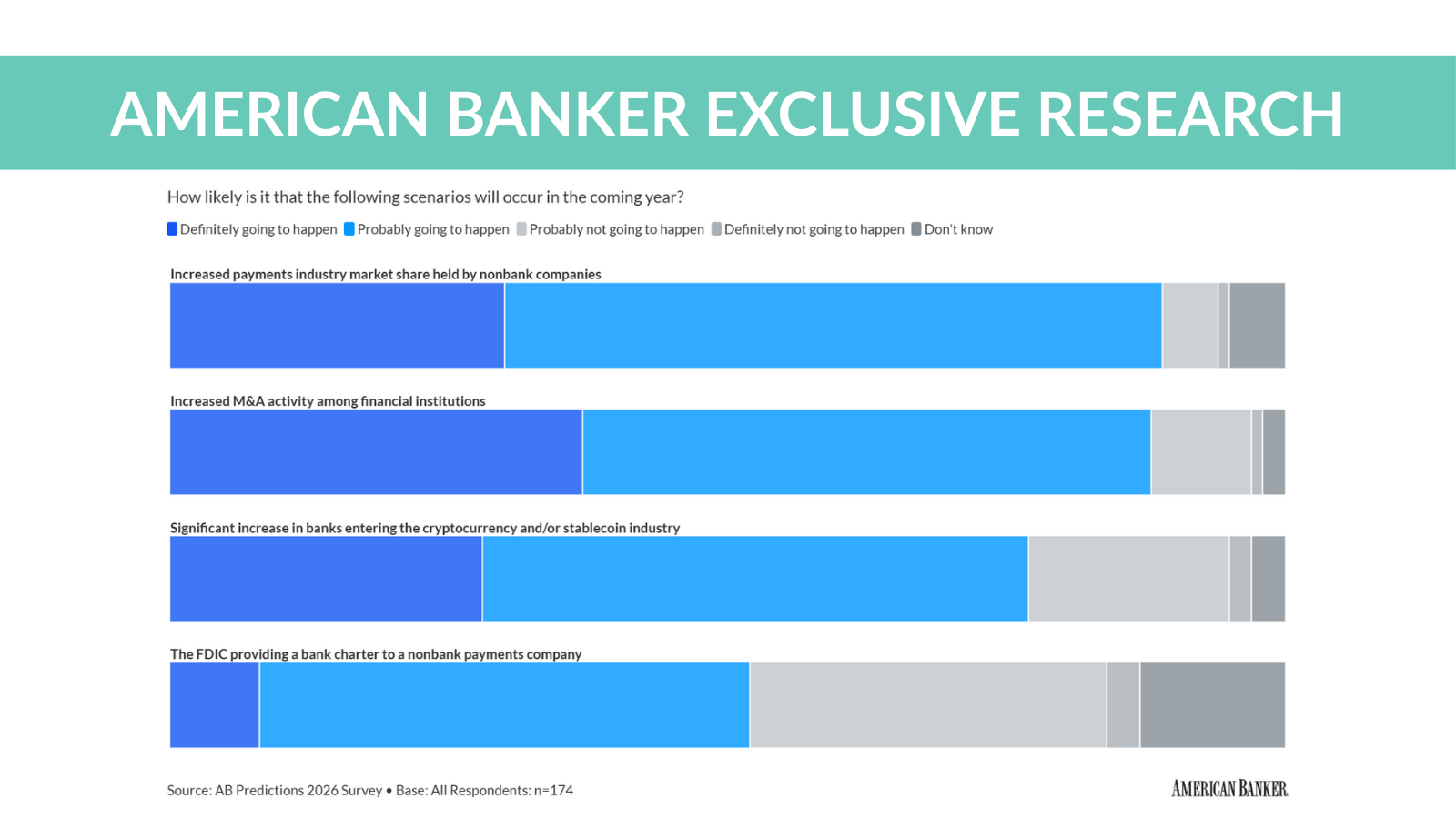
Executives surveyed by American Banker said companies vying to wrestle market share from banks are a major threat to operations in the coming year. View the full article
-
The day after French President Emmanuel Macron wore a pair of Henry Jullien Pacific S 01 aviator sunglasses during his speech at the World Economic Forum in Davos, Switzerland, the world wanted to know more about his eyewear. Search interest for Macron’s shiny, reflective sunglasses spiked Wednesday, and the French luxury eyewear brand’s website is down at time of writing. All it takes is one world leader sporting a ready-to-wear garment or accessory for a brand to get a global spotlight—and just maybe become a meme. Like interest in the Nike tracksuit Venezuelan President Nicolás Maduro was pictured wearing earlier this month after being seized by the U.S., interest in Macron’s shades is just the latest example of a newsmaker driving attention to a piece of fashion, and parlaying a news item into an internet meme. Before you could buy a “Make America Great Again” hat on President Donald The President’s website, he wore one himself. Watch the news and shop the look. Macron’s shades, which cost 659 euros, or $770, weren’t worn primarily as a fashion statement, though, but to prevent something more unsightly, according to the explanation from his office. Macron’s office told Reuters he wore the sunglasses because of a burst blood vessel in his eye, and he was indeed spotted last week with one bloodshot eye. While Macron’s sunglasses hid his eye, they also had the added benefit of sending a visual message that accompanied the contents of his speech. Macron called out U.S. tariffs during his address and urged “more stability” in the world and respect over bullying while wearing a more-than-a-century-old French luxury brand. Online, some people thought Macron’s sunglasses looked cool, while The President mocked him. “I watched him yesterday with those beautiful sunglasses. What the hell happened?” The President remarked during his Wednesday address in Davos. But if Macron hadn’t have worn the sunglasses, everyone would be talking about his red eye. Instead they’re talking about his expensive aviators. The sunglasses drew attention to Macron’s speech, but they also made him look like a French Top Gun at a moment when he needed to communicate he meant business. They also recalled former President Joe Biden at a time when the West feels unmoored as the U.S. shrinks from its post-World War II leadership under The President. This wasn’t the type of speech one could wear Oakleys to. Macron chose the sunglasses for an important speech just right. View the full article

-
The The President administration is dropping its appeal of a federal court ruling that blocked a campaign against diversity, equity, and inclusion threatening federal funding to the nation’s schools and colleges. The Education Department, in a court filing Wednesday, moved to dismiss its appeal. It leaves in place a federal judge’s August decision finding that the anti-DEI effort violated the First Amendment and federal procedural rules. The dispute centered on federal guidance telling schools and colleges they would lose federal money if they kept a wide range of practices that the Republican administration labeled as diversity, equity, and inclusion. The department did not immediately comment. Democracy Forward, a legal advocacy firm representing the plaintiffs, said the dismissal was “a welcome relief and a meaningful win for public education.” “Today’s dismissal confirms what the data shows: government attorneys are having an increasingly difficult time defending the lawlessness of the president and his cabinet,” said Skye Perryman, the group’s president and CEO. The department sent the anti-DEI warning in a “Dear Colleague Letter” to schools last February. The memo said race could not be considered in decisions involving college admissions, hiring, scholarships and “all other aspects of student, academic, and campus life.” It said efforts to increase diversity had led to discrimination against white and Asian American students. The department later asked K-12 schools to certify they did not practice DEI, again threatening to cut federal funding. Both documents were struck down by U.S. District Judge Stephanie Gallagher in Maryland. In her ruling, she said the guidance stifled teachers’ free speech, “causing millions of educators to reasonably fear that their lawful, and even beneficial, speech might cause them or their schools to be punished.” The challenge was filed by the American Federation of Teachers. ___ The Associated Press’ education coverage receives financial support from multiple private foundations. AP is solely responsible for all content. Find AP’s standards for working with philanthropies, a list of supporters and funded coverage areas at AP.org. —Collin Binkley, AP education writer View the full article

-
In an era where email overload is the norm, Google is stepping up its game with the introduction of AI-powered features in Gmail that could reshape how small businesses manage communication. With 3 billion users already relying on Gmail, the tech giant is making significant improvements that promise to enhance productivity and streamline information retrieval. The latest innovation, dubbed the Gemini era, introduces features designed to transform Gmail into a proactive inbox assistant. Small business owners, often swamped with a multitude of emails, can expect to experience substantial benefits from this update. One of the standout enhancements is the AI Overviews feature. Traditionally, finding critical information within a barrage of emails can feel like searching for a needle in a haystack. AI Overviews aim to change this by summarizing lengthy email threads into concise snippets, allowing users to quickly grasp key points without sifting through countless replies. For example, if a business owner receives an email chain with multiple responses about a supplier negotiation, AI Overviews would distill that conversation into digestible highlights. “Your inbox is full of important information, but accessing it has required you to become a power searcher,” said a Google representative. With AI Overviews, Gmail customers can convert complex email discussions into straightforward summaries, transforming the time-consuming process of email management into a more efficient experience. Another game-changing aspect of Gemini is the ability to ask questions directly within Gmail using natural language. Suppose a small business owner wants to retrieve past email correspondence regarding a quote for a bathroom renovation. Rather than scrolling through every email from the past year, they can simply ask, “Who was the plumber that gave me a quote for the bathroom renovation last year?” The Gemini AI taps into the email database, synthesizing the relevant details and providing an instant answer—saving precious time that could be better spent on running the business. These improvements are set to roll out at no cost for users who want to utilize the AI Overview conversation summaries. However, the ability to pose questions directly to the inbox will only be available for Google AI Pro and Ultra subscribers, prompting small businesses to consider the potential benefits of upgrading their plans. For many small business owners, efficiency can mean the difference between staying competitive and falling behind. With the influx of customers relying on their emails for everything from project updates to vendor communications, these new features can significantly improve workflow. Imagine a scenario where a small business team can conclusively address client inquiries without lengthy back-and-forth exchanges—this could lead to faster response times and better client satisfaction. However, as with any new technology, potential challenges remain. While these AI features promise higher productivity, some business owners might have concerns about data privacy and how their information is utilized. Trusting AI to handle sensitive customer interactions may require careful consideration, especially in industries where confidentiality is paramount. Moreover, while the AI enhancements promise significant efficiency, the transition might require some initial adjustment. Employees must adapt to new workflows that include these AI capabilities, and there may be a learning curve associated with leveraging these tools effectively. Ensuring that team members are trained in using the new features will be crucial to maximizing their benefits. Nonetheless, the evolution of Gmail into a more intelligent communication tool presents remarkable opportunities for small business owners to enhance their operational efficiency. By embracing these AI improvements, businesses can look forward to a less cluttered inbox and a more organized approach to managing customer relationships. As the email landscape continues to evolve, small business owners are encouraged to stay informed and perhaps consider leveraging these new tools to navigate the complexities of their communication challenges. For further details about Gmail’s new features, you can read the full announcement on Google’s blog here. Image via Google Gemini This article, "Gmail Transforms into Proactive Inbox Assistant with AI Overviews" was first published on Small Business Trends View the full article
-
A workout habit has a way of building momentum: Once you’re doing something, anything, it’s easy to build on that. Video workouts are a simple way to get started, but if you're having trouble following along, I'm here to help. Below are some ways to make common exercises more accessible, and what to do if you can't get through a whole video yet. If you can’t squatLots of “easy” bodyweight programs ask you to perform a squatting motion without any added weight. But if that’s already more than you can do, try one of these instead: Sit in a chair, and stand back up. Lean your back against a wall and slide down until you’re in a sitting position (this is called a wall squat). Hold onto a countertop or the back of a chair while you do a squat. For any of these, it’s okay to squat as low as you can, even if that’s not all the way to parallel. You can work on going lower over time. If you can’t do pushupsPushups are another move you’ll find in simple beginner workouts, but not everyone can do a pushup on their first day. Pushups get easier the higher your hands are, and harder the higher your feet are. So for the easiest beginner version, put your hands on a wall around shoulder height. Lean into the wall, then push yourself back to a standing position. Once those become easy, choose a lower surface, like a table or countertop. Then move to a chair, and so on. This progression is arguably better than doing pushups on your knees, because no matter which level you’re on, you are practicing holding your entire body straight in a plank position. If you aren’t ready to pick up weightsDumbbells come in all sizes—and fortunately for beginners, the smallest ones are also the cheapest. If your gym doesn’t have dumbbells small enough, any store with a sporting goods section will likely have some one- and two-pound dumbbells you can pick up and add to your gym bag. But if you’re not even ready for dumbbells, that’s okay. A half-liter water bottle weighs about a pound. Same with a can of soup. Larger water bottles, wine bottles, and milk jugs can take you up a bit further in weight; we did the math for you here. You can also hold books, roller skates, or tote bags full of literally anything. (Two water bottles in a grocery bag? That’s a two-pound weight.) Need to start even lighter? It’s okay to do weight workouts using literally nothing. Make your hands into fists and go through the motions. If you’re following a video that does a million reps of bicep curls or tricep extensions, your arms will get tired even if they’re empty. Just move up to the water bottles as soon as you’re ready. If you can't keep up with the pace of the videoWith these substitutions, you may feel ready to start following along with beginner level workout videos. But what if you can’t handle exactly what’s on the screen? Remember, your goal should be to do a workout at your current level of fitness, not to complete a certain number of reps that you theoretically could do if you were in better shape. So if the video asks for 30 seconds of pushups but you can only manage a few reps, do as many as you can and rest for the remainder of the time. It’s fine to bounce from video to video until you find something at your level. Keep an eye out for one that seems like fun but is just out of your reach. Do it anyway, modifying it or resting as needed, and then bookmark it and come back to it next week. Chances are good you’ll be able to keep up a little bit better—and if you keep coming back to that same workout week after week, you’ll eventually master it. Consistency breeds momentum. If cycling workouts are too hardLet’s say you want to do a workout from a Peloton-like cycling instructor. You’ve got your bike, you can pedal, but pretty quickly you’re out of breath and feel like you can’t keep going. These workouts are easy to adjust: All you have to do is pay attention to the instructor’s voice and facial expressions and ignore any specific numbers. It doesn’t matter if she’s asking you for a “20” or a “50.” If the instructor looks and talks like she’s on an easy bike ride, adjust your resistance so you are on an easy bike ride. If she looks like she’s working hard but not dying, adjust your resistance so you are working hard but not dying. If you can’t decide where to startStart literally anywhere. There isn’t a wrong answer. Maybe you start doing cardio dance videos, but it turns out you hate dancing. Well, you’re already moving your body a couple times a week, so you can swap out the dancing for something else. Or maybe you start doing pushups every day, but after a while your wrists are aching. You can choose to address that problem and continue your pushups, or you can look back on how far you’ve come, congratulate yourself, and pick a different thing to try for the next chapter of your fitness journey. After all, you’ve already started, so why not keep going? View the full article
-
Some years we talked about people who get weirdly competitive at work, and I’ve been sitting on this great collections of stories ever since, so here it is! 1. The game of tag It was a company team-building event, they made us play tag. Some senior directors got so into it they ran FACE FIRST into a wall. And cringily after that, ANOTHER senior director actually went and tagged the poor man while he was nearly unconscious on the floor. I remember nothing about my very temporary work there, but would probably never forget that game of tag. 2. The raffle disappointment At Christmas, we used to draw names out of a hat for small prizes. Soaps, $5 gift cards, small crafts, etc. One year an employee was very angry she did not get anything, to the point where she made a formal complaint to HR (?) that the game was rigged to give away prizes to a clique of people on the party-planning committee (?!!). Fast forward a year: as we draw the last name out, she stands up and yells, “Bull#$%@! How did I not win?” She stormed out of the event location and left in her car. Later someone said they had seen her messing with the hat before the drawing. We looked through the names and she had put her name in 10 times. 3. The Slack leaderboard Slack has this thing where it shows the people who send the most messages for the past 30 days. Someone thought it was funny and showed the Slack leaderboard on a slide during a meeting and we all had a good laugh about how everyone’s favorite Project Manager, Barney, sent the most messages BY FAR the past 30 days, because of course! Everyone pings him constantly and he’s super on top of responding. Yay Barney! In second place for number of messages sent was Robin, who works in marketing. And this slide lit the fire of competition under Robin, who desperately wanted to be #1 in a competition NOBODY ELSE thought was a competition. She said, “I’ll take the #1 spot,” everyone had a good laugh thinking she was joking. She was not joking. However, Robin doesn’t naturally send as many messages as Barney (her job simply doesn’t call for as much internal communication via Slack). So, for the next couple months, we were all treated to Robin sharing the Slack leaderboard in a shared channel as her message count crept up. And, because Slack counts number of messages sent, rather than word count, those of us who communicated with Robin regularly would get Slack correspondence like this (each line is its own message): Hi Question for you for TPS report can you send me your stuff early? for review? and then I’ll add on. want to make sure we are aligned. and not doing double work. thanks :) I’d return to my desk and see 40 missed Slacks, think there was an emergency, and see it was only Robin trying to pad her Slack count. After a couple months, she gave it up on her own because nobody engaged her. 4. The cornhole trophy My old boss flipped his lid when his team lost in my company’s March Madness cornhole tourney finals. Like flipped the boards and everything. He even tried to ban the winning team from displaying the trophy (a red solo cup glued to a trophy base) on top of the cube wall even though they were in our division but not on his team. He’s now second in command of the division. The winners were forced out. 5. The shove There was a game of musical chairs at someone’s goodbye party. The guest of honor (who’d already received some generous gifts) was determined to win the cheap, silly prize. They shoved one of their colleagues out of the way so hard that she bruised her hip bones from the fall! 6. The darts A few years ago we had a official but voluntary work gathering at a local bar; this bar had a few dart boards and people were playing casual games of darts mostly as a thing to do while talking. Nobody was trying very hard, there were no stakes at all, and we were barely even keeping score since people kept drifting in and out of the games anyway. It turns out one of the guys on a team that “lost” at darts was a hyper-competitive former college athlete who spent the whole evening seething with rage at his disgraceful failure to be #1 in everything always. He stormed away from the darts area and spent the rest of the event telling anybody who would listen that he only lost because the bar’s darts were in bad condition and his teammates weren’t using proper throwing form. If he had just shrugged after the game and gone on with his life I don’t think anybody would have even really noticed that he “lost.” Certainly, nobody would have cared or remembered it five minutes later. Instead he drew so much attention to it that everybody knew that he was the guy who lost at darts. 7. The scavenger hunt We had a scavenger hunt style competition at my office one summer. We took the whole afternoon, split into teams, and had to complete tasks. It was great fun! One of my coworkers on a different team than mine got SUPER competitive. His team came in last, and he spent the next week trying to prove that the order his team had needed to complete the tasks in had put them at a time disadvantage. He wrote a program to show that they’d had to walk farther. The funniest part was that the differences wound up being minuscule so even his “proof” fell through. The prize was a free lunch. 8. Paul I worked as HR for a startup that had a yearly softball game against another local startup. The owners of both companies had gone to university together and were pretty friendly. It was generally pretty fun and low stakes: the company that lost had to foot the bill for post-game drinks for everyone, but that was it. However, the CTO of our company was insanely competitive and would stack our team every year (to the point of bribing some of our more athletic employees to participate with his own money). We had one employee who reported to the CTO and was an insanely good pitcher and acted as a bit of a ringer. This guy, we’ll call him Paul, was also a bit of a hot head. Two weeks before one of these games, Paul gets fed up with someone on another team, aggressively shouts them out in front of everyone in the entire company and rage quits while we’re in the middle of trying to fire him. Well, game day rolls around and who is waiting on the field for us, but Paul. The owner and I immediately go over to tell him he has to leave (also to question what the actual fuck he thought he was doing there) and he tells us that the CTO had called him right after he quit and told him he still needed to come and play. After we finally got Paul to leave, the owner and I had to have a long talk with the CTO about appropriate workplace relationships. I left the company pretty soon after, but I think the CTO was banned from participating after that. 9. The decorating contest I was a government contractor at a government agency. One year, the social committee decided to have a decorating contest for Halloween. The rules said “cubes, office areas, common spaces, and conference rooms” were allowed, and the prizes were $5 gift cards for the top 5 people. My friend and I got the okay from the head of our department to decorate our department’s conference room with other people as a team bonding activity. Our department heads gave us some money for decorations, people brought stuff from home, it was great! We went all out and it was a lot of fun. Everyone LOVED the conference room and my team won the prize. Then the fall-out for the Christmas (well, winter holiday) decorations. Apparently, people that had decorated their cubes thought it was unfair that we won with a conference room. So the social committee made a team category and a single participant category. People had also complained about our team being too big and re-wrote the team rules. For winter, my team also got SUPER competitive. Other teams formed to decorate competing conference rooms apparently not for fun but so we wouldn’t win again. My team even started talking about sabotaging another team. Someone from our team bought in baked goods and set up his laptop in the conference room to make people vote for us for a treat. I kept saying over and over, “The prize is a $5 gift card.” I just kept getting told, “It’s not about the prize, it’s about the win” and “Why would you enter a contest you don’t want to win?” I almost got kicked off my own team but they decided against it since I bought the decorations with our director money and did most of the decorating. We ended up winning the $5 gift cards and there were a few decorated conference rooms, so I guess it turned out well in the end. 10. The hot sauce eating competition For our Oktoberfest party one year, someone decided we would have a hot-sauce eating competition. Completely optional (thank goodness, I can’t eat spice). So we start with a big group and mild hot sauce and it goes from there, not milk or water allowed, tap out at any time. There was a single gift card ($50?) as the prize. So people tapping out left and right, red faced but laughing. Everyone’s having a good time. Until it’s down to two people and the final hot sauce, some pure capsaicin thing that has an honest-to-god warning label on it. The last two people (a guy and a gal, but mid-career) take their toothpick drop of this stuff. And neither quits. Uh, now what? Two drops. Neither quits. The guy running the competition is looking worried because the bottle says not to eat more than three drops in a day. Normal people would say “yay, a tie!” But there’s only one gift card. So one of the bosses keeps urging them on. About half the audience is expressing concern for the competitor’s health (though they both look cool as cucumbers). Finally someone starts literally passing a hat to get enough money to count up to a second gift card. A more senior person strolls through, looks at the whole tableaux and says, “I’ll get you another gift card tomorrow” to stop the carnage. One competitor threw up in the bushes on his way to the bus. The other was up all night with GI distress. And that was the last hot sauce eating competition. 11. The doily A few years ago, our department banded together with a few others in the building to host a silent auction to benefit the local food bank. Each item had a sheet next to it starting with a 10 cent bid, and people could keep upping the bid on the sheet if they wanted that item. Note: most were going for somewhere between $1-15, so we’re not talking huge sums of money. One coworker, who has very serious anger issues anyways, had made it ridiculously clear she wanted this (rather hideous) doily. She literally stood over the doily and glared at anyone who dared to look at it. As a joke, when angry coworker left for a few minutes, someone went over and put her name down for the doily and upped the bid to a whopping $1. When said angry coworker came back and saw someone had added a new bid, she completely lost it. LOST IT. She started screaming at the top of her lungs about how “this is HERS!! and HOW DARE someone put in another bid.” She then escalated to physically pummeling the coworker on her shoulder and back. Repeatedly. In front of multiple departments (30 people?). Angry coworker was physically escorted out. We have not had anything remotely competitive here ever since. And I’ve often wondered what happened to the doily, but am too chicken to ask. 12. The canned food drive I used to teach at a high school that did a canned food drive around Christmas every year. The homeroom class with the most canned goods donated would get donuts one morning from the principal. One very competitive colleague taught AP Calculus first period, so his homeroom was much smaller than required classes like, say, PE or English. He complained to anyone who would listen about how unfair it was, he tried to get the drive changed to another class period (what kids want to carry canned goods in their backpack until third period?), and he even offered extra points to his students to bring in canned goods until the principal shut that down because it’s considered grade inflation in my state to give points for non-academic activities. We thought he’d let it go after it was over, but the next year he asked for his AP Cal class to be moved to another period so it wouldn’t happen again. 13. The fake money I had to attend a “leadership retreat” for work that included some competitive “survival games.” We were split into teams, and our teams would be able to win “money” (fake leadership dollars) for different events. I think the goal was to have a certain amount of “money” by the end of the retreat in order to win. Our CEO was on my team, and was very competitive, as were a few other team members. One of the ways we could save our “money” was by skipping breakfast (because in this world, food and coffee cost money). I watched in dismay as the CEO and other coworkers got on board with this idea, which meant no breakfast for us (after a night of sleeping on the ground, by the way, because camping was a part of this thing), and another full day of physically demanding “leadership building activities.” My coworker and I were pretty pissed but we didn’t say anything. Later that day my coworker and I bribed the retreat staff with some of the “money” to get us a box of triscuits so we could at least eat something. I just wanted to shout “you know this ISN’T REAL, right??? It’s FAKE MONEY!” 14. The bakeoff Our department hosted a dessert bakeoff to coincide with our winter holiday luncheon. My BFF coworker and I had been doing this about ten 10 when Lonnie (auxiliary) started working in our department. He is “that guy.” You know the one. He thinks he knows everything and will tell you all about how he does know everything even though you didn’t ask because well … he knows everything. Bragged about how he would be staff within a year (which never happens) and wouldn’t you know? He’s still an auxiliary. But back to the bakeoff. BFF and I prepare the tables, appoint the impartial judges from other facilities, print the score sheets, and get ready to go. Prizes include bakeware, baking mixes, utensils, etc. No cash or gift cards because my BFF and I pay for this with our own money. (I’m a couponer and we work for the state. There are no funds for prizes.) We have about 30 entries, including Lonnie. I cannot remember what he made, but regardless of the entries or who we get to judge, it seems like a cheesecake always wins. He did not make cheesecake. My duty after the judging began was to gather score cards and tabulate them in an Excel spreadsheet –— let the computer do all the work. Once the winners were announced, he cornered me, a heavily pregnant, slow-to-escape woman, and asked why he didn’t win. I told him that I didn’t know why, but I could tell him what place he received – 9th. After the luncheon, he came by my office, threw his empty bowl at me — a non-judge who had nothing to do with the actual scoring of the desserts — and screamed, “Does that look like 9th place to you?!?” I was so shocked that I just sat there. He grabbed the bowl and left. I can neither confirm nor deny that his dessert has never and will never win a bakeoff. 15. The escape room Several years ago, my friend planned a team builder for her group (one director, four managers, ~20 individual contributors). She and her planning team decided on an escape room. They had several rooms and mixed ICs across teams and put all the managers and director together. All the IC rooms finished early and huddled around the manager room to listen to them struggle and all try to lead each other. It is still one of her favorite memories at work. The post the cornhole trophy, the Slack leaderboard, and other times people got way too competitive at work appeared first on Ask a Manager. View the full article
-
The Supreme Court Wednesday appeared skeptical of the Justice Department's argument that removal of a Federal Reserve governor is unreviewable or that the president's preference for Fed governors outweighs the harm to the Fed from curbing the central bank's political independence. View the full article

-
Accountants show renewed pricing power as rates gain 5.7%. By CPA Trendlines Go PRO for members-only access to more CPA Trendlines Research. View the full article
-
Accountants show renewed pricing power as rates gain 5.7%. By CPA Trendlines Go PRO for members-only access to more CPA Trendlines Research. View the full article
-
If you’re looking to improve your social media engagement, it’s crucial to implement effective strategies. Start by setting clear goals and identifying metrics to measure success. Knowing your audience’s demographics allows you to create customized content that resonates. Consistent posting and active engagement with your followers can greatly boost interactions. Additionally, utilizing hashtags and analyzing performance will help refine your approach. Now, let’s explore each of these strategies in detail to maximize your impact. Key Takeaways Set SMART goals and track key metrics to measure engagement improvements effectively. Understand your audience’s demographics and preferences to create tailored content. Focus on high-quality visuals and storytelling to enhance emotional connections with followers. Post consistently at optimal times to maximize visibility and engagement rates. Actively engage with your audience by responding promptly and encouraging discussions. Set Clear Goals and Define Metrics To effectively improve your social media engagement, it’s essential to set clear goals and define measurable metrics. Establishing SMART goals—Specific, Measurable, Achievable, Relevant, and Time-bound—creates a roadmap for success. For instance, aim for a 15% increase in Instagram engagement within three months. Define key metrics like engagement rate, reach versus impressions, and follower growth rate to evaluate your performance effectively. Utilizing tools such as Hootsuite or Sprout Social can streamline measurement, offering insights across platforms. Regularly revisiting these goals allows you to adjust strategies based on performance data. Analyzing campaign results against your established metrics helps identify strengths and weaknesses, guiding your future social media engagement strategy and showing you how to boost social media engagement efficiently. Know Your Audience Knowing your audience is essential for creating effective social media content that resonates. Comprehending demographics like age, location, and interests helps you tailor your content. With 90% of Facebook users and 82% of Instagram users engaging regularly, it’s imperative to utilize analytics tools such as Google Analytics to gather insights about audience behavior. This data can inform your content strategies. Crafting messages that align with audience interests is key; 80% of consumers prefer Gen Z brands that recognize their needs. Incorporating contemporary language and trends, especially for demographics like Gen Z, improves relatability. Finally, engage in social listening to monitor conversations, as 70% of consumers expect personalized experiences from brands that know their preferences. Create Engaging and High-Quality Content To create engaging and high-quality content, you need to focus on visual appeal and storytelling. Posts that are visually striking can greatly increase interaction rates, whereas compelling narratives cultivate emotional connections with your audience. Visual Appeal Matters Visual appeal plays a crucial role in social media engagement, making high-quality content a necessity for any effective online strategy. High-quality visuals can lead to an 85% interaction rate on Facebook, emphasizing the need for compelling images and graphics. Posts that include visuals are 94% more likely to be shared, showcasing the strength of visual content in enhancing engagement. Furthermore, platforms like Instagram prioritize visually appealing content, with 80% of users stating that visual content influences their purchasing decisions. Consistent branding in your visuals, such as color schemes and logos, not only boosts recognition but also cultivates trust with your audience. Investing in high-quality visuals will greatly improve your social media presence and user interaction. Storytelling Connects Emotionally During crafting compelling content, incorporating storytelling techniques can greatly augment your social media engagement. By sharing relatable narratives, you can cultivate emotional connections, with 55% of consumers more likely to engage with brands that do so. Posts with storytelling can increase user engagement by up to 30%, capturing attention and encouraging shares. Personal stories or customer testimonials elevate authenticity, boosting trust by 22%. Emotional storytelling evokes feelings that drive action; 70% of people remember brand messages better when conveyed through stories. Brands effectively using storytelling witness a 63% increase in engagement metrics. Metric Impact Percentage Increase User Engagement Attention Capture Up to 30% Trust and Loyalty Authenticity Boost 22% Brand Message Recall Memory Elevation 70% Overall Engagement Metrics Increased Interaction 63% Consumer Engagement Relatable Narratives 55% Post Consistently and at Optimal Times To boost your social media engagement, it’s crucial to maintain a regular posting schedule. By analyzing your audience’s activity, you can identify the best times to post, leading to increased visibility and interaction. Consistency not just helps in building anticipation among your followers, but it additionally improves overall loyalty to your brand. Regular Posting Schedule Establishing a regular posting schedule is crucial for enhancing audience engagement, as it keeps your brand consistently in the minds of your followers. Brands that post consistently can see a significant increase in follower interactions, with studies showing up to a 67% boost. To achieve ideal engagement, aim to post at least 3-5 times a week, as this frequency can lead to a 21% increase in audience engagement. Utilizing social media management tools like Buffer or Hootsuite can streamline your posting process, allowing for effective scheduling without overwhelming your audience. Consistency not just builds anticipation but also nurtures a recognizable brand presence, in the end enhancing trust and loyalty among your followers. Analyze Audience Activity Comprehending your audience’s activity is key to maximizing your social media engagement. By identifying peak times when your followers are most active, you can schedule posts for ideal visibility. For instance, studies show that Instagram posts perform best between 11 AM and 1 PM on weekdays, aligning with many users’ lunch breaks. On Facebook, engagement typically peaks on Thursdays and Fridays, whereas weekends often see increased interactions on Twitter and Instagram. To improve your strategy, consider using social media management tools like Buffer or Hootsuite, which automate posting during these ideal times. Consistently posting 3-5 times per week likewise helps maintain audience engagement, ensuring your brand remains visible in followers’ feeds. Engage Actively With Your Audience Engaging actively with your audience is essential for building a strong online presence and nurturing brand loyalty. Responding quickly to comments and messages improves customer loyalty, with studies showing a 42% higher satisfaction rate for brands with swift responses. You can spark discussions by asking open-ended questions, which may lead to a 25% increase in comment interactions. Acknowledge your audience’s contributions by sharing user-generated content; this can increase engagement rates by up to 28%. Moreover, create opportunities for interaction through contests and giveaways, as these can boost engagement levels considerably, with some brands reporting a 60% increase. Regularly engaging with your followers’ content cultivates community, potentially leading to a 50% rise in brand loyalty among your audience. Utilize Hashtags and Trends After you’ve successfully engaged with your audience, the next step is to amplify your reach by utilizing hashtags and trends effectively. Researching relevant hashtags can considerably increase the discoverability of your posts; tweets with 1-2 hashtags see 21% more engagement than those with three or more. Participating in trending topics lets you connect with broader audiences, enhancing your engagement potential. Creating branded hashtags encourages user participation and nurtures community, which boosts content visibility. Nevertheless, it’s vital to monitor hashtag performance and refine your strategies based on what resonates most with your audience. Analyze and Adjust Your Strategies To effectively improve your social media presence, it is crucial to regularly analyze and adjust your strategies based on performance data. Start by tracking social media metrics to identify trends in audience engagement. Use tools like Hootsuite or Sprout Social to consolidate analytics across platforms, making it easier to evaluate engagement rates. Experiment with various content types and posting times, refining your approach based on previous insights. Generate monthly or quarterly reports to assess performance, spotlighting successful campaigns and areas needing improvement. Stay adaptable to changes in algorithms and audience preferences by monitoring industry trends. Strategy Type Adjustment Recommendation Content Variety Experiment with formats Posting Schedule Test different times Engagement Metrics Focus on high-performing posts Trends Monitoring Stay updated on changes Frequently Asked Questions What Is the 5 5 5 Rule on Social Media? The 5 5 5 Rule on social media suggests you share a balanced mix of content. For every five posts you create, five should be curated from others, and five should encourage interaction, like polls or questions. This strategy helps you avoid being overly promotional, nurturing a more engaging and authentic presence. How to Boost Engagement on Social Media? To boost engagement on social media, focus on comprehending your audience’s interests and demographics. Use high-quality visuals and storytelling to capture attention, as compelling images can greatly improve interaction. Incorporate interactive elements like polls and contests to encourage participation. Maintain a consistent posting schedule and analyze activity for best times. Furthermore, encourage user-generated content through branded hashtags, building a community and strengthening your brand’s credibility and connection with followers. What Is the 50/30/20 Rule for Social Media? The 50/30/20 rule for social media divides your content into three categories: 50% should be informative and valuable, 30% promotional, and 20% personal or entertaining. This balance helps maintain audience interest and prevents fatigue from excessive promotions. By focusing on what your audience needs and enjoys, you can improve engagement and loyalty. Implementing this rule aids in effective content planning, allowing you to allocate resources wisely for a diverse range of posts. What Is the 70/20/10 Rule in Social Media? The 70/20/10 rule in social media marketing emphasizes a balanced content strategy. You should create 70% original and relevant content that provides value to your audience. Then, curate 20% from other sources, sharing insights that promote community engagement. Finally, reserve 10% for promotional posts that directly advertise your products or services. Conclusion By implementing these strategies, you can effectively boost your social media engagement. Setting clear goals helps track progress, whereas knowing your audience allows for customized content. Consistent posting and active engagement nurture community, and utilizing hashtags can expand your reach. Regularly analyzing your performance guarantees you adapt strategies based on what works. By following these tips, you’ll create a more dynamic and engaging social media presence, finally achieving your desired engagement targets. Image via Google Gemini This article, "7 Tips to Boost Social Media Engagement" was first published on Small Business Trends View the full article
-
If you’re looking to improve your social media engagement, it’s crucial to implement effective strategies. Start by setting clear goals and identifying metrics to measure success. Knowing your audience’s demographics allows you to create customized content that resonates. Consistent posting and active engagement with your followers can greatly boost interactions. Additionally, utilizing hashtags and analyzing performance will help refine your approach. Now, let’s explore each of these strategies in detail to maximize your impact. Key Takeaways Set SMART goals and track key metrics to measure engagement improvements effectively. Understand your audience’s demographics and preferences to create tailored content. Focus on high-quality visuals and storytelling to enhance emotional connections with followers. Post consistently at optimal times to maximize visibility and engagement rates. Actively engage with your audience by responding promptly and encouraging discussions. Set Clear Goals and Define Metrics To effectively improve your social media engagement, it’s essential to set clear goals and define measurable metrics. Establishing SMART goals—Specific, Measurable, Achievable, Relevant, and Time-bound—creates a roadmap for success. For instance, aim for a 15% increase in Instagram engagement within three months. Define key metrics like engagement rate, reach versus impressions, and follower growth rate to evaluate your performance effectively. Utilizing tools such as Hootsuite or Sprout Social can streamline measurement, offering insights across platforms. Regularly revisiting these goals allows you to adjust strategies based on performance data. Analyzing campaign results against your established metrics helps identify strengths and weaknesses, guiding your future social media engagement strategy and showing you how to boost social media engagement efficiently. Know Your Audience Knowing your audience is essential for creating effective social media content that resonates. Comprehending demographics like age, location, and interests helps you tailor your content. With 90% of Facebook users and 82% of Instagram users engaging regularly, it’s imperative to utilize analytics tools such as Google Analytics to gather insights about audience behavior. This data can inform your content strategies. Crafting messages that align with audience interests is key; 80% of consumers prefer Gen Z brands that recognize their needs. Incorporating contemporary language and trends, especially for demographics like Gen Z, improves relatability. Finally, engage in social listening to monitor conversations, as 70% of consumers expect personalized experiences from brands that know their preferences. Create Engaging and High-Quality Content To create engaging and high-quality content, you need to focus on visual appeal and storytelling. Posts that are visually striking can greatly increase interaction rates, whereas compelling narratives cultivate emotional connections with your audience. Visual Appeal Matters Visual appeal plays a crucial role in social media engagement, making high-quality content a necessity for any effective online strategy. High-quality visuals can lead to an 85% interaction rate on Facebook, emphasizing the need for compelling images and graphics. Posts that include visuals are 94% more likely to be shared, showcasing the strength of visual content in enhancing engagement. Furthermore, platforms like Instagram prioritize visually appealing content, with 80% of users stating that visual content influences their purchasing decisions. Consistent branding in your visuals, such as color schemes and logos, not only boosts recognition but also cultivates trust with your audience. Investing in high-quality visuals will greatly improve your social media presence and user interaction. Storytelling Connects Emotionally During crafting compelling content, incorporating storytelling techniques can greatly augment your social media engagement. By sharing relatable narratives, you can cultivate emotional connections, with 55% of consumers more likely to engage with brands that do so. Posts with storytelling can increase user engagement by up to 30%, capturing attention and encouraging shares. Personal stories or customer testimonials elevate authenticity, boosting trust by 22%. Emotional storytelling evokes feelings that drive action; 70% of people remember brand messages better when conveyed through stories. Brands effectively using storytelling witness a 63% increase in engagement metrics. Metric Impact Percentage Increase User Engagement Attention Capture Up to 30% Trust and Loyalty Authenticity Boost 22% Brand Message Recall Memory Elevation 70% Overall Engagement Metrics Increased Interaction 63% Consumer Engagement Relatable Narratives 55% Post Consistently and at Optimal Times To boost your social media engagement, it’s crucial to maintain a regular posting schedule. By analyzing your audience’s activity, you can identify the best times to post, leading to increased visibility and interaction. Consistency not just helps in building anticipation among your followers, but it additionally improves overall loyalty to your brand. Regular Posting Schedule Establishing a regular posting schedule is crucial for enhancing audience engagement, as it keeps your brand consistently in the minds of your followers. Brands that post consistently can see a significant increase in follower interactions, with studies showing up to a 67% boost. To achieve ideal engagement, aim to post at least 3-5 times a week, as this frequency can lead to a 21% increase in audience engagement. Utilizing social media management tools like Buffer or Hootsuite can streamline your posting process, allowing for effective scheduling without overwhelming your audience. Consistency not just builds anticipation but also nurtures a recognizable brand presence, in the end enhancing trust and loyalty among your followers. Analyze Audience Activity Comprehending your audience’s activity is key to maximizing your social media engagement. By identifying peak times when your followers are most active, you can schedule posts for ideal visibility. For instance, studies show that Instagram posts perform best between 11 AM and 1 PM on weekdays, aligning with many users’ lunch breaks. On Facebook, engagement typically peaks on Thursdays and Fridays, whereas weekends often see increased interactions on Twitter and Instagram. To improve your strategy, consider using social media management tools like Buffer or Hootsuite, which automate posting during these ideal times. Consistently posting 3-5 times per week likewise helps maintain audience engagement, ensuring your brand remains visible in followers’ feeds. Engage Actively With Your Audience Engaging actively with your audience is essential for building a strong online presence and nurturing brand loyalty. Responding quickly to comments and messages improves customer loyalty, with studies showing a 42% higher satisfaction rate for brands with swift responses. You can spark discussions by asking open-ended questions, which may lead to a 25% increase in comment interactions. Acknowledge your audience’s contributions by sharing user-generated content; this can increase engagement rates by up to 28%. Moreover, create opportunities for interaction through contests and giveaways, as these can boost engagement levels considerably, with some brands reporting a 60% increase. Regularly engaging with your followers’ content cultivates community, potentially leading to a 50% rise in brand loyalty among your audience. Utilize Hashtags and Trends After you’ve successfully engaged with your audience, the next step is to amplify your reach by utilizing hashtags and trends effectively. Researching relevant hashtags can considerably increase the discoverability of your posts; tweets with 1-2 hashtags see 21% more engagement than those with three or more. Participating in trending topics lets you connect with broader audiences, enhancing your engagement potential. Creating branded hashtags encourages user participation and nurtures community, which boosts content visibility. Nevertheless, it’s vital to monitor hashtag performance and refine your strategies based on what resonates most with your audience. Analyze and Adjust Your Strategies To effectively improve your social media presence, it is crucial to regularly analyze and adjust your strategies based on performance data. Start by tracking social media metrics to identify trends in audience engagement. Use tools like Hootsuite or Sprout Social to consolidate analytics across platforms, making it easier to evaluate engagement rates. Experiment with various content types and posting times, refining your approach based on previous insights. Generate monthly or quarterly reports to assess performance, spotlighting successful campaigns and areas needing improvement. Stay adaptable to changes in algorithms and audience preferences by monitoring industry trends. Strategy Type Adjustment Recommendation Content Variety Experiment with formats Posting Schedule Test different times Engagement Metrics Focus on high-performing posts Trends Monitoring Stay updated on changes Frequently Asked Questions What Is the 5 5 5 Rule on Social Media? The 5 5 5 Rule on social media suggests you share a balanced mix of content. For every five posts you create, five should be curated from others, and five should encourage interaction, like polls or questions. This strategy helps you avoid being overly promotional, nurturing a more engaging and authentic presence. How to Boost Engagement on Social Media? To boost engagement on social media, focus on comprehending your audience’s interests and demographics. Use high-quality visuals and storytelling to capture attention, as compelling images can greatly improve interaction. Incorporate interactive elements like polls and contests to encourage participation. Maintain a consistent posting schedule and analyze activity for best times. Furthermore, encourage user-generated content through branded hashtags, building a community and strengthening your brand’s credibility and connection with followers. What Is the 50/30/20 Rule for Social Media? The 50/30/20 rule for social media divides your content into three categories: 50% should be informative and valuable, 30% promotional, and 20% personal or entertaining. This balance helps maintain audience interest and prevents fatigue from excessive promotions. By focusing on what your audience needs and enjoys, you can improve engagement and loyalty. Implementing this rule aids in effective content planning, allowing you to allocate resources wisely for a diverse range of posts. What Is the 70/20/10 Rule in Social Media? The 70/20/10 rule in social media marketing emphasizes a balanced content strategy. You should create 70% original and relevant content that provides value to your audience. Then, curate 20% from other sources, sharing insights that promote community engagement. Finally, reserve 10% for promotional posts that directly advertise your products or services. Conclusion By implementing these strategies, you can effectively boost your social media engagement. Setting clear goals helps track progress, whereas knowing your audience allows for customized content. Consistent posting and active engagement nurture community, and utilizing hashtags can expand your reach. Regularly analyzing your performance guarantees you adapt strategies based on what works. By following these tips, you’ll create a more dynamic and engaging social media presence, finally achieving your desired engagement targets. Image via Google Gemini This article, "7 Tips to Boost Social Media Engagement" was first published on Small Business Trends View the full article
-
The funny thing about smartphone addiction is that it makes low-effort tasks feel totally productive. When I finally quit doomscrolling through Instagram and TikTok and watch an actual movie or TV show, I feel like I've just spent the afternoon studying physics. Platforms like Netflix, which could once be seen as time-wasting entertainment, now seem like antidotes to endless, useless scrolling. But Netflix doesn't seem to appreciate its new role. Instead, the company apparently sees short-form video apps—and smartphones themselves—as a direct threat to its business, and is jumping on the bandwagon. It's not only that Netflix is reportedly now making content with phone scrollers in mind, encouraging creators to craft dialogue that makes their shows and movies easy to understand even if you're not actually paying attention. No Netflix also wants to position its mobile app as an actual competitor to TikTok and Instagram, by introducing a short-form video feed directly within the app. Netflix's take on TikTok The company officially introduced its plans for short-form video during its fourth-quarter earnings call on Tuesday. Netflix co-CEO Greg Peters announced the company will roll out a new app later this year that will include its take on the vertical video feed. This isn't totally new, as the company has been experimenting with vertical video feeds since May. But it's the first time we've seen a larger announcement about how Netflix plans to integrate the short-form experience directly into its app. Unlike TikTok, Instagram, or YouTube, you won't hop on the Netflix app to find short-form videos from independent creators. Instead, Netflix will serve users clips from Netflix-distributed shows and movies in a scrollable TikTok-style feed. You might swipe through this feed and see clips from Stranger Things, Emily in Paris, or His & Hers. Many of us already waste our time watching clips from shows and movies on other platforms—often cropped, slowed down or sped up, in low-quality, and besieged by artifacts meant to throw off copyright claims. Netflix obviously won't need to do this, so I expect the experience will be filled with high-quality videos (depending on how you define "quality" of course). It won't just be TV shows and movies on the feed. Netflix also has big plans for its video podcasts, as evidenced by recent programs like The Pete Davidson Show and recent deals with Spotify and iHeartMedia to bring existing podcasts to its platform. Expect Netflix to sprinkle clips from these video podcasts into the short-form feed to create an experience that sounds not too far off from scrolling through other apps. How many clips you do see from video podcasts, TV shows, and movies on TikTok? As Netflix inches closer to acquiring Warner Bros., you might soon be seeing a lot of official short-form content in the Netflix app. If and when the acquisition closes, I wouldn't be surprised to see clips from HBO shows like A Knight of the Seven Kingdoms, The White Lotus, and Euphoria. Catering to the short attention spanI get the move from a business perspective: Netflix is likely losing subscribers' attention due to the addictive nature of vertical video apps. But do any of us really need another app to scroll through, especially when we're already paying for access to the full content to begin with? Maybe could be a helpful avenue to find new shows and movies to watch, but in all likelihood, it will just be be another addictive time-waster. I have too many of those in my life as it is. View the full article
-
The U.S. stock market is steadying following its worst day since October, though some signs of fear remain on Wall Street Wednesday about President Donald The President’s desire to take Greenland. The S&P 500 rose 0.6% after The President said in a speech before business and government leaders in Europe that he would not use force to take “the piece of ice.” The potential de-escalation in rhetoric, which had ramped up earlier with talk of tariffs crossing the Atlantic, helped the index recover some of its 2.1% drop from the day before and pull closer to its all-time high set earlier this month. The Dow Jones Industrial Average was up 336 points, or 0.7%, as of 11:45 a.m. Eastern time, and the Nasdaq composite was 0.5% higher. Treasury yields also eased in the bond market, a day after jumping in a potential signal of worries about higher inflation in the long term. They got help from a calming of bond yields in Japan, which surged earlier on concerns about the size of its government’s debt. The value of the U.S. dollar also held steadier against the euro, Swiss franc and other currencies after sliding the day before. But some nerves seemed to remain in the market, and the price of gold rose another 1.7% and topped $4,800 per ounce for the first time. The President himself acknowledged how his desire for Greenland led to Tuesday’s drop in the U.S. stock market, but he called it “peanuts compared to what it’s gone up” in the first year of his second term and said it would go up further in the future. While saying he would not use force to take Greenland, he called for “immediate negotiations” for the United States to acquire it from Denmark. The President has a history of making big threats that send financial markets sliding, only to pull back later and reach deals that are seen as less bad for the economy or for inflation than his initial suggestion. On one hand, the pattern has given rise to the “TACO” acronym suggesting “The President Always Chickens Out” if financial markets react strongly enough. On the other, has ultimately struck deals that outsiders may have earlier considered unlikely, ones that he’s crowed about later. The most obvious example is The President’s announcement of high tariffs on “Liberation Day,” which eventually led to trade deals with many of the world’s major economies. Helping to lead the U.S. stock market Wednesday was Halliburton, which rose 4.9% after the oilfield services company reported a stronger profit for the latest quarter than analysts expected. United Airlines climbed 2.9% after likewise reporting a better profit for the end of 2025 than expected. CEO Scott Kirby said that the airline’s strong momentum in revenue is continuing into 2026. They helped offset a 4.8% drop for Netflix. The streamer sank even though it reported a stronger profit than expected as investors focused instead on its slowing subscriber growth and its lower-than-expected forecast for profit in the current quarter. Kraft Heinz sank 5.4% after Berkshire Hathaway warned investors Tuesday that it may be interested in selling its 325 million shares in the food giant that former CEO Warren Buffett helped create in 2015. Berkshire took a $3.76 billion write-down on its Kraft-Heinz stake last summer. Buffett said last fall that he was disappointed in Kraft Heinz’ plan to split the company in two, and Berkshire’s two representatives resigned from the Kraft board last spring. In the bond market, the yield on the 10-year Treasury eased to 4.27% from 4.30% late Tuesday. But it’s still above the 4.24% level where it was at on Friday. That’s before The President threatened to impose 10% tariffs on Denmark, Norway, Sweden, Germany, France, the United Kingdom, the Netherlands and Finland beginning in February for opposing U.S. control of Greenland. That would be on top of a 15% tariff specified by a trade agreement with the European Union that has yet to be ratified. In stock markets abroad, indexes were mixed in mostly modest movements across Europe and Asia. Japan’s Nikkei 225 slipped 0.4%. The country’s prime minister, Sanae Takaichi, has called a snap election for Feb. 8, which had sent yields of long-term government bonds to record levels. The expectation is that Takaichi, who is capitalizing on strong public support ratings, will cut taxes and boost spending and increase the government’s already heavy load of debt. The yield on the 40-year Japanese government bond pulled back to 4.05% Wednesday, down from the 4.22% level that it had surged to on Tuesday. —Stan Choe, AP business writer AP Business Writers Chan Ho-him and Matt Ott contributed. View the full article

-
Nick LeRoy, a longtime SEO consultant, is turning his platform into a fundraising engine. He’s offering consulting in exchange for donations to Minnesota-based immigrant support efforts amid escalating ICE activity in the state. LeRoy said recent events in Minnesota crossed “every ethical line” he had drawn professionally, prompting him to act rather than comment from the sidelines. He announced the initiative yesterday on LinkedIn and in a blog post. What’s happening. LeRoy is trading his services for donations to GiveMN, a Minnesota-based fundraising platform that distributes funds to individuals and families impacted by recent ICE raids and related unrest. Within seven hours of launching, LeRoy reported $1,850 raised, later updating the total to $1,950. Support came from well-known SEO agencies, SaaS companies, and individual practitioners. Why we care. This effort highlights another side of the search marketing industry: we are a tightly knit community capable of mobilizing skills, attention, and resources for causes beyond search. LeRoy is willing to use his professional skills in the service of something larger. This is also another reminder of how quickly our community can mobilize for collective action. Catch up quick. The fundraiser is tied to outrage over Operation “Metro Surge,” a federal immigration enforcement action launched in December. The operation sent roughly 3,000 ICE and Border Patrol agents into the Twin Cities. LeRoy said the action has led to racial profiling, warrantless home entries, workplace detentions, and the fatal shooting of 37-year-old Renee Nicole Good in downtown Minneapolis. These events have triggered widespread protests. What he’s saying. As LeRoy put it: “This is NOT about politics. This is about treating all people as humans.” View the full article
-
An index of contract signings decreased 9.3% to 71.8 last month, according to data released Wednesday by the National Association of Realtors.

-
Labor unions, faith organizations, and local businesses in Minnesota are calling for a statewide “collective pause” this Friday—in which they urge residents not to go to work, school, or do any shopping—in protest of the The President administration’s aggressive deployment of Immigration and Customs Enforcement (ICE) agents in the Twin Cities and beyond. The action, called the “Day of Truth and Freedom,” is planned for January 23, and includes plans for a march in downtown Minneapolis at 2 p.m. Here’s what to know. What’s the situation with ICE in Minnesota? On January 6, the Department of Homeland Security announced it was deploying 2,000 officers to the Minneapolis area to conduct what it called the “largest immigration operation ever.” The next day, an ICE agent shot and killed Minneapolis resident Renee Nicole Good. Residents and officials, including Minneapolis Mayor Jacob Frey, called for ICE to leave the state immediately. Since then, the crackdown has only continued. ICE agents are reportedly conducting door-to-door raids. They have shown up at local schools, prompting districts to switch to remote learning, and have dragged workers out of a Target store and broke into a home to force a man who was wearing just shorts and Crocs outside into the freezing temperatures. What’s happening on the ‘Day of Truth and Freedom’? Minnesotans have been protesting this aggressive presence of ICE. Now, a collection of unions, faith groups, community organizations, and local businesses are calling on them to take collective action on Friday, January 23. “Working people, our schools and our communities are under attack,” Chelsie Glaubitz Gabiou, president of the Minneapolis Regional Labor Federation, AFL-CIO, said in a statement about her group’s support of the Day of Truth and Freedom. “Union members are being detained commuting to and from work, tearing apart families. Parents are being forced to stay home, students held out of school, fearing for their lives, all while the employer class remains silent,” she continued. “Our labor federations are encouraging everyone to participate on January 23rd. It’s time for every single Minnesotan who loves this state and the notion of truth and freedom to raise their voices and deepen their solidarity for our neighbors and coworkers living under this federal occupation.” Along with the Minneapolis Regional Labor Federation, AFL-CIO, and a slew of local businesses, labor groups including the Saint Paul Regional Labor Federation, the West Area Labor Council, the North East Area Labor Council, and the East Central Labor Council are in support of the statewide action. A group of faith leaders and clergy members have also come out in support of the action, announcing that places of worship across the state will participate, and demanding ICE leave Minnesota. “Silence in the face of oppression is not neutrality. It is permission,” one faith leader with the nonprofit Isaiah said in a recent press conference. “That is why on January 23 we are standing with more than 100 organizations across Minnesota.” What are the demands of the Minnesota anti-ICE economic blackout? Organizers of the economic blackout have created a list of demands from their action. They are calling for ICE to leave Minnesota; for the officer who killed Renee Good to be held legally accountable; for the upcoming Congressional budget to give no additional federal funding to ICE and for ICE to be investigated for human and Constitutional violations; and for Minnesota and national companies to cease their economic relations with ICE and refuse entry to ICE agents. A group of Minnesota businesses have announced that they will be closed January 23 for that anti-ICE action. That list includes local restaurants, bars, book stores, and more. Minneapolis is also home to a number of Fortune 500 companies who have been silent about the ICE raids in the state. When Fast Company reached out multiple times in the wake of Good’s killing to General Mills, Target, Best Buy, Cargill, UnitedHealth Group, 3M, and Land O’Lakes for comment, none of them responded. Those companies that have Minnesota retail locations do not appear on lists of businesses that plan to close for the one-day strike. The The President administration has not indicated so far that it will stop its immigration raids in Minnesota. After Minnesota leaders filed a lawsuit saying the crackdown was unconstitutional in an attempt to end it, the Department of Justice (DOJ) has asked a federal judge to reject that bid. The DOJ is also investigating a protest at a St. Paul church in which residents confronted a pastor who they say is the acting field director of the St. Paul ICE field office. And it has subpoenaed at least five Minnesota officials, including Governor Tim Walz and Mayor Frey, as part of an investigation into whether they have obstructed ICE efforts. View the full article

-
Headlines have been challenging in 2025. Companies are under attack publicly and privately for policies viewed as “too progressive” or “woke.” The reality, however, is that most companies have strongly reaffirmed their sustainability commitments but less so their DEI commitments. Corporate social responsibility (CSR) works in the grey area between the two. Many affirming companies have opted for “greenhushing,” staying quiet about their strategies and leadership. There are pros and cons to that, but why are companies staying true to their goals and strategies? A simple but powerful answer: long-term value creation. Those staying the course have built strategies that incorporate and harvest business value from their commitments. Innovation in integrating CSR and sustainability has not been strong over the last 10 years. That is a missed value creation opportunity. Sustainability and CSR trends have not gone away for the long haul; they have just gone quiet. Competition across companies and sectors will continue to seek support from customers, shareholders, and stakeholders whether companies are communicating it or not. TRADITIONAL CORPORATE PHILANTHROPY There are two primary models today: traditional corporate philanthropy and strategic corporate social responsibility. Both are important to maintain, but given the climate companies are working in today—with both shareholder pressure and government discontinuity in the policy environment—a value-creation model built on innovative win-win solutions could accelerate social progress aligned with business success. A great example of traditional corporate philanthropy is ExxonMobil. In public health, ExxonMobil made a long-term commitment to help eradicate malaria, making an impact through their collaborations and large philanthropic investments (exceeding $170 million over 25 years). This philanthropic, public health focus has largely been outward in its emphasis. While there are mentions of it starting from a concern that its African workforce had significant absences due to malaria, the efforts are not central to the oil and gas products company’s overall business strategy. We applaud their long-term commitment and hope it continues for the benefit of millions of people. STRATEGIC CORPORATE SOCIAL RESPONSIBILITY A timely example of strategic corporate social responsibility is Takeda Pharmaceuticals, a global R&D-driven biopharmaceutical company, headquartered in Japan. It has taken a different approach, innovating its commitments and implementation to drive company business success. Takeda has not approached CSR and sustainability as a “program,” but rather as a core strategy integrated strongly into all parts of the company: businesses, functions, and geographies. Takeda has a 240+-year company history, which is remarkable. Deeply embedded values at the heart of their longevity is “PTRB,” which stands for “patient, trust, reputation, and business.” In that order, if they meet patients’ needs, they gain trust and reputation. Then the business will follow. This principled, values-based approach goes back to Takeda’s founder and is kept alive today, integrated in ongoing corporate and business strategy, including CSR. The key difference between a philanthropic contribution and the strategic CSR approach is how Takeda brought PTRB to life in its CSR and sustainability strategy: innovating the intersection between climate and health. For example, Takeda developed vaccines to prevent Dengue fever, a mosquito-borne health risk and unmet medical need that is becoming more challenging with climate change. They focus on public health challenges stemming from climate change as a core part of their CSR strategy. Takeda innovated the “how” of its CSR implementation through a unique grant-making program. The public RFP is developed annually to create win-win opportunities that align with Takeda’s corporate purpose, focusing on transforming health outcomes by investing in climate–resilient health systems worldwide. Potential grantees make applications, which are first reviewed internally by Takeda employees. They look for proposals that are innovative, sustainable, and impactful for the grantee, the identified public health population, and Takeda. This is collaboration, not just check-writing. Then ALL Takeda employees can vote on which proposals to fund, typically for multiyear grants which extend the grantees’ impact across four to 10 years. This voting step has been critical in creating strong awareness within the company about Takeda’s sustainability and CSR focus, driving alignment and creating opportunities for each employee to align their personal purpose with where they want to make an impact. That is very rare. Awareness and employee alignment are critical to long-term company success. This is one area where Takeda has demonstrated innovation to drive results for the company and society. Takeda is not apologetic that their programs will create long-term business value. In fact, its leadership, from the board and executive team down to individual employees, makes this highly integrated approach work. This strategic CSR model is drawing attention. Side events at the 2025 United Nations General Assembly have been oversubscribed, garnering event replays and the attention of millions on social media. And recently Takeda received a distinguished award from the United Nations Association of Greater Boston (UNAGB). “Takeda’s commitment to global health, advocacy for inclusive and sustainable innovation, and leadership in shaping the future of biopharmaceuticals make the organization a deeply deserving recipient of our Global Citizenship Award,” wrote Caitlin Moore, UNAGB’s executive director. VALUE CREATION IN A CSR STRATEGY It is truly amazing what can be achieved when the focus is large scale and long term (ExxonMobil), but also when it is innovative with full strategic integration into business and corporate value creation strategies (Takeda). In these times, we believe that the strategic approach should be replicated and practiced to benefit companies, society, and the planet. A company’s value-creating CSR strategy will likely have the best chance to last and deliver value to shareholders and stakeholders. Barie Carmichael is senior counselor, Member International Advisory Council, at APCO Worldwide. Neil Hawkins is research advisor/graduate faculty at Harvard University Sustainability Masters Program. View the full article

-
We may earn a commission from links on this page. We're going back to Westeros, baby! Not that we ever really left, given that we're merely between seasons of that other Game of Thrones spin-off, and with several more allegedly in development. It seems the only place the Game of Thrones universe is completely stalled is on the page—but I digress. Where the original series saw a kingdom in decline and House of the Dragon takes us back to the Targaryen Dynasty at its height, A Knight of the Seven Kingdoms occurs roughly in-between, shifting the focus from the realm's power players to more tangential (at least for now) smallfolk: Ser Duncan the Tall (Peter Claffey), a lowborn hedge knight, and his faithful squire Egg (Dexter Sol Ansell), who may have a greater destiny. It's that relationship to power that sets the show apart from the rest of the wider franchise, and that's also what ties together these 10 "streamalikes," whether they're solidly in the fantasy genre or works of historical fiction. Alchemy of Souls (2022 – 2023) This popular two-season South Korean import can go toe-to-toe with Knight when it comes to juicy drama and medieval-style action. It's set in the fictional Daeho, a country reminiscent of Korea during the Joseon era. Lee Jae-wook stars as Jang Uk, a noble of questionable parentage who had his natural mage powers taken at birth. Nak-su (Jung So-min), meanwhile, is an assassin who is killed by a rival family. Fortunately, she's able to survive (via alchemy) by transferring her soul into the body of a weak, blind woman. When Uk and Nak-su (in her new body) meet up and he discovers her real identity, they strike a deal: She'll publicly act as his squire while also teaching him everything she knows about fighting and magic, provided he helps her get revenge. Stream Alchemy of Souls on Netflix. Alchemy of Souls at Netflix Learn More Learn More at Netflix House of the Dragon (2022 – ) An obvious choice, given that it's a Game of Thrones spin-off, since (vague spoiler for the new show!) House of the Dragon also focuses in on the Targaryen family—members of which are always up to something. Where Thrones caught up with the dragon riders in their downward spiral and Knight is set a bit before that, House of the Dragon goes back further to show us the royal dynasty at its height, before all that incest and indolence sent them completely 'round the bend. Stream House of the Dragon on HBO Max. House of the Dragon at HBO Max Learn More Learn More at HBO Max Merlin (2008 – 2012) This one's on the lighter side, at least compared to anything going on in Westeros, but we still get a couple of ill-matched buddies, one with a larger destiny, adventuring through a medieval type landscape. Colin Morgan plays the title warlock, who arrives in Camelot to find that magic has been outlawed—which doesn't stop a dragon with the voice of John Hurt from explaining to him that he needs to protect the king's only son (Bradley James), a boy who will grow up to unite the land. (The kid's name is Arthur, in case that weren't obvious.) Stream Merlin on Prime Video and Tubi. Merlin (2008 – 2012) at Prime Video Learn More Learn More at Prime Video Shōgun (2024 – ) Set at the tail-end of Japan's Warring States period, this adaptation of the James Clavell novel finds ambitious English maritime pilot John Blackthorne (Cosmo Jarvis) shipwrecked on the island and in the power of leading warlord Lord Yoshii Toranaga (Hiroyuki Sanada)—each of them with something to offer the other. Blackthorne is made Toranaga's Hatamoto, a flag-bearer and most trusted retainer. Reluctantly serving as translator between the two is Toda Mariko (Anna Sawai), highly loyal to Toranaga, but with a complicated past. The main characters all have real-life analogues, and much of the plot mirrors world history, so there's a verisimilitude to everything in this (mostly) Japanese-language drama that stands up to anything in George R.R. Martin ever dreamed up. Stream Shōgun on Hulu. Shōgun (2024 – ) at Hulu Learn More Learn More at Hulu The Wheel of Time (2021 – 2025) An effective bit of fantasy storytelling, The Wheel of Time follows a group of young people taken from a secluded village by Moiraine Damodred (Rosamund Pike), a powerful magic user who believes that one of them is the reborn Dragon—a being who will either heal the world, or destroy it The show's sweep is more epic than A Knight of the Seven Kingdoms, but it smartly places its focuses on the unworldly villagers, who are experiencing the wider world's dangers at the same time as the audience. The show was cancelled following a third season that just found it getting into its groove, taking us through roughly the first four books of Robert Jordan's lengthy fantasy series, so I suppose could always jump into it with plans to finish the story on the page—rather the reverse of Game of Thrones, which gave us the ending George R.R. Martin has yet to get down on paper. Stream The Wheel of Time. on Prime Video. The Wheel of Time at Prime Video Learn More Learn More at Prime Video Vinland Saga (2019 – 2023) In this handsome anime series, it's England in 1013 CE, and conqueror Sweyn Forkbeard lies near death, his status setting off battles of succession between his sons Harald and Canute (true story!). Amidst this turmoil, the show follows Thorfinn Karlsefni, a dramatized version of the real-life Icelandic explorer who ultimately travelled to Greenland and then on to Vinland (roughly modern-day Newfoundland and Labrador). Initially a vengeful mercenary in the service of a Viking warlord, Thorfinn maneuvers the complex politics of his world before coming to understand the horrors of the bloodshed that he's seen and been responsible for. It's one of the most impressively realized anime series' of the past decade. Stream Vinland Saga on Prime Video, Hulu, and Netflix. Vinland Saga at Prime Video Learn More Learn More at Prime Video The Witcher (2019 – ) Kicking off with a slightly overcomplicated timey-wimey narrative structure in which we follow multiple threads at various points in time, The Witcher ultimately settles into a groove as a show about a big guy who fights creatures in a Tolkien-esque kingdom. Played first by Henry Cavill and more recently, by Liam Hemsworth, the title Witcher is Geralt of Rivia, a genetically engineered (sort of) magical monster hunter who refuses to kill a young woman accused of monstrosity by a jerk of a mage—a decision that puts him on a path that involves protecting and mentoring Ciri (Freya Allan), a crown princess who lots of people want to kill. Stream The Witcher on Netflix. The Witcher (2019 – ) at Netflix Learn More Learn More at Netflix The Pillars of the Earth (2010) There are relatively few knights and no fantasy elements in this historical drama (adapted from the Ken Follett novel), but Pillars shares with A Knight of the Seven Kingdoms a roughly medieval setting (literally medieval in this case) and a story involving individuals with tangential relationships with power navigating extremely fraught times. Set amid England's Anarchy, during which designated heir Matilda battled Stephen of Blois over the throne, the series involves appropriately named mason Tom Builder (Rufus Sewell), tasked with constructing a cathedral in the town of Knightsbridge after he and his family have lost nearly everything. Ian McShane, Matthew Macfadyen, Eddie Redmayne, and Hayley Atwell lead the stacked cast. Rent The Pillars of the Earth from Prime Video. The Pillars of the Earth (2010) at Prime Video Learn More Learn More at Prime Video Those About to Die (2024) Once again we're talking about people on the fringes of power during dodgy times (or maybe they're all dodgy). Roland Emmerich is one of the primary names behind this short-lived series, which gives you a sense of the vibe: It's big, loud, and frequently obvious—but also an awful lot of fun. Think of it as a soap opera set during the opening days of the Roman Colosseum under Emperor Vespasian (Anthony Hopkins): While the emperor's sons struggle for dominance, Tenax (Iwan Rheon), the proprietor of Rome's largest betting tavern, forms an unlikely alliance with Cala (Sara Martins), a black Numidian who came to Rome in pursuit of her children, who were taken into slavery by Roman soldiers. There's nothing (nothing) she won't do to secure their safety. Stream Those About to Die on Peacock. Those About to Die (2024) at Peacock Learn More Learn More at Peacock The Lord of the Rings: The Rings of Power (2022 – ) You want prequels? Here's a prequel. While quite different in tone and execution, both Martin's Westeros and J.R.R. Tolkien's Middle Earth represent efforts to shape unique fantasy worlds form the raw clay of Western European history and mythology. There are a lot of threads to follow in this story set a few thousand years before The Lord of the Rings, but our main character is almost certainly the young(-er) Galadriel (Morfydd Clark). When the helpful but mysterious Annatar offers to aid the elves in forging the title's rings of power, Galadriel is the only one who clocks that something isn't quite right. As with The Hobbit and LOTR, it's the less overtly powerful folk who are the most impacted by the machinations of Middle Earth's elite. Stream The Lord of the Rings: The Rings of Power on Prime Video. The Rings of Power at Prime Video Learn More Learn More at Prime Video View the full article
-
Who dares tell the US president the Arctic island he covets is not as big as it seems?View the full article