ResidentialBusiness
Administrators
-
Joined
-
Last visited
Everything posted by ResidentialBusiness
-
 Feeling burned out? It could be costing your company millions of dollars each year in lost productivity and employee turnover. A new study in the American Journal of Preventive Medicine estimates that employee burnout in the U.S. costs somewhere between $4,000 and $21,000 per worker per year. Do the numbers, and that adds up to about $5 million per year for a company with 1,000 employees. (Another way to look at it: Employee disengagement, or burnout, can cost 0.2 to 2.9 times the average cost of health insurance, and 3.3 to 17.1 times the cost of training per employee.) The research is based on a computational simulation model developed by the Public Health Informatics, Computational, and Operations Research team based at the CUNY Graduate School of Public Health and Health Policy, working with researchers from Baruch College, Johns Hopkins University, and the University of San Diego Knauss School of Business. The model works by simulating how an employee fares at different stages over time—from active engagement to disengagement and burnout—based on stressors the employee encounters both in the workplace (workload, community, control, rewards, fairness, and value) and outside work (family, cultural and psychological environment, finances, and health). It even looks at how a freelance or hourly employee would do versus a salaried one. The team then ran the model to estimate the resulting cost of employee productivity losses to employers. It found a nonmanagerial hourly worker going through burnout would cost an employer on average $3,999. That average cost rose to $4,257 for a nonmanagerial salaried worker, $10,824 for a manager, and $20,683 for an executive. According to the Mayo Clinic, job burnout is defined as a type of stress linked to work. It includes being worn out physically or emotionally, and may involve “feeling useless, powerless, and empty.” While burnout isn’t a medical diagnosis, it can raise the risk of depression and has been tied to anxiety. A lot has been written about the health consequences of employee burnout, but less has been written about the financial effects. “Our model quantifies how much employee burnout is hitting the bottom line of companies and organizations,” Bruce Y. Lee, CUNY SPH professor and senior author of the study, said in a statement. “Therefore, it can give companies and organizations a better idea of how focusing more on employee well-being could help decrease costs and increase profits.” View the full article
-
Green tears were flowing when Lencia Kebede made history this week on Broadway, becoming the first Black actor to assume the role of Elphaba full time in the Broadway company of “Wicked.” “It’s hard to even pinpoint a single emotion because I feel that it changes like every five minutes,” she told The Associated Press, still buzzing a day after her debut. “I woke up and I still sort of felt in the world of Oz.” Kebede, a first-generation Ethiopian American from Los Angeles, spent five years touring with “Hamilton,” most recently in the role of Angelica Schuyler. Stepping into “Wicked” on Tuesday marked her Broadway debut. “Defying Gravity” Kebede had already gone through an emotional wringer by the time the curtain finally came down. She sings the Act 1 showstopper “Defying Gravity,” shooting into the air and the power of the moment ripped through her. “When the lights went off at the end of the song, I started sobbing. Not like just a gentle tear. Viscerally, I had to release,” she says. “I really felt like I was flying, is the simplest way to put it. I felt like I’m doing it myself, though my own power — my vocal power, my emotional power, the power of all of my African ancestors.” “If I’m flying solo/At least I’m flying free/To those who ground me, take a message back from me/Tell them how I am defying gravity,” she sang. “Everyone deserves a chance to fly,” says Kebede. “I’m projecting this message that no matter who you are, what you look like, where you come from, you deserve liberation and you deserve empowerment in the way that the character feels in that moment. It just feels like I’m taking the entire audience in my arms.” Thank goodness it was intermission. “I needed to regroup,” she says, laughing. “My makeup artist was like, ‘Just let it out, just cry, and then we can clean it up.’” Who was watching Kebede’s “Wicked” debut? In the audience were some 60 family and friends — mom and her aunts and uncles, her many cousins, her boyfriend, pals from other shows, her agent and casting directors, even her college choir director. “My whole family was in the audience — just everyone who I’ve ever loved, with everyone who has loved me and supported me through my life is just like under me, lifting me and holding me,” she says. “It was just so important to me to have people there that I could share this moment with, so I could say to their faces, ’I couldn’t be here without a piece of your heart that you gave me.’” A sisterhood of Elphabas The popularity of the Cynthia Erivo-led movie hasn’t dampened the appetite for the Broadway version, which opened in 2003 with songs by Stephen Schwartz and a book by Winnie Holzman. Over Christmas, it took in a staggering $5 million over nine performances, marking the highest weekly gross in history for any Broadway show. Kebede joins a sisterhood of green-clad Black women who have played Elphaba, a list that includes Saycon Sengbloh and Lilli Cooper, both Broadway standbys; Brandi Chavonne Massey, a Broadway understudy; and Alexia Khadime, a full-time West End Elphaba. Others who have played the role over the years include Shoshana Bean, Stephanie J. Block, Jessica Vosk, Eden Espinosa, Ana Gasteyer and, of course, Idina Menzel, who won a Tony Award in the role in 2004. A career takes a turn Kebede graduated from Occidental College in 2016 with a double major of diplomacy & world affairs and politics, intending on a career in law or public policy. By her senior year, she had an itch she needed to scratch. “I just had this creative craving in terms of storytelling in the theatrical way that I was missing,” she says. “So I sat my mother down and I was like, ‘Look, I think I need just a couple years to explore this creative endeavor.’” Her first professional job was a production of “Memphis” at Musical Theatre West and then a stint at Tokyo Disney and touring in “Rent.” In addition to years on the road with “Hamilton,” Kebede also sang backup for Beyoncé during her Coachella rehearsals. “The rigorous nature of touring, I think, prepared me immensely for this,” she says. “I do feel very equipped — physically, vocally, emotionally. I feel like I know how to take care of my body and my mind, how I need to cool down emotionally after such an intense experience for three hours.” A magical night On debut night, Kebede tried to keep a set of mental screenshots, a reel of faces and feelings. As she turned to get backstage, she was feeling the love. “My grandmother and my father passed when I was in high school and I just took a moment to connect with my angels,” she says. “It was, oh God, it was electric.” Family came backstage after the show for photos and a tour, she was toasted at a nearby bar by friends, she finally ate something and then got home to try to sleep. “My battery was dead. I mean, I couldn’t even move. I couldn’t move my face. I was just drinking my tea, playing calming jazz. I had to just turn it off,” she says. And then she had to do it all over again the next night. —Mark Kennedy, AP entertainment writer View the full article

-
Proceeds of deal by Roman Abramovich have been sitting in a fund for more than two years View the full article
-
Kuwait has stripped nationality from 42,000 people after suspending the region’s only parliament last yearView the full article
-
Eduardo Bolsonaro seeks support in Washington as his father faces charges of leading a coup plotView the full article
-
Partner hires on track to hit record high after 155 senior lawyers take new roles in the first two months of 2025 View the full article
-
Pharma group looks to take advantage as Wegovy and Ozempic start to go off patent next yearView the full article
-
Support for female equality is edging up but going backwards among young menView the full article
-
Even Germany’s frugal friends are undergoing policy and sentiment shiftsView the full article
-
Innovation by world’s biggest suppliers potentially smooths path for self-driving vehiclesView the full article
-
The Fast Company Impact Council is a private membership community of influential leaders, experts, executives, and entrepreneurs who share their insights with our audience. Members pay annual membership dues for access to peer learning and thought leadership opportunities, events and more. In most of the world, women are the majority of tourism’s workforce. Hotels, for example, employ a large number of local people, offering economic access and opportunity for communities and often underrepresented groups, particularly women. These jobs and incomes directly affect the communities where the properties are based. There are ripple effects on broader social issues such as health, education, and social equity. When tourism represents 10% of global GDP, the opportunity to drive positive social change is enormous. As I learn more about the travel and tourism sector in my new role at Travalyst, I’ve come across some incredible examples of tourism as a force for good such as SASANE in Nepal. SASANE is a social company that trains female survivors of human trafficking to become certified tour and trekking guides. Similarly, there’s Amba Yaalu at Kandalama, Sri Lanka’s first hotel run entirely by women. From resort manager to gardener, the hotel has 80 staff—all women. This groundbreaking commitment to female empowerment is what is possible when business is viewed not just to make money, but to also give back to the people and places it serves. A double-edged sword However, we know all too well that tourism can be a double-edged sword. And on the flip side, unethical and unfair practices are impacting women employed by the travel and tourism industry. For example: Economic vulnerability: Women have historically been concentrated in assistance roles, occupying positions that are often both undervalued and underpaid. In tourism, they are the cleaners working tirelessly in your B&Bs, the waitresses serving delicious local cuisine in the restaurant, and the receptionists dealing with your questions at the front desk. According to the International Labour Organization, women earn on average about 20% less than men. Women tend to perform a large amount of unpaid work in family-run tourism businesses too. Furthermore, these roles are often seasonal, involve long hours, and little job security, leaving workers exposed and unprotected. Women as spectacles: Overtourism often leads to increased risks of sexual harassment, particularly for women working in customer-facing roles. Tourism environments have been described as “hot” climates, where women are often positioned as the site of spectacle, display, and consumption. Think flight attendants, nightclub promoters, and dancers. Tourism practices can amplify this issue by commodifying local cultures and appropriating women’s traditional roles or attire for photo opportunities, such as the Geishas in Japan. Climate change: Extreme weather events are contributing to an increasing number of natural disasters, many of which are in tourism hotspots such as the recent fires in Los Angeles. These destinations, that rely so heavily on tourism, employ a large number of women, and it’s these women that will be looking for work if tourists are put off by the apocalyptic sights of billowing clouds of smoke and the golden-orange glow of flames against the familiar Hollywood backdrop. Tourism can bring economic and social benefits to women, but the lack of fair and equitable systems often results in exploitation and degradation to local communities. According to UN Tourism, by 2030, we’re expecting 1.8 billion international arrivals each year—nearly double the numbers we saw just two decades ago. Accommodating those kinds of numbers can only be sustainable if we focus beyond profit, prioritizing people and places too. A force for good Travalyst is a coalition of some of the biggest names in travel and technology, founded by Prince Harry, the Duke of Sussex. Through Travalyst, we are looking to change the way we travel, through our industry collaboration and innovative technology solutions—such as our bold new data hub initiative—our mission is to provide trusted information at scale to empower better decision making and accelerate impact-led change across travel and tourism. Tourism can be both a force with potential to do tremendous good, or if mismanaged, inflict significant harm, including on local communities. We aim to gain a clearer understanding of how tourism can be a genuine force for good and determine what changes are needed to ensure that it delivers on that promise. Amina Razvi is chief partnerships and development officer at Travalyst. View the full article

-
This week on Small Business Breakdown, our expert panel is back and talking about headlines saying that consumers are turning their attention to small businesses over bigger retailers. Is this actually happening or just something someone is saying? Our panel discusses. They also tackle the topic of creative companies and their use of AI. If these companies do rely on AI technology to provide their products or services, should they be charging less for those products and services? Check out what they have to say on these topics and more in this week’s episode of Small Business Breakdown … Small Business News Roundup – March 8, 2025 Here is a look at the top headlines for small business owners from the past week … Mailchimp Introduces Enhanced Popup Forms and New Marketing Features Intuit Mailchimp has announced a series of product enhancements, including a completely redesigned popup forms experience, now in beta. The new popup forms aim to help marketers effectively target and engage site visitors using branded, interactive forms for improved lead generation and customer growth. Gas Prices Hold Steady as Oil Costs Decline The national average for a gallon of gasoline has declined slightly, dropping one cent from last week to $3.11, according to AAA. The decrease is attributed in part to lower crude oil prices, though market fluctuations and the seasonal transition to summer-grade gasoline may impact prices at the pump in the coming weeks. Salesforce Unveils AgentExchange, Expanding the Digital Labor Market Salesforce (NYSE: CRM) has launched AgentExchange, a new marketplace integrated into its Agentforce platform, aimed at expanding opportunities in the $6 trillion digital labor market. The company announced that AgentExchange debuts with over 200 partners, including Google Cloud, Docusign, and Box, offering trusted AI solutions that businesses can use to build AI agents efficiently. Adobe Brings Photoshop to Mobile Adobe (Nasdaq: ADBE) has launched Photoshop for iPhone, bringing its widely used image editing and design application to mobile devices. The new app, available starting today, delivers Photoshop’s core tools, including layering, masking, and Firefly-powered Generative Fill, in a mobile-friendly interface. An Android version is set to launch later this year. ADP National Employment Report: Private Sector Adds 77,000 Jobs in February The private sector added 77,000 jobs in February while annual pay increased by 4.7% year-over-year, according to the latest ADP National Employment Report released in collaboration with the Stanford Digital Economy Lab. The report, based on payroll data from over 25 million U.S. employees, offers a high-frequency measure of employment trends in the private sector. NFIB Supports Bipartisan REPAIR Act to Aid Independent Auto Shops The National Federation of Independent Business (NFIB) has announced its strong support for the Right to Equitable and Professional Auto Industry Repair (REPAIR) Act, a bipartisan bill introduced by Rep. Neal Dunn (FL-02). West Virginia Ambulance Business Owner Sentenced to Three Years for Tax Crimes A West Virginia man has been sentenced to three years in prison for failing to pay employment taxes withheld from his employees’ wages and for obstructing the IRS’ efforts to collect those taxes, the Department of Justice announced. Zoho Launches Notebook AI Across Multiple Platforms Zoho Corporation has announced the release of Notebook AI, an AI-powered note-taking assistant now available on iOS, Android, web browsers, and macOS. Users can activate a 15-day trial to explore the app’s features before purchasing, with pricing set at $4.99 per month or $49.99 per year for individual consumers. Wix Launches Native Print-on-Demand Integration with Printful Wix has announced a new native integration with Printful, a leading print-on-demand company, to provide Wix users with direct access to Printful’s fulfillment services. This integration allows merchants, self-creators, and agencies using Wix to create and sell custom-branded merchandise without leaving the Wix platform. Small Biz Breakdown: A New ChatGPT, the Death of Skype … and More The Small Biz Breakdown crew is back this week with more fascinating discussions on some of the hottest topics in small business. Our panel talks about the latest model release from OpenAI, ChatGPT-4.5, and they’re always open to talking about how AI is taking over more aspects of our lives. The crew also talks about the death of Skype and how it will (or won’t) impact their lives. OpenAI Unveils GPT-4.5, Its Most Advanced AI Model to Date OpenAI has introduced GPT-4.5, a research preview of its latest and most advanced AI model, which is now available to ChatGPT Pro users and developers worldwide. The model represents “a step forward in scaling up pre-training and post-training,” according to OpenAI. GPT-4. NSBA Survey Finds Tax Complexity a Major Burden for Small Businesses The National Small Business Association (NSBA) released its 2025 Small Business Taxation Survey, highlighting the challenges small businesses face due to federal tax laws. The report underscores concerns about the expiration of the 2017 Tax Cuts and Jobs Act, which many small businesses fear will result in significant tax increases. Community Bank & Trust Introduces Refund Anticipation Loan for Self-Employed Tax Credit Community Bank & Trust has launched a Refund Anticipation Loan for the Sick Leave and Family Leave (SLFL) tax credit, also known as the Self-Employed Tax Credit (SETC), providing immediate financial relief to self-employed individuals. This article, "Small Biz Breakdown: Should Creative Companies Charge Less If They Use AI?" was first published on Small Business Trends View the full article
-
This week on Small Business Breakdown, our expert panel is back and talking about headlines saying that consumers are turning their attention to small businesses over bigger retailers. Is this actually happening or just something someone is saying? Our panel discusses. They also tackle the topic of creative companies and their use of AI. If these companies do rely on AI technology to provide their products or services, should they be charging less for those products and services? Check out what they have to say on these topics and more in this week’s episode of Small Business Breakdown … Small Business News Roundup – March 8, 2025 Here is a look at the top headlines for small business owners from the past week … Mailchimp Introduces Enhanced Popup Forms and New Marketing Features Intuit Mailchimp has announced a series of product enhancements, including a completely redesigned popup forms experience, now in beta. The new popup forms aim to help marketers effectively target and engage site visitors using branded, interactive forms for improved lead generation and customer growth. Gas Prices Hold Steady as Oil Costs Decline The national average for a gallon of gasoline has declined slightly, dropping one cent from last week to $3.11, according to AAA. The decrease is attributed in part to lower crude oil prices, though market fluctuations and the seasonal transition to summer-grade gasoline may impact prices at the pump in the coming weeks. Salesforce Unveils AgentExchange, Expanding the Digital Labor Market Salesforce (NYSE: CRM) has launched AgentExchange, a new marketplace integrated into its Agentforce platform, aimed at expanding opportunities in the $6 trillion digital labor market. The company announced that AgentExchange debuts with over 200 partners, including Google Cloud, Docusign, and Box, offering trusted AI solutions that businesses can use to build AI agents efficiently. Adobe Brings Photoshop to Mobile Adobe (Nasdaq: ADBE) has launched Photoshop for iPhone, bringing its widely used image editing and design application to mobile devices. The new app, available starting today, delivers Photoshop’s core tools, including layering, masking, and Firefly-powered Generative Fill, in a mobile-friendly interface. An Android version is set to launch later this year. ADP National Employment Report: Private Sector Adds 77,000 Jobs in February The private sector added 77,000 jobs in February while annual pay increased by 4.7% year-over-year, according to the latest ADP National Employment Report released in collaboration with the Stanford Digital Economy Lab. The report, based on payroll data from over 25 million U.S. employees, offers a high-frequency measure of employment trends in the private sector. NFIB Supports Bipartisan REPAIR Act to Aid Independent Auto Shops The National Federation of Independent Business (NFIB) has announced its strong support for the Right to Equitable and Professional Auto Industry Repair (REPAIR) Act, a bipartisan bill introduced by Rep. Neal Dunn (FL-02). West Virginia Ambulance Business Owner Sentenced to Three Years for Tax Crimes A West Virginia man has been sentenced to three years in prison for failing to pay employment taxes withheld from his employees’ wages and for obstructing the IRS’ efforts to collect those taxes, the Department of Justice announced. Zoho Launches Notebook AI Across Multiple Platforms Zoho Corporation has announced the release of Notebook AI, an AI-powered note-taking assistant now available on iOS, Android, web browsers, and macOS. Users can activate a 15-day trial to explore the app’s features before purchasing, with pricing set at $4.99 per month or $49.99 per year for individual consumers. Wix Launches Native Print-on-Demand Integration with Printful Wix has announced a new native integration with Printful, a leading print-on-demand company, to provide Wix users with direct access to Printful’s fulfillment services. This integration allows merchants, self-creators, and agencies using Wix to create and sell custom-branded merchandise without leaving the Wix platform. Small Biz Breakdown: A New ChatGPT, the Death of Skype … and More The Small Biz Breakdown crew is back this week with more fascinating discussions on some of the hottest topics in small business. Our panel talks about the latest model release from OpenAI, ChatGPT-4.5, and they’re always open to talking about how AI is taking over more aspects of our lives. The crew also talks about the death of Skype and how it will (or won’t) impact their lives. OpenAI Unveils GPT-4.5, Its Most Advanced AI Model to Date OpenAI has introduced GPT-4.5, a research preview of its latest and most advanced AI model, which is now available to ChatGPT Pro users and developers worldwide. The model represents “a step forward in scaling up pre-training and post-training,” according to OpenAI. GPT-4. NSBA Survey Finds Tax Complexity a Major Burden for Small Businesses The National Small Business Association (NSBA) released its 2025 Small Business Taxation Survey, highlighting the challenges small businesses face due to federal tax laws. The report underscores concerns about the expiration of the 2017 Tax Cuts and Jobs Act, which many small businesses fear will result in significant tax increases. Community Bank & Trust Introduces Refund Anticipation Loan for Self-Employed Tax Credit Community Bank & Trust has launched a Refund Anticipation Loan for the Sick Leave and Family Leave (SLFL) tax credit, also known as the Self-Employed Tax Credit (SETC), providing immediate financial relief to self-employed individuals. This article, "Small Biz Breakdown: Should Creative Companies Charge Less If They Use AI?" was first published on Small Business Trends View the full article
-
Apple has introduced the latest iPad Air, now powered by the M3 chip, bringing significant performance improvements and enhanced portability. The new iPad Air is available in two sizes, 11-inch and 13-inch, with a starting price of $599 and $799, respectively. Customers can pre-order today, with availability beginning Wednesday, March 12. Apple states that the M3 chip delivers nearly twice the speed of the previous M1 model and up to 3.5 times faster performance than the iPad Air with A14 Bionic. The M3 includes an 8-core CPU, a 9-core GPU, and support for dynamic caching, mesh shading, and ray tracing. These advancements enable faster content creation and improved graphics for gaming and professional applications. “The powerful M3 chip offers a number of improvements over M1 and previous-generation models,” Apple stated. “Featuring a more powerful 8-core CPU, M3 is up to 35 percent faster for multithreaded CPU workflows than iPad Air with M1.” Additionally, the Neural Engine in M3 is up to 60 percent faster than its M1 counterpart, enhancing AI-based workloads. The new iPad Air supports Apple Intelligence, Apple’s personal intelligence system. Users can utilize the Clean Up tool in Photos to remove unwanted elements, and Image Wand in the Notes app allows for AI-enhanced visualizations of rough sketches. Apple Intelligence also introduces Image Playground for creative content generation, Genmoji for personalized emojis, and Writing Tools for refined text editing. Apple states that Siri has been enhanced with improved contextual awareness and the ability to maintain the flow of conversation. Additionally, ChatGPT is now integrated into Siri and Writing Tools, providing access without requiring an OpenAI account. Alongside the iPad Air, Apple has released an all-new Magic Keyboard designed specifically for the device. The keyboard features a larger trackpad, a 14-key function row for quick access to system controls, and a magnetic attachment with Smart Connector support. The 11-inch Magic Keyboard is priced at $269, while the 13-inch version is available for $319. The iPad Air is also compatible with Apple Pencil Pro and Apple Pencil (USB-C), offering users additional input options for creative and productivity tasks. The iPad Air is available in four colors—blue, purple, starlight, and space gray—with storage configurations ranging from 128GB to 1TB. Pricing starts at $599 for the 11-inch Wi-Fi model and $799 for the 13-inch Wi-Fi model, while Wi-Fi + Cellular models start at $749 and $949, respectively. Educational pricing is also available, starting at $549 for the 11-inch model and $749 for the 13-inch model. Customers can pre-order the new iPad Air today via Apple’s website, with in-store availability beginning March 12. Image: Apple This article, "Apple Unveils iPad Air with M3 Chip and New Magic Keyboard" was first published on Small Business Trends View the full article
-
Apple has introduced the latest iPad Air, now powered by the M3 chip, bringing significant performance improvements and enhanced portability. The new iPad Air is available in two sizes, 11-inch and 13-inch, with a starting price of $599 and $799, respectively. Customers can pre-order today, with availability beginning Wednesday, March 12. Apple states that the M3 chip delivers nearly twice the speed of the previous M1 model and up to 3.5 times faster performance than the iPad Air with A14 Bionic. The M3 includes an 8-core CPU, a 9-core GPU, and support for dynamic caching, mesh shading, and ray tracing. These advancements enable faster content creation and improved graphics for gaming and professional applications. “The powerful M3 chip offers a number of improvements over M1 and previous-generation models,” Apple stated. “Featuring a more powerful 8-core CPU, M3 is up to 35 percent faster for multithreaded CPU workflows than iPad Air with M1.” Additionally, the Neural Engine in M3 is up to 60 percent faster than its M1 counterpart, enhancing AI-based workloads. The new iPad Air supports Apple Intelligence, Apple’s personal intelligence system. Users can utilize the Clean Up tool in Photos to remove unwanted elements, and Image Wand in the Notes app allows for AI-enhanced visualizations of rough sketches. Apple Intelligence also introduces Image Playground for creative content generation, Genmoji for personalized emojis, and Writing Tools for refined text editing. Apple states that Siri has been enhanced with improved contextual awareness and the ability to maintain the flow of conversation. Additionally, ChatGPT is now integrated into Siri and Writing Tools, providing access without requiring an OpenAI account. Alongside the iPad Air, Apple has released an all-new Magic Keyboard designed specifically for the device. The keyboard features a larger trackpad, a 14-key function row for quick access to system controls, and a magnetic attachment with Smart Connector support. The 11-inch Magic Keyboard is priced at $269, while the 13-inch version is available for $319. The iPad Air is also compatible with Apple Pencil Pro and Apple Pencil (USB-C), offering users additional input options for creative and productivity tasks. The iPad Air is available in four colors—blue, purple, starlight, and space gray—with storage configurations ranging from 128GB to 1TB. Pricing starts at $599 for the 11-inch Wi-Fi model and $799 for the 13-inch Wi-Fi model, while Wi-Fi + Cellular models start at $749 and $949, respectively. Educational pricing is also available, starting at $549 for the 11-inch model and $749 for the 13-inch model. Customers can pre-order the new iPad Air today via Apple’s website, with in-store availability beginning March 12. Image: Apple This article, "Apple Unveils iPad Air with M3 Chip and New Magic Keyboard" was first published on Small Business Trends View the full article
-
Chancellor-in-waiting Merz’s promise to do ‘whatever it takes’ pushes Bund yields sharply higher in anticipation of more issuanceView the full article
-
I have spent my career watching companies make bold declarations about gender equality, only to see those promises fade when tested. Women are often spotlighted in recruitment campaigns but left behind in promotions, appointments, and development opportunities. Policies designed to level the playing field disappear without explanation, replaced with vague references to “merit,” “culture fit,” and the elusive “gravitas.” The 2025 U.N. International Women’s Day theme—For ALL women and girls: Rights. Equality. Empowerment—is urgent. However, progress in gender equity is not accelerating; it is stalling. In recent months, executive orders have gutted diversity programs, corporate leaders have distanced themselves from gender equity initiatives, and public figures like Mark Zuckerberg have called for “more masculine energy” in corporate America. These moments reinforce outdated narratives about leadership and limit opportunities for women at every level. History has shown that progress does not advance on its own. It must be built, reinforced, and protected. And when companies pull back, the consequences reach far beyond the workplace. The economic case for investing in women Supporting women’s advancement is not about generosity but a strategic decision that strengthens businesses. Companies that fail to integrate women into leadership and decision-making structures actively undermine their potential. The economic benefits of diverse leadership are clear: Businesses with diverse leadership teams outperform competitors by 35%, yet women hold only 10% of executive leadership roles in Fortune 500 companies according to a McKinsey & Co. study. Companies with fewer women in leadership experience higher attrition rates among female employees, which can lead to productivity loss, increased turnover costs, and knowledge drain. The gender pay gap costs the global economy $172 trillion in lost lifetime earnings according to the World Bank. When leadership teams reflect diversity on all spectrums, companies become more resilient, adaptive, and successful. The unwritten rules of leadership Leadership is shaped by vision, resilience, and the ability to unite teams toward a shared goal. Yet the standards used to evaluate leaders continue to be uneven. I remember coaching a senior executive who had just been hired into a leadership role with overwhelming support. Her credentials were impeccable, and her experience outmatched that of many of her peers. Within weeks of joining, however, she was pulled aside and advised to “soften her approach” and “adjust her communication style” to better fit the leadership culture. Her male colleagues, known for their direct and assertive styles, were praised for their confidence. No one asked them to adjust. The unwritten leadership rules determine who is seen as competent, who is given room to grow, and who gets access to certain networks and circles to gain the critical mentorship and sponsorship needed to advance. These rules are still stacked against women, and they are even harsher for women of color. Organizations that police the style of women leaders while excusing the same behaviors in men limit their own growth. Instead of pushing women to fit outdated leadership models, they should be evaluating what leadership actually requires, who possesses these attributes and is already demonstrating them, and then uplift, promote, and celebrate these behaviors. The silent retreat from progress The backlash against DEI has led many organizations to reduce gender equity efforts under the radar. Instead of announcing program eliminations, they allow them to fade. Budgets shrink. Reports disappear. Hiring goals go unmentioned. This is how progress is undone—not through open resistance but through defunding and de-prioritization. Yet I also see organizations that refuse to retreat. Companies like Cisco and JPMorgan Chase continue to invest in women’s leadership programs, sponsorship initiatives, and pay equity efforts. For instance, Cisco’s Women in Technology program has been instrumental in promoting gender diversity in the tech industry, and JPMorgan Chase’s Women on the Move initiative has significantly increased the representation of women in leadership roles. They recognize that the future of work belongs to companies that retain top talent, reflect their customer base, and make decisions informed by an array of diverse perspectives, ideas, and approaches. The cost of doing nothing Companies that fail to invest in women will experience immediate and long-term consequences: Losing the next generation of leaders: High-performing women are leaving companies that fail to support their growth. A 2024 Deloitte report found that 60% of women under 35 would leave their jobs within two years if they did not see a clear path to leadership. This is not just a statistic. It’s a warning sign of the talent drain that could result from neglecting gender equity. Disconnecting from evolving consumer bases: Women control 85% of consumer spending decisions. Companies that fail to reflect their audience in leadership will lose the ability to connect and serve their largest customer base. Falling behind in talent attraction and retention: The most competitive organizations are integrating gender equity into their core business strategy. Those who deprioritize it will struggle to attract top-tier candidates who expect psychologically safe, welcoming, and inclusive workplaces. Ignoring the power of female-driven investment: With women becoming the largest benefactors of inherited wealth and shaping the philanthropic and financial sectors, more investments and resources will now be directed toward social impact, education, and equity-focused initiatives. Companies that fail to engage with this shift risk losing critical partnerships and funding opportunities. Undermining women’s leadership benefits: Research consistently shows that when women participate in leadership and decision-making—whether in business or global diplomacy—the outcomes are more effective and sustainable. Organizations that overlook diverse perspectives miss opportunities for innovation, market expansion, and long-term success. Neglecting the growing presence of women in the workforce: By December 2024, the labor force participation rate for prime-age women reached 78.2%, reflecting a steady increase in workforce engagement. However, without meaningful pathways for leadership, businesses risk stagnation and suffering from untapped talent, potential, and innovation. Gender equity is not a social issue—it is a business imperative that enables organizations to be competitive, progressive, and drive business outcomes. What real investment looks like Achieving progress for all women takes more than corporate statements. Leadership development must be tied to measurable outcomes, ensuring women advance based on their contributions and ensuring they have opportunities to develop, grow, and succeed. Pay equity efforts such as audits, standardized compensation structures, and pay transparency should be as routine as revenue tracking, because addressing wage gaps supports a fair and equitable workplace and builds a high-performance workforce. Mentorship and advocacy play a critical role in career advancement. Women need advocates at all levels of an organization to ensure they are seen, supported, and developed while removing bias from HR processes impacting leadership evaluations, performance reviews, and compensation structures to drive lasting change. Companies that embed gender equity into their business strategies will shape and lead the future of work. The question is not whether businesses should invest in women but whether they can afford the cost of failing to do so. View the full article

-
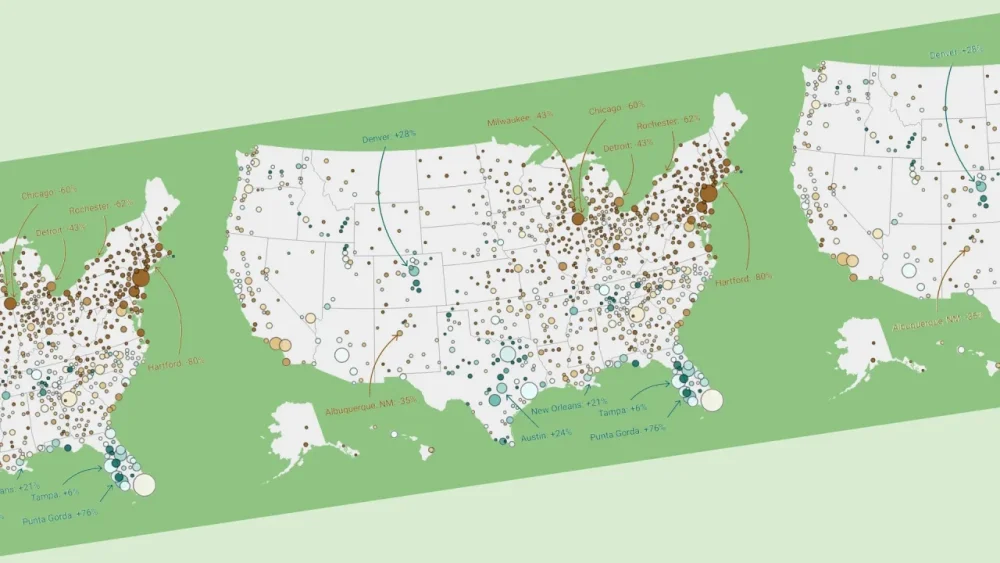
Want more housing market stories from Lance Lambert’s ResiClub in your inbox? Subscribe to the ResiClub newsletter. While homebuyers and home sellers still see headlines about the housing market being a seller’s market and national home prices reaching all-time highs, a deeper look reveals that several regional housing markets have shifted, giving homebuyers some power. During the pandemic housing boom, from summer 2020 to spring 2022, the number of active homes for sale in most housing markets plummeted as homebuyer demand quickly absorbed almost everything that came up for sale. Fast-forward to the current housing market, and the places where active inventory has rebounded to 2019 levels (due to strained affordability suppressing buyer demand) are now the very places where homebuyers hold the most power. At the end of February 2025, national active housing inventory for sale was still 23% below February 2019 levels. However, more and more regional markets are surpassing that threshold. Among the nation’s 200 largest metro area housing markets, 44 markets ended February 2025 with more active homes for sale than they had in pre-pandemic February 2019. These are the places where homebuyers will be able to find the most leverage or market balance in 2025. This list is growing: Last month when we ran this analysis, 41 of these 200 major markets were back above pre-pandemic 2019 inventory levels. Many of the softest housing markets, where homebuyers have gained leverage, are located in Gulf Coast and Mountain West regions. These areas were among the nation’s top pandemic boomtowns, having experienced significant home price growth during the pandemic housing boom, which stretched housing fundamentals far beyond local income levels. When pandemic-fueled migration slowed and mortgage rates spiked, markets like Cape Coral, Florida, and San Antonio, Texas, faced challenges as they had to rely on local incomes to sustain frothy home prices. The housing market softening in these areas was further accelerated by the abundance of new home supply in the pipeline across the Sun Belt. Builders in these regions are often willing to reduce prices or make other affordability adjustments to maintain sales. These adjustments in the new construction market also create a cooling effect on the resale market, as some buyers who might have opted for an existing home shift their focus to new homes where deals are still available. In contrast, many Northeast and Midwest markets were less reliant on pandemic migration and have less new home construction in progress. With lower exposure to that demand shock, active inventory in these Midwest and Northeast regions has remained relatively tight, keeping the advantage in the hands of home sellers. Generally speaking, housing markets where inventory (i.e., active listings) has returned to pre-pandemic levels have experienced weaker home price growth (or outright declines) over the past 24 months. Conversely, housing markets where inventory remains far below pre-pandemic levels have, generally speaking, experienced stronger home price growth over the past 24 months. View the full article
-
When international architecture firm Snøhetta found its New York City lease was coming up last year, a search kicked off for a new workspace. The firm, which had been located in Manhattan for 21 years, scoured neighborhoods near and far, such as the Brooklyn Navy Yards. But in the end, the choice was one many such firms had been making recently, according to partner and managing director Elaine Molinar. They wanted a building with character that was conducive to creative work, and found it within a 25,000 square feet space at 55 Washington Street in Brooklyn’s Dumbo neighborhood, where about 70 workers will move in later this year. “The space is on the ninth floor, with a large, beautiful skylight, a big, open elevated area, a private terrace, a wonderful quality of light, and some odd geometry on one end,” Molinar says. “They’re the kind of quirks that architects love. It just kind of feels like home.” [Photo: Chris Cooper] Snøhetta became the latest in a long line of more than 150 architecture and design firms, showrooms and studios that now call Dumbo home. An historic warehouse district that’s been redeveloped and restored by development firm Two Trees for the last 40-plus years, Dumbo has become an almost default destination for architecture and design tenants. In the last year, a dozen such architecture and design leases have been signed, with roughly 40 signed in the last two years. Firms such as Post Company, Henry Built, Brooklyn Studio and architecture powerhouse BIG—which first moved there in 2019—have relocated Down Under the Manhattan Bridge Overpass. In the last three years, there’s been a push by design and architecture firms to co-locate in the neighborhood, says Alyssa Zahler, Managing Director of Commercial Leasing at Two Trees Management Co., one of Dumbo’s dominant property owners, and Snøhetta’s future landlord. [Photo: Chris Cooper] Dumbo’s transformation Dumbo remains far from a newly rediscovered area. For decades, it’s been a destination of sorts (and subject of gentrification discourse), with its highly Instagrammable bridge view, proximity to Brooklyn’s new waterfront parkland, and restored warehouse buildings. It’s not even necessarily cheaper; Snøhetta will pay more for their new space in Dumbo than they are now, though they will be getting a longer lease and a lower cost per square foot. The area’s residential real estate is some of the city’s most expensive, with the median home listing for $2.3 million, and median rent over $6,000. But the continued and even renewed popularity within the design world speaks to its continued appeal, certain real estate realities, and deliberate real estate strategies by property owners. Two Trees founder David Walentas has made it a priority to try and attract more creative tenants. Walentas had previously been converting property in SoHo for artists. He first came across Dumbo in 1979, after driving over to Dumbo in a red Mercedes convertible to scout out the mostly empty post-industrial collection of abandoned buildings. He saw potential for a similar transformation and purchased a number of buildings in 1981. Jared Della Valle, CEO and Founder of Alloy Development, who has lived in Dumbo since 1998 (there were wild dogs in the neighborhood at the time), says it’s always been a neighborhood that attracted the arts. Preserving lofts and warehouses here have maintained desirable spaces for creative firms. “It’s not like there’s any special infrastructure for architects here,” says Della Valle. “I think it’s the size of the spaces that Two Trees have marketed that have been compelling for the architectural industry.” Two Trees remains the most dominant landlord in the neighborhood, with three properties 45 Main Street, 55 Washington Street and 20 Jay Street. The firm has always prioritized creative class clients, says Zahler, and saw a mini-boom of tech tenants in the early 2000s. Part of that was preservation and conversions of the original building stock, keeping the original building intact and leaving interiors more raw, to give tenants the opportunities to make it their own. Architecture critic Paul Goldberger, who wrote a book on the neighborhood, said of Dumbo that “the combination of raw materials, so to speak, and a developer with Walentas’s sensitivity might just be a once-in-a-lifetime combination.” [Photo: courtesy of Two Trees Management] A certain vibe When the Norwegian firm Snøhetta expanded to New York City in 2004, it was working on the World Trade center site, and financial incentives to locate in Lower Manhattan made the choice of office location an easy one. The firm initially worked out of the Cunard Building in the Financial District, in a mezzanine office that looked down into the great hall, a former cruise line boarding area lined with preserved murals. About a decade ago, they moved nearby to Pine Street, a 1961 tower designed by architect Emory Roth Jr. The firm was happy, but the neighborhood had taken on a very commercial vibe, which “is not quite exactly us,” says Molinar. The space, streetscape, and surroundings in Dumbo were a better fit, she says. That includes what’s called Gair buildings, old brick warehouses built by Robert Gair, a Scottish-American industrialist that boast soaring ceilings and wide-open floor plans that give architects plenty of room to work/play (a neighborhood bar in Dumbo, Gair, is actually owned by architects). In addition to building preservation, Two Trees has also focused on new lobbies and amenities, and direct marketing and outreach to these firms. It’s currently marketing new spaces under 10,000 square feet with private terraces to attract smaller companies and firms, and is chasing a formal design district designation from the city. But it maintains an authentic, [Photo: Chris Cooper] industrial version of Brooklyn and New York City that’s hard to replicate. In addition to smaller spaces, these renovated warehouse spaces also offer more ease for tenants. Snøhetta’s Molinar noted that in Manhattan, as other new buildings, offices tend to have lots of security, including turnstiles, badges, and restrictions. Their Dumbo space on 55 Washington has much easier access, including freight elevators for moving materials and models. Snøhetta will get a few tenant improvements, but the firm mostly wants the space as-is. “It’s not pristine, it’s not precious, it’s okay if we need to mark something up on the floor and tape or paint the patch of color on the wall to test it out,” Molinar says. “That’s what we’re looking for, a place that’s a little more rough and tumble.” Having like-minded neighbors helps, as well as Brooklyn Bridge Park nearby, certainly helps. Within the neighborhood, design and architecture tenants have found common cause and collaborated. JAM Architecture collaborated with Mark Jupiter on custom furniture for projects in the areas, Six Penny and Post Company collaborated on Inness, a luxury upstate hotel, and MARCH interior design collaborated with architecture firm Young Projects. Many of the workers at these firms—especially executives—live in Brooklyn, and in neighboring areas, making a move from Manhattan an easier sell. “In a post 2020 world, people are looking at what the office means,” says Zahler. “Firms are being really intentional, and we see it in the data over and over. Principals of these firms, who live in brownstone Brooklyn, have leases for offices coming due or are starting a new firm, and have an opportunity to pick a new location, and they no longer need to be in Manhattan to meet with their clients.” Dumbo maintains an older type of charm and style that can’t be remade. Della Valle also adds that in other so-called hip neighborhoods in New York, such as Williamsburg, there’s a lot of newer architecture that takes away from that kind of continuity. “Who wants to be in a place that shows off other people’s work?” he says. “When clients come to Dumbo, they can just appreciate the neighborhood.” View the full article

-
The 2001 Tilda Swinton film The Deep End features a scene that has stuck with me for nearly 25 years, even though I’ve forgotten almost everything else about the movie. Swinton’s character is being blackmailed for $50,000 and is given 24 hours to come up with the cash. Although her character is shown to live a comfortable, upper-middle-class life, she spends a stressful day on the phone trying to find the money—and she misses the deadline. As a budding money nerd, I wondered what I would do in her situation. I had some go-to sources of cash for smaller financial emergencies, but there was a limit to how much I could gather quickly. The thing is, everyone has a limit to the cash they can access—even those financial experts who wag their fingers at anyone whose limit seems “too low.” But wherever your financial limit is, a need for more cash than you can access feels insurmountable. It doesn’t have to be. Here are some ways to find money in an emergency that you may not have thought of. How soon is quickly? In the film, Tilda Swinton’s character has 24 hours to come up with a substantial amount of money. If she’d had a month, or even a week, she probably could have found that money with a minimum of fuss—but it takes more than one day to take out a home equity loan, liquidate investments, or sell anything worth tens of thousands of dollars. While few emergencies have a 24-hour turnaround time (unless you’re being blackmailed by Goran Višnjić), they do generally come with looming deadlines. That’s why all the options on this list should take no more than two to three days. Additionally, the best options for quick cash won’t hurt your future finances, your credit score, or your relationships. The options below are as low-impact as possible, but remember to always do your due diligence and understand the potential drawbacks. Up to $500 Downgrade your credit card If you have a credit card with annual fees, you could potentially recoup some of the fee you’ve already paid. Eric Roberge, CFP® and founder of Beyond Your Hammock, offers this suggestion: “Call the credit card company to downgrade the card to one with no annual fee. Most credit card companies will refund you the prorated amount of the annual fee.” Doing this will help you avoid the credit-score-hurting move of closing the card, while still helping you recoup the fee. How much you receive depends on the fee and when you cancel. “If you paid an annual fee of $100 in August and call to downgrade your card to the no-fee version in March, the credit card company will provide you a statement credit of ~$50,” Roberge says. This may not hold true for every credit card, and the found cash is a statement credit—but this option can help if you’re in a situation where every penny counts. Sell stuff on Facebook Marketplace Selling something is usually the easiest way to drum up a couple of Benjamins. Financial coach Justin Brown-Woods recommends using Facebook Marketplace to quickly sell unwanted items. “I’ve sold over $16,000 of items on Facebook and I love using it as a quick spurt for my financial coaching clients,” Brown-Woods says. Brandon Lovingier, a Chartered Financial Consultant based in Maryland, seconds this option. “I did this the other day. I sold an old standing desk and monitor I had laying around for $50 each,” Lovingier explains. “Took a few minutes to take pictures and about an hour total of meeting people.” Sell your plasma Plasma donation has a stigma, but it can be a good way to generate cash quickly. According to Jim Wang, founder of Wallet Hacks, “plasma donation is not a fun process, which is why it pays so much, but does offer a high hourly payout.” How much of a payout? “You can get up to $100 a visit,” Wang says. “It takes a few hours the first time but becomes faster as you don’t have paperwork and are more familiar with the process.” Additionally, many plasma donation centers run promotions, where you can get bonuses for frequent donation. $500 to $2000 Leverage your car Your ride may be a source of ready cash, according to Lovingier. “You can make $500 in a week by listing your car on Turo and bumming rides from friends for the week,” he says. Turo is the app-based peer-to-peer car rental company that allows travelers to rent cars from local vehicle owners. Just note that Turo requires cars that are younger than 12 years old with less than 130,000 miles on the odometer. Another alternative Lovingier recommends is driving for Uber, Lyft, or DoorDash for a few days. “I’ve heard of people earning a lot of money by driving during peak hours for a weekend,” he says. “These can be really lucrative during peak times.” Rent out your home This option depends on your location and timing, but putting your house up on AirBnb could potentially net you big bucks for a short stint. For example, I live in Milwaukee, which hosted the Republican National Convention last summer. Some Milwaukee residents were able to get as much as $2,400 per night by renting out their homes to visitors. Use your skills Like Liam Neeson, you have a very particular set of skills that can equal quick cash. For example, freelance writer Paulette Perhach has photography experience and a great camera, which she used to generate cash in a hurry several years ago. It was nearly Mother’s Day, so she took her camera and business cards to a local park and offered to take photos of the moms and kids for $20 per portrait. Similarly, my husband is an automotive engineer and lifelong grease monkey. He could easily make some money by offering to vet used cars for potential buyers. He has the knowledge and technical skills to know what to look for in a good used car and what issues may present a problem down the road—and that kind of expertise is worth money. Whatever you know well is something someone else needs and is willing to pay for. $2,000 to $10,000 Sell a car If you are in a two-car household and you either finance or own at least one vehicle, selling that car could help you get cash within a day. Lovingier explains that this would be his go-to method. “If I absolutely had to get my hands on $5,000 today, we could sell the nicer vehicle we have and buy a cheaper car,” he says. “This could potentially be enough to get you into the $10,000 to $25,000 plus range, too.” As an added bonus, selling a car means you can cancel insurance on that vehicle. If you paid ahead for your insurance, your insurer will give you a prorated refund on what you’ve already paid. Even if you’re not paid ahead, cancelling your insurance will free up the monthly premium moving forward. Check for unclaimed funds There may be money with your name on it just sitting around unclaimed. As of 2023, states held $70 billion in unclaimed funds, and it’s estimated that one out of every seven Americans is owed unclaimed property. What’s more, the average amount of unclaimed money is more than $2,000. To discover if your state owes you money, you can search your state’s unclaimed property office. Make sure you check any other states you have lived in, as well. But it’s not just state governments that may owe you money. You can also check to see if you’re owed unpaid wages from a former employer, money from someone who has declared bankruptcy, or even unclaimed insurance funds, among other sources of unclaimed funds. $10,000 to $25,000 Tap your home equity A home equity loan or line of credit are common options for generating cash quickly, but the application and approval process typically takes at least 30 days. These kinds of loans are also hard to qualify for if you have a low credit score. However, there is another way to exchange your equity for cash: a home equity sharing agreement. With this process, a company or investor pays you a lump sum of money in exchange for a share of the home’s future appreciation or for partial ownership of the home. You repay the investor when you either sell the home or after an agreed-upon period of time, typically 10 or 30 years. There are several online companies that offer home equity sharing agreements. Typically, you will need to prequalify before filling out the full application, but the process for this option tends to work quickly. Borrow against your investments If you have money invested, you may be able to leverage it for a loan, according to Jim Wang. “Most people don’t consider getting a loan against their investment portfolio,” Wang says. But similar to home equity, your portfolio can work as the basis for a loan of $25,000 or more. “You can take out a loan against your portfolio or take a portfolio line of credit,” Wang suggests. “Talk to your brokerage and see if this is something they offer.” Get your money on time If you find yourself facing a serious financial crisis, don’t stress—strategize. No matter how you define a “large amount of money,” there are a number of methods you can implement to generate big bucks in a couple of days. View the full article

-
We need to talk about AI. Have you noticed it often just isn’t—well, very intelligent? Already, we’ve lived through years of AI hype. We’ve watched companies pitch AI as a great tool for writing boring corporate emails. We’ve seen it shoehorned into all kinds of places it doesn’t belong. And it’s often just been bad. We’re all exhausted. So let’s cut through the fluff: The AI we’re about to go over is actually impressive. I’ve never felt that AI truly delivered—until now. I’m genuinely impressed—and I didn’t expect to be. If you’re intrigued, great! If you’re thinking, “We’ll see about that,” that’s also OK—don’t take my word for it. You truly need to try it yourself. For once, this isn’t some overhyped AI tool with a required subscription and questionable usefulness. It’s back to basics: a web page with a text box. Just you and the response from the AI model. And it’s 100% free—no account, no friction. You can try it in seconds. Let me show you how. Be the first to find all sorts of little-known tech treasures with my free Cool Tools newsletter from The Intelligence. One useful new discovery in your inbox every Wednesday! DeepSeek R1—hosted by Nvidia It seems like everyone’s raving about DeepSeek these days. But it is actually as good as people say? I doubted it—but then I tried it myself. To be clear, I’m not recommending you use the official DeepSeek app, which will send your inputs to a server in China—where there’s no telling how the data might be used. DeepSeek is open source, and other companies can host it. ➜ And now, Nvidia has DeepSeek running on its own super-fast servers. It’s technically intended for developer-level testing, but anyone with the link can access it. A quick note: Nvidia is a sponsor of The Intelligence, but my recommendation has nothing to do with that relationship. I could point you at another DeepSeek instance hosted by a company you’ve never heard of, but Nvidia is a recognizable name with speedy servers. And since this tool is intended for developers, there’s no nonsense involved. You don’t have to pay money—in fact, there’s no upsell at all. It’s just a text box on a web page that lets you access the model on Nvidia’s fast servers. To start, just open the Deepseek-R1 page on Nvidia’s developer website. All you need is the chat box—you can ignore the developer stuff. Here’s my suggestion: Don’t use boring questions. Ask something complex, something that requires knowledge and creativity. I asked DeepSeek for some examples you might want to use, and here’s what it came up with: Generate five absurd tech support FAQs for a dystopian smart fridge that judges your life choices Invent a fake Apple product so pretentious even Jony Ive would blush (and include a press release) Turn the five stages of grief into a guide for switching from iPhone to Android Try one of the above prompts—just copy-paste it right into the text box on Nvidia’s website—or make up your own. After you do, you’ll see DeepSeek’s “reasoning” process in action, followed by the response. It should only take a few seconds to work. (You may have to wait a few extra seconds if the server is a little busy, but it should still be fast!) You can ask the Nvidia-hosted version of DeepSeek virtually anything and get an answer back in seconds. The answers frequently demonstrate impressive amounts of knowledge, logic, and—seemingly—creativity. But DeepSeek can have serious conversations, too. Ask whatever you like and see what happens. (As a general rule, you probably shouldn’t provide private or sensitive information to any AI service, unless you really trust it.) DeepSeek’s answers are surprisingly thoughtful and complex compared to other AI engines. It’s there and waiting. And all you have to do is give it a try. Nvidia’s DeepSeek-R1 site is completely web-based—no downloads or installations, and no accounts to create. The service is free. Bear in mind that it’s for trial purposes and intended for developers, so you may run into a limit if you use it a lot, and Nvidia could pull the plug on it at any moment. Nvidia says it doesn’t store any prompts you send to its server. The website says it logs your “use” of the server—information like your IP address—but doesn’t keep any records beyond that. (Again, I recommend you don’t send anything private or sensitive, even so—and that same suggestion goes for any web-connected AI tool.) Want even more productivity-boosting goodness? Check out my free Cool Tools newsletter for an instant introduction to an incredible audio app—and another off-the-beaten-path gem every Wednesday! View the full article

-
Microplastics—the tiny particles of plastic shed when litter breaks down—are everywhere, from the deep sea to Mount Everest, and many researchers worry that they could harm human health. I am a machine learning researcher. With a team of scientists, I have developed a tool to make identification of microplastics using their unique chemical fingerprint more reliable. We hope that this work will help us learn about the types of microplastics floating through the air in our study area, Michigan. Microplastics—a global problem The term plastic refers to a wide variety of artificially created polymers. Polyethylene, or PET, is used for making bottles; polypropylene, or PP, is used in food containers; and polyvinyl chloride, or PVC, is used in pipes and tubes. Microplastics are small plastic particles that range in size from 1 micrometer to 5 millimeters. The width of a human hair, for comparison, ranges from 20 to 200 micrometers. Most scientific studies focus on microplastics in water. However, microplastics are also found in the air. Scientists know much less about microplastics in the atmosphere. When scientists collect samples from the environment to study microplastics, they usually want to know more about the chemical identities of the microplastic particles found in the samples. Fingerprinting microplastics Just as fingerprinting uniquely identifies a person, scientists use spectroscopy to determine the chemical identity of microplastics. In spectroscopy, a substance either absorbs or scatters light, depending on how its molecules vibrate. The absorbed or scattered light creates a unique pattern called the spectrum, which is effectively the substance’s fingerprint. Just like a forensic analyst can match an unknown fingerprint against a fingerprint database to identify the person, researchers can match the spectrum of an unknown microplastic particle against a database of known spectra. However, forensic analysts can get false matches in fingerprint matching. Similarly, spectral matching against a database isn’t foolproof. Many plastic polymers have similar structures, so two different polymers can have similar spectra. This overlap can lead to ambiguity in the identification process. So, an identification method for polymers should provide a measure of uncertainty in its output. That way, the user can know how much to trust the polymer fingerprint match. Unfortunately, current methods don’t usually provide an uncertainty measure. Data from microplastic analyses can inform health recommendations and policy decisions, so it’s important for the people making those calls to know how reliable the analysis is. Conformal prediction Machine learning is one tool researchers have started using for microplastic identification. First, researchers collect a large dataset of spectra whose identities are known. Then, they use this dataset to train a machine learning algorithm that learns to predict a substance’s chemical identity from its spectrum. Sophisticated algorithms whose inner workings can be opaque make these predictions, so the lack of an uncertainty measure becomes an even greater problem when machine learning is involved. Our recent work addresses this issue by creating a tool with an uncertainty quantification for microplastic identification. We use a machine learning technique called conformal prediction. Conformal prediction is like a wrapper around an existing, already trained machine learning algorithm that adds an uncertainty quantification. It does not require the user of the machine learning algorithm to have any detailed knowledge of the algorithm or its training data. The user just needs to be able to run the prediction algorithm on a new set of spectra. To set up conformal prediction, researchers collect a calibration set containing spectra and their true identities. The calibration set is often much smaller than the training data required for training machine learning algorithms. Usually just a few hundred spectra are enough for calibration. Then, conformal prediction analyzes the discrepancies between the predictions and correct answers in the calibration set. Using this analysis, it adds other plausible identities to the algorithm’s single output on a particular particle’s spectrum. Instead of outputting one, possibly incorrect, prediction like “this particle is polyethylene,” it now outputs a set of predictions—for example, “this particle could be polyethylene or polypropylene.” The prediction sets contain the true identity with a level of confidence that users can set themselves—say, 90%. Users can then rerun the conformal prediction with a higher confidence—say, 95%. But the higher the confidence level, the more polymer predictions given by the model in the output. It might seem that a method that outputs a set rather than a single identity isn’t as useful. But the size of the set serves as a way to assess uncertainty—a small set indicates less uncertainty. On the other hand, if the algorithm predicts that the sample could be many different polymers, there’s substantial uncertainty. In this case, you could bring in a human expert to examine the polymer closely. Testing the tool To run our conformal prediction, my team used libraries of microplastic spectra from the Rochman Lab at the University of Toronto as the calibration set. Once calibrated, we collected samples from a parking lot in Brighton, Michigan, obtained their spectra, and ran them through the algorithm. We also asked an expert to manually label the spectra with the correct polymer identities. We found that conformal prediction did produce sets that included the label the human expert gave it. Microplastics are an emerging concern worldwide. Some places such as California have begun to gather evidence for future legislation to help curb microplastic pollution. Evidence-based science can help researchers and policymakers fully understand the extent of microplastic pollution and the threats it poses to human welfare. Building and openly sharing machine learning-based tools is one way to help make that happen. Ambuj Tewari is a professor of statistics at the University of Michigan. This article is republished from The Conversation under a Creative Commons license. Read the original article. View the full article

-
This week, Apple updated half of its iPad lineup. After updating the iPad Pro and iPad mini in 2024, the company has just unveiled a third-generation iPad Air and an eleventh-generation iPad. Many fans of Apple’s tablets have been eagerly awaiting these updates, especially since before this week, the company’s entry-level iPad had not had a refresh since October of 2022. But if you’ve been waiting until this week’s reveals, hoping for a clear picture of Apple’s iPad offerings in order to select the one best for your needs, well, I’ve got bad news: the iPad lineup remains as confusing as ever. Here’s why. Not all models support Apple Intelligence Apple makes four different types of iPads: the iPad Pro, the iPad Air, the iPad, and the iPad mini. Yet despite each model getting an update within the last year—one of them still lacks the hardware to run Apple’s much-hyped Apple Intelligence AI platform, which debuted in October 2024. That would be the new iPad—yes, the eleventh-generation tablet that Apple announced just this week. In 2025. In a baffling move, Apple decided to equip the new iPad with just 6GB of memory and the A16 chip—the CPU Apple first introduced all the way back in 2022 in the iPhone 14 Pro series and later included in the iPhone 15 series. None of these devices can run Apple Intelligence because the AI platform requires at least 8GB of memory. It’s shocking that Apple decided to limit its new 2025 iPad to just 6GB of memory and the A16 instead of giving it the more advanced A17 Pro chip and 8GB of memory that can run Apple Intelligence and that the smaller iPad mini, introduced in 2024, has packed inside. Why would Apple do this? I’ve reached out to the company for comment and have yet to hear back, but the most likely reason is that Apple wants to push customers into its higher-priced iPad models, like the iPad mini ($499) and iPad Air ($549), instead of having them buy the entry-level iPad ($349). Consumers are starting to go crazy for AI, and, in my opinion, Apple knows that by excluding Apple Intelligence from the entry-level iPad, many of them will instead opt to shell out another $150 to $200 more on an iPad that supports it. You can’t fault a company for wanting to make more money. But the lack of Apple Intelligence support on the new iPad is going to confuse a lot of people. Some may buy it thinking it comes with Apple Intelligence since, you know, every other iPad does. This device is kind of already obsolete—at least if you ever want to use Apple Intelligence. The thinnest and lightest model..is not the one you would think The lack of Apple Intelligence on Apple’s newest iPad isn’t the only thing likely to confuse consumers. Many people are drawn to tablets because they are thin and light and thus easier to lug around than a laptop. Historically, Apple’s thinnest and lightest devices have all fallen under a unique moniker: “Air.” There’s the MacBook Air—the thinnest laptop Apple sells. There’s the (very likely) upcoming iPhone Air, which will be the thinnest iPhone ever, and of course, there is the iPad Air, which is the thinnest…wait, no. You would think the iPad Air would be the thinnest iPad Apple makes, but that’s not true. If you want the thinnest iPad, you actually need to buy the iPad Pro (which is 5.1 mm or 5.3 mm thin, depending on screen size) and not the iPad Air (which is 6.1 mm thin). But what if you want the lightest iPad? Surely, that’s the iPad Air, right? No. That’s the 11-inch iPad Pro, which weighs in at 0.98 pounds. The 11-inch iPad Air is 1.01 pounds (and if you think it’s fair to compare apples to oranges, the iPad mini with its 8.3-inch screen comes in at just 0.65 pounds, beating the iPad Air by a long shot). Do you see how confusing this could be to the average consumer? And don’t even get me started on Apple Pencil compatibility (the Apple Pencil Pro works with the smaller iPad mini from 2024, but not the larger, newer iPad Apple introduced this week). Which iPad should you get? I’ve long hoped that Apple would fix its confusing iPad lineup. They didn’t do it last year, or the year before, and with the new iPads this week, it looks like they aren’t going to do it in 2025 either. So, if you are in the market for a new iPad, maybe this little cheat sheet will help you out: If you want the thinnest iPad, get an iPad Pro (not the iPad Air). If you want the lightest iPad, get the iPad mini. If you want to be able to use the Apple Pencil Pro, get the iPad Pro, iPad Air, or iPad mini. If you want Apple Intelligence, get the iPad Pro, iPad Air, or iPad mini—and avoid the new iPad. And if you want a lack of confusion…I guess maybe wait to see if the 2026 iPad family finally brings much-needed simplicity to Apple’s tablet lineup? The new 2025 iPad and iPad Air are now available to pre-order and will be released on March 12. View the full article

-
Pretty much everyone will sometimes struggle with anger at work. People fear the wrath of abusive supervisors, suppress anger to maintain a facade of professionalism, or vent anger toward coworkers who are, fairly or not, targets. Reactions to anger in the workplace can be strong, but they’re not always effective. As scholars who also fall prey to the pitfalls of anger ourselves, we are fascinated by anger. We have studied the causes, underlying processes, and consequences of anger from the perspectives of management, psychology, marketing, and negotiations. We recently reviewed more than 400 research articles across psychology, business, and related fields on topics ranging from brain activity to negotiation to race relations. Yet despite the ubiquity of anger in the workplace and the decades of anger research that exists across a number of fields, we found no straightforward way to understand the complexity of the life cycle of anger and how to manage it most effectively. As we dived more deeply into the research literature, though, we realized that simply reframing how we think about anger could provide a novel, flexible framework for how to deal with this emotion in daily life. Our suggestion: Think of anger as a flow of emotion, like water through a garden hose. By thinking of the flow of anger, you can unpack its key dimensions: its path and strength. Understanding whether the hose is pointed effectively and whether the strength of the stream is appropriate are critical for knowing when, how, and why to focus or redirect the anger and amplify or weaken its intensity. The direction of anger Imagine a coworker charges into your office, yelling, breathing heavily, face reddened, veins bulging. Even if you are simply an unsuspecting colleague who happened to have your door open, your attention is undoubtedly now fixed on your coworker. Are you the target of their anger for something you did, or merely an observer of their anger at someone else? If you are an undeserving target, do you try to reframe the issue so that the angry person will realize the anger is better directed elsewhere? If you are the observer, you also have a choice about whether to ignore your coworker’s anger or help them redirect it to a more effective outlet. You might simply listen empathetically while they let off steam, perhaps pointing out the relative risks and benefits of their taking their complaints to the supervisor. You are deciding, in effect, what suggestions to make about the direction of this person’s anger. The key to effectively managing the direction of anger is to manage the attention of those in the room. Reshaping how angry people attribute blame, for example, can help people take another person’s perspective or understand the situation in a new way, directing the flow more productively. The intensity of anger When an angry coworker approaches you as the target, do you ignore the signal or offer to work with the person so a similar situation doesn’t happen in the future? Both are ways to tamp down the intensity of the emotion coming at you. When you are angry, do you try to distract yourself from the anger, let it simmer, or embrace it? You are essentially deciding how you want to manage the intensity of your own angry feelings. It is important to recognize that managing the intensity of anger can go in both directions. Sometimes high-intensity anger should be turned down and sometimes subtle anger should be amplified. For example, consider an instance in which you feel anger at what you perceive to be an unfair change to a company policy. In this case, simply going for a walk outside to avoid expressing your frustration may result in the leadership not realizing that you and others on the team feel this way, leaving little opportunity to discuss and update the policy to more reasonable standards. Learning to self-regulate your thoughts and behaviors can help you manage the intensity of any anger you find yourself feeling. Rather than impulsively reacting, you can practice handling your emotions so you control whether you crank up your expressed anger or dial it down. Part of this process is thinking carefully about the cost-benefit trade-offs of expressing your anger. In these ways, you more effectively manage the strength of the flow without unnecessarily just turning it off. Controlling anger Knowing when, how, and why to shape the direction and intensity of anger is no small feat. Some of this decision is rightly based on the situation. For example, is it safe to step in? Do you feel personally skilled at intervening? But it is within everyone’s power to learn how to manage their own and others’ anger more effectively. To do so, you need to understand your role and whether the flow is a onetime situation or a persistent problem. Understanding whether you’re holding the hose, standing in its path, or observing from a distance is the first step to effectively managing the direction and intensity of the flow. Second is deciding whether and how to intervene: Can you reframe the initial trigger so that the faucet is never turned on, or turned on more or less powerfully? If anger is already too strong and you cannot or do not want to avoid it, can you help the angry person regulate the direction and intensity of their anger to overcome the issue in some way? You can get better at controlling the flow of anger in ways that can improve rather than harm relationships and outcomes. Research supports working on your emotional intelligence and building belief in your own capability to handle anger. Manage factors that tend to wrest control of the hose away from you, including becoming defensive, feeling shame, or even suffering from a lack of sleep. Taking these steps and practicing controlling the hose’s path and intensity can help address problems in the short term and prevent anger from becoming a destructive pattern in the long term. Laura Rees is an associate professor of organizational behavior at Oregon State University. Ray Friedman is a professor of management and professor of Asian studies at Vanderbilt University. This article is republished from The Conversation under a Creative Commons license. Read the original article. View the full article

-
Julian Baggini is a philosopher with a long and deep interest in food and where it comes from. His books include internationally bestselling How the World Thinks; How to Think Like a Philosopher; The Virtues of the Table; and The Pig That Wants to be Eaten. He is the Academic Director of the Royal Institute of Philosophy and a member of the Food Ethics Council. He is a regular columnist for The Guardian, Prospect magazine, Financial Times, and The Wall Street Journal. What’s the big idea? Food is such a big topic that few really grasp the whole of it. Using his philosophical skillset, Julian sketches a picture of how all the elements of food consumption and production fit together. Extracted from the complexity of food’s impact on health, economy, wellbeing, nature, civil strife, and so on, there are common principles that characterize food systems that work for us and for the planet. Below, Julian shares five key insights from his new book, How the World Eats: A Global Food Philosophy. Listen to the audio version—read by Julian himself—in the Next Big Idea App. 1. Debate about food and farming is too polarized Polarized debate about food and farming stands in the way of everyone coming together for the common good. Beneath the dichotomous rhetoric, the world is not nearly as divided as it seems. Take the apparent chasm between organic and non-organic agriculture. In one way, it is a sharp divide because you either tick the boxes and get certified organic or you don’t. But in practice, the difference between the two camps is blurry. Some farms are in effect organic but can’t say they are because they don’t pay for certification. Nor can we separate them out based on which use fertilizers and pesticides and which don’t. Organic farms use both, only they can’t be synthetic—in their definition of the term. But so-called “natural” inputs are not necessarily safer. Copper is allowed under the terms of certification as an organic fungicide (commonly used for tomato production), but copper is known to be toxic to humans. Some non-organic farms use chemical inputs with such care and in such limited amounts that they pose no threat to human health or wildlife. Or take the distinction between farmed and wild-caught fish. Whether one is better than the other all depends. There are some terrible practices on the open seas, including the use of huge trawlers to scrape the seabed, basically bulldozing habitats. There are also awful fish farms that pollute surrounding waters and nurture sick fish. But there are also good practices on both sides. Like most either/or questions about food, “farmed or wild?” is just the wrong question. Simplistic, polarized thinking has real consequences. Take the idea that plastic is bad and biodegradable packaging is good. An extra layer of plastic wrap in the packaging of Danish cold meats increases their shelf life and reduces waste, and for almost all food, the environmental impact of waste is higher than that of the packaging that prevents it. Or take the owner of a vegetable box delivery scheme who knows that the greenest option is to use reusable and recyclable hard plastic boxes but must use cardboard because his customer base is so convinced that plastic is always the enemy. 2. Plurality is key to how we feed ourselves There is no one right way to farm, make food, or eat. It depends on context, culture, and circumstance. Grazing cattle is sustainable and efficient on the Argentinian Pampas, but not so easily done at scale on the polders of the Netherlands. The Mediterranean diet may be very healthy, but the Japanese one is at least as good. There is a place for small artisan producers, but the big manufacturers of, say, pasta do a good job supplying reliable, tasty, nutritious food at a good price. What works on a wheat farm in one place may not work in another in the next valley, let alone in another country. Advocates of land sharing argue that farmland must be made more hospitable to wildlife so that we can share our productive land with nature. Land sparers argue that the best way to protect the environment is to make agriculture as efficient as possible so that it uses less land, leaving other habitats pristine. Both perspectives are right, and both are wrong. In some places, land sharing works best, while in others, land sparing is more appropriate. The right option in one place can be wrong elsewhere. Too often, people advocate for one-size-fits-all solutions: that the world needs to go organic, or that everyone should be using more synthetic inputs; that we should all go vegan; that we should bring down the big food and agri-businesses; that everything we eat should be prepared from fresh. We homo sapiens have been able to feed ourselves for millennia because we have been resourceful, adapting ourselves to variable and changing conditions. Plurality has been one of our greatest strengths, and we should continue to encourage and celebrate it. 3. The ground rules of nutrition are simple because it is so complicated It is hubris to think we can micro-manage our diets to make significant differences to our health and longevity. The focus should be on the big, obvious elements of a good diet. It is still difficult to beat Michael Pollan’s famous seven-word maxim: eat food, not too much, mostly plants. By “foods,” he, of course, means real, whole foods and not highly processed “edible food-like substances,” to use his memorable phrase. We keep getting seduced by hucksters and misguided diet guides who promise the ultimate health hacks. Right now, the big noise is about the gut microbiome, with many making millions by selling prebiotics and probiotics, gut shots, and the like. But the Hadza hunter-gatherers of Tanzania have a really healthy gut microbiome, and they don’t eat anything like kimchi or kefir, let alone manufactured so-called “gut-boosters.” They only eat what they have gathered that day. Their guts are healthy because they eat a wide range of fibrous plants. The idea that we should focus on big factors gives us the license to relax a little. What matters is your dietary pattern, not any individual food you eat. If your diet is based on healthy foods, it doesn’t matter if you have the odd twinkie or a triple-cheese pizza. There is a lot of justifiable concern about ultra-processed foods, but they are not poisonous in small doses. Purity in eating is seductive but unnecessary. Many of us have individual needs that demand more specific dietary advice. We have intolerances, allergies, or health conditions that can be triggered by certain foods. But unless you have a specific medical reason to avoid some foods and have more of others, you should stop worrying and eat a good variety of proper foods. 4. Around the world, there are huge injustices in the food system Cocoa farmers who earn less every day than it costs someone to buy a single bar of chocolate made from their beans; migrant workers exploited as farm laborers, sometimes not being paid at all; modern slavery, not just in economically developing nations but under the noses of consumers in industrialized countries too; livestock kept in atrocious conditions, just so that we can enjoy cheap chicken, burgers, and sausages. We all know this, even if we choose to look away. These are not bugs in the food system; they are features of it. Our entire supply chain has been designed or evolved to make food as cheap for consumers as possible. However, it can only do this if humans and animals in the supply chain are exploited. This needs to change, even if it isn’t easy. We have become so reliant on inexpensive food that when prices increased a few years ago, many people found they could no longer afford to eat. This is true even though, by historical standards, households were still spending a smaller portion of their income on food than at nearly any other time in history. Some say food cannot become more expensive because the poor can barely afford it now. But the solution to poverty is not to make food so cheap that even the poor can afford it. The solution is to ensure that even the poorest have enough money to feed themselves properly. Nor should it be verboten to consider food subsidies. After all, many countries, including the USA, already spend billions subsidizing agriculture and other industries. 5. There are seven principles for a humane, sustainable, nutritious food system If you were to skip to the end of my book and read these seven principles, you might think they sound obvious. That is what makes them so powerful. Everyone agrees with them, but hardly anyone is acting in accordance with them. Not only do we almost all agree about what a better food system should look like, but we also know most of what it will take to make it a reality. There are numerous levers we could pull. We could have much higher standards of animal welfare. The power of large businesses to shape the food world in their own interests rather than in those of humankind could be curbed. The costs placed on society and future generations of the food system could be properly measured and either paid for or not allowed to occur in the first place. Every country could have a proper land use framework to achieve the right balance between agricultural productivity, conservation, and regeneration. Our diets can shift away from highly processed foods toward ones based on whole foods. Farmers and farm laborers could receive a much fairer share of the price paid by consumers. Every citizen has the potential not only to have a voice in how the food world is shaped, but real power in using that voice. Too many calls for change are utopian, requiring a wholesale shift of values that is not going to happen. Fortunately, we do not need to tear the whole system down and start again. Positive change depends on people recognizing that the values we already hold are discordant with our food system. Values and practices can be brought into harmony by a series of adjustments, some radical, but all ad hoc and doable. The will for change and the possibility for change can converge, join forces, and transform how the world eats for the better. This article originally appeared in Next Big Idea Club magazine and is reprinted with permission. View the full article