ResidentialBusiness
Administrators
-
Joined
-
Last visited
Everything posted by ResidentialBusiness
-
 Zoho is pushing deeper into AI-driven operations with a wide set of upgrades to Zoho One, its all-in-one business software platform, giving small business owners more ways to automate tasks, surface information instantly, and reduce time spent switching between apps. The company announced the enhancements today from Austin, positioning its expanded Zia AI tools as a way for organizations of all sizes to centralize intelligence and turn scattered data into clearer, faster insight. For small business owners who rely on multiple cloud services—from Google Workspace to accounting, CRM, HR, and project tools—the promise of unified intelligence stands out. Instead of digging through emails, files, or individual apps, Zoho says its upgraded Zia assistant can now “aggregate and contextualize data from multiple platforms… into a single, actionable answer.” That means a quick prompt could pull up sales metrics, meeting takeaways, pending contracts, or outstanding tasks without manual searching. Zoho is also giving its intelligent content system, Zia Hubs, a more prominent role inside Zoho One. The release notes that “executed contracts from Zoho Sign and recorded Zoho Meetings conversations both automatically go into Zia Hubs folders,” making them easy to retrieve through Zia Search. For small businesses that struggle to keep documents organized or often lose track of contract details, automatic categorization and accessible search could significantly reduce administrative friction. Ask Zia, the platform’s prompt-based interface, is now more integrated as well. Zoho emphasizes that users can pull “relevant data across multiple Zoho apps to provide a full picture of a user’s schedule, unfinished tasks, or the latest action items from a meeting.” Small teams—especially those without dedicated operational staff—may find it helpful to have this contextual guidance when juggling deadlines, follow-ups, or customer conversations. While the company highlights immediate improvements, Zoho also outlines upcoming capabilities. One of the most notable is multi-hub querying. In response to questions about future functionality, the company states that cross-departmental insights are on the roadmap, which would allow small businesses to view performance across sales, marketing, finance, and operations in a single unified answer. Zoho says this will “unlock a unified view of operations and performance across the enterprise,” suggesting deeper analytics ahead. Another future development involves expanding Zia Hubs beyond Zoho products. Integration with third-party systems is planned, giving businesses the flexibility to pull outside data into the same intelligence layer. That matters for small businesses that use a mix of Zoho and non-Zoho applications and want more connected workflows without manually moving information between platforms. Still, these capabilities come with considerations. Small businesses may need to assess whether they have clean, well-organized data for Zia to interpret accurately. Teams with inconsistent naming conventions, scattered documents, or outdated processes might face a learning curve in getting full value from federated intelligence. Privacy-minded businesses may also want to review how data flows between connected apps, particularly if integrating third-party systems. The expanded functionality positions Zoho One as a more automated, insight-driven operating system for small businesses that want to reduce manual work and rely more on AI for everyday decision-making. With Zia becoming more deeply embedded—pulling together tasks, documents, meetings, and cross-platform data—the new upgrades could help smaller teams operate with the efficiency traditionally associated with larger organizations. As more AI capabilities roll out, the platform appears to be moving toward a future where small businesses can access enterprise-level intelligence without the complexity or cost typically required. This article, "Zoho Expands Zia AI to Deliver Unified Insights Across Business Apps" was first published on Small Business Trends View the full article
 -
Small business owners relying on Zoho One to run daily operations will soon see tighter security, smoother app management, and more unified workflows across their software stack. Zoho Corporation announced a wave of enhancements to its all-in-one business platform, strengthening its native integrations and introducing tools designed to reduce complexity for growing teams. For many small businesses, maintaining a cohesive tech stack is an ongoing challenge. Disconnected apps create security risks, slow down processes, and force owners to manage multiple logins, data sources, and support channels. Zoho’s latest updates focus on removing those friction points by delivering deeper native integrations and strengthening identity management across the platform. The company emphasized how anchoring integrations inside Zoho One helps improve security and simplify oversight. According to the release, the platform’s built-in protections—including smart offboarding, device management, and encryption key support—now extend more smoothly across both Zoho and third-party applications. Zoho also highlighted the role of Zoho Directory, which “provides admins a secure platform for workforce identity and access management,” and is included as part of Zoho One. For small teams with limited IT resources, these enhancements may provide meaningful time savings. Native integrations reduce the number of external connections that need to be maintained, lowering the attack surface and making it easier to detect unusual activity. The company stated that “Zoho One offers native integration with Zoho apps and third-party software,” enabling organizations to monitor and configure these connections from a centralized panel. Zoho grouped the new capabilities into several integration types that shape how different apps function together. One category, unified integrations, aims to reduce the manual work of connecting software across a business. Users can “create integration flows and monitor their usage” directly within Zoho One, potentially replacing the need for separate tools or custom scripts to keep data synchronized. Foundational integrations broaden how users interact with multiple software portals. The platform’s new Unified Portal “allows for control over multiple apps from a single screen,” offering a customizable space where teams can consolidate app-specific portals—even those tied to third-party or custom applications. This may help employees avoid toggling between multiple dashboards throughout the day, a common productivity drain for small business teams. Zoho also introduced what it calls pragmatic integrations, which handle essential verification and authentication tasks. These connections support behind-the-scenes management functions, such as domain verification, ensuring critical processes are properly authenticated without requiring manual intervention. The final category, outcome-based integrations, addresses more complex workflows that span several applications. These are designed for scenarios where data needs to move across several steps in a defined process. Zoho’s example centers on its new Smart Offboarding tool, which consolidates ownership transfers, device data management, and decisions about user-specific app data into a single workflow. According to the release, “From within a single workflow, employees can easily transfer department ownership to a new department head, manage employee device data from a single menu, and decide what happens to a user’s application data to ensure no loss of access.” For small businesses experiencing turnover or onboarding new hires quickly, this type of structured offboarding may help prevent data loss, compliance issues, and unauthorized access. While these enhancements promise greater efficiency, small business owners may still need to assess how deeply their current systems rely on third-party tools outside Zoho’s ecosystem. Organizations using highly specialized software may see limited benefits from native integrations unless their vendors are already supported. Additionally, streamlined oversight tools may still require someone on staff to configure, monitor, and maintain workflows, which could introduce a learning curve for teams new to consolidated platforms. Still, the latest updates suggest that Zoho is continuing to push its all-in-one model forward, bringing together more components of a company’s tech environment under a single administrative roof. For small businesses seeking a more unified operational structure—and looking to cut down on the patchwork of independent apps—these enhancements may help reduce complexity while strengthening security foundations. As more small teams look for ways to scale without adding IT overhead, Zoho’s broader integration strategy may resonate with owners who need streamlined systems that grow with their operations. This article, "Zoho One Update Strengthens Security and Streamlines App Integration" was first published on Small Business Trends View the full article
-
Small business owners relying on Zoho One to run daily operations will soon see tighter security, smoother app management, and more unified workflows across their software stack. Zoho Corporation announced a wave of enhancements to its all-in-one business platform, strengthening its native integrations and introducing tools designed to reduce complexity for growing teams. For many small businesses, maintaining a cohesive tech stack is an ongoing challenge. Disconnected apps create security risks, slow down processes, and force owners to manage multiple logins, data sources, and support channels. Zoho’s latest updates focus on removing those friction points by delivering deeper native integrations and strengthening identity management across the platform. The company emphasized how anchoring integrations inside Zoho One helps improve security and simplify oversight. According to the release, the platform’s built-in protections—including smart offboarding, device management, and encryption key support—now extend more smoothly across both Zoho and third-party applications. Zoho also highlighted the role of Zoho Directory, which “provides admins a secure platform for workforce identity and access management,” and is included as part of Zoho One. For small teams with limited IT resources, these enhancements may provide meaningful time savings. Native integrations reduce the number of external connections that need to be maintained, lowering the attack surface and making it easier to detect unusual activity. The company stated that “Zoho One offers native integration with Zoho apps and third-party software,” enabling organizations to monitor and configure these connections from a centralized panel. Zoho grouped the new capabilities into several integration types that shape how different apps function together. One category, unified integrations, aims to reduce the manual work of connecting software across a business. Users can “create integration flows and monitor their usage” directly within Zoho One, potentially replacing the need for separate tools or custom scripts to keep data synchronized. Foundational integrations broaden how users interact with multiple software portals. The platform’s new Unified Portal “allows for control over multiple apps from a single screen,” offering a customizable space where teams can consolidate app-specific portals—even those tied to third-party or custom applications. This may help employees avoid toggling between multiple dashboards throughout the day, a common productivity drain for small business teams. Zoho also introduced what it calls pragmatic integrations, which handle essential verification and authentication tasks. These connections support behind-the-scenes management functions, such as domain verification, ensuring critical processes are properly authenticated without requiring manual intervention. The final category, outcome-based integrations, addresses more complex workflows that span several applications. These are designed for scenarios where data needs to move across several steps in a defined process. Zoho’s example centers on its new Smart Offboarding tool, which consolidates ownership transfers, device data management, and decisions about user-specific app data into a single workflow. According to the release, “From within a single workflow, employees can easily transfer department ownership to a new department head, manage employee device data from a single menu, and decide what happens to a user’s application data to ensure no loss of access.” For small businesses experiencing turnover or onboarding new hires quickly, this type of structured offboarding may help prevent data loss, compliance issues, and unauthorized access. While these enhancements promise greater efficiency, small business owners may still need to assess how deeply their current systems rely on third-party tools outside Zoho’s ecosystem. Organizations using highly specialized software may see limited benefits from native integrations unless their vendors are already supported. Additionally, streamlined oversight tools may still require someone on staff to configure, monitor, and maintain workflows, which could introduce a learning curve for teams new to consolidated platforms. Still, the latest updates suggest that Zoho is continuing to push its all-in-one model forward, bringing together more components of a company’s tech environment under a single administrative roof. For small businesses seeking a more unified operational structure—and looking to cut down on the patchwork of independent apps—these enhancements may help reduce complexity while strengthening security foundations. As more small teams look for ways to scale without adding IT overhead, Zoho’s broader integration strategy may resonate with owners who need streamlined systems that grow with their operations. This article, "Zoho One Update Strengthens Security and Streamlines App Integration" was first published on Small Business Trends View the full article
-
Bank of America survey shows a majority of money managers think companies are overinvestingView the full article
-
Small businesses continue to grapple with the challenge of managing scattered apps, disconnected workflows, and rising software costs. Zoho is betting it can solve that problem at scale. The company announced a major update to Zoho One—its unified business operating system—and the changes focus heavily on reducing friction, centralizing information, and making collaboration more intuitive for teams that can’t afford complexity. For small business owners already juggling multiple responsibilities, these updates aim to streamline operations by bringing apps, data, and communication into a single, customizable workspace. Zoho frames the enhancements as a way to help organizations “remove boundaries between apps” and reduce the daily inefficiencies that come with switching between tools. At the center of the update is a redesigned user experience that seeks to simplify how teams access and manage their work. Zoho introduced new “Spaces,” which organize apps by purpose: Personal, Organization, and Department. Personal includes tools relevant to an individual employee, such as productivity apps. Organization brings together company-wide communication tools like Forums, Town Hall, and Ideas. Departmental spaces categorize apps used by HR, Finance, Marketing, and other teams. All spaces can be customized, giving smaller organizations more control over how employees interact with the suite. The redesigned toolbar includes a unified search bar that scans the entire Zoho One ecosystem, allowing users to find information or launch actions without toggling between applications. For small teams where time is tight, this type of consolidation helps reduce the mental overhead that often slows down execution. Another feature meant to improve daily workflow is the new Action Panel and Quick Navigation system. According to Zoho, the Action Panel gives employees “access to their full day with one click,” and users can build custom panels that display upcoming meetings, pending tasks, scheduled messages, emails, and items from a range of Zoho apps. This flexibility may help small business owners who rely on cobbled-together productivity tools and struggle to keep visibility across multiple systems. Zoho also expanded the platform’s Dashboard and Boards capabilities. The enhanced dashboard pulls in data from all connected apps—including third-party tools—and displays it in a central, personalized location. Users can add widgets, create additional dashboards, and manage the entire suite from the hub. This approach could benefit businesses that have historically lacked the resources to build custom reporting systems, giving them a clearer view into operations without additional cost or integration work. A standout addition to Zoho One is Vani, a visual-first collaboration space designed to support brainstorming, planning, and team communication. Zoho describes Vani as “an all-in-one, visual-first intelligent virtual space.” It offers tools for whiteboarding, flowcharts, diagramming, mind mapping, and video calling. For small teams that rely heavily on remote or hybrid collaboration but don’t want to invest in multiple specialized apps, Vani may function as a consolidated alternative. Across all features, Zoho’s message emphasizes the reduction of app fragmentation. For small business owners, the benefits are clear: fewer tools to manage, simpler workflows, and a more cohesive view of operations. At the same time, businesses should be prepared for a learning curve, especially if employees are accustomed to their existing mix of software. Customization features require setup time, and switching to a unified ecosystem could mean rethinking long-established processes. Still, the update signals Zoho’s continued push to offer an alternative to higher-priced competitors by integrating a wide set of business operations into a single subscription. For small businesses seeking an affordable and consolidated tech stack, the enhancements to Zoho One create new opportunities to streamline work, organize teams, and keep data connected without relying on a patchwork of separate apps. This article, "Zoho Revamps Zoho One User Experience to Streamline Small Business Workflows" was first published on Small Business Trends View the full article
-
Small businesses continue to grapple with the challenge of managing scattered apps, disconnected workflows, and rising software costs. Zoho is betting it can solve that problem at scale. The company announced a major update to Zoho One—its unified business operating system—and the changes focus heavily on reducing friction, centralizing information, and making collaboration more intuitive for teams that can’t afford complexity. For small business owners already juggling multiple responsibilities, these updates aim to streamline operations by bringing apps, data, and communication into a single, customizable workspace. Zoho frames the enhancements as a way to help organizations “remove boundaries between apps” and reduce the daily inefficiencies that come with switching between tools. At the center of the update is a redesigned user experience that seeks to simplify how teams access and manage their work. Zoho introduced new “Spaces,” which organize apps by purpose: Personal, Organization, and Department. Personal includes tools relevant to an individual employee, such as productivity apps. Organization brings together company-wide communication tools like Forums, Town Hall, and Ideas. Departmental spaces categorize apps used by HR, Finance, Marketing, and other teams. All spaces can be customized, giving smaller organizations more control over how employees interact with the suite. The redesigned toolbar includes a unified search bar that scans the entire Zoho One ecosystem, allowing users to find information or launch actions without toggling between applications. For small teams where time is tight, this type of consolidation helps reduce the mental overhead that often slows down execution. Another feature meant to improve daily workflow is the new Action Panel and Quick Navigation system. According to Zoho, the Action Panel gives employees “access to their full day with one click,” and users can build custom panels that display upcoming meetings, pending tasks, scheduled messages, emails, and items from a range of Zoho apps. This flexibility may help small business owners who rely on cobbled-together productivity tools and struggle to keep visibility across multiple systems. Zoho also expanded the platform’s Dashboard and Boards capabilities. The enhanced dashboard pulls in data from all connected apps—including third-party tools—and displays it in a central, personalized location. Users can add widgets, create additional dashboards, and manage the entire suite from the hub. This approach could benefit businesses that have historically lacked the resources to build custom reporting systems, giving them a clearer view into operations without additional cost or integration work. A standout addition to Zoho One is Vani, a visual-first collaboration space designed to support brainstorming, planning, and team communication. Zoho describes Vani as “an all-in-one, visual-first intelligent virtual space.” It offers tools for whiteboarding, flowcharts, diagramming, mind mapping, and video calling. For small teams that rely heavily on remote or hybrid collaboration but don’t want to invest in multiple specialized apps, Vani may function as a consolidated alternative. Across all features, Zoho’s message emphasizes the reduction of app fragmentation. For small business owners, the benefits are clear: fewer tools to manage, simpler workflows, and a more cohesive view of operations. At the same time, businesses should be prepared for a learning curve, especially if employees are accustomed to their existing mix of software. Customization features require setup time, and switching to a unified ecosystem could mean rethinking long-established processes. Still, the update signals Zoho’s continued push to offer an alternative to higher-priced competitors by integrating a wide set of business operations into a single subscription. For small businesses seeking an affordable and consolidated tech stack, the enhancements to Zoho One create new opportunities to streamline work, organize teams, and keep data connected without relying on a patchwork of separate apps. This article, "Zoho Revamps Zoho One User Experience to Streamline Small Business Workflows" was first published on Small Business Trends View the full article
-
An activist investor is seeking more information on how, and when, the largest bank deal of 2025 came together. View the full article

-
Pittsburgh International Airport (PIT) was never really meant to serve Pittsburgh. When the modern airport opened in 1992, it was built as a hub for U.S. Airways, primarily serving as a connection point for passengers heading elsewhere. Tens of millions of passengers used PIT annually, though only a small number of them were actually flying into or out of Greater Pittsburgh. Most stayed in the terminal, leaving one gate only to enter another, which was fine—until it wasn’t. “In 2004, the hub went away. Passengers plummeted. All those connecting passengers left,” says Christina Cassotis, who came on as CEO of the Allegheny County Airport Authority in 2015. After years of waiting for the hub, or any hub, to return, the airport authority decided it was time to accept that what PIT had become is an airport meant for people flying into or out of Pittsburgh. “We needed the facility to match the business plan,” Cassotis says. This month, more than 20 years after the U.S. Airways hub left town, Pittsburgh is opening a new $12.7 billion airport terminal building that embraces its status as an origin-and-destination airport, and one that puts its local passengers first. Designed by Gensler and HDR in association with Luis Vidal + Architects, the new PIT landside terminal where passengers arrive and check in to their flights is a grand and welcoming entry hall with light flooding through from all sides. It’s essentially a canopy of a building, with a soaring and undulating roof overhead. Slits in its wavy top bring light in and offer views to the skies outside while subtly directing travelers through the security checkpoint and to their gates. Rooted to the region Pittsburgh’s airport design concept came from Luis Vidal + Architects, known for its work on airports including London’s Heathrow Airport Terminal 2 and Boston’s Logan Airport Terminal E. “It was very obvious the hub was never coming back and this was going to be a destination and origin or an origin and destination. That’s the first clue for this design,” Vidal says. “It’s going to be for the place. It’s going to be rooted to the region, to the city, to its people.” Vidal says the concept was intended to reflect what he calls Pittsburgh’s virtues: nature, technology, and community. This is most obvious in the roof, with a curvaceous form that was inspired by the region’s rolling and forested hills. The roof’s hilly forms roll alongside each other, creating space for light to pour down into the building. Vidal says the effect is akin to taking a walk in a forest. “You see pockets of light coming down through the trees and the trunks,” he says. In this case, the trunks are massive branching steel supports that hold up the roof, powder coated in bronze and poking through the pale wood ceiling. It’s not as fully organic as the recently completed mass timber terminal at Portland International Airport, but the effect is a much calmer setting than conventional terminals that are strong-armed with hard gray concrete and steel. The connection to nature in Pittsburgh’s airport design goes even deeper. Around the terminal building’s sides and in the negative space before it connects with the airport’s X-shaped concourse, large landscaped open spaces are available for travelers and airport staff alike. Two are positioned on the landside, and accessible to the public. Two others are on the airside, past security, and offer a rare space for airport travelers to access fresh air in an almost park-like setting. In contrast to other airports, where outdoor space is small, if it is available at all, PIT’s outdoor terraces make up more than two acres. It’s an amenity that had no small cost, and one that almost got abandoned in the evolution of the design from a concept in 2018 to a completed project in 2025. “We had actually value-engineered that out,” Cassotis admits. “We were like, we can’t do this.” But the pandemic changed minds at the airport, and there was a renewed recognition that access to the outdoors and fresh air would be a benefit to all airport users. “It really became clear to us that we needed to do this and we needed it to be available to everybody,” Cassotis says. The airport declined to disclose how much the terraces cost. The terraces are also designed to work around Pittsburgh’s sometimes volatile weather. Carolyn Sponza, a studio director in Gensler’s Pittsburgh office, says the architects worked to ensure that at least one of the terraces would be accessible year-round, no matter the weather. “Part of that design process was working with the maintenance staff to locate every single piece of equipment they needed to make sure that the walkways were clear, and laying it out in a maintenance room with the hose bed next door,” she says. It’s one of the side benefits of working on an airport like Pittsburgh’s as it transforms from a major hub to a more modest origin-and-destination airport. “A lot of the places that we work in the United States, we’re trying to fix the airports or bring them into this century, but they’re space constrained,” Sponza says. “One of the unique things that this airport had was the ability to dream big and set the vision, and not just try to incrementally fix what was there before.” As Pittsburgh’s airport design officially opens to the public, the redesign is about right-sizing a facility for its actual needs, but also about resetting the expectations of the locals who’ll be its primary users. Rather than brooding as many have for many years over the U.S. Airways hub leaving the airport, the new terminal is a chance to start again. View the full article

-
AI has a writing style, or, at least, an alleged style. Tools like ChatGPT and Claude seem to communicate with a tendency toward formalism. The chatbots are earnest, sometimes too evenhanded or overly complimentary. There’s a noticeable lack of personal flair, and no deeply held opinions. According to Grammarly, AI language tends to evoke “repetitive phrasing” and “robotic tone.” Now, there are even AI buzzwords and phrases like pivotal and delve into and underscore. It’s the verbiage of instruction booklets for middle schoolers writing their first essays. In the age of AI, these helpful crutch words are now verbata non grata. Some people are now trying to avoid using these terms, because they sound like a lowly bot — God forbid. But the problem is bigger than simply sounding like an AI. Human speech is a time-tested neologism supply chain; people have a natural inventiveness when talking and writing. But as we increasingly communicate with chatbots and rely on AI agents to dissect concepts, summarize research reports, and synthesize internet searches, we’re filtering a wide array of content through the stilted and bounded syntax of LLMs. It’s even changing how we communicate. Researchers have suggested some AI-based writing assistance models can whittle away the overall diversity of human writing, shrinking the size of our collective vocabulary. “AI may literally be putting words into our mouths, as repeated exposure leads people to internalize and reuse buzzwords they might not have chosen naturally,” Tom Juzek, a professor at Florida State University, told Fast Company earlier this year. With colleagues, he recently identified a vocabulary list of AI-speak, including words like intricate, strategically, and garner. He also found that these words are now more likely to show up in unscripted podcasts, a strong sign of what’s called “lexical seepage.” Can we plug the leak? AI companies are aware that off-the-self AI isn’t always appealing. And they’re increasingly promising customization and tailoring that can bend these bots to our will and preference. “You can tell ChatGPT the traits you want it to have, how you want it to talk to you, and any rules you want it to follow,” OpenAI explained earlier this year upon the release of a new feature allowing users to choose preferred traits and personality features for their bots. “If you’re a scientist using ChatGPT to do research, you’ll want it to engage with you like a lab assistant. If you’re caring for an elderly family member and need tips or companionship ideas, you might want ChatGPT to adopt a supportive tone.” AI what I am In a perhaps-futile attempt to protect myself from AI speak, I told my ChatGPT agent to be more expansive with its vocabulary. Think widely-read, I told it. Also, try to use new words all the time! I want you to be varying up your vocabulary constantly. I banned the chatbot from ever using the phrases outlined by Juzek’s research. Thus far, ChatGPT seems to have improved. I think, at least. It’s avoiding the banned words, and seems to be making a good-faith effort to communicate less formulaically. It’s reaching for verbs that reflect better understanding of what it’s actually talking about. But AI diction is a wormhole. The problem, Juzek explains, is that the nature of AI writing is about more than just our words, and extends to sentence structure and functional words like that, may, can, and should. “Asking your assistant to avoid buzzwords will probably make your writing look less AI-like to humans and reduce the chance that someone fires up a detector,” he tells me. “What it means for the bigger question of whether AI is homogenizing or flattening language, there — I think the jury is still out.” The great homogening Some believe that a different approach could make AI a less rote communicator. Nathan Lambert writes in the newsletter Interconnects that the current LLMs aren’t trained to be good writers. These AIs are trying to be something for everyone, not platforms with voice and positionality, and are inclined to be succinct and neutral. “The next step would be solving the problem of how models aren’t trained with a narrow enough experience. Specific points of view nurture voice,” he writes. “The target should be a model that can output tokens in any area or request that is clear, compelling, and entertaining.” We’ll need to wait for that technology, though. In the meantime, we cannot AI our way out of this AI conundrum. These companies are advertising tools to make AI extensions of ourselves, and outsource chunks of our individuality into a machine designed by finding correlations and inputting meaning from the web’s surfeit. The fear is that as we increasingly communicate with AI, we’ll flatten human culture – and speech – in the process. Of course, this homogenization isn’t new. Literature, radio, and television, and their linguistic evolutions, all had transnational reach. Social media created global slang. But AI is different. While it is a new technology, it’s not a new platform for our thoughts — it’s a new way of synthesizing them. This makes sense: Large language models are built by consolidating a vast trove of information into reasoning models that communicate like a digital common man. Meanwhile, we’re just here trying to be ourselves. View the full article

-
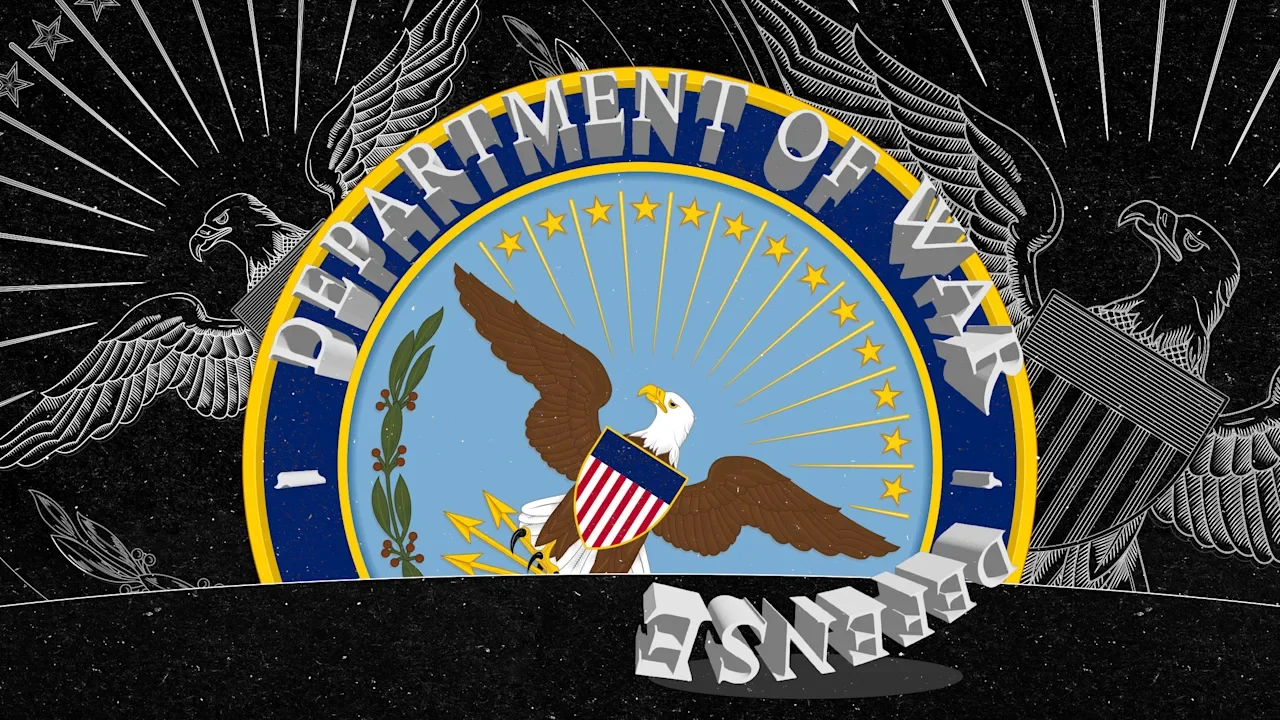
On November 14, Defense Secretary Pete Hegseth, screwdriver in hand, helped Pentagon facilities personnel install two new signs that read “Department of War.” After affixing the sign to the outside of the building, he turned toward onlookers and said, “Here we go.” Hegseth’s handyman moment was more than a symbolic gesture: It was the first act of what he and the The President administration hope will eventually be a wholesale rebrand of the Department of Defense to the Department of War. This rebrand—which would require updating 700,000 buildings and facilities worldwide (not to mention all of the other places the DOD would become the DOW)—could reportedly cost as much as $2 billion. Switching signage, letterhead, placards, and more President Donald The President signed an executive order in September giving the DOD a secondary “War” name, but to make it official will require an act of Congress, and it won’t come cheap, according to figures shared by four senior congressional staffers and two others briefed on the cost to NBC News. The estimated price tag would cover switching signage and letterhead, which together could cost about $1 billion alone, along with placards, badges, software, and code. Rebrands can be tricky for any brand, but they’re especially hard when dealing with public agencies and taxpayer dollars. The public and lawmakers have taken issue with The President’s plan to change the name of the Department of Defense to the Department of War, a name the U.S. used before its military agencies were consolidated following World War II. This isn’t just adding a few letters to a building, like The President has done at the White House. The DOD, the executive-level federal agency that oversees the branches of the U.S. Armed Forces, has more than 3 million personnel and both inward-facing and outward-facing brand assets at facilities in the U.S. and 80 countries around the world. For comparison, Walmart counts 2.1 million associates and stores in 19 countries. Opposition to the rebrand Hegseth said on November 14 that the DOD sign at the Pentagon was replaced “because we want everybody who comes through this door to know that we are deadly serious about the name change of this organization,” according to a press release. But YouGov polling in September found a 58% majority of U.S. adults oppose renaming the DOD, and there’s bipartisan opposition to making the secondary name formal. In a letter to the Congressional Budget Office in October, Senate Democrats on the Budget Committee cited both brand and budget concerns, writing that the new name “risks confusion, redundancy, and unnecessary cost expenditure.” “Given the The President administration’s repeated emphasis on fiscal restraint—particularly its aggressive use of illegal impoundments and now, unconstitutional pocket rescissions—this symbolic renaming is both wasteful and hypocritical,” Democrats wrote. “It appears to prioritize political theater over responsible governance, while diverting resources from core national security functions.” Senator Rand Paul, a Kentucky Republican, told CNN that he believes calling the DOD the Department of War “sends a bad signal to the world.” “In a world with nuclear weapons, I think glorifying war . . . is not something I’m in favor of,” Paul said. Republicans have introduced legislation in the House and Senate to rename the DOD, and Paul said he would “lead opposition” to it if it came before the Senate. Hidden costs The President has sought to cast himself as a peacemaker this year, which a war-themed rebrand is at odds with. It’s also at odds with his campaign promises. The President took office pledging to lower costs and rein in government spending, but coming up on a year back in office, persistent inflation and conspicuous government spending like his White House remodel project have taken a political toll. The President’s net approval rating is sagging, and a pricey rebrand project viewed by many as vanity might not help. Rebranding the DOD could cost taxpayers as much as $2 billion. Its political costs for The President could be even higher. View the full article
-
There's no guaranteed formula for TikTok virality. You can't predict which video will take off. But there are various strategies to increase your chances of achieving viral success on TikTok. These methods still can’t guarantee virality, but they can tip the scales in your favor. This article will share ten such tips to help you create viral content. But first: What does it even mean to go ‘viral’ on TikTok? Jump to a section: What counts as a viral TikTok video? Don’t chase virality just for the sake of it Consistency is the bedrock of virality There’s no one surefire formula for going viral on TikTok How long does it take for a TikTok to go viral? 10 ways to improve your odds of going viral on TikTok 1. Lead with a scroll-stopping hook 2. Use jump cuts to keep viewers engaged 3. Tap into current TikTok trends 4. Study viral videos in your niche for repeatable patterns 5. Keep videos short whenever possible 6. Add a clear call to action 7. Add your own spin to existing viral videos 8. Share your point of view on a controversial topic 9. Share surprising, valuable, out-of-the-ordinary tips 10. Let your personality shine in every video Virality is for a week, community is forever Go viral on TikTok FAQs What counts as a viral TikTok video?At which number of views, likes, comments, or shares does a video classify as a viral video? There’s no universally agreed-upon number, but a Reddit thread shows many TikTok users saying any video with 1 million or more views can be called viral. More important than the raw views, though, is whether the video reaches your target audience and turns those viewers into followers or customers. Here's how we think about viral success: How many relevant TikTok users did you reach: You don’t just want empty five minutes of fame that dies down in a day or two. Creating viral content is about reaching the right audience at scale, not anyone who’d watch.How many of those views converted into followers and/or conversions: Holding someone’s attention for a short video is one thing. Intriguing them enough to stick around, watch your other (not viral) TikTok videos, and hit follow is another. It’s the real win. Again, you don’t want empty reach. The goal is to create content that encourages viewers to stick around. How huge or slim are your chances of replicating this viral success on multiple platforms: A good idea is a good idea on every social media platform. TikTok videos that went viral should also achieve similar results (e.g., more-than-average engagement) on other social media platforms that support short-form video content.When you're thinking about going viral on TikTok, it helps to zoom out a bit: What do you actually want to happen after you go viral? With that, I’d also advise against using virality as the foundation of your social media strategy. Don’t chase virality just for the sake of itTikTok, a social media channel, has made a name for itself as ‘the place where virality takes birth without much effort.' And yes, sometimes creators get lucky and succeed with that one viral video. But those are outlier cases. Trying to go viral on TikTok just to go viral will lead to you: Creating bland content that doesn’t build a lasting impactGetting frustrated at not being able to go viral on TikTok (or not being able to replicate your one viral video’s success)Sharing content that gets a lot of engagement, but does nothing to achieve your long-term social media goals or reach the right audienceYour social media marketing plan should be to get more of your target audience to notice (and buy) from you. Going viral on TikTok is a means to an end, not the end itself. By showing up consistently and staying authentic, you’ll create the kind of community that supports you long after a single viral moment. Not to mention: While going viral on TikTok can certainly be immensely helpful, you should still be able to meet your targets by creating quality content — even if you don’t go viral on TikTok week after week, which leads me to the next section. Consistency is the bedrock of viralityI hate to say it, but your first TikTok video probably won't go viral. If you’re like most people, neither will your second. Or third. Or fourth. Or fifth. And that’s totally normal. A consistent posting schedule is not only part of a wholesome TikTok strategy, but also the foundation of going viral on TikTok. How? First, it’s simple science: The more you post, the higher your chances of creating engaging videos that go viral. The odds are in your favor with consistent posting.Second, your content ideas and video quality will improve: Again, the more you post, the more you’ll learn what kind of content your target audience loves and how to keep viewers engaged. You’ll have more TikTok analytics to guide your content creation, too.Third, the TikTok algorithm loves consistency: The TikTok algorithm pushes accounts that post frequently. It’ll show more of your videos on the For You page — increasing your chances of going viral on TikTok.💡Learn more: TikTok Algorithm Guide 2024Ideally, you should post videos at least once every day. The best approach is to keep virality as the secondary goal of your TikTok strategy. The primary objective should be to create engaging content that resonates and invites more of your target audience to follow you. This is also helpful because... There’s no one surefire formula for going viral on TikTokI said it in the intro, and I’ll say it again: There’s no known formula to go viral on TikTok. If there were, everyone would be using it. If going viral is your only goal, you might find yourself feeling frustrated and burnt out. Aim for growing organically rather than overnight. Work to increase the likelihood of creating a viral video, but don’t view it in a silo. Even if a video doesn’t go viral, it can still help add new followers to your TikTok audience. This is especially important, given that it can take a long time for your TikTok videos to go viral. How long does it take for a TikTok to go viral?Nobody knows for sure. The TikTok algorithm works in mysterious ways. Most TikToks that blow up do so within the first few days, but some take weeks — or even months — to catch fire when the algorithm resurfaces them. Focus on posting quality videos often, and let time work in your favor. The TikTok algorithm can be unpredictable, and sometimes it'll resurface your older videos to new audiences. All you can do is stick to posting consistently and hope to wake up to a million or more views. 10 ways to improve your odds of going viral on TikTokThe above caveats were essential to know and accept before you read about how to go viral on TikTok. Now that you’re aware of the nuances, let’s get into the actual tactics. Here are ten ways to increase your chances of going viral on TikTok: 1. Lead with a scroll-stopping hookYour video needs to grab attention right away, so people want to continue watching. And the only way to stop the scroll is to have an A+ hook — aka the sentence or phrase that starts your video. If you’re just using trending songs or sounds, your “hook” is the text or visual that pauses a watcher in their tracks. An example of a mind-blowing hook is a video that’s garnered over 16.3M views by Mila Jaye, where she says, “Cancel me, call me fake, block me, bully me in the comments, I truly do not care, but...” The video instantly captures your attention with the shock value of what Mila is saying. Using copywriting formulas can help you write more captivating hooks. Also, pay attention while scrolling your own For You page. Which videos are stopping you from scrolling? What did they do to capture your attention? Observation alone can inspire many creative hooks. 💡Related reading: 6 Psychological Techniques to Help You Write Great Social Media Hooks2. Use jump cuts to keep viewers engagedTikTok is notoriously famous for pushing content that serves a short attention span. But you know what keeps a user’s attention? Jump cuts in your video editing. Video editing — particularly jump cuts at the right moment — can convert the most boring topics into a compelling story. It keeps the viewers hooked till the end because it doesn’t ‘feel’ like work to watch the video. You don’t have to spend hours editing your videos. Do something simple, like shoot your video script from various camera angles and combine them using enough changes so the audience keeps watching. If you’re looking for an example of the best jump cuts, no one does it better than Armen Adamjan. Every single video of his is excellent, thanks to his energy and fast video cuts. 💡You might like: The 7 Best AI Video Tools for Creators and Marketers, Tried and Tested3. Tap into current TikTok trendsThere are three ways to use trends on TikTok: a. Find the latest TikTok trends and put your own spin on them. These are platform-wide trends that everyone is doing. You can put your own spin on them by customizing them to your niche. These trends also often extend to other social media channels. An example: the Wes Anderson trend. b. Use trending sounds in the background of your videos. These are popular audio clips or trending songs. Sometimes, these trending songs are also accompanied by unique TikTok trends or trending hashtags. An example is the ‘As it was’ song by Harry Styles. c. Create videos on niche-specific trends: These are the emerging trends in your industry. Conversations about them might be less popular on TikTok as a platform, but they are fresh & trending topics in your niche. For example, glass skin is one of the latest trends in the skincare world. Keep up to date on TikTok trends, trending sounds, and industry trends. This will help you find fresh ideas and increase the chances that a video will go viral. 4. Study viral videos in your niche for repeatable patternsThe TikTok algorithm is a master at studying user preferences and giving viewers exactly what they need. But thankfully, many videos that go viral are often like siblings — they share certain traits. Search for a term or keyword your audience might use to discover content like yours. Watch videos with the most engagement. What are the commonalities between them? For example: Are many of them dance videos with text above? If yes, create entertaining content.Are many of them personal and/or vulnerable? If yes, create behind-the-scenes content that keeps your audience engaged.Are many of them using trending sounds? If yes, it might be a good idea to find trending music & popular audio clips to use in your own videos.For instance, let’s say you’re a food creator. When I searched for “cooking tips” on TikTok, I found all videos with over a million views: Use their own audioShare one or more fundamental cooking principles‘Show’ how to implement the tip and/or hack step-by-stepThese insights can help me understand my audience’s behavior and create content they actually need. If you combine these with conclusions from the Creator Search Insights dashboard and your own TikTok analytics, you’re much more likely to hit the jackpot of a viral content idea. You can also practice competitive analysis and find which videos of your competitors are going viral. Use TikTok’s “Popular” tab in any TikTok account to instantly find anyone’s best-performing videos. Again, analyze the patterns here and look for commonalities. Are all the videos following specific storytelling techniques? Is all the viral content funny videos? Are all of them using trending sounds? Tracing these patterns will help you understand the key factors that make a video go viral. 5. Keep videos short whenever possibleThe TikTok algorithm monitors your average watch time. The more videos you post that people watch till the end, the more TikTok favors you over other creators. And shorter videos have a higher chance of improving your overall watch time. Creating content that’s short and straightforward will require you to put on the video editor’s hat. Go in with a red pen and cut any clip that doesn’t need to be there. CleanTok creator Azure MacCannell has a vast library of viral hits that all thrive due to their short length and use of trending sounds. 💡Dive deeper: The Ultimate Guide to TikTok Video Length (+ What Gets the Most Views)6. Add a clear call to actionOnce the love comes, it just keeps on coming. At the end of your video, encourage your audience to comment and/or share your content. This way, when your video performs well, you create an excellent feedback loop that keeps more people coming back. For example, Gigi Grombacher created a video asking her followers for their opinions, which got over 3.3M views and over 340 comments. The call to action prompts viewers to participate and chime in using the comments, increasing engagement on her post. If you post controversial takes or discuss current trends, comments might roll in simply because people want to keep the conversation going. Whatever you share, think of a strong ending that nudges your audience to engage with you. Pro tip: Social media engagement is a two-way street. Respond to as many comments as possible so your audience knows you’re actively participating in the conversation with them. 7. Add your own spin to existing viral videosTikTok content has a way of feeding off of each other. If a popular video in your niche is already getting traction, stitch your own video with it. Using the same hook will help retain TikTok users who have already seen the video on their feed. It can also be a positive signal to the TikTok algorithm when you add to the conversation. A great example is this viral stitch video by creator Nicole Fay featuring a viral fashion hack (over 17M views). ⚠️ Note: Don’t create content using random or irrelevant TikTok trends. Only stitch videos that fit in your social media niche. Try a unique method like Nicole, or add your own thoughts on a hot conversation topic. Whatever you choose, the video’s topic should fit with the TikTok community you already have. You don’t want to go viral on a random video that has nothing to do with your niche. 8. Share your point of view on a controversial topicIf you have the right marketing sources in your back pocket and if you practice active social listening, you’ll know what’s trending in your industry. Use these insights to create videos around controversial topics and share your opinion. This is similar to the previous method, where you stitch with a video that’s already viral. But instead of relying on the TikTok algorithm to show you a video that’s viral on the topic that you have a strong opinion on, you’re taking a more proactive approach. If the world is buzzing with conversation on a controversial topic, it will generate more reach on TikTok — even if you can’t find videos that are already viral on the subject matter. ⚠️ Note: Don’t be contrarian just to be contrarian. Yes, you will gain virality if you say something controversial, but if you don’t truly believe in what you’re saying, you’ll not build an authentic personal brand. And your TikTok community will lose trust in your content. A great example is this video (over 1.6M views) by Morgan Sanner, where she shared her long-standing opinion on return-to-office mandates. The topic is controversial in her niche (remote work) and to add fuel to the fire, it is also a trending topic in her industry as more and more companies are asking employees to return to the office. ⚡Pro tip: Don’t forget to use niche hashtags and the right keywords to get on the good side of TikTok SEO. Many people might be searching for trending hashtags or queries — especially when the subject matter is relevant to the present. Using trending and relevant hashtags will improve the discoverability of your TikTok content.9. Share surprising, valuable, out-of-the-ordinary tipsCreating viral content is often about sharing extraordinary, unique, and yet surprisingly simple tips within your niche. For example, beauty creator Lena created a video about a last-minute Halloween makeup hack that got over 28.9M views. The reason it went viral was: It’s timely: Halloween is right around the corner. People are already searching for last-minute tips similar to the ones Lena shared.It’s quick and straightforward: The short video length, combined with the easy-to-follow hack, makes Lena’s TikTok content extremely useful and actionable.A great way to find content ideas for this category is to use TikTok’s Creator Search Insights tool and your TikTok analytics. TikTok’s creator search insights can help you pinpoint content gaps in your audience’s feed. Your analytics can help you determine which content topics are a hit amongst your TikTok community. Combine the valuable insights you derive from these sources to find emerging trends and areas where you can offer easy-to-implement tips in your niche. 💡Continue learning: How to Get Your Next Idea Using TikTok's Creator Search Insights10. Let your personality shine in every videoAs corny as it sounds, your biggest advantage is being authentically you. Are you funny, quirky, silly in real life? Bring that energy into your TikTok presence. Creating videos that put your personality front and center will not only increase your chances of going viral but also make you much more memorable. Take Haley Pham. She has built a personal brand around her personality. Various videos of hers have gone viral, and surprise, surprise, most of them show her nature and demeanor. It can be uncomfortable to be completely yourself online, but lean into it to show people what sets you apart. Virality is for a week, community is foreverTikTok can take you from zero to viral success overnight. But if you're only focused on going viral, you might find yourself constantly frustrated and spinning your wheels. So let virality be a pleasant surprise, not the sole goal. Aim to scale your TikTok marketing, grow your followers, and build a solid community. Follow the principles above to create high-quality content for your audience that reaches more new people. If you go viral, nothing like it! But it takes a little time, don’t be disheartened. Focus on building your TikTok presence with authenticity and grace. Going viral will come sooner or later. Go viral on TikTok FAQsQ. How can I get my first 1,000 views on TikTok? A. Getting your first 1,000 views comes down to working with the TikTok algorithm. Keep your video as short as possibleGrab attention using a scroll-stopping hookPost when your target audience is most activePost 1-2 times daily to signal that you’re an active creatorUse trending sounds because the algo favors videos that have popular audiosTools like Buffer can help you plan and schedule content so you can stay consistent, even as you grow. Q. How do I make my TikTok go viral? A. There are no surefire ways to go viral on TikTok. However, you can use some strategies to increase the reach of your videos: Use an attention-grabbing hookEdit your videos with jump cuts to keep viewers engagedHop on trends that can be customized to your niche or industryStitch with an existing viral video that’s relevant in your industryQ. What is the 3-second rule on TikTok? A. The 3-second rule means you have roughly 3 seconds to hook someone on TikTok, or they're gone. TikTok's algorithm heavily weighs how long people watch your video. If viewers scroll past your content within 1-2 seconds, the algorithm assumes it isn't engaging and won't push it to more people. More TikTok resourcesHow Often Should You Post on TikTok? Data From 11 Million+ Posts9 Ways to Find Trending Sounds on TikTok in 2025 (While They're Still Popular)Posting on TikTok for 100 Days Changed Me: Here’s the System That Made it PossibleTikTok Algorithm Guide 2026: Everything We Know About How Videos Are RankedView the full article
-
Today marks a milestone: my 250th “Playing to Win/Practitioner Insights” series post. Back on October 5, 2020, when I published the first piece in this strategy series, “The Role of Management Systems in Strategy,” I was simply responding to a client’s question and trying to provide practical advice on the often-ignored fifth box of the Strategy Choice Cascade. I had no idea that first post would be the launch of a series that reaches 263,000 people (at last count) on a weekly basis. It feels fitting for this 250th post to return to the original topic in Revisiting Management Systems: The Nervous System of Strategy. And as always, you can find all the previous Playing to Win/Practitioner Insights here. I’m delighted to be joined in coauthoring this post by Steve Goldbach and Geoff Tuff. Both are former colleagues I mentored at Monitor Group and are now senior partners at Deloitte. They are the coauthors of three books, and their latest, Hone: How Purposeful Leaders Defy Drift, is dedicated entirely to the power of enabling management systems (EMS) as a leadership tool. This represents the combined view of the three of us. That original piece noted that many treat EMS as a lesser choice—a mere implementation detail tacked on at the end. It argued the opposite: that your strategy is not truly complete until you have specified the distinctive management systems (processes, structures, rules, and protocols) that will build, maintain, and reinforce the must-have capabilities that make your “where to play/how to win” (WTP/HTW) choice a reality. The emphasis in that first piece was distinctiveness, noting that generic management systems that simply replicate so-called best practices are a route to mediocrity. Hone offers a critical and complementary observation. While it is vital to have distinctive management systems to enable a distinctive strategy, all management systems—whether they are distinctive or not—motivate human behavior. Marshaling the right kind of human motivation is the critical underpinning of any successful strategy. Management systems frame “what good looks like” from a behavioral perspective in the organization. We believe nearly everyone shows up to work wanting to be successful; your systems should tell them how. In this way, if the WTP/HTW choice is the heart of strategy, then MHC are the muscles and EMS its nervous system—the network of signals, incentives, and feedback loops that translate strategic intent into coherent, day-to-day action. In biology, the nervous system is the body’s command center, regulating essential functions, processing inputs, and sending signals to muscles, allowing the body to react and control its functions. This is precisely what management systems do for an organization. They are the intricate web of formal rules and cultural norms that shape how people work together inside organizations. Formal systems might include how performance is evaluated, how financial targets are set, or promotion and hiring criteria. Cultural norms are the subtle cues and “unwritten rules” that dictate behavior, such as decision rights—who gets to make what choice, or even who is asked for an opinion. When all the management systems inside an organization are combined, they can either powerfully reinforce behavior consistent with what is necessary to support the strategy choices, or, all too often, hinder it entirely. The Barnacle Problem: Drift Erodes Distinctiveness A very common problem, particularly in large organizations, is that management systems tend to accumulate over time like barnacles on the hull of a ship. Barnacles create drag and can cause a ship to gradually drift off course. Layers of competing management systems have the same effect on organizations. The accumulation of management systems can happen for at least two core reasons: Many designers, narrow designs. Management systems are rarely designed as a set—they usually crop up to address a specific problem. A well-intentioned functional leader in finance creates a new budgeting process. HR adds a new performance metric. IT implements a new security protocol. Each system feels like a “good idea” in isolation, but they accumulate and often unintentionally conflict, sending mixed signals throughout the organization. Layering over, not uninstalling. Even when a company launches a “new strategy,” leaders rarely go back and remove or reshape the old systems. They just layer new ones on top while the old systems are still busily motivating the old behaviors. This accumulation erodes distinctiveness. Your carefully chosen, distinctive EMS are drowned out by the cacophony of the other systems, all pulling people in various directions. Drift is often imperceptible in the moment, and each subsequent deviation is similarly hard to see from the new direction of travel. It is only when a company is way off course that alarm bells start to sound—and by that time, subtle course correction is ineffective. A classic example of legacy management systems holding a company back happened at Sears decades ago. In the 1990s and early 2000s, leadership correctly identified e-commerce as a strategic imperative. They even had a massive advantage: a world-class catalog and fulfillment business. But the company’s formal management systems were barnacles. Its P&L structure and incentive plans were built entirely around the profitability of individual brick-and-mortar stores. When Sears.com was set up as a separate, competing P&L (the conventional wisdom at that time), store managers were inadvertently punished for behaviors that supported the new strategy. For example, if a customer wanted to return an online purchase to a local store (which was considerably easier at that time relative to today), the return would show up on the store’s P&L, reducing its profitability. This motivated store managers to resist taking online returns, something that might have presumably given Sears a leg up in the new online world. Drift tends to end badly. Organizations wake up and discover they are miles away from where they need to be to achieve their goals. They have no choice but to engage in so-called transformation—massive change at a rapid pace. These transformations are costly in terms of dollars, time, and human energy, and have very high failure rates. We are not “anti-transformation” per se; we just believe that with a bit more attention to day-to-day steering of the ship, much of that waste could be avoided. The Antidote to Drift: Honing Hone uses the metaphor of a chef’s knife. Good chefs don’t wait for their knives to become uselessly dull before fixing them. A dull knife is dangerous, so chefs hone it every single day before use. Honing is not sharpening. Sharpening grinds away metal to create a new edge—a transformative, costly act. Honing is a gentle, daily maintenance that realigns the existing edge, keeping it fit for purpose. Honing, as one chef described, is a “meditation and a maintenance” both keeping the knife serviceable and an act that reminds the chef of what’s needed in the forthcoming service. This is the antidote to drift. The external landscape any organization faces is constantly in motion: Customer preferences shift, competitors take new actions, technology advances, and regulation varies constantly. Leaders must respond by honing their organization with small changes to their EMS to steer behaviors consistent with the external shifts. Ideally this can happen by making small changes to existing management systems. But sometimes it might require creating a new distinctive system or “uninstalling” management systems that are no longer needed. The Four Seasons example from the first PTW/PI post impeccably illustrates honing. The “glitch reporting system”—where any employee, at any level, is empowered and rewarded for identifying and reporting a service “glitch”—is an EMS. But it’s not a static one. By its very design, it is a honing system, a feedback loop designed to identify and correct for small drifts (a slow room service order, a dirty light fixture, a slippery floor) in real time, long before they accumulate into a “bad service” barnacle. The Role: The CEO as Chief System Designer This leads to a final, critical point. If EMS are the nervous system of strategy, who is the brain? We have consistently argued that an organization’s leadership must own its strategy, not outsource it. On this front, we believe that CEOs must own the overall design of their collection of EMS. The CEO must be the “chief system designer” because the CEO is the only person in the organization with both the authority and visibility to ensure coherence and congruence across all the organizational systems. While CEOs can (and should) delegate the detailed design of a sales incentive plan or a supply chain metric, they must own the theory of how all those systems interact to collectively motivate the desired behavior. Bel Groupe (maker of brands such as BabyBel, GoGo squeeZ, and the Laughing Cow) is a terrific example of its CEO, Cécile Béliot-Zind, acting as the chief systems designer. Bel’s ownership and management team believe they can create competitive advantage by promoting a more sustainable food system. Béliot-Zind is fond of saying that “sustainability without profitability has no impact and profitability without sustainability has no future.” Bel helps support farmers with whom it works to implement in necessary regenerative practices while enabling a better living. As a result, the company has access to a more resilient, long-term supply chain. To reinforce this commitment, Bel became a mission-led company by law (société à mission) in France, formalizing this commitment in its company by-laws: a very strong management system creating consistency and a long-term commitment to this strategy. Béliot-Zind also knew there were other systems that needed to change to reduce the typical profit versus purpose friction that occurs in many organizations. Her solution was to redesign her finance department to fuse responsibility for both profit and societal impact into a single function. She created a chief impact officer role responsible simultaneously for profit and for societal impact, ensuring both are managed with the same rigor as a traditional P&L. That CEOs must be chief system designers doesn’t mean non-CEOs are powerless. On the contrary, all leaders can and should act as a chief system designer for their own team, honing the management systems within their control. And, just as important, they have a responsibility to identify and elevate the inconsistencies they see, making the case for why a particular system is causing drift. Practitioner Insights Here are four things you can do to put this into practice: Audit your management systems. At the start of every strategy process, we suggest uncovering your “strategy-in-use,” including identifying the key management systems that drive behavior today (whether they are distinctive or not). An easy way to find these is to ask why people behave the way they do inside the organization. Then ask: Do these systems, in their current form, support or conflict with our new WTP/HTW? Connect honing to your What Would Have to Be True (WWHTBT). Use the WWHTBT tool to assess your management systems. We are all fond of saying that strategy doesn’t come with an expiration date. It is good until one of its WWHTBTs is no longer true. This is your signal to hone. When a WWHTBT fails, or is being strained, identify the new behavior you need and then determine which management system must be adjusted (or created, or uninstalled) to motivate it. Stop Blaming Culture. Culture isn’t some immutable bogeyman. As has been pointed out in this series, you can hone it to support your strategy through changes to leadership behavior and careful modification of management systems. Find the specific management systems that are rewarding the behavior that creates cultural defects and change them. Culture is, in the end, a strategy choice. Be aware of your “tells.” Leaders at all levels: Recognize that you are a powerful informal management system. Your attention, your questions, and your emotional reactions in meetings send the clearest signals of all about “what good looks like.” Make sure your personal cues are in alignment with your stated goals. A full 249 PTW/PI later, the core message remains consistent. EMS is a critical element of strategy—its nervous system. Leverage it and hone it, and you will be generously rewarded. View the full article

-
Soooo, do you Labubu? The furry creature went viral this year thanks to Dua Lipa, Blackpink’s Lisa, and Kim Kardashian all buying into the adorably bizarre, plushy monsters. The results were millions in sales, long lines, and frantic scrambles as people tried to get their hands on this latest trendy phenom. Labubu’s Chinese parent company, Pop Mart, reported global revenue for Q3 (July through September) jumped by about 250% compared to a year earlier, and sales in America were up by more than 1,200%. But it goes beyond Pop Mart, as brands from South Korea, Japan, and other Asian countries are finding more inroads into American culture. Just as American cultural influence has spread around the world via Levi’s, Coca-Cola, McDonald’s, Apple, and more, now Asian brands are making it two-way traffic. Mixue, a Chinese ice cream and tea chain that recently overtook McDonald’s as the largest fast-food chain in the world, opened its first U.S. store in New York City in September. Luckin, a Chinese coffee chain, is coming for Starbucks after opening a shop in NYC, too. Chinese automaker BYD surpassed Tesla in EV sales globally last year and is eyeing American expansion. Korean skincare brand CosRX drives 90% of its revenue from international sales, with major traction among Gen Z Americans. Taiwanese restaurant chain Din Tai Fung—with 21 U.S. locations—now has the highest average per-location revenue of any American restaurant chain—$27.4 million per store. A new report from global ad agency network TBWA looks at some of the qualities that drove these companies’ overseas success. The report takes a deep dive into how exports like K-pop, matcha, anime, and Labubus have rebranded Asia for a new generation of consumers—and explores what U.S. brands can learn from it. “With the rise of K-beauty, J-beauty, and now in a world of Miniso and Pop Mart, we’re seeing brands from Asia really building emotional connection with consumers,” says Jen Costello, TBWA’s global chief strategy officer. “It’s not cheap, fast, low-cost, plastic crap, but it’s actually being supported by increasingly breakthrough products that have a real role in culture.” Found in translation The report outlines four underlying cultural values—deep mastery, unapologetic emotion, thoughtful friction, and social etiquette—that the new wave of Asian brands are particularly strong in. These obviously aren’t exclusive to Asian brands, just common threads among them. Deep Mastery Deep mastery revolves around the idea that as culture is increasingly saturated by AI-generated content and digital art, consumers are craving skill-based learning, time-honored craft, and enduring expertise. One brand example is Toku Saké and its focus solely on doing “one thing exceptionally well,” which is creating slow-brewed, small-batch sake. The idea is that specialization, rather than expansion, can be the new growth strategy for brands. Unapologetic Emotion Unapologetic emotion signifies a cultural pivot away from irony, sarcasm, and emotional detachment, where sincerity was often dismissed as “cringe.” The report says audiences are growing bored of performative nihilism, and find freedom in honest emotional expression. Here, Pop Mart’s Labubus are the brand example, rooted in the Japanese culture of kawaii (cuteness). Thoughtful Friction Thoughtful friction challenges the idea that speed and seamlessness equal freedom. Instead, the report contends, the promise of “effortless everything” leads to digital addiction, burnout, and waste. The report uses South Korea’s pay-as-you-throw food-waste system that requires residents to purchase special, volume-based bags, creating a daily constraint that incentivizes people to think twice before discarding waste and to buy only what they need. Costello says the concept of thoughtful friction surprised her the most. It’s unusual for brands to reject effortless experience in favor of creating intentional friction. “It’s counterintuitive to the way that a lot of brands think,” she says. “Especially for Western brands, it’s always about making it seamless. It is always about reducing friction. It is always about making it easy. But there is value in making people think for just a moment and having that be rewarding.” Social Etiquette The report defines social etiquette as an outlook that counters the hyper-individualism encouraged by the “main-character energy” cultural narrative, which has led to widespread incivility. It functions as “soft infrastructure” to preserve social harmony. The report says marketers should recognize that after years of “casual everything,” clear codes of conduct feel “refreshingly helpful.” One example is how Singapore Airlines has built its relationship between crew and passengers with high mutual respect, and has even considered rewarding passengers who demonstrate good behavior on flights through its loyalty program. New export confidence Pop culture and our ability to share it has made the world a much smaller place. The report posits that these core values have played a significant role in Asian brands making inroads with Western audiences. It’s also supported by a boom in tourism. (Visits to Japan soared by 16% last year, and Japan, Thailand, and South Korea are among the top 10 destinations for Gen Z travelers, according to travel visa service Ztartvisa.) Emmanuel Sabbagh, TBWA\Asia’s chief strategy officer, says this overall cultural boost has given brands from Asia more confidence in talking to international audiences. “For many, this is the very first time they’re seeing appeal from the West,” says Sabbagh. “They feel way more confident to be who they are and to express who they are to the rest of the world. It’s a big shift. They say that this is their way to go bigger, stronger, not changed for the West. They want to be more themselves.” Traditionally, Asian companies have been stronger on product than building brands, particularly ones that translate to the West. That challenge remains for many of them. Sabbagh says the brand culture in America is very mature, in terms of how the logo, experience, and story are all tied together. “That’s where brands from the East are not as strong as they should be,” Sabbagh says. “Even a brand as big as Uniqlo, think about how they can go bigger into what is the promise, what is the real brand platform, what people will look for in that specific brand.” Sabbagh adds that many Asian brands hyper focus on process and manufacturing, but that leaves incredible white space for them to grow on the brand side of things. “The brand is what they are missing as the vehicle to go to the other side of the world and to be stronger in their own market,” he says. The aim of the report isn’t to get Western brands to mimic their Eastern counterparts, but rather to use their success to identify insights that work for their own audiences. “The whole point is to make sure that you’re not just trying to hold up a mirror to these values, but find your version of it, find your truth in it, find what makes it real for you,” says Costello. “This isn’t about going out and trying to replicate exactly what Pop Mart or Miniso have done.” View the full article

-
Two new data centers in Silicon Valley have been built but can’t begin processing information: The equipment that would supply them with electricity isn’t available. It’s just one example of a crisis facing the U.S. power grid that can’t be solved simply by building more power lines, approving new power generation, or changing out grid software. The equipment needed to keep the grid running—transformers that regulate voltage, circuit breakers that protect against faults, high-voltage cables that carry power across regions, and steel poles that hold the network together—is hard to make, and materials are limited. Supply-chain bottlenecks are taking years to clear, delaying projects, inflating costs, and threatening reliability. Meanwhile, U.S. electricity demand is surging from several sources—electrification of home and business appliances and equipment, increased domestic manufacturing, and growth in AI data centers. Without the right equipment, these efforts may take years longer and cost vast sums more than planners expect. Not enough transformers to replace aging units Transformers are key to the electricity grid: They regulate voltage as power travels across the wires, increasing voltage for more efficient long-distance transmission, and decreasing it for medium-distance travel and again for delivery to buildings. The National Renewable Energy Laboratory estimates that the U.S. has about 60 million to 80 million high-voltage distribution transformers in service. More than half of them are 33-plus years old—approaching or exceeding their expected lifespans. Replacing them has become costly and time-consuming, with utilities reporting that transformers cost four to six times what they cost before 2022, in addition to the multiyear wait times. To meet rising electricity demand, the country will need many more of them—perhaps twice as many as already exist. The North American Electric Reliability Corp. says the lead time, the wait between placing an order and the product being delivered, hit roughly 120 weeks (more than two years) in 2024, with large power transformers taking as long as 210 weeks (up to four years). Even smaller transformers used to reduce voltage for distribution to homes and businesses are back-ordered as much as two years. Those delays have slowed both maintenance and new construction across much of the grid. Transformer production depends heavily on a handful of materials and suppliers. The cores of most U.S transformers use grain-oriented electrical steel, a special type of steel with particular magnetic properties, which is made domestically only by Cleveland-Cliffs at plants in Pennsylvania and Ohio. Imports have long filled the gap: Roughly 80% of large transformers have historically been imported from Mexico, China, and Thailand. But global demand has also surged, tightening access to steel, as well as copper, a soft metal that conducts electricity well and is crucial in wiring. In partial recognition of these shortages, in April 2024, the U.S. Department of Energy delayed the enforcement of new energy-efficiency rules for transformers, to avoid making the situation worse. Further slowing progress, these items cannot be mass-produced. They must be designed, tested, and certified individually. Even when units are built, getting them to where they are needed can be a feat. Large power transformers often weigh between 100 tons and 400 tons and require specialized transport—sometimes needing one of only about 10 suitable super-heavy-load railcars in the country. Those logistics alone can add months to a replacement project, according to the Department of Energy. Raimond SpekkingCC BY-SA 4.0 Other key equipment Transformers are not the only grid machinery facing delays. A Duke University Nicholas Institute study, citing data from research and consulting firm Wood Mackenzie, shows that high-voltage circuit-breaker lead times reached about 151 weeks (nearly three years) by late 2023, roughly double pre-pandemic norms. Facing similar delays are a range of equipment types, such as transmission cables that can handle high voltages, switchgear—a technical category that includes switches, circuit breakers, and fuses—and insulators to keep electricity from going where it would be dangerous. For transmission projects, equipment delays can derail timelines. High-voltage direct-current cables now take more than 24 months to procure, and offshore wind projects are particularly strained: Orders for undersea cables can take more than a decade to fill. And fewer than 50 cable-laying vessels operate worldwide, limiting how quickly manufacturers can install them, even once they are manufactured. Supply-chain strains are hitting even the workhorse of the power grid: natural gas turbines. Manufacturers, including Siemens Energy and GE Vernova, have multiyear backlogs as new data centers, industrial electrification, and peaking-capacity projects flood the order books. Siemens recently reported a record $158 billion backlog, with some turbine frames sold out for as long as seven years. Alternate approaches As a result of these delays, utility companies are finding other ways to meet demand, such as battery storage, actively managing electricity demand, upgrading existing equipment to produce more power, or even reviving decommissioned generation sites. Some utilities are stockpiling materials for their own use or to sell to other companies, which can shrink delays from years to weeks. There have been various other efforts, too. In addition to delaying transformer efficiency requirements, the Biden administration awarded Cleveland-Cliffs $500 million to upgrade its electrical-steel plants—but key elements of that grant were canceled by the The President administration. Utilities and industry groups are exploring standardized designs and modular substations to cut lead times—but acknowledge that those are medium-term fixes, not quick solutions. Large government incentives, including grants, loans, and guaranteed-purchase agreements, could help expand domestic production of these materials and supplies. But for now, the numbers remain stark: roughly 120 weeks for transformers, up to four years for large units, nearly three years for breakers, and more than two years for high-voltage cable manufacturing. Until the underlying supply-chain choke points—steel, copper, insulation materials, and heavy transport—expand meaningfully, utilities are managing reliability not through construction but through choreography. Morgan Bazilian is a professor of public policy and director at the Payne Institute, Colorado School of Mines. Kyri Baker is an associate professor of civil, environmental, and architectural engineering at the University of Colorado Boulder. This article is republished from The Conversation under a Creative Commons license. Read the original article. View the full article

-
Google's John Mueller answers question about the SEO value of a keyword-based generic Top Level Domain The post Google On Generic Top Level Domains For SEO appeared first on Search Engine Journal. View the full article
-
What’s one thing every leader can do to make sure employees are happy at work and engaged with their jobs? Make sure they can trust in you, your organization, and one another. That’s the finding in a 2024 meta-analysis of studies with more than 1 million participants. When leaders seek to improve employee well-being, they typically think about things like remote work, flexible schedules, and wellness offerings such as gym memberships. But trust may be the most valuable perk of all. A 2024 meta-analysis by an international research team led by Minxiang Zhao and Yixuan Li of the Renmin University of China psychology department examined 132 studies on trust from around the world. The studies had a total of more than 1 million participants. The researchers focused on two types of trust, interpersonal trust and institutional trust, exactly the two types that can occur in workplaces. They found that both types of trust correlate with social, psychological, and to a lesser extent, physical well-being. If trust is so important, how do you get more of it? Unlike some other things, you can’t mandate trust, and you can’t demand that employees trust you, your company, or one another. But you can provide a workplace culture where trust can flourish. Here are some ways to do that. 1. Be transparent If you want employees to trust you and your company, it’s obviously important to treat them fairly. But it’s almost as important to let them know what’s going on. You may have to find a delicate balance between sharing competitive information and keeping too much to yourself. But half the employees in a recent survey said lack of information about what was going on at their companies was their biggest source of stress. Keep that in mind when considering whether to share bad news. 2. Be predictable Many years ago, a CEO known for turning troubled companies around told me that his employees should never have to guess how he would answer a question. He told them his top priorities so they could always predict what he would say. He never wavered from those priorities. We may be fascinated with leaders like Elon Musk who often change their minds. But we trust those like Warren Buffett, who consistently say the same things year after year. The more they can predict what you will say and do, the easier it is for employees to trust you. 3. Be trusting yourself It may be hard for employees to trust you if, say, they know you’re using software to monitor their keystrokes. Admittedly, treating employees with trust can backfire in the short term if you trust the wrong person. But in the long term, research shows that more trusting organizations tend to perform better, even in the often mistrustful retail industry. I believe the reason for this is that, while we can easily see the cost of employee dishonesty when it happens, we don’t always recognize that our mistrust comes at a high cost as well. If an employee has their bag searched every time they leave work, they won’t feel the same trust or affection for the company that they otherwise might. And it’s human nature for them to try to figure out a way to sneak items out despite the search. 4. Help employees trust one another Setting up competitions that pit employees against each other for important things like compensation can bring about acrimony and mistrust among them. Here again, the short-term gain may not be worth the long-term loss. Employees who trust their coworkers are more likely to collaborate effectively with them. They’re also likely to be happier, and to stay in their jobs. Relationships at work are often the biggest deterrent to leaving a company. You can help foster those relationships by asking people to collaborate on important projects and letting them share the credit equally. You can also create teams across different functions so that employees get to know their colleagues outside their immediate areas. And of course, any opportunity for employees to socialize, get together outside of work, or work together on community projects can help create those relationships and that trust. In my book Career Self-Care, I explore workplace happiness, and how relationships at work can contribute to that happiness or detract from it. The more employees can trust in you, your company, and one another, the happier and less burned out they’ll be. It’s your job as a leader to make that happen. Like this column? Sign up to subscribe to email alerts and you’ll never miss a post. The opinions expressed here by Inc.com columnists are their own, not those of Inc.com. —Minda Zetlin This article originally appeared on Fast Company’s sister publication, Inc. Inc. is the voice of the American entrepreneur. We inspire, inform, and document the most fascinating people in business: the risk-takers, the innovators, and the ultra-driven go-getters that represent the most dynamic force in the American economy. View the full article

-
Tim Cook has led Apple for the past 14 years. In that time, the company’s market cap has jumped from $348 billion to $4 trillion. While his predecessor, Steve Jobs, might have been a leader in the field of innovation, few CEOs have shown the business acumen of Cook. But according to a report in the Financial Times, Cook’s run as CEO could be over as soon as next year. The report has set off a guessing game as to who will take over the tech giant when Cook departs. (Apple did not respond to a request for comment on the FT story.) The name most commonly mentioned is John Ternus, Apple’s senior vice president of hardware engineering, though reportedly no final decisions have been made yet. Ternus wasn’t always the first choice. Jeff Williams was once seen as Cook’s most likely successor, but he ended his operational responsibilities in July and plans to retire in the next six weeks. Craig Federighi, Apple’s senior vice president of software engineering, and Greg Joswiak, senior vice president of worldwide marketing, have also been mentioned as possible successors in the past. However, both the Financial Times and Bloomberg’s Mark Gurman have said Ternus is the heir apparent. So who is the person who could inherit Apple as it approaches its latest crossroads—with product design more important than ever and AI coming to the forefront? Meet John Ternus At just 50, Ternus is the youngest top executive at Apple, but he’s hardly a newcomer. He has been with the company for nearly 24 years, leading the hardware engineering division since 2013. That puts him in charge of the teams behind the iPhone, iPad, AirPods, Mac, and more. Over the past five years, he has become a more visible presence at Apple events, unveiling the iPhone Air in early 2025 and showing off Apple’s first silicon chip, the M1, in 2000. His engineering background could assuage critics who have complained Apple has become a less revolutionary company under Cook’s leadership (despite the hundreds of products released during his tenure). Ternus started his career in tech at Virtual Research Systems, working on VR headsets for four years before joining Apple in 2001, which let him work on several products that would prove to be iconic for the company. By 2013, he was overseeing Mac and iPad development and added the iPhone hardware to his list of supervised products in 2020. He is said to be well-liked at the company and by Cook, helping to contribute to product road maps and future strategies for Apple. Will Cook retire? Cook turned 65 this month, which has warmed up the talk of his eventual retirement, but he has previously downplayed questions about whether he plans to step down. In January, Cook was a guest on the Table Manners podcast and said his retirement, whenever it should happen to occur, won’t meet “the traditional definition.” He added he likely has many years left at Apple, though with the caveat that he doesn’t want to be a CEO for the rest of his life. “I don’t see being at home doing nothing and not [being] intellectually stimulated and thinking about how tomorrow can be better than today,” he said. “I think I’ll always be wired in that kind of way and want to work.” View the full article
-
If it seems like everything is getting more expensive, you’re right. Thanks to inflation (up 3%), which has affected goods from food to gas (for which prices are up 4.1%), you can now add the post office to the the long list of places where you’ll have to pay more. Here’s what to know. What’s happening? The U.S. Postal Service (USPS) is planning to increase the price of shipping. The good news is, the changes won’t affect your holiday packages and won’t raise the price of stamps. The changes go into effect next year on January 18, pending a review by the Postal Regulatory Commission (PRC). How much will prices go up? The move will raise prices approximately 6.6% for Priority Mail, 5.1% for Priority Mail Express, 7.8% for USPS Ground Advantage, and 6% for Parcel Select. Although mail price increases are based on the consumer price index, shipping prices are primarily adjusted according to market conditions, USPS said in a news release. Why is the post office raising prices? The price hike is aimed at generating revenue for the ailing U.S. Postal Service. It’s part of its 10-year “modernization and transformation plan” to make the agency financially sustainable over the long term, and able to continue delivering mail and packages at least six days a week. It comes as USPS posted a $9 billion loss for the 2025 fiscal year—which is actually a better financial outcome than last year, when it lost $9.5 billion. One thing to note: USPS relies on revenue from its postage, products, and services to keep it afloat—not tax dollars. How can I find out more about the new prices? The complete USPS price filing, with prices for all products, can be found on the PRC’s website at prc.arkcase.com/portal/filings, or on USPS’s website at pe.usps.com/PriceChange/Index. View the full article

-
It’s happened to you countless times: You’re waiting for a website to load, only to see a box with a little mountain range where an image should be. It’s the placeholder icon for a “missing image.” But have you ever wondered why this scene came to be universally adopted? As a scholar of environmental humanities, I pay attention to how symbols of wilderness appear in everyday life. The little mountain icon—sometimes with a sun or cloud in the background, other times crossed out or broken—has become the standard symbol, across digital platforms, to signal something missing or something to come. It appears in all sorts of contexts, and the more you look for this icon, the more you’ll see it. CC BY-SA You click on it in Microsoft Word or PowerPoint when you want to add a picture. You can purchase an ironic poster of the icon to put on your wall. The other morning, I even noticed a version of it in my Subaru’s infotainment display as a stand-in for a radio station logo. So why this particular image of the mountain peaks? And where did it come from? Arriving at the same solution The placeholder icon can be thought of as a form of semiotic convergence, or when a symbol ends up meaning the same thing in a variety of contexts. For example, the magnifying glass is widely understood as “search,” while the image of a leaf means “eco-friendly.” It’s also related to something called “convergent design evolution,” or when organisms or cultures—even if they have little or no contact—settle on a similar shape or solution for something. In evolutionary biology, you can see convergent design evolution in bats, birds, and insects, which all utilize wings but developed them in their own ways. Stilt houses emerged in various cultures across the globe as a way to build durable homes along shorelines and riverbanks. More recently, engineers in different parts of the world designed similar airplane fuselages independent of one another. For whatever reason, the little mountain just worked across platforms to evoke open-ended meanings: Early web developers needed a simple shorthand way to present that something else should or could be there. Depending on context, a little mountain might invite a user to insert a picture in a document; it might mean that an image is trying to load, or is being uploaded; or it could mean an image is missing or broken. Down the rabbit hole on a mountain But of the millions of possibilities, why a mountain? In 1994, visual designer Marsh Chamberlain created a graphic featuring three colorful shapes as a stand-in for a missing image or broken link for the web browser Netscape Navigator. The shapes appeared on a piece of paper with a ripped corner. Though the paper with the rip will sometimes now appear with the mountain, it isn’t clear when the square, circle, and triangle became a mountain. Althepal/Wikimedia CommonsCC BY Users on Stack Exchange, a forum for developers, suggest that the mountain peak icon may trace back to the “landscape mode” icon on the dials of Japanese SLR cameras. It’s the feature that sets the aperture to maximize the depth of field so that both the foreground and background are in focus. The landscape scene mode—visible on many digital cameras in the 1990s—was generically represented by two mountain peaks, with the idea that the camera user would intuitively know to use this setting outdoors. Another insight emerged from the Stack Exchange discussion: The icon bears a resemblance to the Microsoft XP wallpaper called “Bliss.” If you had a PC in the years after 2001, you probably recall the rolling green hills with blue sky and wispy clouds. The stock photo was taken by National Geographic photographer Charles O’Rear. It was then purchased by Bill Gates’ digital licensing company Corbis in 1998. The empty hillside in this picture became iconic through its adoption by Windows XP as its default desktop wallpaper image. Mountain riddles “Bliss” became widely understood as the most generic of generic stock photos, in the same way the placeholder icon became universally understood to mean “missing image.” And I don’t think it’s a coincidence that they both feature mountains or hills and a sky. Mountains and skies are mysterious and full of possibilities, even if they remain beyond grasp. Consider Japanese artist Hokusai’s “36 Views of Mount Fuji,” which were his series of paintings from the 1830s—the most famous of which is probably “The Great Wave off Kanagawa,” where a tiny Mount Fuji can be seen in the background. Each painting features the iconic mountain from different perspectives and is full of little details; all possess an ambiance of mystery. I wouldn’t be surprised if the landscape icon on those Japanese camera dials emerged as a minimalist reference to Mount Fuji, Japan’s highest mountain. From some perspectives, Mount Fuji rises behind a smaller incline. And the Japanese photography company Fujifilm even borrowed the namesake of that mountain for their brand. The enticing aesthetics of mountains also reminded me of the environmental writer Gary Snyder’s 1965 translation of Han Shan’s “Cold Mountain Poems.” Han Shan—his name literally means “Cold Mountain”—was a Chinese Buddhist poet who lived in the late eighth century. “Shan” translates as “mountain” and is represented by the Chinese character 山, which also resembles a mountain. Han Shan’s poems, which are little riddles themselves, revel in the bewildering aspects of mountains: Cold Mountain is a house Without beams or walls. The six doors left and right are open The hall is a blue sky. The rooms are all vacant and vague. The east wall beats on the west wall At the center nothing. The mystery is the point I think mountains serve as a universal representation of something unseen and longed for—whether it’s in a poem or on a sluggish internet browser—because people can see a mountain and wonder what might be there. The placeholder icon does what mountains have done for millennia, serving as what the environmental philosopher Margret Grebowicz describes as an object of desire. To Grebowicz, mountains exist as places to behold, explore, and sometimes conquer. The placeholder icon’s inherent ambiguity is baked into its form: Mountains are often regarded as distant, foreboding places. At the same time, the little peaks appear in all sorts of mundane computing circumstances. The icon could even be a curious sign of how humans can’t help but be “nature-positive,” even when on computers or phones. This small icon holds so much, and yet it can also paradoxically mean that there is nothing to see at all. Viewing it this way, an example of semiotic convergence becomes a tiny allegory for digital life writ large: a wilderness of possibilities, with so much just out of reach. Christopher Schaberg is a director of public scholarship at Washington University in St. Louis. This article is republished from The Conversation under a Creative Commons license. Read the original article. View the full article

-
Activist investor encouraged by idea that the miner could split into two companies under new bossView the full article
-
What does it mean to be “smart” or “dumb”? Few questions are more deceptively complex. Most of us have strong opinions about what those words mean, but scratch the surface and it becomes clear that “smart” and “dumb” are slippery, subjective constructs. What seems smart to one person may strike another as naive, arrogant, or shortsighted. Worse still, our own perception of what’s smart can shift over time. Yesterday’s clever decision can look like today’s regrettable blunder. Take Jay Gatsby, for instance. His grand plan to reinvent himself, amass a fortune, and win back Daisy once seemed like the height of romantic intelligence; but in the end, it revealed itself as delusional folly, built on illusions as fragile as the dream he chased. For a famous path reversal (from allegedly dumb to obviously smart), consider Forrest Gump, whose simple, seemingly naive choices (e.g., running across America or investing in “some fruit company”) looked foolish to everyone around him. Yet his lack of overthinking and unpretentious sincerity led him to happiness, wealth, and a kind of quiet genius that outsmarted all the so-called smart people. In hindsight, we often discover that our supposed genius was merely luck, and our “dumb” mistakes were actually learning opportunities in disguise. In short: Being smart isn’t a fixed trait; it’s a moving target defined by outcomes, context, and time. In line with that, we tend to withhold judgment until we’ve seen enough evidence. After all, anyone can have flashes of brilliance or moments of foolishness—what matters is the overall pattern. That’s why we evaluate intelligence not by a single act, but by the consistency of choices and behaviors over time. The science of adaptability Charles Darwin famously noted, “It is not the strongest of the species that survives, nor the most intelligent, but the one most adaptable to change.” Along the same lines, psychologists (who are often largely footnotes to Darwin) have a relatively simple and more objective way to define smart versus dumb behavior: adaptability. In that sense, what we call “intelligence” is largely the capacity to adjust one’s behavior to achieve desired outcomes in a changing environment. In other words, smart behavior increases your chances of success, survival, or well-being. Dumb behavior does the opposite. When faced with different options, the smartness of your choice can be judged by its consequences. If your decision enhances your opportunities, relationships, reputation, or resilience, it’s smart. If it narrows your prospects or makes your life worse, it’s dumb. Crucially, this definition also accommodates social consensus. One person’s opinion may be biased, but when many independent observers agree that an action was wise (or foolish), that consensus is usually a good proxy for truth. You can fool some people some of the time, but not everyone all the time. IQ vs. EQ: 2 pathways to smart behavior When it comes to predicting whether people will behave intelligently or not, two psychological constructs stand out: IQ and EQ. IQ (intelligence quotient) reflects cognitive ability—that is, how effectively you learn, reason, and solve abstract problems. It’s the single best predictor of performance in well-defined, rule-bound contexts such as school exams, technical analysis, programming, or chess. People with higher IQs tend to make better decisions when the problem has a right answer. EQ (emotional quotient), on the other hand, captures the capacity to understand and manage emotions, both your own and others’. It predicts success in less structured, interpersonal domains: leading teams, negotiating, managing conflict, or handling stress. In these fuzzy, ambiguous situations, there are rarely clear “right” answers, and emotional intelligence helps navigate the gray zones. Both forms of intelligence matter. IQ helps you see patterns; EQ helps you see people. False stereotypes: book-smart vs. street-smart Part of the reason people resist IQ is that they equate it with cold, academic, or impractical intelligence: the “book-smart but clueless” archetype. Think of high-IQ figures who made disastrous real-world choices: the Enron executives with MBAs from top schools who engineered their own collapse, or Nobel laureates who lost fortunes day-trading because they overestimated their models. Brilliant analysts but poor decision-makers. Conversely, high-EQ individuals (likable, empathetic, persuasive) are often celebrated as “street-smart.” They can read a room, defuse tension, and influence others. Yet this doesn’t mean they always make wise choices either. Importantly, research shows that IQ and EQ are largely uncorrelated. You can be high on both, low on both, or excel in one and lag in the other. They’re complementary tools—like having both a hammer and a screwdriver. One won’t replace the other, but together they let you handle a wider range of problems. Why high-IQ people do dumb things So why do objectively intelligent people sometimes behave foolishly? A few recurring patterns explain it. Overconfidence in reasoning. High-IQ individuals often trust their logic too much, ignoring emotional or contextual cues. This “cognitive arrogance” leads to blind spots, especially in social or moral dilemmas. Complexification. Smart people can overcomplicate simple problems, mistaking verbosity or abstraction for insight. They build intricate arguments to justify poor decisions. True intelligence is making complex things simple, rather than vice versa. Confirmation bias. The cleverer you are, the better you become at rationalizing your mistakes. Intelligence amplifies self-deception when ego is at stake. Too often, smart people are more interested in lubricating their egos than in making the right decision—their desire to feel smart may surpass their appetite for getting to the solution of a problem. Risk illusion. Intelligent people often feel they can “outsmart” uncertainty, taking reckless bets (financial, professional, or personal) under the illusion of control. In particular, when intelligence combines with narcissistic tendencies, it may lead to intellectual underperformance at the expense of grandiosity. Narrow optimization. They focus on optimizing a specific variable (e.g., efficiency, profit, prestige) while ignoring broader consequences. A “smart” business strategy that erodes trust or well-being isn’t smart in the long run. In short, high IQ can make you better at justifying dumb ideas, as well as defending your arguments and actions against others, leading to the “smartest person in the room” syndrome. When emotional intelligence backfires EQ provides no immunity against stupidity either. In fact, its virtues can become liabilities when taken too far. Empathy surplus. Being too attuned to others’ emotions can make you overly accommodating or reluctant to deliver hard truths. Agreeableness overdrive. High-EQ people often avoid conflict, even when confrontation is necessary to prevent bigger problems later. And people who focus on avoiding conflict end up causing a great deal of conflict in the long run. Emotional manipulation. The dark side of EQ is Machiavellian charm, using emotional awareness to manipulate rather than connect. Compassion fatigue. Caring too much can lead to burnout, especially in leadership or caregiving roles. In any job or organization, especially in competitive settings, if you optimize for getting along, you will impair people’s appetite for getting ahead. Emotional suppression. Some emotionally “mature” individuals regulate so well that they disconnect from their authentic feelings, losing spontaneity and creativity. In essence, EQ without boundaries can make you a “nice fool”—liked by everyone, exploited by many. The meta-skill: coachability and learning If IQ and EQ help you make smart choices, what helps you stay smart? The answer is coachability, the willingness and ability to learn from mistakes. This meta-skill distinguishes the chronically dumb from the progressively smart. Everyone makes errors; only the adaptable learn from them. Here are five evidence-based ways to improve your decision-making intelligence. Seek feedback relentlessly. Smart people solicit criticism before failure makes it unavoidable. The goal isn’t to be right; it’s to actually get better (evolve, develop, grow, etc.). Distinguish process from outcome. A good decision can lead to a bad result, and vice versa. Evaluate how you decided, not just what happened. Question your certainties. Treat your beliefs as hypotheses to test, not truths to defend. Balance emotion and logic. Before major decisions, ask: Am I thinking clearly and feeling right about this? IQ and EQ can actually work together to improve outcomes, but you will need to manage this tension and turn them into allies. Study your own patterns. Keep a decision diary, record choices, predictions, and outcomes . . . or at least reflect, get feedback, assess, and recalibrate. Over time, you’ll see which biases or emotions trip you up. In short, the smartest people aren’t those who never err; they’re the ones who systematize their learning from errors. What ultimately separates wisdom from folly isn’t intellect or emotion alone, but the capacity to adapt—to learn, recalibrate, and improve. As author and Harvard professor Amy Edmondson compellingly illustrates: In the end, smartness is less about having the right answers and more about asking better questions after you’ve been wrong. The truly intelligent person is not the one who avoids dumb mistakes, but the one who refuses to repeat them. View the full article

-
It’s been 70 years since Douglas McGregor sketched a management theory at MIT Sloan that leaders still ignore—and their teams pay the price. Known as Theory X and Theory Y, McGregor’s framework built on Abraham Maslow’s work on employee self-actualization, and it quickly became one of the foundational texts of modern management thinking. In McGregor’s theory, leaders fall into two camps. Theory X managers assume that employees are inherently lazy, need constant supervision, and would rather coast along than contribute. Theory Y managers, by contrast, see employees as self-motivated, responsible, and capable of growth if given the right environment. And the kicker is that both kinds of managers usually get exactly the employees they expect, no matter who they originally hired. What McGregor was tapping into was the fact that certain beliefs have an uncanny way of turning into real, measurable effects on human behavior. Whether it’s placebo studies in medicine or examining how teachers’ expectations impact classroom performance, the science is unambiguous about how far-reaching effects simple expectations can have. The psychology behind high expectations Psychologists were among the first to observe and take note of the feedback loops that expectations set off. Take the now-famous study by Rosenthal and Jacobson in 1968. Elementary school teachers were told that a group of randomly selected students had been identified as “late bloomers” who were about to show remarkable academic growth. The result surprised even the researchers themselves. Those students did indeed outperform their peers, in part because the teachers, subconsciously or not, started treating them differently by offering more encouragement, more patience, and more challenging material. The students responded in kind, rising to the challenge now that someone in authority believed them capable of meeting it. The only thing that had changed was the expectations. Journalist David Robson chronicles just how far this phenomenon goes in The Expectation Effect, a book that should be required reading for leadership. From placebo heart surgeries that deliver real relief to workouts that burn more fat just because people believe they’re working harder, Robson lays out the scientific evidence showing how our expectations construct reality around us. The psychology behind the effect is simple: Your brain doesn’t sit around waiting for input like a neutral recordkeeper. It ceaselessly guesses and simulates what might happen so that you can be prepared for whatever comes across your desk. At each moment, the brain is busy constructing an internal map of what’s likely to happen, and then it updates that map based on whatever comes next. It’s no surprise to find that our expectations prime the brain’s sensory and emotional circuits almost as if it’s already happening. If you are expecting pain, the amygdala lights up before you even stub your toe. If you expect failure, your cortisol rises, your attention narrows, and your working memory takes a hit before you’ve even started the task. Expect a sense of existential dread and meaninglessness at work? Here you go, says the brain, lowering your dopamine levels until motivation plummets because your brain’s prediction model no longer sees a reason to invest cognitive effort. That’s why a sugar pill can relieve chronic pain, why sham surgeries produce real outcomes, and why a warm-up jog feels harder if you think it’s the workout. The experience conforms to the prediction, and belief becomes biology. When leaders talk about “setting the tone” or “creating a culture of excellence,” they’re not that far from hitting upon something truly powerful. If we accept that expectations change biology, cognition, and motivation, then leveling them appropriately becomes one of leadership’s central tasks. Be careful what you expect, because you might get it If you walk into a boardroom assuming your team lacks ambition, you’ll subconsciously act like it by designing processes that assume failure. Your team, in turn, will rise—or in this case, sink—to the level you’ve set. Welcome to management by cynicism. Nelson Repenning, an MIT Sloan School of Management professor and coauthor of the new book There’s Got to Be a Better Way, has spent his career helping leaders break out of this cycle. He advises leaders to expect more—and better—from their people as a starting point. “When people fail, we treat it like a character flaw. But in most organizations, failure is a design problem,” he says. “The question every leader should ask isn’t ‘why did they screw up?’ It’s ‘what about our system made it easy to screw up?’” Repenning and his longtime collaborator Don Kieffer argue that modern management has become too disconnected from the work itself. “You’d be amazed how many executives can’t describe how the work actually gets done,” Kieffer says. “It’s like trying to fix a car without opening the hood. These leaders can’t set a good expectation because they’re so far removed from reality to begin with.” Without that intimacy, leaders default to assumptions, not expectations. Before long, you’re managing caricatures of your team instead of the real people doing the work. “Anyone can ask for a 17% increase in revenue and expect it to happen,” Repenning says. “But that’s not a healthy way to set goals, let alone a culture of expectations. Leaders need to know what they are asking for, and they need to understand how powerful the expectations they set are.” This is where too many leaders trip over their own lofty visions. They expect more, but enable less. Perhaps some even care less. Repenning calls this the paradox of servile leadership: “Great leaders don’t set expectations and step back. They ask, ‘What do you need from me to get there?’ Then they go and move those boulders.” The accompanying leadership model isn’t that much more complicated. Set the target, communicate belief, and then roll up your sleeves to start fixing what’s broken—whether it’s systems, workflows, org charts, tools or, yes, your assumptions. McGregor and Maslow would be nodding along if they were still with us. Decades before we started talking about psychological safety and employee empowerment, they argued that the job of management was to unlock people’s natural drive. Give them autonomy and show them how their work connects to a bigger picture. Eliminate the “management by the stopwatch,” and start practicing management by the soul. Expectation is free—disappointment is expensive If you expect your team to take shortcuts, you’ll create a culture of cutting corners. If you expect your team to challenge ideas, they’ll innovate. If you expect mediocrity, you’ll be surrounded by it. And the inverse holds, too. When leaders believe in their people, when they really believe in their capacity to achieve, something remarkable happens. People stretch to meet the expectations, and trust begins to compound. “Done right, simply expecting greatness might do more than any retreat or bonus ever could,” Repenning says. “But expecting isn’t enough. You still have to earn it.” That’s the fine print of McGregor’s theory, and the trap too many leaders fall into. They want the results of Theory Y, but still manage like they believe in Theory X. The message that sends is: “I don’t really think you’ve got it in you. But prove me wrong.” That’s not leadership. That’s abdication. And now you know how to do better. View the full article

-
The most enduring leaders aren’t the ones with flawless résumés. They’re the ones who’ve been tested, humbled, and reshaped by failure. From an early age, I trained intensively to become a professional ballet dancer. Ballet wasn’t just a passion. It was my identity, my future, my entire world. Until an audition in Vienna changed everything. A sudden injury ended the career I had spent years building. That moment could have marked the end of my story. Instead, it became the beginning of a new one. I pivoted into finance and marketing, building a career at American Express and Amazon. Today, I advise boards and CEOs on succession, governance, and talent strategy at Egon Zehnder, one of the world’s preeminent global leadership advisory firms. One truth has stayed with me throughout this journey. Setbacks aren’t detours. They’re gifts. And if you haven’t failed in a meaningful way, you may not be ready to lead yet. Setbacks clarify what matters When things don’t go as planned, it’s a moment that forces reflection. Perhaps you’ve been passed over for a promotion, convinced you were the most qualified candidate. Or the product you thought would set a new sales record didn’t perform as well as expected, and customers were underwhelmed. Suddenly, you start asking different questions. Are you communicating your impact clearly? Have you built strong sponsorship? Are you recognized as a leader or just as someone who executes well? Can you pivot quickly and creatively based on changing circumstances? Failure shakes our sense of certainty and exposes how fragile our narratives about ourselves can be. It reminds us that success isn’t always linear, and performance doesn’t speak for itself. These moments are hard, but they also teach us the difference between doing good work and being seen as ready to lead. Resilience isn’t built in moments of triumph. It’s forged by challenges Mary Barra, now CEO of General Motors, rose through engineering and manufacturing at a time when few women held those roles. Her experience proved essential in 2014, when GM faced a major crisis over ignition-switch failures. Barra didn’t deflect blame. She addressed Congress directly, took responsibility, and began reshaping the company’s culture. That could have been a defining failure. Instead, it became a defining moment. Barra’s story is a reminder that leadership isn’t about never being questioned. It’s about responding to challenges with clarity, consistency, and a willingness to grow. Ultimately, resilience is built in the quiet, difficult moments when no one is cheering you on. Conviction without listening is arrogance Jeff Bezos once said Amazon succeeds by being “stubborn on vision, flexible on details.” That mindset helps explain how even a product like the Fire Phone, a commercial failure, still served a strategic purpose. Rather than doubling down on a misfire, Amazon listened to customer feedback, learned from the experience, and used those insights to develop Alexa. The distinction matters: Conviction without listening is arrogance. But conviction that adapts based on what customers are telling you? That’s leadership. Passion, unfortunately, doesn’t replace market truth. Tenacity can easily turn into tunnel vision. As leaders, our job is not just to have ideas. It’s to make sure those ideas matter to someone else. If we’re not listening—to our teams, to our customers, to the world around us—then we’re building in a vacuum. Ideas only matter if others believe in them In my work advising CEOs and boards, I meet leaders with really good ideas who struggle to influence others. They know what needs to be done, but they can’t bring people along. That’s not a strategic problem. It’s a leadership problem. Influence starts with empathy. The ability to see what others value, where they hesitate, and how to connect with them. Often, that empathy is forged through failure. When leaders fall short, they’re forced to see blind spots, hear hard truths, and confront the real impact of their decisions. Consider Microsoft CEO Satya Nadella. After early stumbles in Microsoft’s mobile strategy, he leaned into a more collaborative, learning-oriented culture that valued listening over ego. That shift helped him rebuild trust internally and reposition Microsoft as a more agile, empathetic company. Nadella’s story is a powerful reminder that failure isn’t just a test of resilience. It’s a chance to become the kind of leader others actually want to follow. Failure builds humanity. And humanity builds leadership Many of today’s most respected leaders have careers marked by public missteps and personal reinventions. In the process, they’ve developed resilience and deeper empathy—the foundations of strong leadership. Because setbacks don’t just humble you, they humanize you. And leadership without humanity doesn’t last. Ballet is still a part of me. I attend performances. Some of my closest friends are dancers and choreographers. In a twist of life’s full circle, I now have a daughter who is already a more talented dancer than I ever was. Watching her on stage reminds me that what I once thought was the end of my story was really the beginning of hers. That’s the unexpected gift of setbacks. They don’t just close doors. They open better ones. But only if you’re willing to walk through them without the armor of perfection. Your best chapter may begin in your hardest moment As I advise CEOs and boards navigating complexity, I see a clear pattern. The most effective leaders are the ones who’ve been tested by hardship and hold their conviction while remaining open to challenge. They’re the ones who understand that every stumble is an opportunity to rethink, reframe, and reemerge more strongly. In a world of relentless disruption, we need leaders who can metabolize failure into progress. We need leaders who understand that credibility isn’t built on being right all the time, but on how you respond when you’re wrong. So if you’re facing a setback, don’t rush to move past it. It could very well be the greatest gift you receive on your leadership journey. Embrace it, learn from it, and let it remake you. Because the story you planned might not be the story you’re meant to live. And your best chapter may be the one that begins right after your biggest setback. View the full article

-
And suddenly, there may be a reverse Midas at the centre of AI’s circular economyView the full article
-
Unlock the power of local search to attract more customers. Elevate your marketing strategy with effective local search techniques. The post From Listings to Loyalty: The New Role of Local Search in Customer Experience appeared first on Search Engine Journal. View the full article