ResidentialBusiness
Administrators
-
Joined
-
Last visited
Everything posted by ResidentialBusiness
-
 Small Business Financial Exchange, Inc. (SBFE) and bluCognition have announced a strategic partnership aimed at enhancing small business lending analytics. By integrating bluCognition’s advanced bank transaction data analysis with SBFE’s extensive credit payment performance data, the collaboration seeks to provide lenders with a more comprehensive view of borrower financial health. The partnership is expected to strengthen SBFE’s existing credit bureau relationships while expanding its membership base among U.S. lending institutions. The goal is to improve risk assessment and provide lenders with deeper insights into small business financial stability. “I am thrilled to have bluCognition partnering with SBFE to bring new products and services that will complement existing offerings from our credit bureau partners,” said Elisabeth Hughes MacDonald, Chief Executive Officer of SBFE. “Our members will benefit greatly from the availability of these new tools.” SBFE’s data exchange network includes information from over 140 members, including the top 10 commercial banks. By integrating bluCognition’s AI and machine learning capabilities, lenders will gain access to real-time financial insights based on borrower banking transactions. “In today’s rapidly changing financial environment, bluCognition’s strategic partnership with the SBFE will significantly advance the accuracy of currently available solutions to predict the financial health of any borrower. This partnership with SBFE will allow us to provide lenders an integrated view of any borrower by combining their credit payment performance with insights derived from leveraging their banking and financial transactions in real time,” said Sangarsh Nigam, President & CEO of bluCognition. This article, "SBFE and bluCognition Partner to Improve Small Business Lending Analytics" was first published on Small Business Trends View the full article
 -
Small Business Financial Exchange, Inc. (SBFE) and bluCognition have announced a strategic partnership aimed at enhancing small business lending analytics. By integrating bluCognition’s advanced bank transaction data analysis with SBFE’s extensive credit payment performance data, the collaboration seeks to provide lenders with a more comprehensive view of borrower financial health. The partnership is expected to strengthen SBFE’s existing credit bureau relationships while expanding its membership base among U.S. lending institutions. The goal is to improve risk assessment and provide lenders with deeper insights into small business financial stability. “I am thrilled to have bluCognition partnering with SBFE to bring new products and services that will complement existing offerings from our credit bureau partners,” said Elisabeth Hughes MacDonald, Chief Executive Officer of SBFE. “Our members will benefit greatly from the availability of these new tools.” SBFE’s data exchange network includes information from over 140 members, including the top 10 commercial banks. By integrating bluCognition’s AI and machine learning capabilities, lenders will gain access to real-time financial insights based on borrower banking transactions. “In today’s rapidly changing financial environment, bluCognition’s strategic partnership with the SBFE will significantly advance the accuracy of currently available solutions to predict the financial health of any borrower. This partnership with SBFE will allow us to provide lenders an integrated view of any borrower by combining their credit payment performance with insights derived from leveraging their banking and financial transactions in real time,” said Sangarsh Nigam, President & CEO of bluCognition. This article, "SBFE and bluCognition Partner to Improve Small Business Lending Analytics" was first published on Small Business Trends View the full article
-
A strong supply chain ensures the right goods are available at the right time, in the right place, and in the right quantities. An effective supply chain strengthens everything from customer loyalty and company reputation to market resilience and consumer safety. But supply chains are notoriously vulnerable to costly disruption, tampering, and theft. In today’s world of rapidly shifting consumer demands, ensuring supply chain integrity is critical to maintaining a healthy supply chain, which can mean the difference between keeping pace with and falling behind the competition. Impinj surveyed 1,000 US supply chain professionals across a variety of industries for its Supply Chain Integrity Outlook 2025 report. We defined supply chain integrity as the reliability, security, and accuracy of all elements within the supply chain, ensuring that products and services are delivered as intended. We discovered that integrity matters a great deal to supply chain leaders. But there’s also a glaring supply chain data accuracy gap that could mean significant headaches for organizations in 2025. Supply chain managers facing data blind spot More than nine out of 10 supply chain managers believe they are equipped to achieve accurate, 360°, real-time inventory visibility, yet just 33% consistently do so. This data blind spot affects the ability to make the informed, data-driven decisions necessary to optimize inventory, boost efficiency, and lower costs. As a result, many companies are struggling to reach the level of insights, visibility, and accuracy required to support supply chain integrity and respond quickly to demand, leading to system-wide impacts across a range of issues, including counterfeiting, theft, sustainability, and the effective use of AI across the supply chain. Disruption from viral trends Viral trends can be a boon to retailers by driving increased sales. But they become a headache for supply chain leaders when they lack visibility into the goods in their supply chain. As a result, more than half of supply chain leaders say they face challenges in responding quickly to shifting demand. They’re also struggling to keep pace with changes in customer shopping habits and demand driven by popular online storefronts like Facebook Marketplace and Instagram Shops. Rapid peaks in customer demand, driven by viral trends, can happen without warning, potentially putting organizations without real-time inventory insights on the back foot. Effective AI strategies require accurate data AI has the potential to revolutionize supply chains. Think efficiency, real-time decision-making, and predictive analytics for inventory management. But effective AI strategies are built on accurate data. In the survey, inaccurate data is the most frequently cited obstacle to implementing AI for supply chain improvements, followed by data availability and real-time data access. These findings emphasize the need to correct supply chain inaccuracies now, giving supply chain leaders a solid foundation for adopting AI and other groundbreaking future innovations that rely on good data. Fighting faux merchandise, shrink, and theft Most respondents, particularly in retail (65%), say they are plagued with counterfeit goods in the supply chain, regardless of the size of their business. Reducing shrink and theft is also a challenge for most (60%) organizations. These remain systemic issues for supply chain leaders, particularly those in the food, grocery, and restaurant sector, where 82% report challenges reducing shrink. Improving supply chain sustainability Supply chain managers are under pressure to reduce the environmental impact of their operations. Over a quarter of respondents report difficulties in reducing the environmental impact of their organization’s supply chain, while nearly half (49%) are concerned about meeting the EU’s upcoming Digital Product Passport (DPP) mandate. A scattershot approach to addressing supply chain integrity Almost all supply chain professionals surveyed say they plan to invest in improving their organization’s supply chain in the next year. However, the best course of action may not be obvious, which is why many respondents are attempting a mix of strategies. Retail supply managers are adopting new technologies for the authentication of goods in transit and general goods verification, and they’re introducing more authentication checkpoints throughout the supply chain. Meanwhile, the food sector is looking to technology for shopfloor surveillance and food waste reduction. To improve sustainability, respondents across sectors cite several strategies, including measurement of their sustainability efforts and improving last-mile delivery efficiency. This scattershot approach may portend an underlying problem: putting narrowly scoped measures into practice could contribute to the general lack of real-time visibility and data accuracy. Real-time visibility can bridge the gap Supply chain integrity matters. Without it, supply chains become insecure and unreliable. Our research shows a pressing need for organizations to address data accuracy gaps for greater supply chain – and business — resiliency. Visibility into everything that enters and moves through a supply chain can have enormous positive impact, delivering real-time insights that help organizations power more robust forecasting and decision-making for a nimbler response to supply chain stressors. Technologies like RAIN RFID are helping supply chain managers drive more accurate data insights to power everything from supply chain automation and AI to advanced anti-counterfeiting, loss prevention and shipment planning. As today’s supply chains face increasing threats from climate change, geopolitical instability, and constantly changing consumer tastes, unaddressed supply chain data gaps are a growing liability that organizations cannot afford to ignore. Jeff Dossett is Chief Revenue Officer at Impinj View the full article

-
High costs and inflexible immigration system deter talent, say peersView the full article
-
Imagine this: A team meeting is scheduled for 4 p.m. in California. For software developers in Mumbai, it’s 5:30 a.m. the next day—prime sleeping hours or, at best, the tail end of an exhausting night shift. In Poland, where other team members are based, it’s already 1 a.m., and the developers are long offline. Awkward timing for a call, to say the least. How do these time zone differences impact overall efficiency? As more projects rely on globally distributed teams with members from every corner of the world, this question is becoming increasingly urgent. This is underscored by a study conducted by Harvard Business School professor Prithwiraj Choudhury. It found that even a one-hour time difference leads to an 11% drop in real-time communication, like calls or video chats, and a 19% reduction in opportunities to connect during the workday. Communication gaps like these ripple through team dynamics, causing stress, forcing employees to catch up outside work hours, and reducing overall efficiency. The cost of poor communication is significant. Grammarly reported that U.S. businesses lose over $1.2 trillion annually due to inefficiencies caused by miscommunication. This is why time zone alignment makes such a big difference. Teams operating within overlapping hours collaborate more effectively, experience less stress, and work more efficiently. This is the driving force behind nearshoring—the practice of outsourcing to nearby regions with overlapping working hours. Harmony across time zones: How nearshoring drives collaboration Nearshoring solves the headaches of time zone misalignment. By working with LATAM teams, U.S. companies can collaborate in real time and have fewer scheduling conflicts. The region’s expanding tech talent, driven by investments in education and connectivity, makes it an ideal partner. Nearshoring means real-time communication, stronger relationships, and a workforce that boosts both productivity and mental health. As distributed teams strive for efficiency and balance, time zone alignment shouldn’t be an afterthought. Prioritizing schedules that support seamless collaboration and reduce stress enables companies to unlock the true potential of remote work. It’s about more than convenience—it’s about creating frameworks that build trust, clarity, and alignment across teams. How? Observing our distributed teams at work, a handful of recommendations come to mind: Implement a collaboration framework: Working remotely across close time zones requires clear guidelines for communication, support, and task ownership. A well-structured framework ensures that responsibilities are clear and minimizes interventions—like being pulled into a late-night Zoom meeting when family time beckons. This clarity and communication allows team members to focus on their work without sacrificing their personal lives. Poor collaboration doesn’t just create personal frustration; it can significantly impact business. When teammates are constantly catching up, replying to endless emails, or joining irrelevant calls, stress levels quickly escalate. Stress-related conditions cost U.S. businesses over $300 billion annually due to absenteeism. With the right framework, teams stay productive and maintain mental well-being. Minimize time zone-related challenges: To secure top tech talent, we’ve expanded our hiring reach to ensure both expertise and seamless collaboration with U.S.-based clients. We focus on time zones that allow overlapping schedules, making nearshoring a clear advantage over traditional outsourcing. Nearshoring eliminates the complexity of scheduling across divergent time zones, enabling real-time collaboration, removing blockers, and supporting time-sensitive solutions. Our team members frequently highlight the mental health benefits of this alignment. Adequate sleep and greater control over their schedules stand out as key contributors to their well-being. Shared schedules also streamline Agile and Scrum methodologies, ensuring planning, daily standups, and retrospectives happen without conflicts. Get Culture Right: While diverse perspectives foster creative problem-solving, mismatched working styles can create friction. In our experience working with distributed teams across LATAM, we’ve found that clear communication, prompt resolution of blockers, and a strong sense of ownership are critical to success. These traits—paired with a hands-on approach to tackling bottlenecks—build trust and ensure progress. Nearshoring supports these expectations by fostering a shared work culture where feedback is encouraged, mistakes are treated as learning opportunities, and collaboration thrives. This alignment ensures teams deliver both innovation and reliability. Optimize scheduling with the right tools: As recent studies show, work schedules have a direct impact on mental health. Effective scheduling is key to maintaining mental health and productivity. Tools like Jira and Asana enable asynchronous work by tracking tasks, assigning ownership, and setting clear deadlines. Platforms like Slack and Zoom keep teams connected and ensure communication is well-documented. Integrations between tools, such as Slack notifications for Google Calendar or Jira updates, centralize information and prevent missed tasks. Leveraging these solutions simplifies collaboration and supports balanced, efficient workflows. As we become more attuned to the importance of mental health, it’s clear that aligning time zones isn’t just practical—it’s transformative. Collaborating with teams in aligned time zones simplifies workflows, reduces stress, and fosters a healthier, more efficient work environment. Thoughtful scheduling, cultural alignment, and nearshoring make remote collaboration effective and enjoyable simply by paying better attention to how we manage the most precious resource at our disposal: time. Nacho De Marco is the cofounder and CEO of BairesDev. View the full article

-
Multiple earthquakes are rattling Santorini, a volcanic island in Greece, prompting authorities to dispatch rescuers with tents, a sniffer dog and drones, and to shut schools on four islands. Residents have been warned to avoid indoor gatherings, check escape routes, stay away from cliffs and to drain swimming pools to reduce potential structural damage to buildings in the event of a large earthquake. Greece lies in a highly seismically active part of the world, and earthquakes are frequent. The vast majority cause no injuries and little or no damage, but the country has also seen deadly quakes. Earthquakes can’t be predicted, but authorities are taking measures as a precaution. Santorini, one of Greece’s most popular tourist destinations, took its present crescent shape following a massive volcanic eruption in antiquity. Now, millions of visitors each year come to see its dramatic scenery of whitewashed houses and blue-domed churches clinging to the cliff along the flooded caldera, or volcanic crater. Last week, scientists said they had noticed increased volcanic activity in the caldera, but say this isn’t linked to the earthquakes. Here’s a look at the current situation: What’s going on? About 200 quakes with magnitudes between 3 and 4.9 were registered from Saturday to Monday afternoon between Santorini and the nearby island of Amorgos, authorities said. Seismologist Gerasimos Papadopoulos said on Greece’s ERT television that the seismic activity began on Jan. 24, but intensified Saturday, with increasing frequency and magnitudes. The fault line producing the current earthquakes runs for about 120 kilometers (75 miles), but only the southern part between Santorini and Amorgos has been activated. The earthquakes have epicenters beneath the seabed, roughly 30-40 kilometers (18-25 miles) from any of the islands. Scientists say this is good news, as an epicenter beneath land could potentially be more destructive. But a large quake could also trigger a tsunami, so authorities have warned people to stay away from coastal areas and head inland if they feel a significant earthquake. So far, there has been no damage or injuries reported, although some minor rock slides have occurred. Could the earthquakes trigger a volcanic eruption? Santorini lies along the Hellenic Volcanic Arc, which stretches from the Peloponnese in southern Greece through the Cycladic islands. Last Wednesday, Greece’s Climate Crisis and Civil Protection Ministry announced monitoring sensors had picked up “mild seismic-volcanic activity” inside the island’s caldera. Similar volcanic activity had been recorded in 2011, when it lasted for 14 months and ended without any major issues. Another volcano — a submarine one called Kolumbo — lies about 8 kilometers (5 miles) northeast of Santorini, nearer to the epicenter of the current earthquakes. But seismologists say the quakes aren’t related to the volcanoes. A meeting between government officials and scientists determined that seismic activity within Santorini’s caldera “remains at the same low levels as in recent days,” the Civil Protection Ministry said Monday, but that it was “particularly increased” between Santorini and Amorgos. What are authorities worried about? Scientists are still trying to determine definitively whether the multiple quakes are foreshocks — smaller earthquakes before a major temblor. Papadopoulos said that there was a “high probability” they are. Santorini’s main villages are built along the rim of the volcano’s caldera — producing the dramatic scenery of cascading whitewashed houses and sunset viewpoints that make the island so popular, but also raising concerns in the event of a major earthquake. The sheer cliffs also make some areas prone to rock slides. What precautions are being taken? Authorities sent a team of rescuers with a sniffer dog and drones to Santorini, where they set up tents in a basketball court next to the island’s main hospital as a staging area. Push alerts have been sent to cellphones warning people to stay away from areas where rock slides could occur, and banning access to some coastal areas. Residents and hotels have been asked to drain swimming pools, as the water movement in a major quake could destabilize buildings. People have been told to avoid old buildings and check for exit routes when in built-up areas. Schools on Santorini, as well as the nearby islands of Anafi, Amorgos and Ios, will remain shut all week. What’s the history? The fault line that has been activated was the site of Greece’s largest quake in the last century: a 7.7 magnitude temblor dubbed the Amorgos earthquake that struck in 1956, triggering a roughly 20-meter (65-foot) tsunami, causing significant damage in Amorgos and Santorini and killing more than 50 people. Santorini is also the site of one of the largest volcanic eruptions in human history. Known as the Minoan eruption, it occurred around 1,600 B.C. and destroyed much of the formerly round island, giving Santorini its current shape. The eruption is believed to have contributed to the decline of the ancient Minoan civilization. Although it’s still an active volcano, the last notable eruption occurred in 1950. “What we must realize is that the Santorini volcano produces very large explosions every 20,000 years,” Efthymios Lekkas, seismologist and head of the scientific monitoring committee for the Hellenic Volcanic Arc, said last week. “It’s been 3,000 years since the last explosion, so we have a very long time ahead of us before we face a big explosion.” —Elena Becatoros, Associated Press View the full article

-
The WordPress Hot Nacho Scandal was a formative event that may have shaped how Mullenweg responds to controversies like the WP Engine conflict The post How WordPress Hot Nacho Scandal Shapes WP Engine Dispute appeared first on Search Engine Journal. View the full article
-
US stocks and peso recover earlier losses after month-long delay agreed with biggest trading partnersView the full article
-
The mortgage securities guarantor told the Government Accountability Office it was held back by the limits of its role and information sharing constraints. View the full article

-
US proposal appears to align with President Zelenskyy’s strategy to keep Washington onsideView the full article
-
Enterprise software giants Salesforce and ServiceNow each excel in their intended domains – customer relationship management (CRM) solution and internal service management, respectively. Yet, it can be challenging to operate both of these platforms simultaneously across a large organization without ending up in two distinct data silos. The software development team or IT department ends up in one, while marketing, sales, and customer support wind up in the other. But these departments can’t function in isolation without the whole organization suffering. When processes get bogged down by redundancy and missing data, customers ultimately feel the impact. The solution isn’t choosing one tool over the other, but strategically integrating them together. This article explores the differences between ServiceNow and Salesforce, the areas of overlap between them, and the benefits of integration with the goal of maximizing efficiency and customer satisfaction. Source: ServiceNow In this article: Salesforce and ServiceNow: An overview Use cases for integrating customer service operations Choosing the right integration tool for your business Customizing your integration experience The future of CRM and service management Salesforce or ServiceNow – Why not have both? FAQ: Salesforce and ServiceNow Salesforce vs. ServiceNow: An overview Salesforce and ServiceNow have each carved their niche, offering a unique set of features and functionalities that cater to different business needs. Salesforce rose from customer relationship management (CRM), focused on sales and external interactions. ServiceNow emerged as an internal IT service management (ITSM) platform. Both now offer wider functionality with modular add-ons. Other areas of overlap include optional native integrations, in-depth customization options for tailoring each instance to an organization’s preferences and brand, as well as a subscription model based on license fees. Customer service management needs more than a cloud After establishing itself as a premiere CRM, Salesforce expanded its cloud-themed modules with Service Cloud, a crucial extension for Salesforce users seeking a comprehensive customer support tool. With additional features such as intelligent case routing, customer feedback analysis, and automation capabilities, Service Cloud is clearly designed to compete with other ITSM solutions. But it’s still an add-on to a larger platform with the purpose of connecting marketing and sales. If you’re a martech leader, that can be a tough sell to your head of IT or CIO. Service now? CRM vs. CSM On the other hand, ServiceNow’s core functionalities center on automating ops for business users with modules that cover service level agreements, incident management, and asset management. Source: ServiceNow ServiceNow’s Customer Service Management (CSM) module streamlines issue resolution, provides agents with a unified workspace, and powers self-service options for customers. However, its deep focus on internal operations and IT service doesn’t always support customer journeys that extend beyond technical troubleshooting. A full CRM provides rich customer history, purchase data, lead information, and marketing insights rarely available in ServiceNow. These features give users immediate answers and facilitate the resolution of IT issues without direct IT support staff involvement, thus enhancing organizational productivity. They also contribute to improved IT decision-making. Choosing the right integration tool for your business This critical decision requires careful examination of the tool’s features, scalability, security, ease of use, and compatibility with other applications. Some key features to consider when choosing an integration tool are: Data encryption Two-factor authentication Real-time alerts Intelligent workflows Security orchestration Automated response engine Both Salesforce and ServiceNow offer these critical security aspects, making them good options for integration. “Some other tools we looked at were kind of crazy when it came to pricing. Another big thing for us is 2-way sync for our Salesforce instance. Most of those options only offer directional sync and Unito is bidirectional, which is what we really needed. Plus they offered the best pricing for us at this stage.” – Anel Behric, IT Manager, Cloudwerx Read the Case Study ServiceNow Integration Hub ServiceNow Integration Hub operates on the Now Platform, enabling process owners and developers to build reusable “spokes” and integration “actions” that interact with external platforms from ServiceNow®. However, Integration Hub requires in-depth knowledge of scripting languages and can be very time-intensive. Want to know how ServiceNow Integration Hub compares to Unito? Get our full guide here. Mulesoft Composer for Salesforce MuleSoft Composer is part of the broader MuleSoft Anypoint Platform, offering wider integration potential alongside tools like RPA (Robotic Process Automation). Designed primarily for Salesforce administrators who want to streamline automation within Salesforce, it provides a no-code interface, pre-built connectors, and guided templates to empower Salesforce users to build automations without relying heavily on IT support. Curious about how Mulesoft Composer compares to Unito? Check out our full guide. Unito 2-Way Sync Platform Unito is a new, simpler approach to integration powered by live 2-way sync. It allows for secure 2-way connections between 50+ industry-leading apps and tools, including ServiceNow and Salesforce. Key features include: Bidirectional integrations Custom workflow automation Field mapping Flexible rule creation Reduction of repetitive tasks These considerations will guide businesses in choosing an integration tool that not only facilitates seamless integration but also aligns with their unique business needs and operational requirements. With the right tool, businesses can fully leverage the benefits of Salesforce and ServiceNow integration. Learn how to Connect Salesforce and ServiceNow with Unito Get the guide Use cases for integrating customer service operations Customer data, product catalogs, and service catalogs are the lifeblood of both Salesforce and ServiceNow, yet often exist in frustrating silos. Integration solutions like Unito can ensure this vital information is always up-to-date and consistent by syncing Salesforce and ServiceNow data. This eliminates discrepancies that cause delays and customer frustration. For example, if someone in your organization changes a customer address in Salesforce, that change can be automatically synced to a matching record in ServiceNow. Similarly, product catalog synchronization can enable sales teams and support reps to see the same product details and availability, and prevent miscommunications and failed orders. Integrating ServiceNow with Salesforce can bring about massive change in the way businesses handle customer data and collaborate between IT departments and the rest of the organization. Unito’s 2-way Salesforce ServiceNow integration, for example, supports an automated end-to-end customer journey with updates syncing in real-time. Coordinating with accurate customer data Imagine if your IT department could create ServiceNow incidents that automatically create corresponding Salesforce cases. Then, manual changes to one would appear instantly in the other, ensuring seamless visibility between platforms. Meanwhile, customer support agents can provide accurate, timely information to end users as the internal IT department works on each incident, ticket, or record. That’s exactly how Unito works. Best of all? It’s entirely no-code, so you don’t need advanced knowledge of scripting languages and you can integrate your tools faster. Case to case in the ServiceNow-Salesforce service cloud Conversely, critical customer insights or escalations captured within Salesforce can be relayed back to the ServiceNow team as synced records. So the IT department can more effectively diagnose and resolve underlying issues. This no-code 2-way solution is optimal for minimizing data-related human error, supporting the customer experiences in a large-scale enterprise through automation, and simplifying data sharing between departments. The future of CRM and service management Salesforce automation tools, including Einstein AI or Apex, offer time-saving business process automation in case classification and activities. The upcoming integration of Einstein for Formulas and Einstein for Flow into their platform represents an advanced step in AI technology aiding CRM tasks. Source: Salesforce ServiceNow, in contrast, enhances efficiency by automating routine UI-centric tasks, using out-of-the-box automation solutions and predictive intelligence for incident ticketing and assignment. Incorporating AI into your automation Meanwhile, ServiceNow’s AI can enhance support experiences by drawing on customer sentiment analysis and purchase data from Salesforce. Imagine a scenario where escalation predictions in ServiceNow are improved because of a 2-way integration that sends Salesforce data directly to your ServiceNow AI. The AI then sees a customer’s recent negative feedback and dwindling engagement within Salesforce and offers solutions for you to respond quickly. These advancements illustrate the innovative strides both Salesforce and ServiceNow are making in shaping the future of CRM and service management. Salesforce vs. ServiceNow – Why not have both? While either tool can be used for IT management, operations, or CRM optimization, each has its specialties that the other lacks. Salesforce excels in fostering strong relationships with customers through deep data on customer interactions, sales, and marketing. Its specialized customer engagement tools make it ideal for sales teams needing visibility into their pipeline, marketing teams executing targeted campaigns, and organizations building community portals for collaboration. ServiceNow specializes in automating internal operations, managing IT services, and boosting productivity across departments. Optimal use cases for ServiceNow include managing internal infrastructure, handling field service requests, and providing IT services to customers. That’s why integrating the two tools is usually the best approach. Integration security and privacy Security and privacy are paramount concerns in any data integration process. Salesforce’s Permission Set security model is designed for granular access control. That, and data safeguards including protection by Amazon Web Services and internal servers, ensures that your data is well-protected from security vulnerabilities during the integration process. Evaluating the security features of integration tools is crucial; organizations should verify they offer strong encryption, secure APIs, and compliance with industry standards like GDPR or HIPAA. Unito’s security and privacy measures include best-in-class practices and procedures, including SOC 2 Type 2 Certification. These measures ensure that your data is not only secure but also privacy-protected during the integration process. Frequently Asked Questions: Salesforce and ServiceNow Can you use ServiceNow as a CRM? Sort of! ServiceNow can be used as a CSM which contains features that allow it to act as a CRM and sales system, despite being primarily an ITSM software. It may not be as effective as a dedicated CRM, but it has some functionality in common with CRM systems. Do Salesforce or ServiceNow offer their own integrations? Salesforce and ServiceNow both offer powerful low-code development platforms that enable customization to align with business needs, with Salesforce also allowing code-level modifications for greater specificity. This customization offers benefits in automating processes, syncing functionality, and managing complex integrations. The Now Platform enhances the integration experience with fully customizable forms, fields, and lists, as well as localized information presentation for global users including diverse languages and currencies. Organizations can enable seamless integration by utilizing the following tools: Workflow mapping and automation tools such as Unito Platforms offering intuitive data mapping Legacy system integration connectors Training and support resources How are Salesforce and ServiceNow typically priced to customers? One critical factor to consider when evaluating the advantages and disadvantages of Salesforce and ServiceNow is their pricing structures. Salesforce provides three primary pricing models: Basic plans like Service and Sales Cloud Starter Suite begin at $25/month per user. The ‘Professional edition costs $80/month per user. Salesforce enterprise plans begin at $165/month per user. On the other hand, ServiceNow’s pricing is often only quoted by custom request. Though according to Capterra, the basic plan begins at $100/month per user. This does not include implementation costs or license fees, though discounts may apply with factors such as industry, region, company size, and selected products affecting the total implementation cost. Understanding these pricing structures can help businesses make an informed decision about which platform best suits their budget and needs. Why is ServiceNow so popular? ServiceNow is popular due to its versatility, customization options, and powerful features for automating workflows, managing incidents, and providing real-time visibility into IT operations. It enables businesses to tailor it to their specific needs, making it a highly sought-after platform. What is Salesforce and ServiceNow in Accenture? Salesforce FSL is a unified platform that connects the workforce, products, and customers into one platform to streamline field service operations, while ServiceNow FSM is an integrated system of action that connects customers and employees to ensure exceptional customer experience in the field. Both platforms are used in Accenture’s operations to enhance field service management. What is the purpose of ServiceNow? ServiceNow serves as a platform for automating various management workflows in enterprises, specializing in IT service management, IT operations management, and IT business management. This allows businesses to fuel strategic growth and offer automated, user-friendly solutions for different operational areas (such as security operations, customer service management, human resources, facilities, and business applications). Is ServiceNow the same as Salesforce? No, ServiceNow is a cloud-based application platform (PaaS) service, while Salesforce is a cloud-based CRM platform. ServiceNow serves as a platform for creating custom applications and automating workflow, while Salesforce is primarily focused on customer relationship management. Contrasting Salesforce’s customer-centric focus, ServiceNow streamlines internal business processes. This platform is designed to enhance productivity across multiple departments and improve overall IT services management. It employs AI and machine learning to: automate risk assessment smart ticket routing predict success of IT changes provide AI tools like chatbots These features optimize the handling of IT issues and enhance user experiences. Source: ServiceNow ServiceNow offers the following features and capabilities, including a self service portal and service cloud, as part of their service management process and service management tool: Self-service portals Chatbots Workflow automation Comprehensive Configuration Management Database (CMDB) system Dynamic workflows tailored for organizations Integrated approach to cybersecurity incidents What are some of the core features of Salesforce? This powerhouse platform offers a variety of robust customer relationship management features such as lead management, sales and marketing management, and reporting that cater to a range of customer needs. Businesses can leverage its CRM features, like lead scoring, nurturing, and crafting lead records from form submissions, to convert leads into sales and manage opportunities. Here’s how to sync Salesforce to Google Sheets with Unito. Moreover, the customer relationship management platform facilitates optimal customer service management, customer services, customer data, and contact management throughout the customer lifecycle, storing essential customer details and managing workflows across multiple teams to provide a seamless customer experience while addressing customer queries. Ready to Sync Salesforce and ServiceNow? Book a demo View the full article
-
I happened to catch some of the Grammy Awards last night, and while pop, rap, and country definitely took center stage, it was the Best Rock Performance category that most caught my attention. The award went to The Beatles for their song "Now and Then," which is a confusing sentence in 2025. You might be aware The Beatles operated largely in the 1960s, not the 2020s, and seeing as only half the group is still alive, winning a Grammy for a new song might sound a bit strange. Nevertheless, the song is new—at least, as new as a Beatles song can be. The track dropped towards the end of 2023, and is built from a demo John Lennon recorded shortly before his death. In the '90s, the living three Beatles members (Paul McCartney, Ringo Starr, and George Harrison) attempted to finish the song, but never completed it, as the original audio quality was too poor. Modern technology, however, made it possible to create the product you hear today. I love The Beatles, but the song itself isn't really what I paid attention to. (I didn't really give it much thought until Sunday.) Instead, an announcer made it clear the song was produced with AI, a statement that, in 2025, elicits anything from an eye roll to a heavy sigh from this tech editor. AI-generated music is very much a reality today. While there are some convincing results from these AI-generated tools, there are plenty of tells to look out for. The idea that The Beatles would put out a song with some level of AI generation didn't sit well with me, and I bet many others out there. However, it's important to note the difference between AI-generated, and AI-produced. They sound the same, but they're not. I want to be clear: "Now and Then" is not an AI-generated song: No one is tapping AI to recreate the voice of John Lennon to make another award-winning song. Not that kind of AIAI doesn't just mean the artificially generated content we're all accustomed to. While it feels like AI took over our lives with the introduction of ChatGPT in late 2022, companies have embedded the tech in our products and services for a lot longer than that. AI is, perhaps, a bit of a misnomer. In this context, machine learning is a bit more accurate. Machine learning is, very simply, when a program is able to adapt and grow based on the data it experiences—similar to how our minds work. You feed the program training data, and it adjusts its assumptions and outputs accordingly. While the actual process is much more complicated than this, machine learning empowers programs to do some great things. One of those things is audio track separation: Part of the reason the "Now and Then" project was shelved was because they couldn't properly mix the song, since Lennon's original recording was so rough. But using an audio editing tool powered with machine learning, producers were able to separate Lennon's vocals from the piano. Neither the piano nor the vocals were generated with AI—rather, the tool was able to break these tracks apart, so producers, along with the two living Beatles, could build upon them to record, mix, and ship a completed song. McCartney posted as much on X the summer before releasing the song: This Tweet is currently unavailable. It might be loading or has been removed. For many reasons, I'm happy this "AI Beatles song" didn't artificially bring back John Lennon. It's genuinely sweet to have a song Lennon started decades ago, properly finished by his former bandmates, with Lennon's son accepting the award on the band's behalf. The music video, on the other hand, definitely pushes things a bit further, juxtaposing archival footage of deceased Beatles members John Lennon and George Harrison alongside current footage of McCartney and Starr. (It was produced by Peter Jackson, who both produced Now and Then, as well as the 2021 Beatles documentary Get Back.) Still, it's more weird than anything else, and certainly isn't a product purporting to represent reality—as opposed to much of the AI-generated content you encounter in the wild. View the full article
-
Survey will alarm ruling party and the Tories ahead of local elections in MayView the full article
-
Paying more and getting less seems to be standard operating procedure these days. Certainly that’s what Microsoft 365 (the fancy new name for Microsoft Office) users are about to experience, as the service's included VPN is being dropped as of February 28. According to a support note on the Microsoft site, the company “routinely evaluate[s] the usage and effectiveness of our features” and has decided that the VPN is no longer a necessary part of Microsoft 365. As VPNs go, it was only OKIn truth, it’s not a major loss. Microsoft’s VPN came with a 50GB monthly data limit and didn’t allow you to trick your browser into thinking you were elsewhere in the world, making it arguably less useful than even some of the best free VPNs. It obscured your traffic, sure, but not much else. Still, it’s a bit of a slap in the face, as it follows the first Microsoft 365 subscription price hike in 12 years. Both the Personal and Family plans now cost $3 more per month, a roughly 43% increase. Supposedly the increases are justified by the addition of limited Copilot AI features, which used to involve paying for a $20 add-on. That add-on still exists if the limited AI credits included with the new subscriptions aren’t enough for you, but my fellow AI skeptics have only one way to avoid paying more for the now VPN-less service: For the next 12-months, existing subscribers can downgrade to a “Microsoft 365 Personal Classic” or “Microsoft 365 Family Classic” plan, which has all the same features as the current plans, minus AI (and the VPN, of course). The company says it’s "assessing the length of availability of these subscriptions,” though, so they may not be around for long. New customers, meanwhile, have no choice but to go along with the new prices. On the plus side, despite its lack of a VPN, the current 365 plan does still include identity theft protection and credit monitoring. View the full article
-
We may earn a commission from links on this page. Unsightly water stains will kill the vibes in even the most beautiful bathroom, to say nothing of what they do to the look of other parts of your home. From shower humidity to internal leaks and ventilation problems, these stains have all kinds of causes. But after you’ve identified what made the mark on your wall in the first place, you still need to remove it without making the problem worse. Water stains typically won't appear on tile; they need a more absorbent surface, which is why they show up on bare walls. Since your walls are probably painted, this presents a problem: How can you wash a wall without damaging it and risk needing to repaint the entire room? A few days ago, I was presented with this very issue when I noticed a water mark on my walls. How did it get there? Hell if I know; it's always something around here. As a renter, I wanted to remove it without causing more damage. Method #1: Soap and waterBefore you try anything more complicated, experiment with a simple solution of dish soap and warm water, at a ratio of about one to two. Use a cloth dipped in the mixture to apply the soapy water to your stain. Gently rub it in from the top down, then rinse with plain water and dry thoroughly with a hair dryer on a cool setting. I gave this a shot, scrubbing at half the stain with a soapy water mix. The stain faded somewhat, but it wasn't really magical and it required a lot of elbow grease on my part. I don't own this home, so I resent having to break a sweat here. I moved on to the next step. Method #2: Lemon juice, vinegar, and baking sodaIf that doesn’t work—like it didn't for me—I tried a mixture of vinegar, lemon juice, and baking soda. This is a classic solution that goes a little like this: Shake it up and spray it on the stain. Leave it for about an hour, then use a damp cloth to rub it away. You may have to repeat this process a few times to get the stain all the way out, so do this when you have time for multiple hour-long soaking intervals. So this worked—but it came at a price. As I was filling my container, I forgot every lesson I learned in third-grade science class. It bubbled up and out of the bottle all over my table. My dining area reeks like vinegar now. Eventually, the reaction calmed down and I was able to proceed with the wall-cleaning. And it worked: The rubbing required was also significantly less than when I was going the soap-and-water route. I easily cleared the half of the stain I designated for this test, then used the excess on my rag to go over the other side again, too. The stain disappeared and I went back over everything with a dry rag to make sure I didn't leave any wetness behind and cause any more problems on an already problematic day. Method #3: Lemon juice and waterAfter I finished this method, however, I found a lot of online conversation about how vinegar and baking soda cancel each other out, as baking soda is a base and vinegar is an acid. Which makes sense. (Again, I have forgotten my grade-school science lessons.) My conclusion, then: The lemon juice is what helped me. If soap and water aren't working for you, you can try adding four tablespoons of lemon to a cup of water and using that first. Here's a triptych of my progress, though the stains were light enough that this image isn't going to win any awards for contrast. Still, you can see that the middle picture, which shows my attempt to clear the left part of the stain with soap and water, is nowhere near as streak-free as the right picture, which shows what I got out of using the bubbled-up lemon juice/vinegar/baking soda combo. Me vs. water stain Credit: Lindsey Ellefson How to get water stains out of woodIf you have wood paneling or cabinets that have water stains, too, you have a few options for removing the marks on your wooden surfaces. You can cover the stain in mayonnaise and let it sit on there overnight, then wipe it away in the morning and polish your wood afterward. You can also mix equal parts vinegar and olive oil and apply to the stain with a cloth, wiping in the direction of the grain until the stain disappears. Afterward, wipe the surface down with a clean, dry cloth. Try placing an iron on a low heat setting over a cloth on top of the stain. Press it down for a few seconds and remove it to see if the stain is letting up, then try again until you’re satisfied. (Be advised that this works best for still-damp stains.) View the full article
-
January was a long month, but we finally have some good news in 2025: Bookseller Barnes & Noble plans to open at least 60 new stores this year, topping last year’s record of 57 stores and marking a steady revival of its brick-and-mortar bookstores across the country. “[Barnes & Noble] is experiencing strong sales in its existing stores and has been opening many new stores after more than 15 years of declining store numbers,” the company told Fast Company. “In 2024, Barnes & Noble opened more new bookstores in a single year than it had in the whole decade from 2009 to 2019 . . . [The company] is enjoying a period of tremendous growth as the strategy to hand control of each bookstore to its local booksellers has proven so successful.” As Fast Company previously reported, after more than a decade of shuttering locations, ultimately closing 150 locations, the chain started ramping up again in 2023 with some 30 new stores, then opened another 57 stores last year alone. Some of the new stores that will be opening this year will be in prime retail locations, like a new D.C. flagship store in upscale Georgetown. 2025 marks a new era for Barnes & Noble and other bookstores thanks to a few factors, including digital fatigue, TikTok’s #BookTok, the loneliness epidemic, and a rise in so-called ‘third spaces’ (more on that below). But first, here’s a list of the cities and states where Barnes and Noble will be opening new locations in 2025. New Barnes & Noble locations already open in 2025 Bellevue, WA Town & Country, TX Naples, FL Superior, CO Brentwood, CA Barnes & Noble locations yet to open in 2025 Barnes & Noble told Fast Company the chain also currently has 37 leases signed for upcoming stores in the following states: California Florida Colorado Texas Washington Pennsylvania Ohio Virgina New York Nebraska Michigan Illinois Connecticut Arizona New Hampshire Maryland Kansas Barnes & Noble also added that it has a number of other leases in the works. It did not offer a timeline for when its new locations will open. Why is there a bookstore revival? While it might seem counterintuitive in this age of digital consumption, when people are often buried in their phones, bookstores and books are actually making a comeback. One major reason is the rise of TikTok’s community of avid readers, #BookTok, which has been credited with helping authors sell millions of books, and has evolved into one of the more popular corners of the platform, with creators making videos of book hauls, reviews, and bookcase setups, and swapping recommendations. “Since the rise of BookTok during the pandemic, bookstores have seen a significant surge in popularity, especially among young people,” Barnes & Noble told Fast Company. “Our stores have become popular social spots, offering an experience that online shopping simply can’t match.” There’s also a recent rise in third spaces, which are gathering places outside of work and home where people can go to be around other people or meet friends, like coffee shops, bars, and gyms. With loneliness and isolation at an all-time high, people are returning to these third spaces, including bookstores because they are free and safe environments stocked with reading material, and often coffee—which draws in more visitors (this is why many newer bookstores have added coffee areas and made the space more inviting). Bookstores also offer a way to be around like-minded people who have similar interests. That’s why, around the country, niche bookstores—romance bookstores in particular—are also booming. In fact, more than 20 have opened in the last few years, up from just two in 2020. One of those is Lovestruck Books, which just opened smack in the center of Harvard Square in Cambridge, Massachusetts. The delightfully decorated store has over 12,000 books, in addition to a retail area with candles, tea, stationery, and a George Howell Coffee shop. (Author’s note: Yes, I’ll admit that I’ve been there—and ended up staying for an hour. I highly recommend finding a bookstore near you!) View the full article

-
The U.S. Copyright Office addresses questions about AI-generated content and creative ownership in a new report. The post Can AI-Generated Content Be Copyrighted? Here’s What U.S. Law Says appeared first on Search Engine Journal. View the full article
-
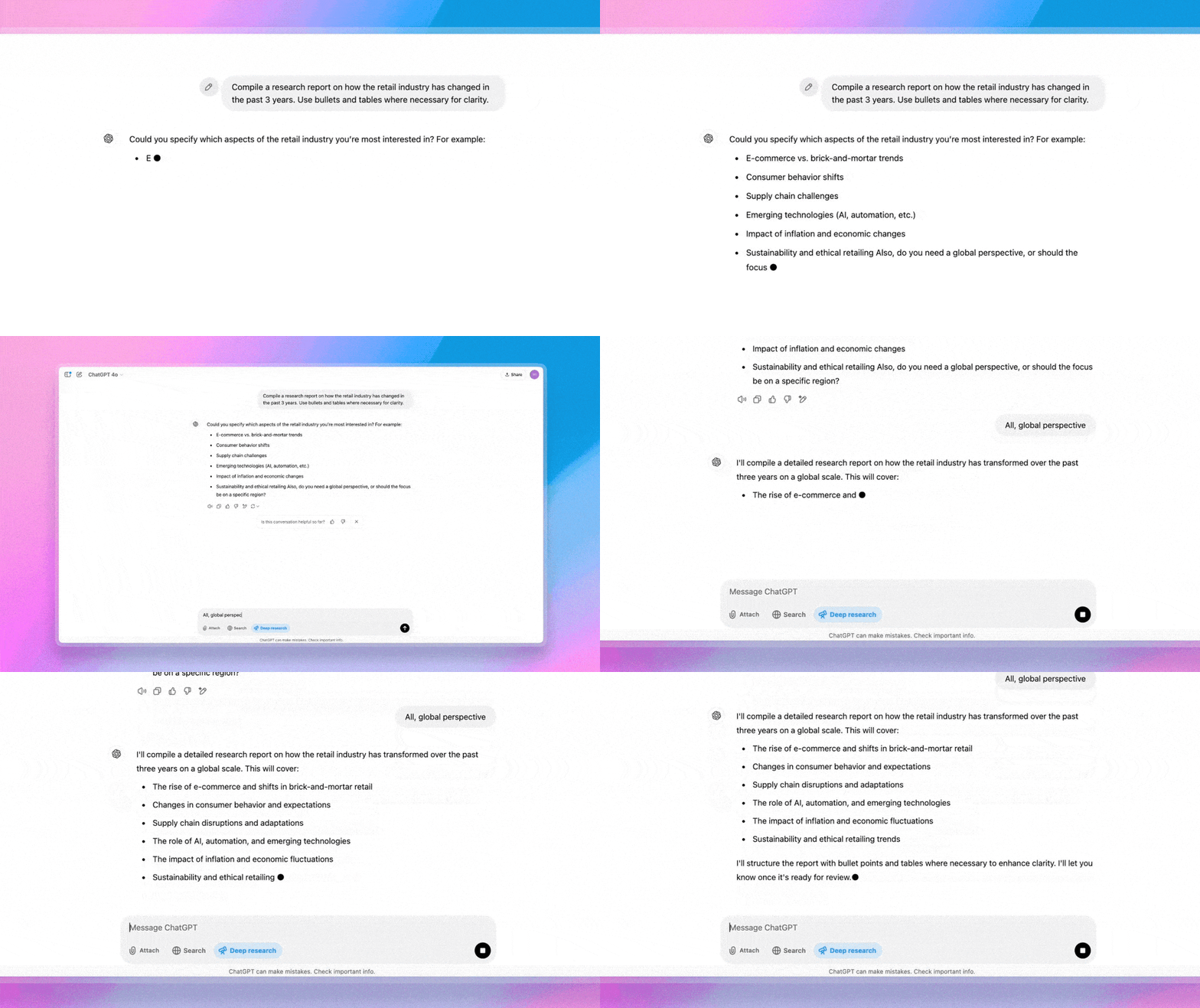
OpenAI is further proving that 2025 is the year of agentic AI. The artificial intelligence giant revealed another new feature from ChatGPT this week, called Deep Research, which it claims can gather research from across the web and summarize it in easy-to-read reports. “Deep research is OpenAI’s next agent that can do work for you independently—you give it a prompt, and ChatGPT will find, analyze, and synthesize hundreds of online sources to create a comprehensive report at the level of a research analyst,” the company wrote in a Sunday blog post. Every output shows clear citations and a summary of the agent’s thinking. The tool is powered by its upcoming OpenAI o3 model, which it says “leverages reasoning to search, interpret, and analyze massive amounts of text, images, and PDFs on the internet, pivoting as needed in reaction to information it encounters.” OpenAI says deep research could take anywhere from five minutes to 30 minutes (compared to several minutes to several hours for a human to do). It will alert users when the task is complete, meaning they can step away and get other tasks done. Deep research is available to users who subscribe to GPT Pro, its $200 a month service. It plans to expand it to other paid services over time. But there are limitations. OpenAI said Deep Research can sometimes hallucinate facts or make incorrect inferences. It may also struggle to distinguish rumors from authoritative information. OpenAI said it expects the issues to “quickly improve with more usage and time.” This category of tech, called agentic AI, is different from standard chatbots. Agentic AI can autonomously complete tasks—like scheduling a meeting, buying a car, or ordering dinner—with little human supervision. They understand natural language, set goals, make decisions, and adapt to changing circumstances. Many experts are betting on agentic AI being the next frontier in AI. “Looking further ahead, we envision agentic experiences coming together in ChatGPT for asynchronous, real-world research and execution,” the company said. View the full article
-
We may earn a commission from links on this page. Heading out to a dazzling restaurant for a lovely meal is certainly the traditional option for a memorable Valentine’s Day, but I've heard more complaints of plans gone awry rather than romantic stories. There are many stress points: reserving a table weeks in advance, unpredictable restaurant atmosphere, holiday price gouging, not to mention that you might get rushed out the door because the place is trying to turn over tables on a tight schedule. Luckily, eating out is hardly the only option for treating yourself (or your valentine) on February 14. Here are nine of my favorite alternatives to dining out at a restaurant for Valentine’s Day. Cook an at-home meal kit togetherCooking can be meditative solo activity, or a fun project to do with a companion. (Plus, you get to eat the project at the end). The beauty of a meal kit is that every step is mapped out, so even novice cooks have a fighting chance at making a restaurant-level meal, and the ingredients are portioned to the recipe, so if you’re a once-a-week sort of cook, you don’t end up with a fridge full of leftover ingredients destined for the trash. Tons of companies offer different types of kits for differing palates and varying interest levels. For those who’d like to try cooking scallops for the first time, try Blue Apron. For a refreshing and satisfying dinner, try a sushi kit from Williams Sonoma. Dinner at the moviesAccording to the internet, dinner-and-a-movie is terrible and horrible for Valentine’s Day, and I agree. Why waste time doing two separate things when you can do them at once? The first time I set foot in an Alamo Drafthouse Cinema, I enjoyed a cocktail, a plate of buffalo cauliflower, and a pizza all while watching a movie. I've since deleted other “normal” movie theaters from my mind. Even if you don’t have an Alamo Drafthouse nearby, select locations of AMC, Regal, and other theaters offer a dine-in movie experience. My advice, go see the latest weird horror movie, order some carbs, and get buzzed off a fruity cocktail. Make a charcuterie boardGrazing as a meal is a valid choice, and a selection of cured meats and aged cheeses might be all you need for a romantic Valentine’s Day. Harry and David offers many a meat and dip kit, that you can slice and arrange with your special salami. For those who don’t enjoy indecisive moments in the wine store, try a kit that includes it already. Most of these kits include the pieces, but rarely are they presentation ready. Try your hand at artistically arranging the sliced meats, tapenade, and crackers, and get ready to snack for the evening. (Read here for more ways to give the gift of meat.) Hire a chefA restaurant date isn’t in the cards, and you’ll be damned if you have to turn on the stove. Get a little bougie and hire a chef to come and cook for you. You can receive the ultimate food pampering without having to do any work yourself, so you can spend quality time with your valentine. There is a great range of pricing when it comes to bringing in a professional, so do a bit of research. You can cut costs by offering to gather the ingredients before they arrive, search for individual chefs who run their own catering, or try companies like Cozymeal. If your budget is real tight, hit up the local culinary school. Schools, like the Institute of Culinary Education, will offer job postings for their students to respond to for extra work and real-life experience. You can post the opportunity and rate, and see if you get any bites. Host a potluck with friendsValentine's day might be "special day" for couples or whatever, but if love is what you want to celebrate, why not gather your chosen family for a meal instead? Ask folks to bring a small side dish, warm up the air fryer with some of these recipes, batch a pink cocktail, and throw on a perfectly cheesy rom-com in the background. Whether it's one friend or 12, it'll be a truly memorable Valentine's Day. The dress code: sweatshirts and stretchy pants. Sign up for a cooking classFor more of a shared experience, sign up for a cooking class. You get the guidance of a chef instructor, top-notch ingredients, and maybe you’ll even learn something new. One-time classes, especially themed ones, are usually fun, light-hearted, and low-pressure events. It’s an opportunity to work as a team with your significant other, or be passive aggressive in public if that’s your thing. Introverts, worry not, you can even keep things cozy at home and do an online cooking class instead. This isn’t a cooking competition show (unless you want it to be) but you will get a food prize at the end. Do a wine tasting and pairingWine used to be grapes, and grapes are food, so you can do a wine tasting as your dinner with no argument from me. Fine, you can do a wine pairing; after all, wine tastes even better with snacks. It can also taste god-awful if you pair it wrong, and that’s where the professionals come in. Check out your local wineries or wine stores to see if they’re hosting any Valentine’s Day tastings. (And again, similarly to cooking classes, you can do a virtual pairing class at home.) Make a tinned fish boardPreserved fish is having a moment (or, ya know, a couple centuries). Why leave all the fun to cured meats? Go to the local fishmonger for advice, raid the canned fish shelves of your supermarket, or order a spread of specialty sardines, cockles, mackerel, and salmon to put together your own board. I respect keeping things protein-forward, but add a smattering of crackers, bread, and vinegar-pickled items to keep the oils from overwhelming your palate. Order delivery (It needed to be said.)At the risk of seeming obvious, ordering delivery needs to be on this list. It’s the go-to option because it’s brilliant. You pay a fair price for a host of people to create and deliver exactly what you want, straight to your door. No need to make reservations, unearth charcuterie boards, see other people, or even put on pants. To some folks, nothing is more romantic than that. Some date night-worthy restaurants even offer delivery so even if you couldn't get a reservation you can still have a beautiful, perfectly prepared, three-course Valentine’s dinner. Be a real hero, and use a service like Goldbelly to secretly have your partner's favorite NYC ramen shipped to them (even though you both live in LA now). View the full article
-
OUR mindset can either work for us or against us. A mind full of false narratives—false beliefs—will keep us from growing into our potential. Unchallenged, these negative beliefs will become the soundtrack we live by and keep us from moving in the direction of our best selves and change the outcome of our lives. Josh Axe identifies in Think This, Not That twelve mental barriers that obstruct personal growth and hinder success. Each comes with a critical mindshift—think this, not that—to realign our thinking and liberate us from our limiting beliefs. Mindshift 1: Create a Breakthrough by Unlimiting Your Beliefs We all have limiting beliefs like “I am not enough or not good enough” or “nothing good ever happens to me.” A belief changes the outcome of our life for better or worse. We need to identify our beliefs and determine if they are serving us well. Going from limiting beliefs to unlimiting beliefs is not like flipping a switch. It is a process taking one belief at a time. There’s one caveat when it comes to discerning your beliefs. You are not the things you say you will do; you are what you actually do. Beliefs are more than your feelings or deepest convictions. They align with your behavior; they demand action. THINK THIS: I can because… NOT THAT: I can’t because… Mindshift 2: Redefine Success by Becoming, Not Accomplishing Success is about what you are becoming as a result of what you do. “When you accumulate accomplishments while ignoring your character, it’s like building a house on sand. Eventually, your house will crumble and wash away.” Axe defines success as maximizing “your unique skills for the greatest good.” And this gets to the heart of leadership: “Your greatest potential is not just about you; it’s about us. It’s about influencing others. It’s about becoming the greatest you so you have the greatest impact on helping someone else become the greatest them.” THINK THIS: What’s most important is who I become. NOT THAT: What matters most is what I accomplish. Mindshift 3: Become Self-Aware to Get Where You Need to Go Self-awareness is knowing how you are percieved and knowing what is happening inside of you—an awareness of how you tend to respond to what is happening to you. It’s knowing your strengths and weaknesses. And importantly, it is knowing who you are now so you can become who you want to be. Having self-awareness allows you to interrupt your unconscious, emotion-driven reactions and control how you respond to your environment—to live intentionally and not on autopilot. Axe says, “Being aware of yourself and others compels you to stop and look at the needs surrounding you, not turn the other way. It frees you from the grip of self-interest.” THINK THIS: I am self-aware and choose not to lie to myself. NOT THAT: I would rather live on autopilot than face hard truths. Mindshift 4: Find a Why or Risk Wasting It All Your why has everything to do with your purpose. Why do you exist? “The best version of yourself always starts with the why.” A meaningful life is built upon an other-focus. “A big part of your life’s purpose is seeing the pain or potential in others and acting with compassion to meet their needs.” It’s not about you. “The idea that purpose is found in pleasure fixes can’t be further from the truth. Studies prove that trying to manufacture this feeling of happiness actually leads to lower well-being and depression.” THINK THIS: My life has value, meaning, and a specific purpose to make this world a better place. NOT THAT: I have no purpose and no power to make a difference. Mindshift 5: Rewrite Your Role in the Story No matter what role in a story you are playing now, if it is not working for you, you can change it. In his book Hero on a Mission, Donald Miller identifies the four characters we play: The victim, the villain, the hero, and the guide. The victim is the character who feels they have no way out—helpless and powerless. The villain is the character who makes others small. The hero is the character who faces their challenges and transforms. The guide is the character who helps the hero.” The role you choose to play affects the life you have. When you accept responsibility for your circumstances and take radical action to change, you automatically step into the shoes of a hero. That is how you begin to write your best story possible. Some of the greatest heroes in your life are probably ones who have done the simplest things, like shown up when you needed it, encouraged you when everyone else walked away, or stood up for you when others did nothing. A quest doesn’t have to be a nearly impossible mission. It means showing up and paying attention to what you can impact to build a better world. What is your story? If it is the victim, you will never grow. Choose a story that transforms you. THINK THIS: I can own my story and edit my role. NOT THAT: I am a helpless victim; everything is out of my control. Mindshift 6: Assemble a Team to Fulfill Your Dreams We need a team. “Life is better with people who make you better. One of the most effective ways to stay on track and reach your goals is to surround yourself with people who are more disciplined than you.” Think in terms of who my community can become. THINK THIS: Life is better with people who help me grow. NOT THAT: Life is better on my own. Mindshift 7: Build an Unshakable Identity So No One Else Does It for You Your identity keeps you grounded. Be intentional about who you are and build on that foundation. I believe four movements have led up to and created the modern identity: irreligion, rationalism, romanticism, and relativism. These four movements led to the foundational principle that undergirds the modern identity—that our life purpose and mission should flow only from within ourselves and should satisfy whatever we think will make us happy, typically in a materialistic and hedonistic way. Choose your identity. “When you think about who you are, consider whether the identity you choose will keep you flailing in your fleeting emotions, chained to the past, or moving forward into your best possible self.” THINK THIS: Figuring out who you are is important because it determines your future. NOT THAT: My identity changes depending on social constructs, the opinions of others, and my background—and that’s okay. Mindshift 8: Bust Vices by Building Virtues Virtues are what build our character and transform us from the inside out. Personal values are built upon virtues. The seven virtues are wisdom, justice, self-control, courage, faith, hope, and love. All of these virtues work together to apply each in our lives for the benefit of all. For instance, you can’t practice true justice without love. Having a virtuous character runs deeper than just being a good person; it is doing the greatest good, which is the most loving thing you can do for everyone around you and for a lasting impact. The greatest good is only possible to accomplish with the underpinnings of the virtues of faith, hope, and love. Axe asks, “Are you aware of the vices that keep your potential at bay?” THINK THIS: A divine identity will motivate me to live and create with excellence, no matter who is watching. NOT THAT: I do my best when someone notices. Mindshift 9: Turn Off Opinions and Turn On Principles Principles guide the application of your virtues. Principles are timeless. Opinions, on the other hand, come and go. “If you want to enjoy success in your relationships, career, and health, choose a path that is lined with principles.” Listening both to everybody and to nobody will lead you down the wrong path. The secret is to listen and follow wise leaders who have had the best results in their businesses, their finances, and their relationships. Today, we often speak of my truth and your truth or, rather, my opinion and your opinion. There is such a thing as absolute truth. “My truth will make you as comfortable as possible. The truth will force you to change. My truth is dependent on what will make me feel good right now. The truth leads to a better outcome in the long run. Don’t seek to discover your truth; act with wisdom and courage to uncover the truth, which leads to life.” THINK THIS: Principles lead to successful choices. NOT THAT: Others’ opinions inform my decisions. Mindshift 10: Flip the Fear to Turn on the Growth Framing events in your life as “all or nothing” are part of a fear-based mindset. You’re thinking in terms of perfection, not growth. Ask, “What can I do better next time?” You live in fear because you’ve tied an event (or series of events) to your identity. Because you are so invested in maintaining this idea of perfection and setting unrealistic expectations for yourself, you’ll do anything to protect your self-image, including keeping up the lie at whatever cost. You won’t be honest with yourself or others. You’ll never grow beyond superficial status because the goal isn’t to develop your character and skills but to achieve, accomplish, and arrive-at least in the eyes of others. THINK THIS: Failure can lead to flourishing. NOT THAT: I must avoid failure at all costs. Mindshift 11: Visualize to Realize Start with the end in mind. Visualization is a way to see the path ahead to reach your dreams. It helps you to prioritize what matters most and give up those distractions that don’t take you where you want to go. THINK THIS: I can dream big and make things happen when I set the right steps in motion. NOT THAT: I have too much going on to dream big. Mindshift 12: Power Up Your Potential with Positive Perseverance We all go through valleys, and if all we do is dwell on the negative, we will create a negative life for ourselves. There is such a thing as toxic positivity. It’s when you deny or distort reality and rely on platitudes such as “Everything will be okay.” On the other hand, positive perseverance is the fusion of hope, grit, and gratitude. Hope is “choosing to think and act in a way that is contrary to the negativity of our present experience.” Grit is “being all in to create your future self. And gratitude is an appreciation for what we do have and what is right “and taps into the abundance of the little things.” Self-talk matters. How much of what you say is uplifting and positive? “Don’t say anything to yourself that you wouldn’t say to anyone else. If you wouldn’t say the words you tell yourself to your best friend, shut that negative self-talk immediately.” THINK THIS: I have the power to choose positivity. NOT THAT: I am at the mercy of whatever life throws my way. * * * Follow us on Instagram and X for additional leadership and personal development ideas. * * * View the full article
-
We may earn a commission from links on this page. GoPro has such a hold over the action camera world, casual users might assume its brand name is synonymous with action cameras as a whole. But simply assuming GoPro is the be-all and end-all of small, dedicated cameras would do a disservice to popular competitors like DJI. It won’t take long when watching any tech YouTuber’s behind the scenes videos to start seeing DJI's products pop up—one creator has even famously gotten in trouble for stress testing a DJI camera by speeding—and that’s for good reason. DJI’s gear tends to punch in the same weight class as GoPro’s while costing a little less, and arguably having slightly better specs. The DJI Osmo Action 5 Pro is no different. Credit: Michelle Ehrhardt What is the DJI Osmo Action Series?If your parents saw you with a DJI Osmo Action camera, they might ask “is that a GoPro?” But if your nerdy tech friend saw the same thing, they’d probably say “nice.” Since 2019, Chinese company DJI has been trying its best to make a foothold in the United States action camera scene, using what it’s learned from making drones and professional level gear (DJI equipment has been used in shows including Better Call Saul and Game of Thrones) to appeal to a more casual market while still maintaining an edge among power users. That’s resulted in a moderately affordable camera line that can really sing if you know what you’re doing, but can take a little time for everyone else to get accustomed with. What’s new with the Osmo Action 5 Pro?To that end, the improvements to the Osmo Action 5 Pro (which is a sequel to the Osmo Action 4, with "Pro" tacked onto the end as a new marketing term) tend to be a bit nerdier than the flashy modular lenses GoPro announced alongside its new Hero 13 Black, but they’re no less meaningful, especially if raw numbers are what you care about most. In other words, open the box and you’ll get the same small rectangular form factor that you’re probably used to by now (the camera measures in at a rough 1.7 x 2.8 x 1.3 inches), plus a larger rear screen, but you won’t see any major surprises. Take one look at the spec sheet, though, and you might start to understand the appeal. Credit: Michelle Ehrhardt Yes, the raw resolution and frame rate limits are the same as on the Osmo Action 4, ranging from 1080p at 240 fps to 4K at 120 fps, and the field of view still tops out at a respectable 155 degrees. But inside the camera, you have a new image sensor with a larger pixel size (meaning better lighting and motion clarity), a more efficient processor for larger battery life, a bigger battery at 1,950 mAh, 48GB of internal storage, and touch-sensitive OLED panels for both displays. Some of those specs immediately put the DJI ahead of the competition, since GoPro cameras have a slightly smaller pixel size, do not have internal storage, have no OLED, and only come with one touch-sensitive screen. GoPro cameras also have a smaller aperture, which could make shooting in low-light conditions more difficult than with a DJI camera, although the aperture in the Osmo Action 5 Pro remains unchanged from the past few models. Do the Osmo Action 5 Pro's improvements make a difference?The DJI Osmo Action 5 Pro is my first time actually going hands-on with a DJI camera, so for my own testing, I’ll be placing it up against the competition more than prior models. My biggest takeaway? Wow, this thing is long-lasting. Usually, when I take an action camera out for testing, I expect to lose about 30 or even 40% of my battery life in one to two hours of on-and-off recording—these devices aren’t really intended to run continuously for long periods of time. With the Osmo Action 5 Pro, I only lost about 20% after going on a 90-minute excursion. Credit: Michelle Ehrhardt That’s a little better than I got on the Hero 13 Black, which was down to 20% after only an hour, and matches the testing done by Lifehacker sister site PCMag. While both numbers are admirable, the Osmo Action 5 Pro is class-leading. PCMag also mentioned that its review unit of the GoPro Hero 13 Black suffered from overheating, and while I only experience mild heat spikes, I had similar issues with the Hero 12 Black. Meanwhile, the DJI camera was always cool to the touch. As for the footage itself, I’m sated. Nothing is exceptionally good or bad, and all results are about as expected, although maybe a little brighter than what I was used to with my GoPro. Image stabilization is smooth and moving objects have little blur to them, at least during the daytime, but I don’t want to oversell it. With the exception of slightly brighter footage, most of the video improvements here are a bit too slight for my casual eyes. I’ve been sitting on this footage for a little bit now, so you’ll see some Halloween decorations in my example shots, and the camera performed well in capturing all the details of artificial spider webs and skeletons. It also did well in capturing more natural environments, like the fall leaves in the trees overhead. But while this does the job of producing footage worthy for use in professional projects, it doesn’t necessarily stand out. Credit: Michelle Ehrhardt Where the Osmo Action 5 Pro does make a bit more of a name for itself, though, is with photos. I was impressed with the out-of-the-box detail here, especially in low light, while I pretty much refuse to take photos on the Hero 13 Black without the $129 Macro Lens Mod attached. With that add-on, it’s a bit more of an even experience, but it’s clear that the DJI camera offers more bang for your buck. Credit: Michelle Ehrhardt A split accessory ecosystemIt might sound odd to say, but the quality of your footage might not be the deciding factor in which action camera you get. There are only so many ways to make 4K at high frame rates look better, so it’s supplemental features that can be the kingmaker here. Aside from improving battery life or built-in screen quality, the big way to make a name for yourself in this space is with accessories. Here, GoPro and DJI take two separate approaches, with neither being objectively better. Both companies offer the basics, including mounts (which are generous enough to work with either brand), cases, extra batteries, and as of the GoPro Hero 13 Black, magnetic adapters, but their approaches differ a little bit when it comes to video and audio. Credit: Michelle Ehrardt Essentially, if you want more lens options, GoPro is your go-to. If you want more microphone options, then you’ll want to opt for DJI. There are third-party options for both, but there are perks to buying straight from the manufacturer. For instance, the GoPro Hero 13 Black introduced a series of modular lenses that I was pretty impressed by, since they open up new aspect ratios, better close-up detail, various ND filters for different lighting conditions, and a wider field-of-view. DJI, meanwhile, only makes ND filters and one lens for upping the field of view, although that lens does give you 182 degrees vs. the GoPro Ultra Wide Lens’ 177 degrees. By contrast, GoPro doesn’t make any microphones, whereas DJI is arguably known just as much for its microphones as for its drones and cameras. And while you can use DJI microphones with GoPro devices, the benefit of using them with the DJI Osmo Action 5 Pro is that certain newer mics will support a direct connection with the camera, resulting in higher quality audio than you’d get over Bluetooth without the need for an adapter. Ultimately, I’d say that the accessory field for either brand is strong, and ultimately depends on what you need. However, given that every video needs audio, but not all of them need, say, an anamorphic lens, DJI might have a slight advantage for most people. The confusing app ecosystemOne place where DJI does not have an advantage is the app experience. On the surface, both DJI and GoPro offer similar features, including a player for your camera’s video clips and a basic editor, but with an optional subscription, GoPro’s app also offers unlimited automatic cloud backups, cross-device sync, an expanded editor, and automatic highlight generation. None of these features are strictly necessary, although it’s nice that they’re an option. But what really makes the GoPro app stand out over DJI’s, even on the free tier, is that it’s optional and easier to navigate. Credit: DJI Frustratingly, setting up the Osmo Action 5 Pro requires activating it via the app, or else you’re not going to get its needed firmware. That means sitting through an entire front page of ads, and if you’re like me, plenty of pairing issues. I actually had to settle for installing the needed firmware through an SD card, but even then, I still needed to use the app to initialize the install. Meanwhile, the GoPro app is much more what-you-see-is-what-you-get, with easy to understand menus and no ads for other GoPro products cluttering up the interface. And if you’d rather ignore it, you can. Should you buy the DJI Osmo Action 5 Pro?With a lower price point and specs matching or sometimes exceeding GoPro’s recent flagship, the DJI Osmo Action 5 Pro seems like the best action camera for most people on paper, but it’s not quite that simple. It’s still an excellent camera, but I’m hesitant to say it’s the best one for everybody. If all you need is a simple, point-and-shoot device and you don’t rely on a lot of different lenses or mobile editing too much, then yes, the DJI is probably for you. If you need professional-level audio, it’s also a good choice. But there’s no denying that GoPro offers an easier-to-understand user experience, and its modular lenses are still a cool add-on option. With that said, I’d say the Osmo Action 5 Pro is probably better for power users, who likely have other gear to help supplement it, while the GoPro Hero 13 Black might be better for beginners who want one device that can do it all, supported by an intuitive mobile experience. But with the Osmo Action 5 Pro starting at $350 (you can pay extra to get bundles with various mounts or backup batteries) and the GoPro Hero 13 Black costing $400 without any of its extra lenses or its mobile app subscription, that’s a fine line to walk. You’d certainly be happy with either, assuming you’re willing to sit through DJI’s subpar mobile app long enough to set up the Osmo Action 5 Pro. It’s also worth pointing out that these are both flagships. If you need a rugged dedicated camera, but don’t need modularity or extra high frame rates, cheaper options like the $180 GoPro Hero should do the job just as well. View the full article
-
Meta CEO Mark Zuckerberg hinted at a “return to OG Facebook” during last week’s Q4 earnings call, listing it as a key goal for 2025. But what exactly does that mean? So far, Meta hasn’t offered any clear details. Could Zuckerberg mean the millennial meme-filled Facebook of the 2010s or the “masculine energy” of its controversial origins as Facemash (a site that ranked Harvard classmates by attractiveness without consent)? Asked about his plans for the “OG Facebook,” Zuckerberg replied, “I think some of this will kind of get back to how Facebook was originally used back in the day,”, while tight-lipped on any other details. “I think there are a lot of opportunities to make [Facebook] way more culturally influential than it is today,” he said. Zuckerberg cautioned investors that these changes may require some tradeoffs in terms of “maximizing business results in the near term”, hinting at potential revenue impacts. The first wave of product updates is expected to roll out within the next six months. Now, “OG Facebook” could mean different things to different people. For many, it’s a throwback to the days before Boomer and Gen X relatives took over. These days, Facebook is often used begrudgingly by those under the age of 30 and is more synonymous with offensive memes and AI slop than cutting-edge youth culture. Studies show Gen Z overwhelmingly prefers TikTok and Snapchat, platforms that exist outside of Meta’s reach. A 2024 Pew Research survey showed that only 33% of U.S. teens (13-17) use Facebook, a steep drop from 71% a decade ago. One thing is clear, the platform is in desperate need of younger users to stay relevant. Meta has tried, and failed, to course-correct before. In 2020, it launched Facebook Campus, a college-only space meant to recapture its early exclusivity. It flopped within 18 months. More recently, in October 2024, the company rolled out a Gen Z-focused redesign putting greater emphasis on local communities, video, and Facebook Groups. Last year, it even quietly resurrected the Poke button. Can Facebook pull off the rebrand of 2025? That’s for Gen Z to decide. View the full article

-
After a year of preparations towards HPE's acquisition of Juniper, the DoJ has thrown a spanner in the works. The post WLAN market shaken as US Department of Justice sues to block HPE’s US$14B Juniper takeover bid appeared first on Wi-Fi NOW Global. View the full article
-
Not to be out-done by Deepseek, OpenAI is launching a new Deep Research feature in ChatGPT. This is OpenAI's newest Agentic AI feature (after Operator), which builds on the recent trend of making AI more autonomous. According to OpenAI, Deep Research is capable of producing detailed reports matching the level of a research analyst. In a layperson's terms, it browses and interprets the internet for you. Deep Research uses OpenAI's upcoming o3 reasoning model to perform complex tasks, taking its own sweet time to do so. The feature is available now for ChatGPT Pro customers (the pricey sub that costs $200/month), but will soon be available for ChatGPT Plus and Enterprise users as well. How OpenAI's Deep Research AI Agent worksOpenAI's Deep Research tool is designed to work independently from you. You give it a detailed prompt, after which it'll ask some clarifying questions. Then, it will go and do its own thing in the background. According to OpenAI, a Deep Research stint can last anywhere between 5 minutes and 30 minutes, but the company claims it's able to do multiple hours worth of human-level work in the span within just a dozen or so minutes. While it's working, there's a panel on the right side of the page that shows everything it's doing, live. Think of this as the bot's citations, but it also explains its "thought process." It can connect to the internet, search online, read web pages, and analyze or synthesize massive amounts of information in the form of text, images, and PDFs. All of this is a bit compute-intensive, so OpenAI is limiting Pro users to just 100 queries a month. A smaller, more efficient model will be rolled out in the coming months, as well. The Deep Research feature is purpose-built for knowledge workers in the field of science, finance, engineering, and policy. But OpenAI says that it can be equally useful for consumers too. OpenAI gave an example of how Deep Research can help perform hyper-personalized research for big shopping decisions. Things like helping you decide between cars, furniture, appliances, or electronics. Since the tool can synthesize information from thousands of articles and reviews, it can supposedly build a report customized to your needs. Credit: OpenAI According to OpenAI, "deep research was rated by domain experts to have automated multiple hours of difficult, manual investigation" OpenAI offers multiple examples where Deep Research's insights can be valuable to users, saving hours of research time. The company says it can be used to understand extremely niche and specific problems via scientific studies and journals. Credit: OpenAI For example, a Chemistry prompt asks ChatGPT to "discuss the differences between pure- and mixed-gas sorption for glassy polymers, how the dual-mode sorption model can be used to predict mixed-gas sorption behavior in glassy polymers," the model then goes on to understand sorption models, accesses open-source information, clarifies key problems, pulls up PDFs, and even refines the model before piecing together all the content. According to OpenAI, this task helped save 4 hours of time. OpenAI's post also highlights similar use cases for Deep Research in the healthcare industry and linguistics, saving five hours and two hours, respectively. Deep Research also supposedly performed well on Humanity's Last Exam, an AI benchmark, testing expert-level knowledge across more than 100 fields. Deep Research scored 26.6% accuracy, the highest score yet on the text. By comparison, DeepSeek-R-1 scored 9.4%, and GPT-4o managed just 3.3%. While Deep Research is based on a reasoning model, and not an LLM, it still uses a language model to work with the input, and generate the output text. OpenAI warns that the Deep Research model can still hallucinate and make up facts, so it's still better to keep an eye on the research output, and not to trust it blindly. View the full article
-
This post was written by Alison Green and published on Ask a Manager. Remember the letter-writer whose mother was pressuring her to babysit their brother in their office after school? Here’s the update — and some more advice from me. Thank you for answering my letter! It was too late to reply to the comments after work, but I’ll address some of them here: For those asking if I still live with my mother: I moved out when I was 18 and live in my own apartment with roommates. My brother was born when I was 10 years old, so that’s where the age gap comes from. For those asking why my brother can’t just stay at home like most teens: He usually does, but given my brother’s recent trouble in school, my mother wanted some adult supervision over him. Also, he could take the bus to my job or to my mom’s house but not to my mom’s job. For those concerned about whether my brother has been a victim of abuse: I absolutely hope not, but nothing has indicated that as of now. His teacher, principal, and school counselor broached the subject, but my brother had repeatedly denied anything nefarious. A commenter brought up unsupervised Internet use, and I think that’s the likely culprit. My brother has his own dumbphone, but my mother lets him on her smartphone all the time. (A point of contention is that my brother will whine to my mom if I don’t let him use mine, and I’ve been practicing standing my ground with mom on that front.) As for the actual update: On the day after you published my letter, I decided to reach out to my manager with a quick warning with the script you suggested. He was very understanding and said that it wouldn’t be a problem. He asked if he should reach out to CPS, and I said maybe not on the first time my brother might show up. Calling CPS still feels like a nuclear option. My manager also asked the receptionist if she had recalled any conversation about “single mothers” allowing their kids in the office. She said that there was a job candidate who had called the other day asking about it. The receptionist said that she kept repeating that she couldn’t disclose childcare policies to candidates but gave a short comment that single mothers sometimes brought children just to get her to stop. (When I pressed my mother about this, she confirmed that she was the “job candidate.”) That was a Thursday. For everyone saying that my brother would have a surprise visit to my workplace, you had predicted my Friday afternoon. I had gotten a call from the receptionist that a boy was sitting on the bench outside the front door. My brother argued that our mom said that he could stay at my job. I made him march to the bus stop to go home, and I stayed outside until the bus came. Later that day, I ran into a different coworker who said that she ran into my brother on her smoke break. She said that he said something “weird” to her that she couldn’t actually make out, so we both went to my manager to talk about it. We decided to pull up the security footage from the front door. When my coworker approached, my brother made an obscene comment to her, out of nowhere. (Note from Alison: I’m censoring the comment because it’s obscene, as well as very weird.) My coworker just stood there and asked, “What?” After some silence, he slouched in his seat and mumbled something. We couldn’t hear it on the feed, but my coworker said she could maybe make out “never mind.” I apologized to her and affirmed that he was not coming to the office again. She told my manager and me that she didn’t want to press the issue as she was more confused than anything when he said it. My phone call with my mother about this was loud and angry, but I did my best to stand my ground. I said that I had already made my “no” clear enough, and if my brother shows up at my job again, my manager will call CPS. She said a lot of things that made me second-guess myself, especially since everything she said is objectively true — that I don’t understand the stresses of motherhood, that someone could’ve kidnapped my brother and it would’ve been my fault, that there is nobody else in her life who can help her, that it’s so easy for me to not care about my brother because I can give him to her, and that I never hang out enough with him anyway. But I told her that I can’t do my job with him there and, conversely, that I also can’t watch him while I do my job. That he was only there for 20 minutes and already harassed a coworker, and that it wasn’t going to be any better for her or my brother if he got in more trouble. I had to hang up on my mother in the middle of talking to her because I was just repeating myself, and I just felt like a bratty teen for doing it, no different from my brother. I realized halfway through talking to her that I was trying to give her that “perfect” argument a commenter mentioned to show that I understood where she was coming from, especially since, as many commenters had noticed, that our family situation has been really strenuous since my dad died. I do want to thank you and the commenters for your advice. Sometimes I get frustrated when people tout about boundaries on the Internet as if it’s trendy and easy, but I still feel like my boundaries don’t help my mother or my brother. My only substantial argument was that having my brother at my job would’ve helped my brother less, and I’ve been holding onto it for personal reassurance. There’s not much else for me to say with this response already so long, so thanks again. I don’t normally provide additional advice when I publish updates, but this is important to say: the main goal of setting boundaries is to help you. As it happens, your boundaries are likely to help your mom and your brother in the long run, too, by modeling healthy interactions and being clear about what you will and won’t accept so they can make their own choices accordingly … but the measure of success in setting boundaries isn’t “does the other person accept this / feel good about it?” or “am I bettering the other person’s situation by maintaining this boundary?” Boundaries are about keeping you in a healthy and sustainable place. The fact that your mom doesn’t want that for you is a mark of the dysfunction in your family dynamics, but it’s not selfish to create a separation between yourself and that dysfunction. (In fact, that’s often the only way to escape it.) You can still love your mom and brother while declining to engage in that dysfunction with them. Frankly, I’d argue setting boundaries is a loving gesture toward them, because it’s an investment in having a healthy relationship with them in the long-term — but that’s not the main driver of why you set boundaries, and whether they perceive them that way or not isn’t the mark of whether boundaries are working. View the full article