ResidentialBusiness
Administrators
-
Joined
-
Last visited
Everything posted by ResidentialBusiness
-
 Russia bets it can gain in US negotiations what it cannot win on the battlefield View the full article
 -
Though many companies are still in the early days of AI adoption, one thing is clear: Many of our interactions—between employees and even organizations—are already being carried out entirely by agentic technology. As this trend increases, the need for leaders to keep humanity at the core of their businesses is critical. That’s why this year’s annual meeting of the Fast Company Impact Council was centered on the theme of “Maintaining a Human Touch in a Digital World.” In May, 123 of the Impact Council’s 422 members gathered in New Canaan, Connecticut, at the 80-acre headquarters of humanitarian nonprofit Grace Farms. In panels and roundtables held across the organization’s buildings—designed by Pritzker Prize–winning architecture firm SANAA—attendees explored how businesses can center innovation around real-world needs and values, even as they navigate the AI revolution. Here are some insights from the event. Lauren Tamaki How to Lead With a Mission “The DEI backlash is short-term thinking. This is a time to stick to your values—it will yield better results than if you hadn’t.” —Sharon Prince, Founder and CEO, Grace Farms Foundation “Your message supports your mission. When you’re doing it right, both of those things are working together. But when those elements get muddied, brands run into problems.” —Celia Jones, Global Chief Marketing Officer, Finn Partners How To Lead Like A Human “Many leaders ask employees how they are but don’t leave space for a real response. It’s about providing space and being prepared for the answer so you can be supportive.” —Elyse Cohen, Chief Impact Officer, Rare Beauty “People like the freedom of remote work, but we also hear from younger employees that they’re struggling with the lack of human contact and learnings they’d get in person—because Zoom doesn’t cut it.” —David Ko, CEO, Calm What Role Does Your Company Play in a City? “One of the core principles of our practice is to create shelters for those in need, but also to elevate the presence of those shelters so that residents feel good about their environment. It’s a little easier for us as architects because it is a built environment, but we are able to project our creativity and social awareness literally onto our city.” —Nerin Kadribegovic, Founder and Principal, Kadre Architects “More public art increases our quality of life. Why wouldn’t every city want some type of focus and intentionality behind what art can do and bring to the city?” —Alan Bacon Jr., Cofounder and Chief Strategist, Ganggang Putting the Customer Back in Customer Experience “Unlike product design, which focuses on unmet user needs, with immersive experiences, you can’t really ask someone what they want from an experience they’ve never had. That’s why an ideation process—with teams that are cross-disciplinary—relies on the alchemy of bringing different people together.” —Andrew Zimmerman, CEO, Journey “A lot of companies are too worried about getting everyone on board with a decision. if you have clear values and a point of view, people will come along.” —Barbara Bouza, Executive Director—Live, Work, Play, CannonDesign Improv For Authentic Connection “What are organizations doing with the time freed up by AI? Are we adding more tasks to people’s workload, or are we giving them space to connect with other humans?” —Tyler Dean Kempf, Creative Director, Second City Works Ensuring Tech for Good is Good for Humanity “We are starting to experience a cognitive industrial revolution. But technology is never neutral. Alone, it won’t make the world better—we have to do that.” —Hala Hanna, Executive Director, MIT Solve “Most nonprofits have a deficit when it comes to tech expertise and capital, and most companies have those things. If you can put those two together, there’s tremendous opportunity, even as tech companies keep their heads down on mission-driven work.” —Tom Subak, Founder, Re/Imagination Lab Beauty And Logic: Music and the Advent of AI “At the base level, human capacity is what we are able to do, imagine, experience, and share that really comes from us. In this moment, it’s worthwhile to advocate for the development and expansion of human capacity—regardless of what the market conditions are.” —Marcus Garrick Miller, Music Director, Grace Farms Leading The Next Generation With Empathy and Purpose “There are so many stereotypes about Gen Z that it can be easy to misinterpret their intentions. So focusing on communication is key to avoiding intergenerational conflict—which you don’t need in the workplace.” —Christina Elson, Executive Director, Center for the Study of Capitalism at Wake Forest University “Graduates face a harsh job market, and many see entrepreneurship as a path to wealth and impact. To turn founder abundance into lasting success, we must scale up support systems and resources for these founders.” —Andrea Carafa, Director of the Blackstone Launchpad Powered by Techstars, QB3 Entrepreneur in Residence, and Lecturer, University of California, Santa Cruz View the full article

-
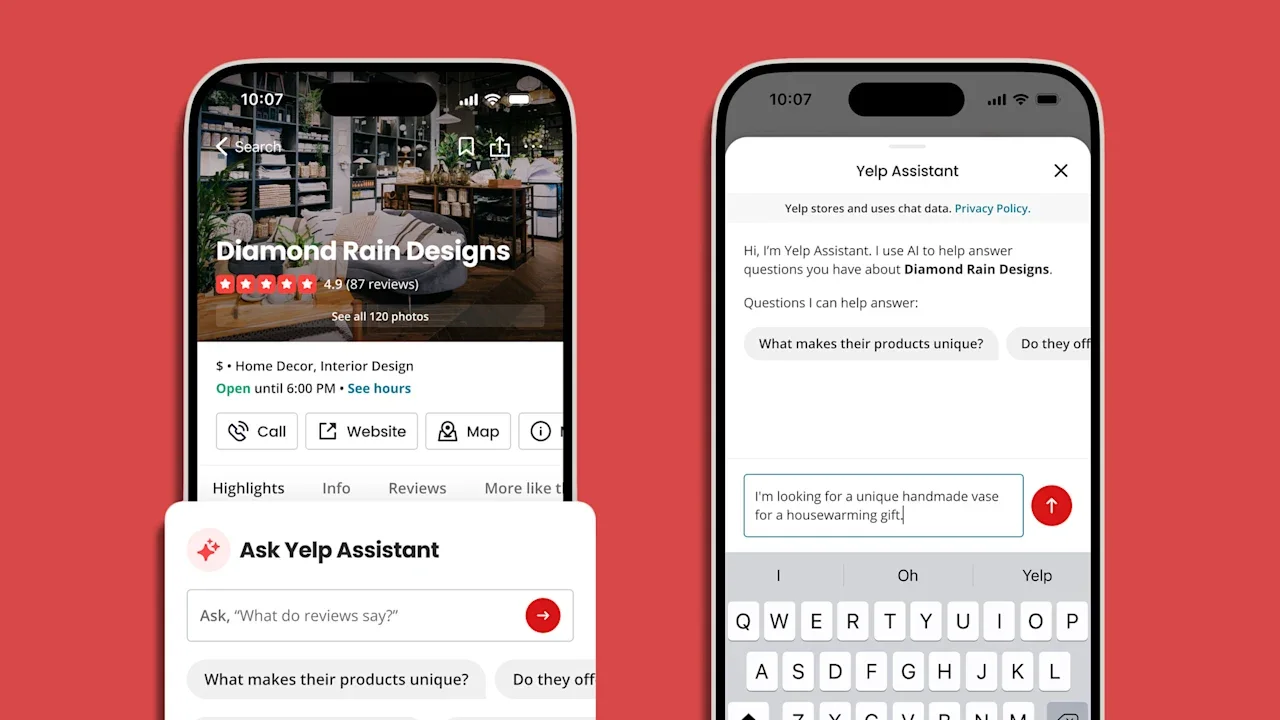
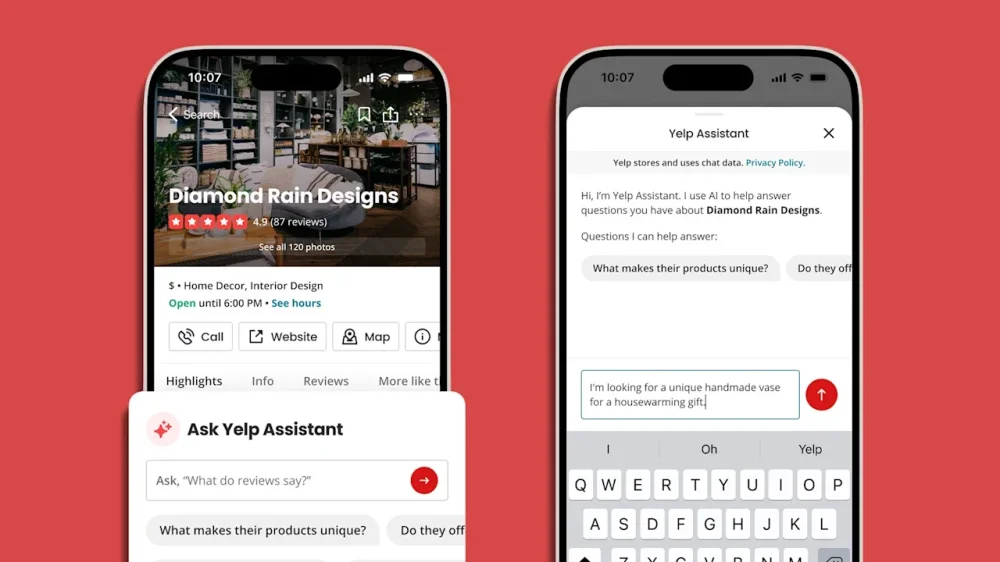
Yelp users looking to learn more about restaurants, businesses, and other locations on the platform can now get information from an AI-powered Yelp Assistant. When logged-in users on Yelp’s iOS and Android apps visit particular business pages, they can now ask specific questions ranging from where to park to whether a restaurant offers vegan options. The answers are generated based on facts from reviews posted on Yelp, information provided to the platform by businesses, and businesses’ own websites, with relevant sections and even photos from Yelp reviews highlighted in the AI response. The assistant also provides a list of suggested questions to ask about a particular business. In addition, a new AI-powered feature called Popular Offerings separately highlights goods and services frequently mentioned and photographed in a business’s Yelp reviews. In a demonstration for Fast Company, Akhil Kuduvalli Ramesh, Yelp senior vice president of product, highlighted how the Yelp Assistant could answer questions about a restaurant’s cuisine, parking, dog-friendly seating, and even the best times to avoid a long wait. The AI surfaced information from reviews and even user-submitted photos of canine-compatible outdoor tables. “This isn’t an AI that’s hallucinating,” says Kuduvalli Ramesh. “This is an AI that is providing me answers, evidence first.” Tapping into a rich vein of contentThe expansion of the Yelp Assistant, which launched last year with a focus on helping consumers find services from home repair to haircuts, comes as other tech companies from longtime rival Google to startups like Perplexity promote AI options for finding and booking tables at local restaurants, which has long been a key part of Yelp’s mission. But Yelp cofounder and CEO Jeremy Stoppelman says the company’s wealth of business data, long trusted by consumers and partner services like Apple Maps, enables it to deliver reliable answers in an age of hallucinating AI. “We’re now at the point where you will be able to ask detailed questions about nearly every business on Yelp,” he says. “And it’s able to tap into the rich content, the reviews, and all of the survey information—everything that we’ve been able to gather about that business.” Stoppelman anticipates the Yelp Assistant will continue to grow more powerful, able to offer more detailed, personalized recommendations across businesses and categories. Already, thanks to Yelp’s AI advances, users can also now type or speak more involved natural language queries into Yelp’s search interface, with the AI able to parse requests like “need help fixing a leaking faucet” or “dog-friendly brunch spot that’s good for groups” instead of simply matching on keywords. “We would like people to basically query Yelp as though they’re talking to it,” says Kuduvalli Ramesh. And when Yelp users visit a particular restaurant, they can also now use the service to quickly find information about particular dishes by using the Yelp app to scan the menu with a new feature called Menu Vision. It can offer quick links to reviews and photos of Yelp-reviewed dishes, and the company plans to continue to expand the feature to include more options and information over time. Growing competitionYelp’s push into AI is far from the first time the company has incorporated new technology to meet new consumer tastes. In the heyday of Foursquare, Yelp added location check-in features. And as TikTok and other video platforms became increasingly important tools for restaurant discovery, Yelp enabled users to post short-form videos alongside text reviews and photos. The company, which for its most recent quarter reported $44 million net income on a record net revenue of $370 million, has also expanded into home services in recent years, taking on rivals like Angi and Thumbtack with its increasingly sophisticated tools to request quotes and communicate with home professionals. And in November 2024, Yelp also acquired RepairPal, which connects users with auto repair shops, and has been integrating its offerings into the core Yelp product. Yelp’s AI also now offers guidance to service professionals on responding to customer requests—and awards visible badges to those with a pattern of helpful responses. A pair of paid AI phone tools, called Yelp Host and Yelp Receptionist, are now also rolling out to restaurants and other businesses, respectively, to field calls from customers. Yelp Host is able to book and modify reservations, including fielding special requests, while Yelp Receptionist can capture contact info and full call transcripts, then summarize the relevant information needed to get back to a potential customer. “By the time the local business gets a lead, it’s a fully vetted lead, and it’s got an AI summary,” says Craig Saldanha, Yelp’s chief product officer. “They can listen to the transcript, but they can also read the summary in 30 seconds and essentially call you back with all of the information.” Yelp Host and Receptionist are designed to let busy restaurants and businesses actually process phone calls, rather than simply amassing voicemails, while they’re closed for the day or assisting other customers. And those services, too, are enabled by the detailed information Yelp has amassed over more than two decades about specific businesses and different types of local merchants, Stoppelman says. “It is grounded in the same underlying infrastructure,” he says. “And so, when you do sign up, we have a very good understanding of businesses, both in that category and then your business specifically.” View the full article
-
A website redesign is essential for remaining competitive, but for multi-location businesses, the risks are much higher. Stripping away the local relevance that drives traffic to location pages can cause rankings and online visibility to plummet. Using localized content on location pages resulted in a 107% rankings lift, something businesses risk losing if a redesign hurts these pages. To mitigate the risk of fallen local rankings and to get the most from your website redesign, you need to maintain good multi-location local SEO and take key steps for a successful redesign. Prioritizing SEO during a location page redesign helps multi-location businesses stay competitive. Technical SEO pre-redesign audit checklist Before launching a new website redesign, it’s essential to perform a comprehensive audit to ensure that your SEO foundation is retained. Thorough auditing before launch can help prevent common mistakes and preserve your rankings. Manage inventory: Document all business locations, Google Business Profile IDs, current URLs, organic rankings, and highest-converting queries. Identify issues: Use a site crawler to uncover duplicate/thin content, poor Core Web Vitals, slow loading, mobile responsiveness, or accessibility gaps. Conduct a technical crawl audit: Confirm crawl budget, indexing, updated sitemaps, and hreflang configuration on multinational sites. Audit and enhance structured data: Ensure LocalBusiness schema is present and NAP is perfectly consistent. Validate canonical tags for duplicate prevention. Expand structured data: Consider implementing review, FAQ, and service schema types for additional SEO coverage. Set up robust tracking: Implement UTM tagging, conversion tracking, and phone call analytics to precisely measure local and national SEO performance PageSpeed Insights can let you know how fast your website loads and indicate potential performance issues. How to optimize site architecture and your URL strate Once your pre-redesign audit is complete and you’ve identified areas for improvement, it’s time to shift focus to your site architecture for SEO. A solid foundation in site architecture ensures both search engines and users can navigate your website with ease. Common structures include: Subfolders (/locations/city) Subdomains (city.brand.com) Multisite frameworks Dedicated microsites Subfolders generally work best for centralizing authority and scalability, with a primary website that branches out into many pages, including one for each location. Note that it’s crucial to maintain consistency with your URL structure. If the existing site already has a URL for each location within a subfolder structure, do not change it! Ensuring that the URL structure remains identical between the existing and new website design is essential for retaining your SEO value and preventing any loss in rankings. Here are some other key considerations: Canonical URLs: Identify canonical URLs that help mitigate the risk of duplicate content. Sitemap strategy: Determine whether your site should implement an XML sitemap or an HTML sitemap, with XML sitemaps being more explicitly effective for site crawlers and SEO, while HTML sitemaps could help with user navigation. URL templates: Use static URLs, they’re cleaner and more optimization-friendly design (e.g., example.com/services/dentistry/location/). Location page content considerations Technical SEO components are important, but so is content. When redesigning your website, it’s crucial to prioritize the content elements that impact the SEO performance of your location pages. A successful redesign should seamlessly integrate these elements to preserve and boost your SEO efforts. Unique H1 on each location page with city intent that targets a relevant keyword, such as “housekeeping services in [city]” Full name, address, and phone number that’s consistent across all directory listings Link to each location’s corresponding GBP page. Business hours that are up-to-date and unique to each location, further aligning with directory information Local phone number, preferably static to maintain consistency with NAP data Service-specific content, including details about each of your offerings, with locally optimized keywords for each Staff and team photos showing the people behind your business, potentially at each location Local testimonials from satisfied customers, including review and schema markup for aggregate ratings h1 optimized for location and main keyword with custom text and clear CTAs. Source As you incorporate these essential content elements into your location page redesign, it’s critical to ensure each page is unique and tailored to its specific location. Each location page should include a designated content block section where you can add customized details about that individual location. This will additionally help reduce duplicate content across your location pages. Location page with h1 and copy optimization Source Top design elements to consider for a multi-location website Redesigning location pages can be challenging because it requires balancing brand consistency with the unique identity of each location. Achieving this balance involves the strategic use of design elements that appeal to both local audiences and the overarching brand. Top design elements include: Location-specific imagery: For brick-and-mortar locations, use high-quality images of the storefronts. For service-based locations, showcase custom visuals that reflect the areas they serve. Interactive maps or location finders: Adding Google Maps or a custom location finder helps users easily find the nearest store or service center. This feature not only enhances usability but also provides a tailored experience for visitors. Interactive map on location page Source Social media feed integration: Integrating a live social media feed on location pages adds dynamic content and more localized imagery. It also provides a space to showcase promotions, events, and local engagement, keeping the page fresh and relevant. Team photos: Featuring photos of local team members helps humanize the brand and create a personal connection with your audience. It’s a great way to reinforce the idea that your business is part of the local community, building trust and authenticity. Example of an optimized H1 with custom images on the team page. Source Complete multi-location redesign audit checklist Website redesigns often require several months of planning and execution. However, before you push the new site live, it’s essential to ensure it passes the following key tests if you want to retain your traffic: Brand consistency: Ensure that branding elements, such as colors, typography, logos, and tone, are consistent across all pages and location-specific content. URL mapping: Double-check that all important URLs are correctly mapped to the new design and are still functional, preserving the SEO value of your existing pages. No URL structure changes: If you’re maintaining a subfolder structure, confirm that no URL structures are altered to prevent any loss of SEO rankings or broken links. Site performance: Test the website’s speed to ensure it meets performance standards, passes Core Web Vitals, is mobile-responsive, and is free of any accessibility issues. Clear CTAs: Ensure that each page features clear, concise calls to action (CTAs) above the fold to encourage user engagement and conversions from the moment visitors land on the page. Analytics setup: Verify that all necessary analytics and tracking codes (e.g., Google Analytics, conversion goals, UTM parameters) are properly implemented to monitor site performance and user behavior across all locations. Mobile optimization: Check that the site is fully optimized for mobile users, with responsive design elements that scale and display well on all devices. SEO-friendly content: Review content for SEO optimization, ensuring that each location page is targeted with local keywords, meta descriptions, and proper header tag hierarchy. Structured data implementation: Verify that all relevant schema markup (e.g., LocalBusiness, Service, Review) is correctly applied to each location page to support search engines in indexing your content. Internal linking: Ensure that all location pages have strong internal linking, guiding users through the site, and boosting SEO by connecting related content. User testing and feedback: Conduct user testing or gather feedback from stakeholders to ensure the new design is intuitive, user-friendly, and aligns with business goals. Content uniqueness: Confirm that all location pages have unique, location-specific content to avoid any potential issues with duplicate content. Legal and compliance checks: Ensure that the website complies with any industry-specific regulations (e.g., ADA compliance, GDPR, HIPAA) before launch. Cross-browser compatibility: Test the website across various browsers to ensure it functions smoothly for all users, regardless of their preferred browser. Backup and contingency plans: Create a backup of the current website before launching the redesign, and have a contingency plan in place in case issues arise post-launch. By ensuring that these elements are in place, you can launch a multi-location website redesign that performs well across all locations and provides a seamless, user-friendly experience for your visitors. Example of before website redesign and after a website redesign The business case: search and revenue impact at scale Partnering with a web design and development agency that truly understands the complexities of multi-location businesses, technical SEO, and CRO is essential. Ignite Visibility is a prime example of this expertise. We implemented a performance-driven SEO strategy to help a home services franchise with over 60 locations across the U.S. The team optimized city-specific landing pages, standardized keyword-rich updates across Google Business Profiles, and strategically matched high-intent keywords to local markets to maximize visibility. The results speak for themselves. The Ignite Visibility approach doesn’t just maintain rankings – it creates massive growth opportunities. If you’re ready to maximize the impact of your next website redesign and achieve measurable, scalable growth, reach out to Ignite Visibility. With our proven track record, we’ll help you stay ahead of the competition and deliver results that matter. View the full article
-
Not long ago, one of our coaching clients called us in a panic. His team was floundering, his peers were keeping their distance, and the feedback from HR was . . . not glowing. He was baffled. “I’m hitting the numbers,” he said. “What else do they want from me?” We’ve had this conversation more times than we can count, and this is what we’ve learned: Leaders rarely fall short because they lack intelligence, but because they lack emotional intelligence. The emotional gaps are what bruise egos, stall progress, and erode trust until there’s nothing left to stand on. Research supports this: High emotional intelligence in leaders is linked to stronger team communication, performance, and innovation, while low-EQ environments see more burnout, conflict, and turnover. The good news? Emotional intelligence is a muscle you can strengthen with feedback and practice. Here’s how: 1. REFLECT ON YOUR IMPACT You can’t improve what you don’t notice. Self-awareness isn’t just about identifying your strengths but recognizing your impact. Harvard Business Publishing reports that 56% of employees say their immediate supervisor demonstrates self-awareness, which means nearly half of leaders may be unaware of how they’re coming across. When a team isn’t responding the way you expect, something in your approach may need adjusting. The question becomes: Are your intentions aligning with your impact? One executive we coached realized his “high standards” came across as micromanagement. Once he saw it, he was able to shift from scrutinizing details to building trust. The action here is simple, but not easy: Ask for feedback. Reflect without defensiveness. Consider not just what you do, but how you do it. Most executives avoid feedback because they’re afraid of what they’ll hear. But pretending you already know how people see you is the fastest route to losing their confidence. In leadership, perception is reality, and you can’t afford to ignore it. 2. HIT PAUSE BEFORE YOU REACT When stress spikes, so do reactions. That’s where self-regulation, the ability to manage your emotions before they manage you, comes in. One emotional outburst can undo months of goodwill. People will forget your PowerPoint. They won’t forget how it felt to be on the receiving end of your anger. EQ isn’t about suppressing emotion, but harnessing it in a way that commands respect instead of fear. We’ve coached leaders who prided themselves on being “straight shooters.” But there’s a difference between candor and emotional impulsivity. One client, after a tense leadership meeting, told us he “blew up because nobody else seemed to care.” The fallout? Silence from his peers for days. Through coaching, he learned to spot his triggers and hit pause. Sometimes that meant walking away for five minutes. Sometimes it meant writing the email, then deleting it. Over time, he rewired his instincts from reacting to responding. 3. REPLACE RESISTANCE WITH ADAPTABILITY Change is hard. But adaptability is a defining trait of emotionally intelligent leadership. One leader we worked with described herself as “decisive, to a fault.” That fault became clear when her team avoided decisions, fearing her inflexibility. What shifted her mindset was honest feedback about how her rigidity was stalling innovation. Adaptable leaders adjust their strategies when new information emerges. That means listening more than talking, asking better questions, and being open to different ways of getting to the goal. Executives often equate adaptability with weakness, but the truth is, rigidity is what makes leaders fragile. In a world where market shifts and disruptions are the norm, adaptability is survival. And your team is watching closely. If you resist change, they’ll resist you. 4. LEAD WITH EMPATHY TO BUILD REAL CONNECTION Empathy isn’t weakness. It’s strategic, ranking second only to integrity as the most valued leadership trait, according to the Harvard Business Publishing report. Yet only 58% of employees say their manager consistently shows empathy, which leaves a gap between what teams need and what they’re getting. When you tune into what others are feeling and respond authentically, you create the conditions for motivation, creativity, and collaboration. One executive we coached led a team through a massive reorg. Technically, she handled it well. But it wasn’t until she started checking in emotionally—asking people how they were really doing and making space for honesty—that engagement began to recover. Many executives fear that showing empathy will make them look “soft.” But who would you rather follow into uncertainty—the leader who makes you feel invisible, or the one who makes you feel human? 5. USE RELATIONSHIPS TO INFLUENCE Some leaders influence with data. Others connect through stories. The best do both. They know when to persuade with logic, when to listen with empathy, and when to lead with conviction. We’ve seen leaders transform simply by becoming better at conflict resolution, and by learning to address issues head-on with respect instead of avoidance. Others learned how to rally a cross-functional team by genuinely valuing diverse input instead of tolerating it. Here’s the leadership edge most miss: Relationships are currency. Ignore them, and your political capital evaporates. Nurture them, and you gain influence that outlasts any quarterly metric. This starts with relational intelligence—reading the room, adjusting your approach, and showing others they matter. The bottom line? In today’s climate, EQ isn’t a “bonus skill.” It’s the differentiator between leaders who merely survive and leaders who truly transform organizations. Ignore it, and you’ll plateau. Embrace it, and you’ll leave a legacy. View the full article

-
Google announced a revolutionary update to voice search that uses AI to make it faster and more accurate The post Google Announces A New Era For Voice Search appeared first on Search Engine Journal. View the full article
-
As small business owners, we often hear about the importance of innovation and adaptability—but sometimes, the most powerful examples come from unexpected places. At SuiteWorld 2025, I had the chance to speak with Claudia Freed, President and CEO of EALgreen, a nonprofit that’s rethinking how to fund higher education through the principles of the circular economy. Her organization doesn’t just hand out scholarships; it transforms surplus inventory that might otherwise go to waste into life-changing financial aid for students. That’s an idea any small business owner can appreciate—turning inefficiency into opportunity. Whether it’s unused products, outdated processes, or legacy systems, every organization faces the challenge of doing more with less. EALgreen’s story proves that innovation doesn’t have to be confined to tech startups or massive corporations. It can come from a mission-driven nonprofit that has sustained itself for over 40 years without outside funding. In our conversation, Claudia shared how EALgreen evolved from a grassroots idea into a model of operational efficiency and purpose-driven leadership. She also discussed how NetSuite’s cloud ERP system helped modernize their operations, eliminate risk, and unlock new growth opportunities—all while staying true to their mission of helping students succeed. Here’s my full conversation with Claudia Freed at SuiteWorld 2025. Leland McFarland All right, I am here at Oracle’s NetSuite’s uh SuiteWorld 2025 with Claudia Freed, President and CEO of EALgreen. So, Claudia, thanks for coming on and uh doing this interview. So, first of all, for those who are maybe not that familiar, uh can you start by telling us what EALgreen does and who you serve? Claudia Freed We are a non-profit organization founded over 40 years ago and what we do is give students scholarships so that they can go to college and fulfill their own human potential. What we do that is so unique is how we do the funding of the scholarships, which is in the space of the circular economy and reverse logistics. We convert donated inventory into financial aid. We serve a population of college students that would love to go to college but sometimes are limited with regards to their finances. We also serve corporate donors that have a supply chain challenge of product that they perhaps would have had to send to the landfill. And ultimately, uh we feel that we serve the world and society so that everyone has an opportunity to go to school. Leland McFarland So similar to like consignment shops that utilize um donations to uh support local uh charities but instead or you utilize um objects that may go to the landfill or even surplus to be able to uh donate to uh college students, right? Claudia Freed In fact, let me help you with an analogy. We think of a college as a small city. So a small city uses products for transportation, equipment, supplies to maintain their infrastructure. Therefore, we work with corporations that have that type of product to donate. And then we evaluate three different channels where we can either reuse the product on a college campus. If the product cannot be reused because it may not be in the right place or in the right condition, we will either try to repair, or if it has to be resold, the funds that we raise fund additional scholarships. And ultimately, if it cannot be reused or repaired, it will be recycled. The brilliant model that we inherited from our founders from 1982 is that when that snowblower, let’s say, went to a college campus, the university generates operational savings. That means that those savings are then transferred to a student to lower their financial aid costs. The cool thing about my story is that I was the very first student that they ever helped in 1982. And I have felt the impact of the work that we do in my own life. And that is what is a large motivator for continuing that legacy. Leland McFarland So what inspired the founding of it? So original founders and and you you were the like the first recipient, so you can you can really attest to this. Claudia Freed The the the great question, you know, what inspired an engineer and a businessman that were friends um in 1982? And there was the perfect storm of ideas and opportunity. What inspired them was the thing they had in common: both gentlemen had gone to college with the financial aid help of a scholarship. So that is what they had in common. And they were really ambitious. And they said to themselves, “Not if, but when we become successful, we want to pay it forward.” So what is the principle behind the founding of EAL? Is this concept of paying it forward and giving back. And that has been the core value of EAL that despite technology changes 40-some years in business, uh we hold very dear. Leland McFarland Great. Uh what challenges or pain points led you to start looking for a solution like NetSuite? Claudia Freed Great question. Part of being successful in business is managing risk very well, recognizing when you have an exposure, managing the risk and taking mitigating actions. A few years ago, we began to look at a potential single point of failure. We were looking at outdated technology. We had gone from pencil and paper to digital, then to um a point where if we hadn’t made the decision of updating our technology, we were going going to probably not be able to continue to grow and thrive. We also had a very fragile system of volunteers and IT personnel that were either going to be retiring or transitioning. So we recognized that as a single point of failure. Our motivation was to save the business from becoming obsolete. And that is the point at which we then began the journey to look for a partner. Leland McFarland Okay. Um, how were you managing operations before NetSuite? Now, you you did cover that. You you said pen and paper and so, yeah. Um, can you share how NetSuite has changed your day-to-day operations? Claudia Freed NetSuite has changed our day-to-day operations in ways that has made in some ways life a little bit simpler. And how? By giving us tremendous visibility into the organization, and giving us mobility, and giving us the safety of our data in the cloud to have a backup. So, specifically how it has changed: at any one point, anyone in my team has been able to develop their own KPIs and their own dashboard. So whatever their area of operation or responsibility, at a moment note—at a moment’s notice, they see data real-time. When we had five different systems, we had to be jumping from one to another. So it has changed the efficiency with which we arrive at data, empower decisions. We can now make decisions much faster. We don’t have to wait for five reports. If we have to pivot, if we have to offer a different solution, the ability for NetSuite to provide that data to us more quickly, more clearly, uh in a reporting format that can be communicated, uh that has been a tremendous boost to the operations of a small organization with 12 employees. Leland McFarland So drilling down a little bit, was there like a aha that like that that that moment where you just go, “Wow, this thing works and this thing is going to save us money”? Was there that defining moment? Claudia Freed Well, yes, and it continues, right? The moment for me, because I am responsible for finance on top of the uh mission, uh was really when we declared that we were going live. And we had to transfer data, so we had to bring data from other systems. The process took a few months, but the aha moment for us was when we recognized our own data in the new shiny model. So for us, it was the ability to trust the data the moment that it landed there. Those were our numbers, that was our P&L, those were our scholarships. I think if we had not been successful in that transition, you cannot accelerate the change the way that we have done it. But we made a very good first step. From there, we can build out from it. The second aha moment is really coming now as we are playing and demo um AI solutions to see the way that AI is expanding our ability to analyze the scenario, the ability to think about potential risks and potential opportunities for us to create more scholarships. You mentioned about, you know, how does the business measure its success in terms of how can you be more financially successful. For us, success is measured by the number of students we can help. And NetSuite has enabled us to measure those uh lives as well. Leland McFarland Great. You’ve already answered some questions that were down here too. So, but um which NetSuite models or tools are you most criti— or are most critical uh to your organization’s success today? Claudia Freed Great question in terms of pairing your business to the right solution. We, as I have said, are a non-profit organization. NetSuite does have a module called Social Impact. Social Impact is designed for non-profit organizations that operate a more traditional fundraising model, where perhaps you are tracking grants, you are tracking ticket sales to a gala or an event. That is not the EALgreen business model. We live in the world of reverse logistics and operations. So for us, what was most attractive was the wholesale distribution model. So we use wholesale distribution to track a catalog that has about 1.5 million SKUs, through which we then fulfill orders. The second module that we use out of NetSuite is SuiteCommerce Advanced. And SuiteCommerce Advanced is, of course, the more advanced version of SuiteCommerce. And why we need that? Because our model is predicated on an object, a piece of inventory, a tool, becoming a scholarship. And when you are under an integrated system, as NetSuite is, that transaction will end up on your general ledger to feed into your financials. And SuiteCommerce Advanced allows us to do that. Leland McFarland That’s great. Um, you already talked about like measurable results and and and the efficiencies that you’ve already um achieved through uh NetSuite. Um, how has having real-time data through NetSuite influenced your decision-making uh um decision-making um as a uh CEO? Claudia Freed It enables me to communicate to my board of directors the impact of their support. So their decision to support a digital journey a few years ago, before this was even a known a known frontier, we said, “We recognize a risk. We need to make an investment. Trust us, we are going to find the right partner.” And the ability to now demonstrate success, not only to the board, but also to donors. How are we measuring success? Over the years, we have converted over $40 million worth of donated inventory into over 30,000 scholarships. Those are real students that have gone to college. Year over year, just in the last year, because of the new tools that we have implemented in NetSuite, we have seen a 55% increase in the scholarships that are being awarded to students. The average scholarship is $3,000. We are on our way to award 1,000 scholarships this year alone. In SuiteCommerce, the platform, through an implementation of AI, which is intelligent item recommendation, our customers, who are physical plant directors of colleges and universities looking for that snowblower, a hard hat, tools to complete their work, they can log onto the system and be provided recommendations. That has increased engagement with our own partners by over 13%. And as a CEO, having data very quickly that you can follow through and investigate why is that happening, why is it 13% and not 15, or what made it go from 10 to 13, it gives you the power of analytics very quickly. Leland McFarland That’s great to hear. Um, as a leader, how do you balance EALgreen’s social mission with the need to stay operati— operationally efficient? Claudia Freed Many, many years ago, I had to come up with a metaphor for that question. Because in life and in business, it’s always about a trade-off. We’re trading off a benefit and a cost. And so for us, it’s always been the idea of flying a twin-engine plane. We need the mission to attract the support. And without the support, we really, what’s the point of a mission? So for us, they they matter in equal measure. And one of the things that we are very proud of is that when we speak to our donors, some of whom have been with us from day one, they funded the very first scholarship and they’re still our donor without interruption. One of the words that are used to describe EAL is that we’re a thoughtful organization. And I believe that that comes from that idea that you have to always be mindful, what’s the mission of EAL? To help students go to college. And what is the business model? We are self-funded. We rely in absolutely no outside funding. We don’t have grants. That’s why we don’t use the Social Impact model, but we use the wholesale distribution. And every aspect from the board of directors on down, we know that what we do every day matters to that student that one day may be sitting here with you speaking because we do change lives. Leland McFarland All right, final question. Uh, if you were to describe your NetSuite experience in one sentence, what would it be? Claudia Freed In one sentence. Um, challenging but rewarding. Challenging and rewarding. I I wouldn’t say but. Challenging and rewarding. Rewarding because uh we are now on the other side. But better yet, let me uh share with you, just before coming here, I’m the CEO, I call Greg at one of our fulfillment centers on a Thursday afternoon at 2:30. He was understandably nervous. Why is the CEO calling me unannounced at 2:30 in the afternoon? And I said, “Greg, I’m preparing for this event in Las Vegas. Would you describe for me a couple of good things about NetSuite and a couple of not-so-good things about NetSuite? What has been your experience?” And he was so quick to enumerate, “Well, Claudia, we now have a lot of visibility. I know where all the snowblowers are.” Great. “Some things that are not so good.” And I heard nothing. Silence for a couple seconds. And I was like, “Greg, are you there?” And he said, “Well, I have to think about it. However, if you had asked me that question two years ago, the list would have been flipped. I would have only bad things to say. It was challenging. We didn’t have the right systems. We had the right data, but we had to put better Wi-Fi in the system, in the warehouse. Um, we had to uh acquire different type of equipment for them to do their job.” So there were some pain points. But with anything, with anything in life that is a change or an improvement, um, it’s difficult. Even if you are trying to be more fit in your own life, um, this is bringing fitness into our operations. And therefore now we are completely reliant on our data that comes from NetSuite. So for us, it has been challenging and rewarding and the proof is that we are here today as their guest, showcasing and sharing the benefit of EAL being a customer, and we believe in that. Leland McFarland Great. Well, thank you uh for your insight. Uh, it speaking with you has been really great. And I I love seeing what you’ve been able to do with NetSuite and and being able to accelerate your growth and and yeah, it’s it’s it’s truly amazing. Thank you. Claudia Freed Thank you, Leland. I I appreciate your curiosity and the questions and, you know, I could talk all day about EAL. I love what I do, but I know we have things to do. So thank you very much. Speaking with Claudia reminded me that technology, at its best, isn’t just about automation—it’s about amplification. It amplifies impact, efficiency, and the reach of a good idea. What EALgreen has done through its partnership with NetSuite isn’t just a story about software implementation; it’s a blueprint for resilience and reinvention. Small businesses can learn a great deal from EALgreen’s journey. Claudia’s focus on managing risk, eliminating single points of failure, and aligning mission with metrics reflects the same balancing act entrepreneurs face every day. Her metaphor of “flying a twin-engine plane”—keeping both the mission and operations in harmony—resonates deeply in an era when many small organizations struggle to grow sustainably without losing their purpose. Even more inspiring is the measurable impact: converting $40 million in donated inventory into 30,000 scholarships, and seeing a 55% increase in awards after modernizing with NetSuite. That’s proof that efficiency and empathy aren’t opposites—they’re partners in long-term success. For small business owners, the takeaway is clear: digital transformation isn’t just for big enterprises. With the right mindset and tools, it’s possible to scale impact, make smarter decisions, and ensure that every ounce of effort drives both profit and purpose. EALgreen’s story shows that meaningful growth starts with a clear mission—and the courage to evolve. This article, "Interview with Claudia Freed, President and CEO, EALgreen" was first published on Small Business Trends View the full article
-
As small business owners, we often hear about the importance of innovation and adaptability—but sometimes, the most powerful examples come from unexpected places. At SuiteWorld 2025, I had the chance to speak with Claudia Freed, President and CEO of EALgreen, a nonprofit that’s rethinking how to fund higher education through the principles of the circular economy. Her organization doesn’t just hand out scholarships; it transforms surplus inventory that might otherwise go to waste into life-changing financial aid for students. That’s an idea any small business owner can appreciate—turning inefficiency into opportunity. Whether it’s unused products, outdated processes, or legacy systems, every organization faces the challenge of doing more with less. EALgreen’s story proves that innovation doesn’t have to be confined to tech startups or massive corporations. It can come from a mission-driven nonprofit that has sustained itself for over 40 years without outside funding. In our conversation, Claudia shared how EALgreen evolved from a grassroots idea into a model of operational efficiency and purpose-driven leadership. She also discussed how NetSuite’s cloud ERP system helped modernize their operations, eliminate risk, and unlock new growth opportunities—all while staying true to their mission of helping students succeed. Here’s my full conversation with Claudia Freed at SuiteWorld 2025. Leland McFarland All right, I am here at Oracle’s NetSuite’s uh SuiteWorld 2025 with Claudia Freed, President and CEO of EALgreen. So, Claudia, thanks for coming on and uh doing this interview. So, first of all, for those who are maybe not that familiar, uh can you start by telling us what EALgreen does and who you serve? Claudia Freed We are a non-profit organization founded over 40 years ago and what we do is give students scholarships so that they can go to college and fulfill their own human potential. What we do that is so unique is how we do the funding of the scholarships, which is in the space of the circular economy and reverse logistics. We convert donated inventory into financial aid. We serve a population of college students that would love to go to college but sometimes are limited with regards to their finances. We also serve corporate donors that have a supply chain challenge of product that they perhaps would have had to send to the landfill. And ultimately, uh we feel that we serve the world and society so that everyone has an opportunity to go to school. Leland McFarland So similar to like consignment shops that utilize um donations to uh support local uh charities but instead or you utilize um objects that may go to the landfill or even surplus to be able to uh donate to uh college students, right? Claudia Freed In fact, let me help you with an analogy. We think of a college as a small city. So a small city uses products for transportation, equipment, supplies to maintain their infrastructure. Therefore, we work with corporations that have that type of product to donate. And then we evaluate three different channels where we can either reuse the product on a college campus. If the product cannot be reused because it may not be in the right place or in the right condition, we will either try to repair, or if it has to be resold, the funds that we raise fund additional scholarships. And ultimately, if it cannot be reused or repaired, it will be recycled. The brilliant model that we inherited from our founders from 1982 is that when that snowblower, let’s say, went to a college campus, the university generates operational savings. That means that those savings are then transferred to a student to lower their financial aid costs. The cool thing about my story is that I was the very first student that they ever helped in 1982. And I have felt the impact of the work that we do in my own life. And that is what is a large motivator for continuing that legacy. Leland McFarland So what inspired the founding of it? So original founders and and you you were the like the first recipient, so you can you can really attest to this. Claudia Freed The the the great question, you know, what inspired an engineer and a businessman that were friends um in 1982? And there was the perfect storm of ideas and opportunity. What inspired them was the thing they had in common: both gentlemen had gone to college with the financial aid help of a scholarship. So that is what they had in common. And they were really ambitious. And they said to themselves, “Not if, but when we become successful, we want to pay it forward.” So what is the principle behind the founding of EAL? Is this concept of paying it forward and giving back. And that has been the core value of EAL that despite technology changes 40-some years in business, uh we hold very dear. Leland McFarland Great. Uh what challenges or pain points led you to start looking for a solution like NetSuite? Claudia Freed Great question. Part of being successful in business is managing risk very well, recognizing when you have an exposure, managing the risk and taking mitigating actions. A few years ago, we began to look at a potential single point of failure. We were looking at outdated technology. We had gone from pencil and paper to digital, then to um a point where if we hadn’t made the decision of updating our technology, we were going going to probably not be able to continue to grow and thrive. We also had a very fragile system of volunteers and IT personnel that were either going to be retiring or transitioning. So we recognized that as a single point of failure. Our motivation was to save the business from becoming obsolete. And that is the point at which we then began the journey to look for a partner. Leland McFarland Okay. Um, how were you managing operations before NetSuite? Now, you you did cover that. You you said pen and paper and so, yeah. Um, can you share how NetSuite has changed your day-to-day operations? Claudia Freed NetSuite has changed our day-to-day operations in ways that has made in some ways life a little bit simpler. And how? By giving us tremendous visibility into the organization, and giving us mobility, and giving us the safety of our data in the cloud to have a backup. So, specifically how it has changed: at any one point, anyone in my team has been able to develop their own KPIs and their own dashboard. So whatever their area of operation or responsibility, at a moment note—at a moment’s notice, they see data real-time. When we had five different systems, we had to be jumping from one to another. So it has changed the efficiency with which we arrive at data, empower decisions. We can now make decisions much faster. We don’t have to wait for five reports. If we have to pivot, if we have to offer a different solution, the ability for NetSuite to provide that data to us more quickly, more clearly, uh in a reporting format that can be communicated, uh that has been a tremendous boost to the operations of a small organization with 12 employees. Leland McFarland So drilling down a little bit, was there like a aha that like that that that moment where you just go, “Wow, this thing works and this thing is going to save us money”? Was there that defining moment? Claudia Freed Well, yes, and it continues, right? The moment for me, because I am responsible for finance on top of the uh mission, uh was really when we declared that we were going live. And we had to transfer data, so we had to bring data from other systems. The process took a few months, but the aha moment for us was when we recognized our own data in the new shiny model. So for us, it was the ability to trust the data the moment that it landed there. Those were our numbers, that was our P&L, those were our scholarships. I think if we had not been successful in that transition, you cannot accelerate the change the way that we have done it. But we made a very good first step. From there, we can build out from it. The second aha moment is really coming now as we are playing and demo um AI solutions to see the way that AI is expanding our ability to analyze the scenario, the ability to think about potential risks and potential opportunities for us to create more scholarships. You mentioned about, you know, how does the business measure its success in terms of how can you be more financially successful. For us, success is measured by the number of students we can help. And NetSuite has enabled us to measure those uh lives as well. Leland McFarland Great. You’ve already answered some questions that were down here too. So, but um which NetSuite models or tools are you most criti— or are most critical uh to your organization’s success today? Claudia Freed Great question in terms of pairing your business to the right solution. We, as I have said, are a non-profit organization. NetSuite does have a module called Social Impact. Social Impact is designed for non-profit organizations that operate a more traditional fundraising model, where perhaps you are tracking grants, you are tracking ticket sales to a gala or an event. That is not the EALgreen business model. We live in the world of reverse logistics and operations. So for us, what was most attractive was the wholesale distribution model. So we use wholesale distribution to track a catalog that has about 1.5 million SKUs, through which we then fulfill orders. The second module that we use out of NetSuite is SuiteCommerce Advanced. And SuiteCommerce Advanced is, of course, the more advanced version of SuiteCommerce. And why we need that? Because our model is predicated on an object, a piece of inventory, a tool, becoming a scholarship. And when you are under an integrated system, as NetSuite is, that transaction will end up on your general ledger to feed into your financials. And SuiteCommerce Advanced allows us to do that. Leland McFarland That’s great. Um, you already talked about like measurable results and and and the efficiencies that you’ve already um achieved through uh NetSuite. Um, how has having real-time data through NetSuite influenced your decision-making uh um decision-making um as a uh CEO? Claudia Freed It enables me to communicate to my board of directors the impact of their support. So their decision to support a digital journey a few years ago, before this was even a known a known frontier, we said, “We recognize a risk. We need to make an investment. Trust us, we are going to find the right partner.” And the ability to now demonstrate success, not only to the board, but also to donors. How are we measuring success? Over the years, we have converted over $40 million worth of donated inventory into over 30,000 scholarships. Those are real students that have gone to college. Year over year, just in the last year, because of the new tools that we have implemented in NetSuite, we have seen a 55% increase in the scholarships that are being awarded to students. The average scholarship is $3,000. We are on our way to award 1,000 scholarships this year alone. In SuiteCommerce, the platform, through an implementation of AI, which is intelligent item recommendation, our customers, who are physical plant directors of colleges and universities looking for that snowblower, a hard hat, tools to complete their work, they can log onto the system and be provided recommendations. That has increased engagement with our own partners by over 13%. And as a CEO, having data very quickly that you can follow through and investigate why is that happening, why is it 13% and not 15, or what made it go from 10 to 13, it gives you the power of analytics very quickly. Leland McFarland That’s great to hear. Um, as a leader, how do you balance EALgreen’s social mission with the need to stay operati— operationally efficient? Claudia Freed Many, many years ago, I had to come up with a metaphor for that question. Because in life and in business, it’s always about a trade-off. We’re trading off a benefit and a cost. And so for us, it’s always been the idea of flying a twin-engine plane. We need the mission to attract the support. And without the support, we really, what’s the point of a mission? So for us, they they matter in equal measure. And one of the things that we are very proud of is that when we speak to our donors, some of whom have been with us from day one, they funded the very first scholarship and they’re still our donor without interruption. One of the words that are used to describe EAL is that we’re a thoughtful organization. And I believe that that comes from that idea that you have to always be mindful, what’s the mission of EAL? To help students go to college. And what is the business model? We are self-funded. We rely in absolutely no outside funding. We don’t have grants. That’s why we don’t use the Social Impact model, but we use the wholesale distribution. And every aspect from the board of directors on down, we know that what we do every day matters to that student that one day may be sitting here with you speaking because we do change lives. Leland McFarland All right, final question. Uh, if you were to describe your NetSuite experience in one sentence, what would it be? Claudia Freed In one sentence. Um, challenging but rewarding. Challenging and rewarding. I I wouldn’t say but. Challenging and rewarding. Rewarding because uh we are now on the other side. But better yet, let me uh share with you, just before coming here, I’m the CEO, I call Greg at one of our fulfillment centers on a Thursday afternoon at 2:30. He was understandably nervous. Why is the CEO calling me unannounced at 2:30 in the afternoon? And I said, “Greg, I’m preparing for this event in Las Vegas. Would you describe for me a couple of good things about NetSuite and a couple of not-so-good things about NetSuite? What has been your experience?” And he was so quick to enumerate, “Well, Claudia, we now have a lot of visibility. I know where all the snowblowers are.” Great. “Some things that are not so good.” And I heard nothing. Silence for a couple seconds. And I was like, “Greg, are you there?” And he said, “Well, I have to think about it. However, if you had asked me that question two years ago, the list would have been flipped. I would have only bad things to say. It was challenging. We didn’t have the right systems. We had the right data, but we had to put better Wi-Fi in the system, in the warehouse. Um, we had to uh acquire different type of equipment for them to do their job.” So there were some pain points. But with anything, with anything in life that is a change or an improvement, um, it’s difficult. Even if you are trying to be more fit in your own life, um, this is bringing fitness into our operations. And therefore now we are completely reliant on our data that comes from NetSuite. So for us, it has been challenging and rewarding and the proof is that we are here today as their guest, showcasing and sharing the benefit of EAL being a customer, and we believe in that. Leland McFarland Great. Well, thank you uh for your insight. Uh, it speaking with you has been really great. And I I love seeing what you’ve been able to do with NetSuite and and being able to accelerate your growth and and yeah, it’s it’s it’s truly amazing. Thank you. Claudia Freed Thank you, Leland. I I appreciate your curiosity and the questions and, you know, I could talk all day about EAL. I love what I do, but I know we have things to do. So thank you very much. Speaking with Claudia reminded me that technology, at its best, isn’t just about automation—it’s about amplification. It amplifies impact, efficiency, and the reach of a good idea. What EALgreen has done through its partnership with NetSuite isn’t just a story about software implementation; it’s a blueprint for resilience and reinvention. Small businesses can learn a great deal from EALgreen’s journey. Claudia’s focus on managing risk, eliminating single points of failure, and aligning mission with metrics reflects the same balancing act entrepreneurs face every day. Her metaphor of “flying a twin-engine plane”—keeping both the mission and operations in harmony—resonates deeply in an era when many small organizations struggle to grow sustainably without losing their purpose. Even more inspiring is the measurable impact: converting $40 million in donated inventory into 30,000 scholarships, and seeing a 55% increase in awards after modernizing with NetSuite. That’s proof that efficiency and empathy aren’t opposites—they’re partners in long-term success. For small business owners, the takeaway is clear: digital transformation isn’t just for big enterprises. With the right mindset and tools, it’s possible to scale impact, make smarter decisions, and ensure that every ounce of effort drives both profit and purpose. EALgreen’s story shows that meaningful growth starts with a clear mission—and the courage to evolve. This article, "Interview with Claudia Freed, President and CEO, EALgreen" was first published on Small Business Trends View the full article
-
Former prime minister gives evidence to official inquiry and defends his government’s response to pandemicView the full article
-
The structural DNA of the newest statement lamp from Ikea is hidden inside its glowing, basket-like construction, but it will be familiar to almost anyone who’s ever assembled a piece of Ikea furniture. Named Ödleblad, the spherical lamp is made up of 60 snap-together pieces that were inspired by the shape of the Allen key wrench, the most essential tool in the Ikea pantheon. But in a twist, the Allen key that inspired the lamp’s design isn’t even needed to put it together. Instead, the Allen key shaped components are flat pieces of birch veneer that use precisely placed notches to slot together, forming pentagon-shaped rings that patch together like an oversize soccer ball. The lamp was designed by one of Ikea’s in-house designers, David Wahl. He says he wanted to explore how he could make something as big as possible from pieces as small as possible. David Wahl “I already had the thought of building something from repeating parts, and after experimenting with different prototypes, the waste-reducing aspect was what first led me to the Allen key shape,” Wahl says. “It turned out to be very practical in production, since the shape leaves almost no waste when cut from the wood—and I basically thought, why not just repeat it 60 times to create a sphere?” This idea took considerable refining, both in its geometry and its materials. To get the shapes just right, Wahl created a parametric 3D model using CAD software. “I could adjust the angles and thickness to see how the shape changed,” he says. “Once it worked, it was quick to tweak, but setting it up was definitely the longest part of the process.” He then started experimenting with different variations, first with the digital model and later through “countless” laser-cut prototypes. “I began with paper, then tried wood, plastic, and even metal. At one point the whole lamp was made of paper,” he says. Birch veneer turned out to be the best choice for the lamp itself. “When the lamp is off it looks like solid wood, and when it’s on the light softly shines through the grain. We tried stiffer versions and other materials, but they didn’t give the same warmth or glowing effect as the wood,” Wahl says. (One version, made out of thin pieces of metal, is still being used in Wahl’s office—as a soccer ball.) There are 60 Allen key–shaped pieces in the lamp, but customers won’t be required to thread every single one together like a large 3D puzzle. A colleague suggested that might be a bit too much work for people, so the lamp’s Allen key pieces have been partly preassembled into flat modules that the consumer will then connect to give the lamp its spherical shape. “At first I imagined people snapping the whole lamp together piece by piece, which I have to admit was an idea that really appealed to me,” Wahl says. “But I also realized it might frustrate.” This approach still allows the lamp’s pieces to fit compactly into a flat box for easy shipping, a key outcome of Ikea’s famously interconnected approach to designing, manufacturing, and shipping its products. Another benefit of using the Allen key shape is that the pieces are easy to cut and leave behind almost no waste. “I wanted to reduce waste from the start, which influenced every other decision,” Wahl says. “In the end, it almost became more of a study in construction and material efficiency than a typical lamp project, which I think makes it even more interesting.” View the full article

-
This drone is so small that it can sneak anywhere. Flying with the stability and agility of a normal quadcopter, its design is unlike anything you’ve seen before. The tiny aircraft, which could fly comfortably through a Pringles can, also has a built-in camera. Imagine the Death Star’s trench-run-like possibilities. “I wanted to build the world’s smallest FPV drone,” declares its creator in his how-to video. While there are other commercial drones that are almost as small, I couldn’t find a true first-person-view drone—a remote-controlled aircraft you can maneuver with VR glasses on—that could approach the diminutive size of this thingamajig. To create the drone, the inventor, who goes by the YouTube alias Hoarder Sam, needed to redesign traditional drones, defying the accepted wisdom in the drone community that quadcopters with a 2.5-inch (65-millimeter) frame are the absolute minimum for stable flight. His flying critter measures just 0.86 inches between rotors, and yet it flies with perfect precision. Hoarder Sam’s genius wasn’t in inventing new parts or embracing biomimicry, like experimental robotic insects, but in radically rearranging existing parts. The core idea was inspired by an old community design known as a “bone drone,” which overlaps its propellers to create an extremely narrow profile, allowing it to navigate tight spaces. He started by gutting a popular commercial micro-drone, the BetaFPV Air65, and transplanting its electronics into a completely new, much more compact body. To understand how radical this is, you have to consider how a standard quadcopter works. Drones achieve stability and movement by precisely controlling the speed of four propellers, each placed at the corner of a square or “X” frame. This layout gives it a stable center of gravity and allows for straightforward control logic. A bone drone throws that convention out the window by stacking the motors and propellers closer together, creating an “I” shape that looks like a comic-book dog bone. This arrangement makes the drone inherently unstable and much harder to control, as the physics of its lift and balance are completely altered. Sam’s challenge was to make this unstable design work at a micro scale. Using SolidWorks, a 3D modeling program, he designed a new chassis with just 0.86 inches (22 millimeters) between the motors—a nearly 70% reduction from the original Air65. The new 3D-printed skeleton sandwiches the flight controller between two plates and positions the motors on offset mounts. The final structure, fully assembled with its battery and camera, weighs just under an ounce (25 grams). Microsurgery and key components The drone’s brain is its five-in-one flight controller, which combines five essential components—the flight controller itself, an electronic speed controller (ESC) for each motor, and the radio receiver—onto a single tiny board. It uses an ICM42688P gyroscope—a device that knows the orientation of whatever object it’s attached to—and runs on a central processor unit with an unusually high amount of computing power for its size. This processing is crucial, because the drone’s strange layout requires constant, lightning-fast calculations to stay in the air. The gyroscope feeds motion data to the processor thousands of times per second, and the processor adjusts motor speeds independently in real time to keep the drone from tumbling out of the sky. This brain is paired with four motors that spin up to 23,000 times per minute, designed to power quick adjustments for its extreme agility. Power comes from a LiPo battery that’s a bit bigger than a quarter. As with the other core electronics, he reused the camera from the original BetaFPV Air, transplanting it to his reduced micro-chassis. Taming the software With the hardware assembled, the rebuilt drone was a totally new beast, so its original control software couldn’t handle its flight. The “bone” configuration completely confused the system. Using Betaflight, an open-source drone configuration software, Sam rewrote the flight parameters from scratch. He discovered the flight controller’s orientation was off by 45 degrees, and the motor configuration was wrong. He had to correct the yaw angle—the drone’s rotation on its vertical axis—and then remap the motors one by one in the software until the system understood the new physical layout. After several trials, the micro-drone finally hovered as expected, responding to his controls with surprising stability. Despite its extreme design, the machine is remarkably functional, albeit limited by its battery’s size: It achieves a flight time of two and a half minutes. That’s only 30 seconds less than the commercial drone it was born from, but still too little time to be practical for, say, military surveillance missions. It also has to be hand-launched to prevent the propellers from hitting the ground—but once airborne, it demonstrates incredible agility. The latter is not a showstopper. The former could be fixed, perhaps, with wireless power using microwaves. I have no doubt that will happen. We live in the era of the drone. As the war in Ukraine keeps raging on, we are seeing daily iteration and innovation in drones of all sizes and form factors. From Cessna-size aircraft and drones that think they are cruise missiles to hypersonic drone motherships, there is no end to this particular flavor of destructive creativity. Ukraine used radios to jam Russian drone transmissions. So Russia responded by tethering its drones with direct cable connections as long as 25 miles. The idea of swarms of insect-size snooping drones that could be easily deployed by troops to map a terrain, locate enemies, or establish defensive perimeters seems like the kind of application every army will want to have. If only an insect-size flying camera could be limited to creative selfies. View the full article

-
While most teams have managers and team leads, many also have something less official, but just as recognizable: the “workplace parent.” They’re the go-to for advice . . . even for things that may not even be related to work. They remember birthdays, organize celebrations, and somehow have everything you might need. Paper clip? No problem. Jumper cables? Of course. The phone number for the receptionist you’re too scared to call—don’t worry, they did it for you. But what does it really mean to be the caretaker of your workplace? And can that caring nature sometimes hold you back professionally? Here are four signs that you’re the workplace parent, plus the risks . . . and how to pull back if needed. You’re the one who has everything for everybody Jamie Jackson has been an HR professional for 21 years. She says she herself has been known to be the “workplace parent,” and that they’re not too hard to spot: look for the person regularly doling out “batteries, a Band-Aid, Tylenol,” she says. Jackson explained that when cleaning out her old office, she realized just how much she’d leaned into the role. “I had things like birthday candles, a lighter, every kind of pain reliever you can think of,” she says. “Oh, you don’t take ibuprofen? No worries, I’ve got Aleve and Tylenol.” For her, it wasn’t just about being prepared—it was about making sure everyone around her felt supported. “I don’t think it’s necessarily just an HR thing,” she says. “I just want to make sure people are taken care of and have what they need. If it meant me having a few of these things in my desk at all times, I was going to do it.” You’re the go-to helper Another way to spot a workplace parent is by how often people turn to you for guidance or advice. “If they know they can trust you to help them, then you’re probably the workplace parent,” Jackson says. It often shows up in the small moments—when colleagues seek your help on something they’re unsure about or just need someone to listen. A clear sign? When a colleague comes to you saying, “I need help. I don’t know what to do.” And you hand them a tissue box, close the office door, and just let them vent. You’re in charge of the fun Being the workplace parent often means being the fun committee for the office. You might be the person who remembers all the little things, like colleagues’ anniversaries or what kinds of pets they have. “At the beginning of every month, I’d check whose birthday was coming up, get the cards ready, make sure they were signed, and send them off a few days before. Not too early, because I didn’t want it to feel forced,” Jackson says. Or you might be the default event organizer, planning happy hours, team celebrations, even bridal or baby showers. “I was often the one saying, ‘Let’s do this in the break room,’” she adds. While being a workplace parent is an honorable, nurturing role, it can come with some drawbacks. Why do people do this? According to organizational psychologist Erica Pieczonka, a workplace parent often stems from a better-known term: people-pleasing. “A people pleaser measures their self-worth by being helpful to others; what motivates them is being helpful,” Pieczonka says. This might look like someone who simply can’t say no, or the moment a coworker needs help, they’re already jumping in with a solution or offering to fix it. The behavior could come from a fawn response someone’s had since childhood, in which they’re constantly trying to please authority figures for validation. Being the go-to helper can quietly sabotage your career if you’re not careful. “Sometimes it distracts you from your ‘real’ job,” Jackson says. While admirable, it can become risky if the president starts to wonder, “‘What does that lady actually do?’” Jackson notes. Pieczonka says workplace parents often end up neglecting their own career goals because they’re so focused on everyone else’s. They may also struggle with delegation. “They might feel like, ‘If I ask somebody else to do this, it’s going to be a burden to them, so I need to do it myself’—or think, ‘It’s easier for me to just do it.’” On top of that, they wind up carrying the team’s emotional load. They’re the ones “scheduling social gatherings,” and the people colleagues go to “when they have emotional issues.” Even in situations where they need to give criticism, they may hold back. “They’ll often soften it or pull back because they don’t want to hurt somebody’s feelings,” Pieczonka says. But then, “the other person doesn’t benefit from really understanding how they could improve.” By constantly solving others’ problems, workplace parents inadvertently create dependency, keeping colleagues from learning to tackle challenges themselves. “The workplace parent is taking away the challenge,” Pieczonka explains. This pattern can accumulate over time, making it harder to sustain performance and satisfaction at work. “Burnout is my biggest concern,” Pieczonka says. The Fix? Boundaries Jackson started protecting her time by scheduling support instead of providing it on demand. If someone stopped by in crisis mode, she’d offer, “Today’s not a good day. But what if I give you 15 to 20 minutes tomorrow?” she explains. Often, people would sleep on it and no longer need to talk. And when someone insisted on immediate hand-holding, she’d shift into tough-love mode: “This is a big-boy, big-girl job,” she’d say. “You’ve got to take charge and handle it.” Pieczonka adds that setting boundaries starts with understanding your own capacity. Ask yourself: “Really, where am I investing time? Is this the right investment of time, and what are my true priorities?” she says. She also recommends asking before assuming someone needs your help. “A lot of workplace parents assume that they have to be the person to help, or that the person wants their help,” but they may not. If you find yourself doing this, ask yourself: Am I the right person to help right now? Do I know this person needs my help?” Finally, she emphasizes reframing self-care as strategic rather than selfish. Workplace parents can feel selfish taking care of themselves because their worth is tied to helping others, but you have to fill your own cup. “Schedule it—five minutes of meditation, a walk, a workout, whatever you need—and treat it as nonnegotiable on a weekly basis.” Being the workplace parent comes from a good place, but protecting your time and setting boundaries ensures you can keep helping others—without losing yourself in the process. View the full article

-
If there were any app that was ✨ not like other social media apps ✨ it’d be TikTok. Its casual, fun, and off-the-cuff nature makes it one of the best places to find your tribe and build a community. And it’s also great for monetization. TikTok offers various ways to earn money, whether you’re a creator or a small business. The app has crossed $15 billion (yes, that’s a B!) in lifetime global consumer spending across the Google Play and iOS App Store. But as great as TikTok is, it can also be overwhelming. Determining a niche, staying on top of trends, understanding the algorithm, experimenting with various content types…there’s a lot to do. How do you string all of these pieces together? Enter: This TikTok marketing guide. In this article, I’ll break down everything you need to know to form a successful and sustainable TikTok strategy. It doesn’t matter whether you’ve signed up on TikTok today or are a seasoned user — you’ll find help here. We’ll cover: Why TikTok marketing is worth your time (even if you don’t speak to Gen Z)How to navigate the various old and new features of TikTokHow to build your TikTok marketing strategyVarious ways to earn money using TikTokBest practices to create TikTok contentGot your favorite beverage ready? Let’s begin! 👇 What is TikTok marketing?TikTok marketing is the process of using TikTok to promote your brand, product, or service. So, if you’re a food creator, you might use TikTok videos to share recipes. A food brand might use TikTok to talk about its products. And a nutritionist might use TikTok to share informational content about food and how she can help. Your TikTok strategy can include three aspects: Organic marketing: Consistently post videos, carousels, and stories to grow your following. This also includes creating trending content, going live, and interacting with your audience.TikTok ads: You can run a TikTok advertising strategy by using the TikTok ads manager.Collaborations: If you’re a brand, you can run TikTok influencer marketing campaigns or share user-generated content to collaborate with creators. If you’re a TikTok creator, you can collaborate with other creators or partner with small businesses.If you’re just starting on the platform, begin with an organic TikTok strategy. When you see some progress, start adding collaboration and ads in the mix. In this article, we’ll focus on organic marketing efforts since it's the foundation of the two other aspects. Why TikTok marketing is worth your time (even if you don’t speak to GenZ or Alpha)There’s often a misconception that TikTok marketing is only beneficial if you want to reach a younger audience. And while it is true that a majority of TikTok users tend to skew younger, the average age of a TikTok user is climbing. Image source“You can find all different audience types and segments on TikTok. It’s just that those groups might be slightly smaller than others,” says Jade Beason, founder of the social media agency, The Social People Agency. “I encourage people not to rule out social media channels based on age demographics because everyone can still find success on the platform.” She also suggested thinking about it this way: Let’s say your ideal audience is between 35 and 44 years old. And TikTok has over one billion users, of whom 19% fall into your target audience. That’s still 190 million people fitting the age description of your potential customers. Another common objection around TikTok marketing is that it's too saturated. It seems as though all your competition has already hijacked TikTok — among all the noise, is there a place for you? Turns out, this is a false perception. Data shows that the most active 25% of U.S. adult TikTok users produce 98% of content on the platform. That means about half of all U.S. adults on TikTok have never posted a video themselves. Image sourceAnd the best part about marketing on TikTok is that it doesn’t need you to create overly polished, neatly edited, aesthetic content. TikTok thrives on casual, unplanned, spontaneous content. Creators who film casual chats in parked cars — as if the idea just occurred to them en route — are a great example. Compared to other social media sites, TikTok has less pressure to be perfect. You can just set up your camera and start recording. If that weren’t enough to convince you, maybe these statistics would: 45% of TikTok users say they’ve continued searching for more details about a product or service after discovering something on the TikTok app.Another survey found that 1 in 5 participants have purchased something they saw on TikTok.And 30% of people said they’ve bought something from the TikTok Shop in the last year. The majority of these were people between the ages of 35-54, aka not the most active user demographic of the app.💡Discover more TikTok statistics to understand the current state of the platform better.Conclusion: There’s still a lot of potential to grow on TikTok, even if you’re starting today. And TikTok can not just help you build brand awareness, but also convert your followers into real customers. Before we dive into how you can create your TikTok marketing strategy, it’s important to understand how the social network actually works. We’ll cover that in the following section. Understanding TikTok: How to build the right foundationBefore you begin using TikTok for business, it’s essential to understand the basics. Like how a TikTok account works, the kind of content you can create, and how to navigate the platform. Once you’ve understood these 101 tactics, you’ll have a strong foundation to build your strategy. 1. Create a TikTok business accountTikTok has two types of accounts: A personal account (sometimes also called a creator account). This type of account is for content creators, public figures, and users who just want to watch and interact with TikTok content.A business account is for people and brands looking to use TikTok to promote their business or services. It has access to additional features like advanced analytics, auto-replies to DMs, access to the business creative hub, and more.The only con of the TikTok business account is that it allows you to access only the commercial music library for your videos. You can’t use all sounds available (even if they are used in another post) — they must be cleared for business use. Original sounds are usually okay to reuse, but some tracks might be copyrighted. To verify if a sound is okay for you to use, look for the “Approved for business use” label on TikTok. Or you can also go and search for your desired music/sound in the commercial music library. TikTok advertising options are also limited to business accounts only. If you plan to run TikTok ads in the future, it’s worth creating or switching to a TikTok business account. By default, you’ll create a personal account on TikTok when signing up. Here’s how you can switch to a business account: 1. Log in to your account and go to your profile. 2. Tap on the Menu icon to go to your Privacy and Settings. 3. Go to Manage Account and switch to a TikTok business account. 4. Answer a few questions about your business (like the category) and you’re done. Note: The navigation might look slightly different if you’re using the TikTok desktop app or browser version. In all devices, you’ll find the option to switch to a business account in the settings. 2. Set up your TikTok profileOnce you create an account on TikTok, the next step is setting up your profile with the following elements: Profile picture: If you’re a creator, your profile image should be a photo of yours that shows your face. If you’re a brand, your profile image will likely be a clear photo of your logo. The profile picture should be high-quality and similar across all your social media accounts so people can easily recognize you.Name: You can add your or your brand’s name in the name field. But you can also use this area to add a little bit about your niche. For example, you can add “remote work” in your name field if you create content in that niche. The name is one of the first things someone sees when they land on your TikTok profile. Having a phrase that establishes what your content is about can be extremely helpful. The name field is also searchable in TikTok SEO (more on that later) — adding a phrase about your niche can help you show up in search results.Username: Your username can be your name or your company’s name. But you can also get creative here! For example, if you’re a food creator, you can have a “naomicooks” username. That said, it’s best to keep your username consistent across all your social media accounts so your audience can easily find you.Bio: Your TikTok bio is the place to tell people who you are, what you do, and how your TikTok content can help them. If you’re a creator, also add your email to your bio so brands know where they can reach you.Laura is a good example of how to optimize your TikTok profile. Her profile image and username are consistent across all her accountsHer username isn’t just cheeky, it’s also the name of her websiteShe adds “healthy vegan recipes” in her name field, making her account easily searchableYou’ll notice she has also added a link in her bio — TikTok only allows this once you have over 1,000 followers on your business account. The only exception to this (if you don’t have more than 1,000 followers) is proof of business registration. 💡Want to learn how to register your business or find a workaround to this? Read our guide about how to add a link in your TikTok bio.Once you start posting regularly on TikTok, you can also pin up to three posts on your profile. These posts can be: An introductory video about who you are, how you can help your audience, and what inspires you to create content on TikTokA video that’s part of a content series to engage people who visit your profile to watch more of your contentAn underperforming video that is useful for your audience (and could use some love!)An old video that’s relevant now — for example, soup recipes you posted a while ago that people might want to recreate in the winterA popular video that would encourage people who visit your profile to follow youIt’s a good idea to keep rotating your pinned posts to the most relevant ones. This way, you can also experiment and see what works best for your account. 3. Understand the various content types (and their best practices)TikTok isn’t as versatile as Instagram when it comes to content formats. But it isn’t too far behind either. There was a time when video ruled TikTok. And while it’s still the most loved content type, it’s not the only one. Here are the various content types available on TikTok and how you can make the most of them: TikTok videosTo no one’s surprise, videos are one of the most creative and lucrative types of content on TikTok. Our analysis of over one million posts found videos get 18% more views than text posts and 7% more than photos or carousels. But you’ll notice the race between these content formats is not that far apart! Carousels and text-based posts are still worth experimenting with because they’re catching up to videos soon. Videos you create using the TikTok app can be up to 10 minutes long, and videos you upload to TikTok can be up to 60 minutes long. So, what’s the best TikTok video length? Our research found videos longer than 60 seconds tend to get at least 43.2% more reach and 63.8% more watch time than shorter videos. “What works well tends to change quite drastically on TikTok. Before, short videos worked well because it was easier to get people to watch your videos on a loop,” says Jade. “But now, TikTok likes to recommend longer videos because it’s better for TikTok to keep people on their platform for longer. So, these things will change constantly.” Best practices for TikTok videosExperiment with various video lengths. The best way to understand the ideal TikTok length for your account is to experiment with multiple lengths and see what performs best. The perfect video length might also vary depending on what’s in the video content. You might find how-to videos perform best when they’re longer. In contrast, product review videos work better when they’re shorter.Use features like duets, stitches, and reply videos. TikTok has various creative ways to elevate your video content. You can create a duet with other creators, stitch your video to another creator’s video, and share a video reply to one of the comments on your posts. All of these are excellent ways to make your video content more interesting and engaging.Add trending sounds to your videos. Where relevant, add trending sounds to your videos as they get pushed by the algorithm more. Here’s a detailed guide about how you can find trending TikTok sounds while they’re still popular.TikTok carouselsTikTok carousels are like photo albums or slideshows where you can add up to 35 images in one post. It’s rumored that TikTok is pushing carousels — creator economy expert, Lia Haberman, said they can get 2.9x more comments, 1.9x more likes, and 2.6x more shares than video posts. But this was in 2024. In 2025, our study (mentioned previously) confirmed that videos still reign supreme — although only by 7%. “I’m a big fan of carousels — and I think they’re still underrated on TikTok. Someone once called it “swipe-left storytelling,” and that’s stuck with me ever since,” says Lia. “This isn’t your average photo dump. I’ve seen creators, brands, and even government agencies use carousels in really intentional ways to tell a story across multiple frames. It’s a great format for tutorials, cliffhangers, or anything that benefits from a sequence.” Best practices for TikTok CarouselsUse carousels to tell a story. Like Instagram carousels, TikTok carousels are a great content format to share an engaging story. You can highlight how you started creating content, share a product tutorial, or simply share a brand-adjacent story that keeps your audience hooked.Ensure your carousels are easy to read at a glance. People are scrolling through your carousel post fast. Ensure each slide you add is easy to read, has a decent font size, and isn’t too crowded with graphics.Maintain brand consistency. Visuals are a great way to reinstate your brand’s colors, fonts, and logos. Create a template for your carousel and stick to it. This will not only make content creation easier, but also allow more and more people to remember your brand. TikTok text-only postsTikTok launched text-only posts in 2023 to help users who prefer text-only content to create more on the platform. TikTok launched it at nearly the same time as Threads was released and Twitter rebranded as X. While text-only posts aren’t a top-performing content type on the platform, you can still experiment with them to see if your audience likes them. Best practices for TikTok text postsAdd some pizzazz to your text posts. While TikTok text posts are textual, they are still shown on the platform as a visual. Use stickers, music, and background colors to add a pop to your text posts.Use text posts to collaborate with other creators. You can tag accounts in text posts on TikTok and even allow Duets. Use these features to collaborate with influencers or fellow creators on the platform.Keep it short and snappy: Even if it is text, users still scroll on TikTok at whip speed. Write short, concise, and engaging text posts rather than long ones.TikTok StoriesTikTok Stories aren’t all that different from Instagram Stories: You can share photos or videos that stay visible only for 24 hours. People can see them in their profile, inbox, and the For You and Following feeds. They can also reply or react to your stories. Best practices for TikTok StoriesShare behind-the-scenes content: Stories are famous for casual, unedited, day-in-the-life content. Your followers love to peek behind the curtain — create more candid content for TikTok Stories.Create story-exclusive content: Creating content exclusively available on stories for 24 hours can encourage more of your audience to follow you and seek out your TikTok content proactively.Use stories to generate buzz: Share limited-time offers, a sneak peek into a sale or upcoming video, and an inside scoop on important announcements using stories. TikTok has also recently launched Flip Stories to add hidden content inside your stories.TikTok LiveTikTok Live is exactly what it sounds like: You set up your camera, click the red button, and go live to interact with your audience in real-time. You have to be over 18 and have over 1,000 followers to go live on TikTok. Best practices for TikTok LiveGo live when your audience is online: You want to go live when a majority of your audience is already scrolling on TikTok. Check your analytics to learn more about when your target audience is online and schedule your live during that time.Promote your live in advance: Inform your audience multiple times about when you’ll be going live and what you’ll be doing in that streaming session. This will help create buzz around the TikTok live and encourage more people to show up.Offer something exclusive in live: Explain why people should join your live video. Offer exclusive discounts, answer frequently asked questions, or show a new product update. The more incentive your audience has to join, the more people will tune in to your TikTok live.TikTok ShopTikTok Shop is an e-commerce feature where you can display your products in a storefront and create shoppable posts on your TikTok account. You can also sell using this channel on your live stream. Currently, this channel is available only in a few markets: IndonesiaMalaysiaThe PhilippinesSingaporeThailandUnited KingdomUnited StatesVietnamBest practices for TikTok ShopPartner with affiliates: TikTok Shop works better when you partner with influencers to create content around your products. These influencers act as affiliates and take a cut of each sale they bring in.Offer exclusive discounts: Exclusive discounts give people an incentive to buy from your shop immediately.Go live: You can go live on TikTok Shop to talk more about your products and share the story behind your brand. Do this as often as you can to build brand awareness and encourage more people to explore your products.TikTok Bulletin BoardsTikTok Bulletin Boards are a one-to-many messaging channel that allows you to communicate with your followers without the hindrance of an algorithm. It’s like a group broadcast channel between you and your TikTok community. Yes, they’re almost exactly like Instagram Broadcast Channels. Bulletin boards are in the baby stage — they haven’t yet been rolled out to all creators and businesses. Best practices for TikTok Bulletin BoardsEncourage your audience to join your bulletin board: Your TikTok followers have to choose to be added to your bulletin board. Promote it in your TikTok content and ask your community to join your channel. If you can, offer an incentive to join — like an exclusive video every month.Use TikTok Bulletin Boards to promote other types of content: Bulletin boards are an excellent way to bypass the algorithm and reach your audience’s inbox directly. Use this space to share new videos you’ve posted and remind your audience about when you’re going live.Ask for your audience’s opinion: Even if your followers can’t respond directly to your bulletin board messages (yet), you can still ask your audience to participate by asking them to react with specific emojis — like testing a content idea with a thumbs up or down.4. TikTok analyticsIf you’ve already been posting on TikTok for a while, check your analytics to understand: The demographics of people you’re reaching (and whether they match your target audience)Where they find most of your content (search, For You page, Following feed)What queries do people search for to land on your TikTok postsWhen exactly in a video do you lose your audienceImage SourceYou can find all of this info (and a lot more) inside your analytics. Dig through the numbers regularly to understand what you need to tweak in your strategy. For example, if you find that most viewers stopped watching a video in the first few seconds, you may need to spend more time working on your hook. Or if you find a majority of people discovering your posts using a particular search term, you can double down on it. 💡Learn more about how to use analytics on TikTok to your advantage: What You Need to Know About TikTok Analytics5. A brief explainer of the TikTok algorithmThe TikTok algorithm is what dictates what users see on their For You page. And I won’t lie: The TikTok algorithm is a little elusive and more complex compared to other social media platforms. But even a basic understanding of the algorithm can help you stay in the platform’s good books and avoid getting shadowbanned. A new user on TikTok who has just signed up is asked about their interests and shown videos based on what they select. If they don’t choose anything, they’re shown popular videos on the platform and content that a similar audience demographic liked. Once the user starts to interact with content, TikTok starts noticing behavioral patterns, the creators they engage with, and their device and account settings to refine the For You feed. Here are the three core signals that the TikTok algorithm uses to recommend content to its users: User interactions: TikTok notes the kind of content users like, comment on, share, and watch till the end. These engagement signals help TikTok understand what type of content and creators a particular user likes.Video information: This includes details like captions, hashtags, sounds, and more. TikTok uses this info to understand what the video is about and present it to the right audience.Device and account settings: This includes things like a user’s language preference, device type, and country. TikTok says these factors have less weightage in the recommendation system — they’re primarily used to ensure that TikTok’s system is optimized for best performance.Now, all these signals aren’t created equal. “A strong indicator of interest, such as whether a user finishes watching a longer video from beginning to end, would receive greater weight than a weak indicator, such as whether the video's viewer and creator are both in the same country,” TikTok says. It’s unclear how much weight is assigned to each signal. And these aren’t the only elements driving the FYP. The algorithm is also influenced by actions such as following a creator or searching for something specific in the Discover tab. If someone marks a video as “not interested,” the algorithm also takes that into account. But the good news is, TikTok has confirmed that a high follower count isn’t a direct factor in the recommendation system. This means you have a ton of potential to grow on the platform, even if you don’t have a lot of followers just yet. 💡Dive deeper: How to Get your Videos on FYPsRemember: The TikTok algorithm keeps evolving as user preferences change and the platform adds new features. You don’t need to be daunted by it, though. Try to stay on top of TikTok’s updates, but keep your primary focus on creating quality content that your audience will find helpful and enjoyable. 6. Ways to make money on TikTokThere are various ways to make money on TikTok — regardless of your follower count. Knowing the multiple methods to monetize your TikTok presence can help you form more accurate goals and work toward them from day 1. Here are a few popular ways creators can earn money on TikTok: Creator Rewards Program: The TikTok Creator Rewards Program helps you earn money by creating engaging content. You get paid based on the number of views your videos get, although the actual amount varies based on factors such as video length, engagement, and region-specific performance. You need at least 10K followers to join the program. Currently, the program is active in the United States, the United Kingdom, Germany, Japan, South Korea, France, and Brazil.TikTok Subscriptions and video gifts: TikTok offers various creator tools to help you earn money on the platform. For example, you can provide subscriptions to your audience to access exclusive content on your profile. Or you can get video gifts during TikTok Live from your audience that you can encash later. You can also pair these with methods like virtual tip jars. Your TikTok community has various options to support your work.Partnering with brands: You can partner with brands as a TikTok influencer to promote their products via a sponsored post. Affiliate marketing is another great way to collaborate with brands. Share content about the products you already use and get a small cut from each sale coming through your unique link or discount code.Learn more ways to earn money on TikTok in this video: If you’re a brand, making money on TikTok = boosting sales using your brand presence. This is also relevant if you’re selling products as a creator. Followers (and watchers) will turn into customers if you continue creating excellent posts that build trust and brand awareness. But if you want a more direct approach to boosting sales on TikTok, TikTok Shop is a great tool. You get a shop page to feature all your products and can also add relevant product links to your videos to redirect them to your shop. You can even partner with affiliates to promote your products within the shop. It’s worth remembering, though, that setting up and seeing success from this channel takes a lot of effort and resources from your marketing team. “TikTok Shop is a whole beast within itself. I don't think brands realize the level of set-up, seeding, and promotion you have to do,” says social media consultant and expert Kendall Dickieson. “I would ask first if you can handle your own inventory to ensure you can manage shipping effectively if a video pops. TikTok Shop requires its own support as a channel.” If you’re looking to build your TikTok Shop, the best time is when you’ve already seen some organic success via marketing on TikTok and have the resources to support it. Similarly, you can also dive into TikTok ads once you’ve created and aced organic content on TikTok. After understanding all of the above things, you have a decent idea of how TikTok works. The next step is forming a strategy that translates all the theoretical knowledge into action. How to create your TikTok marketing strategy in 6 stepsTikTok has the power to shift your personal brand or business into the fast lane — it’s true. And while we’re big fans of experimentation, it’s better to have TikTok as a part of a well-formed, cohesive strategy. The following sections will share how you can create a TikTok marketing plan for your brand step-by-step. 1. Determine your niche, audience, and goalsTo niche or not to niche — that’s often the question social media marketers and creators have about TikTok. Because the vibes are chill-er than other platforms, do you even need a defined niche for your account? Why can’t you post whatever you like? The reality is there’s a lot of merit in having a singular or a handful of connected niches. Take the case of Kirsti Lang (Senior Writer at Buffer) — she grew her following by 1,000% (you read that right!) in just 30 days. One of her primary takeaways was how having a niche — even a broad one — helps immensely in getting more followers. “If you do find a video you enjoy or find helpful in your FYP, you may tap over to the creator’s profile to see if there are more,” she says. “And if what you find there is a hot mess of all sorts of unrelated things, you’re going to bounce back to the FYP without tapping ‘follow’ real fast.” Pssst…want to learn more tactics to grow a following on TikTok? Watch our video. You don’t need your niche to be narrow. Have a relatively broad niche that can fit multiple content pillars. This way, you aren’t too restricted in your creativity. For example, if you’re a productivity creator, your pillars can be: helpful productivity toolsremote work hacksproductivity techniquesOnce you’ve defined your niche, the next step is defining your target audience. Who is the person who’d be interested in your content? What are they trying to accomplish? What are some things they might be struggling with? To continue our above example, people interested in productivity content might be knowledge workers battling procrastination, software overwhelm, and a never-ending to-do list. They need help creating systems that keep them organized and sane. Having a fixed audience in mind can help you empathize and come up with more content ideas. You can also check whether your content is reaching your audience by checking your TikTok analytics (more on that in upcoming sections). Once you know your niche and your audience, the final step is determining exactly how you’re going to use TikTok to help your potential audience and reach your personal goals. Continuing the same example, a productivity creator might aim to make money on TikTok by doing authentic brand partnerships with tools they use. This way, they help their audience and fulfill their own goals, too. If you’re a brand, your goals for TikTok need to be aligned with your larger business goals. For example, if your business goal is to increase brand awareness, your TikTok strategy needs to contribute to that goal. “TikTok is really great for driving awareness,” says Jade. “Even if you aren’t growing at a wild rate on the platform, you’re still probably reaching a lot more people if you’ve got a new account than you would be on other platforms with a brand new channel.” Whatever goals you set, ensure that they are SMART goals: specific, measurable, achievable, relevant, and time-bound. This means you don’t plainly aim to ‘get more followers’. It's not just vague, but also not 100% in your control. Instead, aim to ‘post 3 times a week for the next 3 months to build a loyal community.’ Having a niche, audience, and goal in mind will help simplify the next (and often the most daunting) step: creating content. 2. Decide your post cadence for TikTokOne of the biggest barriers to creating content (on any social media platform) is not knowing what to post. But when you follow the first step of defining your niche, understanding your audience, and setting actionable goals, you’ll have an overflow of content ideas. Hurray! 🎉 And the best part is, each TikTok post you create will have an intention behind it — it won’t be a shot in the dark. You’ll know how your post idea fits your niche, benefits your followers, and helps you achieve your goals. I recommend storing all the content ideas you get in one place so you have a singular place to work from. My preferred choice is Buffer’s Create space because: It’s easy to organize ideas using tags (use them for your content pillars!)It’s super easy to jot down an idea even if I’m on the go (using the mobile app)It’s within my social media management tool (aka, Buffer), so I can take one idea from draft to publishing quicklyYou can also use spreadsheets or your Notes app to store your TikTok post ideas. The goal is to have a repository to pull from whenever you sit to create content. It’s no surprise that every social media platform wants you to show up consistently. According to our research, creators who posted at least once a week for over 20 weeks get 450% ( 🤯) more engagement per post than those who posted fewer than five times across the same period. But what does it actually mean to post consistently? How often should you post on TikTok? The ideal frequency is to post one to four times a day. But this isn’t set in stone (and is unrealistic for most creators and business owners). It’s more important to share quality content that actually helps your audience than to focus on boosting the volume of your posts. “Consistency beats everything,” says Kendall. “Doesn’t matter if that's four times a week or seven times a week.” That said, there is some benefit to posting more on TikTok compared to other social media platforms — especially in the beginning when you’re learning the ropes. “TikTok is a volume game,” says Jade. “If you want to figure out what works for you and your audience, share a lot of content varying in formats and lengths.” An easy way to post more content is to repurpose it. If you already have a YouTube strategy or if you already post Instagram Reels consistently, you can repurpose that short-form video content and carousels for TikTok. Instagram Reels and TikTok videos specifically work very similarly. “I do notice if a piece of content performs significantly better on our TikTok, it will usually also do significantly better on our Instagram,” says Ian Evans, part of the organic social media team at tl;dv. He frequently repurposes content from TikTok for Instagram (or vice-versa). “I can't tell you which one will get more views, but if a video does better on one platform, it’s very likely it’ll outperform the other, too.” Another way to stick to consistent posting is content batching — create a schedule of your week, dividing your days into various ‘themes’ for scripting, recording, editing, and filming your content. When you batch your content in advance, you’ll see plenty of benefits: You don’t have to get camera-ready every day (comfy PJs for editing, scripting, and scheduling days)You can enter and stay in that ‘deep work’ zone while filming and editing your content instead of constantly context switchingYou create a reliable library of posts you can schedule instead of relying on motivation to shoot, edit, and post something on TikTok each day or week3. Schedule your TikTok posts in advance (for the right time)Okay, you’ve decided how often you’ll post and created content in advance. Now, take your productivity up a notch by creating a content calendar and scheduling TikTok posts in advance. A content calendar is a document that tells you which posts will go live on which platforms at what time. This means you don’t have to scramble to find the right video whenever it’s time to post. If you’re interested in learning more about what a social media calendar is, how it can help you make your workflows more efficient, and how to create one, watch this thorough guide: To make it even more powerful, schedule your TikTok posts in advance. This way, you don’t have to post manually each time. Once you schedule a post, it’ll go out automatically at the date and time you’ve set — like magic. ✨ You can schedule your posts using the TikTok Studio app, or you can use a tool like Buffer. If you use Buffer, it also acts as your one-stop content calendar for all your social media accounts. Choosing Buffer (or any other social media management tool) has a lot of benefits over native scheduling: You can cross-post on multiple platforms at onceYou can use Buffer’s AI assistant to refine your captionsYou can store hashtags, write captions, and schedule posts in a single tabYou can browse through the template library when you’re stumped for content ideasYou can collaborate with your team (has different access levels for all types of roles)Lastly, Buffer is the only social media management tool that has habit-building features like Streaks to help you post regularly. When you cross that 1,000-follower mark and want to add a fancy link in your bio, Buffer can also help you create that within minutes. 👉Start scheduling your TikTok posts using Buffer today. It’s free!When you start scheduling your posts on TikTok, the question you might encounter is: Should I just schedule my posts for…whenever? Not really. If you’ve already been posting for TikTok for a bit (and reaching the right audience), you’ll find when your audience is the most active inside your analytics. But if you’re new to TikTok, you might not have enough posts to get accurate info about when your audience is online. Until then, rely on the findings from our comprehensive study of over one million posts. The best time to post on TikTok is Sunday at 8 p.m., followed by Tuesday at 4 p.m. and Wednesday at 5 p.m. If you want to understand more about where this data came from, find the best time to post for each day, and find the best day to post, watch our detailed video on the topic: Let’s say you decide to post twice a week and batch content for the next two weeks in advance. Now, that doesn’t mean you never have to open TikTok again or create a new video. TikTok thrives on trends and spontaneity. The next section will show you how you can leave room for trending content in your calendar. 4. Jump on relevant TikTok trends and use duets or stitchesTrending content isn’t going to make you gain a million followers overnight. Yes, you may go viral with it sometimes, but you still need a majority of your posts to be evergreen content. To begin with, there are three kinds of trending content on TikTok: TikTok trends are unique to the platform or a cultural moment, like the ‘pretend you’re in a Wes Anderson movie’ trend.Trending songs are audio clips or music tracks that are going viral, like the ‘Pretty Little Baby’ song.Industry-specific trends are trends in a specific niche or industry, like ‘glass skin’ in skincare.Now, the line between these three types is a little blurry. You’ll find most TikTok trends almost always need a specific audio to participate — like the ‘Take a look at my girlfriend’ trend (the cutest one of all, in my opinion). Your calendar should balance trending and evergreen content. Test how a few trending audios perform for you, jump in on popular trends, and participate in niche-specific trends. The easiest way to stumble across these trends is to use TikTok regularly. The platform automatically shows trending content on nearly everyone’s FYP. You can also find the “Use template” option and create trending content easily and quickly using templates. Image sourceYou can’t really create trending content in advance (or schedule it for later) because trends are time-sensitive. If you want to hop on the bandwagon, you need to do it while the trend is still popular. That said, stay true to your brand values and only jump on trends if you can make them your own. “The trends that have most benefited my business are the ones I personally had an emotional reaction to,” says Alice Kim, founder and CEO of PerfectDD, who generated $25,000 for her business using TikTok in a month. “There are plenty of trends on TikTok, so find the ones that speak to you. If you miss one, it’s okay — there will be another one to hop on to.” Another thing you should leave room for in your content calendar is duets and stitches with other creators. Duets are when you create a video side by side with another creatorStitches are when you take a snippet from someone’s video and follow it up with your ownYou can use duets and stitches to share your take on a popular opinion or offer a solution to a common problem. “Some of our most popular videos lately have been duets or stitches with other women complaining about the exact problems that we’re trying to solve,” says Alice. TikTok features are designed for collaboration and community — use them to your advantage. Plan out as much content as possible in advance to stay consistent, yes. But don’t forget to still use the platform regularly and participate in conversations using trends, duets, and stitches. Even beyond this, TikTok is a place where you want to be more raw, spontaneous, and vulnerable (scary, I know). It’s what people connect with the most. “Many of my most popular videos haven’t followed trends at all. Instead, it's just me talking to the camera about why I started the brand and why I make the business decisions that I do,” says Alice. “Usually, I’m barely wearing makeup, don’t have my hair done, and haven’t planned a script. It may feel unpolished while filming, but it makes me more relatable and trustworthy, leading to more engagement on TikTok.” Speaking of collaboration and community, let’s move to the next step of forming your strategy. 5. Engage with your audience regularlySocial media is a two-way street. Engaging with your audience is a crucial part of growing on any channel. It doesn’t just turn your followers into a community, it also makes the whole job a lot more fulfilling. “It helps the brand feel real. It reminds us that even if we’re on different sides of the phone, there are still people here,” says Ian. “I know when I comment on my favorite creators’ posts, when they respond, I'm like, ‘oh, they saw me.’ It builds that community feeling so much faster.” The easiest way to communicate with your audience is by replying to their comments and messages. With the Q&A feature, you can easily spot questions in your comments. “Open the dialogue with your audience as much as possible,” Jade recommends. “Respond to comments and questions on a regular basis so people know that your content is the place where you’re not just speaking at them, you’re speaking with them.” You can also reply to a comment with a TikTok video to show your audience you’re listening to them! TikTok comments can also help you create more authentic content because it shows you what your audience actually wants. “Rather than just creating content that is engaging to my audience, I also look for ways to engage with them,” says Tiffany Yu, who landed $160k in brand partnerships and a book deal using her TikTok account. “Early on in growing my channel, I not only made sure to try to respond to most of the comments, but I would also respond to questions with video replies.” Kendall also saw a big uplift in organic performance using reply videos while working with D.S.& Durga. “Some of the videos were getting 20K+ views, 15K+ views, 10K+, when normally the videos were getting ~2K views on a good day and a few hundred otherwise,” says Kendall. “I pick the best comments based on what I know people ask the most across other platforms as well, or where there is an opportunity to educate them on something important to the brand.” Beyond comments, duets and stitches are another way to reach new people and communicate with your audience and fellow creators. For example, if a customer has created a negative product review for your brand, create a duet or stitch with the video to address their concerns (in addition to responding to them privately). You can also invite your audience to stitch or duet with your videos. Ask them to share product reviews, suggestions, opinions, and more. Make them feel included and use these features to deepen your relationship with your audience (and conduct some market research in the process). With bulletin boards and stories, you can also create more opportunities to interact with your audience. Ask them to react to a story or a message and invite them to DM you, too. 6. Measure your performance and hone in on what’s workingYour analytics are a great place to understand what content is resonating with your audience and where you can improve. For example, if you notice one video has a lot more shares and saves, dissect why. Does it share unique information that’s not readily available? Is it something people would want to reference later and share with their friends? What are the comments like — can you create more adjacent content around the same topic? And you don’t have to stay limited to your own analytics. Practice competitive analysis using the Creator Growth tab to understand how other businesses or creators in the same niche have grown, which are their most viewed posts, and more. Image sourceYou also need analytics to understand how close you are to reaching the goals you set in step one. Set aside time every month to dissect your performance — check the analytics under each video and how your account did overall. Remember: Data isn’t just quantitative. If you’re regularly interacting with your audience, you’ll also have qualitative data to supplement your numbers. If a topic regularly gets more traction than others and your audience asks lots of questions on it, it might be a signal to turn it into a content series. Use both qualitative and quantitative data to understand and report on your TikTok performance. 6 best practices for a successful TikTok marketing strategyThe steps above are great to provide a direction to your efforts. Once you’ve set that solid foundation, you want to move into more advanced steps that help you refine your strategy. Here are six tried-and-tested tactics s tot help you do just that. 1. Create a video content seriesA content series is when you create episodic content about a subtopic in your niche. For example, you can make a “thrift store finds” series as a home decor creator. The excellent thing about episodic content is that it keeps your audience coming back for more. “It can be difficult to build a community on TikTok because people are so used to seeing so many different faces and creators in one scrolling session. So, you need to create content that keeps people coming back to check in on how the story is developing,” Jade explains. “If you’re in the process of buying a house, provide updates on that process regularly. This will make people feel connected to you and they’ll follow along instead of just getting a dopamine hit from one post.” Take the ramen brand, immi. They’ve transformed one of their content series into an account of its own — @ramenonthestreet — that’s how popular and loved it was! “While testing different formats on the @immieats account, I noticed that the interviews performed exceptionally well. This organic success inspired us to create a separate account for the series,” says Emely Alba, former senior TikTok Strategist at immi. “At first, we saw no traction, but then, nine months in, we had our first viral video. It was a testament to the power of organic growth and the impact of our strategic experimentation.” Nine months sounds like a long time, and content series might take longer to show results — especially when compared to trending content — but they create a strong and lasting impression. Instead of getting a few one-hit wonders quickly, you get a loyal army of true fans in the long term. “Creating an original social series takes time and patience,” says social media consultant Rachel Karten. “That’s why most brands revert to the quick dopamine hits of trends.” TikTok also makes it easy to organize your content series via its playlist feature. Using playlists, you can create a neat feed of your series in the right order so someone new landing on your profile can watch them without missing a single video. Image sourceContent series are a great way to dig deep into a topic your audience cares about and involve your audience to be a part of your journey. Analyze your analytics and comments to understand which topics your audience has the most follow-up questions about, what they are most interested in, and create a series around it. It doesn’t need to be complicated or a never-ending series. For example, you can create a playlist about: FAQs about your productvarious use cases of your productthe behind-the-scenes work you do to make your products2. Use TikTok SEO to improve your content’s discoverabilityOver two in five Americans use TikTok as a search engine. The good news: Your content doesn’t need to rely on the FYP or Explore page alone to get discovered. People can also find you in their search results. The even better news: It’s easy to optimize your TikTok posts for SEO to rank higher in search results. Start by thinking about what your target audience might be searching for when they look for products or services like yours. For example, if you sell products that help remove acne, your audience might be typing “how to remove acne,” or “best products that help calm acne.” Next, start typing broad terms related to your niche in the TikTok search bar. To continue our previous example, you can type “acne” and TikTok will auto-fill a lot of the popular search terms people use related to the term on their platform. You can use these search terms in your content, and also use the content that shows up as inspiration. Once you click enter on any search, you’ll also find the “Others searched for” section on the right. These are also related keywords to your primary phrase. Organize all the keywords you find for your various content pillars and sprinkle them where they fit naturally in your captions, hashtags, and video subtitles. Make sure to use a bunch of related keywords (without stuffing them) along with the primary keyword. You can check the effectiveness of your SEO optimization efforts using your analytics. Under “Traffic sources,” you can see what percentage of your followers discovered your content in search results and even some of the top phrases they used to find you. Image sourceOptimizing your videos for content is a little thing that goes a long way to make your content more discoverable. It’ll take you a little bit of extra time to search for keywords and add them to your content, but the payoff is worth it. 3. Think beyond going viralTikTok is famous for helping creators and businesses go viral. And while that’s excellent news, you also want to make the most of that virality. “Virality is great — but it’s only a door-opener. To turn that spike into something sustainable, you need to be ready when people click back to your profile,” says Lia. “That means making sure everything you're doing on social ladders up to your bigger goal — whether that’s growing followers, driving newsletter signups, or monetizing your affiliate links.” She recommends having a clear bio, engaging in comments, and pinning your best content to capitalize on your small window of fame. “Pin strategic content to showcase your best work, explain who you are, or provide next steps,” she suggests. “Engage in the comments, pin the best ones, and reply to some comments with a video response. Post the version that never made it out of the drafts or a follow-up quickly while attention is still high.” Going viral is a great feeling — but remember that it’s fleeting in nature. Your TikTok strategy can’t survive on virality alone (and neither should virality be your only goal). Create content that’s helpful, entertaining, and shareable. And if it goes viral, stay prepared so you can make the best out of it. “Brands like Alexis Bittar, MERIT, and Gant might not be going viral every week — but they’ve built a sustainable, engaging presence that consistently delivers on its promise,” says Rachel. “People say ‘I love this brand on social’ not ‘I love this post on social.’. That's worth a lot.” 4. Treat TikTok like a TV showStorytelling is fodder for TikTok growth. Your audience on TikTok needs something to come back to (as we explored in the content series pointer) — characters, plot lines, current updates, etc. Your TikTok presence needs to be instantly recognizable and jog your audience’s memory in a scrollable feed of gripping videos. “If Instagram is your brand's TV channel, TikTok is your brand's TV show. Try a focused, repeatable format or storyline,” says Rachel. “The way the algorithm works is that when you watch one piece of content from a brand, it will start serving you more content from the brand. In order to retain viewership, that next piece of content should feel within the same world as the video that hooked them.” The best way to keep your audience hooked to your stories is to make them relate to your characters. Shape them around the problems your follower faces, write the jokes they’d just ‘get’, and speak their language. “Create content that makes your audience feel seen and that gets in front of their eyeballs — people will start sharing. Then, two or three months later, you can get much deeper in the jokes because you've learned more things reading your comments,” says Ian, who has multiple relatable (and hilarious) characters as the stars of the tl;dv TikTok account. “Somebody called it asynchronous crowd work: You put something out there, you see what comes back, you try again with a slightly deeper joke, you put something out there again, and the cycle continues. After six months of doing this, you can get quite deep into a character.” For your next series or videos, challenge yourself to create a video from your audience’s perspective. What would make them feel seen and heard? What would they find funny because it’s relatable? If that works, go deeper! This is the true ‘get to know your audience’ practice. 5. Focus extra hard on the hooksPeople scroll on their For You page faster than they click ‘skip intro’ on Netflix. To stop their scroll, an attention-grabbing hook isn’t a nice-to-have, it’s a must-have. And luckily, a hook is more science than art. You can ace it if you know the right formula. It needs harmony in these four elements: 💡Learn more about the anatomy of a great hook (and how to craft one).Spend more time designing and refining your video hooks for TikTok. Leverage psychological techniques like curiosity gap, fear of missing out (FOMO), and identity triggers to grab the attention of your audience. 6. Prepare for TikTok’s uncertain futureTikTok’s future in the U.S. is…rocky. “Nothing is likely to happen overnight, but it’s still worth monitoring the situation and having a contingency strategy ready — just in case the landscape shifts quickly,” Lia says. The first thing you want to do is back up all your TikTok posts to prevent losing your hard work. You can always repurpose that content for other social media channels. The next thing is to grab your key performance analytics. Lia also suggests reviewing contracts if you’ve collaborated with influencers. And lastly, consider joining some TikTok alternatives. “Diversify your presence. Reels and YouTube Shorts are the clear alternatives, but don’t overlook Snapchat, Pinterest, LinkedIn, X, or Facebook — they’re all investing in short-form video,” Lia recommends. “Even if you’re not posting yet, secure your username on other major platforms.” Hope for the best, prepare for the worst. TikTok marketing is ever-evolvingMarketing on TikTok is about adapting more than anything else. As the platform adds new features, retires old ones, and changes the algorithm, you need to weather the storm — no matter what comes your way. What makes it easier is treating TikTok not like a chore, but a fun task on your to-do list. It’s low-pressure, allows you to be yourself, and doesn’t punish experimentation. When you look at TikTok as an avenue to be more creative and find your tribe, you’ll find it much easier to grow on the platform. An easy way to make TikTok fun is to automate the manual tasks — like posting regularly — so you can focus on interacting with your audience and creating content. Sign up for Buffer (at no cost!) to manage your TikTok marketing efforts. View the full article
-
When AI wearable company Friend blanketed New York City with ads last month, there was significant backlash. Many of the company’s ads (which included rage-baiting copy like, “I’ll never bail on our dinner plans”) ended up defaced with graffiti that called the product “AI trash,” “surveillance capitalism,” and a tool to “profit off of loneliness.” Despite the campaign running in New York, it struck a national nerve as it became a lightening rod for people’s feelings around AI. It was only a matter of time before the brands got in on the debate. A couple weeks after the campaign’s debut, beer giant Heineken joined the chat, posting on Instagram: “The best way to make a friend is over a beer.” It touted its own social wearable—a bottle opener—that bears a striking resemblance to the AI-powered Friend necklace. Now, the brand has turned that into a new outdoor ad campaign around New York, adding that the brand has been “social networking since 1873.” Created with agency Le Pub New York, it is a silly poke at the NYC-centric zeitgeist for Heineken. But it’s also the latest in a consistent string of work by the brand over the years that has aimed to remind people to put down their phones and log off social media in favor of IRL social interaction. The new ads feature the hashtag #SocialOffSocials, harking back to the “Social Off Socials” campaign the brand launched in April. Built around the premise that adults spend too much time online, but also feel trapped in a vicious cycle of social media addiction, it starred Joe Jonas, Dude with Sign, Lil Cherry, and Paul Olima. For that campaign, Heineken commissioned a study of 17,000 adults in the U.S., U.K., and seven other international markets and found that more than half of adults feel overwhelmed keeping up-to-date with social media. And nearly two-thirds say they are nostalgic for the 1990s when there were no smartphones. More social, less social media Earlier this year in South Africa, the brand created an installation in a mall so that people watching soccer on their phones alone could actually combine their screens to make one giant, collective viewing experience. The brand also created a limited edition phone case called The Flipper, that would flip your phone over to screen down when it heard the word, “Cheers.” Meanwhile, last year’s “The Boring Phone” tapped into the dumb phone trend among Gen Z. Created with streetwear retail brand Bodega, Heineken made 5,000 Boring Phones to give away. But the message is very much the same: It’s time to ditch the phone for a real social life. I reached out to both Heineken and Le Pub for comment, and to find out if the Friend-like bottle openers will be available to the public. This story will be updated as soon as I hear back. View the full article

-
As tech companies shell out millions for top AI talent—even reportedly billions—regular rank-and-file employees are left wondering how to get in on the action and land a job in artificial intelligence. One report found that job postings that mention needing at least one AI skill had salaries 28% higher than other jobs, which translates to $18,000 more. Jobs that required two AI skills had a 43% salary jump. To begin with, it’s worth considering where the AI jobs are and how this intersects with your interests and existing skills. Many jobs in AI can roughly be divided into five different categories: researchers engineers business strategists domain experts policymakers Researchers bring a deep understanding of neural networks and algorithm design to the table and can push the technology forward, but this is a very small pool and typically requires a PhD. Engineers typically have programming skills that they can use to build AI applications. Business strategists can fold AI into their company’s workflows and processes, or spearhead product development. Domain experts understand how to apply AI to their field, while policymakers can craft AI ethics and use guidelines. But what do you do once you’ve identified where you want to go? Getting experience in AI, and developing skills in it, is a tricky proposition because the field is still so nascent. Plus, things are evolving at breakneck speed; what worked a couple years ago may not be a silver bullet today. But some strategies—being scrappy, curious, and adaptable—could prove timeless. We interviewed both HR and recruiting pros, as well as people who have managed to build up their AI skills to land a job in the industry, to learn: What AI industry insiders at LinkedIn and Amazon recommend are the surefire ways to get a hiring manager’s attention How workers are turning their regular jobs into “AI jobs” to get experience Where one talent recruiter looks to see if someone is working on developing AI skills 1. Figure out ways to learn on the job While companies such as Boston Consulting Group (BCG) and Thomson Reuters are rolling out company-wide initiatives to ensure their entire staff gets trained in AI, that isn’t true of most companies. Only 2 in 5 employees report receiving AI training on the job. If your company doesn’t have AI training, get on projects that do involve AI. “Get some experience at your existing company before you try to jump into a truly AI-focused role,” says Cheryl Yuran, chief human resources officer at Absorb Software, an AI-powered learning platform provider. “Have something on your résumé to talk about from an AI standpoint.” Yuran points out that Absorb isn’t able to find enough people with AI experience for all of their teams. That’s how few people are out there in the workforce with an actual background in it. Instead, the company makes sure there are one or two members with AI experience on their teams. The remaining jobs go to candidates or insiders who demonstrate they can add value, whether it’s deep product knowledge or excellent communication skills. If there aren’t AI projects or initiatives at your job, create them. Or experiment with ways to use AI to help you do your job. Gabriel Harp, a former product manager for multiple companies in academic publishing, oversaw the launch of an AI-powered writing assistant in 2023 at Research Square, an Inc. 5000 company. “Although my degree is in English and German, I’ve spent more than a decade building software products,” Harp says. For the AI writing assistant, Harp set the initial vision and scope of the project, working on the branding and go-to-market strategy, conducting quality analysis, and much more. Harp wasn’t an engineer, yet he still leveraged his background to get great AI experience just before it was popular (or needed) to have any. Since then, he’s served as head of product strategy at a startup that uses AI to build privacy tools. When Harp went on the job market, he had plenty to discuss during interviews, although he has a degree in the humanities. “Since I’d been using AI in the workplace, I was more familiar than the average person with these tools,” he says. He recently landed a senior staff product manager job at Mozilla. “We’re seeing a lot of emerging talent or people who want to shift their career path,” says Prashanthi Padmanabhan, VP of engineering at LinkedIn, who regularly hires for AI talent. “Nothing beats showing you’ve actually [used AI] on the job.” 2. Take a course If getting close to an AI project at work isn’t an option, you can always take courses. Right before the pandemic, Amanda Caswell was working as a copy lead at Amazon when she became interested in AI. She started listening to podcasts about AI and signed up for courses, including an online prompt engineering class at Arizona State University, an AI boot camp by OpenAI, and a generative AI and prompt engineering master class by LinkedIn. “Start at the 101 level, even if you have some experience,” she says. “That way you’ll know industry best practices, which can help you teach others. Because who knows? You might have to do a job in AI training.” In 2020, Caswell started getting gigs as a prompt engineer at Upwork and has made close to $200,000 on the platform, only working about 20 hours a week. In addition, her knowledge of prompt engineering helped her land a job as an AI journalist at Tom’s Guide. Similarly, Cesar Sanchez, a full-stack engineer (who is now an AI engineer) became interested in AI in 2023. He immediately signed up for a Coursera course on generative AI with large language models to get an understanding of the fundamentals. “It was a great decision. It offered me a strong foundation and helped me understand the theory,” Sanchez says. He also signed up for another course that offered him access to a network of AI engineers. “While I didn’t necessarily learn new things, I was able to connect with other engineers and compare my skills to what else was out there in the market,” he adds. “Plus, I got lots of free credits for using tools and platforms.” 3. Take on a side project However, even if you aren’t able to fold AI into the job or take a course, recruiters say there’s always the trusty side project. Having a side gig is often a privilege that’s unavailable to some, but having one can sometimes grow into something that’s more full-time, sustainable, and meaningful, regardless of the field. AI, experts say, may be no different. “A lot of candidates will say, ‘I just focus full-time on my current role,’” says Taylor King, CEO of Foundation Talent, which recruits for top tech startups. “But the ones really thriving are the people who dive headfirst into new AI or LLM tools, constantly experimenting and building on the side,” he adds. “An active GitHub tells you they’re genuinely curious—someone who’s growing beyond the boundaries of their job, not defined by it.” (A McKinsey report found that people who are adaptable are 24% more likely to be employed.) Nico Jochnick had no background in AI, but managed to land a job as lead engineer at Anara, an AI startup that helps research teams organize and write scientific papers. He says he got a job in AI because of his experience using AI for side projects. “I was fascinated with AI and using Cursor to code side projects, and was doing hackathons,” he says. “[Anara’s founder] and I knew these tools were giving us tons of leverage, and we connected over that.” While Harp, now at Mozilla, was job searching, he also worked on AI side projects, such as using AI coding tools to create a bingo game for his favorite podcast, as well as a recruiting tool in ChatGPT that allowed recruiters to ask questions about his work experience. “I was worried about getting rusty,” he says. “I needed to continue experimenting with the tools out there.” 4. Create your own job Ben Christopher, a screenwriter, taught himself to code in order to keep the lights on. He started experimenting with AI in 2022 and built Speed Read AI, a tool that summarizes scripts and provides business insights, such as budget estimates, for Hollywood executives. “I started showing it to some people in the industry, and got enough feedback where people said, ‘We’ll pay for that,’” Christopher said. Today, his team is five people strong with a growing customer base. (Christopher is careful to stress the point of Speed Read AI is to help Hollywood executives dig through massive slush piles and find more unique scripts.) Meanwhile, Victoria Lee originally trained as a lawyer but then took a coding boot camp when she felt like she was getting pigeonholed in her career development. She graduated from the boot camp and got her first coding job in 2022, a few months before ChatGPT launched publicly. In her spare time, she had started putting publicly available legal contracts into ChatGPT for analysis and comparing them with her own. She built an understanding of what ChatGPT did well, and where it had gaps. Lee realized the legal industry was embracing AI, and that she was perfectly positioned to fill a gap; she knew what lawyers wanted and also knew how to speak to engineers. She landed a job in product strategy at eBrevia, which uses AI in mergers and acquisitions (M&A) due diligence. However, Lee realized she could add more value by creating her own company. Today, she provides legal services for, as well as works with, mid-market law firms to help them implement AI and craft AI policies. Lee recommends that people who want to go into AI should “identify their specialty” and build “knowledge to understand how it can work better with AI, or where AI currently falls short.” Jochnick has since left Anara to found his own AI-powered company, which is still in stealth mode. “The people I’d hire are already building projects and putting them out in the world,” he says. In fact, Jochnick notes the biggest mistake you can make today when experimenting with AI is not trying. “It’s insane to see how much more powerful you can become in a few months. This is a really fun journey to be on. Everyone should be upskilling themselves.” View the full article

-
Many news outlets have reported an increase—or surge—in attention-deficit/hyperactivity disorder, or ADHD, diagnoses in both children and adults. At the same time, health care providers, teachers, and school systems have reported an uptick in requests for ADHD assessments. These reports have led some experts and parents to wonder whether ADHD is being overdiagnosed and overtreated. As researchers who have spent our careers studying neurodevelopmental disorders like ADHD, we are concerned that fears about widespread overdiagnosis are misplaced, perhaps based on a fundamental misunderstanding of the condition. Understanding ADHD as one end of a spectrum Discussions about the overdiagnosis of ADHD imply that you either have it or you don’t. However, when epidemiologists ask people in the general population about their symptoms of ADHD, some have a few symptoms, some have a moderate level, and a few have lots of symptoms. But there is no clear dividing line between those who are diagnosed with ADHD and those who are not since ADHD—much like blood pressure—occurs on a spectrum. Treating mild ADHD is similar to treating mild high blood pressure—it depends on the situation. Care can be helpful when a doctor considers the details of a person’s daily life and how much the symptoms are affecting them. Not only can ADHD symptoms be very different from person to person, but research shows that ADHD symptoms can change within an individual. For example, symptoms become more severe when the challenges of life increase. ADHD symptoms fluctuate depending on many factors, including whether the person is at school or home, whether they have had enough sleep, if they are under a great deal of stress, or if they are taking medications or other substances. Someone who has mild ADHD may not experience many symptoms while they are on vacation and well rested, for example, but they may have impairing symptoms if they have a demanding job or school schedule and have not gotten enough sleep. These people may need treatment for ADHD in certain situations, but may do just fine without treatment in other situations. This is similar to what is seen in conditions like high blood pressure, which can change from day to day or from month to month, depending on a person’s diet, stress level, and many other factors. Can ADHD symptoms change over time? ADHD symptoms start in early childhood and typically are at their worst in mid-to late childhood. Thus, the average age of diagnosis is between 9 and 12 years old. This age is also the time when children are transitioning from elementary school to middle school and may also be experiencing changes in their environment that make their symptoms worse. Classes can be more challenging beginning around fifth grade than in earlier grades. In addition, the transition to middle school typically means that children move from having all their subjects taught by one teacher in a single classroom to having to change classrooms with a different teacher for each class. These changes can exacerbate symptoms that were previously well-controlled. Symptoms can also wax and wane throughout life. For most people, symptoms improve—but may not completely disappear—after age 25, which is also the time when the brain has typically finished developing. Psychiatric problems that often co-occur with ADHD, such as anxiety or depression, can worsen ADHD symptoms that are already present. These conditions can also mimic ADHD symptoms, making it difficult to know which to treat. High levels of stress leading to poorer sleep, and increased demands at work or school, can also exacerbate or cause ADHD-like symptoms. Finally, the use of some substances, such as marijuana or sedatives, can worsen, or even cause, ADHD symptoms. In addition to making symptoms worse in someone who already has an ADHD diagnosis, these factors can also push someone who has mild symptoms into full-blown ADHD, at least for a short time. The reverse is also true: Symptoms of ADHD can be minimized or reversed in people who do not meet full diagnostic criteria once the external cause is removed. Kids with ADHD often have overlapping symptoms with anxiety, depression, dyslexia, and more. How prevalence is determined Clinicians diagnose ADHD based on symptoms of inattention, hyperactivity, and impulsivity. To make an ADHD diagnosis in children, six or more symptoms in at least one of these three categories must be present. For adults, five or more symptoms are required, but they must begin in childhood. For all ages, the symptoms must cause serious problems in at least two areas of life, such as home, school, or work. Current estimates show that the strict prevalence of ADHD is about 5% in children. In young adults, the figure drops to 3%, and it is less than 1% after age 60. Researchers use the term “strict prevalence” to mean the percentage of people who meet all of the criteria for ADHD based on epidemiological studies. It is an important number because it provides clinicians and scientists with an estimate on how many people are expected to have ADHD in a given group of people. In contrast, the “diagnosed prevalence” is the percentage of people who have been diagnosed with ADHD based on real-world assessments by health care professionals. The diagnosed prevalence in the U.S. and Canada ranges from 7.5% to 11.1% in children under age 18. These rates are quite a bit higher than the strict prevalence of 5%. Some researchers claim that the difference between the diagnosed prevalence and the strict prevalence means that ADHD is overdiagnosed. We disagree. In clinical practice, the diagnostic rules allow a patient to be diagnosed with ADHD if they have most of the symptoms that cause distress, impairment, or both, even when they don’t meet the full criteria. And much evidence shows that increases in the diagnostic prevalence can be attributed to diagnosing milder cases that may have been missed previously. The validity of these mild diagnoses is well-documented. Consider children who have five inattentive symptoms and five hyperactive-impulsive symptoms. These children would not meet strict diagnostic criteria for ADHD even though they clearly have a lot of ADHD symptoms. But in clinical practice, these children would be diagnosed with ADHD if they had marked distress, disability, or both because of their symptoms—in other words, if the symptoms were interfering substantially with their everyday lives. So it makes sense that the diagnosed prevalence of ADHD is substantially higher than the strict prevalence. Implications for patients, parents, and clinicians People who are concerned about overdiagnosis commonly worry that people are taking medications they don’t need or that they are diverting resources away from those who need it more. Other concerns are that people may experience side effects from the medications or that they may be stigmatized by a diagnosis. Those concerns are important. However, there is strong evidence that underdiagnosis and undertreatment of ADHD lead to serious negative outcomes in school, work, mental health, and quality of life. In other words, the risks of not treating ADHD are well-established. In contrast, the potential harms of overdiagnosis remain largely unproven. It is important to consider how to manage the growing number of milder cases, however. Research suggests that children and adults with less severe ADHD symptoms may benefit less from medication than those with more severe symptoms. This raises an important question: How much benefit is enough to justify treatment? These are decisions best made in conversations between clinicians, patients and caregivers. Because ADHD symptoms can shift with age, stress, environment, and other life circumstances, treatment needs to be flexible. For some, simple adjustments like classroom seating changes, better sleep, or reduced stress may be enough. For others, medication, behavior therapy, or a combination of these interventions may be necessary. The key is a personalized approach that adapts as patients’ needs evolve over time. Carol Mathews is a professor of psychiatry at the University of Florida. Stephen V. Faraone is a distinguished professor of psychiatry at SUNY Upstate Medical University. This article is republished from The Conversation under a Creative Commons license. Read the original article. View the full article

-
When someone opens the door and enters a hospital room, wearing a stethoscope is a telltale sign that they’re a clinician. This medical device has been around for over 200 years and remains a staple in the clinic despite significant advances in medical diagnostics and technologies. The stethoscope is a medical instrument used to listen to and amplify the internal sounds produced by the body. Physicians still use the sounds they hear through stethoscopes as initial indicators of heart or lung diseases. For example, a heart murmur or crackling lungs often signify an issue is present. Although there have been significant advances in imaging and monitoring technologies, the stethoscope remains a quick, accessible, and cost-effective tool for assessing a patient’s health. Though stethoscopes remain useful today, audible symptoms of disease often appear only at later stages of illness. At that point, treatments are less likely to work and outcomes are often poor. This is especially the case for heart disease, where changes in heart sounds are not always clearly defined and may be difficult to hear. We are scientists and engineers who are exploring ways to use heart sounds to detect disease earlier and more accurately. Our research suggests that combining stethoscopes with artificial intelligence could help doctors be less reliant on the human ear to diagnose heart disease, leading to more timely and effective treatment. History of the stethoscope The invention of the stethoscope is widely credited to the 19th-century French physician René Theophile Hyacinthe Laënnec. Before the stethoscope, physicians often placed their ear directly on a patient’s chest to listen for abnormalities in breathing and heart sounds. In 1816, a young girl showing symptoms of heart disease sought consultation with Laënnec. Placing his ear on her chest, however, was considered socially inappropriate. Inspired by children transmitting sounds through a long wooden stick, he instead rolled a sheet of paper to listen to her heart. He was surprised by the sudden clarity of the heart sounds, and the first stethoscope was born. Over the next couple of decades, researchers modified the shape of this early stethoscope to improve its comfort, portability, and sound transmission. This includes the addition of a thin, flat membrane called a diaphragm that vibrates and amplifies sound. The next major breakthrough occurred in the mid-1850s, when Irish physician Arthur Leared and American physician George Philip Cammann developed stethoscopes that could transmit sounds to both ears. These binaural stethoscopes use two flexible tubes connected to separate earpieces, allowing clearer and more balanced sound by reducing outside noise. These early models are remarkably similar to the stethoscopes medical doctors use today, with only slight modifications mainly designed for user comfort. Listening to the heart Medical schools continue to teach the art of auscultation—the use of sound to assess the function of the heart, lungs, and other organs. Digital models of stethoscopes, which have been commercially available since the early 2000s, offer new tools like sound amplification and recording—yet the basic principle that Laënnec introduced endures. When listening to the heart, doctors pay close attention to the familiar “lub-dub” rhythm of each heartbeat. The first sound—the lub—happens when the valves between the upper and lower chambers of the heart close as it contracts and pushes blood out to the body. The second sound—the dub—occurs when the valves leading out of the heart close as the heart relaxes and refills with blood. Along with these two normal sounds, doctors also listen for unusual noises—such as murmurs, extra beats, or clicks—that can point to problems with how blood is flowing or whether the heart valves are working properly. Heart sounds can vary greatly depending on the type of heart disease present. Sometimes, different diseases produce the same abnormal sound. For example, a systolic murmur—an extra sound between first and second heart sounds—may be heard with narrowing of either the aortic or pulmonary valve. Yet the very same murmur can also appear when the heart is structurally normal and healthy. This overlap makes it challenging to diagnose disease based solely on the presence of murmurs. Teaching AI to hear what people can’t AI technology can identify the hidden differences in the sounds of healthy and damaged hearts and use them to diagnose disease before traditional acoustic changes like murmurs even appear. Instead of relying on the presence of extra or abnormal sounds to diagnose disease, AI can detect differences in sound that are too faint or subtle for the human ear to detect. To build these algorithms, researchers record heart sounds using digital stethoscopes. These stethoscopes convert sound into electronic signals that can be amplified, stored, and analyzed using computers. Researchers can then label which sounds are normal or abnormal to train an algorithm to recognize patterns in the sounds it can then use to predict whether new sounds are normal or abnormal. Researchers are developing algorithms that can analyze digitally recorded heart sounds in combination with digital stethoscopes as a low-cost, noninvasive, and accessible tool to screen for heart disease. However, a lot of these algorithms are built on datasets of moderate-to-severe heart disease. Because it is difficult to find patients at early stages of disease, prior to when symptoms begin to show, the algorithms don’t have much information on what hearts in the earliest stages of disease sound like. To bridge this gap, our team is using animal models to teach the algorithms to analyze heart sounds to find early signs of disease. After training the algorithms on these sounds, we assess their accuracy by comparing them with image scans of calcium buildup in the heart. Our research suggests that an AI-based algorithm can classify healthy heart sounds correctly over 95% of the time and can even differentiate between types of heart disease with nearly 85% accuracy. Most importantly, our algorithm is able to detect early stages of disease, before cardiac murmurs or structural changes appear. We believe teaching AI to hear what humans can’t could transform how doctors diagnose and respond to heart disease. Valentina Dargam is a research assistant professor of biomedical engineering at Florida International University. Joshua Hutcheson is an associate professor of biomedical engineering at Florida International University. This article is republished from The Conversation under a Creative Commons license. Read the original article. View the full article

-
When Accenture announced plans to lay off 11,000 workers who it deemed could not be reskilled for AI, the tech consulting giant framed the decision as a training issue: some people simply cannot learn what they need to learn to thrive in the world of AI. But this narrative fundamentally misunderstands—and significantly underplays—the deeper challenge. Doug McMillon, the CEO of Walmart, pointed to this bigger challenge recently when he said, “AI is going to change literally every job.” Now, if this turns out to be true, every role will have to be reimagined. And when every role changes, this is more than a change in each job or even a specific field. It implies a profound and systemic change in the nature and meaning of the work itself. For instance, when a customer service rep’s job changes from answering questions to managing AI escalations, they are no longer doing old-fashioned customer service—they are doing AI supervision in a customer service context. Their supervisor isn’t managing people anymore; they are orchestrating a hybrid intelligence system composed of humans and AI. And HR isn’t evaluating communication skills; they are assessing human–AI collaboration capacity. The job titles remain the same, but the actual work has become something entirely different. You cannot prepare people for this disruption by sending them to a three-day workshop on how to prompt more effectively. When the change is as systemic as this, the real question is not whether individuals can be separately reskilled. It is whether organizations can transform themselves at the scale and speed AI demands. Two types of transformation To understand the reskilling demands created by AI transformation, it helps to distinguish between bounded and unbounded transformations. Bounded transformations are organizational changes that follow a predictable path, starting from specific areas of operation with well-defined capabilities to develop. They unfold in distinct stages, allowing companies to master one phase before moving to the next. Unbounded transformations, on the other hand, are sweeping changes that affect all parts of an organization at the same time, with no single point of origin. Because they simultaneously alter job functions, competencies, processes, and performance measures in interconnected ways, they can’t be tackled piecemeal or rolled out sequentially—they demand a holistic, coordinated strategy. The AI revolution is a paradigmatic example of an unbounded transformation, as it fundamentally reshapes how we think, work, and create value across every industry, function, and level of the organization—redefining not just individual tasks but the very nature of human contribution to work itself. And that means that it is not enough to simply reskill employees for AI. Instead, business leaders will need to transform the entire ecosystem of work—the infrastructure, the interconnected roles, and the culture that enables change. And they will often need to do all of this across the entire organization at once—not sequentially, not department by department, but everywhere simultaneously. There are three key dimensions that organizations need to address if they are to successfully transform themselves and reskill their workers for the AI revolution. 1. Rebuilding the infrastructure of work Most reskilling budgets cover workshops and certifications. Almost none cover what actually determines success: rebuilding the systems people work within. For example, AI often now handles routine inquiries in contact centers while humans tackle complex cases. As McKinsey argues, successfully implementing this shift demands far more than teaching agents to use AI tools. Businesses must rethink operating models, workflows, and talent systems—creating escalation protocols that integrate with AI triage, metrics that measure human-AI collaboration rather than individual ticket counts, and training that builds the judgment needed to handle the ambiguous cases that AI can’t decide. Career paths and team structures must evolve to support hybrid human-AI capacity. Very little of this work is “training” in any classical sense—rather, it is organizational architecture and system-building. And the organizations that do not undertake this work will find that their AI reskilling programs will inevitably fail. 2. The network effect: why roles must transform together Organizational roles do not exist in isolation. They are interconnected nodes in an organizational network. When AI transforms one role, it also transforms every other role it touches. For example, when AI chatbots handle routine customer inquiries, frontline agents typically shift to managing only complex situations, which may be more emotionally charged for the client. This immediately transforms the role of their trainers and coaches, who must now redesign their curriculum away from teaching efficient delivery of scripted informational responses toward teaching de-escalation techniques, empathy skills, and complex judgment calls. Further, team supervisors will now no longer be able to evaluate performance based on call handle times and throughput—they must instead develop new frameworks for assessing emotional intelligence and problem-solving under pressure. The result is that holistic and comprehensive role redesign is essential if employees are to be successfully reskilled for AI. AI transformation requires synchronized change across interconnected roles—when one piece of the network shifts, every connected piece must shift with it. 3. Cultural transformation As Peter Drucker almost said, culture eats reskilling for breakfast. It is crucial for organizations to understand that cultural transformation is not a nice-to-have follow-on that comes after technical change. Rather, it is the prerequisite that determines whether technical change takes root at all. Without the right culture, training budgets become write-offs and transformation initiatives become expensive failures. Consider a financial services firm training analysts on AI tools. If the culture punishes AI-assisted mistakes more harshly than human mistakes, adoption dies. If success metrics still reward “heroic individual effort,” collaboration with AI will be undermined. If executives do not visibly use AI and acknowledge their own learning struggles, teams will treat it as optional theater rather than strategic imperative. The culture that enables AI reskilling is one built on curiosity, not certainty. This culture prizes experimentation over perfection and treats failure as data, not disgrace. Indeed, because AI tools evolve so quickly, the defining capability of an AI-ready culture is not mastery but continuous learning. Relatedly, psychological safety becomes essential: people must feel free to test, question, and sometimes get it wrong in public. And the signal for all of this comes from the top. When leaders openly use AI, admit what they don’t know, and share their own learning process, they make exploration permissible. When they do not, fear takes its place. In short, successful AI cultures don’t celebrate competence—they celebrate learning. Conclusion AI reskilling is not a training challenge—it is an organizational transformation imperative. Companies that recognize this will rebuild their infrastructure, redesign interconnected roles, and cultivate learning cultures. Those that don’t will keep announcing layoffs and blaming workers for failures that were always about systems, not people. View the full article

-
Totals for both September and first half of financial year are highest since 2020View the full article
-
AI is often sold as the ultimate productivity hack. Just imagine: the report you dreaded writing, drafted in seconds. The spreadsheet you didn’t want to touch, analyzed instantly. The code that once took you days, generated before lunch. For professionals who already struggle with overwhelm and the daily battle to manage their time, AI feels like salvation. At Lifehack Method, where we help clients master time management and build systems for living fulfilling, balanced lives, we see this every day. People are desperate for tools that promise to take the weight off their shoulders. AI seems like the next logical step in that search. There’s no denying the dopamine hit of a blank page suddenly filling with words or lines of code. AI gives the illusion of acceleration, and in the moment, that feels like productivity. You’re doing something, and the grind of starting from scratch is gone. But there’s a problem: faster doesn’t always mean more productive, and saved time doesn’t always translate into better outcomes. The real test of productivity isn’t how quickly you start, but whether you finish with work that’s accurate, useful, and aligned with your goals. That’s where cracks begin to show. AI can make you feel productive without actually being productive A recent MIT study found that 95% of generative AI pilots in companies produced little to no measurable impact on profit and loss, despite $30–40 billion in enterprise investment, because “most GenAI systems do not retain feedback, adapt to context, or improve over time.” In other words, the time people think they’re saving isn’t translating into organizational productivity. A similar story shows up among software developers in a recent controlled study. After trying AI coding assistants, developers estimated they experienced 10–30% productivity gains. But in actuality, experienced coders took 19% longer when using AI tools on codebases they knew well. They not only lost time in practice—they walked away convinced they’d saved it. That’s a dangerous mismatch. McKinsey’s research adds nuance: AI can indeed help with repetitive or “shallow work” tasks like painstakingly referencing large documents or analyzing invoices. But the productivity boost shrinks when tasks are complex or require deep, sustained attention. In other words, AI may help you clear the easy stuff off your plate, but it’s harder to get it to do the work that really moves the needle. Why is that? The 90% mirage Here’s the paradox of AI: it often gets you 90% of the way there, which feels like a huge time savings. But that last 10%—checking for errors, refining details, making sure it actually works—can eat up as much time as you saved. The most common mistake is assuming 90% is good enough and shipping it. Jeff Escalante is an engineering director at Clerk, puts it bluntly: “Anything that you ask it to do, it will more than likely end up making one or more mistakes in what it puts out. Whether that’s fabricating statistics, or making up things that are not real . . . or writing code that just doesn’t work,” he says. “It’s something that is really cool and really interesting to use, but also is something that you have to know you can’t trust and can’t rely on. It needs to be reviewed by an expert before you take what it puts out and deliver it, [especially if] it’s sensitive or important.” His advice? Treat AI like an intern: great for low-level work, occasionally useful when given training, but absolutely not someone you’d send into a client meeting unsupervised. And if you’re hoping eventually it’ll be foolproof, think again. Jeff Smith, PhD is the founder of QuantumIOT and a serial technology entrepreneur. He says it’s important to think of the AI as an assistant because “it still makes mistakes and it will make mistakes for a long time. It’s probabilistic, not deterministic.” If you’re a domain expert, you can spot and fix that last 10%. If you’re not, you risk handing off work that looks polished but is quietly broken. That means wasted time correcting mistakes—or worse, reputational damage. Many ambitious employees eager to “level up” with AI end up doing the opposite: walking into client pitches with beautiful decks full of hallucinated insights and an action plan that doesn’t match the Statement of Work. So should we throw AI out the window? Not exactly. But definitely stop treating it like a self-driving car and more like a stick shift: powerful, but only if you actually know how to drive. How to use AI without losing control of your time The most productive people don’t hand over the keys to AI. They stay in the driver’s seat. Here are a few rules emerging from early research and expert guidance: Be the subject matter expert. If you don’t know what “excellent” looks like, AI can lead you astray. The time you save drafting could vanish in endless rounds of corrections. Use AI as a draft partner, not a finisher. The sweet spot is breaking inertia—helping you brainstorm, sketch a structure, or generate a starting point. Iterative prompting is the key to better AI outputs, but the final say will always belong to you. Automate the shallow, protect the deep. Let AI knock out routine, low-value work—summaries, boilerplate, admin, certain emails. Guard your deep-work hours for the kind of thinking that actually moves the needle. Real productivity isn’t about speed; it’s about aligning time with your top priorities. Track actual outcomes. Don’t confuse the feeling of speed with actual results. Measure it. Did the AI really shave an hour off your workflow—or just generate more drafts to wade through? And keep some perspective: we’re still in the early-adopter stage. As Smith puts it, “It’ll be a bit of a rocky road [but] there’s tons of great tools that are going to come your way.” Productivity is still human business At its best, AI helps remove the drudge work that crowds our days, giving us more room to think, plan, and focus on what matters. At its worst, it tricks us into mistaking busywork for progress. AI won’t manage your time for you. It won’t choose your priorities or tell you which meetings to skip. That discipline—of mastering your schedule, focusing on high-leverage work, and knowing where your energy should go—still rests on human shoulders. Once that foundation is in place, AI can be a powerful ally. Without it, AI risks amplifying the chaos. AI is a fast, powerful, occasionally unreliable tool. But like any tool, it only works if you wield it with intention. You’re still the driver. AI can help you go faster, but only if you know where you want to go. View the full article
-
So long, nine-to-five. There’s a new work schedule that’s taking over. The grueling “996” schedule—which stands for 9 a.m. to 9 p.m., six days a week—is gaining momentum across the U.S., especially in certain industries. If a 72-hour work week sounds all-consuming, that’s precisely the point. The 996 schedule—which became popularized in China, eventually leading to protests and even claims that it led to a handful of worker deaths—is meant to foster a eat-sleep-work lifestyle. Keith Spencer, a career expert at FlexJobs, told Fast Company that the trend is most commonly being seen across AI startups that “are embracing this approach to accelerate growth and remain competitive on a global scale.” While the intense work ethic sounds overwhelming, Spencer says that some young and hungry workers may actually be drawn to it. “Certain employees, especially younger workers, may even welcome this level of intense dedication, particularly when additional pay or incentives are offered,” he explains. That may be especially true as the rise in 996 culture has been touted by major tech leaders like Elon Musk, who have long promoted a work ethic that asks employees to make some major sacrifices. Musk opened up about the need for increased time commitments on X back in 2018 in a tweet promoting working for his companies as being revolutionary, but requiring immense dedication. “There are way easier places to work, but nobody ever changed the world on 40 hours a week,” Musk wrote. When a commenter asked the Tesla CEO what the right number of hours a week was, he replied that it “varies per person, but about 80 sustained, peaking above 100 at times. Pain level increases exponentially above 80.” With that same hardcore work ethic in mind, companies embracing the lifestyle seem only to be interested in hiring employees who are “obsessive,” a word that appears on New York City-based AI startup Rilla’s career page to describe those who work there. Rilla explains on its applications that candidates who aren’t “excited” about working “70 hrs/week in person with some of the most ambitious people in NYC” should not apply. Will Gao, the company’s head of growth, previously told Wired about the benefits of the schedule. “There’s a really strong and growing subculture of people, especially in my generation—Gen Z—who grew up listening to stories of Steve Jobs and Bill Gates, entrepreneurs who dedicated their lives to building life-changing companies,” Gao explained. “Kobe Bryant dedicated all his waking hours to basketball, and I don’t think there are a lot of people saying that Kobe Bryant shouldn’t have worked as hard as he did.” At Cognition, a San Francisco startup that is building an AI software engineer, the mansion workspace has living quarters for employees who don’t have time to go home. The company’s CEO Scott Wu explained what’s expected on X. “Cognition has an extreme performance culture, and we’re up-front about this in hiring so there are no surprises later,” Wu wrote. “We routinely are at the office through the weekend and do some of our best work late into the night. Many of us literally live where we work.” The 996 trend seems to be taking off in the U.S. at a time when burnout is already at an all-time high. A 2025 report from online marketplace Care.com found that burnout was more impactful than employers thought. Companies believed 45% of their workers were at risk of burnout. But a staggering 69% of employees said they were actually at moderate to high risk. For that reason, Spencer warns that companies should “exercise caution” when leaning into the 996 schedule. In addition to burnout and overwhelm, Spencer says that overworking can even trigger “a quarter-life career crisis” when employees feel disconnected with their career as a result of overworking—which isn’t great for the employee and doesn’t serve the company either. Winter Peng, founder and CEO of Silveroak Capital Academy, an elite career coaching and mentorship firm, agrees that the hustle culture can backfire. She tells Fast Company that it “destroys the creativity that drives real innovation.” Peng continues: “U.S. startups adopting 996 are trading innovation for compliance” and says that ultimately, “their best talent will simply leave” in favor of companies who believe in work-life balance. View the full article

-
‘Takaichi trade’ reflects optimism that ruling coalition will increase defence spending and cut some taxes View the full article
-
Regulators are nearing a key step in overhauling credit scoring as the MBA touts its influence on GSE policy and close alignment with Washington leaders. View the full article

-
It’s five answers to five questions. Here we go… 1. My coworkers aren’t following our return-to-office mandate My company’s return-to-office mandate is eight days a month for at least five hours each day. The tracking system, however, only records “days in office,” not hours. As a result, many coworkers come in for an hour or two, grab coffee (we have very good coffee), and leave. They don’t get flagged because the system shows compliance, even though they’re not following the written rules. My manager hasn’t addressed it, though he must know it’s happening. I’ve been following the letter of the rules, and resentment is starting to build. Upper management keeps stressing the mandate, but on the ground there’s no real enforcement. I’ve only been here for a year but I have good relationships with my coworkers and manager. I value the flexibility we have and don’t want to be the office tattletale. How should I handle my frustration in this situation? It’s really up to your manager to decide (a) whether he cares that it’s happening and (b) whether to address it. He may not care! That’s his prerogative, if so — at least to the extent that management above him permits him to look the other way. For all we know, the managers above him might not care either. You can either keep doing what you’re doing or, if you want to, start to use some of the flexibility your manager is apparently granting to others. If your concern is that your coworkers are going to ruin work-from-home for everyone else by abusing the current system … well, they might. But it’s not something you have control over; it’s your manager’s to decide how to manage that, and at the moment he’s choosing to let it go. That said, you could ask him directly about that: “Should we be worried that we’re at risk of work-from-home being revoked completely if people don’t work their full five hours in the office when they come in? I admit it worries me and I wondered what your take is on that.” 2. My employee has a suspicious spot on their hand I manage a team remotely so I rarely see my team from the shoulders down. We had an on-site event recently and I noticed that one of my direct reports has a very suspicious looking spot on their hand that looks like that could be cancerous. I only recognized it because I have a similar spot on my foot and my doctor was concerned it might be cancer (it wasn’t). Is there any way I could bring this up as something they might want to get checked out? None of us are medical professionals and I don’t know if I would be severely overstepping as their manager by saying anything. You can bring it up once; just leave it in their court after that, regardless of what they do with the info. Don’t check back with them, and make it clear you’re just giving them information that they can act on or ignore as they want. I’d say it this way: “I don’t want to overstep and I try not to comment on health things, but I noticed you have a spot on your hand that looks exactly like one I had that my doctor wanted me to get checked out in case it was cancerous. You might have already looked into this, but in case you haven’t, I wanted to mention it.” Then, leave it to them. 3. I was rejected for culture fit — should I encourage them to reconsider? I was recently invited to interview for an admin position at a very small business. They emphasized heavily that the role involves a lot of time pressure, and in particular that the boss (who puts a lot of focus on getting each project perfect for each client) can be quite demanding, but that she recognizes when she oversteps and apologizes / offers perks to make up for it. The interviewer mentioned having worked for her for over 20 years, so I believe her that this wouldn’t be like walking into a nightmare like the horror stories you so often hear. I felt like the interview went really well, that it was a role that would really suit me, and that I’d done a great job of conveying my skills to the interviewer. Unfortunately, that same afternoon I received a rejection letter: “After lengthy discussions among my team, I need to advise you that unfortunately your application has not been successful. We felt that you interviewed well and we are sure you would be able to manage the work, but your gentle and quiet demeanor made us unsure as to whether you would be happy working in our sometimes very hectic office. If you wish to discuss anything, please reach out to me next week. We otherwise wish you the very best in your search for a new job.” I understand it takes me a little bit of time to warm up to people and that I tend to listen more than speak until I do, but I really feel that this won’t be the sort of long-term obstacle to my success and happiness that they’re worried it would become. I understand that part of the reason why employers are reluctant to offer specific feedback is because it invites the applicant to disagree, and I respect that they understand the role a lot better than I do, but… I understand myself a lot better than they do, and it feels rough being rejected based on something I would have removed myself from the pool over if I had serious reservations about it. I’m not sure what to make of their offer to call them back if I have anything to discuss. My main thought is to call them, thank them for the consideration and feedback, explain what I’ve just told you, and wish them luck with their other candidates but invite them to reconsider me if it turns out they don’t like any of their other options? I’m not really sure whether that would come across as overstepping. Should I do it, or just move on? Move on and consider that this might be a bullet dodged. A very small business emphasizing heavily that the role involves a demanding boss who tends to oversteps and needs to apologize and offer perks to make up for it does sound like it has high potential to be a nightmare. The fact that your interviewer had worked there for 20 years makes me more concerned, not less, because people tend to get used to dysfunction over time and start to accept things someone newer to the business would be horrified by. If you’d talked to multiple people who had been there only a few years and seemed happy, I’d find that more reassuring — but a small business with a 20-year employee reporting this? Big caution sign. Moreover, in a small business, personality fit can be really important, and you don’t want to try to persuade them the fit is right if they’re not already convinced. And in this context, “your gentle and quiet demeanor made us unsure as to whether you would be happy here” sounds highly likely to mean “you need a much thicker skin because you’ll be working in what most people would consider a difficult environment.” When you combine it with the paragraph above, I’d figure the rejection is a blessing in disguise — or at the very least, not one to try to get overturned. Related: should I work for a tiny organization? 4. I don’t want to post a photo on our website I work in academia in a support team. I’ve worked in this position for several years. I have an academic work ID and was able to get a department badge before they discontinued creating them. Last week, I received an email from upper management saying that they’d like my team to have recognizable photos on the website for our department and in our directory because we deal with a lot of customers. The message did include a line saying that if for some reason we don’t want a photo, we should contact a specific person. This messages also went to the other three women techs and the rest who do not have a headshot image on the website. The exception being one of my coworkers who is friends with one of the upper management and who was not included in the email. He had his image removed about a year or so ago because he didn’t like how he looked. At one of my previous jobs, I was harassed by the clientele. Some of them tried to get more specific details about me like my last name. I feel like that could have led to creepy behavior and/or something worse. Any suggestions I can use to say no respectfully? Especially in academia, I strongly prefer to minimize my online presence for my own safety. Again, I have my ID and badge. I have no problem showing those when requested. It seems like they pretty explicitly opened the door for you to say no, by acknowledging that someone might have a preference not to do this. But even if they hadn’t, it would be fine to reply back and say, “I prefer not to post a photo for safety reasons, although of course I’m always happy to show my ID and badge if asked.” 5. My coworker keeps insisting I must speak Spanish I have a coworker who keeps asking me if I speak Spanish. I have told her multiple times that I am not fluent in Spanish and cannot translate, but she keeps asking.. My name is Jose and I have a darker complexion compared to her. In my mind, this has surpassed the reasonable expectation that someone would forget about my skill set and has ventured into profiling based on my heritage. Is this a valid issue to bring to HR if this type of behavior continues even after I’ve consulted with the department heads of both parties? Yes, and it’s a problem that your coworker’s boss has been informed and hasn’t put a stop to it yet. I wish I knew what both managers’ responses had been when you addressed it with them — but regardless, if it’s still happening, talk to HR. The post my coworkers aren’t following our return-to-office mandate, employee has a suspicious spot on their hand, and more appeared first on Ask a Manager. View the full article
-
Capitalism is not giving me what I want, but I’m not behaving like a good free market consumer myselfView the full article