ResidentialBusiness
Administrators
-
Joined
-
Last visited
Everything posted by ResidentialBusiness
-
 Chancellor seeks to bear down on inflation as Treasury braces for latest figures on Wednesday View the full article
 -
Yelp just unveiled its 2025 Fall Product Release, a sweeping AI-driven update that turns the local discovery platform into a more conversational, visual, and intelligent experience. Driving the news: Yelp’s rollout includes over 35 new AI-powered features, headlined by: Yelp Assistant, an upgraded chatbot that instantly answers customer questions about restaurants, shops, or attractions—citing reviews and photos. Menu Vision, which lets users scan menus to see photos, reviews, and dish details in real time. Yelp Host and Yelp Receptionist, AI-powered call solutions that handle reservations, collect leads, and answer questions with natural, customizable voices. Natural language and voice search, allowing users to search conversationally (“best vegan sushi near me”) for smarter, more relevant results. Popular Offerings, which highlights a business’s most-mentioned services, products, or experiences. Why we care. Yelp’s new AI tools make it easier to capture and convert high-intent customers at the moment of discovery. With features like Yelp Assistant, AI-powered call handling, and natural language search, businesses can respond instantly, stay visible in smarter search results, and never miss a lead. The update turns Yelp from a review site into an always-on customer engagement platform—giving advertisers more efficient ways to connect, communicate, and close. What’s next. Yelp plans to make its AI assistant the primary interface for discovery and transactions in 2026, merging instant answers, booking, and customer messaging into one seamless experience. The bottom line. Yelp’s latest AI release gives brands smarter tools to engage customers in real time—turning everyday search and service interactions into instant connections. View the full article
-
White House announces two leaders have ‘no plans’ to meet to discuss ways to end the war View the full article
-
Taylor Swift is an economic force all on her own. The superstar’s relationship with Kansas City Chiefs tight end Travis Kelce brought not only eyeballs to his games but a monetary boost to the city overall. Thanks to her Eras tour, Swifties spent an estimated $5 billion across the country. And most recently, she spurred fans to give more than $2 million in donations to the Monterey Bay Aquarium’s sea otter program—just by wearing an old t-shirt. Earlier this month, Swift launched her “The Official Release Party of a Showgirl” movie, an 89-minute film tied to the release of her latest album. It was only shown in theaters for three days. Eagle-eyed fans noticed how, in that film, Swift wore a 1993 Monterey Bay Aquarium t-shirt featuring an illustration of sea otters. And swiftly, “social media lit up with requests for us to bring it back,” Liz MacDonald, Monterey Bay Aquarium director of content strategy, said via email. The Aquarium quickly realized this moment could be huge. “It was an opportunity to elevate our Sea Otter Program to a global audience and engage new supporters in our conservation work in a big and fun way,” MacDonald says. Long story shirt Aquarium staff got to work building a donation campaign about the t-shirt. They tracked down the original artwork from the 1990s, first printed by Harborside Graphics. That company has since become a part of Liberty Graphics, an employee-owned cooperative, and the aquarium worked directly with Liberty to re-issue the design. The campaign came together in about a week, offering the t-shirt for $65.13 (a nod to Swift’s favorite number, 13). In just seven hours, the aquarium hit its goal of raising $1.3 million. The re-issue of the sea otter shirt has since raised more than $2.3 million for the aquarium’s sea otter program, which has rescued, rehabilitated, and returned threatened southern sea otter pups to the wild for more than 40 years. The campaign was launched on Tiltify, an online fundraising platform that uses social media sites like Twitch and TikTok to foster virtual donations. Tiltify’s flexibility and online experience (it has hosted campaigns for YouTube stars MrBeast and Jacksepticeye that brought donations in the double-digit millions in just hours) helped the aquarium respond to the viral moment, CEO Michael Wasserman says in a statement. “When Swifties mobilized, we processed tens of thousands of orders . . . Most traditional donation platforms would crash handling 20,000 shirt orders in hours, plus 13,000+ backorders before the campaign had to pause for fulfillment,” Wasserman said. “This is the difference between modern giving and traditional fundraising—it’s interactive, social, and immediate.” Even before the Tiltify campaign, Monterey Bay staff had noticed a bump of $13 donations coming in after Swift’s movie. But the t-shirt campaign went beyond what staff could have expected. “The outpouring of love for the Aquarium is honestly touching,” MacDonald says, adding that she hopes the increased attention will draw even more people to the cause of helping sea otters. “We had a Taylor Swift dance party in the office when we hit our initial goal.” View the full article

-
OpenAI has released a new web browser, the company’s latest bid to become consumers’ chief gateway to the web. The new browser, called ChatGPT Atlas, will initially be available on macOS on the desktop. Versions for Windows, iOS, and Android are coming soon, OpenAI says. OpenAI worked hard to build as many AI-driven features into Atlas as possible. For example, Atlas learns the user’s browsing history and, in some cases, can make content suggestions proactively. OpenAI CEO Sam Altman suggested that this first version of the browser is just the start, pledging to add “way more stuff that we will tell you about later” and adding that the company “can take this pretty far.” The browser also integrates an AI agent, which can perform certain tasks for the users, such as filling out web forms and booking reservations. These things can happen in the background while the user does other things on the web. This, OpenAI says, may cut down on the number of browser tabs that users must currently wade through. However, “agent mode” is only available to OpenAI’s paying Plus and Pro subscribers. The Atlas browser isn’t the only AI-first product out there—Perplexity, for instance, launched its Comet browser earlier this year. But Atlas may pose a serious threat to Google’s dominant Chrome browser, which plays a central role in the company’s advertising business model. OpenAI announced the new browser via a livestream on Tuesday. “We think AI presents a rare once-in-a-decade opportunity to rethink what a browser can be about,” Altman said at the beginning of the stream. View the full article
-
OpenAI launched ChatGPT Atlas, a browser built around ChatGPT with unified search tabs, agent mode, and more. Available now on macOS. The post OpenAI Launches ChatGPT Atlas Browser For macOS appeared first on Search Engine Journal. View the full article
-
Small business confidence dipped in September, signaling renewed concern among entrepreneurs over inflation, supply chains, and hiring challenges. According to the latest report from the National Federation of Independent Business (NFIB), the Small Business Optimism Index fell two points to 98.8 — the first decline in three months — though it remains above the survey’s 52-year average of 98. The report also noted that the Uncertainty Index climbed seven points to 100, the fourth-highest reading in more than five decades. “Optimism among small business owners decreased in September,” said NFIB Chief Economist Bill Dunkelberg. “While most owners evaluate their own business as currently healthy, they are having to manage rising inflationary pressures, slower sales expectations, and ongoing labor market challenges. Although uncertainty is high, small business owners remain resilient as they seek to better understand how policy changes will impact their operations.” For many entrepreneurs, inflation remains a persistent headache. Fourteen percent of owners identified inflation as their most significant problem — up three points from August — with higher input costs and supply chain issues leading the concerns. Nearly one-third of owners (31%) said they plan to raise prices over the next three months, signaling that cost pressures are not easing. Supply chain problems also worsened, with 64% of small business owners reporting disruptions in September, a 10-point jump from the previous month. Inventory levels also shifted sharply, with the number of owners viewing their stocks as “too low” dropping by seven points — the largest monthly decline in the survey’s history. Despite these challenges, small business owners reported an uptick in profits, with actual earnings changes reaching their highest level since December 2021. A net negative 16% reported profit declines, a modest improvement that suggests businesses are adapting to higher costs through pricing adjustments or improved efficiency. Hiring continues to be a mixed picture. Eighteen percent of owners cited labor quality as their top concern, tying with taxes as the most frequently mentioned problem. About 32% of small business owners reported job openings they couldn’t fill, unchanged from August. Of those hiring or attempting to hire, 88% said they found few or no qualified applicants. Still, hiring plans edged up slightly — 16% plan to create new jobs in the next three months, the highest level since January. Wages also remain under pressure. A net 31% of small business owners reported raising compensation, and 19% plan further increases in the next three months. Labor costs ranked as the most pressing issue for 11% of owners, up three points from August. Investment activity held steady, with 56% of small business owners making capital outlays in the past six months. Most of that spending went toward equipment, vehicles, and facility improvements. However, only 21% plan future capital outlays — a historically weak figure that suggests caution in the months ahead. Borrowing costs are also climbing. The share of owners paying higher interest rates rose to 7%, with average short-term loan rates hitting 8.8%. More owners reported difficulty securing credit, a sign that tighter financial conditions may be squeezing growth plans. When asked about the overall health of their businesses, 11% of owners said “excellent” and 57% said “good,” while 27% described their business as “fair.” Only 4% rated their business health as “poor.” Taxes continue to be a significant concern, cited by 18% of owners as their biggest problem. Government regulations and red tape fell to 6%, while poor sales (10%) and competition from larger businesses (5%) remained stable. Overall, the report paints a picture of cautious resilience among small businesses — a group facing rising costs, persistent labor shortages, and uncertainty over future policy. Still, many remain optimistic that conditions can improve with stable demand and clearer economic signals. The full NFIB report is available on the organization’s website at here. Image via Envanto This article, "Small Business Optimism Slips as Inflation and Uncertainty Rise" was first published on Small Business Trends View the full article
-
Small business confidence dipped in September, signaling renewed concern among entrepreneurs over inflation, supply chains, and hiring challenges. According to the latest report from the National Federation of Independent Business (NFIB), the Small Business Optimism Index fell two points to 98.8 — the first decline in three months — though it remains above the survey’s 52-year average of 98. The report also noted that the Uncertainty Index climbed seven points to 100, the fourth-highest reading in more than five decades. “Optimism among small business owners decreased in September,” said NFIB Chief Economist Bill Dunkelberg. “While most owners evaluate their own business as currently healthy, they are having to manage rising inflationary pressures, slower sales expectations, and ongoing labor market challenges. Although uncertainty is high, small business owners remain resilient as they seek to better understand how policy changes will impact their operations.” For many entrepreneurs, inflation remains a persistent headache. Fourteen percent of owners identified inflation as their most significant problem — up three points from August — with higher input costs and supply chain issues leading the concerns. Nearly one-third of owners (31%) said they plan to raise prices over the next three months, signaling that cost pressures are not easing. Supply chain problems also worsened, with 64% of small business owners reporting disruptions in September, a 10-point jump from the previous month. Inventory levels also shifted sharply, with the number of owners viewing their stocks as “too low” dropping by seven points — the largest monthly decline in the survey’s history. Despite these challenges, small business owners reported an uptick in profits, with actual earnings changes reaching their highest level since December 2021. A net negative 16% reported profit declines, a modest improvement that suggests businesses are adapting to higher costs through pricing adjustments or improved efficiency. Hiring continues to be a mixed picture. Eighteen percent of owners cited labor quality as their top concern, tying with taxes as the most frequently mentioned problem. About 32% of small business owners reported job openings they couldn’t fill, unchanged from August. Of those hiring or attempting to hire, 88% said they found few or no qualified applicants. Still, hiring plans edged up slightly — 16% plan to create new jobs in the next three months, the highest level since January. Wages also remain under pressure. A net 31% of small business owners reported raising compensation, and 19% plan further increases in the next three months. Labor costs ranked as the most pressing issue for 11% of owners, up three points from August. Investment activity held steady, with 56% of small business owners making capital outlays in the past six months. Most of that spending went toward equipment, vehicles, and facility improvements. However, only 21% plan future capital outlays — a historically weak figure that suggests caution in the months ahead. Borrowing costs are also climbing. The share of owners paying higher interest rates rose to 7%, with average short-term loan rates hitting 8.8%. More owners reported difficulty securing credit, a sign that tighter financial conditions may be squeezing growth plans. When asked about the overall health of their businesses, 11% of owners said “excellent” and 57% said “good,” while 27% described their business as “fair.” Only 4% rated their business health as “poor.” Taxes continue to be a significant concern, cited by 18% of owners as their biggest problem. Government regulations and red tape fell to 6%, while poor sales (10%) and competition from larger businesses (5%) remained stable. Overall, the report paints a picture of cautious resilience among small businesses — a group facing rising costs, persistent labor shortages, and uncertainty over future policy. Still, many remain optimistic that conditions can improve with stable demand and clearer economic signals. The full NFIB report is available on the organization’s website at here. Image via Envanto This article, "Small Business Optimism Slips as Inflation and Uncertainty Rise" was first published on Small Business Trends View the full article
-
A reader writes: I have developed a stance over time that my friends, partner, and colleagues all say is unprofessional: I let people at work be wrong, especially if it’s not going to impact our bottom line, due dates, or project quality. I particularly stay out of things if they’re trying to get someone in trouble and it bites them in the butt afterward. When I was younger, I would over-explain myself, which made things worse/made me look unprofessional, so when someone’s wrong now I just let them be wrong, especially if I’m met with rude pushback, which can be typical in my line of work. Some examples of this include a mix-up with a client meeting due to time zones. I pointed out the time difference and got called a know-it-all. For the record, I didn’t dance around banging a pot and spoon yelling about how smart I am, I professionally and politely pointed out that there was an hour time difference and we could still make up lost meeting time and got told to shut up and stop acting like I know everything. My not engaging often backfires for the individuals involved. There was a big client escalation while I was on vacation. The person covering for me ignored it and passed it on to our boss as my error. When I was back, my boss, asked why I ignored the escalation, informing me they were moving the issue to HR. When I tried to remind him I was on vacation, he put his hand up and said, “No excuses.” HR dismissed it because the communication sent in as proof of my “mistake” included multiple pages of my out-of-office reply with steps on how to contact me during vacation and tho to handle escalations, with evidence that my boss and coverage openly ignored it. My boss got mad at me for making him look bad. Recently my coworker “Leslie” spent a lot of time during an important staff meeting critiquing an old logo we don’t use anymore that she attributed to me having designed, saying, “I’m sure LetterWriter did the best she could, but this logo is unusable. LetterWriter’s not ready for this kind of responsibility.” A few people looked at her like she was bonkers, and after a good chunk of time basically calling me incompetent someone else finally said, “LetterWriter didn’t design that logo, a contractor did. And we don’t use it anymore anyway.” Leslie then spent the afternoon openly complaining that I set her up to make her look stupid, which I didn’t. My partner says I’m being a pushover, I say I’m just letting people dig their own graves. This is a small part of our company culture that doesn’t reflect the whole thing, it’s just annoying and I’m not the only one they do it to, I’m just the only one who doesn’t rise to the bait. I still speak up, I still ask for clarification and politely course-correct if something’s really off but if someone’s digging themselves a hole, I let them. Today a designer was going off about how something wasn’t the right color green. If you look at the hex code, it’s correct. His screen settings are the problem. I recommended he adjust his screen and he ignored me, so I just let him go off about it and complain up the chain until our project manager told him to knock it off. I think this saves me mental energy and peace, but is this professionally wrong? Well, first, what is going on in your workplace that people are so routinely rude and adversarial? Telling you shut up and to stop acting like you know everything because you noted a timezone difference?! That response would be out of line for nearly any provocation, so if they’re responding that way about something so minor, something is seriously weird in your work culture. Also, your boss cutting you off with “no excuses” before you could even respond to his concern? And then sending the issue to HR, instead of just … managing you, as your manager? Why on earth? And someone hectoring a colleague in a public meeting for “not being ready” for their responsibilities? All of this is bizarrely adversarial, and not normal for most workplaces. So I’m not surprised that you’ve landed on just shrugging if someone is wrong and figuring that they can handle the natural consequences on their own without help from you — particularly when your help is so likely to be thrown back in your face. I don’t think your solution is unprofessional, generally speaking. It does have the potential to make you look bad in certain situations if you apply it across the board, like if you clearly had the opportunity to prevent a mistake from being made and chose not to. But speaking up once, getting shut down, and then shrugging and not pursuing it further, like with the hex code? Completely reasonable in an environment like this. In fact, it’s an inevitable result of this kind of work culture. My one caution for you is that if you move to a company that doesn’t operate like this, you’ll need to readjust at that point; this isn’t a habit you should carry over to a more functional company. In a healthier environment, what you’re doing would come across as disengaged/uninvested. In your current environment (where people frankly seem unhinged), it makes sense. The post can I just let difficult coworkers be wrong? appeared first on Ask a Manager. View the full article
-
OpenAI announced the launch of its first web browser, which they named ChatGPT Atlas. Atlas is currently available on Mac only right now and has all the features you would expect from an AI browser. But the most surprising part is that its built-in search features seem to be powered by Google and not Microsoft Bing, its early partner and one of its largest investors. How to download Atlas. If you are on a Mac, you can download ChatGPT Atlas at chatgpt.com/atlas. From there, the web browser will download to your computer, you double click on the installer and then drag the application to your application folder. What Atlas does. It is a web browser, first and foremost. You can go directly to web pages and browse them, but as you do that, there is ChatGPT available on the sidebar, like other AI powered web browsers. You can ask ChatGPT questions, you can have it re-write your content in Gmail and other tabs, offers personalization and memory, plus it will help you complete tasks, code and even shop using agentic features. Search in Atlas. The interesting thing is that when you search in ChatGPT Atlas, it gives you a ChatGPT like response but also adds search vertical tabs to the top, like you have in other search engines. Like web, images, videos, news and more. Then when you go to those tabs, there is a link at the top of each set of search results to Google. Here are screenshots: More details. ChatGPT Atlas is launching worldwide on macOS today to Free, Plus, Pro, and Go users. Atlas is also available in beta for Business, and if enabled by their plan administrator, for Enterprise and Edu users. Experiences for Windows, iOS, and Android are coming soon. You can download it at chatgpt.com/atlas. View the full article
-
We may earn a commission from links on this page. Deal pricing and availability subject to change after time of publication. It's not very common to see a budget 75-inch Smart TV for $400, but that's what Amazon is offering right now with the Toshiba C350 Smart TV for $399.99 (originally $729.99), the lowest price it has ever been, according to price-tracking tools. If you're looking for a massive, affordable budget TV that won't break the bank, this is your best bet right now. TOSHIBA 75-inch Class C350 Series LED 4K UHD Smart Fire TV with Voice Remote with Alexa (75C350NU) $399.99 at Amazon $729.99 Save $330.00 Get Deal Get Deal $399.99 at Amazon $729.99 Save $330.00 The Toshiba C350 Smart TV won't be winning any awards or be on the list for best TVs of 2025, but it serves a purpose for people who want size at an affordable price. This TV series has been around for many years, getting an update every couple of years. This is the 2025 version, which comes with some new features, like Apple AirPlay compatibility, so you can seamlessly cast your media from your iPhone. This is a 4K LED TV with Fire TV as its OS, meaning you'll be able to install Kodi to virtually stream anything you want for free. It has a 60 Hz refresh rate and 300 nits of brightness; neither is impressive, but it's a budget TV after all. The viewing angle is 178 degrees, which is perfect for such a big TV, so a sports night with friends and family gathered around the TV should not be a problem. There is HDR10, so compatible streaming services should look good. The remote is an Alexa Voice Remote, making searches and navigation much easier. There are three HDMI ports as well, so you can have a different streaming stick, a soundbar, and a video game console installed all at once if you wish. This is a good deal for anyone looking for a statement TV in a large living room for a budget price. Getting 75-inch TVs of any caliber usually costs much more than $400, so getting the Toshiba C350 Smart TV for $399.99 is a great deal. Our Best Editor-Vetted Tech Deals Right Now Apple AirPods Pro 2 Noise Cancelling Wireless Earbuds — $169.99 (List Price $249.00) Samsung Galaxy S25 Edge 256GB Unlocked AI Phone (Titanium JetBlack) — $799.99 (List Price $799.99) Apple iPad 11" 128GB A16 WiFi Tablet (Blue, 2025) — $299.00 (List Price $349.00) Blink Mini 2 1080p Indoor Security Camera (2-Pack, White) — $69.99 (List Price $69.99) Ring Battery Doorbell Plus — $149.99 (List Price $149.99) Blink Video Doorbell Wireless (Newest Model) + Sync Module Core — $69.99 (List Price $69.99) Ring Indoor Cam (2nd Gen, 2-pack, White) — $79.99 (List Price $99.98) Amazon Fire TV Stick 4K (2nd Gen, 2023) — $49.99 (List Price $49.99) Shark AV2501S AI Ultra Robot Vacuum with HEPA Self-Empty Base — $359.89 (List Price $549.99) Amazon Fire HD 10 (2023) — $139.99 (List Price $139.99) Deals are selected by our commerce team View the full article
-
The Coca-Cola Co. said sales of premium beverages and mini cans helped boost its third-quarter results despite tepid demand in the U.S. and elsewhere. The Atlanta beverage giant said Tuesday it continues to see a divergence among consumers in North America and Europe, with higher-income buyers opting for its more expensive brands like Smartwater, Topo Chico, and Fairlife, while middle- and lower-income consumers are under more pressure. Henrique Braun, Coke’s chief operating officer, said the company has focused on affordability by shrinking package sizes and leaning into sales of mini cans. Earlier this month, Coke announced it will sell individual, 7.5-ounce mini cans for the first time at North American convenience stores starting Jan. 1. The mini cans have a suggested retail price of $1.29. “We’re pivoting accordingly. We know that the consumer landscape has not changed,” Braun said during a conference call with investors. Coca-Cola said its organic revenue rose 6% to $12.41 billion in the July-September period. That was in line with what Wall Street expected, according to analysts polled by FactSet. Unit case volumes were up 1% worldwide, reversing a 1% slide in the second quarter. Case volumes were flat in North America and Latin America and down 1% in Asia. But they rose 4% in the company’s Europe, Middle East and Africa region. Coke said prices grew 6% in the quarter, partly due to the mix of beverages sold. Coca-Cola Zero Sugar was a standout in the third quarter, with unit case volumes up 14% globally, while Diet Coke and Coca-Cola Light sales grew 2%. Case volumes for water, sports drinks, coffee and tea rose 3%, while dairy and juice volumes fell 3%. The company’s net income jumped 30% to $3.69 billion. Adjusted for one-time items, Coke earned 82 cents per share. That was also higher than the 78 cents analysts forecast. Coca-Cola reiterated its full-year financial guidance, including organic revenue growth of 5% to 6% and adjusted earnings-per-share growth of 3%. Coke also said it continues to expect the impact of tariffs to be “manageable.” Coca-Cola shares rose 3.5% in morning trading Tuesday. Coca-Cola also said Tuesday it is refranchising its bottling operations in Africa. Coke and Gutsche Family Investments, a private South African company, have agreed to sell a 75% controlling interested in Coca-Cola Beverages Africa to Coca-Cola HBC AG, a major bottler for the company based in Switzerland. The deal is worth $2.55 billion. Coca-Cola will retain a 25% stake in Coca-Cola Beverages Africa. The transactions are expected to close by the end of 2026. Coca-Cola Beverages Africa is the largest bottler on the continent, operating in 14 countries and accounting for 40% of Coke’s product volume in Africa. Coca-Cola HBC operates in 29 countries in Europe and Africa, including Nigeria and Egypt. Coca-Cola Chairman and CEO James Quincey said Tuesday that the deal in Africa and a similar transaction in India in July were the last two big pieces of a bottler refranchising plan that Coke set in motion a decade ago. Quincey said the strategy helps Coke focus more on brand building and innovation while bottlers can invest in the manufacturing system. “The bottler performs better and it helps us drive overall growth for the total system, so that the combination grows faster and is more profitable,” Quincey said. Rival PepsiCo is under some pressure from an activist investor, Elliott Investment Management, to refranchise its bottling operations in North America. —Dee-Ann Durbin, AP business writer View the full article

-
Google Merchant Center is rolling out a new Issue Details Page (IDP) to help advertisers more easily diagnose and resolve account or product-level problems. How it works: Located under the “Needs attention” tab, the page provides a consolidated overview of current issues. It surfaces recommended actions, business impact metrics, and sample affected products — giving merchants a clearer sense of what to fix first. Why we care. Until now, identifying and fixing issues in Merchant Center often required navigating multiple sections and reports. The new Issue Details Page (IDP) in Google Merchant Center gives advertisers a single place to view and fix account or product issues. It highlights the problem’s impact, recommends actions, and shows affected products, helping advertisers resolve issues faster and keep listings active. In short, it saves time, improves visibility, and helps prevent lost sales. The big picture. The update is part of Google’s broader push to improve Merchant Center usability ahead of the holiday shopping season, when product accuracy and uptime are critical for advertisers. The bottom line. Google’s new IDP could save advertisers time and guesswork by putting all issue diagnostics and solutions in one place. First seen. The newly released help doc was spotted by PPC News Feed founder, Hana Kobzová View the full article
-
Warner Bros. Discovery, the parent company of CNN and HBO, announced Tuesday that it is up for sale after receiving unsolicited interest from multiple potential buyers. The news adds a new wrinkle to an already-planned shakeup at the media giant. In June, WBD announced plans to cleave the company into two separate publicly traded companies. The company’s streaming and studio brands—which include HBO, HBO Max, Warner Bros. Pictures, and New Line Cinema—would be part of Warner Bros., while Discovery Global would oversee its cable networks that include CNN, TNT Sports, and Discovery. Though it’s not abandoning plans to split the company, WBD indicated in its announcement on Tuesday that it’s now reviewing “strategic alternatives,” with no set timeline for this process. This move merely confirms what many people had already suspected—that the company wants to be acquired. Earlier this month, the newly merged Paramount Skydance Corporation reportedly made a lowball offer for the company. WBD rejected a takeover offer from Paramount of about $20 per share, according to reporting by Bloomberg. The newly appointed Paramount CEO, David Ellison, has made it clear he’d like to buy Warner Bros. Discovery before that split can occur. ‘INTEREST FROM MULTIPLE PARTIES’ But Ellison isn’t the only interested buyer, it seems, and that news sent shares of WBD surging more than 10% in midday trading Tuesday to as high as $20.58. And it may scuttle plans that Ellison, son of billionaire Oracle founder Larry Ellison, has for completing another mega-consolidation in the media industry. “It’s no surprise that the significant value of our portfolio is receiving increased recognition by others in the market,” David Zaslav, president and CEO of WBD, said in a statement. “After receiving interest from multiple parties, we have initiated a comprehensive review of strategic alternatives to identify the best path forward to unlock the full value of our assets.” Among the other companies interested in a possible acquisition of part or all of WBD? The list includes Netflix and Comcast, sources told CNBC’s David Faber. SHAREHOLDER VALUE While splitting up the company—similar to what NBCUniversal did this year with its networks and various entitites—is still WBD’s preferred path forward, its board decided to consider all opportunities, according to chair Samuel A. Di Piazza, Jr. “We determined taking these actions to broaden our scope is in the best interest of shareholders.” WBD shares have nearly doubled in value this year. And the acquisition interest means it’s likely that Warner Bros. Discovery could sell before that split occurs. And if there’s a bidding war, the winner may have to pay upwards of $60 million to acquire the media company, according to estimates, even though the company is saddled with more than $40 million in debt related to its 2022 merger of WarnerMedia and Discovery Inc. View the full article

-
JPMorgan Chase unveiled its new 60-story headquarters to the public on Monday, one of the first major office buildings to be constructed after the COVID-19 pandemic and one that will remake the New York City skyline for decades. The bronze and steel tower at 270 Park, which reportedly cost $3 billion, replaced the Union Carbide Building, which sat on a full city block at 48th Street and Park Avenue for nearly 60 years. JPMorgan expects to house roughly 10,000 of its 24,000 New York-based employees in the new building, with employees starting their first workday at the tower at the same time as the company holds its ribbon cutting ceremony. “For 225 years, JPMorgan Chase has always been deeply rooted in New York City. The opening of our new global headquarters is not only a significant investment in New York, but also testament to our commitment to our clients and employees worldwide,” said Jamie Dimon, CEO and chairman of JPMorgan, in a statement. The building contains 2.5 million square feet and a block’s worth of public space. The bank also commissioned five new artworks for the building, adding to the bank’s already substantial art collection. The bank will house its trading operations in the building across eight floors. At 1,388 feet, the new building is taller than the Empire State Building’s roofline and is now the fourth-largest building in Manhattan. The building was a major engineering and architectural undertaking by Norman Foster, the building’s lead architect and Tishman Speyer. Engineers had to systematically demolish the old Union Carbide building over a period of two years — the site sits above the rails of the Metro North Railroad and the Long Island Rail Road that run underneath Park Avenue. For years, JPMorgan has worked out of several buildings around Grand Central Station, a result of the bank’s growth and acquisitions over the years. Corporate execs and investment bankers still use 383 Madison Ave, the former headquarters of Bear Stearns, and 277 Park, which housed Chemical Bank, also a predecessor of the current JPMorgan Chase. Parts of JPMorgan started using 270 Park in the mid-1990s, but the bank always struggled to fit all its operations in the building. With 270 Park finished, the bank says it will now start a renovation of 383 Madison. The completion of 270 Park is a major accomplishment for Dimon, who has been one of loudest voices about the need for employees to report to an office for work. The building was designed before the COVID-19 pandemic and was completed after the pandemic, when remote work became more common. —Ken Sweet, AP business writer View the full article

-
Robert Redford’s legacy and mission were always going to be a key component of the 2026 Sundance Film Festival, which will be the last of its kind in Park City, Utah. But in the wake of his death in Septemberat age 89, those ideas took on a new significance. This January, the institute that Redford founded over 40 years ago, plans to honor his career and impact with and a screening of his first truly independent film, the 1969 sports drama “Downhill Racer,” and a series of legacy screenings of restored Sundance gems from “Little Miss Sunshine” to “House Party,” festival organizers said Tuesday. “As we were thinking about how best to honor Mr. Redford’s legacy, it’s not only carrying forward this notion of ‘everyone has a story’ but it’s also getting together in a movie theater and watching a film that really embodies that independent spirit,” festival director Eugene Hernandez told The Associated Press. “We’ve had some incredible artists reach out to us, even in the past few weeks since Mr. Redford’s passing, who just want to be part of this year’s festival.” Archival screenings will include “Saw,” “Mysterious Skin,” “House Party,” and “Humpday” as well as the 35th anniversary of Barbara Kopple’s documentary “American Dream,” and 20th anniversaries of “Half Nelson” and “Little Miss Sunshine,” with some of the filmmakers expected to attend as well. “Over the almost 30 years of Sundance Institute’s collaboration with our partner, the UCLA Film & Television Archive, we’ve not only worked to ensure that the Festival’s legacy endures through film preservation, but we’ve seen that output feed an astonishing resurgence of repertory cinema programming across the country,” said festival programmer John Nein. “The films we’ve preserved and the newly restored films screening at this year’s festival, including some big anniversaries, are an important way to keep the independent stories from years past alive in our culture today.” Tickets for the 2026 festival, which runs from Jan. 22 through Feb. 1, go on sale Wednesday at noon Eastern, with online and in person options. Some planning is also already underway for the festival’s new home in Boulder, Colorado, in 2027, but programmers are heads down figuring out the slate of world premieres for January. Those will be revealed in December. “There’s a lot more to come and a lot more to announce,” Hernandez said. “This is just laying a foundation.” Redford’s death has added a poignancy to everything. “Seeing and hearing the remembrances took me back to why I felt compelled to go to the festival in the first place,” Hernandez said. “It’s been very grounding and clarifying and for us as a team it’s been very emotional and moving. But it’s also been an opportunity to remind ourselves what Mr. Redford has given to us, to our lives, to our industry, to Utah.” —Lindsey Bahr, AP film writer View the full article

-
SpaceX has settled a lawsuit filed by the maker of the popular party game Cards Against Humanity over accusations that Elon Musk’s rocket company trespassed and damaged a plot of land the card company owns in Texas. Texas court records show a settlement was reached in the case last month, just weeks before a jury trial was scheduled to begin on Nov. 3. The card maker said in a statement Monday that it could not disclose the terms, and SpaceX did not return email and telephone messages left with the company and its Texas lawyer seeking comment. Cards Against Humanity, which is headquartered in Chicago, originally purchased the plot of land in 2017 as part of what it said was a stunt to oppose President Donald The President’s efforts to build a border wall. In its lawsuit, Cards Against Humanity alleges SpaceX essentially treated the game company’s property — located in Cameron County in far south Texas — as its own for at least six months. The lawsuit said SpaceX, which had previously acquired other plots of land near the property, had placed construction materials, such as gravel, and other debris on the land without asking for permission to do so. Cards Against Humanity said in an email Monday to The Associated Press that SpaceX admitted during the discovery phase of the case to trespassing on its property. The company said a trial “would have cost more than what we were likely to win from SpaceX.” “The upside is that SpaceX has removed their construction equipment from our land and we’re able to work with a local landscaping company to restore the land to its natural state: devoid of space garbage and pointless border walls.” The company has previously said 150,000 people had each contributed $15 toward helping purchase the land in Texas and that they had hoped to pay back those donors with proceeds from a settlement. Over the years, Cards Against Humanity says the land has been maintained in its natural state. It also says it displayed a “no trespassing” sign to warn people they were about to step on private property. The company was asking for $15 million in damages, which it says includes a loss of vegetation on the land. “Were we hoping to be able to pay all our fans? Sure. But we did warn them they would ‘probably only be able to get like $2 or most likely nothing,’” the company said. —Sean Murphy, Associated Press View the full article

-
Stenger joins the Chicago-based lender after more than a decade at Movement Mortgage and will oversee its retail platform, including new tech enhancements. View the full article

-
For most people, it’s natural to assume that if something is exclusive to the wealthiest echelons of society, it must be better. Asset management firms looking to access trillions of “retail” investor dollars explicitly reference this exclusivity when marketing private equity offerings. But investors should be wary when fund marketers talk about “democratizing investing” or opening access to areas previously only available to the elite. Reasons to be wary Investing is already democratized. The SEC eliminated fixed trading commissions in 1975, and innovation has made investing in publicly traded stocks cheaper and easier ever since. Online trading platforms allow people of modest means to easily buy shares in almost any publicly traded company. The advent of cheap, passively managed mutual funds and exchange-traded funds has made building a diversified portfolio easier and more affordable than ever. Moreover, public capital markets are a good thing. Investors who buy publicly traded stocks or bonds get transparency about their investment with ready liquidity. Meanwhile, private capital investments are often opaque and illiquid. There has been considerable debate about whether private investments generate higher returns. Measuring performance for private equity and private debt is not straightforward. Most industry benchmarks use internal rates of return, which aren’t really comparable to traditional performance measures like total return. Researchers have examined some of the findings related to this topic. A 2020 paper by Ludovic Phalippou, “An Inconvenient Fact: Private Equity Returns & The Billionaire Factory,” argues that net of fees, returns for private equity funds have been in line with those of the public equity markets since 2006. PitchBook, which is part of Morningstar, has also gathered data on public market equivalent returns for private equity. Based on those metrics, private equity funds with 2020-2023 vintage years did not generate positive excess performance returns, although funds with 2011-2019 vintages fared significantly better. Semiliquid private equity and venture capital funds Even if private capital had a performance edge in the past, there’s no guarantee that this advantage will continue or that those managers will be the better performers. As Morningstar’s Jeff Ptaknotes, private equity funds typically have widely dispersed returns, meaning a large gap between the top and bottom performers. Your returns could differ wildly from those of benchmark indexes. As large private equity firms increasingly tap retail capital, the instruments available to average investors probably won’t be the best. Investment sage Bill Bernstein stated: “The first people who invested in private equity got the filet mignon and the lobster tails, and the Vanguards and Fidelities of this world are going to wind up with tuna noodle casserole.” On the venture capital side, getting access to the next startup unicorn early in the game sounds appealing. But for every SpaceX, thousands of early-stage companies never take off, and there is additional risk from leveraged exposure to privately held companies. Final thoughts When you hear about the virtues of access to investments that were off-limits, it’s worth considering who really benefits. As passively managed funds with rock-bottom expense ratios continue to gain market share, asset management firms are pressed to find new sources of high-margin revenue. That new source of revenue, in many cases, is you. —Amy C. Arnott, CFA is a portfolio strategist for Morningstar. This article was provided to The Associated Press by Morningstar. For more personal finance content, go to https://www.morningstar.com/personal-finance View the full article

-
Twitter/X has a unique problem. After the departure of users following Elon Musk’s takeover of the social media site (and again following his short stint with the The President administration), the site has a surplus of unused user names. Now it’s looking to capitalize on that. The company has opened a waitlist for what it’s calling the “handle marketplace,” where it will sell abandoned and inactive usernames. But there’s a slight catch: To make a bid for one, you’ll likely need to be a Premium+ or Premium Business subscriber to the site. Some handles will be effectively free, included in the cost of the subscription. But for “rare” handles, X is warning users the price tag could be steep. “Rare handles,” the company wrote in an FAQ about the marketplace, “may be priced anywhere from $2,500 to over seven figures, depending on demand and uniqueness.” It’s unclear if usernames X took away from active users (including @music and @sports) will be included in the sale. Two types of “‘inactive’ handles will be made available,” the company said. “Priority” usernames will include “full names, multi-word phrases, or alphanumeric combinations.” Handles that have “short, generic, or culturally significant names” will be deemed “rare.” If you’re considering signing up for a Premium+ or Premium Business subscription just to grab the name you want, then cancelling—much like streaming subscribers do when hot series roll out—you’re likely to be disappointed. If the username you choose is classified as “Priority,” you’ll only be allowed to keep it as long as you’re a subscriber. Once you cancel or downgrade, you’ll revert to your current username. A Premium+ subscription on X.com costs $40 per month or $395 per year. Business subscriptions run from $2,000 per year (or $200 per month) to $10,000 (or $1,000 per month). X has been looking for ways to boost revenues since Musk took over in 2022. While the company as a whole has not reported any financials, its U.K. division made a financial filing in April showing a 66.3% drop in revenue in the year following Musk’s takeover. Research firm EMarketer, however, projects that X’s U.S. digital ad revenue will jump 17.5% to $1.3 billion this year from $1.1 billion in 2024. The distribution of “Rare” handles will be handled differently. The company says there will be “public drops” for some, which will be given away for free “based on merit,” with multiple users allowed to apply. The handle will be awarded based on the user’s engagement and “past contributions.” Users will not, seemingly, have to be a Premium+ or Premium Business subscriber to take part in these disbursements. Other rare handles, though, will be sold at “fixed” prices via invitation and will require a subscription. The price, X says, will be “determined by a number of factors, including popularity of word, character length, and cultural significance.” Once purchased, buyers of these handles will keep them even if they cancel their subscription. Examples of Direct purchase usernames included @one, @fly, and @compute. X said it’s hoping the handle marketplace will extend beyond the X world. “We are establishing a new standard for social media handles—a framework we hope the broader industry will adopt, similar to how Community Notes has influenced online transparency,” it wrote. X’s sale of inactive usernames has been rumored for months. In April, a user spotted the framework for the “handle inquiry” process. Reselling usernames was something Musk began discussing as early as January of 2023, however, as part of his campaign of purging the site of inactive accounts. X might stand alone right now in terms of reselling usernames, but it’s not the only company that’s thinning out inactive users. Google, in 2023, announced plans to do away with inactive Google accounts, deleting Gmail, Google Chat, Google Drive and other services that hadn’t been accessed for a long period of time (generally two years), saying those were more likely to be compromised by hackers. View the full article

-
It's now more expensive than ever to stream shows like House of the Dragon and Hacks. On Tuesday, Oct. 21, Warner Bros. Discovery announced that all HBO Max subscription prices will increase, effective immediately. In fact, for some plans, it is now more expensive to subscribe to HBO Max than it is to subscribe to Netflix. Here's the deal: Prices are going up across all three of HBO Max's subscription tiers. That includes the following: HBO Max Basic With Ads: $10.99 per month (was $9.99 per month), or $109.99 per year (was $99.99 per year) HBO Max Standard: $18.49 per month (was $16.99 per month), or $184.99 per year (was $169.99 per year) HBO Max Premium: $22.99 per month (was $20.99 per month), or $229.99 per year (was $209.99 per year) These price points are now in effect for all new subscribers. Current monthly subscribers will be notified of the price hike, and will see increases on their next billing cycle, on or after Nov. 20, 2025. Similarly, annual subscribers will not see a price increase until their plans are up for renewal. If you signed up for an annual Premium subscription yesterday, for example, you're locked into that $209.99 price until next year. If your annual Premium plan renews next month, however, you'll be charged that extra $20. This is, of course, the most expensive HBO Max has ever cost, and will be especially felt by any subscribers that pay for extra member accounts. In fact, HBO Max Basic With Ads and HBO Max Standard now costs more than Netflix with Ads and Netflix Standard, by quite a bit. Netflix with Ads is only $7.99 at this time, while Netflix Standard is $17.99. It costs $.50 more to subscribe to HBO Max Standard than Netflix Standard, and $3 more to subscribe to deal with HBO's ads over Netflix's. The only edge HBO Max still has is in the Premium category, as Netflix charges $24.99 for the privilege of 4K content with four concurrent streams at once. If you're looking at these price points, and are committed to only one streaming service at a time, you might be convinced to take the Netflix route. As such, Warner Bros. Discovery might be banking on the demand for its content over the dollar and cents here: Between series like The Last of Us, The Gilded Age, The Penguin, and The White Lotus, and content like Weapons and Peacemaker, HBO Max is host to some of the most talked-about shows. Maybe that will convince people to stick with the service even through these price hikes, especially as the Game of Thrones spinoff A Knight of the Seven Kingdoms is on the horizon. View the full article
-
A reader writes: I’d love some advice about how to help out a very timid staff member, let’s call her Jane. Jane and I have 1-1 weekly professional development meetings where I can offer support, mentorship, and advice. She is not my direct report and we don’t work in the same department so our workflows never cross; our company culture is that each senior staff member (i.e., me) has regular mentoring meetings with some junior employees. Jane is very, very timid. She doesn’t feel like she can advocate for herself in her own team, and she doesn’t push back when she’s given unachievable deadlines. If she knows she can’t meet a deadline, she tries to anyway because she doesn’t want to say no to her team leader. This results in Capital S Stress for her, and a missed deadline for the team. Recently, Jane ended up crying in my office, totally overwhelmed by her workload, and feeling like she’s not able to do anything about it. I investigated with her team leader, Kate, who told me that Jane always produces brilliant work, even if it’s sometimes after a deadline. Her team has nothing but positive feedback about Jane’s work ethic, even though it seems like she often works overtime to try and meet a deadline (something else that causes her stress). All in all, it seems to me like a supportive team environment. Kate and I are peers, and I know for a fact that she is an incredibly supportive leader who would not react badly to Jane speaking up at the right time. Kate and I have tried for months now to give Jane some ways to help her communicate to her team members when she’s struggling, and how/when to speak up when she’s given a deadline that she knows is unachievable. The problem is that Jane is so timid that she refuses to actually carry out any of the ideas that we discuss in our meetings. She just says that she “doesn’t think she can say that to Kate.” Jane’s stress levels are getting worse, and I’m at a loss with what to try next. I answer this question — and two others — over at Inc. today, where I’m revisiting letters that have been buried in the archives here from years ago (and sometimes updating/expanding my answers to them). You can read it here. Other questions I’m answering there today include: I gossiped and upset my coworker Is pushy networking the new norm for college students? The post how to mentor a very timid employee appeared first on Ask a Manager. View the full article
-
Salesforce is making significant strides in the realm of artificial intelligence with its recent introduction of Agentforce 360 at Dreamforce 2025. This innovative platform aims to redefine how businesses operate by integrating humans and AI in a way that enhances productivity rather than replacing human jobs. As small business owners face an ever-changing landscape, understanding this technology and its implications becomes crucial. Agentforce 360 is described as the world’s first platform designed to seamlessly connect employees and AI agents within a single, trusted system. This integration means that every employee can achieve more every day, every interaction with customers can yield better outcomes, and businesses can operate with exceptional efficiency. As Marc Benioff, Chair and CEO of Salesforce, puts it, “Agentforce 360 connects humans, agents, and data on one trusted platform, helping every employee and every company achieve more than they ever thought possible.” The surge towards the “Agentic Enterprise” model comes amid heightened interest in leveraging AI for improved operational intelligence. By using a 24/7 intelligent framework, business teams can ensure no sales lead goes unnoticed, service quality remains high irrespective of time, and every team member has an AI partner to assist in decision-making. Small businesses can derive numerous benefits from adopting Agentforce 360. For instance, the platform includes several advanced features designed to simplify workloads and enhance operational flow. Key offerings include a new conversational builder, hybrid reasoning capabilities that lead to accurate data interpretations, and voice technology that allows for real-time interactions. These innovations allow employees to focus on high-value activities, while routine and repetitive tasks are managed by AI agents. Real-world use cases illustrate how Agentforce 360 has already yielded impressive results. Reddit managed to deflect 46% of support cases, resulting in a drastic reduction in resolution time from 8.9 to 1.4 minutes. Such efficiency boosts customer satisfaction and can significantly improve the cost structure for small businesses. Similarly, Adecco utilized AI agents to handle over half of candidate communication outside regular working hours, enabling recruiters to concentrate on more strategic engagements. However, small business owners must consider some potential challenges before fully embracing Agentforce 360. First and foremost, integrating AI technologies may require upfront investment in terms of time and resources. There is also the factor of change management; transitioning to an AI-augmented workplace necessitates training and adjustment to new workflows for employees. As AI takes over routine tasks, there may be concerns among staff about job displacement, making it crucial for owners to foster a culture that views AI as an augmentation, not a replacement. Moreover, small businesses must ensure they have the right data architecture in place. Agentforce 360 leverages a unified data layer known as Data 360, which facilitates effective context and understanding derived from existing data. This transition may require changes to current systems and processes, making planning and execution fundamental to a successful implementation. As Marc Benioff emphasized, “We’re entering the age of the Agentic Enterprise — where AI elevates human potential like never before.” Such transformative changes may feel overwhelming, but the benefits could substantially tilt the operational balance toward greater efficiency and customer connection. For small business owners eagerly exploring ways to enhance their operations in today’s competitive market, embracing Agentforce 360 could unlock new avenues for growth. The intersection of human capabilities and AI-driven technology could help them streamline processes and focus more on strategic initiatives that promote overall business success. In light of these advancements, it’s wise for small businesses to remain proactive and informed about the technologies that could shape their future. To explore further about Agentforce 360 and how it might fit into their operational strategies, business owners can refer to the original Salesforce announcement here. This article, "Salesforce Unveils Agentforce 360, Revolutionizing AI and Human Collaboration" was first published on Small Business Trends View the full article
-
Salesforce is making significant strides in the realm of artificial intelligence with its recent introduction of Agentforce 360 at Dreamforce 2025. This innovative platform aims to redefine how businesses operate by integrating humans and AI in a way that enhances productivity rather than replacing human jobs. As small business owners face an ever-changing landscape, understanding this technology and its implications becomes crucial. Agentforce 360 is described as the world’s first platform designed to seamlessly connect employees and AI agents within a single, trusted system. This integration means that every employee can achieve more every day, every interaction with customers can yield better outcomes, and businesses can operate with exceptional efficiency. As Marc Benioff, Chair and CEO of Salesforce, puts it, “Agentforce 360 connects humans, agents, and data on one trusted platform, helping every employee and every company achieve more than they ever thought possible.” The surge towards the “Agentic Enterprise” model comes amid heightened interest in leveraging AI for improved operational intelligence. By using a 24/7 intelligent framework, business teams can ensure no sales lead goes unnoticed, service quality remains high irrespective of time, and every team member has an AI partner to assist in decision-making. Small businesses can derive numerous benefits from adopting Agentforce 360. For instance, the platform includes several advanced features designed to simplify workloads and enhance operational flow. Key offerings include a new conversational builder, hybrid reasoning capabilities that lead to accurate data interpretations, and voice technology that allows for real-time interactions. These innovations allow employees to focus on high-value activities, while routine and repetitive tasks are managed by AI agents. Real-world use cases illustrate how Agentforce 360 has already yielded impressive results. Reddit managed to deflect 46% of support cases, resulting in a drastic reduction in resolution time from 8.9 to 1.4 minutes. Such efficiency boosts customer satisfaction and can significantly improve the cost structure for small businesses. Similarly, Adecco utilized AI agents to handle over half of candidate communication outside regular working hours, enabling recruiters to concentrate on more strategic engagements. However, small business owners must consider some potential challenges before fully embracing Agentforce 360. First and foremost, integrating AI technologies may require upfront investment in terms of time and resources. There is also the factor of change management; transitioning to an AI-augmented workplace necessitates training and adjustment to new workflows for employees. As AI takes over routine tasks, there may be concerns among staff about job displacement, making it crucial for owners to foster a culture that views AI as an augmentation, not a replacement. Moreover, small businesses must ensure they have the right data architecture in place. Agentforce 360 leverages a unified data layer known as Data 360, which facilitates effective context and understanding derived from existing data. This transition may require changes to current systems and processes, making planning and execution fundamental to a successful implementation. As Marc Benioff emphasized, “We’re entering the age of the Agentic Enterprise — where AI elevates human potential like never before.” Such transformative changes may feel overwhelming, but the benefits could substantially tilt the operational balance toward greater efficiency and customer connection. For small business owners eagerly exploring ways to enhance their operations in today’s competitive market, embracing Agentforce 360 could unlock new avenues for growth. The intersection of human capabilities and AI-driven technology could help them streamline processes and focus more on strategic initiatives that promote overall business success. In light of these advancements, it’s wise for small businesses to remain proactive and informed about the technologies that could shape their future. To explore further about Agentforce 360 and how it might fit into their operational strategies, business owners can refer to the original Salesforce announcement here. This article, "Salesforce Unveils Agentforce 360, Revolutionizing AI and Human Collaboration" was first published on Small Business Trends View the full article
-
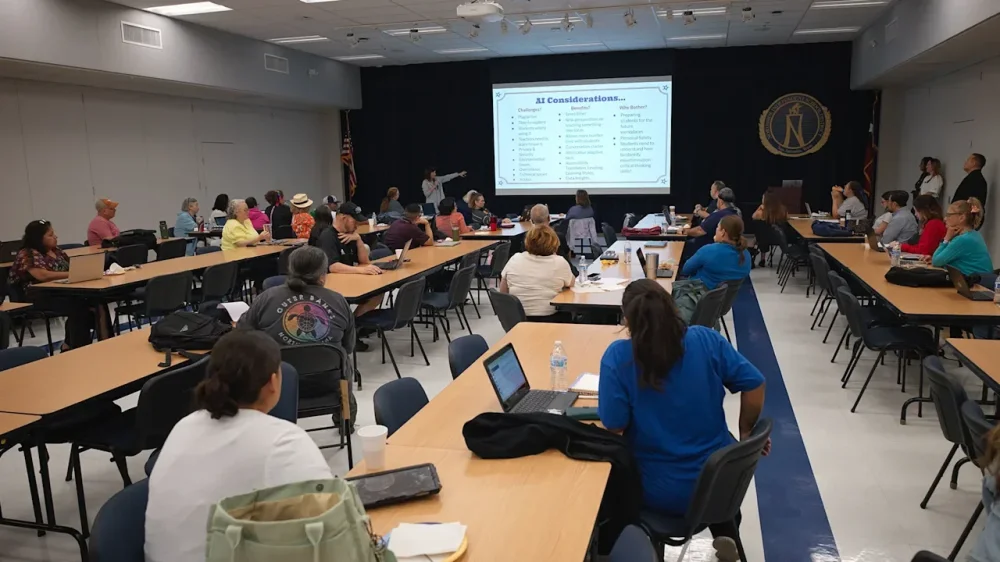
On a scorching hot Saturday in San Antonio, dozens of teachers traded a day off for a glimpse of the future. The topic of the day’s workshop: enhancing instruction with artificial intelligence. After marveling as AI graded classwork instantly and turned lesson plans into podcasts or online storybooks, one high school English teacher raised a concern that was on the minds of many: “Are we going to be replaced with AI?” That remains to be seen. But for the nation’s 4 million teachers to stay relevant and help students use the technology wisely, teachers unions have forged an unlikely partnership with the world’s largest technology companies. The two groups don’t always see eye to eye but say they share a common goal: training the future workforce of America. Microsoft, OpenAI and Anthropic are providing millions of dollars for AI training to the American Federation of Teachers, the country’s second-largest teachers union. In exchange, the tech companies have an opportunity to make inroads into schools and win over students in the race for AI dominance. AFT President Randi Weingarten said skepticism guided her negotiations, but the tech industry has something schools lack: deep pockets. “There is no one else who is helping us with this. That’s why we felt we needed to work with the largest corporations in the world,” Weingarten said. “We went to them — they didn’t come to us.” Weingarten first met with Microsoft President and Vice Chairman Brad Smith in 2023 to discuss a partnership. She later reached out to OpenAI to pursue an “agnostic” approach that means any company’s AI tools could be used in a training session. Under the arrangement announced in July, Microsoft is contributing $12.5 million to AFT over five years. OpenAI is providing $8 million in funding and $2 million in technical resources, and Anthropic has offered $500,000. Tech money will build an AI training hub for teachers With the money, AFT is planning to build an AI training hub in New York City that will offer virtual and in-person workshops for teachers. The goal is to open at least two more hubs and train 400,000 teachers over the next five years. The National Education Association, the country’s largest teachers union, announced its own partnership with Microsoft last month. The company has provided a $325,000 grant to help the NEA develop AI trainings in the form of “microcredentials” — online trainings open to the union’s 3 million members, said Daaiyah Bilal, NEA’s senior director of education policy. The goal is to train at least 10,000 members this school year. “We tailored our partnership very surgically,” Bilal said. “We are very mindful of what a technology company stands to gain by spreading information about the products they develop.” Both unions set similar terms: Educators, not the private funders, would design and lead trainings that include AI tools from multiple companies. The unions own the intellectual property for the trainings, which cover safety and privacy concerns alongside AI skills. The The President administration has encouraged the private investment, recently creating an AI Education Task Force as part of an effort to achieve “global dominance in artificial intelligence.” The federal government urged tech companies and other organizations to foot the bill. So far, more than 100 companies have signed up. Tech companies see opportunities in education beyond training teachers. Microsoft unveiled a $4 billion initiative for AI training, research and the gifting of its AI tools to teachers and students. It includes the AFT grant and a program that will give all school districts and community colleges in Washington, Microsoft’s home state, free access to Microsoft CoPilot tools. Google says it will commit $1 billion for AI education and job training programs, including free access to its Gemini for Education platform for U.S. high schools. Several recent studies have found that AI use in schools is rapidly increasing but training and guidance are lagging. The industry offers resources that can help scale AI literacy efforts quickly. But educators should ensure any partnership focuses on what’s best for teachers and students, said Robin Lake, director of the Center on Reinventing Public Education. “These are private initiatives, and they are run by companies that have a stake,” Lake said. Microsoft’s Brad Smith agrees that teachers should have a “healthy dose of skepticism” about the role of tech companies. “While it’s easy to see the benefits right now, we should always be mindful of the potential for unintended consequences,” Smith said in an interview, pointing to concerns such as AI’s possible impact on critical thinking. “We have to be careful. It’s early days.” Teachers see new possibilities At the San Antonio AFT training, about 50 educators turned up for the three-hour workshop for teachers in the Northside Independent School District. It is the city’s largest, employing about 7,000 teachers. The day started with a pep talk. “We all know, when we talk about AI, teachers say, ‘Nah, I’m not doing that,'” trainer Kathleen Torregrossa told the room. “But we are preparing kids for the future. That is our primary job. And AI, like it or not, is part of our world.” Attendees generated lesson plans using ChatGPT, Google’s Gemini, Microsoft CoPilot and two AI tools designed for schools, Khanmingo and Colorín Colorado. Gabriela Aguirre, a 1st grade dual language teacher, repeatedly used the word “amazing” to describe what she saw. “It can save you so much time,” she said, and add visual flair to lessons. She walked away with a plan to use AI tools to make illustrated flashcards in English and Spanish to teach vocabulary. “With all the video games, the cellphones you have to compete against, the kids are always saying, ‘I’m bored.’ Everything is boring,” Aguirre said. “If you can find ways to engage them with new technology, you’ve just got to do that.” Middle school teacher Celeste Simone said there is no turning back to how she taught before. As a teacher for English language learners, Simone can now ask AI tools to generate pictures alongside vocabulary words and create illustrated storybooks that use students’ names as characters. She can take a difficult reading passage and ask a chatbot to translate it into Spanish, Pashto or other languages. And she can ask AI to rewrite difficult passages at any grade level to match her students’ reading levels. All in a matter of seconds. “I can give my students access to things that never existed before,” Simone said. “As a teacher, once you’ve used it and see how helpful it is, I don’t think I could go back to the way I did things before.” The Associated Press’ education coverage receives financial support from multiple private foundations. AP is solely responsible for all content. Find AP’s standards for working with philanthropies, a list of supporters and funded coverage areas at AP.org. _ This story was first published on Oct 17, 2025. It was re-published on Oct. 20, 2025, to show Brad Smith is the president and vice chairman of Microsoft, not the CEO. —Jocelyn Gecker, AP Education Writer View the full article