ResidentialBusiness
Administrators
-
Joined
-
Last visited
Everything posted by ResidentialBusiness
-
 Google is testing using the italic font type for the links in AI Mode. So the links have a bit of a slant to them, compared to the other text in the AI Mode response.View the full article
 -
US investment bank is one of the largest-known creditors to the bankrupt auto parts firm View the full article
-
Today’s customers don’t separate their lives into channels, and they don’t expect brands to either. They want experiences that feel relevant and personal, whether that’s confirming a delivery, getting a reminder about an appointment, or receiving an offer they actually care about. Imagine a shopper who adds items to their cart but never checks out. Hours later, the reminder email arrives, but by then it’s buried in a crowded inbox. The opportunity to recapture their attention has passed. This is the challenge marketers face today: timing and trust matter just as much as the content itself. For marketers, the challenge is not in deciding which channel to use in isolation. It’s in orchestrating connected journeys that reflect customer preferences across every touchpoint. When journeys connect, customers respond When brands get this right, the impact is measurable. According to McKinsey, omnichannel customers shop 1.7 times more than those who engage on a single channel. That difference underscores a simple truth: value comes from the overall experience, not from any one channel on its own. Messaging is where customers expect brands to show up Customers are making their expectations clear: they want to connect with brands in the same seamless, familiar ways they already communicate in their personal lives. Messaging is no longer a side channel; it’s quickly becoming the default. Kantar research shows that 74 percent of online adults say they want to be able to communicate with businesses in the same way they communicate with friends and family. The adoption trend reinforces that shift. Messaging apps generate hundreds of millions of downloads every month, and WhatsApp continues to lead the category. In June 2025 alone, WhatsApp was downloaded more than 57 million times globally. With well over two billion active users across 180 countries, it represents both massive reach and a level of trust that few other digital channels can match. For marketers, this is not a call to abandon email, SMS, or push. Those remain essential. The opportunity lies in weaving messaging into orchestrated journeys, creating interactions that are more immediate, more visible, and ultimately more relevant. Choosing the moments that matter most Adding messaging to the customer journey is not about sending more messages. It is about choosing the moments where speed, visibility, and trust matter most. Omnichannel engagement works best when every touchpoint feels timely, relevant and welcome. Imagine reminding a loyal customer that they are one purchase away from unlocking a new rewards tier. If the message sits in an inbox for days, the moment is lost. But when it appears instantly in a messaging app they check throughout the day, the impact is different. The customer feels seen, and the brand earns attention. Those moments can vary by region. In places like Brazil, India and Indonesia, WhatsApp is often the primary channel for both customers and brands. In the U.S. or Canada, it may work best as a high-trust option for transactional updates, rather than broad marketing outreach. Using journey data and regional insight helps marketers decide where messaging adds value and ensures the channel is used in ways that feel authentic rather than excessive. Adding channels should not add complexity As messaging becomes a larger part of the customer engagement mix, the challenge for marketers is to keep the journey connected and coherent. Adding new channels should not mean adding more complexity. The opportunity is to manage orchestration from a single place, so that every message feels coordinated and every touchpoint reflects a unified view of the customer. With Adobe Journey Optimizer, WhatsApp can become a native part of the journeys marketers are already building. That might mean a welcome flow for new customers, a re-engagement series for those who have lapsed, or a follow-up after a purchase. Messages can be triggered by real-time actions, tailored using customer profiles, and kept consistent across touchpoints — all without adding operational complexity. The next step: Putting messaging to work in your strategy The shift toward messaging-first engagement is well underway, and the opportunity for marketers is clear. The future of customer experience will not be defined by any single channel but by how well they come together. With messaging now at the center of how people live and communicate, the next step is putting it to work in a way that serves both customers and brands. Every organization will find different points in the journey where messaging makes the most impact. For some, it may be in helping customers stay informed with service updates. For others, it may be in re-engaging shoppers who have drifted away, or reminding loyal customers of rewards they have earned. The key is to think strategically about where messaging complements the channels already in use, creating a journey that feels seamless rather than fragmented. A new eBook explores this opportunity in greater detail, showing how the WhatsApp channel can be used inside Adobe Journey Optimizer to strengthen omnichannel strategies without adding complexity. It highlights examples of where messaging makes the most impact and offers practical guidance for identifying the moments that matter, building on existing journeys and moving step by step toward more connected engagement. Download the eBook today to see how Adobe Journey Optimizer and WhatsApp can help you design journeys that connect with customers in the moments that matter most. View the full article
-
In my old banking job, where I worked for 12 years, I found myself frustrated with the slow pace of the work, the layers of red tape and approvals to get anything done. After all, banking was a highly regulated industry, and while there were many rules to follow, they were just simply being a good bank by following them. I felt tired, drained, and lacked energy—similar symptoms to burnout. While the organization was frequently voted a “best place to work,” I couldn’t figure out why my “great job” felt so bad. I wasn’t overworking or spending endless evenings logging in, so the typical paths to burnout didn’t make sense. What I was actually experiencing was rust out. A COSTLY CONDITION The literal definition of rust out is to decay and become unusable through the action of rust. Rust out is a type of burnout that comes from not using your unique skills and talents at work, lacking learning opportunities, and ultimately, dreading the repetitive tasks at work that sap your creativity. Not only is this costly to an employee’s peace and mental health, but it’s costly to employers, too. According to Gallup’s 2025 engagement report, the global percentage of engaged employees was 21% in 2024. It’s even worse for leadership. For young managers (under 35), engagement dropped by 5%, and female manager engagement dropped by 7%. Here’s what to do if you suspect you may be experiencing rust out: CONDUCT AN ENERGY AUDIT One of the biggest contributors to rust out is spending your energy in places that don’t align with your unique talents and skills. In my own experience, and in working with my clients, a simple way to uncover your unique talents is to notice your energy. I believe every work activity falls into one of three categories: energy suckers, energy stallers, and energy surgers. Energy suckers feel like they take heroic effort, even though the task wasn’t all that large or difficult. Energy stallers are tricky because they throw your energy into neutral. You don’t feel drained while doing them, but they don’t ignite your energy either. Energy surgers are the sweet spot you’re looking for. These projects bring a paradox—they are challenging, but they make you feel amazing, in flow, and like your most creative self. When conducting an energy audit, assess what percentage of your time is spent on energy suckers, energy stallers, and energy surgers. DUMP, DELEGATE, OR OUTSOURCE After you conduct your energy audit, the next step is to ask yourself: “What can I dump, delegate or outsource?” You want to dump the things that drain your energy the most. They are likely tasks or projects that we said yes to months or years ago that we keep doing because we’re on autopilot. In my own experience, these were old reports I would review that no one was paying attention to. If you don’t want or need to be there, and it doesn’t align with your values and priorities, it may be time to dump it. If you can’t dump it, can you delegate it? In a day of back-to-back meetings, I noticed that two of my team members were in there with me. They could handle the meeting and make the decisions, but because I was in the meeting as their leader, people would defer to me anyway. I decided to delegate that meeting. And by asking myself, “Where does my presence subtract value for fellow team members?” I found more meetings I could delegate. And finally, if you can’t dump it or delegate it, can you outsource it? In my years of working at technology and consulting firms, I discovered the power of outsourcing: from office snack delivery to marketing activities to contractors. ADVOCATE FOR YOUR TALENTS Once you are clear on what your energy surgers are, it is up to you to communicate clearly to your boss and peers what your strongest talents are and what type of work you’d most like to take on. Leaders can’t read minds, so the more you communicate the work you value and ask them to think of you when opportunities come up, the more likely they are to share your name and talents when you are not in the room. This may not happen overnight but through consistent conversations it can work. The good news is that several of my clients have stayed at a company they loved and redesigned their roles into something more enjoyable simply by having this energy and talents conversation with their leader. DECIDE IF A CAREER CHANGE IS NEEDED Sometimes, all of this reflection, advocacy, and self-awareness can bring us to an unexpected place: wondering if we are in the right career and if a change is needed to overcome rust out. While I always encourage folks to advocate and change their current environment so we don’t bring the same issues into a new role, there are some questions you can ask to help you determine if it’s time to stay or go, such as: Does this organization align with my values? Do I agree with the way leadership makes decisions? How have I advocated for the changes I want? Have I set and communicated necessary boundaries for how I spend my time and energy? If you determine that there isn’t values alignment and no changes have been made despite your advocacy, it might be time to look elsewhere. The results of beating rust out can boost an employee’s—and their employer’s — peace, potential, and paychecks and profits through improved productivity, well-being, and engagement. View the full article

-
Industry body says policy is based ‘on outdated premises and optimistic assumptions’View the full article
-
US Big Tech groups in final stages of agreeing deal with Brussels to avoid series of escalating finesView the full article
-
Washington wants American companies to be exempted from rules such as having to draw up climate transition plansView the full article
-
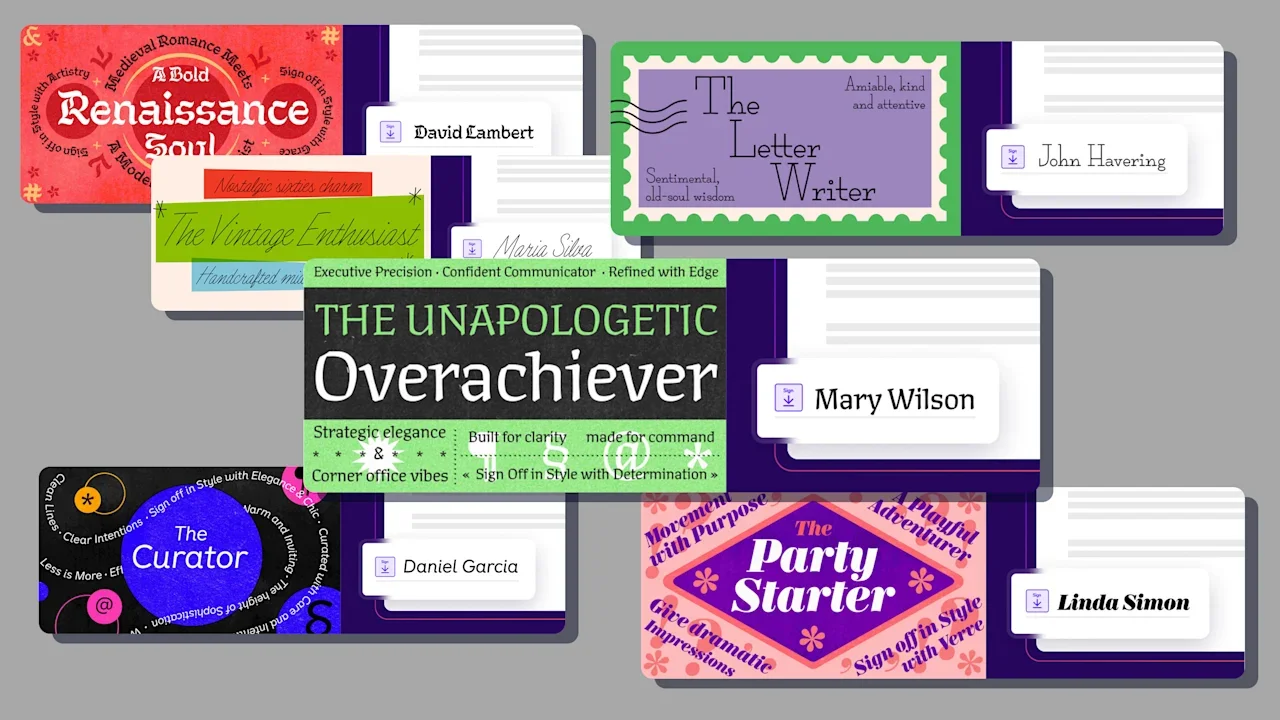
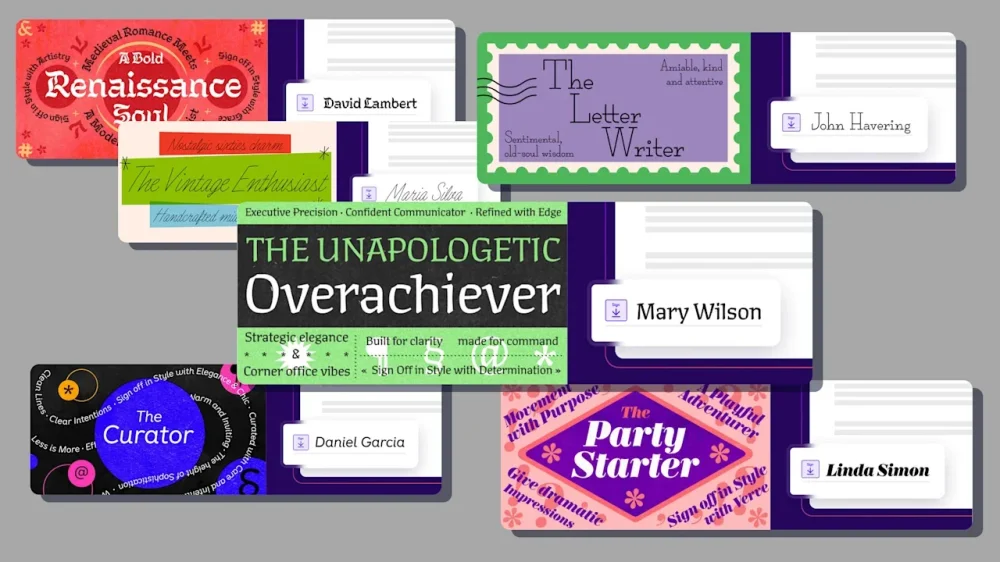
Libbie Bischoff didn’t set out to reinvent the signature. Really, she was just flipping through a vintage knitting magazine from the 1950s. The Minneapolis-based type designer collects the mags, partly because her grandmother taught her to knit, and partly because she finds incredible typography hidden within their pages. It was in one of these magazines that she found the casual, flowing script that would become one of Docusign’s new signature styles. Together with Lynne Yun—a New York-based type designer, calligrapher, and founder of the studio Space Type—Bischoff is responsible for the first major update to the platform’s signature options in more than 20 years. For Docusign, a company that has processed a billion-plus digital signatures, changing the look of a digital John Hancock is no small decision. It’s a move that reflects a quiet but significant cultural shift: Cursive is fading, as is the traditional idea of what a signature should be. [insert paywall] Reviving history A Docusign survey found that only 51% of Gen Zers sign their name in cursive, compared to 80% of boomers. As a lover of cursive and calligraphy, I feel depressed when I read that, but facts are hard to dispute. As our most important life moments move online, it’s logical to expect that the digital signature would become a new form of self-expression. Bischoff and Yun were tasked with injecting personality into a digital interaction that can often feel sterile. Their work explores how a signature can be authentically digital by moving beyond traditional cursive to reflect a user’s personality in an era when fewer people write by hand. For Bischoff, the process of creating the new signatures was an act of revival. She wanted to breathe digital life into historical handwriting. The script from the knitting magazine became “The Vintage Enthusiast,” a friendly, flowing cursive with printed, upright capital letters. “The capitals are all printed, but then the cursive lowercase element of it is very fast and kind of casual and more similar to . . . how [somebody] would write their signature,” she tells me. The style carries a sentimental weight for her, evoking the era when her grandmother would have been knitting. Her other creation, “The Letter Writer,” came from an even older source: a beautifully inscribed book from 1916 she spotted in an antique store. Bischoff was so struck by the penmanship that she snapped a picture. From there, she built the complete typeface—a clean, upright script with a professional feel, featuring bold caps and quirky lowercase letters. “The writing is very beautiful and just very professional,” she says. “That level of care going into a gift as simple as a book is, I don’t know, I just thought that was so nice.” “Calligraphy” for a digital age While Bischoff looked for inspiration in found artifacts, Yun got deep into the craft of calligraphy itself, exploring how the human hand could be felt in a digital format. Her four typefaces for the Docusign project push the boundaries of what a signature can be. “The Overachiever” is a sharp, confident script born from Yun’s study of 20th-century Czech calligrapher Oldřich Menhart. Menhart’s work is characterized by earthy, bold, and expressive calligraphic forms. For Yun, his work was the inspiration she needed to craft a modern digital typeface that would bridge the gap between traditional and contemporary design. As a calligrapher herself, she believes Menhart provided a foundation for a new style that feels personal and expressive without falling into the common traps of being either too gimmicky or overly formal. “I wanted to embody that era of calligraphy where it’s about personal expression, but you want to express yourself, like not in a way where it’s full-on goofy or full-on like ‘Here is my crown,’” she tells me. For “The Renaissance Soul,” she took a more experimental approach. “If ‘The Overachiever’ is like, Ooh, I cross my Ts . . . I think ‘The Renaissance Soul’ is the other way, where I do what I want,” Yun says with a laugh. She started by writing letters over and over with a calligraphy marker, then moved to a square brush and ink to explore how expressive the forms could get without losing legibility. The result is a bold, dramatic typeface with voluptuous curves and expressive, sculptural forms designed to command attention. Not all of Yun’s new typefaces are based on traditional script, though. For “The Curator,” a slanted, geometric sans serif, Yun says she wanted to create a hybrid that feels modern yet personal. The challenge was to infuse warmth into a typically clean and cool style. “I purposely wanted it to feel like a very modern version of handwriting, although it is nothing like handwriting at all because it is a very sans-serif feeling,” she explains. The creative process was about playing with perception. She started with “the structure of a modernist sans serif” and then worked to give it “warm, handwritten . . . vibes.” The key to this, she says, was creating the illusion of a connected script without actually connecting the letters. “It has that notion of like, ‘Oh, it would connect if it was like a handwritten scribble,’ but it’s not,” she tells me. Indeed, it’s clean-cut but still representative of a digital-native style rooted in a personal, human feeling. Finally, “The Party Starter” is a bold, high-contrast typeface with a playful attitude, as Yun describes it, noting the inspiration for it began with a French specimen from Constantine in 1834 that she wanted to combine with the spirit of 19th-century American woodcut type. “I think that in mid-century America we had a lot of big personalities. No matter what they look like, that was the vibe I wanted to capture,” she says. Yun made initial sketches that were faithful to the historical source but then intentionally deviated for a more refined, modern feel. She says she identified the “inconsistencies and quirks” in the original that worked against a harmonious texture and updated them for a modern aesthetic. The goal was to create something with a “slightly wilder, playful appearance” that wouldn’t look out of place at a formal function. The result is a typeface defined by what Yun calls “huge contrast, like big, bold, bulk terminals”—a visual representation of packing the biggest personality possible into a small space, which feels appropriate given how small signature spaces can be in so many documents. Beyond cursive I still question whether people are really ready to sign a legal document with something that doesn’t look like, well, a signature. Bischoff believes the reaction will be positive, if generational. “I think younger people don’t care about cursive-style things. I think older people will gravitate maybe towards those,” she suggests. Which is why Docusign wanted this new generation of typefaces, of course. Yun sees it as a natural evolution. For years, the digital world was stuck between the “super formal” and gimmicky Comic-sansy “marker writing.” This project, she feels, allows signatures to be “authentically digital” rather than just mimicking analog tools. “I think we’ve evolved past the point of wanting to fake pens in the digital space,” she says. “And now we’re just like, ‘Hey, this is a typeface and it has a personality.’” Docusign claims this is all about acknowledging that in a 99.9% digital world, your digital signature should still feel like you. Yun and Bischoff tell me that it was a chance to expand the definition of digital identity. To me, being neither a boomer nor a millennial or a Z but a Gen Xer, the answer to my rhetorical question is really much simpler: Sorry, Docusign, but your previous signatures really sucked. These new ones? They are pretty cool, even if I still hate the end of calligraphy and the actual bloody pen. View the full article
-
For small businesses constantly juggling communication across tools, documents, and meetings, Zoho’s newest product aims to simplify how teams work together. The company has launched Vani — an intelligent visual collaboration platform that turns brainstorming, planning, and execution into one seamless, shared experience. Vani introduces a visual-first workspace designed to replace the patchwork of apps that small businesses often rely on for project management, whiteboarding, and communication. Instead of hopping between spreadsheets, slides, and chat threads, teams can collaborate on what Zoho calls an “infinite canvas” — a digital space where ideas, data, and discussions coexist. Karthikeyan Jambulingam, Head of Product for Vani, says the platform was built to eliminate friction in everyday teamwork. “For small and medium-sized businesses, the ability to increase ease of collaboration, even a small percentage, can lead to extraordinary gains in productivity,” he explains. “Vani provides a comprehensive set of tools for all departments within one canvas, eliminating the need for app-switching, process building, or complicated onboarding.” The tool’s Space and Zone model structures collaboration in a way that supports both focus and visibility. A Space serves as the overall project canvas, while Zones let different contributors or teams work independently within that project — for example, marketing might refine campaign visuals while operations finalize logistics, all without stepping on each other’s work. It’s a model that mirrors how small teams collaborate in the real world, where different departments or individuals tackle connected parts of a project simultaneously. Beyond structure, Vani offers a library of templates and kits to help small teams start faster. Templates cover essentials like brainstorming sessions, strategic planning, or product roadmaps. The kits go deeper, providing ready-made frameworks for visuals such as design diagrams, network plans, or social media layouts. These elements are designed to help businesses that may not have dedicated design or planning staff execute more professional deliverables quickly. For idea generation, mind mapping tools help teams visually connect thoughts and turn concepts into actionable plans. And for those who often struggle to turn scattered meeting notes into results, Vani integrates AI-powered features throughout its interface. These include auto-generating flowcharts and mind maps from text, summarizing complex visuals, or providing quick insights from a project’s overall view down to individual shapes or notes. Video meetings are built directly into the canvas, making collaboration more immediate. Teams can launch calls, share updates, or brainstorm on the same page without toggling to another app. Every meeting can be recorded, allowing for asynchronous review — particularly useful for remote or hybrid teams managing flexible schedules. Industry analysts see potential in how Vani merges creativity and communication. “For distributed teams, whiteboarding has always been a challenge,” says Shashi Bellamkonda, Principal Research Director at Info-Tech Research Group. “Vani will help teams brainstorm together, no matter where they are. I am especially intrigued by the video catchup feature for brainstorming—it’s a great step toward replacing traditional meetings by mimicking the spontaneous ‘office walk over’ to discuss ideas with colleagues or a team.” For small business owners, these capabilities can translate into fewer meetings, faster project alignment, and less time spent stitching together tools that don’t integrate. Vani’s deep ties within the Zoho ecosystem — along with compatibility for third-party apps — make it a potential central hub for visual collaboration, no matter what software stack a business uses. Pricing may also appeal to small businesses watching their budgets. Vani offers a free plan with unlimited user onboarding, while its Team plan starts at $5 per user per month, one of the lowest rates among comparable collaboration platforms. The service is available globally, and its pay-as-you-scale model allows startups and growing teams to expand usage without committing to high upfront costs. Vani’s introduction underscores Zoho’s push into intelligent, AI-driven productivity tools built for flexibility and affordability — two priorities for small businesses navigating hybrid work. By combining brainstorming, communication, and project management into a single visual environment, the platform could help teams turn ideas into outcomes more efficiently. Small business owners can explore or sign up for Vani at www.vanihq.com. This article, "Zoho Launches Vani, a Visual Collaboration Platform for Teams" was first published on Small Business Trends View the full article
-
For small businesses constantly juggling communication across tools, documents, and meetings, Zoho’s newest product aims to simplify how teams work together. The company has launched Vani — an intelligent visual collaboration platform that turns brainstorming, planning, and execution into one seamless, shared experience. Vani introduces a visual-first workspace designed to replace the patchwork of apps that small businesses often rely on for project management, whiteboarding, and communication. Instead of hopping between spreadsheets, slides, and chat threads, teams can collaborate on what Zoho calls an “infinite canvas” — a digital space where ideas, data, and discussions coexist. Karthikeyan Jambulingam, Head of Product for Vani, says the platform was built to eliminate friction in everyday teamwork. “For small and medium-sized businesses, the ability to increase ease of collaboration, even a small percentage, can lead to extraordinary gains in productivity,” he explains. “Vani provides a comprehensive set of tools for all departments within one canvas, eliminating the need for app-switching, process building, or complicated onboarding.” The tool’s Space and Zone model structures collaboration in a way that supports both focus and visibility. A Space serves as the overall project canvas, while Zones let different contributors or teams work independently within that project — for example, marketing might refine campaign visuals while operations finalize logistics, all without stepping on each other’s work. It’s a model that mirrors how small teams collaborate in the real world, where different departments or individuals tackle connected parts of a project simultaneously. Beyond structure, Vani offers a library of templates and kits to help small teams start faster. Templates cover essentials like brainstorming sessions, strategic planning, or product roadmaps. The kits go deeper, providing ready-made frameworks for visuals such as design diagrams, network plans, or social media layouts. These elements are designed to help businesses that may not have dedicated design or planning staff execute more professional deliverables quickly. For idea generation, mind mapping tools help teams visually connect thoughts and turn concepts into actionable plans. And for those who often struggle to turn scattered meeting notes into results, Vani integrates AI-powered features throughout its interface. These include auto-generating flowcharts and mind maps from text, summarizing complex visuals, or providing quick insights from a project’s overall view down to individual shapes or notes. Video meetings are built directly into the canvas, making collaboration more immediate. Teams can launch calls, share updates, or brainstorm on the same page without toggling to another app. Every meeting can be recorded, allowing for asynchronous review — particularly useful for remote or hybrid teams managing flexible schedules. Industry analysts see potential in how Vani merges creativity and communication. “For distributed teams, whiteboarding has always been a challenge,” says Shashi Bellamkonda, Principal Research Director at Info-Tech Research Group. “Vani will help teams brainstorm together, no matter where they are. I am especially intrigued by the video catchup feature for brainstorming—it’s a great step toward replacing traditional meetings by mimicking the spontaneous ‘office walk over’ to discuss ideas with colleagues or a team.” For small business owners, these capabilities can translate into fewer meetings, faster project alignment, and less time spent stitching together tools that don’t integrate. Vani’s deep ties within the Zoho ecosystem — along with compatibility for third-party apps — make it a potential central hub for visual collaboration, no matter what software stack a business uses. Pricing may also appeal to small businesses watching their budgets. Vani offers a free plan with unlimited user onboarding, while its Team plan starts at $5 per user per month, one of the lowest rates among comparable collaboration platforms. The service is available globally, and its pay-as-you-scale model allows startups and growing teams to expand usage without committing to high upfront costs. Vani’s introduction underscores Zoho’s push into intelligent, AI-driven productivity tools built for flexibility and affordability — two priorities for small businesses navigating hybrid work. By combining brainstorming, communication, and project management into a single visual environment, the platform could help teams turn ideas into outcomes more efficiently. Small business owners can explore or sign up for Vani at www.vanihq.com. This article, "Zoho Launches Vani, a Visual Collaboration Platform for Teams" was first published on Small Business Trends View the full article
-
Plaintiffs accusing the lender of steering them to higher rates cited comments LOs made under oath describing elements of the alleged scheme. View the full article

-
For many stars, writing a children’s book is a fun side project they do to capitalize on their fame. Kate McKinnon—a Saturday Night Live alum who has starred in recent movies like Barbie and The Roses—is certainly famous. But the truth is that she had dreamed of writing a novel for middle schoolers since her mid-twenties, years before she even auditioned for SNL. As a child, McKinnon had loved books about slightly oddball characters, like those found in Roald Dahl books. Her favorite heroine was Pippi Longstocking, whom she played in a kindergarten performance. She loved the character so much that she would show up at school for years in a full-on Pippi costume, complete with pipe cleaners in her hair to mimic the heroine’s iconic protruding red pigtails. After graduating from Columbia University, between auditioning for sketch comedy roles, McKinnon sat down to write a middle-grade novel of her own. Holed up in her apartment, she plotted out a story about a trio of sisters in the Victorian era who don’t fit in in their stuffy town, where girls are meant to be prim and proper. The problem was that she could not get past the first chapter; she just wrote and rewrote it, frustrated that it wasn’t quite hitting the right notes. Then, in 2012, at the age of 28, McKinnon snagged a spot on SNL and quickly became one of the show’s biggest stars, leaving very little room for her novel. “It was very much at the back—and the middle—of my mind,” McKinnon recalls. “Every time I had a week off, I would work on it.” In 2022, McKinnon departed SNL and finally had time to devote to the novel. After marinating on it for more than a decade, it came together, and she landed a book deal with Hachette. Her book, The Millicent Quibb School of Etiquette for Young Ladies of Mad Science, debuted in 2024 and became an instant New York Times bestseller. She’s just released the second book, called Secrets of the Purple Pearl, in what will eventually become a series. I sat down to speak with her about her creative process, and why we should feel free to pursue several dreams at the same time. Here are three things I learned. She Didn’t Let A Lack of Expertise Stop Her McKinnon studied theater in college and had spent years training as an actress and comedian. She had never studied creative writing, but she didn’t let that stop her from taking a stab at writing a novel. “I didn’t know anything about writing,” she recalls. “I didn’t know you’re supposed to write a whole draft before going back and fixing the first chapter. So I just fixed the first chapter, probably 500 times.” Many writing instructors urge their students not to get hung up on the details so early on. But McKinnon’s approach was actually helpful because it allowed her to figure out many aspects of the plot and the characters. It was an unconventional approach to character development, but it helped her create her first three characters, the sisters Gertrude, Eugenia, and Dee-Dee. But after writing several drafts of the first chapter, she felt like something was missing. “My big problem was that I was writing about three oddball girls who had no adults in their life validating them,” she says. “It ended up being sad every time I wrote it. Then I felt there needed to be a mentor figure who recognized the good in these girls.” This figure ended up being Millicent Quibb, the title character of the series. McKinnon was also noodling through the broader themes of the book she wanted to communicate. While she was very interested in painting these quirky characters, she also wanted to say something more profound about identity, and how hard it can feel not to fit in. “The themes eluded me for the longest time,” she says. “I needed to know what I am actually trying to say here.” Ultimately, McKinnon didn’t let her lack of formal training prevent her from throwing herself into novel writing. In fact, it’s the process of trial and error that has allowed her to hone her craft. Now, McKinnon has novel writing down to a science. It took her more than 12 years to write the first Millicent Quibb book, but she wrote the second one in a matter of months. “Left to my own devices, I would never complete anything because I am so hard on myself,” she says. “But being under a deadline is what allowed me to complete this.” She Wove Her Other Passions Into This Project While McKinnon hadn’t trained as a writer, she did have other skills that most writers don’t have: an ability to build quirky, complex characters from the ground up. To create the characters in her book, McKinnon would pace around her room speaking in funny voices, which is something she’s enjoyed doing her whole life (and that eventually became her full-time job on SNL). “In my mid-twenties, before getting on SNL, writing this book was almost like doing sketch comedy, without anybody there to watch you,” she says. “I was just doing it alone in my room.” It’s been a very effective strategy. All of her characters are memorable and hilarious. Eventually, she was able to bring all of these characters to life in the audiobook of the series, which she voices along with her sister, Emily Lynne. It’s Important For Her To Speak To Children Most of McKinnon’s career has targeted adult audiences. Her first acting jobs were in comedy, starting with The Big Gay Sketch Comedy Show and then SNL. And much of her acting has been in movies targeting adults, like The Roses, Bombshell, and the TV series Joe vs. Carole on Peacock. But McKinnon is also eager to reach children, particularly at this moment when the world feels so volatile. Writing the Millicent Squibb books has been meaningful to her because it has allowed her to connect with children and give them hope. Indeed, the Squibb character is inspired by the many mentors in her own life who believed in her and helped her find her path. But looking back, her childhood seems idyllic compared with what children are dealing with today. “Young people today are up against a whole host of problems I could not even conceive of when I was in middle school in the ’90s,” she says. Her hope is that her voice gives children some joy in a stressful time, but also empowers them to act to make things better for themselves and others. “I think this genre is not just fun, but hopeful, because it focuses on questions of identity and moral engagement in society,” McKinnon says. “It’s about figuring out who you are so that you can help other people. That’s something young people today can’t ignore the way I could.” View the full article

-
Today’s labor market may be stagnating, but it’s also uncertain. Candidates aren’t behaving as many leaders would expect. The dynamic is trending towards an employer’s market. As a result, employers expect that candidates will increase their job searches, accept lower pay increases, and accept new roles more eagerly. But in reality, job searching has actually declined, pay expectations remain high, and candidates are reluctant to move. And this has resulted in a critical talent supply shortage. According to research from Gartner, 29% of candidates spent more than five hours per week on active job searches in the second quarter of 2025. That’s down from 49% in the first quarter of 2023. Additionally, in a 2025 Gartner survey of nearly 3,000 candidates, 53% identified higher compensation as their top reason for accepting a job offer. Acceptances are also significantly down with 51% of candidates reporting they accepted their most recent offer in the second quarter of 2025, down from 75% in the first quarter of 2025. Candidates might expect more from jobs today, or they might be responding more to uncertainty than market stagnation. Whatever the reason may be, they’re willing to wait for jobs that meet their higher expectations. As a result, recruiters are feeling greater pressure to understand candidates’ wants and how to deliver on them. To compete successfully for critical talent today, organizations need to adopt an approach that’s more consistent with a fluid labor market. Below are the things that leaders need to focus on if they want to hire the best and brightest. Engaging talent selectively Many leaders expect candidates to put more effort into their job search today. The reality is that job searching has sharply declined. To bridge the job search expectation gap, organizations need to focus on building deeper relationships with the right talent, just like they would in a more fluid market. HR can guide business leaders to narrow their hiring focus to roles with the greatest business impact or complexity. This is especially important in today’s cost-constrained environment. HR should prioritize deploying recruiters who excel at building long-term candidate relationships. Automating hiring processes for less critical roles can also help free up resources. This allows recruiters to concentrate on attracting talent for the capabilities that matter most. Managing attribute mix Labor market observers may expect candidates to settle for modest pay increases. But many are holding out for the full employment deal they want. To close this expectation gap, it’s up to the organization to amplify the right mix of attributes for the talent they’re targeting. HR can help business leaders pinpoint the critical skills and experience levels that they need, then identify current employees who match those profiles. Running focus groups with those employees can uncover the attributes that differentiate the organization from the perspective of those specific employees. Enlisting current employees from target talent segments can also help craft powerful messaging. They can help shape the tone, emphasis, and content that will resonate most with the candidates that the organization wants to attract Mitigating career risks Seasoned HR leaders might expect candidates to be eager to accept offers in today’s climate. In reality, candidates are hesitant to accept. Gartner research finds that candidate willingness to accept job offers peaked in the last quarter of 2023, at 87%. This fell significantly by mid-2024. By the second quarter of 2025, only 51% of candidates reported they had accepted a new job offer. To resolve this offer-acceptance expectation gap, organizations need to focus less on convincing candidates to move jobs and more on the risk of not moving in the first place. HR needs to equip recruiters to help candidates think through their options, weigh risks, and make confident decisions. When candidates feel supported by the organization, they’re more likely to move forward. That’s why it’s important to train recruiters to be able to have these types of conversations, so that they’re in a better position to build relationships Following this path, HR is not simply reapplying the playbook from a fluid market. In today’s climate, if the primary hesitation among talent is a fear of being “Last In, First Out,” then recruiters need to shift the conversation from the risk of making the move to not making it. HR leaders today can’t rely on traditional assumptions about candidate behavior in a stagnating market. Today’s market may be stagnant, but it’s also uncertain. Candidates are responding less to stagnation and more to that uncertainty. Until that changes, organizations should adopt a candidate playbook that reflects a more fluid market. And that’s a market that demands tighter positioning and greater assertiveness. View the full article

-
Move over quiet quitting, bare minimum Mondays, and career cushioning. A new workplace behavior is on the rise: the self-aware underperformer. Contrary to hustle culture, these workers are knowingly underperforming and not doing anything about it. It used to be the delusional underperformer—the employee who thought they were doing a great job—that gave HR headaches. The self-aware underperformer, on the other hand, is aware that they’re underperforming and not taking any actions to rectify it. As leaders, this isn’t something you can afford to ignore. After all, underperformance doesn’t just materialize. The culture has been brewing and cultivating on our watch. Unfortunately, far too many companies prioritize optics over results, turn to placating instead of coaching, and compensate instead of addressing. In some cases, they’ve repurposed authenticity and transparency (both of which are positive attributes) to serve as convenient excuses. This dynamic leads to the self-aware underperformer. Many have hailed self-awareness as the holy grail of performance. It’s often tied to superior decision-making, enhanced team dynamics, and thriving leadership behavior. Despite the admissions, true self-awareness appears to be in short supply. According to a 2018 article by Harvard Business Review, 95% of people think they’re self-aware, yet only 10% to 15% actually are. This is the confronting dilemma. The perceived claim of awareness without the change is a disguise for the underperformer’s illusion of responsibility. It feels like accountability. Yet when employees repeatedly demonstrate awareness, apologies, and empathy but fail to change, it’s no longer just their performance that suffers. Here are five signs you are working with a self-aware underperformer 1. Underperformance as an identity These employees wear their underperformance like a badge. They deliver the bare minimum. Previously, people would have seen their behavior as complacent. Now, they’ve reframed it as a kind of delusional authenticity. “I know I might not be the best, but I’m steady.” By leaning into this identity, they transform underperformance into their personal brand. As a leader, you need to separate awareness from accountability. Remember, awareness isn’t a deliverable. A useful response is, “Thanks for raising that. What’s your plan to fix it this week?” This keeps the conversation future-focused and signals that it’s not enough for them to recognize they’re underperforming. 2. Self-deprecation Some employees deflect by making light of their shortcomings. They might say the following statement with a smile or a joke. “You know I’m hopeless at numbers.” They disarm criticism. Managers might even laugh along. But six months later, the reports continue to be late. What feels like humility in the moment is a shield that protects a lackluster effort to improve. To address this, anchor evaluations to progress, not personality. Self-aware underperformers often rely on charm, humility, or likability. That means grounding assessments to measurable outcomes. What matters is not how self-aware they appear, but whether their output improves quarter to quarter. 3. Passively reframing underperformance as a moral issue They position self-awareness as a conscious decision to reject the hustle culture. They might make excuses like “why should I extend myself?” or “we’re not saving lives.” They might champion underperformance as a moral cause. Tackling this attitude requires managers to raise the bar on that employee’s comfort zone. If someone openly settles for less, it’s on you as a leader to decide whether that’s an acceptable plateau. In high-expectation roles and cultures, make clear that comfort is not a contract. Performance standards exist for a reason, and you can’t suspend them simply because someone is candid about not aspiring higher. 4. Your narrative becomes theirs You want to be “that supportive manager.” In the beginning, you might be patient and give them the benefit of the doubt. “They are still coming up to speed,” or “they need more training, resources, and help.” But there comes a point when it becomes over-accommodating. You might find yourself allocating their work to others, extending deadlines, and making continual allowances. Before you know it, their performance is no longer their responsibility, but yours. You need to interrupt the rationalization loop. Shift the discussion from causes to choices. Ask, “Given these constraints, what can you still control and improve?” This reframes the narrative from circumstance to agency, which puts responsibility back in the employee’s hands. 5. An abundance of excuses Self-aware underperformers rarely run out of explanations: outdated systems, shifting market trends, and unclear mandates. These rationalizations are often factually correct, but function as shields. Rather than moving from problem to solution, employees stay stuck in the narrative of why things couldn’t be done. When they appear to show empathy, it becomes harder to confront. “I know this must be frustrating for the team, and I really appreciate everyone’s patience.” It’s a clever move because it’s a neat redirect away from the issue. Instead, redefine empathy as action. Empathy is valuable only when it translates into behavioural change. Encourage employees to pair recognition with repair. “You’ve named the impact on the team, now let’s agree on what you’ll do differently.” The real leadership test isn’t spotting underperformance. As leaders, you need to see through the packaging of awareness without improvement. Awareness without change is simply underperformance in more eloquent clothing. The best leaders know how to thank people for their honesty, and then hold them to the change that honesty demands. View the full article

-
Financial Policy Committee warns equity prices are at levels comparable with dotcom bubbleView the full article
-
Spend five minutes on the “how to grow” side of TikTok, and you’ll quickly learn one thing: if you’re not posting multiple times a day, you’re doing it wrong. Or so the algorithm experts say. As a fledgling TikTok creator, I’ve always been a bit sceptical of this advice. I managed to build a small audience within about a year by posting a couple of times a month, rather than daily. But… would I have been able to get more views on TikTok if I had? I put the question to Buffer’s data scientist, Julian Winternheimer. And because he never does anything by halves, Julian analyzed a massive dataset to find the answer: 11.4 million TikTok posts from over 150,000 accounts. We (by we, I mean Julian) went full science on this 2025 TikTok Study: running fixed-effects regressions and Z-score analyses to control for account size and performance differences. The goal: To understand how posting frequency impacts your odds of success on TikTok. If you’ve ever wondered how often you really need to post to grow on TikTok, this is for you. Spoiler: The “post 3 times a day” crowd isn’t totally wrong… but the data tells a much more nuanced story. Jump to a section: How often should you post on TikTok? How posting frequency affects views on TikTok — the study The highest lift is moving to 2 to 5 posts per week More posts mean more chances to go viral Post smarter, not just more More TikTok resources 💡If you’re keen to dig into the data or you want some receipts for the recommendations we’re making below, scroll down to the section The study: How posting frequency affects views on TikTok.How often should you post on TikTok?The short answer: Aim for 2 to 5 posts per week. Our data shows that going from posting just once to 2 to 5 times per week on TikTok can offer the most meaningful lift in views. However, posting more does mean more views — though not quite as many more as that first jump. Julian’s analyses consistently showed that posting more often means more views per post. He found that TikTokers who go from posting once a week to: 2 to 5 times → get up to 17% more views per post6 to 10 times → get up to 29% more views per post11+ posts → get up to 34% more views per postYes, 11+ posts a week is a lot — and technically gives you the most significant average lift. But here’s the best bit (if you’re a creator with a day job like me): The biggest jump happens when you go from 1 → 2 to 5 posts per week. In other words, you’ll get the most reward for your efforts if you up your cadence from 1 to between 2 and 5 posts every week. Of course, because TikTok is complicated, this doesn’t mean you’ll automatically start seeing an uptick in views, even if you jump to that 11+ posts per week cadence. This is because the increase in views doesn’t come from a steady rise in performance per post but rather from the increased chances of breakout success. In fact, the median views per post stay pretty flat no matter how much you post. (More on this below). The reason: Our analysis showed that the more you post, the greater your chances of going viral with a single post. Let’s unpack that. ✨Take the guesswork out of posting: Buffer makes it easy to plan, schedule, and analyze your TikTok posts — so you can stay consistent and get back to creating. 👉 Try Buffer for free →How posting frequency affects views on TikTok — the studyPosting more means more views per post. (I’m about to share some pretty impressive numbers, but there’s a lot of nuance here, so do read the next couple of sections and not just this one!) Compared to just posting once per week, TikTokers who post: 2 to 5 times → 17% more views per post6 to 10 times → 29% more views per post11+ posts → 34% more views per postJulian uncovered this with a fixed-effects regression model, which compares each account to itself over time. (Meaning it isolates the effect of frequency by removing account-level differences like follower count, niche, or brand strength.) The highest lift is moving to 2 to 5 posts per weekHere’s some of that nuance: the returns are diminishing. In other words, you’ll get the best bang for your buck when you go from 1 post per week to 2 to 5. So yes, posting 11+ times a week brings the biggest lift. But the most efficient gain per extra post is in the 2 to 5 per week range. If you’ve read our studies on how often to post on Instagram and LinkedIn, you’ll know this is true of those platforms, too. Pretty convincing, right? Simply looking at the data above, we could reasonably conclude that TikTok seems to ‘reward’ users for posting more. Well, that’s not exactly the case (buckle up, my friend). More posts mean more chances to go viralIn some of Julian’s initial analyses, average views per post remained relatively steady, no matter how frequently users post. Similarly, the median views per post actually fall a bit at higher cadences. So, er — what the heck is going on? “This implies that the distribution of views per post becomes more skewed at higher posting frequency, even if the typical post doesn’t necessarily perform better,” Julian explains. In other words: TikTok views are heavily skewed. Most posts get modest numbers, and a few go viral. So, looking at the mean or median views alone can miss what’s happening at the top end. To better understand this, Julian sorted the view counts from lowest to highest and turned his magnifying glass on the top 10% of posts (aka the 90th percentile or p90) This helps answer: “How much better are the best posts doing when people post more often?” Weekly Posts Median Views 90th Percentile Views Viral Potential (p90/median ratio) 1 Post 489 3,722 7.6x 2–5 Posts 506 6,983 13.8x 6–10 Posts 487 10,092 20.7x 11+ Posts 459 14,401 31.4x Even though the median views per post stay around ~500, the top 10% of posts perform significantly better at higher cadences. Hold up: what about smaller accounts? Those p90 views per post numbers are impressive — and something you might not be used to seeing if you have a new or smaller account (🙋♀️). Does that mean increasing your posting frequency will only help when you have a larger account? Not at all! Julian’s regression models controlled for that — and found that the relative gains hold true across all account sizes. And remember, that 90% percentile was per post, not account. TikTok content performance is not as follower-dependent as a platform like Instagram. Even new creators can have viral posts. Whether you have 500 followers or 50,000, increasing your posting cadence can help increase your chances of virality. I really like this analogy: Posting more frequently doesn’t necessarily raise the floor, but it does raise the ceiling. Post smarter, not just moreAs always, remember that quantity is impactful, but quality will always be the most important factor in social media success. So instead of stressing about daily uploads, focus on showing up consistently and making content you’re proud of. As our data shows, even increasing your output from one post to three posts per week can move the needle. Julian summed it up best: “Posting more helps — but mostly because it increases your chances of getting lucky. TikTok is heavy-tailed. You only need one post to pop off. Posting more just increases your odds.” More TikTok resourcesThe Best Time to Post on TikTok in 2025 — New DataTikTok Algorithm Guide 2025: Everything We Know About How Videos Are RankedTikTok Bulletin Boards: What They Are, How They Work, and Why They Matter14 Ways to Get More Followers on TikTok in 2025 — Tried and Tested13 Trending Songs on TikTok in 2025 (+ How to Use Them)Top 250 TikTok Hashtags for 2025 + How to Use Them for GrowthView the full article
-
Camping. Why anyone would put themselves through an odyssey of gross insects and pooping in holes is beyond me, but you do you, Steve. I’ll do me. However, if I were forced to go sleep in the woods, I would like to use this new camping mattress by Chinese sleep startup Mazzu created in collaboration with London-based design studio Layer. It looks like the closest thing to a Four Seasons bed this side of the Rio Grande. Or any río (just don’t get me close to a river). The Mazzu Camping Mattress isn’t your typical inflatable pad that promises comfort on-the-go but delivers back pain for a week. It’s built around 72 precision-engineered elastic spring units—pre-compressed coils encased in durable jackets that adapt independently to your body’s contours. Each unit flexes on its own, providing ergonomic support whether you’re lying flat or curled up on your side (you know, like in an actual bed). Layer tells me via email that people want “the comfort of home when they’re outdoors, and traditional inflatable or foam mats just don’t deliver that.” Which, yes, that’s exactly my point. The company says conventional options are bulky, unreliable, or simply uncomfortable. And many are unsustainable. Layer and Mazzu saw a clear gap to create a sustainable, portable system that offers bed-like comfort without compromise, bringing “a real sense of restfulness to the camping experience.” Come together, right now The collaboration between Layer and Mazzu wasn’t just about slapping springs into a camping format. Mazzu’s engineers have been developing elastic spring technology since they started their sleep company in Fujian, China, in 2024. Layer worked closely with Mazzu to translate that into a modular outdoor system. The design studio says there were many rounds of prototyping—exploring different spring densities, connection systems, and layouts—until they arrived at something simple and robust that’s also intuitive to use. The pieces click together like Lego bricks and are secured with a strong cord. When the mattress base is assembled, you add a thin, 100% cotton cushion on top to smooth everything out. Layer tells me it gets assembled “in just a matter of minutes,” and you can be set up and ready to rest almost as quickly as rolling out a standard mat, “but with a completely different sleep experience.” The other advantage of this design, the company points out, is that it’s not harmful to the planet. Layer says the portable coils structure is built without foam or glue (Mazzu, however, points out that the pad on top uses polyester fiber and high-resilience polyurethane). Layer says the mattress is built to last: “Every component can be replaced, repaired, or upgraded individually, which extends its lifespan and reduces waste—something that’s very rare in camping gear.” Packed in a cooler The complete mattress—including foldable base, spring modules, and topper—packs into a wheeled case no larger than a cooler. Once emptied, Layer says, that case doubles as a nightstand or storage box at the campsite. So it’s not just about better sleep, the company says, it’s about circularity and smart use of space. The color palette takes cues from outdoor gear: foliage tones and bright accents for visibility. The open structure showcases the engineering inside, which I appreciate (if I’m paying for 72 independent spring units, I want to see them). The Mazzu Camping Mattress launches this month. Pricing in China is about 2,259 yuan (about $320), but no official price has been announced internationally. If it actually delivers on the promise of bringing regular mattress comfort into the wilderness, it might be worth whatever they’re charging. Maybe then I’ll consider camping. (LOL! No.) View the full article

-
Senior officials from Qatar and Turkey also expected to attend in push for breakthrough over Donald The President’s peace planView the full article
-
The The President administration is spending more than half a billion dollars to help prop up the dying coal industry. It’s also weakening pollution regulations and opening up more federal land to coal mining. All of this isn’t likely to save the industry—and also isn’t likely to do much to meet the surging demand for power from data centers for AI. Coal power is expensive, and that isn’t going to change Aging coal power plants are now so expensive to run that hundreds have retired over the last decade, including around 100 that retired or made plans to retire during The President’s first term. Offering relatively small subsidies isn’t likely to change the long-term trend. “I don’t think it’s going to change the underlying economics,” says Michelle Solomon, a manager in the electricity program at the think tank Energy Innovation. “The reasons why coal has increased in cost will continue to be fundamentally true.” The cost of coal power grew 28% between 2021 and 2024, or more than double the rate of inflation. One reason is age: the average coal power plant in the U.S. is around 50 years old, and they aren’t designed to last much longer. Because renewable energy is cheaper, and regulation is likely to ramp up in the future, investors don’t see building new coal power plants as viable. But trying to keep outdated plants running also doesn’t make economic sense. The new funding can’t go very far. The Department of Energy plans to spend $625 million on coal projects, including $350 million to recommission and retrofit old plants. Another $25 million is set aside for retrofitting coal plants with natural gas co-firing systems. But that type of project can cost hundreds of millions or even a billion dollars for a single plant. (The $25 million, presumably, might only cover planning or a small pilot.) Other retrofits might only extend the life of a power plant by a few years. Because the plants will continue to be expensive to run, some power plant owners may not think the subsidies are worth it. Utilities want to move on If coal power plants keep running past their retirement age, even with some retrofits, costs keep going up for consumers. “That’s something that you really see in states that continue to rely on coal for a big part of their electricity mix,” says Solomon. “Like Kentucky and West Virginia, who have had their cost for power increase at some of the fastest rates in the country.” In Michigan, earlier this year, the DOE forced a coal power plant to stay open after it was scheduled to retire. The DOE cited an “emergency,” though neither the grid operator nor the utility said that there were power supply issues; the planned retirement of the plant included building new sources of energy to replace it. The utility reported to the SEC that within the first 38 days, alone, it spent $29 million to keep the plant running. (The emergency order is still in place, and being challenged by multiple lawsuits.) The extra expense shows up on consumers’ bills. One report estimates that by 2028, efforts to keep large power plants from retiring could cost consumers more than $3 billion a year. Utilities have long acknowledged the reality that there are less expensive energy sources. In the first The President administration, in 2018, utilities resisted The President’s attempts to use emergency powers to keep uneconomic coal plants open. When utilities plan to retire a power plant, there’s a long planning process. Plants begin making decision to defer maintenance that would otherwise be necessary. And many won’t want to reverse their decisions. It’s true that demand for power from data centers has led some utilities to keep coal plants online longer—and electric bills are already soaring in areas near large data centers. But The President’s incentives may not make much difference for others. The last coal plant in New England just shut down years early, despite the current outlook for data centers. “Utilities do have to take a long-term view,” says Lori Bird, director of the U.S. energy program at the nonprofit World Resources Institute. “They’re doing multi-year planning. So they consider the durability and economic viability of these assets over the longer term. They have not been economic, and they’re also the highest-emitting greenhouse gas facilities.” Even if the The President administration has rolled back environmental regulations, she says, future administrations could reverse that; continuing to use coal is a risky proposition. In most states, utilities also have to comply with renewable power goals. There are better solutions It’s true that the U.S. needs more power generation, quickly. It’s not clear exactly how much new electricity will be needed—some of that will depend on how much AI is a bubble and how much tech companies can shrink their power usage at data centers. But the nonprofit Rewiring America calculated that data centers that are under construction or in planning could add 93 gigawatts of electricity demand to the U.S. grid by the end of the decade. The nonprofit argues that some or even all of that new capacity could be covered by rooftop solar and batteries at homes. Cheap utility-scale renewable power plants could obviously also help, though the The President administration is actively fighting them. Battery storage can help provide 24/7 energy. One analysis of a retiring coal plant in Maryland found that it would be less expensive to replace it with batteries and transmission upgrades than to keep it running. Temporarily saving a handful of coal power plants won’t cover the new power needs. It would add to air pollution, water pollution, and climate pollution. And it would significantly push up power bills when consumers are already struggling. Real support for an “energy emergency” would include faster permitting and other work to accelerate building affordable renewable energy, experts say. “Making sure that resources can compete openly is really important,” says Solomon. “It’s important to not only meet the demand from AI, but make sure that it doesn’t raise costs for electricity consumers.” View the full article

-
The return-to-office debate sees no end in sight. Workers still want flexible work—and drag their feet complying with RTO, it was reported this week. Some workers have suspected such policies have been a way of companies saying: “Don’t like it? Quit.” Turns out, maybe they are. A recent Fortune article, citing a 2024 survey of more than 1,500 U.S. managers, found that a quarter of C-suite executives hoped for some voluntary turnover after introducing an RTO policy. One in five HR leaders went further, admitting their stricter office requirements were designed to push staff out. So when the article started making the rounds on Reddit last week, the general lack of surprise was telling, and renewed discussion around worker suspicion that RTO goes beyond “fostering collaboration.” “This belongs on the ‘no shit sherlock’ subreddit,” one user wrote. “This should have been pretty obvious to any person with the ability to think objectively,” another added. One suggested, “The rest just aren’t admitting it yet.” Their skepticism isn’t misplaced. In fact, business leaders across the U.S. told the Federal Reserve’s Beige Book they’re banking on in-office requirements to quietly and cheaply trim headcount, all without having to play the bad guy. More than half of Fortune 100 companies now have a full-time office requirement, and research shows nearly 3 in 10 companies will demand five days a week in the office by the end of 2025. That’s despite almost half of workers warning they’d quit if remote work disappeared. To some, the ability to work from home is a perk equivalent to 8% of their salary, and not something they are prepared to give up without a fight. But those threatening to quit may have less bargaining power than they believe. A mass exodus triggered by RTO might seem like it wouldn’t be in companies’ best interests, yet in fact, the opposite may be true. Forcing disgruntled employees to quit provides companies looking to reduce their workforce with an easy out, all without the need to foot the severance packages and bad press tied to layoffs. Rather than cleverly killing two birds with one stone, however, RTO mandates, as a workforce reduction tactic, often simply drains talent along with morale among remaining employees. At a time where employees are already disengaged at work, there’s something to be said for a business strategy that’s all stick—and no carrot. View the full article

-
Below, Nick Foster shares five key insights from his new book, Could Should Might Don’t: How We Think About the Future. Nick has spent the last 25 years working within companies at the very forefront of emerging technology, from Apple and Sony to Nokia and Dyson. Most recently, he was head of design at Google X. He has established himself as a leading figure in the field of Futures Design. In 2021, he was awarded the title Royal Designer for Industry, the highest accolade for a British designer. What’s the big idea? We need to have a conversation about the future, but not the kind you’d expect. Humans have already talked at length about what the future may or may not hold. What we rarely discuss, and need to start addressing, is how we think about the future. By understanding the ways in which people process what lies ahead, we can all become better-equipped critics of the futures we are shown or sold. To design a better future, we need better futurists. 1. Thinking about the future is more important than ever. There is a palpable sense of curiosity, uncertainty, and anxiety about the future. Google searches for What will the future be like? have tripled since 2020. I think that’s because we have experienced more change in the last hundred years than at any other time in history. A hundred years ago, we had not yet invented penicillin, and less than half the homes in America had electricity. My father, who lived in the U.K., has experienced both a world before the creation of vinyl albums and after the creation of ChatGPT. Even if I think about myself, there were half as many people on Earth when I was born as there are today. Much of this rapid change has come with baggage, and many of the things we’re trying to fix today are the result of insufficient thought about the future from previous generations. This needs to change. To start, we need to have a conversation about our ability to think about the future. I see the world through a design lens, but I’ve spent my entire career around entrepreneurs, scientists, engineers, strategists, investors, business leaders, and policymakers, and it seems that no one is very good at thinking about the future. This skill is significantly underprioritized, underfunded, and underdeveloped in almost all of us. Our thinking about the future tends to fall into one of four main varieties: could, should, might, don’t. 2. Could Futurism. Could Futurism is a way of thinking about the future with wide-eyed optimism. This is probably the most familiar and publicly embraced type of futurism. If you type “futuristic” into Google images, you’ll see over-the-top visions of flying cars, humanoid robots, and towering glass architecture. This is the kind of stuff you see from futurists on conference stages or when futurists are invited onto TV, and this is also how we typically experience the future when we go to things like trade shows or expos. This futurism is built around the modernist idea of growth and change through strident progress, mechanization, and industrialism. This way of thinking about the future has largely grown in parallel with the growth of science fiction, which has fed ideas into the minds of powerful leaders. It’s exciting, escapist, and intended to shock. “This futurism is built around the modernist idea of growth and change through strident progress, mechanization, and industrialism.” But Could Futurism has weaknesses that are often overlooked. Just like sci-fi storytelling, this kind of futurism is heroic. It treats the future as a world filled with extreme characters having extreme experiences in extreme places—and often treads a bit closer to advertising than truth. It encourages us to think of the future as a place of extreme transformation, but doesn’t talk about transition or interstitial change. While it prides itself on imagination, Could Futurism is also incredibly repetitive, as evident in those Google search results. This futurism represents a placeholder for deep thinking, offering simplified icons that we can drop into our slideshows and conversations. It lacks genuine, rigorous consideration. 3. Should Futurism. Should Futurism is focused on finding some sort of certainty and assuredness in the future. In the olden times, this was mostly built around things like soothsaying and predictions by people like Nostradamus or cutting open the belly of a goat and interpreting the shape of the entrails that fell out. This futurism can help us narrow down the future and concentrate on one dot that lies ahead. In contemporary society, the world of Should Futurism is mostly dominated by corporate strategy. It is built on the idea that we can somehow take data from the past and convert that solid line into a dotted line that leads us to a position in the future. Though often useful, the downfall of this thinking is that we are creating pieces of well-styled, well-executed numeric fiction. Those dotted lines on charts are not real facts. Once the solid line turns into a dotted line, it ceases to be data and becomes a story. You’ll often find people in the world of Should Futurism making bold predictions or statements about things that are “definitely” going to happen. They love that quote from Wayne Gretzky about skating to where the puck will be. But knowing where the puck will be is essentially a story. This type of thinking tends to view the world as a system that can be decoded, converted into an algorithm, and then utilized to create simulations. But anybody who’s put any money into the stock market knows that the dotted line heading into the future is just a story. Our world is volatile, stochastic, and ultimately unmappable. The idea of using historical patterns to project futures is remarkably unreliable. To use an acronym from the Army, our world is VUCA: volatile, uncertain, complex, and ambiguous. 4. Might Futurism. Might Futurism emerges from the idea of plotting multiple scenarios out into the future, kind of like chess. This thinking is embedded, to an extent, in all of us whenever we’re planning an event or thinking through eventualities. But Might Futurism became more formalized around the Cold War with organizations like the Rand Corporation and people like physicist Herman Kahn. It was also grown upon by people like Pierre Wack, who worked for Royal Dutch Shell, trying to run scenarios for the future of their business. “The problem with Might Futurism is, it can get tangled up in jargon and diagrams that provide countless possibilities but no real answers.” In today’s world, this is referred to mostly by the term strategic foresight, and it’s probably one of our most popular modern forms of futurism. It has an awful lot of methodologies, matrices, diagrams, and techniques for thinking about the future as a series of decision trees. The problem with Might Futurism is, it can get tangled up in jargon and diagrams that provide countless possibilities but no real answers. It’s also not very good at imagining things. We often think that certain things are ridiculous or unlikely, but just look at companies like Blockbuster, Nokia, and Kodak, which didn’t anticipate what was coming for them in the future. Or, if they did, put them in the realm of near impossibility. That’s how our brains work. That’s why when we watch things like magic and illusions, they fill us with wonder. Imagining what might happen in the future and building a sufficiently broad number of scenarios is extremely difficult. 5. Don’t Futurism. Don’t Futurism is focused on what might go wrong or things that we don’t want to do. We may refer to these things as dystopian. Fear is a potent storytelling technique, which is why fairy tales and rhymes often focus on what might go wrong if we choose the wrong path. We also see this in oppositional democratic politics, where you have a position of power and a party that’s in opposition, who are there to point out the mistakes that might happen if we follow the rules of what’s been put in place by the leading power. It’s also found at the center of things like protests. There is a more nuanced form of Don’t Futurism emerging today, which focuses on the externalities and implications of the things we’re bringing about in the world, such as how new services and technologies we embed in society will age. The problems with Don’t Futurism are numerous. They force us into oppositional, divided factions. They’re often polemic and call for immediate and often impossible action. And they don’t integrate well with the people or industries they want to change. Don’t Futurism is difficult because it often wants to be. Finding a balance between don’t ideas and actionable change can be tricky. This article originally appeared in Next Big Idea Club magazine and is reprinted with permission. View the full article

-
Discover how to leverage AI for conversion rate optimization (CRO) to increase lead conversions and eliminate friction from your sales funnel. The post How AI is Helping Brands Convert More Customers [Webinar] appeared first on Search Engine Journal. View the full article
-
Office for National Statistics says there was an error in VAT receipts used to calculate the figures View the full article
-
Wi-Fi optimisation pioneers Plume have been all but relaunched with new management & a new strategy. Get the details in this interview. The post Interview: Plume’s new strategy zooms in on needs of CSP & embraces all platforms, says Marcio Avillez appeared first on Wi-Fi NOW Global. View the full article
-
AI fluency is quickly becoming the new leadership divide: Some executives are already embedding it into strategy, while others are still asking what it means. The gap is widening—and it’s shaping who gets hired to lead. That’s why AI fluency is becoming a top priority in leadership searches. Not deep technical mastery, but a practical understanding of how these tools work and where they apply. Companies want leaders who aren’t just talking about transformation but are actively engaged in it. People who’ve run pilots, evaluated risks, collaborated with product and tech, or led adoption efforts in their function. They don’t need to be engineers. But they do need to know what these tools can (and can’t) do—and how to help others use them responsibly. How executives are actually using AI Executives at the forefront are already putting AI to work in meaningful, strategic ways. According to Salesforce, top-tier leaders are leveraging AI for critical tasks: running high-stakes market analysis, stress testing new business ideas before launch, and anticipating market shifts before they happen. A recent TechRadar piece reports that 74% of executives now trust AI’s input more than that of colleagues, with 44% “willing to let it override their own decisions.” AI has become more than a dashboard—it’s a boardroom copilot. Behind the scenes, back-office leaders are increasing AI spending: 92% of executives surveyed plan to ramp up investments in AI over the next three years, and 55% expect a boost of at least 10%. Yet execution is uneven. A recent IBM study found that while CEOs expect AI investment growth to more than double in the next two years, only 25% of AI initiatives have delivered expected ROI—and just 16% have scaled enterprise-wide. Similarly, PwC found that while 79% of senior executives are adopting AI agents, many see success only when implementations are tied directly to measurable productivity gains in targeted areas. But high adoption doesn’t always mean high impact. MIT researchers recently found that 95% of generative AI pilots fail to deliver measurable ROI, often because they’re launched without clear objectives or integration into core workflows. Meanwhile, another study warns of “workslop”—a proliferation of low-quality output from poorly managed AI usage. These findings underscore a growing reality: AI fluency among leaders isn’t just a nice-to-have—it’s the difference between pilots that fizzle and initiatives that scale. Leaders who understand both the capabilities and constraints of these tools are far better equipped to unlock value while avoiding the hidden costs of misuse. What leaders who use AI well do differently Here’s what separates AI-fluent executives from the rest: Hands-on experimentation—These leaders gain firsthand experience with generative AI—understanding not just the tech’s capabilities, but its limitations. Visible, scalable fluency—Harvard Business Publishing’s new study shows that employees with fluency aren’t just dabbling—they integrate AI into daily workflows. In “best-in-class” organizations, 98% of AI-fluent users are confident in using tools and report significant team performance gains. Strategic, not siloed, use—AI isn’t just owned by the CTO. Leaders from across the organization—from chief human resources officers (CHROs) to CFOs—are embedding AI literacy into their domains, turning it from a technical specialty into leadership capability. Intentional oversight—Even when AI is applied, responsible use is rare: Infosys found that 95% of executives experienced AI mishaps, and only 2% of firms meet responsible-use standards. Don’t just hire faster—hire toward the future Most companies today aren’t ignoring AI—they’re trying to figure out how to keep up. They know they can’t afford to fall behind, especially when competitors are investing aggressively in AI across operations. The challenge is finding people who can lead that shift—not just within their function, but across the business. That’s the conversation I’m having with clients right now. Not “how do we hire someone fast?” but “how do we hire someone who can take us where we want to go?” Takeaways for talent teams and leaders Screen for real fluency. Ask candidates to share where they’ve deployed tools, navigated roadblocks, coled adoption, and managed both opportunity and risk. Favor hands‑on experience, not academic abstraction. AI fluency is demonstrated, not talked about—from pilot artifacts to team processes. Insist on governance and oversight. Pair fluency with accountability. Use AI, yes—but responsibly. Prioritize curiosity and adaptability. Leaders don’t need to master every tool, but they do need to stay agile, ask questions, and foster a culture of experimentation. AI will keep evolving, and so must the people leading its adoption. Leaders aren’t expected to be coders. But they must know how to marshal AI, translate insight, and guide adoption—balanced with judgment. The future of leadership is not running from change. It’s defining it. View the full article