ResidentialBusiness
Administrators
-
Joined
-
Last visited
Everything posted by ResidentialBusiness
-
 In April 2025, the bank admitted that it may have made a mistake in denying the plaintiff forbearance. View the full article
-
Jonathan Goldstein’s Heavyweight, where he helps people confront things from their past, is one of the most beloved podcasts of all time. In 2023 when Spotify was making huge cuts, it was one of them. But earlier this year, Malcolm Gladwell’s Pushkin Industries picked it back up, and episodes will be returning soon. If you want more Heavyweight-ish stuff now, this list of podcasts will keep you satisfied. They share Heavyweight’s ethos—curiosity, empathy, a sense of humor, and beautiful audio. Wiretap Credit: Wiretap Wiretap is Jonathan Goldstein’s earlier CBC show, and it’s the spiritual ancestor of Heavyweight—weird, warm, and moving. Each episode blends scripted monologue with real-life moments and absurd sketches, all wrapped in Goldstein’s signature self-deprecating wit. It’s looser and more surreal than Heavyweight, but the emotional core is the same: people trying to make sense of themselves and each other. You'll hear stories that feel like confessions told late at night, or voicemails from someone who knows you better than you know yourself. Listening to Wiretap is like reading Jonathan’s diary—and discovering it's somehow yours, too. Proxy Credit: Proxy Yowei Shaw is trying to help people. With her beautiful show Proxy, Yowei (who refers to herself as an emotional journalist) solves niche emotional conundrums, investigated by proxy—finding people with unresolved relationships and linking them up with a stranger who can help them better understand their problems. (Recently she connected a man whose wife left him for another woman with another woman who left her husband for a woman.) Yowei comes from the massively popular podcast NPR Invisibilia, so you can trust her to deliver a good story that is tender and professionally structured. There is nothing like Proxy, making it a space for unique conversations never heard before. Selected Shorts Credit: Selected Shorts Selected Shorts is like a mixed bag for audio lovers, a magazine and time capsule all in one. Every month, executive producer and host Mitra Kaboli releases curated audio documentaries, interviews, and discussions made by and with the best people in the business. This is the stuff from the past that has inspired some of the best things you’re listening to now. There is free content on the feed (I recommend “Call Now” by Sean Cole, a hilarious piece about lawyer ads) but you need a subscription to get all the goodies. Family Ghosts Credit: Family Ghosts In episodes of Family Ghosts, host Sam Dingman starts with a personal mystery—an old family rumor, a missing person—and digs until he finds gold. It’s the mystery that snags your attention, but it's Sam’s thoughtful meditation on what it means that will keep you adding these episodes to your queue. These are stories about identity, legacy, and truth that often lack a tidy resolution, like so many of our relationships. It’s tender and comforting to hear about the complications that are happening in other people’s families. It’s why we peek into windows at night; it makes us feel less alone. This Is Love Credit: This Is Love Phoebe Judge’s This is Love has the same soulful curiosity and emotional depth that makes Heavyweight so beloved. It’s almost like Phoebe is painting a mural of the theme of love, and she is using human stories about love in all forms (friendship, romance, love for animals) to do it. Her voice is famously calm and steady, the kind that makes you want to sit still and really listen to what she has to say as she unspools stories of connection, devotion, and the unexpected ways love shows up in people’s lives. The show isn’t afraid of melancholy, but always offers a sense of awe rather than despair. Snap Judgment Credit: Snap Judgment On Snap Judgment, Glynn Washington is your emcee for a poetry slam of stories, starting out each episode with one of his own, told with such energy that you can feel it pulsing through your body. Then he hands the mic to his storyteller and you hear their story, expertly assembled with killer beats. The result? Movies for your ears. These stories—a foreign negotiator attempts to free an American journalist being held captive, someone experiences a glitch in the universe, an underwater photographer is saved by harp seals—will stick with you. Listen to just one story (I recommend starting with “The Border Hacker”) and join the huge community of Snappers who sit at the altar of storytelling master Glynn Washington, waiting for him to drop new beats. Articles of Interest Credit: Articles of Interest Like Heavyweight, Articles of Interest is a meticulously crafted show that finds profound meaning in unexpected places. Host Avery Trufelman investigates the hidden histories behind clothing and fashion with the same mix of curiosity and narrative perfection that Jonathan Goldstein brings to his show. Both shows make the small feel big, unearthing emotional depth in things most of us overlook. There’s a gentle wit and generosity in the storytelling, making you feel smarter and more connected by the end of every episode. If Heavyweight is about people trying to understand their past, Articles of Interest is about understanding the past stitched into what we wear. Beautiful / Anonymous Credit: Beautiful / Anonymous Episodes of Beautiful / Anonymous (short for Beautiful Stories from Anonymous People) take you to unexpected, human places. Every episode is a phone call to a stranger—host Chris Gethard sets his stop watch to 60 minutes and has a conversation with them, letting them take the conversation however they see fit. Chris Gethard brings a tender curiosity to every anonymous call, allowing space for the sometimes strange, sometimes funny, always heartfelt conversations that, like Heavyweight, often unlock a human mystery about someone. Chris has talked to a witch, a man whose wife is dying of cancer, a funeral director, someone who opens up about their heroin addiction, and many more. The Memory Palace Credit: The Memory Palace The Memory Palace and Heavyweight are kindred spirits, both obsessed with the weight of the past. But with The Memory Palace, the stories are quieter and a little bit more mysterious. Nate DiMeo tells true, often forgotten tales with the rhythm of a lullaby and the punch of a good short story, slipping history into your ears like a secret. Episodes don’t need resolutions or jokes to get you to feel all the feelings, but episodes will stick in your head for a while. "The House of Lowe" is an evocative story about a pioneering woman in fashion, "Below, from Above" is an account of the construction of the Brooklyn Bridge, and "I'm Still Alive" explores the history of premature burials. Endless Thread Credit: Endless Thread Most Endless Thread stories begin with something strange found on Reddit and evolve from there into a story about people IRL. Using storytelling, interviews, and discussions, hosts Ben Brock Johnson and Amory Sivertson find the people involved in the stories and bring their threads to life. What makes it like Heavyweight is the mixture of mysteries and personal experiences that will give you a glimpse into the lives of people around the world, both online and off. View the full article
-
If you’ve ever felt like your pet knows exactly when to pull you away from the stress of your computer screen, you aren’t alone. A landmark study surveying over 30,000 pet owners in 20 different countries found that 78% of dog or cat owners report that their pets remind them to take breaks during work or tasks, with 50% of the participants saying this happens daily. The study, which was conducted by YouGov on behalf of Mars, is the largest international survey of its kind in the world. The findings resonated deeply with David Reilly, Global VP at Mars Petcare. “If my dog’s at daycare, I don’t take a break at lunch time,” he says. “But if my dogs’s not at daycare, somehow miraculously, I find the space to create up an hour to take my dog on a walk.” Knowing that his relationship with his own pet had such an impact on his mental health, David was excited by the data. “I think 46% of people globally report their mental well-being is their number-one health priority and 56% of the population of the world has a pet. So if we can help unlock this idea that the pet could be your well-being superhero . . . then there’s a real opportunity there,” he says. To do this, Mars Petcare team needed to seek further expertise. “We have a deep knowledge of pets and we actually have a deep knowledge of the bond between people and pets. But we aren’t experts in human mental health,” says Reilly. The solution was to collaborate with consumer mental health company Calm. Together, Mars and Calm collaborated on a collection of content meant to help pet lovers think about their bond with their pets as ways to improve their own well-being. Its launch marks the first pet-inspired collection featured on Calm. The content on Calm will include: A series of sleep stories inspired by the emotional connection between people and their pets. A series of guided meditations meant to help listeners reflect on the ways pets support their mental wellness. A series of breathing exercises. On Mars’s pet advice platform Kinship, Mars and Calm are launching the interactive quiz My Pet Guru, which helps pet owners learn which of six “wellbeing superpowers” their pet has based on questions about their personalities and behaviors. “Together, we’re helping more people—and their pets—experience the proven benefits of the human-animal bond through real stories, science-backed tools, and supportive content,” says Greg Justice, chief content officer at Calm. “Once the insights are rich . . . it doesn’t need to be overly clinical” says Reilly. The researchers, pet experts, and content creators, “worked together to find the sweet spot of ensuring that the content was true to what we’d heard, but also really accessible and also engaging for pet owners or other people who love pets.” Mars and Calm are also seeking touching stories from pet owners to inform the wave of pet stories from Calm. “What I’m looking forward to, honestly, is hearing the stories that people share. Pets genuinely make a really incredible impact on people’s lives,” says Reilly. View the full article

-
As a nearly 60-year-old brand, Hot Wheels has been a playroom staple for generations of children. But while the tiny cars and buildable track sets have managed to find their way into the playrooms of millions of children, the looping, curving track pieces have always been a bit of a challenge to actually put together. Mattel, which created the Hot Wheels brand in 1968, knows this is a pain point, especially at the younger end of their target market. Recent research found that less than a third of kids aged 3 to 6 are able to assemble Hot Wheels track sets without help. “That to us was a really big call to say that we need to approach this in a different manner,” says Roberto Stanichi, executive vice president of Hot Wheels. So, in 2022, Hot Wheels launched an unusually detailed research and development effort to improve the assembly of its playsets. The outcome is the new Hot Wheels Speed Snap Track System, which makes every section of track easier to connect together. Instead of the somewhat complicated existing system that requires a small connector piece to slide into the end of each section of track, the new system’s track pieces come together with a simple snap that’s manageable for kids as young as 3. Products will start hitting stores in early summer, and will come with adapters to connect to the existing track system. “It’s the first time we’ve done this big of an innovation in the track system in over 50 years,” says Katie Buford, vice president of product at Mattel. Building a new track For Hot Wheels, the typical pipeline to bring a new product to market takes about 18 months. When it came to the tracks, the brand spent almost three years to get this essential piece of the playsets right. Buford says consumer research helped inform the need for a different approach, and Hot Wheels designers and engineers worked their way through six prototypes, and variations of those six, before landing on the approach that was the most intuitive and the most accessible. “It comes back to the testing. Like, lots and lots of rounds of making sure that the snap is the right tolerance, and that it is the right amount of pressure for kids to be able to put together, but also the right amount for it not to come apart,” Buford says. “It’s a fine balance to strike.” Hot Wheels playsets, which come in a range from conventional racetrack loops to extravagantly looped and motorized contortions, can be a make or break for consumers, according to Stanichi. Some consumers will buy a track product and call it a day, while the more engaged Hot Wheels fan might buy many track sets over time, connecting them together in wild and YouTube-ready arrays. All Hot Wheels playsets sold over the past decade or so have included at least one connection point that allows them to link up with other sets for more creative and expansive play. But for those kids who have been unable to build the playsets on their own, the drive to get more tracks just wasn’t there. “Kids are already engaged in our brand. They are already our fans. But because of some of these usability challenges, we were not getting them to go deeper into our track system,” Stanichi says. “When the Hot Wheels track system really comes to life is when you’re expanding it.” Endlessly expandable The new system was intentionally designed to be modular, so that it could be endlessly expanded. Redesigning the tracks became a way to nudge more kids away from thinking of the playsets as a contained activity and toward thinking of them more as what Stanichi calls “a sandbox for creativity.” According to user testing, Hot Wheels’s Speed Snap Track System addresses the main problem with the existing track system, making assembly easier for a majority of the Hot Wheels 3-to-6-year-old target audience. Track setup time was also reduced by 10%. Stanichi says the product will be a success if it gets more Hot Wheels customers to go from just buying toy cars to buying playsets, and for more of those who already have playsets to double or even triple the number of sets they own. Whether a few stretches of plastic race-car track will convince kids—or, really, parents—to buy more Hot Wheels stuff remains to be seen. But according to Stanichi, the brand doesn’t actually need that much help. It’s seen seven years of revenue growth, and shows no sign of slowing down. “The last seven years have been the best performing years in the history of the brand,” Stanichi says. That makes redesigning one of the key components of the brand a possibly confusing decision. But Stanichi says the user data on the existing track’s assembly challenges was impossible to ignore. “There’s been a lot of excitement and support within Mattel overall to innovate and to break something that is not broken so we can make it better,” Stanichi says. View the full article

-
Google is testing ways to get more people to try AI Mode with a new AI Mode button in the Google Search bar on the Google home page. We've seen Google test AI Mode promotions with banners in the search results but now Google is placing large buttons in the search bar to get people to use AI Mode.View the full article
-
Google Ads' built-in AI tool promises convenience, but how does it compare to third-party solutions in key creative tasks? The post Google Ads AI Vs. Third-Party AI Tools: Comparison For Google Ads Creatives appeared first on Search Engine Journal. View the full article
-
Google seems to be on the verge of rolling out AI Overviews in within Google Search in more countries and regions. We are seeing signs of Google testing AI Overviews in the wild in Turkey, Sweden and the Netherlands. This is a week or so before Google's big conference, Google I/O.View the full article
-
Beijing and London’s deals with The President leave the future exceedingly uncertainView the full article
-
Pope Leo XIV calls Ukraine’s Volodymyr Zelenskyy days after his election as head of Catholic ChurchView the full article
-
Google has confirmed a "rare" bug with Google Ads reporting where it can lead to over-reporting click-through rate percentages. Brad Geddes posted about the issue on LinkedIn, and Ginny Marvin, the Google Ads Liaison, responded with confirmation. View the full article
-
Report warns that half a million people are starving with conditions to worsen if Israel does not ease blockadeView the full article
-
Google is testing a new recipe search feature that seems to be powered by AI Overviews, it also seems to be a Search Labs feature. This allows you to see recipe ideas, then filter by recipe replacements, ingredients, in this carousel format style.View the full article
-
Clare Lombardelli says forward-looking indicators suggest ‘substantial progress’ on pay but more evidence neededView the full article
-
Google has a new beta feature to encourage searchers to add comments and have discussions around a specific topic. It is called "Discussions" and has a beta label on it. You can add your own thoughts/comments to the topic and those comments can appear across a number of Google properties and services.View the full article
-
A summary of the measures the government is taking in its quest to cut net migrationView the full article
-
Originators feel neutral about bombshell acquisitions and regulation news, remaining focused on inventory, mortgages rates and costs, an NMN survey says. View the full article

-
Hello and welcome to Modern CEO! I’m Stephanie Mehta, CEO and chief content officer of Mansueto Ventures. Each week this newsletter explores inclusive approaches to leadership drawn from conversations with executives and entrepreneurs, and from the pages of Inc. and Fast Company. If you received this newsletter from a friend, you can sign up to get it yourself every Monday morning. Long before the The President administration tapped Elon Musk to cut federal costs and headcount via the Department of Government Efficiency (DOGE), business leaders and politicians have been trying to find ways to make government leaner, less bureaucratic, and more like a well-run corporation. In 1982, Ronald Reagan asked J. Peter Grace, CEO of W.R. Grace & Co., to lead a private sector committee to root our government waste. While campaigning for the presidency in 1992, Bill Clinton promised to “radically change the way government operates—to shift from top-down bureaucracy to entrepreneurial government.” The notion that federal agencies and programs can be run more like businesses has animated the Oval Office aspirations of executives such as Michael Bloomberg, Howard Schultz, and Doug Burgum. Public-sector playbooks for CEOs But are there lessons that executives in the private sector can learn from their public counterparts? Businesses certainly have benefitted from government; tech companies owe a debt to DARPA, the U.S. Defense Advanced Research Projects Agency, for funding the predecessor to the internet, for example. Local governments can be particularly good at empowering employees at all levels to innovate, something that can confound large corporations. Rick Wartzman and Lawrence Greenspun, when they were with the Drucker Institute, shared the story of how a single front-line employee and two-middle managers in South Bend, Indiana, streamlined the city’s application for tax-abatement to four pages from 22 and moved the process online. The mayor who challenged them to innovate? Pete Buttigieg, who went on to become U.S. Secretary of Transportation during the Biden administration. Government has produced and shaped other notable leaders, including Christina Romer, the former chair of the Council of Economic Advisers in the Obama administration; and Maura Healey, the current governor of Massachusetts, whom I happened to interview last week at Think 2025, IBM’s annual event for senior business and technology leaders (Fast Company was a strategic media partner at Think). At a time when many forces are pushing government entities to be more like businesses, I asked both of them to reflect on what business can learn from government. Here’s what they had to say: Maura Healey, governor, Massachusetts: “Nobody has ever asked me that question. In many ways, government can do better by operating like a business, but in other cases that just doesn’t hold. Government is the place where things have to get done that the market isn’t going to do. As governor, I have to be attentive to the needs of seven million residents, some of whom voted for me and some of whom didn’t, many of whom have competing interests. In government you have to find a way to account for all of that. It gets messy; it gets noisy; but at the end, it helps in terms of productive policy formulation when you have that kind of stakeholder incorporation. “For purposes of creating a better world—I think in big terms—a world where there is an abundance of energy, of housing, of healthcare, of transportation, of economic opportunity and prosperity for every child, it has to come from a broader lens than sometimes might be incentivized by the bottom line.” Christina Romer, professor emerita, Graduate Division, University of California at Berkeley, former chair of the Council of Economic Advisers: “Government policymaking is often chided for being slow, and it can indeed be frustratingly bureaucratic and incremental. But ‘moving fast and breaking things’ is not what Social Security recipients want when they are waiting for their checks or what the public expects when the FAA is reconfiguring flight patterns and deciding control-tower staffing. At their best, government actions are carefully researched, broadly vetted, and deliberately implemented. This approach wouldn’t work in every business setting, but it could certainly help prevent many bad decisions and unintended consequences. “Something else that impressed me during my time in government was the high quality of government workers. Far from being the lazy, overpaid bureaucrats they are often caricatured to be, I found government workers to be knowledgeable, hard-working, and committed to serving the public. Businesses would certainly benefit if they could generate that kind of loyalty and passion in their workers.” Good enough for government work Are you a business leader who has worked in government? What did you learn from your experiences in the public sector? Send your stories to me at stephaniemehta@mansueto.com. I may include insights in a future newsletter. Read and listen to more: good government The first 100 days at the SBA Gen Z really wants to work for the federal government Reclaiming the phrase “good enough for government work” The Computer Freaks podcast tells the untold story of how the internet almost didn’t happen View the full article

-
A group backed by tech billionaires spent years and $800 million secretly buying up over 60,000 acres of land in Solano County, California, 60 miles northeast of San Francisco. The group—which calls itself California Forever and is funded by Marc Andreessen, LinkedIn cofounder Reid Hoffman, and Laurene Powell Jobs, among others—planned from the start to build a brand-new city for as many as 400,000 residents. But to do that they needed voter approval to change the county’s development rules. Just before heading to the ballot this past November, California Forever yanked its initiative despite spending over $9 million on its campaign. Now it seems California Forever may have found a way to develop the property it owns without needing to win an election. The pulled ballot measure caught the attention of Bret Prebula, the city manager of Suisun City, a small city in the area. It was the “trigger,” he tells Fast Company, for coming up with the idea to expand the city’s borders and annex nearby land as a way to address the city’s finances and budget deficit. There is only a small bit of undevelopable marshland to the city’s west; to the east are the vast tracts of land owned by the tech titans. Prebula brought his idea to the Suisun City council last year, and in January it voted four to one to explore the possibility of annexing land. It was a heated meeting, with critics bringing up California Forever’s likely involvement, but the mayor of Suisun City chastised attendees multiple times that California Forever was not on the agenda. And yet, when Suisun City later sent letters out to property owners surrounding the city, California Forever was the main group that responded to indicate its interest. The map Suisun City produced of what land it’s looking at annexing is “exactly” where California Forever’s proposed city would be, says Sadie Wilson, director of planning and research at The Greenbelt Alliance, which has been leading the opposition to California Forever’s development plans. A few weeks later, Rio Vista, another small city in the area, announced it, too, would explore annexation in response to Suisun City’s announcement. The city voted to join the effort to ensure that, as City Manager Kristina Miller said at the meeting, it will have “a seat at the table so that, for lack of a better word, we are not on the menu.” Many of the councilmembers took the same stance, voicing their opposition to California Forever’s plans while saying, in the words of Councilmember Rick Dolk, the city needs to take a “defensive” position. Indeed, Rio Vista’s hand may have been forced: the land Suisun City is looking at annexing that’s owned by California Forever goes right up to the city’s west border. If it didn’t join in, the city could “feel the impacts and get none of the benefits,” Wilson says. At a meeting in mid-April, the two cities signed a memorandum of understanding to avoid being pitted against each other. Suisun City is also pursuing an agreement with California Forever that would require the group to cover all of the costs of consultants and other needs the cities will have as it explores the idea of annexation so it doesn’t have to spend its own money. That could also include an agreement that California Forever won’t put another measure on Solano County’s ballot next year as the group vowed to do after it pulled last year’s initiative. For California Forever, it seems that “annexation is the focus right now,” says Nate Huntington, resilience manager at the Greenbelt Alliance. Representatives from the group have attended meetings in both cities in which these plans were discussed. In response to a request for comment, a California Forever spokesperson says: “We look forward to working with Suisun City, Rio Vista, and Solano County to bring new industries, amazing neighborhoods, and new sources of tax revenue to the region.” The annexation process is typically lengthy, often unfolding over several years. Before either city can expand its sphere of influence to include additional territory, the city councils must first vote in favor of the proposal. They must then reach an agreement with the county on how to share property tax revenue. After that, detailed plans and analyses must be developed to outline what the expansion would involve and how the cities would provide municipal services to the new areas. The plan must then be approved by the Solano Local Agency Formation Commission, which oversees jurisdictional boundaries. The process also requires a municipal service review, an environmental review, and multiple city council votes. But opponents of California Forever’s development plan point out that the group has a track record of trying to do things differently than what is typical. “There are roadblocks, but also I think they’ve shown they’re really willing to go around the normal process,” Wilson says. “California Forever is very powerful and they have a lot of resources.” Prebula, for his part, sees it similarly, saying that it could make sense, if annexation moves forward, to see if the state legislature will pass legislation shortening the process as it did for the construction of a new NBA stadium. But the deal could be a raw one for the cities if they move forward. Although they would get upfront development fees from California Forever, a fiscal study of the group’s ballot initiative commissioned by the county last year found that, had it won and developed the city, the county would over time actually lose $103.1 million, and that was under an arrangement where all tax revenue would have flowed to the county. If the cities go forward with annexation, they’ll have to share tax revenue with each other and the county, earning even less. Prebula rebuts those findings, arguing the analysis “happened way too quickly” and was based on “archaic” ways of delivering services. Opponents of California Forever’s efforts say the annexation plan reflects the group’s belief that it can’t win at the ballot box, “especially when they got off on such a bad start and there’s so much distrust,” Huntington says. The group kept its plans secret until the New York Times revealed who was behind the land acquisition in 2023. California Forever also sued local ranchers and farmers—most of whom had refused to sell their land—alleging they violated antitrust law when they “collude[d]” by holding out for higher offers and seeking $510 million in damages. Many of those landowners were ultimately forced to settle and give up their property. Jan Sramek, former Goldman Sachs trader and CEO of California Forever, told Fast Company last August that the group would refuse to drop the case. They also say it represents an end-run around the public. “If you go the annexation route, there is no vote,” noted Duane Kromm, a former member of the Solano County Board of Supervisors who was involved in opposing California Forever’s ballot initiative. Prebula argued that county residents’ voice “can be heard without a public vote” and that his approach “brings more people into the conversation when you have a select group of people who can foster a process and a project.” That, he argued, is “what democracy is, it’s just not about a vote.” But Wilson argued that it’s a way to go around the process California Forever should have followed. “It’s saying you don’t care about the public’s vote, don’t care about the county process,” she says. “Time and again they seem to just be doing whatever they want and not respecting the people or laws or processes or communities.” View the full article

-
When you’re running a superpower, you can’t just ignore the outside worldView the full article
-
This article explores how AI-driven search is reframing brand visibility and offers a framework to help marketers respond effectively. The post The Triple-P Framework: AI & Search Brand Presence, Perception & Performance appeared first on Search Engine Journal. View the full article
-
By 2027, nearly every new home in England might be required to include solar panels. That’s according to a story last month from The Times, which reported that U.K. Prime Minister Keir Starmer is set to approve a mandate that will require all English homebuilders to install solar panels on the roofs of new properties starting in 2027. The move is part of two wider government plans: decarbonizing England’s grid by 2030 and building 1.5 million new homes by the end of the current parliament. Meanwhile, the U.S. is busy taking aim at clean energy while bolstering fossil fuels. Just last week, President The President announced that he planned to end the energy efficiency program Energy Star, which curtails household emissions and saves American households $40 billion in energy bills per year. It’s a stark picture of how the The President administration is walking back clean energy initiatives in the name of consumer “freedom”—at the same time that other countries are moving ahead with ambitious goals to cut emissions. England’s solar plan 2024 was a major year for solar energy around the world. According to a recent study from Solar Power Europe, global solar installations reached nearly 600 gigawatts (GW)—a 33% year-over-year increase—and accounted for 81% of all renewable energy capacity added worldwide. A report from Solar Energy Industries Association and Wood Mackenzie shows that, in the U.S., new solar generation capacity far surpassed any other source of electricity in 2024. In the U.K., renewables also reached a record high, totaling 45% of all energy production. Data from the U.K.’s Department for Energy Security and Net Zero indicates that solar capacity increased by 1.2 GW in 2024, a 7.5% increase over the course of the year. Still, experts say the rate of solar deployment will need to increase if the U.K. is to meet its 2030 decarbonization goal, which includes a target of 47 GW of added solar. Currently, two in five new builds in England are outfitted with solar panels. Based on documents reviewed by The Times, Starmer’s soon-to-be-approved building rules will require 99% of new homes to have at least some solar roof paneling beginning in 2027. The changes are expected to cost homeowners between $3,700 and $4,500. Ultimately, though, the change will likely result in savings, as the solar panels are estimated to recoup around $1,100 in energy bills every year. It’s an ambitious plan that, if enacted, would go a long way toward helping the U.K. reach its clean energy target. The U.K. takes two steps forward; the U.S. takes two steps back Since entering office, The President has repeatedly made it clear that he plans to prioritize fossil fuels over renewables, including with an executive order on his first day in office aimed at lifting restrictions on the fossil fuel industry (despite the fact that oil and gas production is at record highs in the U.S.). He has since withdrawn from international climate agreements, curtailed funds for renewable energy projects, and expressed a markedly intense disdain for wind farms. Within his order for “Unleashing American Energy,” The President listed the goal of “safeguard[ing] the American people’s freedom to choose from a variety of goods and appliances, including but not limited to light bulbs, dishwashers, washing machines, gas stoves, water heaters, toilets, and showerheads.” Last week, that resulted in the administration announcing plans to scrap Energy Star, a program that helps consumers identify energy-efficient home products like appliances and electronics. Since its inception, Energy Star has saved households and businesses more than $500 billion in energy costs and stopped 4 billion metric tons of emissions from entering the atmosphere. It’s a paradoxical plan that, while framed as a way to give Americans more “freedom,” actively works against The President’s promise to slash energy prices. The The President administration has also ignited uncertainty around the future of American solar power. Following the growth of the industry in 2024, solar companies in the U.S. are facing new challenges in 2025—namely, price hikes due to The President’s global trade war. Solar companies that rely on parts from China have already been hit with higher costs due to tariffs. And at the end of April, the U.S. Commerce Department announced plans to impose tariffs of up to a whopping 3,521% on some imports of solar panels from Vietnam, Thailand, Malaysia, and Cambodia, which together account for over 80% of U.S. solar module supply. Still, solar is one of the cheapest forms of energy to deploy. Back in March, multiple solar companies told Fast Company that they felt the business proposition of solar was too strong to be damaged by the new administration. Several experts have warned that solar will be key to powering American data centers and keeping the country ahead in the global AI race. It remains to be seen whether this economic argument will ultimately sway The President into reconsidering his crackdown on renewables. View the full article

-
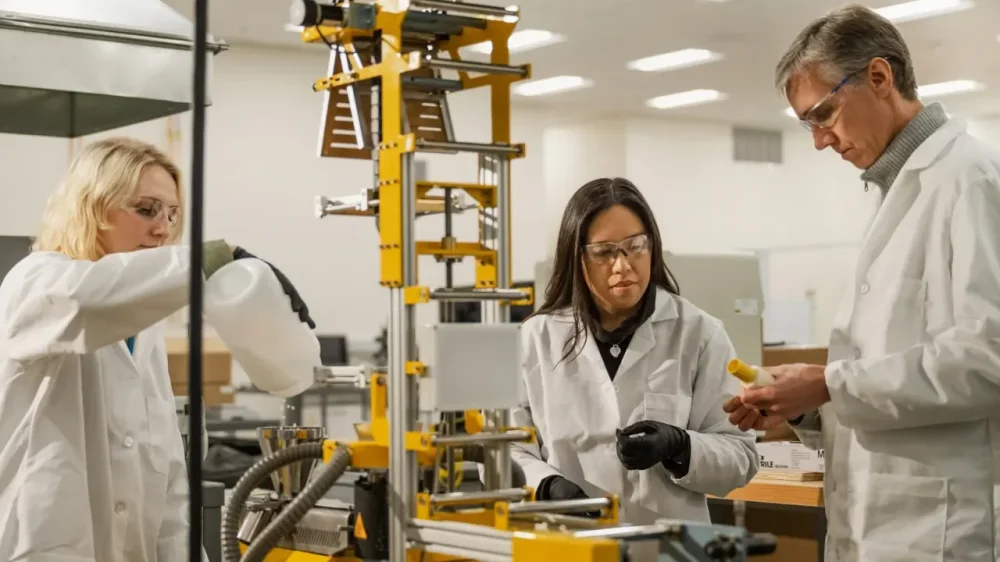
There’s no question that Amazon is known for its packaging. Boxes and mailers with the ubiquitous smile logo now dot the porches of every neighborhood in the country. And with the company’s 2017 purchase of Whole Foods, it became a major player in food packaging as well, wrapping everything from produce to potato chips. Since then, the chain has expanded to 535 locations and increased its sales 40%. That means that every day, millions of people take home some food wrapped in plastic from Whole Foods—but probably rarely think about the packaging. But in a nondescript warehouse in a still-industrial part of Seattle, five scientists at Amazon’s Sustainable Materials Innovation Lab are trying to design a better package. This work is twofold. First, researchers are putting dozens of bio-based plastics through a gauntlet of tests on things like tensile strength, tear strength, and seal strength to see how they compare to their fossil-fuel-based counterparts. Second, they’re working with a handful of partners to make sure that when this packaging hits the market, there’s a recycling infrastructure already in place that can support it. “Our long-term objective is to enable simplicity and recycling of plastics in the same way that you have paper today,” says Alan Jacobsen, the director of Materials and Energy Sciences at the lab. “You don’t need to know, is it a 1, 2, 3, 4. You just throw it.” The intense focus on circularity sands in stark contrast to the overconsumption that Amazon’s business model entails—and the vast amounts of junk it distributes, particularly with the recent launch of Haul, where every item is under $20. Jacobsen, for his part, says that he knows people are going to buy products at “a range of price points. . . . We try to figure out how to enable that in the most sustainable way.” And the company says it intends to make the research and technology available beyond Amazon, which means that if it’s successful, it could lead to a fundamental change in packaging—and recycling—throughout the economy. The challenges of designing food packagingLast October, Amazon announced that it had swapped out all of its plastic fillers with paper, part of its overall commitment to reducing plastic use. Paper isn’t just more environmentally friendly than plastic, it also has much higher rates of recycling (68% compared to 6%). “When you’re at home recycling paper, you just throw it in the bin and you know it’s going to get recycled,” Jacobsen says. “Because it’s easier to recycle, it’s recycled more.” But for some applications, paper just isn’t a viable solution. That’s especially true for food packaging “because of the physical properties of the material,” says Jacobsen. “Sometimes this has to do with the tear strength or puncture strength; sometimes it has to do with the moisture barrier properties or oxygen barrier properties—just properties that it is not possible for paper to meet.” Food packaging has to keep potato chips crispy and pretzels salty and baby carrots wet; it has to be tough enough that a pile of apples don’t tear open the bag, with a seal strong enough that frozen peas don’t spill all over the floor (while still being easy to open). Food has way more demands of its packaging than something like a book, a tube of lipstick, or even a set of dishes. The default solution to this has always been plastic. But Jacobsen and his team are working on a replacement: biopolyesters. That means the plastic is biodegradable and uses biological materials, waste, or recycled content as the feedstock (or raw material used to make the plastic). But this packaging doesn’t just have to be developed, tested, and produced—Amazon also wants it to be easily recyclable, which is where things get even more complicated. Our current recycling infrastructure is finicky: It’s not good at differentiating between different types of plastic, and if it gets confused, it errs on the side of landfill. (Because if the different types of plastic get bundled together, it downgrades the entire bale, which means less money for the recycling facility.) Jacobsen and his team want to eliminate this problem entirely. They want to make biopolyesters that are a blend of feedstocks (including different types of recycled plastic) and then have recycling plants (called “materials recovery facilities,” or MRFs) be able to take it all in, easily separate it, and find a home for these streams. “But one new type of material is not going to work,” says Jacobsen. “You’re going to need a range of different materials. You often have to blend these materials together. You have to put them in different layers to meet the requirements for a particular application.” But most recycling facilities aren’t set up to deal with these kinds of mixed waste streams in a single piece of packaging. So Amazon is working with a network of other companies to help redesign the plastic recycling infrastructure to make it simple for their designs to always be made into something new. Glacier—designing robots to go through the trashMuch of the recycling infrastructure in the United States is built on MRFs. These massive warehouses take in gobs of recycling—cardboard boxes and wine bottles and take-out containers and everything in between—and sort hundreds of tons of waste each day. But in the course of that sorting, a lot of otherwise recyclable stuff can get missed or thrown out, maybe because the machines can’t tell what it is, maybe because it gets mixed in with other items. That means a lot of theoretically recyclable materials get sent to the landfill, and also that a lot of bundles of recycled plastic are too degraded with other materials to be properly reused. Glacier, a San Francisco-based company that Amazon invested in last fall, designed a robot to eliminate these pain points. It can sort through more than 30 different types of material, meaning the end bales are more accurate, and fewer items get trashed. (One company, for example, added a Glacier robot, and found that its paper bales were 17% more pure as a result.) “Our society tends to view recycling as a nice alternative to landfilling our trash,” says Rebecca Hu-Thrams, one of the cofounders. “[But] we very much see recycling as an absolutely crucial pillar of society’s necessary transition toward circular manufacturing. In other words, recycling is at its core a way to get your hands on more raw feedstocks, more materials to turn into new stuff.” Hu-Thrams referenced a customer in the Midwest that installed one of Glacier’s AI camera’s on what’s known as a “last chance line,” where all the trash leaves the facility and there’s one more shot to pick out recyclable items. This facility quickly realized that about two-thirds of its total “leakage” was coming from beverage bottles; when they identified where and why this was happening, they were able to fix the issue. “So in the span of a couple of weeks or less, they actually are now on track to rescue 15 million more of these PET bottles every single year that would’ve ended up in landfill,” says Areeb Malik, Glacier’s other cofounder. Amazon plans to install one of these robotic systems in its lab next month. The goal is that as they develop new biopolyesters that are a mix of materials, they can simultaneously be training the system to recognize them and mark them as recyclable—never getting confused and thinking they belong in the trash. “We want to make sure that once the materials are out in the market, we know that they’ll be identified in these systems right away,” says John Shane, a principal materials engineer who worked in Amazon’s lab for three years. “And we’ll be able to generate data sets here that we can share with Glacier and then they can share with their customers.” As that information is fed back to the companies, they’ll ideally be able to design packaging that’s easier to recycle (and better identified by the robot). That’s a huge priority for Amazon, which plans to share what it learns from its biopolyester development. “We don’t want to own the IP and keep it to ourselves,” says Jacobsen. “We want everybody to have access; we have no financial motivation.” EsterCycle—designing chemicals to break down the plasticsBut even if Glacier’s tech scales up and is able to identify much more theoretically recyclable plastic, the current recycling infrastructure isn’t necessarily able to transform that into new products. And that’s the problem EsterCycle is trying to solve. The Denver-based startup spun out of the National Renewable Energy Laboratory last August, after completing a successful project with Amazon on mixed recycling waste. Julia Curley was a postdoctoral researcher at NREL working on the project; she’s now EsterCycle’s founder and only full-time employee. Curley stresses that EsterCycle isn’t looking to upend traditional recycling processes—it’s developing an entirely new one. The goal is to be additive to the current system, taking what MRFs now see as contaminated, lower quality plastic and transforming it into materials that can be made into new products. Our existing system essentially collects bales of similar plastic; shreds, washes, and melts it; and then turns it into something new: It’s a mechanical process. EsterCycle, on the other hand, is working on chemical recycling. “Plastics are made of these long chains of molecules called polymers,” Curley says. “And what we’re doing is actually cutting that chain into its individual components, kind of like taking apart a large string of Legos into its individual pieces. And then they can be remade into new plastics.” (Some environmental groups criticize wide-scale chemical recycling as being a pipe dream of Big Oil, although most of the research in this area thus far solely relates to fossil-fuel-based plastic.) This will be especially relevant for compostable plastics, which are commonly used in food packaging. While this is still a small portion of overall plastic (just 1%, as of 2024), it’s projected to keep increasing—and our current infrastructure isn’t designed to recycle it. Curley says that currently, if too much of it is in a recycling bale, it will significantly lower the quality and price that a MRF can ask for it. Commercial composters, meanwhile, often don’t accept it either, because of contamination issues, or because they’re skeptical that it actually breaks down. EsterCycle is now using a lot of these compostable plastics as feedstocks to demonstrate how well its chemical process works at breaking them down and making them usable for the supply chain. As EsterCycle breaks down these kinds of plastics, the resulting “building blocks” can be sold to any kind of manufacturer. “The idea is that they can be drop-in additions to existing manufacturing, meaning the process doesn’t have to change at all,” Curley says. Novamont—designing packaging to be recycledNovamont, an Italian company, has been working on biodegradable and compostable products since its launch in 1990—and it’s exactly the kind of company that might buy those building blocks. Its Mater-Bi is used in things like shopping bags and packaging; while it was originally made out of fossil-fuel-produced polyesters, the company has been working to increase the amount of renewable content in this material. While EsterCycle isn’t yet sending its feedstock their way, the idea is that ultimately, Novamont and similar companies would be able to seamlessly incorporate those biopolyesters into their products. In the meantime, Amazon and Novamont are testing out bio-based plastic grocery bags in Amazon Fresh stores in Valencia, Spain. “That was a great application where paper was being used and it wasn’t meeting the requirements,” Jacobsen says. The grocery bags were being put in the fridge before being delivered to customers and because of the moisture, they were falling apart when people took them out. Switching to the plastic bags has “made it better for the folks that are delivering them and improved it all around.” In the U.S., Jacobsen and his team have been testing out produce bags made from biopolyesters at some Whole Foods locations and at Amazon Fresh stores in the Seattle area. There, they have QR codes where customers can give feedback on the bags. The Amazon lab collects that feedback, shares it with Novamont, and then they keep iterating on the design until it gets closer to what they want. “We learned that lettuce wilted faster [in the early bags],” says Jacobsen. “Is it the end of the world? Probably not, but to some customers, it’s not ideal.” Researchers at the lab could then take that feedback and reexamine the moisture barrier properties in the bags to see how that element could be adjusted. Once these bags have been used, the goal is that they’re fed back into the recycling stream. To that end, Novamont is also conducting trials with one of Glacier’s AI models to ensure that the bags can be properly sorted once they reach a MRF. And then, of course, the ideal is that EsterCycle would be able to chemically break down the bags to be fed back into Novamont’s production system. Designing a better recycling system—no matter who’s in the White HouseMany of these developments are still years from being widely used in the market. That would seem compounded by the fact that the The President administration appears actively hostile toward anything that benefits the environment and is cutting funding and staffing at research institutions across the country. (Just last week, 114 people were fired from NREL as part of massive cuts to the Department of Energy.) Jacobsen admitted that it’s a bit of “a wait-and-see period,” and notes that while their funding isn’t necessarily dependent on the government, they do partner with government labs “where there’s an opportunity to accelerate progress.” He hopes that will continue to be possible over the next four years. The Glacier team, meanwhile, is cautiously optimistic about what The President means for their business. “Recycling in the waste industry as a whole tends to be extremely bipartisan,” says Glacier’s Hu-Thrams. “Whether you’re thinking about recycling from a climate crisis mitigation angle, or an onshoring and workforce development and job creation angle, there’s so many reasons why advancing recycling infrastructure and recycling efficiency is a really, really good thing to do for our society.” Much of this work is also done at the state and local level, where decisions are more insulated from The President’s rhetoric and slapdash executive orders. That’s where Jacobsen hopes to make the most progress, noting that cities like Seattle, San Francisco, and Denver are interested in incorporating these products into their recycling infrastructure. It can be a bit jarring to try to square the innovations coming out of Jacobson’s team—and the genuine passion that they have for a fossil-fuel-free supply chain—with Amazon’s position as the largest online seller of stuff in the U.S. But our addiction to consumption—and Amazon’s commitment to fulfilling it—means that this cycle is unlikely to end anytime soon. Ensuring that it’s not wrapped in plastic made from fossil fuels is a big deal. And if they’re successful at transforming food packaging, it has implications far beyond just what we eat. View the full article
-
It is hard to believe that in 2025, we are still dialing to schedule doctor appointments, get referrals, refill prescriptions, confirm office hours and addresses, and handle many other healthcare tasks. In fact, I created Zocdoc nearly 20 years ago to help patients avoid the dysfunctional phone experience and schedule appointments online. But I must confess that I have to pick up the phone sometimes, too—and I dread it. I am not alone. According to a recent survey my company conducted, most Americans say they dread calling their doctor about as much as they dread getting a shot. At best, it is an inconvenience. At worst, the phone is a barrier to care and a wildly inefficient and costly channel for providers. Given that billions of healthcare interactions occur over the phone each year, this is a calamitous liability. Relying on technology that was revolutionary in 1876 is no way to manage America’s healthcare administration. Especially because 150 years later, a new technology has emerged that will transform how healthcare operates: artificial intelligence. While AI incites a range of feelings when it comes to its clinical implications and possibilities, I am much more focused on leveraging AI to solve healthcare’s administrative challenges. Considering these burdens cost $600 billion to $1 trillion annually, AI offers a remarkable opportunity to increase efficiency, reduce waste, and deliver first-class experiences for everyone. As I see it, the effort to leverage AI to improve healthcare administration will unfold in three stages: Assistive, Autonomous, and Augmentative AI. Assistive AI: Supervised Intern In the Assistive stage, I view AI as a capable but dependent intern. It supports healthcare workers—but requires ample supervision. Take AI scribes, for example. Although the technology takes records and transcribes patient encounters, physicians must still review and revise the notes to ensure they are correct. However, because AI scribes cannot yet work autonomously, documentation burdens remain and there is not a pure efficiency gain. And they do not even begin to clear the waste and friction burdening office staff and patients. Autonomous AI: Productive Peer AI that works independently defines the Autonomous stage. Instead of an intern, think of the technology as a peer. This is where efficiency gains begin to accrue, and it is where we are now. To understand Autonomous AI’s potential, let’s return to the phone. In healthcare, the phone is bad for business. Up to 20 percent of calls go unanswered, with each missed call costing provider organizations $200 to $300 in lost revenue. Half of Americans say they’re likely to switch providers if they cannot get through to their doctor’s office. The phone is also bad for health outcomes. More than half of patients admit to delaying care when they cannot reach their doctor’s office, while a third admit to giving up on scheduling a visit entirely. Autonomous AI is perfectly suited to remove these challenges. Appointment management is high volume, with billions of calls a year. It is highly volatile, with fluctuating peak times that are hard to efficiently staff. And it is highly rote, with most scheduling tasks being simple and repetitive. This makes appointment management a prime area for AI, freeing staff to focus on more valuable, complex responsibilities. In fact, the best AI phone assistants can successfully and independently handle more than 70 percent of a practice’s inbound scheduling calls. The AI phone assistant’s ability to scale efficiency, improve the patient experience, and help practices counter macroeconomic headwinds and bolster their bottom lines is compelling. Augmentative AI: Superhuman Colleague When AI surpasses—and then scales—anything humans can do, we enter the Augmentative stage. Soon, polyglot AI phone assistants will detect and then offer to converse in a patient’s preferred language. AI models will recognize patients’ appointment preferences, from cadence of visits to time of day and day of the week. AI will even predict the likelihood of a patient attending an appointment and then create custom engagement plans to increase those odds. Augmenting AI will also excel at anticipating patients’ needs. It may contact a patient before a prescription runs out and offer to refill it with their pharmacy, or it may proactively schedule a checkup at their preferred appointment time. This might sound futuristic, but given AI’s rapid advances, this stage is fast approaching. My prediction is this is likely only 12 to 18 months away. AI or Obsolescence It is tempting to point AI toward healthcare’s moonshots, but our biggest and most immediate opportunities for transformation lie in fixing the basics. With AI, we finally have the technology to bring America’s healthcare experience out of the 1800s and into the modern age. In doing so, we can remove the friction, barriers, and waste that have disempowered patients and saddled providers for decades. Change will happen suddenly, and then all at once. Because AI improves by the minute, healthcare organizations that wait to adopt this technology lose more ground every day. In no time, they will find themselves as relevant as a rotary phone. View the full article

-
Greenland’s coastline is huge: a sprawling 27,394-mile labyrinth of fjords, glaciers, and ice-choked waters, longer than Earth’s circumference. Its length and topography makes it one of the planet’s longest and most logistically hostile to patrol in peacetime. Now, with countries like Russia and the United States’s neo-imperialist plans to grab as many Arctic natural resources as possible, it is one of Europe’s frontlines. Which is why people like Jens Martin Skibsted—global partner and VP of foresight and mobility at design studio Manyone—are thinking about how to better protect a wonderland that is key for the future Denmark and the European Union. For decades, Denmark has relied on the Sirius Dog Sled Patrol (yes, soldiers using sleds and good boys), satellites, and sporadic aerial surveys to monitor this vast expanse. These methods are slow, costly, and imprecise. For example, in 2023, a tsunami in Dickson Fjord went unnoticed for a year, clearly exposing the systemic gaps in this mixed surveillance system. Skibsted and his design team originally thought drones could be a solution. Drones are efficient, they can act in swarms, and they can be fitted with cameras and sensors that can feed an artificial intelligence system to keep track of that vast ice landscape at all times. But traditional drones have problems. The big ones are long range but expensive to operate and require human crews. The small ones don’t have enough range: Their batteries run out after a short time and they need to return to a base to reload. Skibsted and his team thought that they needed a new solution—one that could fly, so they could quickly cover large patches of territory, but also one that could operate entirely on its own, landing, recharging, and taking off again. The AquaGlider, as they called their drone, is a solar-powered autonomous drone. It reimagines the USSR’s ekranoplan, a large airplane-like vehicle once feared by NATO, which the Red Army wanted to use for coastal invasions. Its origins trace back to the 1960s, when Soviet engineer Rostislav Alexeyev designed a hybrid aircraft-boat that exploited ground effect, an aerodynamic phenomenon where wings gain increased lift and reduced drag when flying within one wingspan of a flat surface. By skimming 10–30 feet above water, these mammoth craft, like the 550-ton “Caspian Sea Monster,” achieved fuel efficiency double that of airplanes, hauling military assets at 300-plus mph. Soviet GEVs were plagued by instability in rough seas, navigational hazards, and political abandonment after the USSR’s collapse. It’s ironic that a machine inspired by Soviet ingenuity could become Europe’s first line of defense in a region where Russia is rapidly militarizing (and which The President also wants to control). But Skibsted saw potential in this forgotten tech to create a new kind of vehicle. The proposed AquaGlider would fly on its own for weeks at a time, taking off and landing on water; it’s designed to recharge while floating thanks to solar panels, and avoids storms by simply sitting on the water rather than flying. The drones make the most efficient use of energy, dozens of them zipping along the huge coastline a few feet above the water to absorb information and transmit it to base, surveilling everything from illegal fishing to Russian submarine activity. Engineering perpetual motionThe AquaGlider is basically a wing that uses two propellers to speed forward, trapping air against the ocean or ice. This creates an air cushion that allows it to glide with minimal energy. This ground effect lets it travel twice as far as a conventional aircraft on the same power. During takeoff, retractable hydrofoils lift the hull above waves, reducing drag until the craft transitions to flight. If storms surge, electric thrusters enable vertical takeoff, though Skibsted told me in an email interview that this “zaps the battery” and is a last resort. Solar panels cloak its wings and underbelly, harvesting energy even in twilight—a critical feature near the Arctic Circle, where summer brings 24-hour sunlight and sometimes the sun rays go almost parallel to the ground for most of the day. Still, Greenland’s winters, with months of darkness, pose a problem. Here, the AquaGlider docks with buoys that store energy from waves and offshore wind farms. These buoys double as communication relays, transmitting data to satellites or coastal stations. Durability is baked into its graphene-coated composite hull, which resists corrosion and iceberg collisions. “It avoids obstacles like any driverless car,” Skibsted tells me, relying on Lidar and thermal sensors to navigate. For icing—a fatal flaw in Soviet designs—the drone borrows deicing systems from modern aircraft designed to work under extreme conditions, like those of Air Greenland’s he says, using heated surfaces or pneumatic boots to shed frost. The geopolitical iceberg aheadFor now, however, after all the technical work done with an unnamed drone manufacturer that was Manyone’s client, the AquaGlider remains a design on paper. “The client aborted the project because they were too busy making drones for the Ukraine war,” Skibsted says. “So, basically we own it ourselves. We don’t know what will happen, but Denmark is investing heavily in the arctic.” Indeed. Denmark knows that things may get really bad. Russia’s Arctic ambitions loom large. Its “shadow fleet” patrols the GIUK Gap (Greenland-Iceland-U.K.), mapping underwater cables and wind farms for potential sabotage. Danish intelligence warned that Russia could mobilize for regional war within five years, which now have been updated to just two if NATO appears divided, according to Troels Lund Poulsen, the Danish defense minister: “Russia is likely to be more willing to use military force in a regional war against one or more European NATO countries if it perceives NATO as militarily weakened or politically divided.” In response, Denmark’s 2024–2033 defense agreement has committed $570 million to maritime upgrades, including autonomous drones, underwater sensors, and 21 new Home Guard vessels. The AquaGlider fits neatly into this strategy—a low-cost, persistent patrol akin to Ukraine’s low cost maritime drones, which have destroyed or damaged at least 26 Russian naval vessels in the Black Sea since the war began including the Red Navy’s Moskva flagship. But Denmark’s immediate investments are pragmatic: four minelaying ships and underwater drones will deploy by 2030. But there’s also a section of the budget that will be dedicated to “autonomous surveillance crafts that can monitor the coastlines,” Skibsted tells me. That’s where AquaGlider can fit. It makes sense from a design perspective. It will be up to the engineers to make it a reality, if it picks up the interest of the Danish government. View the full article

-
Charles Suppon has big plans for the Tunkhannock Area School District. At any given time, the northeastern Pennsylvania district’s chief operating officer can rattle off statistics about fields in which its schools excel: arts, AP classes and softball, as well as on-the-job training programs for future farmers, welders and more. Goats and chickens roam the high school’s courtyards, where students also tend to koi fish; in the hallways just beyond, high schoolers tinker with tractors, build furniture to sell and offer free tax services for the broader community. But Suppon speaks with vigor when he talks about the five-megawatt system he hopes to install across five solar arrays on the district’s buildings and surrounding property. The solar panels will heat the district’s pool and serve as the basis for new curricula and jobs training classes on the solar industry. For a rural district of around 2,000, Tunkhannock is punching above its weight class, he believes. “We’re a smaller school district doing big things.” Suppon’s district is in a bright red portion of Pennsylvania northwest of Scranton, narrowly outside one of the state’s more prolific natural gas regions. For him, solar is simply a pathway toward cost savings—just as natural gas, from which the district earns royalties off several leases, has been. Tunkhannock believes it could save upwards of $1 million a year by switching to solar, money that could be used for student initiatives. “It was always a financial decision,” Suppon said. “We wanted to be able to offset our energy costs, produce our own energy, and only pay distribution [fees] back to the grid.” There’s one catch: Tunkhannock’s plan to go solar is contingent upon winning more than $1 million in funding from the state’s Solar for Schools program. Currently in its inaugural year, Solar for Schools was born from a bill that faced an uphill battle in a legislature where environmental bills often die by attrition—a battle that required its creator, progressive Rep. Elizabeth Fiedler (D-Philadelphia) to reach across the aisle and help marry what are often competing interests in the state—labor, education, and climate. But that money for Tunkhannock might not come through because of the stiff competition for the limited funds. While last year’s state budget gave the Solar for Schools program $25 million to disperse to school districts, the program received applications that add up to nearly four times that amount from schools and districts large and small, rural and urban, and conservative and liberal. “I was pleased, but hardly surprised,” Fiedler said in an email to Capital & Main of the demand. The disparity between the grant program’s budget and the size of its application pool mirrors a broader reality within the state Legislature: Despite clear and growing demand for solar energy, the political will to meet it has yet to catch up. A 2022 poll of more than 1,300 Pennsylvanians conducted by Vote Solar Action, an advocacy group urging pro-solar legislation at the state level, found that 65% of Pennsylvanians support large-scale solar farm development in the state. More than 80% said they support rooftop solar, while 73% support natural gas and 52% support coal. “I [have] visited nearly every corner of the state, from Waynesburg to Bethlehem, and in every place I met folks who wanted to save money on electricity, create good local jobs, and preserve the beauty of their communities,” Fiedler said. Yet the state lags far behind most others in solar development: Pennsylvania currently ranks 49th in the nation for its growth in solar, wind, and geothermal generation over the last decade, according to the nonprofit advocacy group PennEnvironment. It has fallen behind other major fossil-fuel producing states, like Texas, the country’s second-largest solar generator in 2023; California, where solar and wind together comprise close to half the state’s energy generation; and New Mexico, which Environment America, the national organization behind PennEnvironment, ranked 4th in the U.S. for renewable energy production in 2024. Just 3% of Pennsylvanians now have solar panels on their roofs, Vote Solar Action’s poll found—though 31% said they’d be interested in installing them. The lag could be attributed, in part, to interconnection delays by the regional grid operator PJM—though many of its neighbors in the same system, like Washington D.C., New Jersey, and North Carolina, have eclipsed Pennsylvania’s solar production. Because of increased demands predicted by PJM, utility bills in Pennsylvania are slated to increase this summer. Fiedler sees solar production as an antidote to what could be an oncoming energy crisis in the state. “We must generate more electricity,” she said. “Nuclear, wind, geothermal, and gas power plants can all be part of the solution, but the fact is we need energy now, and solar is the fastest.” But solar initiatives continue to hit gridlock in the halls of state power. After making its way through the state House last summer, a bill that would have enabled community solar—a program that allows multiple residents to enroll in a shared solar array separate from their homes—died in the Republican-controlled Senate. The bill’s author, Rep. Peter Schweyer (D-Lehigh), who introduced it as a way to make solar accessible for renters, apartment dwellers and those who can’t afford solar panels by themselves, has had to reintroduce the bill and start over again this session. Gov. Josh Shapiro’s attempt to pass an updated renewables target also failed to gain traction in the Legislature last session. Where a 2004 target required 0.5% of the state’s energy generation to come from solar, the new plan would have required the state to reach a 35% target by 2035 that included solar, wind, and nuclear energy generation. He has reintroduced it as part of a broader energy package dubbed the “Lightning Plan.” In a divided legislature, the fate of both initiatives is tenuous. As renewable energy faces sweeping attacks at the federal level under the direction of President Donald The President, states are stepping up to hold the line. Whether Pennsylvania will prove itself to be a meaningful player in this fight remains an open question. “Climate change has become politicized,” said David Masur, executive director of nonprofit advocacy group PennEnvironment. “Which then potentially can create more powerful special interests who are opposed to common sense policies and have a vested self-interest in the status quo, and politicians having sort of a knee jerk reaction to oppose things [that] are probably good even for their very own constituents.” Case in point: Solar for All, a federal grant program initiated by the Biden administration that awarded Pennsylvania $156 million for residential solar installations on low-income households, was designed to save residents $192 million over the next 20 years in energy costs while averting 43 million tons of planet-warming carbon dioxide emissions from entering the atmosphere, the equivalent of removing more than 9 million cars from the road for a year. These funds quickly became a negotiating chip. During deliberations over the 2024 state budget, a line was inserted into an omnibus fiscal code bill that prevented the state from accessing the funds. Though the Solar for All program was just one of several dozen federal environmental grants Pennsylvania won under Biden-era initiatives, the budget bill specifically calls out that one program. It requires legislative approval for the program’s funds to be disbursed. So, Fiedler sought out exactly that when she authored HB 362, a bill that would force the Legislature to vote on allowing the Pennsylvania Energy Development Authority, the state’s independent financing authority, to distribute funds it has already been awarded. Fiedler said the funds are already under contract with the federal government. HB 362 passed the House Energy Committee, which Fiedler chairs, in March. It now sits in the state House, home to a slim one-vote Democratic majority, as a battle to free the money falters after being confronted with a last-minute hurdle. Two days after the bill passed, Rep. Craig Williams (R-Chester County), introduced an amendment that would require the state’s utility regulator to promulgate regulations on net metering—a system that allows residential solar users to sell surplus energy back to the grid to incentivize the buildout of rooftop solar. Environmentalists fear the amendment could open the door to doing away with net metering—a major financial incentive for many residential solar owners. Reforming net metering has long been a priority of the American Legislative Exchange Council, a conservative lobbying firm that disburses model bills to states, including those fighting renewable energy and attacking environmentalists. The group argues that paying solar owners for the energy they produce is costly for utilities—they pay them retail rates, rather than wholesale rates, and residential solar producers may end up generating enough energy to offset distribution fees they’d pay for the wires that move energy around the grid. Utilities then pass those costs onto consumers, and nonsolar users end up subsidizing their neighbors with solar panels, they argue. Williams has used similar language in opposing solar legislation; environmentalists generally disagree with this premise. Critics were quick to point out that, prior to joining the Pennsylvania House in 2020, Williams spent more than 10 years as general counsel for PECO, a Philadelphia-based utility that has come under fire from environmentalists for neglecting to increase its share of renewable energy. State lobbying and campaign finance records show the company spent more than $600,000 on lobbying in 2024, and donated $6,000 to Williams in 2024 between a failed run for attorney general and a successful campaign to keep his seat in the state House. The trade group that represents PECO and other utilities, the Edison Electric Institute, has long challenged net metering as states have grown their share of solar production. “The more people who generate energy from their homes, the less [utilities] get to build out their larger operations,” said Elowyn Corby, Mid-Atlantic regional director for Vote Solar Action. Williams’ amendment passed with support on both sides of the aisle. Environmentalists, however, consider it a poison pill—one that could weaken the state’s fledgling solar industry. “In Pennsylvania, probably the best thing we have going for solar is net metering,” said Masur, the PennEnvironment director. Minus Williams’ amendment, Fiedler’s Solar for All bill makes common sense, Corby said. “At its heart, the goal of this legislation is to make sure Pennsylvania doesn’t send federal money that belongs to our neighbors back to DC,” Fiedler said. The Solar for All program focuses specifically on serving homeowners who might otherwise be unable to afford solar panels of their own. In Pennsylvania, funds are specifically earmarked for low-income households, who are guaranteed at least 20% savings on their electricity bills. It’s unclear whether Fiedler will push forward to advance HB 362 now that it includes a threat to net metering. In the coming months, the state Legislature may also vote on initiatives that would put solar panels on municipal and emergency response buildings; warehouses and distribution centers; and townhouses governed by homeowners associations. Shapiro has proposed reupping the Solar for Schools program’s $25 million appropriation in the 2025-2026 budget, set to be finalized by June 30. Though Fiedler said she’s pleased to see the program reinstated, she said “that number is the minimum we should budget.” Jim Gregory, a former state representative and now executive director of the Conservative Energy Network-Pennsylvania, has committed himself to convincing his former colleagues of the importance of renewables in a diverse state energy portfolio. “If that money is going to be made available, we want to see it made available to low- and moderate-income families in rural Pennsylvania,” he said. Gregory said he’s watched as attitudes toward solar among conservatives in state government have shifted. “I don’t oppose anyone who wants to put solar on their rooftop or anything like that to help with utility bills,” said Rep. Kathy Rapp (R-Warren) at a recent meeting of the House Energy committee on Fiedler’s bill. Rapp has, for several sessions, introduced legislation requiring solar operators to create end-of-life plans for their arrays, which has yet to pass. Though far from an all-out embrace of solar, Rapp’s language offers a window into a softening stance on renewables. In 2019, Rapp wrote on her Facebook profile that solar and wind energy pose “serious environmental risks,” and called its supporters “radical Green New Deal proponents.” Despite past roadblocks, Fiedler remains optimistic about the fate of solar initiatives in the state. She sees the Solar for Schools program as evidence of broadening support for clean energy. “I believe there is political will for solar and all types of energy development in the state,” she said. “A lot of that success comes from the broad stakeholder coalition we built and from the support of colleagues on the other side of the aisle.” For school districts like Tunkhannock, the state’s ability to reach consensus has very real consequences. With the fate of federal solar tax credits unclear, district leaders say they are currently on the edge of their seats. The Solar for Schools grant could end up being a lifeline. “To say not getting potentially a million dollars in grant money wouldn’t affect us at all I think would be a lie,” said Suppon, the school district’s chief operating officer. This piece was originally published by Capital & Main, which reports from California on economic, political, and social issues. View the full article