ResidentialBusiness
Administrators
-
Joined
-
Last visited
Everything posted by ResidentialBusiness
-
 Unexpected decline comes even as President Donald The President and Chinese leader Xi Jinping seal a truceView the full article
 -
The country’s annual statistical compendium is now available, but only in hardback View the full article
-
Record package of shares wins 75% approval, reinforcing billionaire’s control of the electric-car makerView the full article
-
As the founder, chair, and CEO of the Exceptional Women Alliance, I am fortunate to be surrounded by extraordinary female business leaders. Our purpose is to empower each other through peer mentorship that provides personal and professional fulfillment within this unique sisterhood. This month, I’m pleased to introduce Sammie Dabbs. Sammie is passionate about building and scaling high-performing commercial organizations. As chief commercial officer, she oversees revenue strategy, sales, and marketing alignment—driving growth through a combination of operational rigor and customer-centric innovation. With a proven track record of leading teams, entering new markets, and unlocking sustainable revenue, Sammie brings a front-line perspective on how companies can thrive in an increasingly competitive and complex business landscape. Q: As a chief commercial officer, how do you define your core mandate? Dabbs: My mandate is to be the architect of growth. That means aligning sales, marketing, customer success, and revenue operations into one unified strategy. I don’t see these as separate functions—they’re different parts of the same engine. My job is to ensure that engine runs smoothly, efficiently, and with clear direction. Ultimately, a CCO has to deliver consistent revenue performance, but the path there requires strategy, executional discipline, and a relentless focus on the customer. Q: Why is sales and marketing alignment such a challenge for many organizations? Dabbs: Sales and marketing often grow up in silos—different metrics, different budgets, different perspectives. Marketing says, “We delivered leads.” Sales says, “Those leads aren’t qualified.” It’s a cycle of finger-pointing that hurts the business. Alignment requires shared ownership of pipeline, shared KPIs, and constant communication. In my role, I set a single commercial target, so everyone is working toward the same number. When sales and marketing win together, the customer feels it. Q: What have you found to be the biggest barrier to growth? Dabbs: Complexity. Companies layer on too many tools, too many initiatives, too many priorities—and in the process, they lose focus. The real barrier isn’t the market; it’s internal misalignment. I’ve seen teams hit their stride when we strip away the noise, focus on ideal customers, and empower reps with clear messaging and support. Simplicity and executional discipline will beat complexity every time. Q: What’s your approach to leading a commercial team? Dabbs: I believe in clarity and accountability. Teams need to know the strategy, their role in it, and how success will be measured. Then it’s about coaching for execution and celebrating wins along the way. I’m very data-driven, but data is only useful if it drives action. I set targets, track outcomes, and make adjustments in real time. At the same time, I want teams to feel empowered to bring forward ideas from the field—we learn the most from our customers. Q: How do you think about the role of marketing in driving revenue? Dabbs: Marketing is no longer just a brand function—it’s a revenue driver. A strong marketing team generates demand, accelerates pipeline, and positions sales to succeed. But that only happens when marketing is tied directly to commercial strategy and accountable for pipeline contribution alongside sales. When marketing owns revenue, they create campaigns that resonate with buyers, not just campaigns that look good on paper. Q: Technology is changing the commercial function rapidly. What’s your philosophy on tools like AI and automation? Dabbs: Technology is essential, but it’s not the strategy—it’s the amplifier. AI and automation can make sales and marketing faster and smarter, but they don’t replace human judgment or relationships. My philosophy is: Get the fundamentals right first. If you don’t have clear positioning, a disciplined process, and strong teams, no tool will save you. But if you do, then technology allows you to scale, personalize, and optimize in powerful ways. Q: Can you share an example of a commercial pivot that made a major impact? Dabbs: One example is when we restructured our go-to-market model to focus on fewer, higher-value customer segments. Instead of spreading resources thin across too many markets, we doubled down on accounts where we could deliver outsized value. That shift required marketing to retool messaging and sales to change their targeting, but the results were dramatic—higher win rates, shorter sales cycles, and better customer retention. Sometimes growth is about addition, but more often it’s about focus. Q: If you had to give one piece of advice to other executives leading commercial teams, what would it be? Dabbs: Treat growth as a company-wide responsibility, not just a sales number. Every function—product, finance, operations—contributes to the customer experience. As CCOs, we have to be the integrators, making sure the entire business is aligned around delivering value to customers. When you break down silos and build a culture of accountability, growth becomes sustainable. Larraine Segil is founder, chair, and CEO of The Exceptional Women Alliance. View the full article

-
Company leaders said current strategy sets it up to profit and compete against its rivals as the mortgage market improves in the coming months. View the full article
-
The average price of a single-family home increased 1.7% from last year to $426,800 in the third quarter. View the full article
-
Many organizations are racing to build AI strategies, but too often they focus on adopting the latest tech, rather than creating the environment to support it. The reality is that lasting transformation is fueled by people, which requires companies to take a good look at their culture. At Architech, that’s exactly what we did. By prioritizing and rewarding innovation, we aligned our culture with our AI strategy—and it worked. This year, we are proud to be recognized as one of Fast Company’s Most Innovative Workplaces. We are one of 10 companies globally recognized by Fast Company for excellence in AI, automation, and machine learning. Here’s how we built an award-winning culture. MAKE INNOVATION REPEATABLE Innovation comes from people. At Architech, we operationalized that idea by creating an Innovation Lab, a dedicated R&D space where curiosity thrives and exceptional geeks are celebrated as heroes. Backed by a 10% reinvestment of revenue, our Innovation Lab provides the time and tools to tackle real problems. One of our standout successes: an intelligent collections application that earned a spotlight in Microsoft’s AI Lunch and Learn series. Infrastructure and investment create a foundation for continuous innovation, enabling organizations to tackle its top priorities. INNOVATION THRIVES WHEN EVERYONE PARTICIPATES We launched a company-wide AI Innovation Challenge in September, 2024 inviting every employee to identify their own workplace challenge to solve and to tackle organizational inefficiencies using AI. Over three months, cross-functional teams reimagined workflows and built automation tools that reduced friction, accelerated delivery, and inspired new client offerings. The challenge sparked experimentation and breakthroughs from the bottom-up. Among the most impactful was an automated quality assurance testing system that improved consistency and freed our teams to focus on creativity. We celebrated winning ideas at the town hall and they became a badge of honor for employees. We continue to spotlight the most creative employee-led breakthroughs with a monthly AI Innovation Award. Innovation happens when people are given the tools, trust, and time to experiment. LEARNING FUELS INNOVATION With AI knowledge scarce across tech companies, upskilling and mentorship have become the real differentiators. At Architech, internal knowledge-sharing sets the pace: We offer project showcases, AI Bytes Learning Series, and real-time experimentation to create a culture of continuous growth. We launched Elevate, a four-week technical bootcamp for interns led by Architech experts in product, design, data, AI, and engineering. Mentees solve real business challenges using cutting-edge tools and are encouraged to explore what inspired them the most. One finalist team built an AI-powered customer support platform and graduated knowing the AI fundamentals, and with the confidence for the next step in their tech careers. Today, our internal expertise in emerging technologies is pushing us further than external experts ever could. Our mentors are emerging as leaders, armed with new courage and bold ideas. We endeavor to empower our people and build a culture where learning drives innovation forward and grows innovators from within. EMBED INNOVATION INTO CULTURE We also created an AI Incubator to drive technology forward and a Responsible AI Governance Committee to ensure guardrails are in place to safeguard our company and clients. Nearly 50% of our workforce participates in the incubator, with active workstreams exploring real-world applications of AI: code review, test automation, developer productivity, and data enablement. AI experimentation is embedded into the daily flow of work on all our teams, from engineering to operations. Our CEO hosts training sessions, leads open discussions, and reinforces the expectation that everyone experiments with AI, every day. This is what transformation looks like: It’s fueled by inspiration, grounded in discipline, and powered by people. FINAL THOUGHTS There’s no app for transformation. There’s something better: culture. That’s what powers our AI strategy and our people are leading the way. To transform your AI strategy into culture, make it: Inclusive: Invite every employee to contribute and celebrate progress. A habit: Bring change into the daily rhythm of work. A growth engine: Teach, mentor, and invest in skills development across the organization. Repeatable: Build systems that last. If your people aren’t part of your AI strategy, you don’t have one. Lara Shewchuk is COO and CFO of Architech. View the full article

-
Federal Reserve may need to begin asset purchases if short-term rates flare up againView the full article
-
Federal Reserve Gov. Christopher Waller said there was a popular "misunderstanding" Thursday regarding who can qualify for a "skinny" master account, noting that only firms with a bank charter would qualify for approval. View the full article

-
Google published guidance emphasizing context-driven technical SEO audits over tool-generated scores, explaining when high 404s are normal. The post Google Warns Against Relying On SEO Audit Tool Scores appeared first on Search Engine Journal. View the full article
-
Treasury calls Swiss trader ‘Kremlin’s puppet’ and says it would block its licence to operateView the full article
-
Google is rolling out two key updates to Performance Max (PMax) campaigns — adding Waze ad inventory for store goal campaigns and introducing channel performance reporting for greater visbility. Why we care. Advertisers using PMax for store goals in the U.S. can now reach drivers directly on Waze through “Promoted Places in Navigation” pins — no extra setup required. The integration automatically optimizes existing assets for store visits or sales, arriving just in time for the holiday travel season, with a global rollout planned for 2026. Search partner comes to Channel reporting. PMax campaigns are also getting enhanced channel performance reporting, allowing advertisers to see where their ads appear across Google’s network — including Search partners, which will soon be included in the reports and visualizations. Between the lines. Advertisers have long requested more visibility into PMax’s opaque performance data. These reporting updates signal Google’s effort to make the campaign type more transparent and accountable, especially for brands managing multiple accounts through MCC. The backstory. The updates follow several September improvements — including bulk reporting, segmentation options, and download capabilities — all designed to make PMax easier to analyze at scale. The big picture. With the Waze integration and expanded reporting, Google is positioning Performance Max as a full-funnel, omnichannel solution — blending automation with better insights to help advertisers drive both online and offline results. View the full article
-
ChatGPT maker is not seeking a US federal financial backstop for its $1.4tn investment binge, CEO saysView the full article
-
IDEAS shared have the power to expand perspectives, change thinking, and move lives. Here are two ideas for the curious mind to engage with: I. Nick Huber on responsibility: “This might hurt. This is likely hard to swallow. It isn’t anyone else’s fault. Your life today is a direct result of your own decisions and actions. Successful people understand this and take ownership in every situation. If you cultivate resilience, you have a significant competitive advantage over most people. If you are willing to do hard things, your tolerance for discomfort will become a superpower. If you swim against the current and try something new that might lead to a different result from the majority of people, you learn to adapt to difficult conditions without constantly looking for someone or something to blame. You, and only you, are responsible for your life, your business, and your future. Not a politician. Not your parents. Not the economy. Not the world around you. You. If you can accept that fact, embrace it even, no one person or situation can shake you.” Source: The Sweaty Startup: How to Get Rich Doing Boring Things II. Adam Grant on discomfort: “Becoming a creature of discomfort can unlock hidden potential in many different types of learning. Summoning the nerve to face discomfort is a character skill—an especially important form of determination. It takes three kinds of courage: to abandon your tried-and-true methods, to put yourself in the ring before you feel ready, and to make more mistakes than others make attempts. The best way to accelerate growth is to embrace, seek, and amplify discomfort.” Source: Hidden Potential: The Science of Achieving Greater Things * * * Look for these ideas every Thursday on the Leading Blog. Find more ideas on the LeadingThoughts index. * * * Follow us on Instagram and X for additional leadership and personal development ideas. View the full article
-
New guidelines should provide homeownership opportunities for certain consumer segments with thin credit files and open up product options, lenders said. View the full article
-
The FBI is targeting a popular website for snapshotting websites on request, and may soon make it harder to get past paywalls online. The domain registrar of the site Archive.Today has reportedly been subpoenaed in an attempt to uncover the archive's owner, as first reported by 404 Media. A PDF of the subpoena posted to the Archive.Today X account late last week. The site is similar to the Internet Archive's Wayback Machine, but is intended more for immediate short term access rather than maintaining a longterm record. As opposed to the Internet Archive's methodical web crawlers, Archive.Today's work quickly in response to user requests, but don't make any promises to keep website snapshots around in the future. Essentially, while the Wayback Machine is intended as a way to see how a website used to look like, Archive.Today is more about seeing how a website looks right now. A popular option for avoiding paywallsThe obvious use case is to get past paywalls or other blocks that would prevent users from just going to a website directly. Alternatively, you could use an Archive.Today snapshot to be able to read an article without supporting the site hosting it. I have had others tell me they do use Archive.Today to check historical versions of websites and articles too, although I've found it to be a little less reliable than the Internet Archive for this purpose. It's unclear why the site is being targetedWhile the FBI's subpoena doesn't reveal the exact reason for the request, it does say it "relates to a federal criminal investigation being conducted by the FBI." Given Archive.Today's potential to skirt paywalls, and similar crackdowns on tools like 12ft.io, it's possible the investigation has to do with copyright infringement. Not much is known about Archive.Today's owner, aside from the original site domain being registered in 2012 under the name of a Denis Petrov from Prague, Czech Republic. It seems the name is either common enough to throw a wrench in the FBI's investigation, or is a pseudonym. In the subpoena, the organization requests the Archive.Today owner's "name, address of service, and billing address" as well as numerous other details, including length of service and telephone records. The web registrar hosting the site had until November 29 to comply. The site is still up, for nowIn the meantime, Archive.Today (as well as mirrors like Archive.is) remains operational, and has not made a statement on the matter aside from posting the subpoena PDF to X, alongside the word "canary." Previously, the site's owner has said that they doesn't give guarantees that it will remain operational indefinitely, and that "it is an overly optimistic assumption that there will be no risks [to the archive] before I die." Perhaps the idea is that the subpoena is a canary in a coal mine? For now, it seems like the best users can do is wait and see. Archive.Today is notably not open source, meaning that any threat to individual running it could see the site and its mirrors shut down with no immediate successor. The subpoena follows news that Google has delisted 749 million URLs for literary piracy website Anna's Archive. Together, they point to an internet that might be about to get far more strict about respecting copyright. View the full article
-
Sleep patterns. Heart rates. Menstrual cycles. Weight fluctuations. Medication schedules. The location of major world leaders. Every morning, millions of people strap on smartwatches, open period-tracking apps, and upload their most intimate details to the cloud. We're told this data will optimize our health, help us live better lives. But there's a darker question lurking beneath the surface: Who actually owns all this information, and where exactly is the line between optimization and surveillance? First things first: What HIPAA actually protectsIn discussing this topic with friends and family, most everyone I know assumed their health data enjoys robust federal protections under HIPAA (the Health Insurance Portability and Accountability Act). Sadly, they're wrong. HIPAA applies exclusively to "Covered Entities," aka health plans and healthcare providers. The fitness tracker on your wrist? Not covered. The period-tracking app on your phone? Not covered. The sleep monitor beside your bed? You get the picture. "When we think we are protected and we're not—that's when we run into danger," says Ron Zayas, an online privacy expert and CEO of Ironwall by Incogni. "So when you let a company collect your health data, it is safe to assume two things: 1) you are not covered by HIPAA protections. and 2) the company is going to sell your data." The reason is simple economics. Selling user information often generates more revenue than the product itself. Your health data is intensely personal, which makes it intensely valuable. What happens when we don't own our health dataI remember firsthand when my friends and I frantically deleted apps period-tracking apps after the Supreme Court overturned Roe v. Wade in 2022. What once felt like simple tools for monitoring my cycle suddenly looked a lot like potential evidence in criminal investigations. We were terrified our menstrual data could be subpoenaed to prove we'd had abortions, and this fear wasn't paranoid. As Zayas explains, governments can purchase the same data anyone else can and cross-reference it with location information from mobile phones. "When you had—or skipped—your period can imply if you are pregnant or trying to get pregnant," he says. "Governments can buy this information and tie it to your recent trips to decide if you had an abortion or miscarriage." At the same time, I love all kinds of health-related "optimization." I love sharing my runs on Strava and checking my sleep score on my Garmin. Outside of my vanities, health gadgets can deliver life-changing benefits—monitoring blood sugar, tracking heart rate variability, detecting irregular sleep patterns. But what happens when that data shows you're not exercising enough, or eating poorly, or sleeping irregularly? Could your rates increase? Could you be denied coverage? Like with the period-tracking fears, the very real concern here is that same data streams that help you feel in control of your health—that make your daily life more "optimized"—can be exploited for insurance profiling, targeted advertising, or even employment decisions, if data-sharing policies aren't strictly controlled. Let's take a look at the fine print to see where exactly your data is going, and what you can do to protect yourself. The fine print nobody readsJulia Zhen, a third-party information security risk manager at a major nonprofit, says, "If you want to know what information is being gathered and/or stored—which are two distinct acts—start with the privacy policy for the app itself." On top of that, third parties like the Google app store have their own terms of service, creating multiple points of data collection to investigate. Zhen recommends a shortcut: Search for keywords like "sell" or "share" within privacy policies to quickly understand what happens to your data. "Most of the time, companies are de-identifying individuals from their data because they want to aggregate information and speak to certain demographics," she explains. That aggregation still might raise ethical concerns, but according to Zhen, it's industry standard practice these days. Using this strategy, Zhen says she has encountered privacy policies that brazenly admit to selling user data. And even when companies claim to anonymize information, the protection isn't foolproof. Jacob Kalvo, a cybersecurity expert and CEO at Live Proxies, says there still exist risks of re-identification down the line. Because even a giant like Apple can't safeguard your data once you choose to share it beyond their ecosystem. Jake Peterson, Lifehacker's senior technology editor, says, "Apple has some good privacy policies in place to keep your health data private, but if you choose to share it with outside sources, you'll lose that control." In other words, if you share medical data directly to a healthcare provider through the health app and later delete it, Apple won't retain it anymore, but you might not have control over the data your healthcare provider has collected. How to protect yourself in the digital health ageEven if you trust a company's privacy policy today, there's another threat lurking: cybersecurity breaches. "The real risk that we accept on a daily basis is hackers and cyber attacks," Zhen says. Hackers are sophisticated, and you can count on them staying ahead of security development. Even if companies don't intentionally sell your data, they can be careless. Most privacy policies acknowledge they try to protect against attacks, but breaches are endemic in the tech industry. Your carefully guarded health information could be stolen and sold on the dark web regardless of a company's good intentions. Once your data is leaked, it can be used outside your control with zero recourse. When asked about period-tracking apps in the current political climate, Zhen says these service providers "may be at a higher rate of being targeted by cyber attacks because of restrictive reproductive laws." This is important to keep in mind across platforms: What information are you willing to risk? Still, this doesn't have to mean abandoning health tech entirely. Experts agree on several protective measures: Read the damn privacy policy. Zhen's advice is to go straight to the privacy policy for every point of data collection and search for keywords like "sell" and "share." Most policies include data retention information and a contact email where you can request details about what information they hold on you. Understand what you're giving up. Before downloading an app, understand exactly what data it collects and why. When in doubt, assume the worst in every privacy policy. Practice good data hygiene. As a rule, avoid ever giving out your mobile number. Use alias email addresses you don't use elsewhere. Enable a VPN to hide your identity and location. Turn on multi-factor authentication everywhere. Don't overshare. Don't give out any more information than you need for your purposes. Does the company need to know your exact birthdate, or just a year? Do they need to know where you live? If not, don't provide the information, or feel free to lie when you can. Remember that privacy policies aren't binding contracts. Companies typically reserve the right to modify their terms whenever they want. The bottom lineThe reality is most people accept all sorts of data-collection risks daily, because modern life demands it. My goal here isn't to fear-monger, but to help make informed choices in what ultimately is a calculated gamble. If you are the kind of person who posts on social media, downloads apps to order takeout, and accepts risk as it comes with the convenience of modern tech norms, then "downloading a reputable health metrics app is usually going to be fine—so long as the privacy policy isn't directly stating they're selling your data," Zhen says. Then again, I'd argue your health data is more intimate, more permanent, and more potentially damaging than your food delivery history. If you ask me, we're conducting a massive, uncontrolled experiment in health surveillance, and we're all the test subjects. The technology offers genuine benefits—better health outcomes, earlier disease detection, personalized medicine. But we're trading something precious and poorly understood for those benefits: privacy, autonomy, and control over our most intimate information. The question isn't whether to use health tech. For many people, the benefits are too significant to ignore. The question is whether we're making that choice with full awareness of what we're giving up—and whether the companies collecting our data can be held accountable, if and when a reckoning comes. View the full article
-
A new research report this week found AI could 'unlock' $370 billion in profits for banks, though they're not yet ready to capture it. But big-bank executives say they are already seeing measurable results from their generative and traditional AI investments. View the full article

-
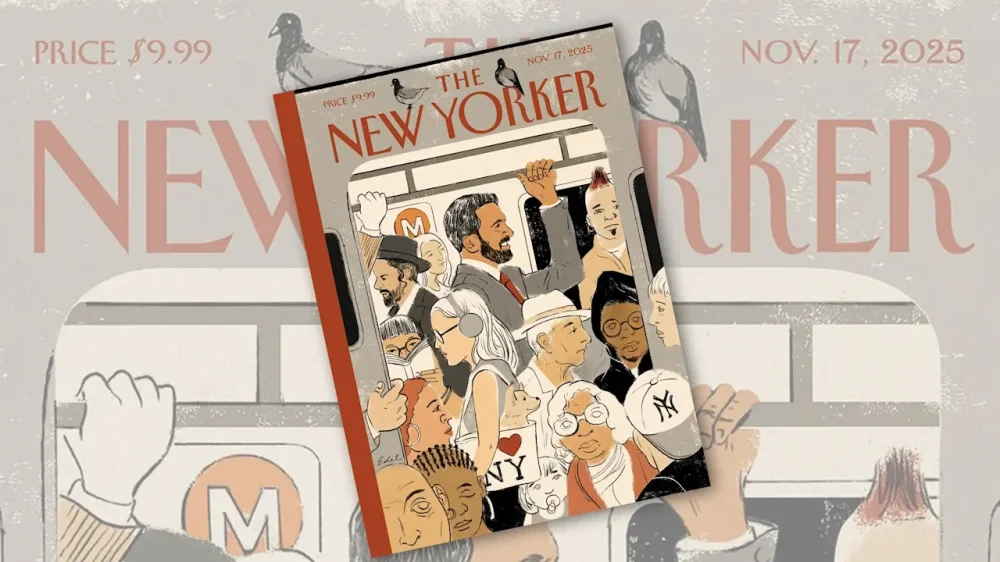
Artist Edel Rodriguez is famous for his satirical images of Donald The President. Since 2016, he’s produced dozens of images of the President in an ultra-simple, pop-art style. But for Rodriguez’s new cover of The New Yorker commemorating Zohran Mamdani’s victory in the New York City mayoral race, he threw that signature look out the window. The illustration, which will run on the November 17 issue of The New Yorker, shows Mamdani smiling broadly as he holds onto the hand rail on an M train headed to Queens. Around him, New Yorkers of all walks of life—including a young woman with a dog in her bag, a child with her mother, and an elderly gentleman in a fedora—jostle to board and deboard the car. The whole picture is made in expressive, sketch-like lines and depicted in toasty hues of brown and rust orange. It has a hand-drawn, humanistic quality that none of Rodriguez’s illustrations of The President possess. https://www.instagram.com/p/DQqNAoQDR04/ “With the The President stuff, I wanted to create imagery that was so visually basic and a bit dumb—for it to not have any gesture, or line, or anything soft,” he says. The images are meant to be a bit like traffic signs: all symbols and conceptual shapes, intended to get the viewer to pay attention, but not to attract real visual interest. “I actually want you to be repelled by it,” he says. Looking beyond The President During The President’s first term in office, Rodriguez published over 125 satirical illustrations and 25 magazine covers depicting the President as everything from a massive wrecking ball to a flaming trash can, always in a bright orange hue and typically with an angry-looking, wide open mouth. As an immigrant born in authoritarian Cuba, Rodriguez’s personal history is deeply tied to his work. Back in 2018, he compared The President’s rhetoric to that of Fidel Castro’s. At that time, he saw his satirical The President art as a warning of what was to come. Now, he says, those warnings have come to fruition. “The frustration with the second The President term is, like, I already warned you everything I could warn you about and you still voted for this guy,” Rodriguez says. “You’re Latino, and you still voted for this guy. What can I do now? I’m able to find a few ways to tell the story in a different manner, but the purpose of it is different in the second term.” https://www.instagram.com/p/DP6iufTjYhM/?hl=en Most recently, Rodriguez created an image of The President using the Burger King logo that reads “No King,” an image that was widely used throughout the national No Kings protests. But while he’s continuing to work on imagery of the President, he’s now looking to branch out into other projects that center “less negativity,” he says. When The New Yorker selected him to illustrate its cover of Mamdani, he saw it as an opportunity to work on something more uplifting. “The difference is night and day. I mean, it’s so much more enjoyable,” Rodriguez says, adding, “When you have an opportunity to do something more positive, it feels good. What I like about [“Mayor Mamdani”] is that it’s positive, but it doesn’t feel like propaganda. It is just showing a scene. I don’t generally like to do anything that says, ‘Vote for this guy.’” What makes Zohran Mamdani different Like many of Mamdani’s supporters, Rodriguez first learned about Mamdani through his social media content. Mamdani’s campaign team posted videos of him walking New York City, speaking casually to viewers about his vision for an affordable NYC for all. In one series of videos, Mamdani tried to pitch himself to all New Yorkers by speaking in fluent Bengla and Urdu, as well as in Spanish, a language that he’s still working to learn. Rodriguez was struck by Mamdani’s willingness to leave clips of his own Spanish-speaking errors in the final video—a move that, he says, was a rare choice from a politician that showed Mamdani is “fallible, and not perfect.” “It’s what made him so popular is that he’s very relatable in many ways,” Rodriguez says. “I think it was that idea of just riding the subway with everyone else and not taking an Uber or a black car around town, or the way he just showed up in bodegas and would do a little video.” The week before the mayoral election, that idea of Mamdani as a regular New Yorker inspired Rodriguez to reach out to The New Yorker’s longtime art editor, Françoise Mouly, with a few sketches for a potential cover. Having worked with Mouly in the past, Rodriguez says he occasionally sends her ideas “as they pop into my head,” to get her feedback and workshop together. His rough sketch first ideas included images of Mamdani subway surfing with the New York City skyline behind him; driving a cab across different boroughs; conducting the M train; and riding inside the M train as a passenger. Mouly, and The New Yorker’s editor-in-chief David Remnick, liked the last concept the best. “I have been talking to artists about the mayoral election for a while,” Mouly says. “Of course it’s a good topic for The New Yorker. Last week, Edel sent a flurry of sketches, anticipating a victory by Mamdani. All of Edel’s ideas showed Mamdani connecting with people everywhere in the five boroughs. The most succinct way to show that was the idea we went with: simply showing him with his bright and winning smile in the melting pot of the subway.” With Mouly’s final approval, Rodriguez had less than a day to finalize his illustration ahead of the November 4 election. While Rodriguez lives in New Jersey with his wife today, he previously lived in Brooklyn while attending Pratt Institute and later while serving as an art director at Time magazine. During that era, Rodriguez was a frequent subway rider—and, like most art students, had often used the commute to sketch fellow passengers. He used those memories of fellow subway passengers to fill out the scene around Mamdani. “If you’ve ridden the subway, that’s how it is,” Rodriguez says. “It’s always like, the girl with the bag and the little puppy, and maybe a punk rock kid, and maybe a Hasidic Jew, and then a mom with a kid, and a guy in a hoodie. Whatever character popped into my head as I was drawing, that’s what I drew, pretty much until I filled the page. I probably could have drawn 20 more characters.” Ultimately, Rodriguez’s work captures a quality Mamdani has managed to convey that most politicians can’t even come close to: relatability. “We’ve all been on the train—it’s totally packed, it’s not pleasant,” he says. “But if your politician or your mayor is there with you, it just makes him more relatable. I wouldn’t show Andrew Cuomo or The President that way.” View the full article
-
When I reviewed the Nintendo Switch 2 launched earlier this June, my assessment was that it would be worth buying eventually, but probably not right away. The console then went on to have the biggest gaming launch of all-time, so there's egg on my face, but I stand by what I said: Until now, the Switch 2 has been a great way to play enhanced Switch 1 games, but hasn't had many exclusives, so you could generally still play Nintendo's newest titles without upgrading your device (unless you're an impatient Mario Kart or Donkey Kong fan). But now, it seems that's about to change, and if you haven't gotten the Switch 2 yet, it might finally be time to take the plunge. In a financial results briefing on Wednesday, Nintendo admitted that "going forward, we will shift our primary development focus to Nintendo Switch 2 and expand our business around this new platform." That doesn't mean the original Switch is being discontinued right away, but despite the latest Pokémon game having come out for it just half a month ago, it does mean the system is getting prepped for retirement. Despite the Switch's success (154.01 million lifetime sales so far!), the transition makes sense. That console is eight years old at this point, and was already using older hardware than that when it came out. Continuing to make the latest first-party Nintendo games compatible with the original Switch as well could hold Switch 2 development back—and with such a large player base having upgraded to the Switch 2 already (the successor system has sold 10.36 million as of Sept. 30), the company probably doesn't see it as necessary. Can I still buy a Switch 1?Hardware sales won't be affected for now, if you want to play the existing original Switch library and somehow don't own one already. In the same report, Nintendo said it will continue to sell the original Switch, "while taking consumer demand and the business environment into consideration." This also lines up with Nintendo's previous behavior, as Nintendo waited three years until after the launch of the original Switch to discontinue the 3DS. When should you get the Nintendo Switch 2?Nintendo didn't give too many more hints at its plans in its briefing, but we can take the company's statement to mean that it won't start development on any new Switch 1 games that haven't already been announced. That means we probably already have a good idea of what the Switch 1's final first-party game will be—after which content for the console will probably start to dry up. And, to be fair, the Switch's swan song is fitting. Releasing on December 4, the final first-party game for Nintendo Switch is likely to be Metroid Prime 4: Beyond. It's the fruition of a troubled development that has taken almost as long as the Switch lasted, with the game's announcement coming just a few months after the console debuted. Not a bad way to go. Like other recent Switch 1 games, Metroid Prime 4 is also getting a Switch 2 edition that will improve performance and add features like mouse controls, but as it stands, you won't need to upgrade to play it. If you're as stubborn as me, that means you can probably hold off on a Switch 2 until 2026, but to play Nintendo's big new releases after that, you'll need to move on. What about third-party games?The one exception to the Switch's impending retirement might be third-party games, which according to this helpful chart from redditor u/ieatdragonz, are planned through at least late next year. Even those are starting to be impacted, though, as many of these games are ports of titles that have already been released elsewhere, while more demanding third-party games like Indiana Jones and the Great Circle are already starting to skip Nintendo's last-gen system. Which Nintendo Switch 2 exclusives are coming out before next year?While those looking to keep up with Nintendo's games after December will probably no choice but to upgrade, there are reasons to upgrade before then, depending on your tastes. Mario Kart World and Donkey Kong Bananza are both exclusive to the Switch 2, and Hyrule Warriors: Age of Imprisonment, which launched today, is also unavailable on the original Switch. Later this month, these titles will also be joined by Kirby Air Riders. If any of these games strike your fancy, they already present a compelling reason to upgrade. If not, Nintendo will probably get you at some point now that it's moved the full force of its development to its new console. What about the Switch 2's smaller player base?In moving development focus to Switch 2 games, Nintendo is making its studios' lives a bit easier, but also shrinking its active player base. More than 10.3 million players is a lot, but it's a fraction of the over 150 million players on the original Switch. That means sales for new Nintendo games could be held back by a smaller total possible audience, at least for a while. But at the same time, making its shiny new releases exclusive to its new console could also easily push sales of the new system even further. Plus, it's not like every original Switch owner is buying every new release now, anyway. At $450, the Switch 2 is an expensive bit of kit compared to its predecessor (though to be fair, the onld system recently got a tariff-related price increase that made the difference smaller), so it is unclear if its strong early performance will keep up long enough to rebuild Nintendo's player base from its last generation. But it's clear the company's going to be giving the system its all going forward, and based on recent success, it's got a lot of money to throw at it. That means that if you don't want to be left behind when the next Zelda or Mario comes out, it's finally time to consider opening up your wallet. I still prefer competing hardware like the Steam Deck, to be honest, but I also like that little red plumber, so I guess I've got no choice now but to start saving up my gold coins. View the full article
-
Google Ads is now prompting advertisers to create “investment strategies” when campaign budgets are limited — a fresh addition to the budget recommendations interface. How it works. When Google detects a budget-limited campaign, a new section appears with the message: “Grow your account by creating your own Google investment strategy.” Advertisers can click “Create investment strategy” to model potential budget increases and preview possible gains in conversions, value, or clicks. Why we care. The feature encourages advertisers to think beyond daily caps and model how increased spend could impact performance. It lets advertisers model how incremental budget increases could affect conversions, value, or clicks — insights that once required manual or third-party modeling. By simulating outcomes, advertisers can justify spend adjustments with ROI projections pulled directly from Google Ads. The backstory. This feature was spotted by PPC News Feed founder Hana Kobzová, who shared screenshots showing the new interface element in action. The big picture. Google continues to nudge advertisers toward automated, growth-oriented budgeting tools — positioning the platform as a predictive partner rather than just an ad delivery system. View the full article
-
US political consultancy bought a 20% share of Global Counsel in 2024 but wants to end partnership in wake of Epstein affairView the full article
-
United Airlines, American Airlines, and Delta Air Lines said they will refund tickets for customers who will be flying starting on Friday, November 7, after the Federal Aviation Administration (FAA) announced a 10% reduction in flights at 40 major airports, expected to affect some 3,500 to 4,000 flights daily. The reductions come amid the ongoing federal government shutdown, which has created a shortage of air traffic controllers, some of whom are not being paid. “Any customer traveling during this period is eligible for a refund if they do not wish to fly—even if their flight isn’t impacted,” United Airlines CEO Scott Kirby said in a statement. “That includes non-refundable tickets and those customers with basic economy tickets.” News of the refunds comes after Transportation Secretary Sean Duffy warned that the air traffic controller shortage could result in disruptions, and would likely “lead to more cancellations.” American Airlines told Fast Company that it expects the vast majority of its customers’ travel will be unaffected, and long-haul international travel will remain as scheduled. As schedule changes are made, American said it will proactively reach out to those impacted customers. “During the impacted travel period, customers whose flights are cancelled for any reason or who choose not to travel will be able to change their flight or request a refund, without any penalty,” American Airlines confirmed in an email statement to Fast Company. The airline also urged leaders in Washington to reach an immediate resolution to end the shutdown: “We remain grateful to the air traffic controllers, TSA officers, CBP officers and other federal employees who are working right now without pay—all to get our customers where they need to be safely.” In a statement on its website, Delta Air Lines said it expects to operate most flights as scheduled, including all long-haul international flights. “We are providing additional flexibility to our customers traveling to, from or through the impacted markets during the impacted travel period to change, cancel or refund their flights, including Delta Main Basic fares, without penalty during this travel period,” it said. Southwest Airlines, JetBlue, and Alaska Airlines have not yet determined a refund policy, according to USA Today. Both the airlines and experts recommend using the airlines’ mobile apps for the latest information on cancelations and delays. 40 U.S. airports likely to be most affected by delays While the FAA has not finalized the list of the 40 airports that will be affected by 10% flight reductions, New York, Atlanta, and Los Angeles airports will likely be among them. Here is a preliminary list, according multiple sources including ABC News, CBS News, and USA Today: Anchorage International (ANC) Hartsfield-Jackson Atlanta International (ATL) Boston Logan International (BOS) Baltimore/Washington International (BWI) Charlotte Douglas International (CLT) Cincinnati/Northern Kentucky International (CVG) Dallas Love (DAL) Ronald Reagan Washington National (DCA) Denver International (DEN) Dallas/Fort Worth International (DFW) Detroit Metropolitan Wayne County (DTW) Newark Liberty International (EWR) Fort Lauderdale/Hollywood International (FLL) Honolulu International (HNL) Houston Hobby (HOU) Washington Dulles International (IAD) George Bush Houston Intercontinental (IAH) Indianapolis International (IND) New York John F. Kennedy International (JFK) Las Vegas Harry Reid International (LAS) Los Angeles International (LAX) New York LaGuardia (LGA) Orlando International (MCO) Chicago Midway (MDW) Memphis International (MEM) Miami International (MIA) Minneapolis/St. Paul International (MSP) Oakland International (OAK) Ontario International (ONT) Chicago O`Hare International (ORD) Portland International (PDX) Philadelphia International (PHL) Phoenix Sky Harbor International (PHX) San Diego International (SAN) Louisville International (SDF) Seattle/Tacoma International (SEA) San Francisco International (SFO) Salt Lake City International (SLC) Teterboro (TEB) Tampa International (TPA) View the full article
-
United Airlines, American Airlines, and Delta Air Lines said they will refund tickets for customers who will be flying starting on Friday, November 7, after the Federal Aviation Administration (FAA) announced a 10% reduction in flights at 40 major airports, expected to affect some 3,500 to 4,000 flights daily. The reductions come amid the ongoing federal government shutdown, which has created a shortage of air traffic controllers, some of whom are not being paid. “Any customer traveling during this period is eligible for a refund if they do not wish to fly—even if their flight isn’t impacted,” United Airlines CEO Scott Kirby said in a statement. “That includes non-refundable tickets and those customers with basic economy tickets.” News of the refunds comes after Transportation Secretary Sean Duffy warned that the air traffic controller shortage could result in disruptions, and would likely “lead to more cancellations.” American Airlines told Fast Company that it expects the vast majority of its customers’ travel will be unaffected, and long-haul international travel will remain as scheduled. As schedule changes are made, American said it will proactively reach out to those impacted customers. “During the impacted travel period, customers whose flights are cancelled for any reason or who choose not to travel will be able to change their flight or request a refund, without any penalty,” American Airlines confirmed in an email statement to Fast Company. The airline also urged leaders in Washington to reach an immediate resolution to end the shutdown: “We remain grateful to the air traffic controllers, TSA officers, CBP officers and other federal employees who are working right now without pay—all to get our customers where they need to be safely.” In a statement on its website, Delta Air Lines said it expects to operate most flights as scheduled, including all long-haul international flights. “We are providing additional flexibility to our customers traveling to, from or through the impacted markets during the impacted travel period to change, cancel or refund their flights, including Delta Main Basic fares, without penalty during this travel period,” it said. Southwest Airlines, JetBlue, and Alaska Airlines have not yet determined a refund policy, according to USA Today. Both the airlines and experts recommend using the airlines’ mobile apps for the latest information on cancelations and delays. 40 U.S. airports likely to be most affected by delays The FAA has not finalized the list of the 40 airports that will be affected by 10% flight reductions. But New York, Atlanta, and Los Angeles airports are likely to be among them. Here is a preliminary list, according multiple sources including ABC News, CBS News, and USA Today: Anchorage International (ANC) Hartsfield-Jackson Atlanta International (ATL) Boston Logan International (BOS) Baltimore/Washington International (BWI) Charlotte Douglas International (CLT) Cincinnati/Northern Kentucky International (CVG) Dallas Love (DAL) Ronald Reagan Washington National (DCA) Denver International (DEN) Dallas/Fort Worth International (DFW) Detroit Metropolitan Wayne County (DTW) Newark Liberty International (EWR) Fort Lauderdale/Hollywood International (FLL) Honolulu International (HNL) Houston Hobby (HOU) Washington Dulles International (IAD) George Bush Houston Intercontinental (IAH) Indianapolis International (IND) New York John F. Kennedy International (JFK) Las Vegas Harry Reid International (LAS) Los Angeles International (LAX) New York LaGuardia (LGA) Orlando International (MCO) Chicago Midway (MDW) Memphis International (MEM) Miami International (MIA) Minneapolis/St. Paul International (MSP) Oakland International (OAK) Ontario International (ONT) Chicago O`Hare International (ORD) Portland International (PDX) Philadelphia International (PHL) Phoenix Sky Harbor International (PHX) San Diego International (SAN) Louisville International (SDF) Seattle/Tacoma International (SEA) San Francisco International (SFO) Salt Lake City International (SLC) Teterboro (TEB) Tampa International (TPA) View the full article
-
Bailey’s comments on market pricing suggest the country may settle at a higher rate than in the US or EurozoneView the full article